Pasing Grades
  • Start Selling
  • Blog
  • Contact
  • 0

    Your cart is empty!

English

  • English
  • Spanish
  • Arabic
Create Account Sign In
  • Library
    • New Prep Guides
    • Featured Prep Guides
    • Free Exam Prep Guides
    • Best sellers
  • General
  • Nursing
    • Research Paper
    • Case Study
    • Discussion Post
    • Assignment
    • Exam
    • Practice Questions and Answers
    • Test Bank
    • solutions manual
  • Accounting
    • Case Study
    • Thesis
    • Study Guide
    • Summary
    • Research Paper
    • test bank
  • English
    • Creative Writing
    • Research Paper
    • Summary
    • Rhetorics
    • Literature
    • Journal
    • Exam
    • Grammar
    • Discussion Post
    • Essay
  • Psychology
    • Hesi
    • Presentation
    • Essay
    • Summary
    • Study Guide
    • Essay
    • Solution Manual
    • Final Exam Review
    • Class Notes
    • test bank
  • Business
    • Lecture Notes
    • Solution Manual
    • Presentation
    • Business Plan
    • Class Notes
    • Experiment
    • Summary
    • Practice Questions
    • Study Guide
    • Case Study
    • test bank
    • Exam
  • More
    • Computer Science
    • Economics
    • Statistics
    • Engineering
    • Biology
    • Religious Studies
    • Physics
    • Chemistry
    • Mathematics
    • History
    • Sociology
    • Science
    • Philosophy
    • Law
  • Pages
    • About Us
    • Selling Tips
    • Delivery Policy
    • Faq
    • Privacy Policy
  • Flash Sale
  • Home
  • Test Bank for Therapeutic Exercise Foundations and Techniques, 6th Edition, Carolyn Kisner, Lynn Allen Colby

Test Bank for Therapeutic Exercise Foundations and Techniques, 6th Edition, Carolyn Kisner, Lynn Allen Colby

Preview page 1 Preview page 2 Preview page 3
Add To Favorites

Share this item Share this item

  • Item Details
  • Comments (0)
  • Reviews (0)
  • Contact Seller
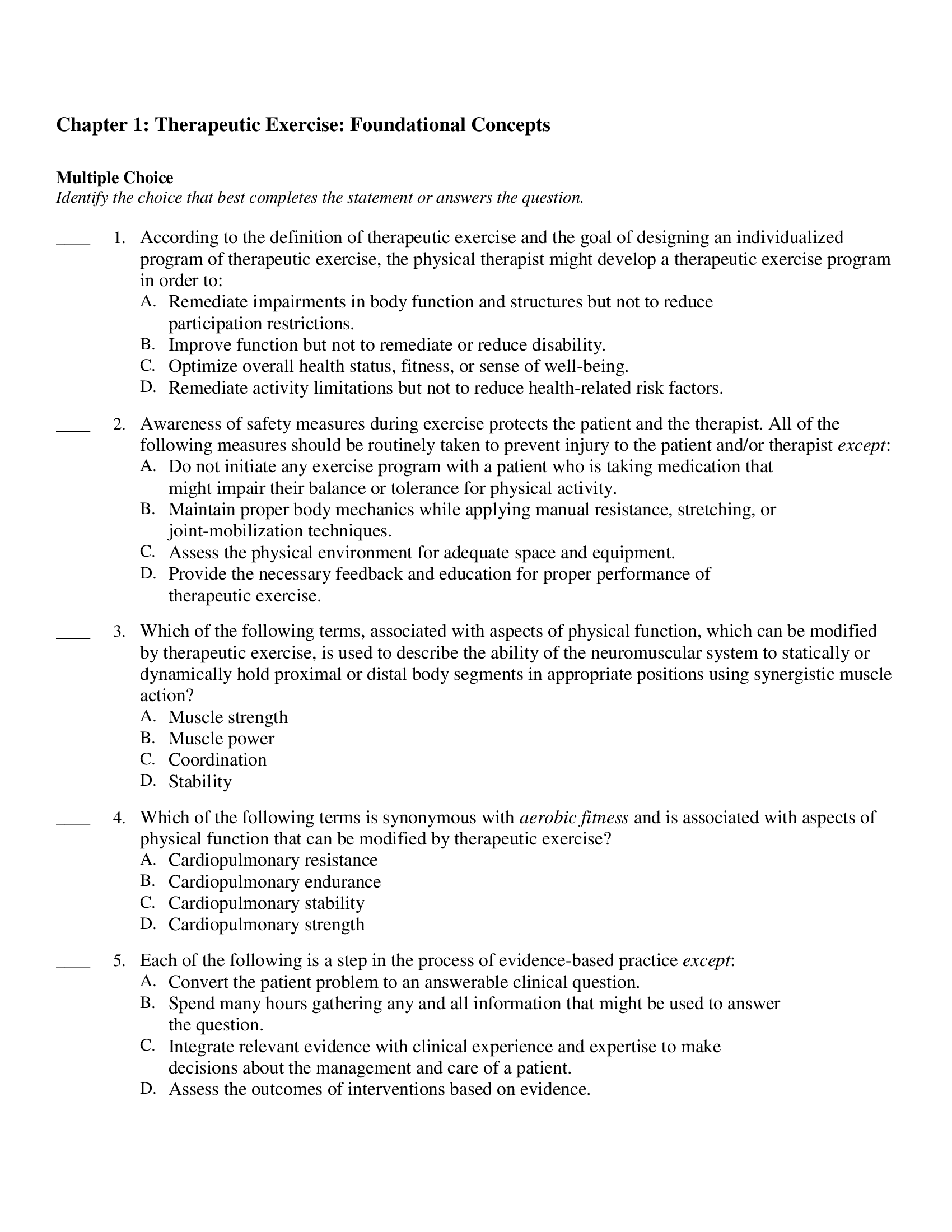
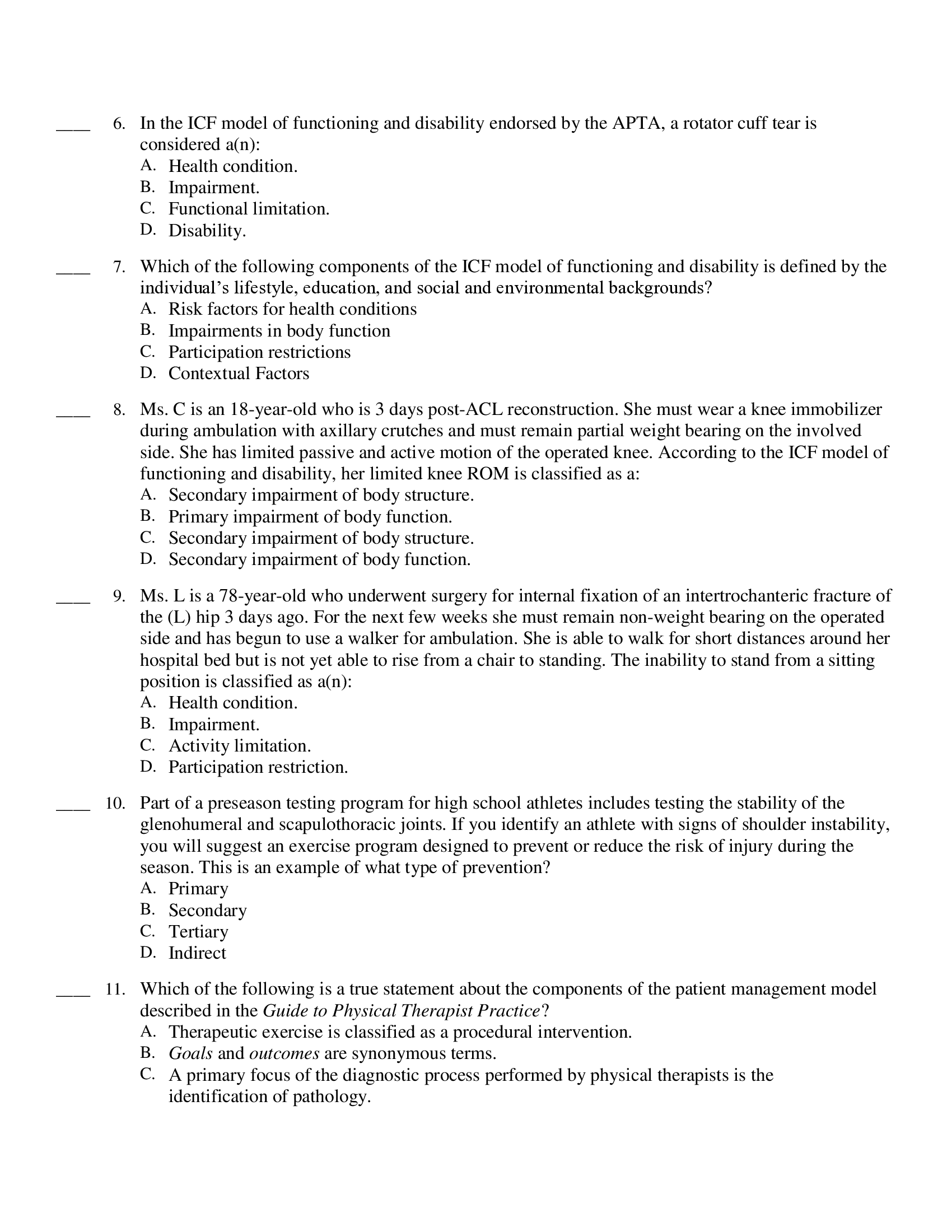
Test Bank for Therapeutic Exercise Foundations and Techniques, 6th Edition, Carolyn Kisner, Lynn Allen Colby Chapter 1: Therapeutic Exercise: Foundational Concepts Multiple Choice Identify the choice that best completes the statement or answers the question. ____ 1. According to the definition of therapeutic exercise and the goal of designing an individualized program of therapeutic exercise, the physical therapist might develop a therapeutic exercise program in order to: A. Remediate impairments in body function and structures but not to reduce participation restrictions. B. Improve function but not to remediate or reduce disability. C. Optimize overall health status, fitness, or sense of well-being. D. Remediate activity limitations but not to reduce health-related risk factors. ____ 2. Awareness of safety measures during exercise protects the patient and the therapist. All of the following measures should be routinely taken to prevent injury to the patient and/or therapist except: A. Do not initiate any exercise program with a patient who is taking medication that might impair their balance or tolerance for physical activity. B. Maintain proper body mechanics while applying manual resistance, stretching, or joint-mobilization techniques. C. Assess the physical environment for adequate space and equipment. D. Provide the necessary feedback and education for proper performance of therapeutic exercise. ____ 3. Which of the following terms, associated with aspects of physical function, which can be modified by therapeutic exercise, is used to describe the ability of the neuromuscular system to statically or dynamically hold proximal or distal body segments in appropriate positions using synergistic muscle action? A. Muscle strength B. Muscle power C. Coordination D. Stability ____ 4. Which of the following terms is synonymous with aerobic fitness and is associated with aspects of physical function that can be modified by therapeutic exercise? A. Cardiopulmonary resistance B. Cardiopulmonary endurance C. Cardiopulmonary stability D. Cardiopulmonary strength ____ 5. Each of the following is a step in the process of evidence-based practice except: A. Convert the patient problem to an answerable clinical question. B. Spend many hours gathering any and all information that might be used to answer the question. C. Integrate relevant evidence with clinical experience and expertise to make decisions about the management and care of a patient. D. Assess the outcomes of interventions based on evidence. ____ 6. In the ICF model of functioning and disability endorsed by the APTA, a rotator cuff tear is considered a(n): A. Health condition. B. Impairment. C. Functional limitation. D. Disability. ____ 7. Which of the following components of the ICF model of functioning and disability is defined by the individual’s lifestyle, education, and social and environmental backgrounds? A. Risk factors for health conditions B. Impairments in body function C. Participation restrictions D. Contextual Factors ____ 8. Ms. C is an 18-year-old who is 3 days post-ACL reconstruction. She must wear a knee immobilizer during ambulation with axillary crutches and must remain partial weight bearing on the involved side. She has limited passive and active motion of the operated knee. According to the ICF model of functioning and disability, her limited knee ROM is classified as a: A. Secondary impairment of body structure. B. Primary impairment of body function. C. Secondary impairment of body structure. D. Secondary impairment of body function. ____ 9. Ms. L is a 78-year-old who underwent surgery for internal fixation of an intertrochanteric fracture of the (L) hip 3 days ago. For the next few weeks she must remain non-weight bearing on the operated side and has begun to use a walker for ambulation. She is able to walk for short distances around her hospital bed but is not yet able to rise from a chair to standing. The inability to stand from a sitting position is classified as a(n): A. Health condition. B. Impairment. C. Activity limitation. D. Participation restriction. ____ 10. Part of a preseason testing program for high school athletes includes testing the stability of the glenohumeral and scapulothoracic joints. If you identify an athlete with signs of shoulder instability, you will suggest an exercise program designed to prevent or reduce the risk of injury during the season. This is an example of what type of prevention? A. Primary B. Secondary C. Tertiary D. Indirect ____ 11. Which of the following is a true statement about the components of the patient management model described in the Guide to Physical Therapist Practice? A. Therapeutic exercise is classified as a procedural intervention. B. Goals and outcomes are synonymous terms. C. A primary focus of the diagnostic process performed by physical therapists is the identification of pathology. D. It is appropriate to discharge a patient from an exercise program only when the patient has attained the goals stated in the initial or original plan of care. ____ 12. According to the patient management model described in the Guide to Physical Therapist Practice, each of the following is a component of an examination performed by a physical therapist except: A. Selecting and performing appropriate tests and measures. B. Taking a patient’s history. C. Interpreting information derived from specific measurement tools to form a diagnosis and prognosis. D. Performing a systems review. ____ 13. Due to supraspinatus impingement syndrome, Mrs. J is unable to fully lift her arm overhead without pain. You plan to design an exercise program consisting of both discrete and serial tasks. You do not want to include continuous tasks at this time. Which of the following should not be included? A. ROM exercises using a cloth to wipe down the wall B. Active reaching exercises to place small objects in a cabinet C. Active Assisted stretching by lifting a cane overhead in supine D. Warming up on the UE ergometer (UE cycling) ____ 14. Your patient is performing pelvic tilt exercises for the first time and needs verbal and tactile cues (feedback) to perform this exercise correctly. This represents which stage of motor learning? A. Cognitive B. Contemplative C. Associative D. Autonomous ____ 15. During several physical therapy sessions, a patient you have been treating for low back pain learned how to perform pelvic tilt exercises in several positions (supine, sitting, quadruped, standing). With continued practice at home, your patient is now able to perform extremity movements while maintaining a stable pelvic position. This represents which stage of motor learning? A. Cognitive B. Continuous C. Associative D. Autonomous ____ 16. You are helping a patient learn a motor skill. You set up several variations of the same task (walking on several types of surfaces). You have the patient perform one variation of the task; you have him identify his own errors after the first repetition (or point out errors to him after the first repetition). Next, allow him to repeat the same variation of the task one or two more times before moving on to another variation of the task. What term best describes this type of practice? A. Blocked B. Random-blocked C. Random D. Augmented ____ 17. In which of the following stages of motor learning does augmented/extrinsic feedback have the most positive impact on acquisition of a motor skill? A. Cognitive stage B. Associative stage C. Autonomous stage D. External feedback is equally effective in any stage of motor learning. ____ 18. Helping a patient acquire the ability to shift his weight from side to side in a standing position by means of manual guidance by the therapist is called: A. Summary feedback. B. Delayed feedback. C. Concurrent feedback. D. Instantaneous postresponse feedback. ____ 19. For which of the following tasks will teaching components (parts) of the motor task be most effective? A. Swinging a golf club B. Riding a stationary bicycle C. Grasping an object D. Performing a standing-pivot transfer from bed to wheelchair ____ 20. Consistent with the taxonomy of motor tasks, which of the following activities is the best example of body stability in an open environment with inter-trial variability without manipulation? A. Maintaining sitting balance while riding a bus from school to home B. Maintaining standing balance while on an escalator C. Maintaining balance on a sidewalk or on the grass D. Maintaining sitting balance in different-height chairs in your family room when you are home alone ____ 21. Which of the following is not a prerequisite for motor skill acquisition and retention? A. Augmented feedback B. Understanding the task or goal C. Being able to activate the motor system D. Being able to retrieve motor memories over time ____ 22. As a therapist, one way you can be relatively confident that motor learning has taken place is when your patient demonstrates which of the following? A. Consecutive repetitions of a task without error during the treatment session B. Decreased need for manual guidance during the treatment sessions C. The ability to perform a slight variation of the task in a new context during the treatment session D. Increased speed demonstrated when carrying out the task ____ 23. Patient satisfaction is an important area for outcome assessment in physical therapy when following the patient management model described in The Guide to Physical Therapist Practice. There are several determinants of patient satisfaction that, if included in the gathering and analysis of data, may help clinics to improve the quality of care being provided. Each of these has been shown in the literature to be determinants of patient satisfaction except: A. Professionalism, empathy, and helpfulness of the therapist B. Patient participation in goal setting in the plan of care C. The chronicity of the patient’s condition (higher satisfaction with patients having chronic conditions) D. Convenience of access and flexibility for scheduling appointments Chapter 1: Therapeutic Exercise: Foundational Concepts Answer Section MULTIPLE CHOICE 1. ANS: C PTS: 1 DIF: Intermediate KEY: Book Part: Part I: General Concepts 2. ANS: A PTS: 1 DIF: Basic KEY: Book Part: Part I: General Concepts 3. ANS: D PTS: 1 DIF: Basic KEY: Book Part: Part I: General Concepts 4. ANS: B PTS: 1 DIF: Basic KEY: Book Part: Part I: General Concepts 5. ANS: B PTS: 1 DIF: Basic KEY: Book Part: Part I: General Concepts 6. ANS: A PTS: 1 DIF: Basic KEY: Book Part: Part I: General Concepts 7. ANS: D PTS: 1 DIF: Basic KEY: Book Part: Part I: General Concepts 8. ANS: B PTS: 1 DIF: Basic KEY: Book Part: Part I: General Concepts 9. ANS: C PTS: 1 DIF: Basic KEY: Book Part: Part I: General Concepts 10. ANS: B PTS: 1 DIF: Basic KEY: Book Part: Part I: General Concepts 11. ANS: A PTS: 1 DIF: Basic KEY: Book Part: Part I: General Concepts 12. ANS: C PTS: 1 DIF: Basic KEY: Book Part: Part I: General Concepts 13. ANS: D PTS: 1 DIF: Intermediate KEY: Book Part: Part I: General Concepts 14. ANS: A PTS: 1 DIF: Basic KEY: Book Part: Part I: General Concepts 15. ANS: D PTS: 1 DIF: Intermediate KEY: Book Part: Part I: General Concepts 16. ANS: B PTS: 1 DIF: Difficult KEY: Book Part: Part I: General Concepts 17. ANS: A PTS: 1 DIF: Basic KEY: Book Part: Part I: General Concepts 18. ANS: C PTS: 1 DIF: Intermediate KEY: Book Part: Part I: General Concepts 19. ANS: D PTS: 1 DIF: Basic KEY: Book Part: Part I: General Concepts 20. ANS: A PTS: 1 DIF: Difficult KEY: Book Part: Part I: General Concepts 21. ANS: A PTS: 1 DIF: Intermediate KEY: Book Part: Part I: General Concepts 22. ANS: C PTS: 1 DIF: Intermediate KEY: Book Part: Part I: General Concepts 23. ANS: C PTS: 1 DIF: Basic KEY: Book Part: Part I: General Concepts Chapter 1: PTA: Therapeutic Exercise: Foundational Concepts Multiple Choice Identify the choice that best completes the statement or answers the question. ____ 1. You are asked to perform therapeutic exercises with a patient who has impairments in muscle performance. You could expect to do any of the following except: A. Strength exercises. B. Coordination exercises. C. Power exercises. D. Muscular endurance exercises. ____ 2. Using the ICF model of functioning and disability, the loss of range of motion and pain present with an inversion sprain of the ankle is referred to as the: A. Health condition. B. Impairment of body function. C. Activity limitation. D. Impairment of body structure. ____ 3. Using the ICF model of functioning and disability, the inability to perform self-care activities such as feeding is referred to as: A. Pathology. B. Impairment. C. Activity limitation. D. Participation restriction. ____ 4. The best way to develop effective treatment procedures is to use which of the following methods? A. Evidence-based practice B. Anecdotal evidence C. Clinical tradition D. Opinion of the experienced clinician ____ 5. Which of the following components of patient management is within the scope of practice of a PTA? A. Evaluation of data collected B. Determination of a PT diagnosis C. Establishment of a prognosis and plan of care D. Implementation of appropriate interventions ____ 6. Which of the following elements is not a source of a patient’s history? A. Self-report heath questionnaire B. Medical record review C. Posture analysis D. Interview with a significant family member of the patient ____ 7. Which of the following is an example of task-specific functional training? A. Instructing a patient in self-ROM for the shoulder to improve independence with ADLs. B. ISOM quad strengthening to improve stair-climbing ability C. Hamstring stretching to improve knee extension at heel strike D. Sit-to-stand activities with a weighted backpack to improve strength for transfers ____ 8. Any of the following would be grounds for discontinuation of PT services except: A. Patient decision to stop. B. Expected goals are achieved and outcomes are attained. C. Change in medical status. D. Patient unwillingness to pay when insurance coverage is maximized. ____ 9. The stage of learning in which an open environment with distractions interferes with learning is which of the following? A. Cognitive B. Transformative C. Associative D. Autonomous ____ 10. Each of the following is a good instructional strategy for the autonomous stage of learning except: A. Use little to no feedback. B. Set up a series of more difficult exercises. C. Demonstrate the movements. D. Suggest ways that the task can be used in more challenging situations. ____ 11. According to the Patient Management Model outlined in The Guide to Physical Therapist Practice, all of the following are components of intervention except: A. Communication with the physician and the insurance company. B. Therapeutic exercise and modalities to treat impairments resulting in activity limitations and participation restrictions. C. Interviewing the patient and family members to understand the prior level of function. D. Instruction to the patient and the family members about the patient’s health condition. Chapter 1: PTA: Therapeutic Exercise: Foundational Concepts Answer Section MULTIPLE CHOICE 1. ANS: B PTS: 1 DIF: Basic KEY: Book Part: Part I: General Concepts 2. ANS: B PTS: 1 DIF: Basic KEY: Book Part: Part I: General Concepts 3. ANS: C PTS: 1 DIF: Basic KEY: Book Part: Part I: General Concepts 4. ANS: A PTS: 1 DIF: Basic KEY: Book Part: Part I: General Concepts 5. ANS: D PTS: 1 DIF: Basic KEY: Book Part: Part I: General Concepts 6. ANS: C PTS: 1 DIF: Basic KEY: Book Part: Part I: General Concepts 7. ANS: D PTS: 1 DIF: Difficult KEY: Book Part: Part I: General Concepts 8. ANS: B PTS: 1 DIF: Basic KEY: Book Part: Part I: General Concepts 9. ANS: A PTS: 1 DIF: Difficult KEY: Book Part: Part I: General Concepts 10. ANS: C PTS: 1 DIF: Difficult KEY: Book Part: Part I: General Concepts 11. ANS: C PTS: 1 DIF: Intermediate KEY: Book Part: Part I: General Concepts

Contact the Seller

Please Sign In to contact this seller.


  • 👎  Report Copyright Violation

Frequently Asked Questions

What Do I Get When I Buy This Study Material?

+

When you buy a study material on Passing Grades, an instant download link will be sent directly to your email, giving you access to the file anytime after payment is completed.

Is Passing Grades a Trusted Platform?

+

Yes, Passing Grades is a reputable students’ marketplace with a secure payment system and reliable customer support. You can trust us to ensure a safe and seamless transaction experience.

Will I Be Stuck with a Subscription?

+

No, all purchases on Passing Grades are one-time transactions. You only pay for the notes you choose to buy, with no subscriptions or hidden fees attached.

Who Am I Buying These Study Materials From?

+

Passing Grades is a marketplace, which means you are purchasing the document from an individual vendor, not directly from us. We facilitate the payment and delivery process between you and the vendor.

Does Passing Grades Offer Free Study Materials?

+

Yes, sellers on Passing Grades have uploaded numerous free test banks, exams, practice questions, and class notes that can be downloaded at no cost.


Pasinggrades - Quality Study Materials

USD 15

    • Quality checked by Pasing Grades
    • 100% satisfaction guarantee
    • Seller: Pasing-Grades
Buy PDF $15

Seller Information

Pasing-Grades

Member since May 2021

  • icon
View Profile
  • total sales

    0
  • Favourites

    0
  • Comments

    0
    ( 0 Ratings )

Item Information

  • Uploaded

    28 August 2023

  • Updated

    01 October 2025

  • Category

    No category

  • Item Type

    test bank

  • Tags

    Test Bank for Therapeutic Exercise Foundations and Techniques 6th Edition Carolyn Kisner Lynn Allen Colby

Related Exam Prep Guides by Pasing-Grades

Understanding Anatomy and Physiology; A Visual, Auditory, Interactive Approach by Gale. S. Thompson
View Document

Understanding Anatom...

  • Pasing-Grades

    Pasing-Grades

  • test bank

Third Edition: Understanding Anatomy and Physiology; A Visual, Auditory, Interactive Approach by Gal...

15 USD

0

0

Workbook to Accompany Understanding Anatomy & Physiology: A Visual, Auditory, Interactive Approach by Gale Sloan Thompson RN
View Document

Workbook to Accompan...

  • Pasing-Grades

    Pasing-Grades

  • test bank

Workbook to Accompany Understanding Anatomy & Physiology: A Visual, Auditory, Interactive Approach b...

15 USD

0

0

Test Bank for Fundamentals of Nursing 10th Edition by Taylor
View Document

Test Bank for Fundam...

  • Pasing-Grades

    Pasing-Grades

  • test bank

Get now the Test Bank for Fundamentals of Nursing 10th Edition by Taylor. Instant PDF Download....

15 USD

0

0

Purchase

Download link will be sent to this email immediately after purchase.

IMPORTANT LINKS

  • How To Upload Class Notes
  • Selling Tips
  • Passing Grades's Study Materials
  • Scholarships for International Students 2026

POPULAR CATEGORIES

  • Law
  • Accounting
  • English
  • Psychology
  • Business
  • Nursing
  • Computer Science
  • General

View Document

  • Blog
  • Contact
  • Delivery Policy
  • Latest Scholarships Around the World
  • How to Pass Bar Exams: Passing Grades’ Strategies
  • How to Study and Pass the CPA Exam
  • All Test Banks
  • Faq
  • Copyright Claims
  • Privacy Policy
  • Terms of Use

KNOWLEDGE BASE

  • How to Write A+ Grade Good Research Paper
  • How to Manage Stress During Exam Period
  • Best Time to Study
  • How to Pass NCLEX-RN Exam
  • How To Effectively Utilize Test Banks
  • Popular Shadow Health Exam Assessments
  • Popular HESI Case Studies
  • How to Prepare for a Nursing Career
  • The Importance Of Summaries in Exam Revisvion

© 2026 Pasing Grades. All rights reserved.