Pasing Grades
  • Start Selling
  • Blog
  • Contact
  • 0

    Your cart is empty!

English

  • English
  • Spanish
  • Arabic
Create Account Sign In
  • Library
    • New Prep Guides
    • Featured Prep Guides
    • Free Exam Prep Guides
    • Best sellers
  • General
  • Nursing
    • Research Paper
    • Case Study
    • Discussion Post
    • Assignment
    • Exam
    • Practice Questions and Answers
    • Test Bank
    • solutions manual
  • Accounting
    • Case Study
    • Thesis
    • Study Guide
    • Summary
    • Research Paper
    • test bank
  • English
    • Creative Writing
    • Research Paper
    • Summary
    • Rhetorics
    • Literature
    • Journal
    • Exam
    • Grammar
    • Discussion Post
    • Essay
  • Psychology
    • Hesi
    • Presentation
    • Essay
    • Summary
    • Study Guide
    • Essay
    • Solution Manual
    • Final Exam Review
    • Class Notes
    • test bank
  • Business
    • Lecture Notes
    • Solution Manual
    • Presentation
    • Business Plan
    • Class Notes
    • Experiment
    • Summary
    • Practice Questions
    • Study Guide
    • Case Study
    • test bank
    • Exam
  • More
    • Computer Science
    • Economics
    • Statistics
    • Engineering
    • Biology
    • Religious Studies
    • Physics
    • Chemistry
    • Mathematics
    • History
    • Sociology
    • Science
    • Philosophy
    • Law
  • Pages
    • About Us
    • Selling Tips
    • Delivery Policy
    • Faq
    • Privacy Policy
  • Flash Sale
  • Home
  • Test Bank For Strategic Management 17th Edition David

Test Bank For Strategic Management 17th Edition David

Preview page 1 Preview page 2 Preview page 3
Add To Favorites

Share this item Share this item

  • Item Details
  • Comments (0)
  • Reviews (0)
  • Contact Seller

Test Bank For Strategic Management 17th Edition David

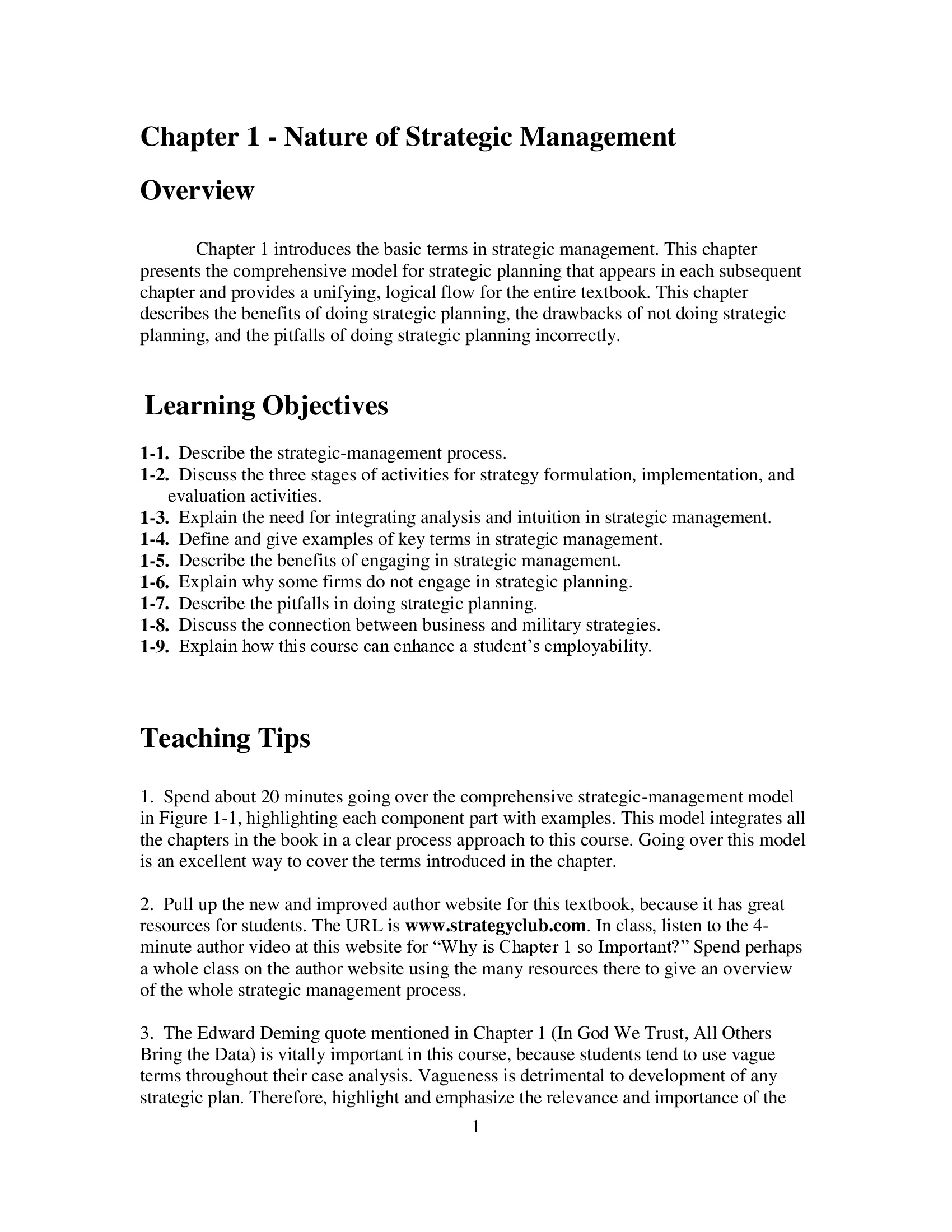
Chapter 1 - Nature of Strategic Management Test Bank

Overview

 Chapter 1 introduces the basic terms in strategic management. This chapter

presents the comprehensive model for strategic planning that appears in each subsequent

chapter and provides a unifying, logical flow for the entire textbook. This chapter

describes the benefits of doing strategic planning, the drawbacks of not doing strategic

planning, and the pitfalls of doing strategic planning incorrectly.


 Learning Objectives 


1-1.

 Describe the strategic-management process.

1-2.

 Discuss the three stages of activities for strategy formulation, implementation, and 

evaluation activities.

1-3.

  Explain the need for integrating analysis and intuition in strategic management.

1-4.

  Define and give examples of key terms in strategic management.

1-5.

 Describe the benefits of engaging in strategic management.

1-6.

  Explain why some firms do not engage in strategic planning.

1-7.

  Describe the pitfalls in doing strategic planning.

1-8.

 Discuss the connection between business and military strategies.

1-9.

 Explain how this course can enhance a student’s employability.


1 


Teaching Tips


1.  Spend about 20 minutes going over the comprehensive strategic-management model

in Figure 1-1, highlighting each component part with examples. This model integrates all

the chapters in the book in a clear process approach to this course. Going over this model

is an excellent way to cover the terms introduced in the chapter.


2.  Pull up the new and improved author website for this textbook, because it has great

resources for students. The URL is www.strategyclub.com. In class, listen to the 4minute

author

video

at

this

website

for

“Why

is Chapter

1 so Important?”

Spend

perhaps


a

whole

class

on the author

website

using

the many

resources

there

to

give

an

overview


of

the

whole

strategic

management

process.


3.

 The

Edward

Deming

quote

mentioned

in Chapter

1 (In

God We

Trust,

All Others


Bring

the

Data)

is vitally

important

in

this

course,

because

students

tend

to use

vague


terms

throughout

their

case

analysis.

Vagueness

is

detrimental

to

development

of any


strategic

plan.

Therefore,

highlight

and

emphasize

the relevance

and

importance

of the


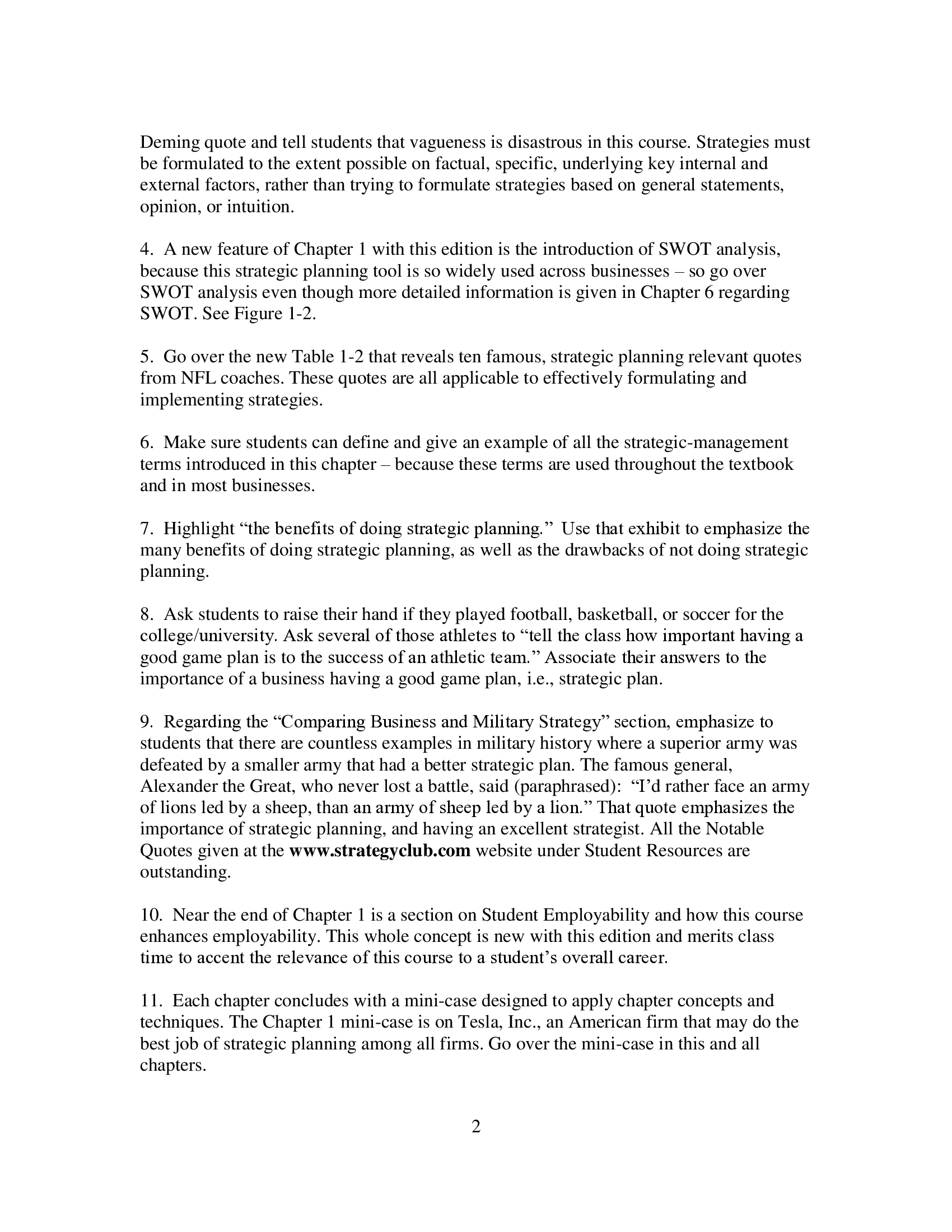
Deming quote and tell students that vagueness is disastrous in this course. Strategies must

be formulated to the extent possible on factual, specific, underlying key internal and

external factors, rather than trying to formulate strategies based on general statements,

opinion, or intuition.


4.  A new feature of Chapter 1 with this edition is the introduction of SWOT analysis,

because this strategic planning tool is so widely used across businesses – so go over

SWOT analysis even though more detailed information is given in Chapter 6 regarding

SWOT. See Figure 1-2.


5.  Go over the new Table 1-2 that reveals ten famous, strategic planning relevant quotes

from NFL coaches. These quotes are all applicable to effectively formulating and

implementing strategies.


6.  Make sure students can define and give an example of all the strategic-management

terms introduced in this chapter – because these terms are used throughout the textbook

and in most businesses.


7.  Highlight “the benefits of doing strategic planning.”  Use that exhibit to emphasize the

many benefits of doing strategic planning, as well as the drawbacks of not doing strategic

planning.


8.  Ask students to raise their hand if they played football, basketball, or soccer for the

college/university. Ask several of those athletes to “tell the class how important having a

good game plan is to the success of an athletic team.” Associate their answers to the

importance of a business having a good game plan, i.e., strategic plan.


9.  Regarding the “Comparing Business and Military Strategy” section, emphasize to

students that there are countless examples in military history where a superior army was

defeated by a smaller army that had a better strategic plan. The famous general,

Alexander the Great, who never lost a battle, said (paraphrased):  “I’d rather face an army

of lions led by a sheep, than an army of sheep led by a lion.” That quote emphasizes the 

importance of strategic planning, and having an excellent strategist. All the Notable 

Quotes given at the www.strategyclub.com website under Student Resources are

outstanding.


10.  Near the end of Chapter 1 is a section on Student Employability and how this course

enhances employability. This whole concept is new with this edition and merits class

time to accent the relevance of this course to a student’s overall career.


11.  Each chapter concludes with a mini-case designed to apply chapter concepts and

techniques. The Chapter 1 mini-case is on Tesla, Inc., an American firm that may do the

best job of strategic planning among all firms. Go over the mini-case in this and all

chapters.


2 

12.  All end-of-chapter review questions are excellent, so go over as many as possible in

class. Sometimes in class, the authors will assign every student a question and give the

class 10 minutes to develop answers and then let each student give the class the answer,

and then comment on the answer (answers to all questions are given later in this manual). 

This is a great way to promote teacher/student interaction.


13.  Ask students to read the Coca-Cola Company Cohesion Case presented after Chapter

1 because a third of all the end-of-chapter exercises at the end of every chapter apply

chapter concepts to the Coca-Cola case – thus preparing students for developing a case

analysis on their assigned company. Divide students into three- or four-person teams

within the first two weeks of class and assign to them one of the 30 cases in the book, and

schedule a day for the teams to each give a 10- to 15-minute oral presentation revealing

their recommended three-year strategic plan for the firm. The authors and most

professors using this book use this approach.


14.  It is important to spend some class time also on the Chapter 1 end-of-chapter

Exercises 1A and 1B that apply the strategic-management process to the Coca-Cola

Company Cohesion Case. Associated exercises at the end of other chapters utilize the

information obtained from Exercises 1A and 1B and collectively help prepare students

for performing case analysis on their assigned company.


15.  A popular exercise at the end of Chapter 1 is 1C titled “Strategic Planning for My

University.” You could spend a whole class day on this exercise alone. Definitely spend

some time on this exercise because associated exercises at the end of each chapter apply

strategy concepts to your college/university. Students are very knowledgeable about their

university and their opinions differ widely as to strengths/weaknesses and

opportunities/threats/strategies. Thus, spending class time working through this exercise

will reveal to students how opinions vary regarding the importance of various

factors/issues; opinions also vary in companies doing strategic planning. We use this

exercise also to facilitate teacher/student interaction as well as student/student interaction,

which is especially beneficial to do early in the semester.


16.  Exercise 1E introduces a new group vs. individual decision-making exercise that

appears at the end of each chapter in the 17


th

 edition. These are fun, informative, effective

exercises to determine winners and losers each day in class.


17.  Encourage your students to use the free Excel Student Template at the author website

at www.strategyclub.com. Your students will find this template to be immensely helpful

in this course. Plus, two example strategic-management case projects are provided at this

website as a guide for students to follow. 


3 

Answers to End-of-Chapter 1 Review Questions 


1-1.  Why do you believe SWOT analysis is so commonly used by businesses in doing

strategic planning?

Answer:  SWOT analysis is the most widely used strategic planning tool because it is

intuitively simple, contains no numbers, lends itself to group discussion, and contains the

basic building blocks of a strategic plan, namely strengths, weaknesses, opportunities,

and threats.


1-2.  What variable does recent research reveal to be most important of all in doing

business? Explain why this variable is so important.


Answer: Three Harvard Business School professors, Amy Cuddy, Susan Fiske, and Peter

Glick, recently revealed in a new book, Presence, that the most important variable in

doing business with someone you do not know is trustworthiness. The authors say that

within seconds of meeting someone, people determine first and foremost the extent that

the person is trustworthy. They say that variable is far more important than competence,

intelligence, looks, strength, height, and numerous other variables.


1-3.  For your college or university, identify a strategy that would exemplify the

matching concept evidenced in SWOT analysis.


Answer: An external threat could be “a 10% annual decline in state funding.” A

weakness could be “lack of sufficient external fund raising.” The strategy to offset could

be for the university to seek external funds by placing people’s names on buildings,

classrooms, and even seats in classrooms.


1-4.  Diagram the comprehensive strategic-management model.


Answer:  See Figure 1-1 in Chapter 1.


1-5.  Develop a diagram to reveal the benefits to a firm for doing strategic planning. 

Include “improved understanding,” “enhanced communication,” “all managers and

employees on a mission,” and “greater commitment” – in the correct order.


Answer:  See Figure 1-2 in Chapter 1.


1-6.  How important do you feel “having an excellent game plan” is to winning a

basketball or football game against your university’s major rival? Discuss.


Answer:  Having an excellent game plan oftentimes is the key difference between winning and

losing in an athletic event. A reason for this is that in most leagues in most sports, there is

growing parity in terms of talent and skills among players. Player desire, motivation, and other

intangible factors play a significant role in winning or losing, but every player relies on the head

coach to develop an effective game plan by watching film of rivals’ prior games and studying

the opponents’ strengths, weaknesses, and strategies – and devising a winning plan of action.  


4 

Outstanding coaches are often paid millions of dollars, for example in Division 1 college

football and basketball, partly because they have demonstrated superior expertise in devising

excellent game plans versus rival teams.


1-7.  Are “strategic management” and “strategic planning” synonymous terms? Explain.


Answer:  The term “strategic management” in this text is used synonymously with the term

“strategic planning.” The latter term is more often used in the business world, whereas the

former is often used in academia. Sometimes the term “strategic management” is used to refer

to strategy formulation, implementation, and evaluation, with “strategic planning” referring

only to strategy formulation.


1-8.  Why do many firms move too hastily from vision/mission development to devising

alternative strategies?


Answer:  Firms that move too hastily from vision and mission development to devising alternative

strategies are overlooking two important steps in the strategic management process:  1) identify and

evaluate internal strengths/weaknesses and 2) identify and evaluate external opportunities/threats. 

Reasons why many firms are negligent in this regard include 1) laziness, 2) lack of time, 3) lack of

knowledge, 4) unwillingness to do research to find specific facts and figures, and 5) being unaware

that matching key external with internal factors is a key to strategy formulation.


1-9.  Why are strategic planning retreats often conducted away from the work site? How

often should firms have a retreat, and who should participate in them?


Answer:  The rationale for periodically conducting strategic-management meetings away from

the work site is to encourage more creativity and candor from participants. Good

communication and feedback are needed throughout the strategic-management process in order

to 1) formulate effective strategies and 2) achieve understanding and commitment that are vital

to strategy implementation.


1-10.  Distinguish between long-range planning and strategic planning.


Answer:  Long-range planning is striving to optimize for tomorrow the trends of today, whereas

strategic planning is striving to exploit and create new and different opportunities for tomorrow.  

Strategic planning requires much more work and diligence as indicated by the activities and stages

described in the chapter.


1-11.  How important do you think “being adept at adapting” is for business firms?

Explain.  


Answer:  Being adept at adapting is vital for survival of business firms (and organisms). The

strategic-management process is based on the belief that an organization’s survival can depend on

how well the firm continually monitors internal and external events and trends and makes timely

changes as needed.


5 

1-12.  As cited in the chapter, Edward Deming, a famous businessman, once said, “In God

we trust. All others bring data.” What did Deming mean in terms of developing a strategic

plan?  


Answer:  The strategic-management process can be described as an objective, logical, systematic

approach for making major business decisions in an organization. The process attempts to organize

qualitative and quantitative information in a way that allows effective decisions to be made under

conditions of uncertainty. Mr. Deming insisted on facts and figures because he knew that vague

generalities were not helpful in choosing among many attractive alternative strategies. Mr. Deming

insisted on seeing #’s, $’s, ratios, and %’s across regions and products in order to best chart a path

forward for any organization.


1-13.  What strategies do you believe can save newspaper companies from extinction?  


Answer:  Newspaper companies could invest more in Internet technologies, including developing

nice apps for smartphones, and charging for the apps. Also, they could charge for an online

subscription. Perhaps they could shift to a business model of giving away newspapers, while

simultaneously enticing advertisers to advertise more, given the expected increased circulation from

“free at newsstands and nominal fee for delivery.” Free is a good price, if expenses can be exceeded

by advertising revenue. But any strategies pursued should be determined after thorough analysis as

described in this text, rather than haphazardly determined.


1-14.  Distinguish between the concepts of mission and vision.


Answer:  Mission statements are “enduring statements of purpose that distinguish one business from

other similar firms.” Vision statements answer the question “What do we want to become?” A vision

statement should be one sentence, whereas a mission statement is several sentences, but less than 200

words.


1-15.  Your university has fierce competitors. List three external opportunities and three

external threats that face your university. 


Answer:  

Opportunities – 1) The blackboard collaborating technology for online classes has become easier,

more popular, and less expensive. 2) The USA economy and GDP is growing 6% annually. 3)

Construction costs for building new buildings is declining 14% year-over-year.

Threats – 1) The local tech school has cheaper tuition and easier classes that transfer into our

university. 2) Our rival firms all offer a BBA Degree online. 3) There is an 8% decline in population

in the last few months in our county.


1-16.  List three internal strengths and three internal weaknesses that characterize your

university.  


Answer: 

Strengths – 1) Our College of Business is AACSB accredited at both the BBA and MBA levels. 


6 

2) Our average classroom size is 19 students. 3) Our university has a new Nursing Program and

Building.

Weaknesses – 1) Only 50% of our business faculty hold a PhD in business. 2) Our university lacks

sufficient dorm space for students. 3) Our university lacks sufficient parking for students and faculty.


1-17.  List reasons why objectives are essential for organizational success. 


Answer:  Objectives are essential for organizational success because they state direction, aid in

evaluation, create synergy, reveal priorities, focus coordination, and provide a basis for effective

planning, organizing, motivating, and controlling activities.         


1-18.  Why are policies especially important in strategy formulation?


Answer:  Policies, like annual objectives, are especially important in strategy implementation

because they outline an organization’s expectations of its employees and managers. Policies allow

consistency and coordination within and between organizational departments. Policies can be broad

and include rules, regulations, and procedures.


1-19.  What is a “retreat” and why do firms take the time and spend the money to have

these?  


Answer:  Retreats are formal meetings conducted semiannually to discuss and update the firm’s

vision/mission, opportunities/threats, strengths/weaknesses, strategies, objectives, policies, and

performance. Retreats are commonly held off-premises to encourage more creativity and candor

from participants. The feeling is that an off-premise retreat facilitates communication, shared

understanding, and commitment.


1-20.  Discuss the notion of strategic planning being more formal versus informal in an

organization. On a 1 to 10 scale from formal to informal, what number best represents

your view of the most effective approach? Why?  


Answer:  Formality refers to the extent that participants, responsibilities, authority, duties, and 

approach are specified. Application of the strategic-management process is typically more formal in 

larger and well-established organizations. Smaller businesses tend to be less formal. Firms that

compete in complex, rapidly changing environments, such as technology companies, tend to be more

formal in strategic planning. Firms that have many divisions, products, markets, and technologies

also tend to be more formal in applying strategic-management concepts. Greater formality in

applying the strategic-management process is usually positively associated with the cost,

comprehensiveness, accuracy, and success of planning across all types and sizes of organizations. 

Informality too often invites guessing, laziness, politics, and emotion, which are generally not good

in strategic planning.


1-21.  List wh

garnered fro


Answer:  Both business and military organizations must adapt to change and constantly improve to

be successful. Table 1-3 provides narrative excerpts from The Art of War, but some of the following

especially apply to business.

o Analyze the enemy’s plans so that you will know his shortcomings as well as his strong

points. 

o An army should be likened to water. Just as flowing water avoids the heights and hastens to

the lowlands, so an army should avoid strength and strike weakness.

o Unskilled leaders work out their conflicts in courtrooms and battlefields. Brilliant strategists

rarely go to battle or to court; they generally achieve their objectives through tactical positioning well

in advance of any confrontation.

o When you do decide to challenge a rival, much calculating, estimating, analyzing, and

positioning bring triumph.

o Skillful leaders do not let a strategy inhibit creative counter-movement.  

o When a decisive advantage is gained over a rival, skillful leaders do not press on. They hold

their position and give their rivals the opportunity to surrender or merge.  

o Brilliant strategists forge ahead with illusion, obscuring the areas of major confrontation, so

that opponents divide their forces in an attempt to defend many areas.   


1-22.  What is the fundamental difference between business strategy and military strategy

in terms of basic assumptions?  


Answer:  The fundamental difference between military and business strategy is that business strategy

is formulated, implemented, and evaluated with an assumption of competition, whereas military

strategy is based on an assumption of conflict.  


1-23.  Explain why the strategic management class is often is called a “capstone course.”


Answer:   Strategic management is commonly called a capstone course because students’ major

responsibility in this class is to use all knowledge gained in prior courses to chart the future direction

of different organizations. Students have the opportunity in this course to utilize their marketing,

finance, management, MIS, and accounting knowledge.


1-24.  What aspect of strategy formulation do you think requires the most time? Why?


Answer:  Important aspects of strategy formulation include developing a business mission,

performing an external audit, conducting an internal audit, generating alternative strategies, and

choosing among alternative strategies. Performing an external audit generally takes the most time.

For example, identifying competitors’ strengths and weaknesses is an essential aspect of the external

audit. Effective use of the Internet can reduce the time required for performing an external audit.


1-25.  Why is strategy implementation often considered the most difficult stage in the

strategic-management process?


Answer:  Strategy implementation is often considered to be the most difficult stage in strategic

management because it requires discipline, sacrifice, commitment, and hard work from all employees

and managers. It is always more difficult to do something than to say you’re going to do it. 


8 


1-26.  Why is it so important to integrate intuition and analysis in strategic management?


Answer:  No analytical tools can capture all aspects of a given organization’s culture and situation.

Nor can analytical tools assimilate all the subjective information that must be considered in strategic

management, such as personalities, emotions, values, beliefs, customs, and ethical factors. However,

analytical tools are essential to utilize in strategic planning because they have been developed over

many years using actual data, and are effective for assimilating facts and figures. Intuition alone is

insufficient for making good strategic decisions. Based on one’s past experiences, judgment, and

“gut” feelings, intuition is especially under time constraints, and in assigning weights and ratings in

planning matrices. Strategists must integrate intuition and analysis in strategic management, but in

the view of this author, analysis is more important than intuition. Unfortunately, too many firms rely

too heavily on intuition, and some disastrously rely exclusively on intuition.


1-27.  Explain the importance of a vision and mission statement.


Answer:  Reaching agreement on a formal vision and mission statement can greatly facilitate the

process of reaching agreement on an organization’s strategies, objectives, and policies.

Organizational success depends on reasonable agreement on key issues, so a clear, jointly developed

and supported, vision and mission statement are essential in strategic management.


1-28.  Discuss relationships among objectives, strategies, and policies.


Answer:  Long-term objectives and strategies are products of strategy formulation. Short-term

(annual) objectives and policies are products of strategy implementation. Firms should translate longterm

objectives

into

annual

objectives.

Strategies

should

be

supported

with

clear

policies.


1-29.

 Why

do

you

think

some

chief

executive

officers

fail

to use a strategic-management


approach

to decision

making?


Answer:


Various

reasons

listed

and

described

in

Chapter

1

include:

 Lack

of

knowledge

or


experience

in

strategic

planning,

poor

reward

structures,

firefighting,

waste

of

time,

too

expensive,


laziness, content with success, fear of failure, overconfidence, prior bad experience, self-interest, fear 

of the unknown, honest difference of opinion, and suspicion.


1-30.  Discuss the importance of feedback in the strategic-management model.


Answer:  As indicated in the strategic-management model, feedback is critically important. Changes

can occur at any stage in the process and impact all other strategic-management activities. Feedback

allows these changes to be identified and adjustments to be made. Feedback promotes the creation of

a climate for two-way communication and, thus, allows esprit de corps to be achieved in an

organization.


1-31.  How can strategists best ensure that strategies will be effectively implemented?


9 

Answer:  Strategists can best assure that strategies formulated will be effectively implemented by

involving as many managers as possible in the strategy formulation process. It is important to

communicate effectively why changes are needed, and how managers and employees will benefit

from the expected results. Good communication yields good understanding yields good commitment,

which is essential for good implementation (See Figure 1-2).


1-32.  Give an example of a recent political development that changed the overall strategy of an

organization.


Answer:  Gun control legislation is pending at the federal level and in some state legislatures,

which has led to increased demand for ammunition and various guns. So, companies that make

ammo and guns have increased production in the short term, but in the long term, some are

diversifying into related products and services, such as hunting and fishing products.


1-33.  Who are the major competitors of your college or university?  What are their strengths

and weaknesses?  What are their strategies? How successful are these institutions compared to

your college?


Answer:  Answers to this question will vary by institution. But, online courses and online

degrees are becoming commonplace. Two-year schools are continually offering 100- and 200level

classes

more

cheaply

and

“easier”

than

four-year

schools,

that are

more

and

more

focusing


on

graduate

schools.

Schools

are

also

becoming

more

student-friendly,

modifying

curriculum

to


be

more

“practical,”

and

even

offering

certifications

in

some

areas.


1-34.

 In

your

opinion,

what

is the

single

major

benefit

of

using

a strategic-management


approach

to decision

making?

 Justify

your

answer.


Answer:

 The

single

major

benefit

is

the potential

for

improved

understanding

of the

business


and

industry

on the part

of

all

managers

and

employees.

Understanding

generally

leads

to


increased

commitment,

which,

in turn,

leads

to

creativity,

innovativeness,

and

overall


cooperativeness.

The

process

is

more

important

than

the plan.

Also, the

strategic-management


process

allows an

organization

to initiate

and

influence,

rather

than

just

respond

and

react

to

its


environment. That is, it allows an organization to be proactive, rather than reactive, in 

controlling its own destiny. Strategic-management concepts provide an objective basis for

allocating resources and for reducing internal conflicts that can arise when subjectivity alone is

the basis for major decisions.


1-35.  Most students will never become a chief executive officer or even a top

manager in a large company. So, why is it important for all business majors to study

strategic management?


Answer:  Strategic management takes place at multiple levels within an organization. Although

most students may never become the CEO of a corporation, they may become the “branch

manager” or department head or manager. In these roles, they may be asked to participate in

development of a strategic plan. Employees at all levels are frequently asked to contribute to 


10 

development of their firm’s strategic plan. Thus, an understanding of the strategic-management

process is important, perhaps for the career development of any business major.


1-36.  Describe the content available on the strategy club website at

www.strategyclub.com.  


Answer:  The strategy club website provides the new, free, Excel Student Template designed to

help students generate the matrices required for case analyses. The site also provides several

sample student case presentations and other resources to benefit strategic management students.


1-37.  List four financial and four nonfinancial benefits of a firm engaging in strategic

planning.


Answer:  Businesses engaging in strategic planning experience many financial benefits,

including: 1) significant improvement in sales, profitability, and productivity compared to firms

without strategic planning activities, 2) superior long-term financial performance relative to

their industry, 3) seem to make more informed decisions with good anticipation of both short

and long-term consequences, and 4) better prepared for fluctuations in their external and

internal environments. In addition to the financial benefits, firms using strategic planning also

experience nonfinancial benefits that include 1) an enhanced awareness of external threats, 2) an

improved understanding of competitors’ strategies, 3) increased employee productivity, 4)

reduced resistance to change, and 5) a clearer understanding of performance-reward

relationships. 


1-38.  Why is it that a firm can sustain a competitive advantage normally for only a limited

period of time?


Answer:  A firm can sustain a competitive advantage for only a certain period of time due to

rival firms continually trying to imitate and duplicate strategies, products, and services of the

lead firm, in order to take market share from the leader, and build their own competitive

advantage.


1-39.  Why is it not adequate to simply obtain competitive advantage?


Answer:  Rival firms will constantly attempt to undermine firms with competitive advantages

and try to imitate/duplicate those advantages/products/services – and perhaps offer similar

products at much lower prices. Organizations must constantly strive to achieve sustained

competitive advantage by continually evaluating their own strategies/products/services as well

as rival firms’ efforts to undermine and overcome.


1-40.  How can a firm best achieve sustained competitive advantage?


Answer:  Sustained competitive advantage can best be achieved by 1) continually adapting to

changes in external trends and events and internal capabilities, competencies, and resources, and

by 2) effectively formulating, implementing, and evaluating strategies that capitalize upon those

factors. 


11 


* 1-41.  In sequential order in the strategic-planning process, arrange the following

appropriately:  policies, objectives, vision, strategies, mission, strengths.


Answer:  Vision > Mission > Strengths > Objectives > Strategies > Policies


* 1-42.  Label the following as an opportunity, a strategy, or a strength.


a.  XYZ, Inc. is hiring 50 more salespersons. 

b.  XYZ, Inc. has 50 salespersons. 

c.  XYZ, Inc.’s rival firm has only 50 salespersons.  


Answer: 

a.  XYZ, Inc. is hiring 50 more salespersons. > A Strategy

b.  XYZ, Inc. has 50 salespersons. > A Strength

c.  XYZ, Inc.’s rival firm has only 50 salespersons. > An Opportunity 


* 1-43.  Explain why internal strengths and weaknesses should be stated in

divisional terms to the extent possible. 


Answer:  Arguably the most important strategic decision facing firms is how best to

allocate resources across divisions. To facilitate this decision making, internal strengths

and weaknesses should be stated in divisional terms to the extent possible.


* 1-44.  Explain why both internal and external factors should be stated in specific terms,

i.e., using #’s, %’s, $’s, ratios, and comparisons over time, to the extent possible.


Answer:  Business people already know the vague generalities, and desperately need to know

the specifics, in order to decide among many available good alternative strategies. Thus, the

underlying external opportunities/threats must be stated in specific terms to give guidance in

formulating and selecting alternative strategies. Thus, avoid saying “Canada’s GDP is

increasing.” Instead, say “Canada’s expected GDP next year is 6% and Mexico’s expected GDP

is 3%.” Words such as increasing, decreasing, growing, and expanding can mean virtually

anything. Avoid vagueness. Vagueness is not helpful in making tough resource allocation

decisions among divisions, regions, products, etc.


* 1-45.  Identify the three activities that comprise strategy evaluation.


Answer:  The three fundamental strategy-evaluation activities are (1) review external and internal

factors that are the bases for current strategies, (2) measure performance, and (3) take corrective

actions. The first activity involves determining whether strength/weakness/opportunity/threat facts

and figures have changed, which is actually facilitated by activity two, that involves comparing actual

performance to expected results across regions and products. The third activity can include altering a

firm’s vision/mission/objectives/strategies/policies/procedures/organizational chart, etc.


*

1-46.  List six characteristics of annual objectives.


12 


Answer:  Like long-term objectives, annual objectives should be measurable, quantitative,

challenging, realistic, consistent, and prioritized.


* 1-47.  Would strategic-management concepts and techniques benefit foreign businesses

as much as domestic firms?  Justify your answer.


Answer:  The answer to this question is YES. But, management style and culture varies

considerably across countries, as will be elaborated upon in Chapter 11. For example, northern

European countries tend to be more participative in management style, whereas southern

European countries tend to be more autocratic (as does Mexico). Many foreign businesses are

using strategic-management concepts and techniques effectively. This textbook is very widely

used globally, being the best seller in Japan, China, and Mexico.


* 1-48.  What do you believe are some potential pitfalls or risks in using a strategicmanagement

approach

to

decision

making?


Answer:

 Thirteen

risks are

listed

under

the

“Pitfalls

in Strategic

Planning”

section

of

Chapter

1. 

But,

there

is a risk

of

too little

top management

support

for

the

process.

There

is a risk

of

too

little

involvement

by

line

managers

and

employees.

There

is a risk

that

top

managers

will


underestimate

the importance

of understanding

and

commitment.


*

1-49.

 What

does recent

research

reveal

to be

the most

important


component/activity

in

the strategic-management

process?


Answer:

 Recent

research

has

examined

the strategic-management

process

and

concluded


that

perhaps

the

most

important

“activity”

is the

feedback

loop, because

strategy

must

be


thought

of as

a

“verb

rather

than

a

noun.”

Rose

and

Cray

contend

that

strategy

is a

“living,

evolving

conceptual

entity,”

and

as

such must

be

engulfed

in flexibility.


“Flexibility”

should

also

be reflected

in the structures

put

in place

to monitor

and

modify


strategic

plans.

Flexibility

safeguards

should increasingly

be

known

and

practiced


throughout

the

firm,

especially

at

lower

levels

of the organization.

The

stages

of strategic


management

(formulation,

implementation,

and evaluation)

are

so fluid as to

be virtually


indistinguishable

when

one

starts

and the

other

ends.

Thus, in

the comprehensive

model


illustrated,

the

encompassing

feedback

loop is

vitally

important

to

enable

firms

to readily


adapt

to

changing

conditions.

A significant

change

in any

activity

(box)

in the

model

could

necessitate

change(s)

in other

activities.

(Source:

 Based

on Rose,

Wade

and

David


Cray

(2013),

“The

Role

of

Context

in

the Transformation

of Planned

Strategy

into


Implemented

Strategy,”

International

Journal of

Business

Management

and

Economic


Research,

4(3),

721-737.)


MyLab Management


1-50.  Strengths and weaknesses should be determined relative to competitors, or by

elements of being, or relative to a firm’s own objectives. Explain.


13 

Answer:  This is a true statement. An internal factor, such as ROI of 4%, can be stated much

better as, ROI of 4% vs. Industry Avg. of 14%, or ROI of 4% vs. Company Objective of 2%, or

ROE of 4% vs. negative 4% the prior year. Relative strength/weakness deficiency or superiority

is vital information in formulating strategies, and is much better than a single number with no

comparison over time or to industry average. An example of “elements of being” would be that

Firm A owns 10,000 acres of oil lands.


1-51.  What are the three stages in strategic management? Which stage is more analytical?

Which relies most on empowerment to be successful? Which relies most on statistics?

Justify your answers.


Answer:  The three stages of strategic management are:  strategy formulation, strategy

implementation, and strategy evaluation. Because it is the decision-making stage of strategic

management, strategy formulation is the most analytical stage. The strategy implementation stage

relies most on empowerment to be successful, and hinges upon managers’ ability to motivate

employees, which is more an art than a science. Strategy evaluation relies the most on statistics, as it

deals with reviewing external and internal factors, measuring performance, and analyzing

variances between expected vs. actual outcomes.


Answers to the End-of-Chapter 1 Assurance of

Learning Exercises 


Set 1:  Strategic Planning for Coca-Cola 


EXERCISE 1A

Gather Strategy Information for Coca-Cola Company


Answer: 

Possible external opportunities/threats and internal strengths/weaknesses are listed below 

for Coca-Cola Company. The factors were derived from the sources suggested for finding

information about Hershey, its rival firms, and the confectionery industry. Make sure

students see the difference in internal vs. external factors. Remind students to be as

specific as possible in stating each factor. Remind students also that key external and

internal factors need to be actionable, quantitative, comparative, and divisional to the

extent possible. Ask students to keep this information for use in later exercises.  


Opportunities


1. Soft drink consumption increased by 39% from 2012-2017 in the Asia Pacific region.

2. Soda consumption in Africa is expected to rise 29% between 2015 and 2020.

3. Bottled water consumption increased by 9% in 2016 in the United States. 


14 

4. Volume sales of sports drinks in the USA increased 10% from 2012 to 2015.

5. The global energy drink market is the fastest growing beverage market with a projected 3.7% growth from 

2017 to 2022.

6. The global juice market is predicted to increase 3.4% between the years 2016 and 2024. 

7. Ready to drink tea consumption grew by 3.7% in the USA in the year 2015.

8. Coffee consumption in the USA increased 5% in 2016.

9. The worldwide protein market grew 60% from 2016 to 2017.

10. The global snack food market is expected to be worth $620 billion by 2021, a 5.8% increase. 


Threats


1. USA soft drink consumption per capita decreased from 45.5 gallons in 2010 to 40.7 gallons in 2015. 

2. The Healthy Eating Index of Americans has a projected growth of 1.7% to 69.6% of the recommended

diet on average that Americans consume.


3. Sugar consumption in the USA has declined 14% since its peak in 1999. 

4. Sales of full-calorie soda in the USA declined 25% between 1995 and 2015. 

5. In 2016 Americans consumed 400 million more gallons of bottled water than soda. 

6. Soda consumption in Mexico fell by 12% between 2014 and 2016 after the implementation of the "junk

food" tax. 

7. Daily soda consumption among USA teenagers declined 13% between 2007 and 2015. 

8. Keurig, the largest coffee company in terms of sales, purchases Dr Pepper Snapple for $18.7 million.  

9. Soda sales in Berkley, CA, the first US city to impose sugar taxes, declined by 10% in the first year.

10. The beverage Dr Pepper posted a 1.3% increase in sales in 2016 while Pepsi and Coca-Cola both posted 

negative sales. 


Strengths


1. 23 of the 34 largest restaurant chains in the USA serve Coca-Cola over Pepsi.

2. Dasani had a 5.3% increase in volume sales in 2016. 

3. Monster energy drink sales increased by 50% between 2014 and 2015 and is now the second most

consumed energy drink in the USA. 

4. Coca-Cola serves the most countries globally at 200.

5. Simply Orange and Minute Maid are 2 of the 5 most consumed orange juices in the USA with $940 

million in 2016 sales.

6. PowerAde’s market share has increased by 10% since 2006. 

7. Coke’s net Revenue in North America increased by 3.7% between 2015 and 2016.

8. Fairlife milk sales increased 79% in 2016.

9. Sprite had a 3.7% increase in global consumption in 3.7%. 

15 


10. Fanta added $100 million in sales growth from 2015 to 2016. 


Weaknesses


1. Overall Coca-Cola sales were down 11% from April 2016 to April 2017.

2. Net revenues have declined outside the USA by 16% from 2014 to 2016.

3. Total revenue declined by 5% from 2015 to 2016.

4. Net revenue declined by 4% in the Europe, Middle East, Africa division from 2015 to 2016.

5. Coca-Cola does not own a snack food brand while Pepsi generates 52% of its revenue from food.

6. PowerAde holds 20% of the sports drink market while Gatorade controls 77%.

7. Coca-Cola’s ROA and ROE ratios are well below rivals’. 

8. The beverage Coke volume of sales decreased by 0.01% in 2016.

9. Diet Coke sales volume declined 4.3% in 2016. 

10. Coca-Cola's most popular ready to drink tea (Honest Tea) only holds 1.9% of the total sales in the

market. 


EXERCISE 1B

Enter Coca-Cola Vitals Into The Strategic Planning Template


Answer:

Use this exercise to get students moving around in the free Excel strategic planning

template. Point out the two parts of the template as well as the hints and instructions. Let

students know that nearly all business students are familiar enough with Excel to use the

template efficiently. See the numerous benefits of using the template as listed at the

author website.


Set 2:  Strategic Planning for My University 


EXERCISE 1C

Perform SWOT Analysis for My University


Answer:

Ask students to keep results of this exercise because, at the end of each chapter, at least one

exercise applies chapter material to your university. Make sure students see the difference in

internal vs. external factors, because Chapter 6 reveals that matching key external with

internal factors is a key to effective strategic planning. Ask students to note the need to be

as specific as possible in stating each factor. While answers to this exercise will vary for

each institution, a sample is provided below. 


Strengths:

1. Located in a state capital with several Fortune 500 companies nearby 

16 

2. $200 million technology donation has resulted in high-tech facilities

3. Diverse (28%) student body and faculty, up from 21% three years prior

4. Visionary presidential leadership

5. Nationally-ranked programs in nursing and business

6. Athletic teams performing excellent, raising college visibility

7. Tuition 15% lower than peer institutions

8. Our engineering and life sciences buildings are new and modern

9.   We operate at full capacity in our dorms


Weaknesses:

1. Urban campus with limited space for expanding campus

2. Police arrests on campus rising 5% annually

3. Gyms and athletic facilities 30 years old

4. Food service complaints up 11% vs. prior year

5. 30% of faculty are near retirement age and drawing high salaries

6. Student activity surveys indicate 14% decline in satisfaction

7. Alumni giving declining 10% annually 

8. 30% of classes taught by adjunct faculty

9. Student/faculty ratio of 51 to 1 is higher than peer institutions 


Opportunities:

1.    14% increase in percentage of minority students enrolling in college vs. prior year

2.    Need for adult education programs in the area growing 15% annually

3.    Demand for international and online programs growing 20% annually

4.    Large local firms seek new certification programs from the institution

5.    Demand for nursing graduates growing 12% annually

6.    The USA GDP is rising 1% annually

7.    Social media use is growing 6% annually in North and South America

8.    Demand for engineers is growing 5% annually in the USA


Threats:

1.    Pressure from state to admit marginal students in order to provide increased access for

underserved minority students

2.    Local two-year institutions offer courses 20% cheaper and less rigorous

3.    15% decline in international student applications

4.    12% annual decline in state funding levels

5.    Major rival peer institutions offer and heavily market online degrees in our area

6.    State population declining 4% annually

7.    Unemployment rate stable at 9.0% causing many would-be students to have to work

8.    The number of high school graduates is dropping 3% annually

9.    The number of two-year tech school students is growing 8% annually

10.  Demand for liberal arts degree students is declining 6% annually


Set 3:  Strategic Planning to Enhance My Employability 


17 


EXERCISE 1D

Perform SWOT Analysis on Myself


Answer:


Leave Blank Strengths – S 


1. GPA in Finance is 3.8

2. My parents will pay for 

my college education

3. Strong communication 

skills

4. Motivated 

5. Good team player

6. No student loans

7. Strong expertise in 

SPSS

8. Yes, I am mobile 

18 

Weaknesses – W

1. No work experience 

2. No foreign language 

skills

3. Degree in construction 

from two-year

community college 

4. Not certified to do

anything 

5. Weak writing skills 

Opportunities – O

1. Demand for MBAs 

growing 5%

2. Health care and 

biotechnology industries

growing 10% 

3. USA GDP growing 1%

4. Online job searching is 

becoming easier

5. Online graduate degrees 

are readily available

6. The banking industry is 

growing 8%


      SO Strategies

1. Apply to graduate 

school (S1, S2, O1)

2. Apply to work for a 

bank (S1, S3, S4, S5,

O6) 

3. Apply to work for

national hospital system

(S1, S7, S8, O2) 

     WO Strategies

1. Work full-time while 

going to grad school

part-time (W1, O1) 

2. Enroll in an online

graduate degree

program, while working

part-time in the

healthcare industry

(W1, O2, O5) 

Threats – T

1. Overabundance of 

students receiving BBA

college degrees 

2. Entry-level

wages/salaries are very

low 

3. Political unrest in the

Far East and Middle

East 

4. My university has weak

placement operations 

5. Some cities and states 

ST Strategies 

1. Seek services of a 

national employment

agency (S7, T4) 

2. Aggressively seek

outstanding references

and put them on my

résumé (S3, T4) 


WT Strategies

1. Enroll in an MBA 

Program (S1, T1)

2. Start my own 

construction business

(W3, T2) 


losing in population

growth 

6. Minorities and women

may have edge of me in

being hired simply due

to EEOC 


Set 4:  Individual vs. Group Strategic Planning  


EXERCISE 1E

How Detrimental Are Various Pitfalls in Strategic Planning?


Answer: The Expert Ranking


Pitfalls to Avoid In                Authors’ Ranking

Doing Strategic Planning  (1 = most detrimental to 13 = least detrimental)


1.  Using strategic planning to gain control    11

2.  Doing strategic planning only to meet requirements    4

3.  Too hastily moving to strategy formulation     3

4.  Failing to communicate the plan to employees     6

5.  Top managers making too many intuitive decisions    5

6.  Top managers not actively supporting the process    7

7.  Not using plans as a standard to measure performance    8

8.  Delegating planning to a “planner”    10

9.  Failing to involve key employees     12

10. Failing to create a collaborative climate for change    9

11. Viewing planning as unnecessary       1

12. Too engrossed in current problems to plan     2

13. Being too formal in planning     13


Rationale:


The authors have developed strategic plans for many companies. The rankings given above are

based on their experience and the readings given at the end of Chapter 1, rather than being

based on empirical research. First, millions of businesses, especially small businesses, view

planning as unnecessary, so that pitfall is the #1 most potentially detrimental or severe. Millions

more businesses report that they are too engrossed in current problems to plan, so that pitfall is

the #2 most detrimental when it is encountered. Millions of businesses that do strategic planning

in some form move too hastily from vision/mission to deciding/selecting strategies to pursue,

bypassing the external and internal audit, so that pitfall is #3. Hundreds of thousands of

businesses do strategic planning only to meet accreditation or government requirements, so that 

19 

pitfall is #4. At thousands of businesses that do strategic planning, the top managers make too

many intuitive decisions without using planning matrices or taking the time to gather relevant

data and statistics, so that pitfall is #5. The #6 most detrimental pitfall is doing strategic

planning but not communicating the plan to employees who then basically work in the dark.

The #7 pitfall is top managers not actively supporting the planning process for a variety of

reasons ranging from differences of opinion about the process itself to disagreement about the

strategies selected for implementation. The #8 pitfall most detrimental is doing strategic

planning but not using the plans as a standard to measure performance, basically just filing the

planning documents away rather than using them to guide operational and strategic

expectations. The #9 pitfall is failing to create a collaborative climate for change; the only

constant is change and change must be viewed as essential for the firm to successfully adapt to

its external environment. Less potentially detrimental are pitfalls # 10, 11, 12, and 13 listed

above that, respectively, deal with delegating planning to a planner or technocrat rather than

using a collaborative approach, using the planning process to gain control over decision making,

failing to involve key employees to help facilitate change, and being too formal, ritualistic in the

planning process.


Answers to End-of-Chapter 1 Mini-Case Questions 


MINI-CASE ON TESLA, INC. (TSLA)

WHAT AMERICAN COMPANY DOES THE BEST JOB OF STRATEGIC

PLANNING, AND HOW IS IT DONE?


Questions Posed:


1.  Identify several external opportunities and threats that face Tesla. 

2.  Identify several internal strengths and weaknesses that face Tesla.

3.  Match several of your external and internal factors to formulate several strategies that 

Tesla is (or could) use going forward. 

4.  What is Tesla’s competitive advantage in the automobile industry? 


Answer: 

External Factor Evaluation (EFE) Matrix 

 Opportunities

1

Nations worldwide comply with new climate and energy policies 


under the "Paris Agreement." 

2

Electric cars sales reached 36%, 53%, and 13% growth in USA,

China, and Europe from 2015 to 2016, respectively. 

20 


3

Electric vehicles benefit from tax incentives for renewable energy

all around the world, including a federal income tax credit of $7,500

in the USA. 

4

Lower unemployment rate (4.1% in USA and 3.95% in China)

increases the standard of living for American and Chinese citizens

and their willingness to invest. 

5

As of August 2017, the consumer confidence index was at 122.9,

increase by 12.6% over the five years to 2017, which is a 16-year

high. 

6

Automakers, telecommunications giants, software companies, and

app developers are seeing huge potential and are willing to invest

billions in electric car infrastructure. 

7

Millennials are willing to spend extra money for sustainable

offerings and technological capability; 85% seek out responsible

products when possible. 

8

The world price of steel has fallen at an annualized rate of 2.2%

during the period which are beneficial to profit margin. 

9

An increase in average miles driven since 2014, including an

acceleration to 3.5% growth in 2015 and a 2.8% increase in 2016,

leads to parts wearing out and simulates demand for new vehicles. 

10

Gas is extremely volatile and is expected to increase in price in

2018. 


 Threats

1

Since Tesla is a cyclical company, investors might hesitate to invest 

in it in case of a recession after nine years of a stable economy.

2

Industry revenue declined at an annualized rate of 4.2% over the 

five years to 2017 to reach $94.8 billion, including a 15.8%

decrease in 2017. 

3

Ford and GM, among other competitors, will invest more than $11

billion in fully electric vehicles by 2023. 

4

Trade-weighted index (TWI) is expected to have risen at an

annualized rate of 3.2% over the five years to 2017, which makes

the U.S. dollar less appealing and slows export trade in 2017. 

5

U.S. auto sales expected to fall 3% in 2017 due to rising interest rate

of 25 basis point in 2017 after initial rise in March.  

6

Republicans curtailed solar and wind power subsidies and instead

showed the support of preserving billions in subsidies for fossil

fuels. 

7

Connecticut, Utah, Arizona, West Virginia, Michigan, and Texas

prohibited sales of Tesla vehicles to consumers that would bypass

dealerships. 

8

In U.S., Tesla buyers’ $7500 tax credit will phase out once the total 

sales volume of electric vehicles reach 200,000 while buyers of 

other competitors will still receive the benefit.

9

China implemented 50% purchase tax reduction on purchase of 

locally manufactured cars. 

21 

10

Wages have risen at an annualized rate of 6.7% over the five years

to 2017. 


  Total EFE Score 


With the economy experiencing upward and optimistic trends in recent years, Tesla can

leverage on this upward trend and increase its presence in emerging markets as well as

developed countries by installing additional Supercharger stations and stores worldwide,

in order to allow better and quicker customer assistance. Tesla’s business is also highly

dependent on government policies and incentives. To counter these unfavorable

government policies, the company should employ highly competent communication

strategists or lobbyists to remove the no-sale policy in restricted states. Even though the

automobile market has reached some level of maturity, the sales of electric vehicles is

expected to increase in the coming years. Therefore, it is crucial for Tesla to step up the

game and develop innovative models that the average population can afford.  

Internal Factor Evaluation (IFE) Matrix 

 Strengths

1

Automotive revenue increased $2.16 billion, or 63% to $5.59 billion 

during the year ended December 31, 2016 compared to the year

ended December 31, 2015, primarily related to a 55% increase in

vehicle deliveries to approximately 50,700.  

2

Tesla Model 3 is affordable to the majority of the population and

could reach out to new market segments. 

3

Tesla is competitive in its technological innovation, product quality,

and safety, and generating a brand perception that is luxurious and

ingenious.  

4

Energy generation and storage revenue increased $166.9 million, or

1,153%, primarily due to $84.1 million as a result of the inclusion of

revenue from SolarCity from the acquisition date of November 21,

2016 through December 31, 2016. 

5

Automotive leasing revenue increased $452.4 million, or 146%, to

$761.8 million during the year ended December 31, 2016 compared

to the year ended December 31, 2015. 

6

Service and other revenue increased by $404.3 million, or 131%, in

the nine months ended September 30, 2017 as compared to the nine

months ended September 30, 2016. 

7

Tesla had $1.4 billion of unused committed amounts under their

credit facilities and financing funds. 

8

Tesla maintains an excellent relationship with its 17,782 full-time

employees and SolarCity Corporation (acquired)'s 12,243 full-time

employees. 

9

Tesla’s second generation energy storage products, Powerpack 2 and

Powerwall 2, offer significant price advantage per kWh and higher

energy density. 

10

Tesla focuses on direct customer experience and has many service

options to assist customers directly from their company. 

22 


 Weaknesses

1

Tesla’s total long-term debt amount has increased from $364,976 to 


$1,891,449, up 418% during the year ended December 31, 2016

compared to the year ended December 31, 2015. 

2

Tesla experiences significant delays or other complications in the

design, manufacture, launch, and production ramp of new vehicles

and other products, which could harm financial condition and

operating results. 

3

R&D expenses increased $116.5 million, or 16%, to $834.4 million

during the year ended December 31, 2016 compared to the year

ended December 31, 2015. 

4

Cost of automotive revenues increased $1.63 billion, or 62%, to

$4.27 billion during the year ended December 31, 2016 compared to

the year ended December 31, 2015. 

5

Limited amount of charging stations; 790 Supercharger stations and

4140 locations worldwide have Tesla wall connectors as of

December 31, 2016. 

6

Tesla’s operations are subject to foreign currency and interest rate

fluctuations since total revenue consists of 60% U.S., 15% China,

8% Norway, and 20% other countries. 

7

Compared to other car manufacturers, such as BMW, Audi, and

Ford, Tesla has considerably less experience in the industry with its

first electric vehicle production starting in 2008.  

8

Employees at Tesla complain about work conditions, safety

instructions, and racial harassment.  

9

Future growth and success is dependent upon consumers’

willingness to adopt electric vehicles, especially in the mass market

demographic which Tesla is targeting with Model 3. 

10

Tesla is highly dependent on the services of CEO Elon Musk, who is

also responsible for two other companies. 

  Total IFE Score 


Tesla in unique in the effort in providing a direct customer experience. However, this also

slows down the process of delivery and timely vehicle assistance. Therefore, to counter

this weakness, Tesla should focus on improving the logistic process with suppliers by

forming a long-term strategic partnership that will secure the timely distribution of high

quality materials. Tesla should also improve the logistic process with customers by

setting up additional Tesla stores in each metropolitan area. The company is impressive

in product development, which results in high revenue generation. However, Tesla should

evaluate the capital allocation strategy to avoid incurring profit loss and excessive use of

debt.  

SWOT Matrix (Proposed Strategies)

  SO Strategies 

23 

1

Host events in major cities worldwide with celebrity advocates to increase brand 


awareness and introduce Tesla’s most recent tech features (S10, O1). 

2

Hire three financial planning and investor relationship personnel to network with a

Wall Street banker to bring in more funds from institutional investors (S1, S4, O6). 

3

Organize six environmental awareness campaigns in industry districts of Asia,

Europe, and U.S. to promote electrification of transportation (S10, O1). 


  ST Strategies 

1

Expand the electric vehicle product line by five new and affordable models, 

including family SUVs and trucks, to maintain a strong, competitive position in the

market (S2, T3). 

2

Research and develop second-to-none safety features in autonomous cars to ensure

the customers’ confidence in our products (S3, T3). 

3

Implement a wellness program offering appealing work benefits for Tesla employees

to attract workers, enhance performance, and maintain a strong, positive reputation

(S8, T10).  

4   

Offer timely and excellent customer service by setting up at least one customer

service center in a major city in each state to maintain a strong customer base and

loyal customers (S10, T3). 


  WO Strategies 

1

Build a new Gigafactory in China to decrease delays and increase overall 

manufacturing efficiency in the growing EV market (W2, W6, O2).

2 


Increase the number of Tesla Superchargers worldwide by 50% to facilitate the use 

of electric vehicles (W5, O10). 

3

Increase marketing and promotion expenditures by 45% through implementing a 

marketing strategy targeting millennials and early adopters (W9, O7).


  WT Strategies 

1

Increase Human Resource funds by 20% for a Cafeteria Model to retain and recruit 

top talent employees (W6, T10). 

2

Hire two headhunters who specialize in recruiting experts for business departments

as well as technical departments (W10, W2, W4, W9, T1, T2, T3, T10). 

3

Aim for developing long-term partnerships with quality suppliers and technical

companies that are reliable and willing to invest in the company (W3, T1).  

4

Hire three lobbyists to persuade politicians to pass laws that allow Tesla to sell cars

in restricted states (Connecticut, Michigan, Arizona, Utah, West Virginia, Texas)

(W2, T7). 


Tesla stands on the frontier of automobile innovation and is associated with a luxurious

and extravagant lifestyle. In the future, the company positions itself to be more affordable

and suitable to the average population. Therefore, it is crucial for Tesla to build additional 

24 

stores and customer service centers, in order to be accessible for customers all around the

world. Besides this, Tesla needs to demonstrate operational excellence by employing the

most competent personnel. By doing this, the company is able to bring in more

institutional funding and increase the use of debt. In addition, it’s important to increase

Tesla’s brand awareness and stay committed to the goal to increase market share across

the globe. Looking forward, Tesla’s strategies intertwine with the goal to improve

logistic, increase sales, and keep innovating. 


ADDITIONAL NOT-IN-THE-BOOK ASSURANCE OF

LEARNING EXERCISES WITH ANSWERS CHAPTER 1 


ASSURANCE OF LEARNING EXERCISE 1AA:


Compare Business Strategy with Military Strategy 


Purpose


This exercise will enable you to compare and contrast military strategy with business

strategy because in many ways, operating a business is similar to conducting a military

campaign. Many strategic-management concepts evolved out of the military. Napoleon

Bonaparte listed 115 maxims for military strategy. U.S. Civil War General Nathan

Bedford Forrest, however, had only one strategic principle: “to git thar furst with the

most men” (to get there first with the most men). The strategy concepts given as essential

in the United States Army’s Field Manual (FM-3-0) of Military Operations (sections 4–

32 to 4–39) say there are nine key military strategy maxims:


 1. 

Objective—direct every military operation towards a clearly defined, decisive, and 

attainable objective

 2. 

Offensive—seize, retain, and exploit the initiative

 3. 

Mass—concentrate combat power at the decisive place and time

 4. 

Economy of Force—allocate minimum essential combat power to secondary efforts

 5. 

Maneuver—place the enemy in a disadvantageous position through the flexible 

application of combat power

 6. 

Unity of Command—for every objective, ensure unity of effort under one 

responsible commander

 7. 

Security—never permit the enemy to acquire an unexpected advantage

 8. 

Surprise—strike the enemy at a time, at a place, or in a manner for which he is 

unprepared

 9. 

Simplicity—prepare clear, uncomplicated plans and clear, concise orders to ensure 

thorough understanding


Instructions


25 

Step 1

Consider the extent to which each of the nine maxims listed are applicable in

formulating and implementing strategies in a business setting. 

Step 2

Rank order the nine maxims above, from 1 = most important to 9 = least

important in formulating and implementing strategies in a business setting. 

Step 3

Compare your ranking to the authors’ ranking by getting the difference

between each of your rankings and each of the authors rankings, and summing

those differences, i.e., summing the absolute value of those differences. 

Step 4

    Determine who in the class has the lowest summed difference score. This

student(s) scored best in the class on this exercise based on the author

rankings. 


Answer:

All nine of the military maxims listed in this exercise do have direct business applications, as

indicated below. Rankings as to relative importance with rationales will vary by industry and

situation.


1. Objective – Numerous benefits of objectives are given in Chapters 1 & 5;

objectives are vital for business success. 

2. Offensive – As revealed in Chapters 5 & 6, being aggressive is appropriate in

many business strategy settings, but not all. Sometimes defensive strategies are

best, such as retrenchment and divestiture. 

3. Mass – This is almost always applicable in a business setting. Rarely can firms

pursue a little bit of many strategies. In contrast, tough strategic decisions must

generally be made among many alternative strategies that could benefit the firm –

and then commit substantial resources to the chosen direction. 

4. Economy of Force – Businesses must cull unprofitable and secondary endeavors,

and focus on profitable, growth segments and areas. 

5. Maneuver – Gaining and sustaining competitive advantage is a huge need for

businesses; this can be achieved by knowing the rival firms and continuously

putting those firms at a disadvantage in terms of price and service. 

6. Unity of Command – Businesses commonly assign a “champion” for new

products, i.e., a lead person. In addition, businesses increasingly delegate

accountability and responsibility to a President of various segments. 

7. Security – Businesses continuously gather and analyze competitive information

trying to never let rival firms surprise them with new products/services/strategies. 

8. Surprise – Businesses do seek to put rival firms out of business by aggressively

identifying and attacking their weak areas in unsuspecting ways. 

9. Simplicity – Businesses realize that good communication leads to excellent

understanding which leads to high commitment to achieve objectives; simplicity

rather than complexity is necessary. 


EXERCISE 1BB 

Strategic Planning at a Local Company 


26 

Purpose


This activity is aimed at giving you practical knowledge about how organizations in your

city or town are doing strategic planning. This exercise also will give you experience

interacting on a professional basis with local business leaders. 


Instructions


Step 1

Contact several business owners or top managers. Find an organization that 


does strategic planning. Make an appointment to visit with the strategist

(president, chief executive officer, or owner) of that business. 

Step 2

Seek answers to the following questions during the interview:

•


How does your firm formally conduct strategic planning? Who is involved 

in the process? Does the firm hold planning retreats? If yes, how often and

where? 

•


Does your firm have a written mission statement? How was the statement

developed? When was the statement last changed? 

•


What are the benefits of engaging in strategic planning?

•


What are the major costs or problems in doing strategic planning in your 

business?

•


Do you anticipate making any changes in the strategic-planning process at 

your company? If yes, please explain.

Step 3

Report your findings to the class.


Answer:  Answers will vary for each student. The following questions could be used to guide

the class discussion. 


ď‚· Were organizations more formal versus informal planning? How did formality vary by

size and type of firm? 

ď‚· How many of the firms had a written vision and/or mission statement? How did this

vary by size and type of firm? 

ď‚· Did the persons interviewed recognize the benefits of strategic planning? How did the

persons interviewed inform the organizations’ employees of the strategic plans and the

benefits of strategic planning? 


EXERCISE 1CC 

Get Familiar With the Author Website 


Purpose


You may use for free all the resources provided at the author website,

www.strategyclub.com

, including the downloadable Excel student template. Thousands

of students have found this template to be immensely useful in preparing a strategic

management case analysis.


27 

Instructions


Step 1

Go to the www.strategyclub.com website. Review the following free 


resources:

1.


Excel student template

2.


Sample case analysis PowerPoints

3.

  Live author videos

3.


Live case analysis presentations

4.


Chapter and case updates 

Step 2

 Prepare to give your class an overview of your impression of the website.


Answer:

A popular Excel Student Template is provided free to all students who use this textbook.

Just go to the www.strategyclub.com website. Widely used for more than a decade by

both students and businesses for actually doing strategic planning, and improved

continually by the authors, the free Excel Student Template enables students to more

easily apply strategic-management concepts, while engaging in assurance of learning

exercises or case analysis. Using the Template, students can devote more time to

applying strategy concepts and less time to the mechanics of formatting strategy matrices,

tables, and PowerPoints. It would likely be worthwhile to show in class the four-minute

author video that introduces each chapter in the text. The sample case analyses provided

at the website are also excellent.


EXERCISE 1DD 

Game Plans vs. Strategic Plans:  Teams vs. Companies 


Purpose 


As discussed in Chapter 1, athletic teams develop elaborate game plans to

compete against rival teams. This exercise can get you familiar with how game

planning for a football or basketball game compares to strategic planning for a

company, organization, or even for an institution such as your college or

university.


Instructions


Step 1

 Make an appointment to visit with a head football, basketball, or

soccer coach at your college or university. Ask that person about how they

develop a game plan for their most important rival team. 

Step 2

  Report back to class on your findings. Compare and contrast what

the coach told you versus what you read in Chapter 1 about strategic planning in

a business setting.  


Answer: Answers will vary by student but should be quite interesting, especially since most

guys and gals in class likely played some kind of sport sometime in their schooling. 

28 

Contact the Seller

Please Sign In to contact this seller.


  • 👎  Report Copyright Violation

Frequently Asked Questions

What Do I Get When I Buy This Study Material?

+

When you buy a study material on Passing Grades, an instant download link will be sent directly to your email, giving you access to the file anytime after payment is completed.

Is Passing Grades a Trusted Platform?

+

Yes, Passing Grades is a reputable students’ marketplace with a secure payment system and reliable customer support. You can trust us to ensure a safe and seamless transaction experience.

Will I Be Stuck with a Subscription?

+

No, all purchases on Passing Grades are one-time transactions. You only pay for the notes you choose to buy, with no subscriptions or hidden fees attached.

Who Am I Buying These Study Materials From?

+

Passing Grades is a marketplace, which means you are purchasing the document from an individual vendor, not directly from us. We facilitate the payment and delivery process between you and the vendor.

Does Passing Grades Offer Free Study Materials?

+

Yes, sellers on Passing Grades have uploaded numerous free test banks, exams, practice questions, and class notes that can be downloaded at no cost.


Pasinggrades - Quality Study Materials

USD 15

    • Quality checked by Pasing Grades
    • 100% satisfaction guarantee
    • Seller: mentor2000
Buy PDF $15

Seller Information

mentor2000

Member since April 2021

  • icon
  • icon
View Profile
  • total sales

    0
  • Favourites

    0
  • Comments

    0
    ( 0 Ratings )

Item Information

  • Uploaded

    04 July 2023

  • Updated

    19 May 2025

  • Category

    Business

  • Item Type

    test bank

  • Tags

    Test Bank For Strategic Management 17th Edition David

Related Exam Prep Guides by mentor2000

Test Bank for Essentials for Nursing Practice 8th Edition by Potter | All Chapters
View Document

Test Bank for Essent...

  • mentor2000

    mentor2000

  • test bank

Master nursing concepts with this study material; Test Bank for Essentials for Nursing Practice, 8th...

15 USD

0

0

A &P 1 MA278 BSC2 Final Module II Questions & Answers 2026 Update
View Document

A &P 1 MA278 BSC2 Fi...

  • mentor2000

    mentor2000

  • test bank

Prepare for success with A&P 1 MA278 BSC2 Final Module II 2024 Q&A. Boost your grades with this comp...

15 USD

0

0

ATI Comprehensive Predictor Exam 2026
View Document

ATI Comprehensive Pr...

  • mentor2000

    mentor2000

  • test bank

Prepare for success with the ATI Comprehensive Predictor Exam 2026. Access key practice questions to...

15 USD

0

0

Purchase

Download link will be sent to this email immediately after purchase.

IMPORTANT LINKS

  • How To Upload Class Notes
  • Selling Tips
  • Passing Grades's Study Materials
  • Scholarships for International Students 2025

POPULAR CATEGORIES

  • Law
  • Accounting
  • English
  • Psychology
  • Business
  • Nursing
  • Computer Science
  • General

View Document

  • Blog
  • Contact
  • Delivery Policy
  • Latest Scholarships Around the World
  • How to Pass Bar Exams: Passing Grades’ Strategies
  • How to Study and Pass the CPA Exam
  • All Test Banks
  • Faq
  • Copyright Claims
  • Privacy Policy
  • Terms of Use

KNOWLEDGE BASE

  • How to Write A+ Grade Good Research Paper
  • How to Manage Stress During Exam Period
  • Best Time to Study
  • How to Pass NCLEX-RN Exam
  • How To Effectively Utilize Test Banks
  • Popular Shadow Health Exam Assessments
  • Popular HESI Case Studies
  • How to Prepare for a Nursing Career
  • The Importance Of Summaries in Exam Revisvion

© 2026 Pasing Grades. All rights reserved.