Pasing Grades
  • Start Selling
  • Blog
  • Contact
  • 0

    Your cart is empty!

English

  • English
  • Spanish
  • Arabic
Create Account Sign In
  • Library
    • New Prep Guides
    • Featured Prep Guides
    • Free Exam Prep Guides
    • Best sellers
  • General
  • Nursing
    • Research Paper
    • Case Study
    • Discussion Post
    • Assignment
    • Exam
    • Practice Questions and Answers
    • Test Bank
    • solutions manual
  • Accounting
    • Case Study
    • Thesis
    • Study Guide
    • Summary
    • Research Paper
    • test bank
  • English
    • Creative Writing
    • Research Paper
    • Summary
    • Rhetorics
    • Literature
    • Journal
    • Exam
    • Grammar
    • Discussion Post
    • Essay
  • Psychology
    • Hesi
    • Presentation
    • Essay
    • Summary
    • Study Guide
    • Essay
    • Solution Manual
    • Final Exam Review
    • Class Notes
    • test bank
  • Business
    • Lecture Notes
    • Solution Manual
    • Presentation
    • Business Plan
    • Class Notes
    • Experiment
    • Summary
    • Practice Questions
    • Study Guide
    • Case Study
    • test bank
    • Exam
  • More
    • Computer Science
    • Economics
    • Statistics
    • Engineering
    • Biology
    • Religious Studies
    • Physics
    • Chemistry
    • Mathematics
    • History
    • Sociology
    • Science
    • Philosophy
    • Law
  • Pages
    • About Us
    • Selling Tips
    • Delivery Policy
    • Faq
    • Privacy Policy
  • Flash Sale
  • Home
  • Test Bank for Sonography 5th Edition by Curry

Test Bank for Sonography 5th Edition by Curry

Preview page 1 Preview page 2 Preview page 3
Add To Favorites

Share this item Share this item

  • Item Details
  • Comments (0)
  • Reviews (0)
  • Contact Seller

Test Bank for Sonography 5th Edition by Curry

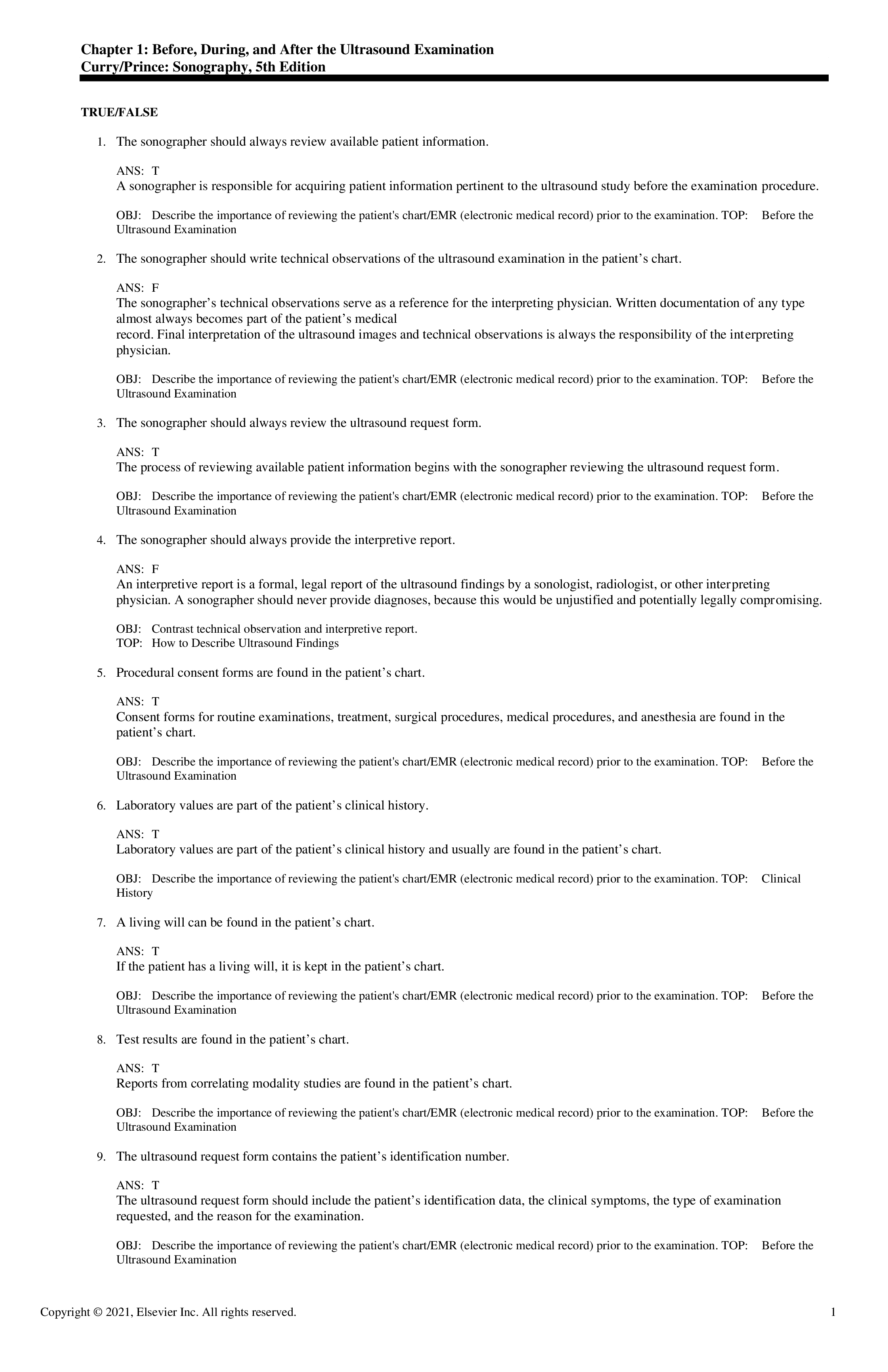
Chapter 1: Before, During, and After the Ultrasound Examination Curry/Prince: Sonography, 5th Edition

TRUE/FALSE

1.         The sonographer should always review available patient information.

ANS: T

A  sonographer is responsible for acquiring patient information pertinent to the ultrasound study before the examination procedure.

OBJ: Describe the importance of reviewing the patient's chart/EMR (electronic medical record) prior to the examination. TOP:        Before the Ultrasound Examination      

2.         The sonographer should write technical observations of the ultrasound examination in the patient’s chart.

ANS: F

The sonographer’s technical observations serve as a reference for the interpreting physician. Written documentation of any type almost always becomes part of the patient’s medical record. Final interpretation of the ultrasound images and technical observations is always the responsibility of the interpreting physician.

OBJ: Describe the importance of reviewing the patient's chart/EMR (electronic medical record) prior to the examination. TOP:        Before the Ultrasound Examination      

3.         The sonographer should always review the ultrasound request form.

ANS: T

The process of reviewing available patient information begins with the sonographer reviewing the ultrasound request form.

OBJ: Describe the importance of reviewing the patient's chart/EMR (electronic medical record) prior to the examination. TOP:        Before the Ultrasound Examination      

4.         The sonographer should always provide the interpretive report.

ANS: F

An interpretive report is a formal, legal report of the ultrasound findings by a sonologist, radiologist, or other interpreting physician. A sonographer should never provide diagnoses, because this would be unjustified and potentially legally compromising.

OBJ: Contrast technical observation and interpretive report. TOP: How to Describe Ultrasound Findings

5.         Procedural consent forms are found in the patient’s chart.

ANS: T

Consent forms for routine examinations, treatment, surgical procedures, medical procedures, and anesthesia are found in the patient’s chart.

OBJ: Describe the importance of reviewing the patient's chart/EMR (electronic medical record) prior to the examination. TOP:        Before the Ultrasound Examination      

6.         Laboratory values are part of the patient’s clinical history.

ANS: T

Laboratory values are part of the patient’s clinical history and usually are found in the patient’s chart.

               OBJ: Describe the importance of reviewing the patient's chart/EMR (electronic medical record) prior to the examination. TOP:                                                                     Clinical

History

7.         A living will can be found in the patient’s chart.

ANS: T

If the patient has a living will, it is kept in the patient’s chart.

OBJ: Describe the importance of reviewing the patient's chart/EMR (electronic medical record) prior to the examination. TOP:        Before the Ultrasound Examination      

8.         Test results are found in the patient’s chart.

ANS: T

Reports from correlating modality studies are found in the patient’s chart.

OBJ: Describe the importance of reviewing the patient's chart/EMR (electronic medical record) prior to the examination. TOP:        Before the Ultrasound Examination      

9.         The ultrasound request form contains the patient’s identification number.

ANS: T

The ultrasound request form should include the patient’s identification data, the clinical symptoms, the type of examination requested, and the reason for the examination.

               OBJ: Describe the importance of reviewing the patient's chart/EMR (electronic medical record) prior to the examination. TOP:                                                                   Before the

             Ultrasound Examination       

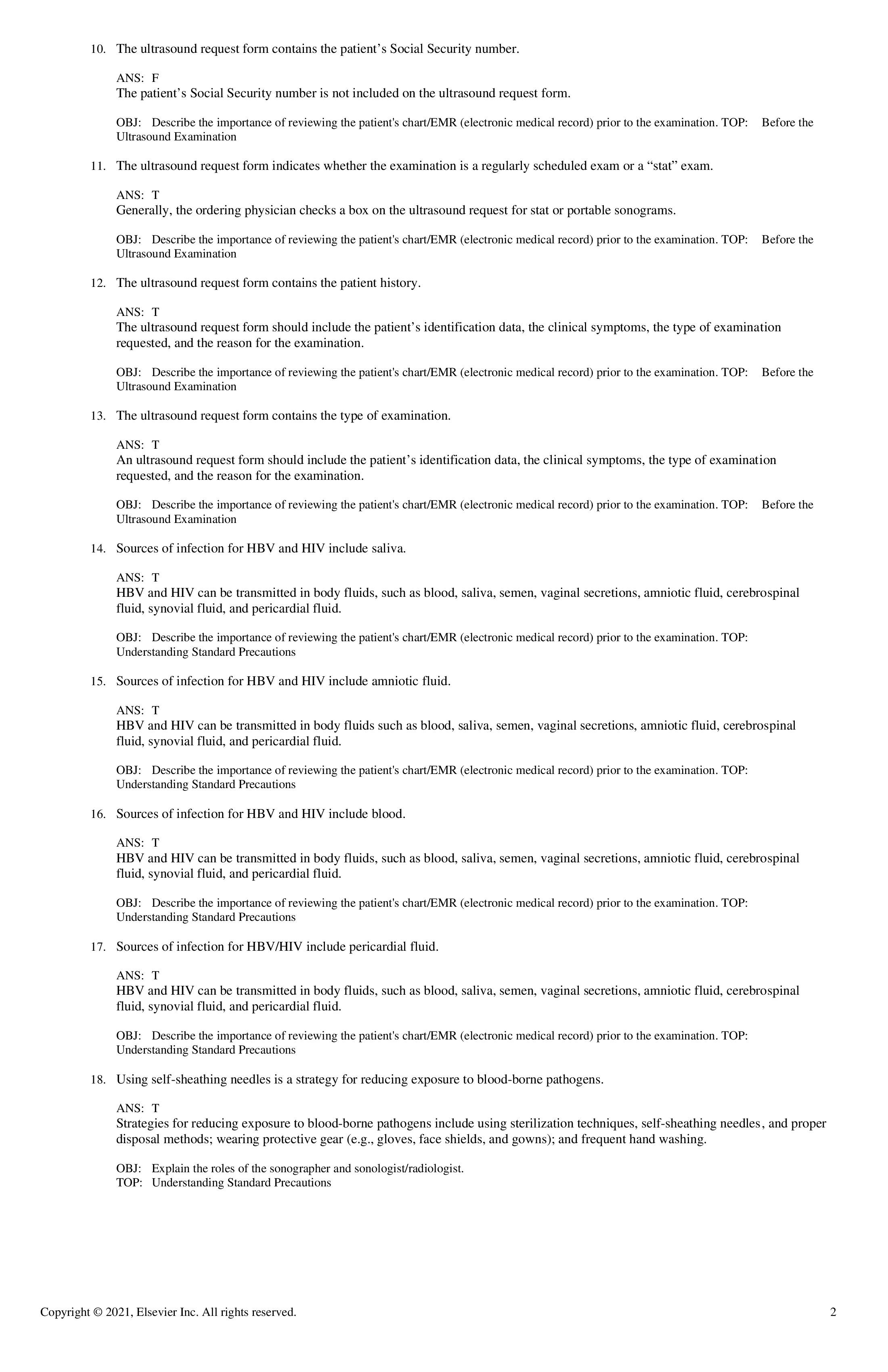
10.     The ultrasound request form contains the patient’s Social Security number.

ANS: F

The patient’s Social Security number is not included on the ultrasound request form.

OBJ: Describe the importance of reviewing the patient's chart/EMR (electronic medical record) prior to the examination. TOP:        Before the Ultrasound Examination      

11.     The ultrasound request form indicates whether the examination is a regularly scheduled exam or a “stat” exam.

ANS: T

Generally, the ordering physician checks a box on the ultrasound request for stat or portable sonograms.

OBJ: Describe the importance of reviewing the patient's chart/EMR (electronic medical record) prior to the examination. TOP:        Before the Ultrasound Examination      

12.     The ultrasound request form contains the patient history.

ANS: T

The ultrasound request form should include the patient’s identification data, the clinical symptoms, the type of examination requested, and the reason for the examination.

OBJ: Describe the importance of reviewing the patient's chart/EMR (electronic medical record) prior to the examination. TOP:        Before the Ultrasound Examination      

13.     The ultrasound request form contains the type of examination.

ANS: T

An ultrasound request form should include the patient’s identification data, the clinical symptoms, the type of examination requested, and the reason for the examination.

OBJ: Describe the importance of reviewing the patient's chart/EMR (electronic medical record) prior to the examination. TOP:        Before the Ultrasound Examination      

14.     Sources of infection for HBV and HIV include saliva.

ANS: T

HBV and HIV can be transmitted in body fluids, such as blood, saliva, semen, vaginal secretions, amniotic fluid, cerebrospinal fluid, synovial fluid, and pericardial fluid.

OBJ: Describe the importance of reviewing the patient's chart/EMR (electronic medical record) prior to the examination. TOP: Understanding Standard Precautions            

15.     Sources of infection for HBV and HIV include amniotic fluid.

ANS: T

HBV and HIV can be transmitted in body fluids such as blood, saliva, semen, vaginal secretions, amniotic fluid, cerebrospinal fluid, synovial fluid, and pericardial fluid.

OBJ: Describe the importance of reviewing the patient's chart/EMR (electronic medical record) prior to the examination. TOP: Understanding Standard Precautions            

16.     Sources of infection for HBV and HIV include blood.

ANS: T

HBV and HIV can be transmitted in body fluids, such as blood, saliva, semen, vaginal secretions, amniotic fluid, cerebrospinal fluid, synovial fluid, and pericardial fluid.

OBJ: Describe the importance of reviewing the patient's chart/EMR (electronic medical record) prior to the examination. TOP: Understanding Standard Precautions            

17.     Sources of infection for HBV/HIV include pericardial fluid.

ANS: T

HBV and HIV can be transmitted in body fluids, such as blood, saliva, semen, vaginal secretions, amniotic fluid, cerebrospinal fluid, synovial fluid, and pericardial fluid.

OBJ: Describe the importance of reviewing the patient's chart/EMR (electronic medical record) prior to the examination. TOP: Understanding Standard Precautions            

18.     Using self-sheathing needles is a strategy for reducing exposure to blood-borne pathogens.

ANS: T

Strategies for reducing exposure to blood-borne pathogens include using sterilization techniques, self-sheathing needles, and proper disposal methods; wearing protective gear (e.g., gloves, face shields, and gowns); and frequent hand washing.

OBJ: Explain the roles of the sonographer and sonologist/radiologist. TOP: Understanding Standard Precautions 

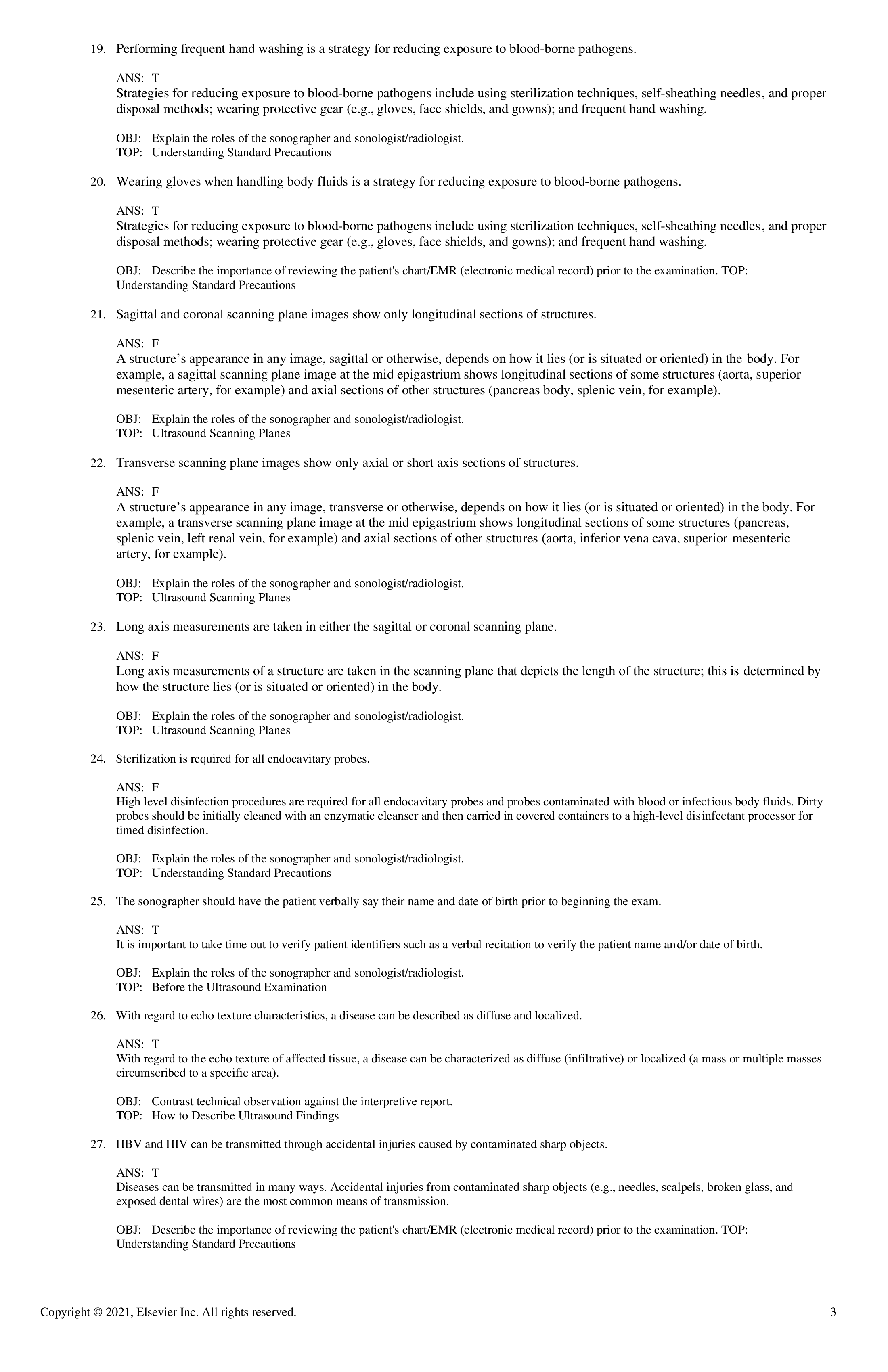
19.     Performing frequent hand washing is a strategy for reducing exposure to blood-borne pathogens.

ANS: T

Strategies for reducing exposure to blood-borne pathogens include using sterilization techniques, self-sheathing needles, and proper disposal methods; wearing protective gear (e.g., gloves, face shields, and gowns); and frequent hand washing.

OBJ: Explain the roles of the sonographer and sonologist/radiologist. TOP: Understanding Standard Precautions 

20.     Wearing gloves when handling body fluids is a strategy for reducing exposure to blood-borne pathogens.

ANS: T

Strategies for reducing exposure to blood-borne pathogens include using sterilization techniques, self-sheathing needles, and proper disposal methods; wearing protective gear (e.g., gloves, face shields, and gowns); and frequent hand washing.

OBJ: Describe the importance of reviewing the patient's chart/EMR (electronic medical record) prior to the examination. TOP: Understanding Standard Precautions            

21.     Sagittal and coronal scanning plane images show only longitudinal sections of structures.

ANS: F

A  structure’s appearance in any image, sagittal or otherwise, depends on how it lies (or is situated or oriented) in the body. For example, a sagittal scanning plane image at the mid epigastrium shows longitudinal sections of some structures (aorta, superior mesenteric artery, for example) and axial sections of other structures (pancreas body, splenic vein, for example).

OBJ: Explain the roles of the sonographer and sonologist/radiologist. TOP: Ultrasound Scanning Planes

22.     Transverse scanning plane images show only axial or short axis sections of structures.

ANS: F

A  structure’s appearance in any image, transverse or otherwise, depends on how it lies (or is situated or oriented) in the body. For example, a transverse scanning plane image at the mid epigastrium shows longitudinal sections of some structures (pancreas, splenic vein, left renal vein, for example) and axial sections of other structures (aorta, inferior vena cava, superior mesenteric artery, for example).

OBJ: Explain the roles of the sonographer and sonologist/radiologist. TOP: Ultrasound Scanning Planes

23.     Long axis measurements are taken in either the sagittal or coronal scanning plane.

ANS: F

Long axis measurements of a structure are taken in the scanning plane that depicts the length of the structure; this is determined by how the structure lies (or is situated or oriented) in the body.

OBJ: Explain the roles of the sonographer and sonologist/radiologist. TOP: Ultrasound Scanning Planes

24.     Sterilization is required for all endocavitary probes.

ANS: F

High level disinfection procedures are required for all endocavitary probes and probes contaminated with blood or infectious body fluids. Dirty probes should be initially cleaned with an enzymatic cleanser and then carried in covered containers to a high-level disinfectant processor for timed disinfection.

OBJ: Explain the roles of the sonographer and sonologist/radiologist. TOP: Understanding Standard Precautions 

25.     The sonographer should have the patient verbally say their name and date of birth prior to beginning the exam.

ANS: T

It is important to take time out to verify patient identifiers such as a verbal recitation to verify the patient name and/or date of birth.

OBJ: Explain the roles of the sonographer and sonologist/radiologist. TOP: Before the Ultrasound Examination 

26.     With regard to echo texture characteristics, a disease can be described as diffuse and localized.

ANS: T

With regard to the echo texture of affected tissue, a disease can be characterized as diffuse (infiltrative) or localized (a mass or multiple masses circumscribed to a specific area).

OBJ: Contrast technical observation against the interpretive report. TOP: How to Describe Ultrasound Findings

27.     HBV and HIV can be transmitted through accidental injuries caused by contaminated sharp objects.

ANS: T

Diseases can be transmitted in many ways. Accidental injuries from contaminated sharp objects (e.g., needles, scalpels, broken glass, and exposed dental wires) are the most common means of transmission.

OBJ: Describe the importance of reviewing the patient's chart/EMR (electronic medical record) prior to the examination. TOP: Understanding Standard Precautions            

28.     A person can become infected with HBV or HIV by touching contaminated surfaces and transferring contaminants to the eyes, nose or mouth.

ANS: T

Touching contaminated surfaces and transferring the infectious material to the mouth, nose, or eyes is a more indirect means of transmission.

OBJ: Describe the importance of reviewing the patient's chart/EMR (electronic medical record) prior to the examination. TOP: Understanding Standard Precautions            

29.     There is a specific patient position that is best for visualization of each organ.

ANS: F

The best patient position is determined by what will produce optimal views of areas of interest.

OBJ: Explain the roles of the sonographer and sonologist/radiologist. TOP: During the Ultrasound Examination 

MULTIPLE CHOICE

1.         Structures are accurately identified on ultrasound images by

a.        scanning plane interpretation.

b.        two-dimensional cross-sections.

c.        their location.

d.        their sonographic appearance.

ANS: C

Body structures are accurately identified on ultrasound images by their location, not by their sonographic appearance, which may be altered by a pathologic condition or other factors.

OBJ: Contrast technical observation against the interpretive report. TOP: How to Describe Ultrasound Findings

2.         Documented areas of interest

a.        are represented in a single scanning plane.

b.        cover approximately every 2 cm of a structure.

c.        must be represented in at least two scanning planes.

d.        must include survey images.

ANS: C

Documented areas of interest or required images must be represented in at least two scanning planes perpendicular to each other for a more dimensional and therefore accurate representation.

OBJ: Contrast technical observation against the interpretive report. TOP: How to Describe Ultrasound Findings

3.         Organ parenchyma is described in terms of

a.        echo texture.

b.        location.

c.        focal zone.

d.        refraction.

ANS: A

As sonographers become practiced at recognizing the echo patterns of normal anatomy, they can more easily identify changes in the normal appearance that may suggest the presence of an abnormality.

OBJ: Contrast technical observation against the interpretive report. TOP: How to Describe Ultrasound Findings

4.         Sonographically, the lumen of the gastrointestinal tract

a.        resembles a “bull’s eye.”

b.        has an appearance that depends on the lumen’s contents.

c.        is hypoechoic relative to its walls.

d.        is highly reflective.

ANS: B

The sonographic appearance of the gastrointestinal tract is dependent on its contents. A fluid-filled lumen appears anechoic or echo free. A gas- or air-filled lumen will appear bright, highly echogenic, and generally hyperechoic relative to adjacent structures. The lumen can also have a complex or mixed appearance, displaying anechoic portions from fluid, along with echogenic portions that vary in brightness depending on their composition (partially digested food, indigestible material, gas, air). All or individual sections of the GI tract may cast a posterior shadow where air or gas is present in the lumen because air/gas attenuates the sound beam. Empty, collapsed bowel has a distinctive “bull's eye” appearance due to the contrast between the very bright collapsed lumen and dark/black walls.

OBJ: Contrast technical observation against the interpretive report. TOP: How to Describe Ultrasound Findings

5.         When an organ is described as hypoechoic to another organ, this means that

a.        one organ is diseased relative to the other.

b.        one organ is less echogenic relative to the other.

c.        one organ is visualized inferior to the other.

d.        one organ is visualized posterior to the other.

ANS: B

A structure that is hypoechoic has decreased echogenicity relative to adjacent structure(s).

OBJ: Contrast technical observation against the interpretive report. TOP: How to Describe Ultrasound Findings

6.         Structures that cast an acoustic shadow

a.        attenuates the sound beam.

b.        are nonattenuating.

c.        are always directly in front of another structure.

d.        show acoustic enhancement.

ANS: A

Structures that cast a shadow (e.g., calculi) reflect and impede (attenuate) sound waves.

OBJ: Contrast technical observation against the interpretive report. TOP: How to Describe Ultrasound Findings

7.         The term through transmission is synonymous with

a.        sound attenuation.

b.        posterior enhancement.

c.        acoustic shadowing.

d.        infiltrative process.

ANS: B

The terms through transmission, posterior through transmission, posterior enhancement, and acoustic enhancement describe the bright, highly echogenic appearance of the unimpeded sound beam posterior to fluid-filled structures.

OBJ: Contrast technical observation against the interpretive report. TOP: How to Describe Ultrasound Findings

8.         Pathologic findings that are in a specific area or localized are referred to as a.  focal.

b.        diffuse.

c.        enhanced.

d.        regional.

ANS: A

Localized (focal) disease represents a circumscribed mass or multiple masses. Diffuse disease parenchymal texture appears heterogeneous with varying degrees of echogenicity.

OBJ: Contrast technical observation against the interpretive report. TOP: How to Describe Ultrasound Findings

9.         A characteristic of an intraorgan mass is

a.        discontinuity of the organ capsule.

b.        obstruction of other organs and structures.

c.        disruption of the normal internal architecture.

d.        internal invagination of organ capsules.

ANS: C

Features of an intraorgan mass include disruption of the normal internal architecture, external bulging of organ capsules, and displacement or shifting of adjacent structures.

OBJ: Contrast technical observation against the interpretive report. TOP: How to Describe Ultrasound Findings

10.     Which of the following terms would NOT be used to describe a true cyst?

a.        Anechoic

b.        Irregular margins

c.        Posterior enhancement

d.        Refractive shadows

ANS: B

The criteria for describing a true cyst are anechoic; posterior acoustic enhancement; smooth, thin wall margins; and in some cases refractive shadowing.

OBJ: Contrast technical observation against the interpretive report. TOP: How to Describe Ultrasound Findings

11.     Which term refers to decreased echogenicity as compared with other body structures? a.        Anechoic

b.        Isoechoic

c.        Hyperechoic

d.        Hypoechoic

ANS: D

Hypoechoic is a comparative term used to describe an area on a sonogram where the echoes are decreased or not as bright compared to surrounding structures.

OBJ: Contrast technical observation against the interpretive report. TOP: How to Describe Ultrasound Findings

12.     Which of the following occurs during an initial scanning survey?

a.        Measurements of abnormal anatomy are obtained.

b.        No images are taken during an initial scanning survey.

c.        Images required by the institution’s protocol are obtained.

d.        Sagittal and transverse scanning plane images of pertinent anatomy are obtained.

ANS: B

During the survey portion of an ultrasound examination no images are taken; areas of interest are evaluated in at least two scanning planes, abnormalities are ruled out, and technique and scanning approach(es) are determined.

OBJ: Contrast technical observation against the interpretive report. TOP: During the Ultrasound Examination 

13.     Which anatomic area is NOT demonstrated in a sagittal scanning plane image? a.        Lateral

b.        Inferior

c.        Anterior

d.        Posterior

ANS: A

A sagittal scanning plane image demonstrates anterior, posterior, superior, and inferior anatomic areas.

OBJ: Contrast technical observation against the interpretive report. TOP: Ultrasound Scanning Planes

14.     Which anatomic area is NOT demonstrated in a transverse scanning plane image? a.   Medial

b.        Anterior

c.        Posterior

d.        Superior

ANS: D

A transverse scanning plane image demonstrates anterior, posterior, medial, and lateral anatomic areas.

OBJ: Contrast technical observation against the interpretive report. TOP: Ultrasound Scanning Planes

15.     Which anatomic area is NOT demonstrated in a coronal scanning plane image?

a.        Medial

b.        Lateral

c.        Anterior

d.        Inferior

ANS: C

A coronal scanning plane image demonstrates medial, lateral, superior, and inferior scanning planes.

OBJ: Contrast technical observation against the interpretive report. TOP: Ultrasound Scanning Planes

16.     Sonographers must

a.        have excellent handwriting.

b.        be licensed by the state.

c.        present images to the interpreting physician.

d.        diagnose disease.

ANS: C

Sonographers primary work involves using ultrasound imaging equipment to produce cross-section images of anatomy and diagnostic data. Specific responsibilities include the following: excellent communication skills; strong computer skills; ability to obtain and record patient data pertinent to the ultrasound study; proper use of ultrasound systems; provide quality patient care; acquire, analyze, modify, and select images to store and present to the interpreting physician for diagnosis; use ultrasound terminology to document the technical summary of the ultrasound findings, which are presented or sent to the interpreting physician.

OBJ: Explain the roles of the sonographer and sonologist/radiologist.

TOP: Image Documentation Criteria

17.     Which of the following is an example of professional and clinical standards?

a.        Wearing an identification badge

b.        Discussing the sonographic findings with the patient

c.        Using slang words, so patients feel more comfortable

d.        Not inquiring about the patient’s illness, so they do not get upset

ANS: A

Whether in a classroom or clinical setting, certain professional and clinical standards should be followed: conversations with patients should be proper and professional; never discuss the sonographic findings or offer your opinion of the study results with a patient; inquire about the patient's symptoms and history of illness or surgeries.

OBJ: Explain the roles of the sonographer and sonologist/radiologist. TOP: Clinical Criteria

18.     Coronal planes divide the body into unequal

a.        medial and lateral sections.

b.        anterior and posterior sections.

c.        superior and inferior sections.

ANS: B

The coronal plane is any plane parallel to the long axis of the body and perpendicular to sagittal scanning planes.

OBJ: Contrast technical observation against the interpretive report. TOP: Ultrasound Scanning Planes

19.     Transverse planes divide the body into unequal

a.        right and left sections.

b.        anterior and posterior sections.

c.        superior and inferior sections.

ANS: C

A transverse scanning plane image demonstrates the anatomy visualized in an anterior-to-posterior (or posterior-to-anterior) dimension and right-to-left dimension or a lateral-to-medial dimension and anterior-to-posterior dimension.

OBJ: Contrast technical observation against the interpretive report. TOP: Ultrasound Scanning Planes

20.     Sagittal planes divide the body into unequal

a.        right and left sections.

b.        anterior and posterior sections.

c.        superior and inferior sections.

ANS: A

A sagittal scanning plane image demonstrates the anatomy visualized in an anterior-to-posterior (or posterior-to-anterior) dimension and superior-to-inferior dimension.

OBJ: Contrast technical observation against the interpretive report. TOP: Ultrasound Scanning Planes

21.     Which planes are parallel to the long axis of the body?

a.        Transverse and coronal

b.        Sagittal and transverse

c.        Sagittal and coronal

ANS: C

The sagittal and coronal planes are parallel to the long axis of the body.

OBJ: Contrast technical observation against the interpretive report. TOP: Ultrasound Scanning Planes

22.     Longitudinal views show a structure’s depth and

a.        height.

b.        volume.

c.        width.

d.        length.

ANS: D

Longitudinal (long axis) views demonstrate the depth and length of a structure. Measurement calipers are used to obtain length, width, and anteroposterior measurements to provide the dimensions or total volume of a structure of interest.

OBJ: Contrast technical observation against the interpretive report. TOP: Ultrasound Scanning Planes

23.     The normal echotexture appearance of soft tissues is characterized as

a.        homogeneous.

b.        heterogenous.

c.        isoechoic.

d.        complex.

ANS: A

Normal organ parenchyma (soft tissue) is demonstrated on a sonogram as homogeneous, or uniform in texture.

OBJ: Contrast technical observation against the interpretive report. TOP: How to Describe Ultrasound Findings

24.     With regard to composition, a mass is classified as

a.        high gain or low gain.

b.        cystic, complex or solid.

c.        big, medium, or small.

d.        single or many.

ANS: B

A mass may be described as solid, cystic, or complex, depending on its composition.

OBJ: Contrast technical observation against the interpretive report.

TOP: How to Describe Ultrasound Findings

25.     A “circumscribed disease process” describes

a.        diffuse disease.

b.        intraorgan features.

c.        extraorgan features.

d.        a mass.

ANS: D

A mass is a circumscribed disease process.

OBJ: Contrast technical observation against the interpretive report.

TOP: How to Describe Ultrasound Findings

26.     An accumulation of serous fluid in the abdominopelvic cavity is called

a.        ascites.

b.        pleural effusion.

c.        infiltrative disease.

d.        complex.

ANS: A

Ascites is an accumulation of serous fluid anywhere in the abdominopelvic cavity.

OBJ: Contrast technical observation against the interpretive report.

TOP: How to Describe Ultrasound Findings

27.     “Homogenous liver texture” is an example of

a.        clinical history.

b.        technical observation.

c.        interpretive report.

ANS: B

Technical observations should be confined to descriptions of the ultrasound findings based on echo pattern and size.

OBJ: Contrast technical observation against the interpretive report.

TOP: How to Describe Ultrasound Findings

28.     “Fever and chills x 3 days” is an example of

a.        clinical history.

b.        technical observation.

c.        interpretive report.

ANS: A

“Fever and chills × 3 days” describes clinical symptoms (clinical history).

OBJ: Contrast technical observation against the interpretive report.

TOP: The Sonographer's Technical Observation and Comments 

29.     “Right lower quadrant pain” is an example of

a.        clinical history.

b.        technical observation.

c.        interpretive report.

ANS: A Right lower quadrant pain is a clinical symptom and part of the patient’s clinical history.

OBJ: Contrast technical observation against the interpretive report.

TOP: The Sonographer's Technical Observation and Comments 

30.     “Splenomegaly” is an example of

a.        clinical history.

b.        technical observation.

c.        interpretive report.

ANS: B

Technical observations should be confined to descriptions of the ultrasound findings based on echo pattern and size.

OBJ: Contrast technical observation against the interpretive report.

TOP: The Sonographer's Technical Observation and Comments 

31.     “Inflammed appendix” is an example of

a.        clinical history.

b.        technical observation.

c.        interpretive report.

ANS: C

An interpretive report (final report) includes a detailed description of the ultrasound findings and a diagnosis (or diagnoses) derived from them.

OBJ: Contrast technical observation against the interpretive report.

TOP: The Sonographer's Technical Observation and Comments 

32.     “Chronic pancreatitis” is an example of

a.        clinical history.

b.        technical observation.

c.        interpretive report.

ANS: C

An interpretive report (final report) includes a detailed description of the ultrasound findings and a diagnosis (or diagnoses) derived from them.

OBJ: Contrast technical observation against the interpretive report.

TOP: The Sonographer's Technical Observation and Comments  

Contact the Seller

Please Sign In to contact this seller.


  • 👎  Report Copyright Violation

Frequently Asked Questions

What Do I Get When I Buy This Study Material?

+

When you buy a study material on Passing Grades, an instant download link will be sent directly to your email, giving you access to the file anytime after payment is completed.

Is Passing Grades a Trusted Platform?

+

Yes, Passing Grades is a reputable students’ marketplace with a secure payment system and reliable customer support. You can trust us to ensure a safe and seamless transaction experience.

Will I Be Stuck with a Subscription?

+

No, all purchases on Passing Grades are one-time transactions. You only pay for the notes you choose to buy, with no subscriptions or hidden fees attached.

Who Am I Buying These Study Materials From?

+

Passing Grades is a marketplace, which means you are purchasing the document from an individual vendor, not directly from us. We facilitate the payment and delivery process between you and the vendor.

Does Passing Grades Offer Free Study Materials?

+

Yes, sellers on Passing Grades have uploaded numerous free test banks, exams, practice questions, and class notes that can be downloaded at no cost.


Pasinggrades - Quality Study Materials

USD 15

    • Quality checked by Pasing Grades
    • 100% satisfaction guarantee
    • Seller: mentor2000
Buy PDF $15

Seller Information

mentor2000

Member since April 2021

  • icon
  • icon
View Profile
  • total sales

    0
  • Favourites

    0
  • Comments

    0
    ( 0 Ratings )

Item Information

  • Uploaded

    22 May 2022

  • Updated

    19 May 2025

  • Category

    Nursing

  • Item Type

    test bank

  • Tags

    Test Bank for Sonography 5th Edition by Curry

Related Exam Prep Guides by mentor2000

Test Bank for Essentials for Nursing Practice 8th Edition by Potter | All Chapters
View Document

Test Bank for Essent...

  • mentor2000

    mentor2000

  • test bank

Master nursing concepts with this study material; Test Bank for Essentials for Nursing Practice, 8th...

15 USD

0

0

A &P 1 MA278 BSC2 Final Module II Questions & Answers 2026 Update
View Document

A &P 1 MA278 BSC2 Fi...

  • mentor2000

    mentor2000

  • test bank

Prepare for success with A&P 1 MA278 BSC2 Final Module II 2024 Q&A. Boost your grades with this comp...

15 USD

0

0

ATI Comprehensive Predictor Exam 2026
View Document

ATI Comprehensive Pr...

  • mentor2000

    mentor2000

  • test bank

Prepare for success with the ATI Comprehensive Predictor Exam 2026. Access key practice questions to...

15 USD

0

0

Purchase

Download link will be sent to this email immediately after purchase.

IMPORTANT LINKS

  • How To Upload Class Notes
  • Selling Tips
  • Passing Grades's Study Materials
  • Scholarships for International Students 2025

POPULAR CATEGORIES

  • Law
  • Accounting
  • English
  • Psychology
  • Business
  • Nursing
  • Computer Science
  • General

View Document

  • Blog
  • Contact
  • Delivery Policy
  • Latest Scholarships Around the World
  • How to Pass Bar Exams: Passing Grades’ Strategies
  • How to Study and Pass the CPA Exam
  • All Test Banks
  • Faq
  • Copyright Claims
  • Privacy Policy
  • Terms of Use

KNOWLEDGE BASE

  • How to Write A+ Grade Good Research Paper
  • How to Manage Stress During Exam Period
  • Best Time to Study
  • How to Pass NCLEX-RN Exam
  • How To Effectively Utilize Test Banks
  • Popular Shadow Health Exam Assessments
  • Popular HESI Case Studies
  • How to Prepare for a Nursing Career
  • The Importance Of Summaries in Exam Revisvion

© 2026 Pasing Grades. All rights reserved.