Pasing Grades
  • Start Selling
  • Blog
  • Contact
  • 0

    Your cart is empty!

English

  • English
  • Spanish
  • Arabic
Create Account Sign In
  • Library
    • New Prep Guides
    • Featured Prep Guides
    • Free Exam Prep Guides
    • Best sellers
  • General
  • Nursing
    • Research Paper
    • Case Study
    • Discussion Post
    • Assignment
    • Exam
    • Practice Questions and Answers
    • Test Bank
    • solutions manual
  • Accounting
    • Case Study
    • Thesis
    • Study Guide
    • Summary
    • Research Paper
    • test bank
  • English
    • Creative Writing
    • Research Paper
    • Summary
    • Rhetorics
    • Literature
    • Journal
    • Exam
    • Grammar
    • Discussion Post
    • Essay
  • Psychology
    • Hesi
    • Presentation
    • Essay
    • Summary
    • Study Guide
    • Essay
    • Solution Manual
    • Final Exam Review
    • Class Notes
    • test bank
  • Business
    • Lecture Notes
    • Solution Manual
    • Presentation
    • Business Plan
    • Class Notes
    • Experiment
    • Summary
    • Practice Questions
    • Study Guide
    • Case Study
    • test bank
    • Exam
  • More
    • Computer Science
    • Economics
    • Statistics
    • Engineering
    • Biology
    • Religious Studies
    • Physics
    • Chemistry
    • Mathematics
    • History
    • Sociology
    • Science
    • Philosophy
    • Law
  • Pages
    • About Us
    • Selling Tips
    • Delivery Policy
    • Faq
    • Privacy Policy
  • Flash Sale
  • Home
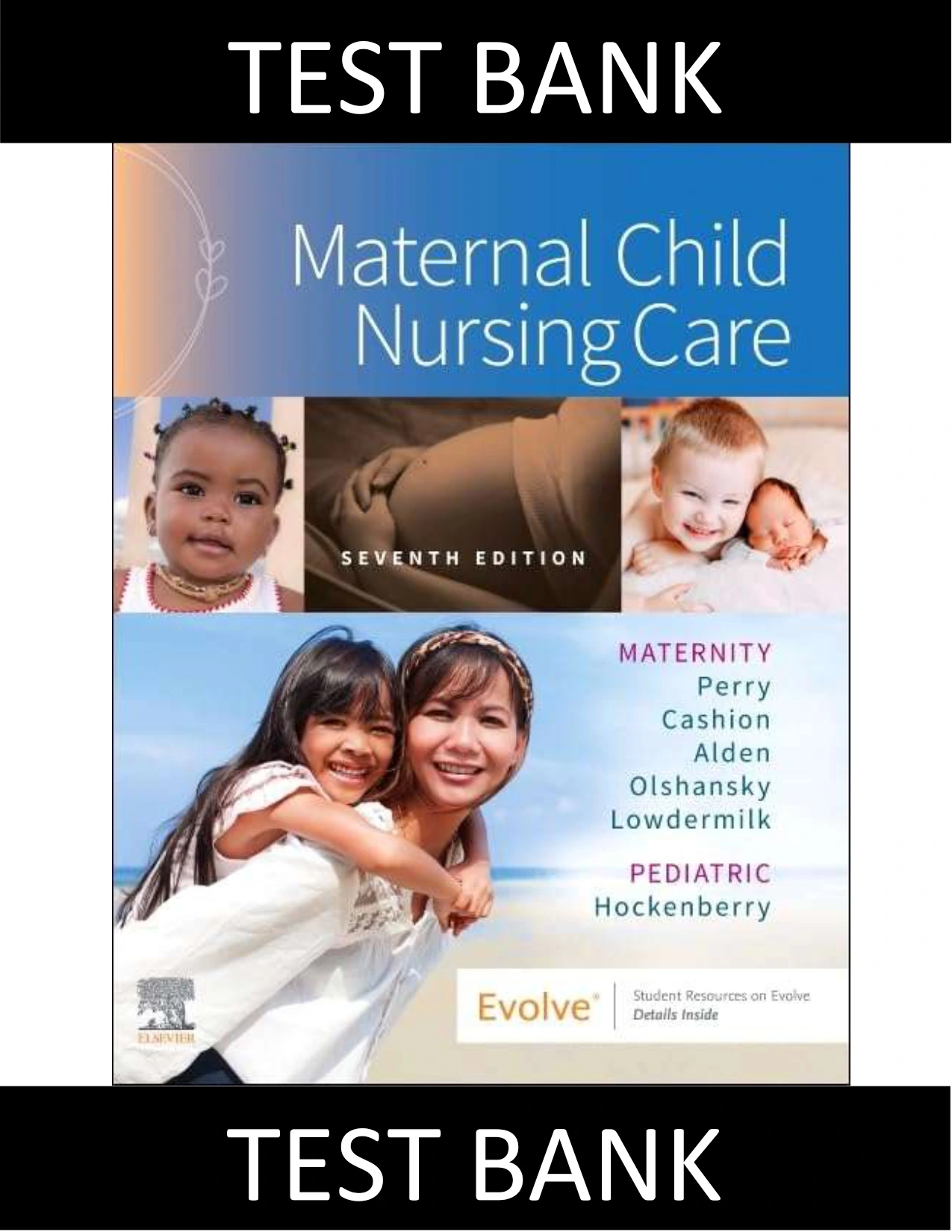
  • Test Bank for Perry’s Maternal Child Nursing Care in Canada, 4th Edition

Test Bank for Perry’s Maternal Child Nursing Care in Canada, 4th Edition

Preview page 1 Preview page 2 Preview page 3
Add To Favorites

Share this item Share this item

  • Item Details
  • Comments (0)
  • Reviews (0)
  • Contact Seller

Test Bank for Perry’s Maternal Child Nursing Care in Canada, 4th Edition

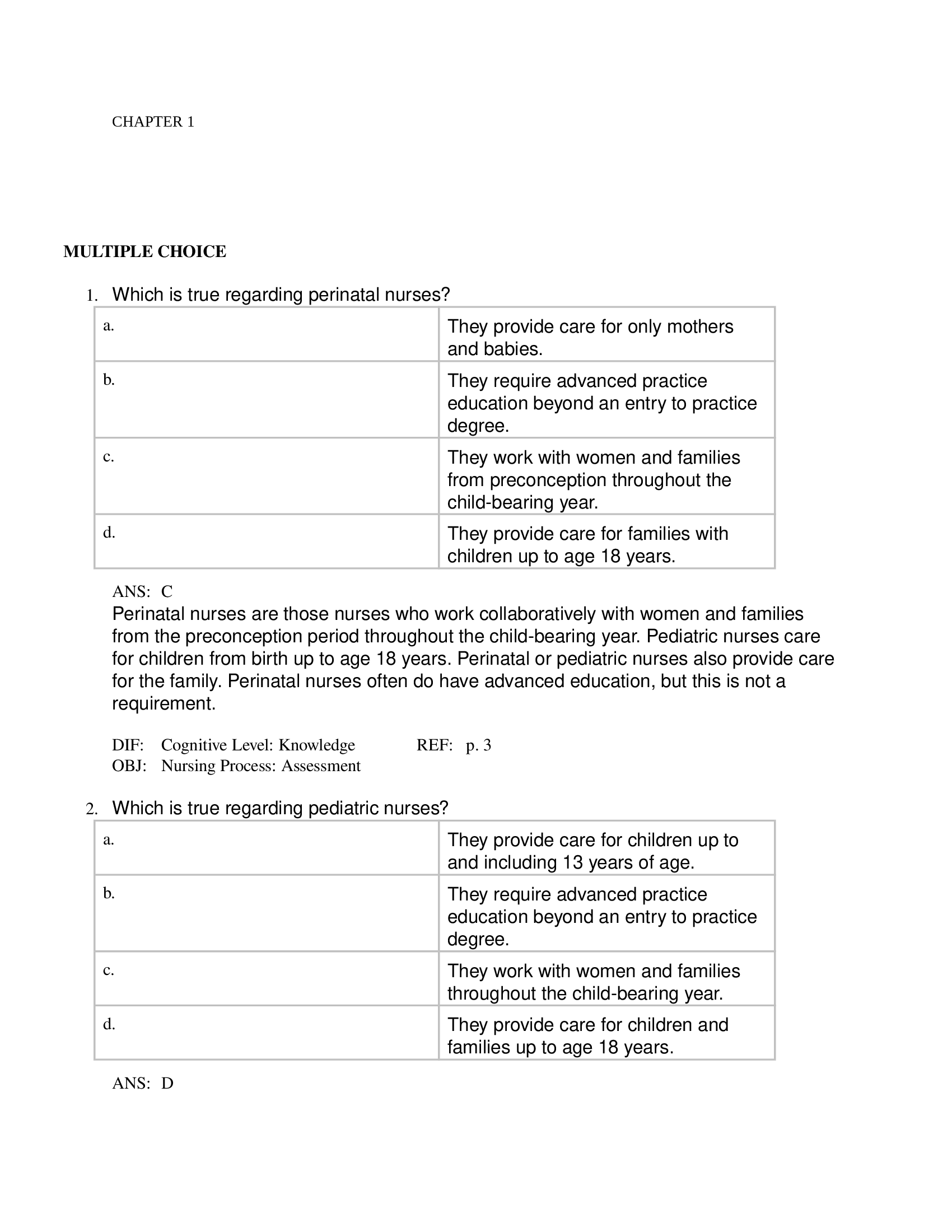
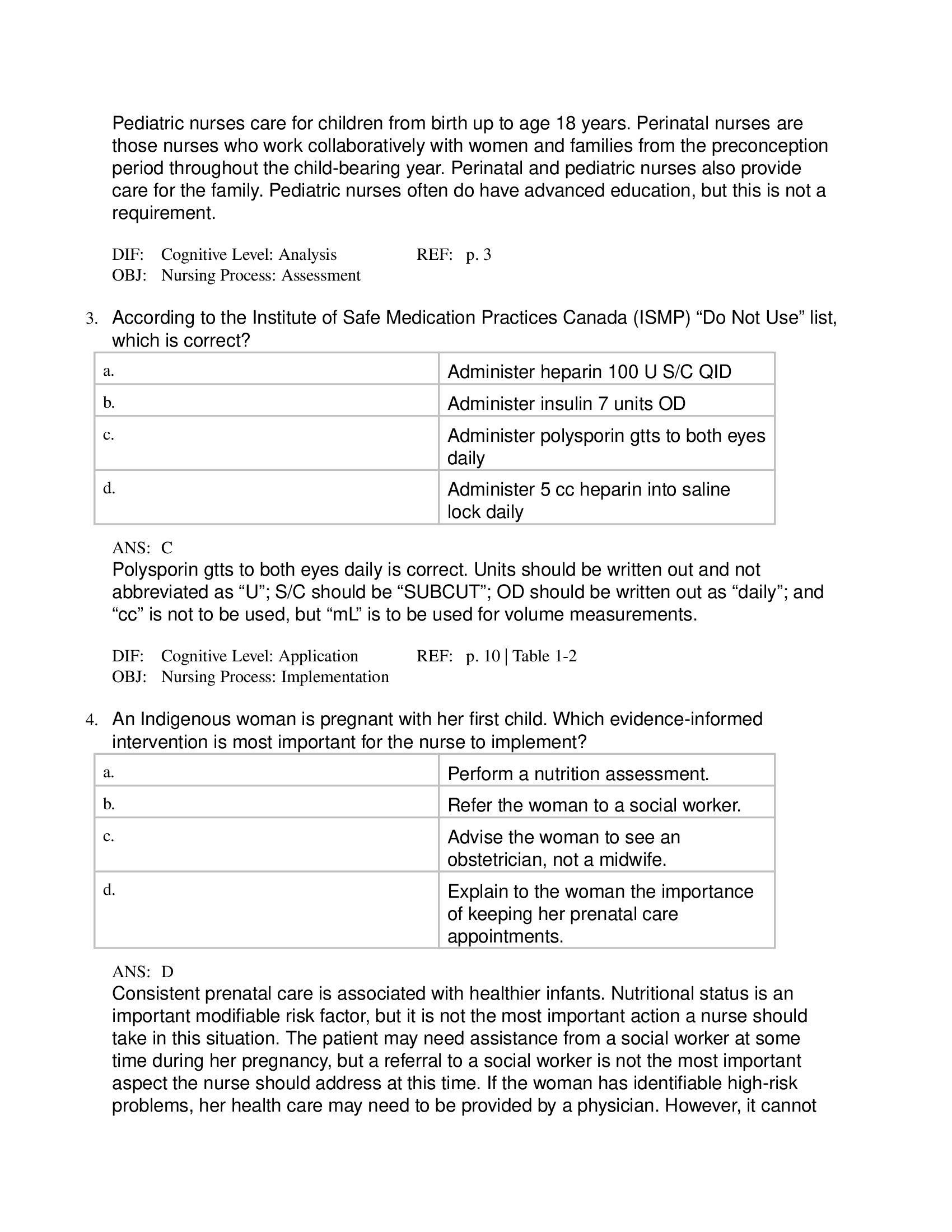
21. Which is a principle of the Canada Health Act? a. Justice b. Universality c. Health and well-being d. Informed decision making ANS: B Universality is one of the five principles of the Canada Health Act. Justice is a guiding principle for perinatal and pediatric nursing in Canada. Informed decision making is a guiding principle for perinatal and pediatric nursing in Canada. Health and well-being is a guiding principle for perinatal and pediatric nursing in Canada. DIF: Cognitive Level: Knowledge REF: p. 4 OBJ: Nursing Process: Assessment 22. Which is true of the Muskoka Accord? a. It focused on a commitment to increase global health across the lifespan. b. It provided assistance in developing countries to address health inequities with mothers and infants. c. It expressed an international commitment to develop a global partnership for development of future health care goals. d. It was a strategy to promote gender equality and empower women in health care decisions. ANS: B In 2010, with the signature of the Muskoka Accord, the Canadian government promised to assist developing countries in addressing health inequities that affect mothers and infants. DIF: Cognitive Level: Knowledge REF: p. 11 OBJ: Nursing Process: Assessment 23. The obligation to minimize or prevent harm is which ethical principle? a. Autonomy b. Nonmaleficence c. Beneficence d. Justice ANS: B Nonmaleficence is the obligation to minimize or prevent harm. Autonomy is the patient’s right to be self-governing; beneficence is the obligation to promote the patient’s wellbeing; and justice is the concept of fairness. DIF: Cognitive Level: Comprehension REF: p. 11 OBJ: Nursing Process: Planning MULTIPLE RESPONSE 1. Which abbreviations are included on the ISMP “Do Not Use” list? Select all that apply. Express answer in small letters, with a comma followed by a space—e.g., a, b, c, d. a. OD b. mcg c. mL d. D/C e. U f. IU g. cc ANS: A, D, E, F, G The following are not to be used: U, IU, OD, QOD, OS, OD, OU, D/C, μg, and cc. Acceptable abbreviations to use include mcg and mL. DIF: Cognitive Level: Knowledge REF: p. 10 | Table 1-2 OBJ: Nursing Process: Assessment 2. Which are included in the International Nurse Regulator Collaborative 6 P’s for social media use? Select all that apply. Express answer in small letters, followed by a comma and a space—e.g., a, b, c, d. a. Positive b. Pause c. Probability d. Purpose e. Privacy f. Performance g. Professional ANS: A, B, E, G The 6 P’s of social media use are professional, positive, patient/person-free, protect, privacy, and pause. Probability, purpose, and performance are not part of the 6 P’s as identified by the International Nurse Regulator Collaborative. DIF: Cognitive Level: Knowledge REF: p. 8 | Box 1-1 OBJ: Nursing Process: Implementation CHAPTER 2 Chapter 02: The Family and Culture MULTIPLE CHOICE 1. A married couple lives in a single-family house with their newborn son and the husband’s daughter from a previous marriage. Which family form best describes this family? a. Blended family b. Extended family c. Nuclear family d. Same-sex family ANS: A Blended families are formed as the result of divorce and remarriage. Unrelated family members join together to create a new household. Members of an extended family are kin, or family members related by blood, such as grandparents, aunts, and uncles. A nuclear family is a traditional family with a male and female partner along with the children resulting from that union. A same-sex family is a family with homosexual partners who cohabit with or without children. DIF: Cognitive Level: Knowledge REF: p. 15 OBJ: Nursing Process: Assessment 2. In what form do families tend to be most socially vulnerable? a. Blended family b. Extended family c. Nuclear family d. Lone-parent family ANS: D The lone-parent family, particularly the female lone-parent family, is more likely to have a lower income and to experience poverty, which in turn can affect the health status of family members. The married-blended family, the extended family, and the nuclear family are not most socially vulnerable. DIF: Cognitive Level: Knowledge REF: p. 16 OBJ: Nursing Process: Planning 3. What is the focus of relational nursing? a. Primarily disease prevention b. Provision of health services c. Recognition of determinants of health d. Resiliency of the woman and her family ANS: C Relational nursing focuses primarily on the recognition of the determinants of health. It is more congruent with health promotion than disease prevention. The focus of perinatal nursing has moved away from the provision of health service in order to focus on the determinants of health. The resiliency of the woman and her family is not the focus of relational nursing. DIF: Cognitive Level: Knowledge REF: p. 17 OBJ: Nursing Process: Planning 4. The nurse should be aware that the criteria used to make decisions and solve problems within families are based primarily on which factor(s)? a. Rituals and customs b. Values and beliefs c. Boundaries and channels d. Socialization processes ANS: B Values and beliefs are the most prevalent factors in the decision-making and problemsolving techniques of families. Although culture may play a part in the decision-making process of a family, ultimately values and beliefs dictate the course of action taken by family members. Boundaries and channels affect the relationship between the family members and the health care team, not the decisions within the family. Socialization processes may help families interact with the community, but they are not the criteria used for decision making within the family. DIF: Cognitive Level: Comprehension REF: p. 20 OBJ: Nursing Process: Planning 5. Using the family stress theory as an intervention approach for working with families experiencing parenting, the nurse can help the family change which internal context factor? a. Success in coping with stressors b. Maturation of family members c. The family’s perception of the event d. The prevailing cultural beliefs of society ANS: C The family stress theory is concerned with the family’s reaction to, and perception of, stressful events; internal context factors include elements that a family can control, such as psychological defences. It is not concerned with maturation of family members or with the prevailing cultural beliefs of society. The family’s success in coping with stressors is an external rather than internal context. DIF: Cognitive Level: Comprehension REF: p. 17 OBJ: Nursing Process: Diagnosis 6. When planning interventions for diverse families, you realize that acceptance of the interventions will be most influenced by which factor? a. Educational achievement b. Income level c. Subcultural group d. Individual beliefs ANS: D The patient’s culture, beliefs, and values are ultimately the key to acceptance of health care interventions. However, these beliefs may be influenced by factors such as educational level, income level, and ethnic background. Educational achievement, income level, and subcultural group are all important factors. However, the nurse must understand that a woman’s concerns from her own point of view will have the most influence on her adherence to interventions. DIF: Cognitive Level: Application REF: p. 20 OBJ: Nursing Process: Planning 7. Which would be considered when viewing the family through a phenomenological lens? a. Professional relationships b. Experience of childbirth c. Cultural meanings and significance d. Health promotion within an environmental context ANS: B The phenomenological lens cues the nurse to learn more about the woman’s and family members’ experiences of health and illness. Professional relationships would be considered when using the sociopolitical lens. The spiritual lens considers cultural meanings and significance. The socio-environmental perspective encourages an understanding of health and health promotion that focuses on the family in their environmental context. DIF: Cognitive Level: Application REF: p. 20 OBJ: Nursing Process: Assessment 8. Upon arriving for a follow-up postpartum and newborn home visit, the woman’s family members are present. What should the nurse do? a. Observe the family members’ interactions with the newborn and with one another. b. Ask the woman to meet with her and the baby alone. c. Do a brief assessment of all family members present. d. Reschedule the visit for another time so that the mother and infant can be assessed privately. ANS: A The nurse should introduce herself to the patient and the other family members present. Family members in the home may be providing care and assistance to the mother and infant. However, this care may not be based on sound health practices. Nurses should take the opportunity to dispel myths while family members are present. The responsibility of the home care maternal-child nurse is to provide care to the new postpartum mother and her infant, not to briefly assess all family members. The nurse can politely ask about the other people in the home and their relationships with the woman. Unless an indication is given that the woman would prefer privacy, the visit may continue. DIF: Cognitive Level: Application REF: p. 17 OBJ: Nursing Process: Assessment 9. Canada’s official multiculturalism policy (1971) confirmed which statement? a. The rights of African-Canadian people b. The value and dignity of lesbian and gay people

Contact the Seller

Please Sign In to contact this seller.


  • 👎  Report Copyright Violation

Frequently Asked Questions

What Do I Get When I Buy This Study Material?

+

When you buy a study material on Passing Grades, an instant download link will be sent directly to your email, giving you access to the file anytime after payment is completed.

Is Passing Grades a Trusted Platform?

+

Yes, Passing Grades is a reputable students’ marketplace with a secure payment system and reliable customer support. You can trust us to ensure a safe and seamless transaction experience.

Will I Be Stuck with a Subscription?

+

No, all purchases on Passing Grades are one-time transactions. You only pay for the notes you choose to buy, with no subscriptions or hidden fees attached.

Who Am I Buying These Study Materials From?

+

Passing Grades is a marketplace, which means you are purchasing the document from an individual vendor, not directly from us. We facilitate the payment and delivery process between you and the vendor.

Does Passing Grades Offer Free Study Materials?

+

Yes, sellers on Passing Grades have uploaded numerous free test banks, exams, practice questions, and class notes that can be downloaded at no cost.

Pasinggrades - Quality Study Materials

USD 18

    • Quality checked by Pasing Grades
    • 100% satisfaction guarantee
    • Seller: mentor2000
Buy PDF $18

Seller Information

mentor2000

Member since April 2021

  • icon
  • icon
View Profile
  • total sales

    0
  • Favourites

    0
  • Comments

    0
    ( 0 Ratings )

Item Information

  • Uploaded

    18 December 2023

  • Updated

    01 October 2025

  • Category

    Nursing

  • Item Type

    exam

  • Tags

    Test Bank for Perry’s Maternal Child Nursing Care in Canada 4th Edition

Related Exam Prep Guides by mentor2000

Test Bank for Essentials for Nursing Practice 8th Edition by Potter | All Chapters
View Document

Test Bank for Essent...

  • mentor2000

    mentor2000

  • exam

Master nursing concepts with this study material; Test Bank for Essentials for Nursing Practice, 8th...

18 USD

0

0

A &P 1 MA278 BSC2 Final Module II Questions & Answers 2026 Update
View Document

A &P 1 MA278 BSC2 Fi...

  • mentor2000

    mentor2000

  • exam

Prepare for success with A&P 1 MA278 BSC2 Final Module II 2024 Q&A. Boost your grades with this comp...

18 USD

0

0

ATI Comprehensive Predictor Exam 2026
View Document

ATI Comprehensive Pr...

  • mentor2000

    mentor2000

  • exam

Prepare for success with the ATI Comprehensive Predictor Exam 2026. Access key practice questions to...

18 USD

0

0

Purchase

Download link will be sent to this email immediately after purchase.

IMPORTANT LINKS

  • How To Upload Class Notes
  • Selling Tips
  • Passing Grades's Study Materials
  • Scholarships for International Students 2025

POPULAR CATEGORIES

  • Law
  • Accounting
  • English
  • Psychology
  • Business
  • Nursing
  • Computer Science
  • General

View Document

  • Blog
  • Contact
  • Delivery Policy
  • Latest Scholarships Around the World
  • How to Pass Bar Exams: Passing Grades’ Strategies
  • How to Study and Pass the CPA Exam
  • All Test Banks
  • Faq
  • Copyright Claims
  • Privacy Policy
  • Terms of Use

KNOWLEDGE BASE

  • How to Write A+ Grade Good Research Paper
  • How to Manage Stress During Exam Period
  • Best Time to Study
  • How to Pass NCLEX-RN Exam
  • How To Effectively Utilize Test Banks
  • Popular Shadow Health Exam Assessments
  • Popular HESI Case Studies
  • How to Prepare for a Nursing Career
  • The Importance Of Summaries in Exam Revisvion

© 2026 Pasing Grades. All rights reserved.