Pasing Grades
  • Start Selling
  • Blog
  • Contact
  • 0

    Your cart is empty!

English

  • English
  • Spanish
  • Arabic
Create Account Sign In
  • Library
    • New Prep Guides
    • Featured Prep Guides
    • Free Exam Prep Guides
    • Best sellers
  • General
  • Nursing
    • Research Paper
    • Case Study
    • Discussion Post
    • Assignment
    • Exam
    • Practice Questions and Answers
    • Test Bank
    • solutions manual
  • Accounting
    • Case Study
    • Thesis
    • Study Guide
    • Summary
    • Research Paper
    • test bank
  • English
    • Creative Writing
    • Research Paper
    • Summary
    • Rhetorics
    • Literature
    • Journal
    • Exam
    • Grammar
    • Discussion Post
    • Essay
  • Psychology
    • Hesi
    • Presentation
    • Essay
    • Summary
    • Study Guide
    • Essay
    • Solution Manual
    • Final Exam Review
    • Class Notes
    • test bank
  • Business
    • Lecture Notes
    • Solution Manual
    • Presentation
    • Business Plan
    • Class Notes
    • Experiment
    • Summary
    • Practice Questions
    • Study Guide
    • Case Study
    • test bank
    • Exam
  • More
    • Computer Science
    • Economics
    • Statistics
    • Engineering
    • Biology
    • Religious Studies
    • Physics
    • Chemistry
    • Mathematics
    • History
    • Sociology
    • Science
    • Philosophy
    • Law
  • Pages
    • About Us
    • Selling Tips
    • Delivery Policy
    • Faq
    • Privacy Policy
  • Flash Sale
  • Home
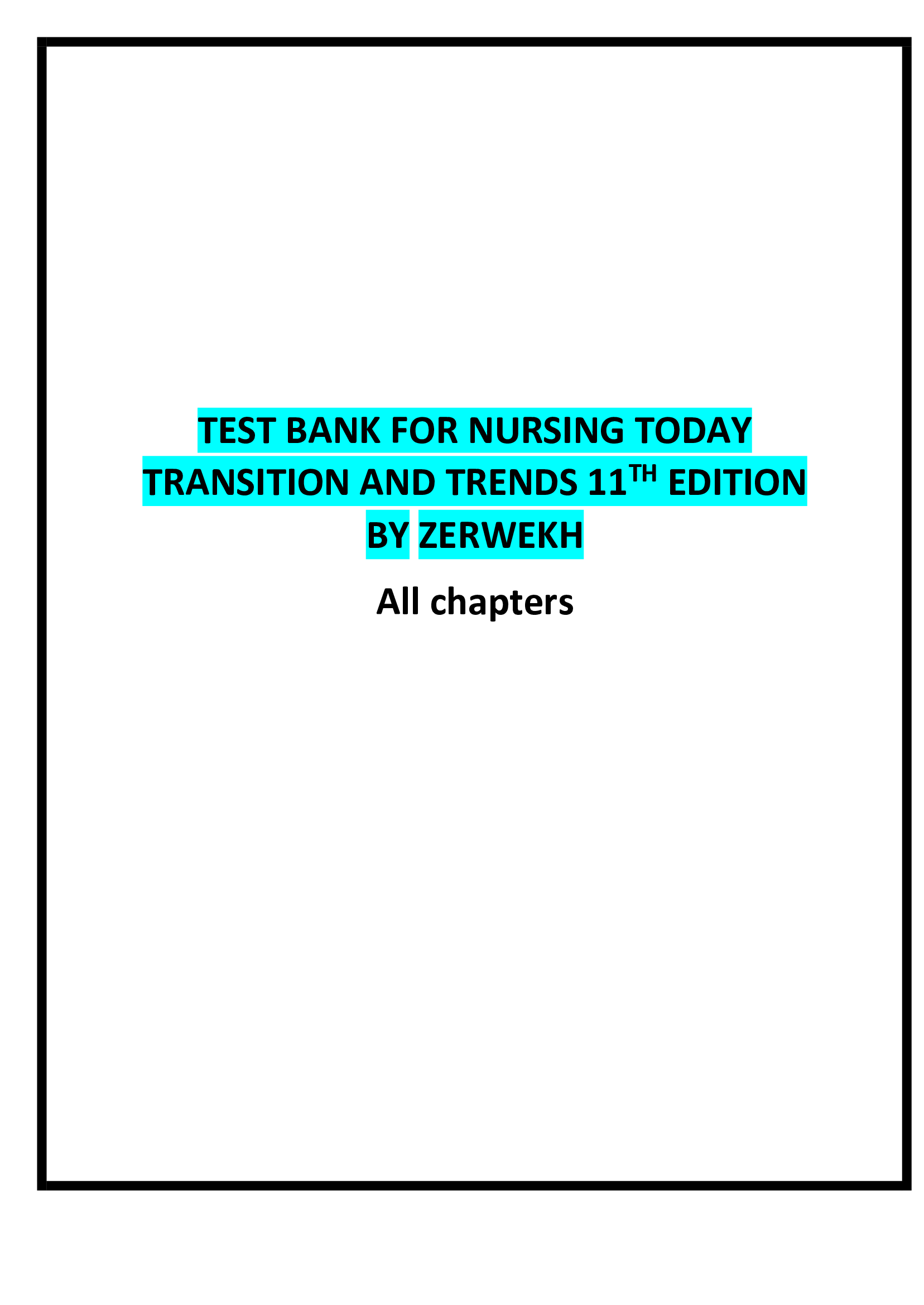
  • TEST BANK FOR NURSING TODAY TRANSITION AND TRENDS 11TH EDITION BY ZERWEKH

TEST BANK FOR NURSING TODAY TRANSITION AND TRENDS 11TH EDITION BY ZERWEKH

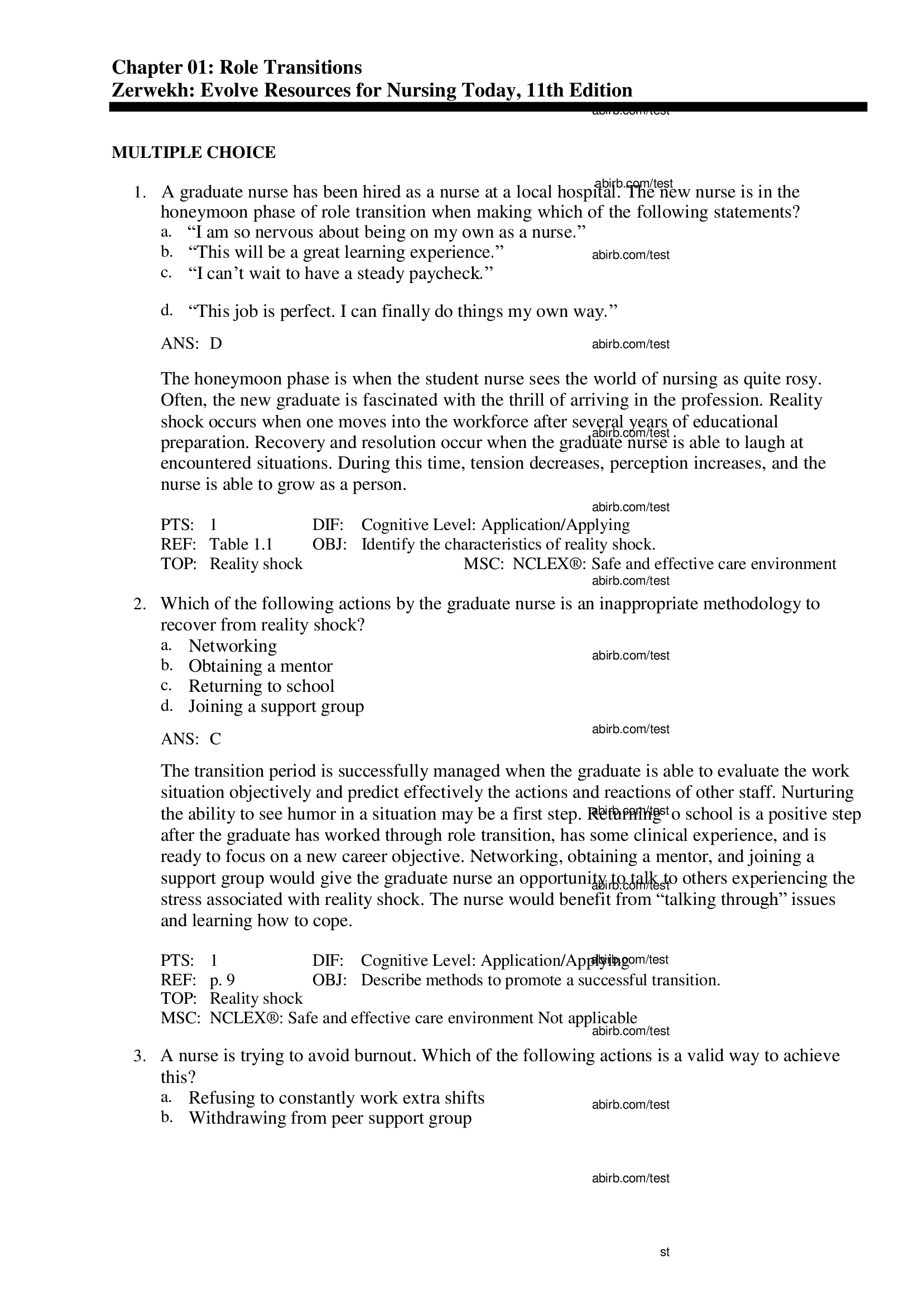
Preview page 1 Preview page 2 Preview page 3
Add To Favorites

Share this item Share this item

  • Item Details
  • Comments (0)
  • Reviews (0)
  • Contact Seller

TEST BANK FOR NURSING TODAY TRANSITION AND TRENDS 11TH EDITION BY ZERWEKH 

d.

Cross out goals as they are met.


ANS: A

In planning goal-related activities, making a master list of goals and prioritizing the list are

helpful strategies for completing activities and accomplishing goals. It is also helpful to cross

off each goal as it is completed. Doing so provides a sense of accomplishment and immediate

gratification for completing a goal. It is important to continually review the list of goals

established to determine if activities or tasks need to be moved based on how quickly they

need to be attended to. Reviewing a list of goals yearly would not be sufficient in helping the

student plan for completing his/her educational goals.


PTS: 1 DIF: Cognitive Level: Application/Applying

REF: p. 35

OBJ: Identify your individual time style and personal time-management strategies.

TOP: Managing your goals  MSC: NCLEX®: Not applicable


 20.

Which of the following actions by the nurse helps prevent burnout?

a.

Picking up extra shifts each week

b.

Staying late to help out at the end of each shift

c.

Scheduling a massage on a day off

d.

Teaching at the local community college one day a week


ANS: C

A fun, relaxing activity that is not work-related can help prevent burnout, such as scheduling a

massage on a day off. Picking up extra shifts, staying late to help out at the end of the shift,

and teaching part-time one day a week may lead to burnout if the nurse is not careful.


PTS: 1 DIF: Cognitive Level: Knowledge/Remembering

REF: p. 36 OBJ: Identify strategies for self-care. TOP: Self-care strategies

MSC: NCLEX®: Health promotion and maintenance


 21.

Which of the following statements by the nursing student is an affirmation?

a.

“I must maintain As in my school grades.”

b.

“I am human and capable of making mistakes.”

c.

“If I fail at something, the results will be catastrophic.”

d.

“If I am not liked by everyone, I am a failure.”


ANS: B

Stating, “I am human and capable of making mistakes” is an affirmation or a positive

statement concerning the ways we would like to think, feel, or behave. The other statements

are self-defeating thoughts.


PTS: 1 DIF: Cognitive Level: Knowledge/Remembering

REF: Box 2.9 OBJ: Identify strategies for self-care. TOP: Self-care activities

MSC: NCLEX®: Not applicable


MULTIPLE RESPONSE


 1.

When taking an online or web-enhanced course, what are effective time-management

strategies? (Select all that apply.)

a.

Enroll in an online or web-enhanced course that has fewer than 15 students to

reduce the amount of time it takes to respond to everyone in the class.

b.

Print your syllabus and create a calendar with assignment due dates and discussion

posting requirements.

c.

Create a directory on your computer to place assignments and resources specific

for the course.

d.

Determine what the best time is for logging into the course website and create a

schedule for weekly log-in times.

e.

Develop an online group of colleagues that meet in the chat room or participate in


instant messaging.

ANS: B, C, D, E

Online or web-enhanced courses can take as much, if not more, time as traditional face-to-face

classes. The following are helpful strategies to improve time management involving the

course:

•

Print the syllabus and place deadlines on your calendar before the first

course meeting.

•

Identify how to contact your instructor, and schedule online office hours

in your calendar.

•

Schedule weekly times for logging into the class website.

•

Schedule a time for class work, and select a specific site.

•

Develop collegial support groups.

•

Be active in the course by participating appropriately in discussion

groups.

•

Establish an evidence-based file to download important articles (.pdf

format).

•

Bookmark websites (but before bookmarking these, review the

information; do not assume all sites are up-to-date and evidence based).


PTS: 1 DIF: Cognitive Level: Knowledge/Remembering

REF: pp. 31-32

OBJ: Identify your individual time style and personal time-management strategies.

TOP: Time management  MSC: NCLEX®: Not applicable


 2.

To achieve success in the workplace, which actions by the nurse would focus on improving

skills? (Select all that apply.)

a.

Taking a course on communication

b.

Thinking of a way to improve time management

c.

Understanding the layout of the hospital

d.

Spending some time working on organizational skills

e.

Knowing where supplies are on the unit


ANS: B, D

Employers of new graduates identify lack of organizational and time-management skills as

areas where new nurses need improvement and assistance. Focusing on improving these skills

before employment will help the new nurse succeed. A communication course is not related to

skills. Understanding the layout of the hospital also is not focused on improving skills.

Knowing where supplies are may help with time management but will not improve skills.


PTS: 1 DIF: Cognitive Level: Comprehension/Understanding

REF: p. 24 


OBJ: Identify your individual time style and personal time-management strategies.

TOP: Managing your time  MSC: NCLEX®: Not applicable


 3.

What actions by the student would manage the physical environment? (Select all that apply.)

a.

Set up an area that is specific to school work.

b.

Choose a work area that has soft, dim lighting.

c.

Choose a work area that is free from distractions.

d.

Gather appropriate tools before each study session begins.

e.

Study for 30 minutes at a time and take a 5-minute break in between.


ANS: A, C, D

To have success when studying, students should first set up an area that is specific to school

work. Students should choose a work area that is free from distractions and gather appropriate

tools needed for studying. Students should choose an area with adequate lighting and study in

50-minute sessions, taking a 10-minute break in between.


PTS: 1 DIF: Cognitive Level: Application/Applying

REF: pp. 26-27

OBJ: Identify your individual time style and personal time-management strategies.

TOP: Managing your time  MSC: NCLEX®: Not applicable


 4.

What actions can the nurse take to manage a habit of procrastinating? (Select all that apply.)

a.

Consider the consequences of not completing each activity.

b.

Start on time and plan for the project to end on time.

c.

Break projects into small, manageable pieces.

d.

Set up a reward system for project completion.

e.

Be realistic about what can be accomplished.


ANS: A, C, D, E

To avoid procrastination, the nurse should consider the consequences of not completing each

activity. The nurse should break down projects into small, manageable pieces; set up a reward

system; and be realistic about what can be accomplished. Projects should be started ahead of

time and be planned to take more time than anticipated.


PTS: 1 DIF: Cognitive Level: Application/Applying

REF: pp. 30-31

OBJ: Discuss strategies that increase organizational skills and personal priority setting.

TOP: Managing tasks  MSC: NCLEX®: Not applicable


 5.

The nurse understands stress-related illness when stating which of the following? (Select all

that apply.)

a.

“Stress can cause insomnia.”

b.

“Stress is known to cause muscle and joint pain.”

c.

“Stress can cause headaches.”

d.

“Stress is not known to cause any health problems.”

e.

“Stress can cause gastrointestinal disturbances.”


ANS: A, B, C, E

Stress is known to cause a variety of physical and psychological ailments, including insomnia,

muscle and joint pain, headaches, and gastrointestinal disturbances.


PTS: 1 DIF: Cognitive Level: Knowledge/Remembering 


REF: p. 36 OBJ: Describe how compassion fatigue and burnout affect nurses.

TOP: Self-care strategies  MSC: NCLEX®: Health promotion and maintenance


Chapter 03: Mentorship, Preceptorship, and Nurse Residency Programs

Zerwekh: Evolve Resources for Nursing Today, 9th Edition


MULTIPLE CHOICE


 1.

The nurse manager is presenting at a conference and shows an adequate understanding of a

mentoring relationship when giving the following as an example:

a.

A coach and a player

b.

A teacher and a learner

c.

An intern and a resident

d.

An advisor and a partner


ANS: D

In nursing, mentor is synonymous with trusted advisor, and mentoring is a partnership

between two people. Coaches help individuals find new ways to solve problems, reach goals,

and design plans of action to motivate people to perform at the “top of their game.” The

teacher and learner relationship involves an evaluation component (receiving a grade in a

course). The intern reports to the resident, so there is more of a precepting relationship

because the resident is the clinical expert, and there may also be an evaluation component in

this relationship.


PTS: 1 DIF: Cognitive Level: Application/Applying

REF: p. 53 OBJ: Describe the difference between mentoring, coaching, and precepting.

TOP: Mentoring relationship MSC: NCLEX®: Not applicable


 2.

The nurse professor is lecturing to students in their final semester of nursing school. Which

statement by the nurse professor about mentoring is accurate?

a.

“Mentoring involves solving an individual’s problems.”

b.

“Mentoring focuses on the needs of someone else.”

c.

“Mentoring means helping someone reach his or her long-term goals.”

d.

“Mentoring requires pairing an experienced person with a novice.”


ANS: B

Mentoring requires a primary focus on the needs of the mentee and an effort to fulfill the most

critical of these needs. Meeting these needs first makes achievement of goals more realistic.

Mentoring does not involve solving an individual’s problems, helping someone reach

long-term goals, or pairing an experienced person with a novice.


PTS: 1 DIF: Cognitive Level: Comprehension/Understanding

REF: p. 53 OBJ: Identify characteristics of effective mentors, mentees, and preceptors.

TOP: Description of mentoring MSC: NCLEX®: Not applicable


 3.

While discussing a mentoring program with the nursing director, the nurse manager correctly

states that mentoring is a

a.

partnership.

b.

one-way street.

c.

static relationship.

d.

method of gaining more experience.


ANS: A


Mentoring is a partnership and a two-way street, with both parties freely contributing to the

relationship as equals working together and based on mutual respect. Mentoring is not used as

a method to gain more experience. Mentoring is a dynamic, not a static, relationship. Gaining

experience is often associated with precepting.


PTS: 1 DIF: Cognitive Level: Comprehension/Understanding

REF: p. 54 OBJ: Identify characteristics of effective mentors, mentees, and preceptors.

TOP: Description of mentoring MSC: NCLEX®: Not applicable


 4.

You are a graduate nurse in search of a mentor. To find a good “match,” what should you look

for?

a.

Choose an experienced nurse who is successful.

b.

Look for things you and the potential mentor have in common.

c.

Be very specific with the questions you ask of the possible mentor.

d.

Be careful not to disclose too much personal information.


ANS: B

When considering establishing a mentoring relationship, look for commonalities in nursing

education, areas of expertise or practice, or interests. Feeling comfortable and building trust

are crucial for a successful mentoring relationship. Broad, open-ended questions stimulate

discussion and offer an opportunity to assess and establish the mentor relationship. It is

important to discuss yourself and be open in a light and friendly manner when talking with a

potential mentor. Being an experienced nurse would be an important criterion for a preceptor.


PTS: 1 DIF: Cognitive Level: Application/Applying

REF: p. 55 OBJ: Identify characteristics of effective mentors, mentees, and preceptors.

TOP: Effective mentoring relationship MSC: NCLEX®: Not applicable


 5.

A group of nursing students is discussing mentors. One of the students correctly states a

characteristic of a successful mentor when stating which of the following?

a.

“They ensure that their mentees do not fail.”

b.

“They push the mentees to a higher level.”

c.

“They always ask a lot of questions of their mentees.”

d.

“They encourage mentees to question their skills so they can improve.”


ANS: B

Mentors need to communicate high expectations to mentees and push them to meet or exceed

these expectations. Mentors should not ensure that mentees do not fail because this is often a

great learning experience for mentees. Frequently questioning mentees or encouraging

mentees to question their skills is not indicative of a successful mentor. Mentors are good

listeners, offer empathy and encouragement, and are generous with their time and knowledge.


PTS: 1 DIF: Cognitive Level: Comprehension/Understanding

REF: p. 56 OBJ: Identify characteristics of effective mentors, mentees, and preceptors.

TOP: Successful mentorship MSC: NCLEX®: Not applicable


 6.

The role of the mentee needs to be understood early in the mentoring relationship. What is a

characteristic or example of the mentee’s role?

a.

Not interrupting the mentor

b.

Absorbing what the mentor explains in detail

c.

Establishing personal short- and long-term goals


d.

Finding out what the mentor has to offer in terms of experience


ANS: C

Establishing your goals early will help you get exactly what you need from the mentoring

relationship. The mentee should ask questions when clarification is needed because

communication is very important. The mentor’s nursing experience is not considered part of

the mentee’s role. Absorbing information may relate more to a preceptor providing

information on content or skills. Finding out the experience is probably more applicable to the

preceptor relationship.


PTS: 1 DIF: Cognitive Level: Application/Applying

REF: p. 55 OBJ: Identify characteristics of effective mentors, mentees, and preceptors.

TOP: Role of mentee 

MSC: NCLEX®: Safe and effective care environment—management of care


 7.

Which statement indicates the student nurse’s understanding of a situational relationship?

a.

“A situational relationship occurs only one time.”

b.

“A situation relationship is established by the organization.”

c.

“In a situational relationship, both mentee and mentor mutually accept it.”

d.

“A situational relationship is structured to ensure situational success.”


ANS: A

Characteristically, a situational mentoring relationship is a one-time event. Organizations

usually establish formal relationships. Acceptance by the mentee and mentor is characteristic

of an informal relationship. A structured relationship is formal.


PTS: 1 DIF: Cognitive Level: Comprehension/Understanding

REF: Table 3.2 OBJ: Discuss the types of mentoring relationships.

TOP: Situational mentoring relationship MSC: NCLEX®: Not applicable


 8.

The “honeymoon” is a specific phase of reality shock. What should the mentor do during this

phase?

a.

Share personal transition experiences with the mentee.

b.

Reinforce the need for the mentee to problem solve.

c.

Encourage the mentee to try new things.

d.

Act as the intermediary for the mentee with staff members.


ANS: D

During the “honeymoon” phase, the mentor should be supportive (by listening and

understanding), act as an intermediary with other staff members, and be a role model. Sharing

feelings and experiences and the mentor’s own transition experience are appropriate in the

shock and rejection phase. Trying new things and stepping outside the mentee’s comfort zone

would be appropriate for the mentor to encourage during the recovery phase of reality shock.


PTS: 1 DIF: Cognitive Level: Application/Applying

REF: p. 59 OBJ: Discuss the types of mentoring relationships.

TOP: Mentoring during reality shock phase 

MSC: NCLEX®: Safe and effective care environment—management of care


 9.

A new graduate is looking for a mentor. Which staff nurse would be the best choice?

a.

A skilled clinician who appears hurried, curt, and occasionally sarcastic

b.

A new graduate who worked 2 years as an LPN and seems confident

c.

A nurse who has 3 years of experience, good skills, and a sense of humor

d.

A seasoned nurse who is highly intellectual but is aloof and self-centered


ANS: C

The mentor not only serves as a role model or counselor for the new graduate but also actively

advises, guides, and promotes the graduate’s career. It is important to select someone who will

work with you and has nursing experience. Frequently, nurses with 3 to 5 years of experience

remember their own role transition and can relate to what the new graduate is experiencing.

The clinician is curt and sarcastic, which would not be supportive behavior for a mentor. The

new graduate would not be the best choice. The seasoned nurse is aloof and self-centered and

would not be a good candidate for a mentor because mentors are willingly and personally

invested in their mentee.


PTS: 1 DIF: Cognitive Level: Analysis/Analyzing

REF: Box 3.2 OBJ: Describe characteristics of effective mentors, mentees, and preceptors.

TOP: Selecting a mentor  MSC: NCLEX®: Not applicable


 10.

Which of the following statements by the nurse indicates an understanding of mentors?

a.

“Mentors focus on fostering the mentee’s individual growth and development over

an extended period of time.”

b.

“Mentors develop nurturing relationships during work time.”

c.

“Mentoring is the approach of assisting an individual’s growth through

partnership.”

d.

“The strength of mentoring lies in the facilitation and development of personal


qualities.”

ANS: A

Mentoring involves focus on fostering the mentee’s individual growth and development over

an extended period of time. Mentors develop nurturing relationships during personal time.

Coaching is the approach of assisting an individual’s growth through partnership. The strength

of mentoring lies in the mentor’s specific knowledge and wisdom.


PTS: 1 DIF: Cognitive Level: Comprehension/Understanding

REF: p. 54 OBJ: Describe the difference between mentoring, coaching, and precepting.

TOP: What mentoring is and is not MSC: NCLEX®: Not applicable


 11.

A nursing student is in the mentoring process. Which action would occur if the student nurse

were in the “follow” phase?

a.

The nursing student observes as the mentor places a urinary catheter.

b.

The nursing student places a urinary catheter while the mentor stands nearby for

guidance.

c.

The nursing student reads the hospital policy regarding urinary catheter placement.

d.

The nursing student places the urinary catheter without guidance from the mentor.


ANS: B


In the “follow” phase, the student nurse and the mentor walk side by side down the same path,

and the mentor assumes a more passive role. Therefore, the student would place the urinary

catheter, with the mentor nearby for guidance. In the “lead” phase, the student would observe

the mentor; in the “get out of the way” phase, the student nurse would place the urinary

catheter without guidance. Reading the hospital policy on urinary catheterization does not

indicate a phase of the mentoring process.


PTS: 1 DIF: Cognitive Level: Knowledge/Remembering

REF: p. 54 OBJ: Identify characteristics of effective mentors, mentees, and preceptors.

TOP: What is a nurse residency program?   MSC: NCLEX®: Not applicable


 12.

A nursing student is in the mentoring process. Which action would occur if the nursing

student were in the “Get out of the way phase”?

a.

The nursing student would assess chest tubes with the mentor nearby for guidance.

b.

The nursing student would assess chest tubes independently.

c.

The nursing student would observe the mentor assessing chest tubes.

d.

The nursing student would read the hospital policy on chest tubes.


ANS: B

In the “get out of the way” phase, the nursing student would assess chest tubes independently.

In the “follow” phase, the nursing student would observe the mentor assessing chest tubes. In

the “lead” phase, the nursing student would assess chest tubes with the mentor nearby for

guidance. Reading hospital policy on chest tubes does not indicate a phase in the mentoring

process.


PTS: 1 DIF: Cognitive Level: Knowledge/Remembering

REF: p. 54 OBJ: Identify characteristics of effective mentors, mentees, and preceptors.

TOP: What is a nurse residency program?   MSC: NCLEX®: Not applicable


 13.

A nursing student is meeting with a possible mentor for the last semester of nursing school.

Which of the following questions would be most appropriate for the student to ask?

a.

“Do you like working on this unit?”

b.

“Do you like your coworkers?”

c.

“How are things going today?”

d.

“What kinds of problems are you having?”


ANS: C

The nursing student should ask open-ended questions such as, “How are things going today?”

The questions “Do you like working on this unit?,” “Do you like your coworkers?,” and

“What kinds of problems are you having?” are direct questions. Open-ended questions

stimulate discussion and are less likely to make the other person feel vulnerable.


PTS: 1 DIF: Cognitive Level: Knowledge/Remembering

REF: p. 55 OBJ: Implement strategies for finding a mentor. 

TOP: How to find a mentor  MSC: NCLEX®: Not applicable


 14.

Which statement by the nursing student best describes the characteristics of a mentee?

a.

“The mentee should be passive and observe only.”

b.

“The mentee should challenge constructive feedback.”

c.

“The mentee should communicate clearly.”

d.

“The mentee should let learning opportunities come to him or/her.”


ANS: C

The mentee should always strive to communicate clearly with the mentor. Being passive,

challenging constructive feedback, and not seeking out learning opportunities are not

characteristics of a mentee.


PTS: 1 DIF: Cognitive Level: Comprehension/Understanding


REF: Table 3.1 OBJ: Identify characteristics of effective mentors, mentees, and preceptors.

TOP: What are the characteristics of a mentee?  MSC: NCLEX®: Not applicable


 15.

Which action by the mentor can help reduce the impact of reality shock on the mentee during

the honeymoon phase?

a.

Listen as the mentee discusses the excitement of starting a new position as a nurse.

b.

Avoid discussions about the excitement of the mentee’s new position as a nurse.

c.

Ask the mentee not to discuss the new position during work hours.

d.

Tell the mentee that the excitement will not last long.


ANS: A

To help reduce the impact of reality shock, the mentor can listen as the mentee discusses the

excitement of starting a new position as a nurse. Avoiding discussions about the new position

or telling the mentee that the excitement will not last long are not ways to help reduce the

impact of reality shock.


PTS: 1 DIF: Cognitive Level: Application/Applying

REF: p. 59 OBJ: Discuss the types of mentoring relationships.

TOP: Mentoring through reality shock MSC: NCLEX®: Not applicable


 16.

What action can the mentor take to help reduce the impact of reality shock on the mentee

during the shock or rejection phase?

a.

Withhold personal transition stories.

b.

Encourage the mentee to discuss his/her feelings.

c.

Encourage mentees to keep their feelings to themselves during work hours.

d.

Ignore the feelings caused by reality shock.


ANS: B

During the shock or rejection phase, the mentor can encourage the mentee to discuss his/her

feelings to decrease the impact of reality shock. Withholding their own personal transition

stories, encouraging mentees to keep their feelings to themselves, or ignoring these feelings

are not ways that the mentor can help the mentee through this time of transition.


PTS: 1 DIF: Cognitive Level: Application/Applying

REF: p. 59 OBJ: Discuss the types of mentoring relationships.

TOP: Mentoring through reality shock MSC: NCLEX®: Not applicable


 17.

Which action by the mentor can help reduce the impact of reality shock on the mentee during

the recovery phase?

a.

Encourage the mentee to perform skills that he or she is comfortable with.

b.

Maintain a semi-open line of communication.

c.

Encourage the mentee to try new skills.

d.

Allow the mentee to work independently.


ANS: C

During the recovery phase, the mentor should encourage the mentee to step outside of his/her

comfort zone. This can be best achieved by encouraging the mentee to try new skills. The

mentee should maintain an open line of communication while working with the mentee.


PTS: 1 DIF: Cognitive Level: Application/Applying 

REF: p. 59 OBJ: Discuss the types of mentoring relationships.

TOP: Mentoring through reality shock MSC: NCLEX®: Not applicable


 18.

Which action by the mentor can help reduce the impact of reality shock on the mentee during

the resolution phase?

a.

Expect the mentee to problem solve clinical issues independently.

b.

Continue to practicing skills that he or she is comfortable with.

c.

Reinforce positive qualities that the mentee possesses.

d.

Point out negative qualities for the mentee to change.


ANS: C

The role of the mentor during the resolution phase is to remain supportive to the mentee.

Pointing out positive qualities that the mentee possesses is one way to achieve this. Expecting

the mentee to problem solve independently and pointing out negative characteristics will not

assist in the resolution of reality shock.


PTS: 1 DIF: Cognitive Level: Application/Applying

REF: p. 60 OBJ: Discuss the types of mentoring relationships.

TOP: Mentoring through reality shock MSC: NCLEX®: Not applicable


MULTIPLE RESPONSE


 1.

Review the following characteristics. Which best describe the role of the mentor? (Select all

that apply.)

a.

Requires a primary focus on the needs of the new nurse

b.

Assists the new nurse with difficult nursing procedures

c.

Serves as a primary resource on the nursing unit for the new nurse

d.

Is assigned to the new nurse for the orientation period

e.

Is interested in the new nurse’s personal growth and nursing goals

f.

Is available to the new nurse after hours to discuss problems and needs


ANS: A, E, F

A mentor is more interested in a nurturing role, focusing on the needs of the new nurse and

frequently sharing personal time. The preceptor acts in a formal role and functions during a

defined period of time. The primary focus of the preceptor is to serve as a role model during

the specified period. The other options (assists the new nurse with difficult nursing

procedures, serves as a primary resource on the nursing unit, and is assigned to the new nurse

for the orientation period) are characteristic of a preceptor.


PTS: 1 DIF: Cognitive Level: Knowledge/Remembering

REF: pp. 48-49 OBJ: Describe the difference between mentoring, coaching, and precepting.

TOP: Characteristics of a mentor MSC: NCLEX®: Not applicable


 2.

A nurse manager and a nurse director are discussing e-mentoring. Which statements by the

nurse director indicate an understanding of the components of e-mentoring? (Select all that

apply.)

a.

“E-mentoring involves distance mentoring.”

b.

“E-mentoring is done through instant messaging.”

c.

“E-mentoring involves contact between mentee and mentor via electronic mail.”

d.

“E-mentoring is a mentoring program for first-year nursing students.”

e.

“E-mentoring uses a videoconferencing system such as Skype to meet virtually.”

f.

“E-mentoring involves planning a meeting at a coffee shop to discuss the progress

of the preceptorship.”

Contact the Seller

Please Sign In to contact this seller.


  • 👎  Report Copyright Violation

Frequently Asked Questions

What Do I Get When I Buy This Study Material?

+

When you buy a study material on Passing Grades, an instant download link will be sent directly to your email, giving you access to the file anytime after payment is completed.

Is Passing Grades a Trusted Platform?

+

Yes, Passing Grades is a reputable students’ marketplace with a secure payment system and reliable customer support. You can trust us to ensure a safe and seamless transaction experience.

Will I Be Stuck with a Subscription?

+

No, all purchases on Passing Grades are one-time transactions. You only pay for the notes you choose to buy, with no subscriptions or hidden fees attached.

Who Am I Buying These Study Materials From?

+

Passing Grades is a marketplace, which means you are purchasing the document from an individual vendor, not directly from us. We facilitate the payment and delivery process between you and the vendor.

Does Passing Grades Offer Free Study Materials?

+

Yes, sellers on Passing Grades have uploaded numerous free test banks, exams, practice questions, and class notes that can be downloaded at no cost.

Pasinggrades - Quality Study Materials

USD 16

    • Quality checked by Pasing Grades
    • 100% satisfaction guarantee
    • Seller: mentor2000
Buy PDF $16

Seller Information

mentor2000

Member since April 2021

  • icon
  • icon
View Profile
  • total sales

    0
  • Favourites

    0
  • Comments

    0
    ( 0 Ratings )

Item Information

  • Uploaded

    21 August 2023

  • Updated

    20 May 2025

  • Category

    Nursing

  • Item Type

    test bank

  • Tags

    TEST BANK FOR NURSING TODAY TRANSITION AND TRENDS 11TH EDITION BY ZERWEKH

Related Exam Prep Guides by mentor2000

Test Bank for Essentials for Nursing Practice 8th Edition by Potter | All Chapters
View Document

Test Bank for Essent...

  • mentor2000

    mentor2000

  • test bank

Master nursing concepts with this study material; Test Bank for Essentials for Nursing Practice, 8th...

16 USD

0

0

A &P 1 MA278 BSC2 Final Module II Questions & Answers 2026 Update
View Document

A &P 1 MA278 BSC2 Fi...

  • mentor2000

    mentor2000

  • test bank

Prepare for success with A&P 1 MA278 BSC2 Final Module II 2024 Q&A. Boost your grades with this comp...

16 USD

0

0

ATI Comprehensive Predictor Exam 2026
View Document

ATI Comprehensive Pr...

  • mentor2000

    mentor2000

  • test bank

Prepare for success with the ATI Comprehensive Predictor Exam 2026. Access key practice questions to...

16 USD

0

0

Purchase

Download link will be sent to this email immediately after purchase.

IMPORTANT LINKS

  • How To Upload Class Notes
  • Selling Tips
  • Passing Grades's Study Materials
  • Scholarships for International Students 2025

POPULAR CATEGORIES

  • Law
  • Accounting
  • English
  • Psychology
  • Business
  • Nursing
  • Computer Science
  • General

View Document

  • Blog
  • Contact
  • Delivery Policy
  • Latest Scholarships Around the World
  • How to Pass Bar Exams: Passing Grades’ Strategies
  • How to Study and Pass the CPA Exam
  • All Test Banks
  • Faq
  • Copyright Claims
  • Privacy Policy
  • Terms of Use

KNOWLEDGE BASE

  • How to Write A+ Grade Good Research Paper
  • How to Manage Stress During Exam Period
  • Best Time to Study
  • How to Pass NCLEX-RN Exam
  • How To Effectively Utilize Test Banks
  • Popular Shadow Health Exam Assessments
  • Popular HESI Case Studies
  • How to Prepare for a Nursing Career
  • The Importance Of Summaries in Exam Revisvion

© 2026 Pasing Grades. All rights reserved.