Pasing Grades
  • Start Selling
  • Blog
  • Contact
  • 0

    Your cart is empty!

English

  • English
  • Spanish
  • Arabic
Create Account Sign In
  • Library
    • New Prep Guides
    • Featured Prep Guides
    • Free Exam Prep Guides
    • Best sellers
  • General
  • Nursing
    • Research Paper
    • Case Study
    • Discussion Post
    • Assignment
    • Exam
    • Practice Questions and Answers
    • Test Bank
    • solutions manual
  • Accounting
    • Case Study
    • Thesis
    • Study Guide
    • Summary
    • Research Paper
    • test bank
  • English
    • Creative Writing
    • Research Paper
    • Summary
    • Rhetorics
    • Literature
    • Journal
    • Exam
    • Grammar
    • Discussion Post
    • Essay
  • Psychology
    • Hesi
    • Presentation
    • Essay
    • Summary
    • Study Guide
    • Essay
    • Solution Manual
    • Final Exam Review
    • Class Notes
    • test bank
  • Business
    • Lecture Notes
    • Solution Manual
    • Presentation
    • Business Plan
    • Class Notes
    • Experiment
    • Summary
    • Practice Questions
    • Study Guide
    • Case Study
    • test bank
    • Exam
  • More
    • Computer Science
    • Economics
    • Statistics
    • Engineering
    • Biology
    • Religious Studies
    • Physics
    • Chemistry
    • Mathematics
    • History
    • Sociology
    • Science
    • Philosophy
    • Law
  • Pages
    • About Us
    • Selling Tips
    • Delivery Policy
    • Faq
    • Privacy Policy
  • Flash Sale
  • Home
  • TEST BANK FOR NESTER’S MICROBIOLOGY A HUMAN PERSPECTIVE 9TH EDITION BY ANDERSON

TEST BANK FOR NESTER’S MICROBIOLOGY A HUMAN PERSPECTIVE 9TH EDITION BY ANDERSON

Preview page 1 Preview page 2 Preview page 3
Add To Favorites

Share this item Share this item

  • Item Details
  • Comments (0)
  • Reviews (0)
  • Contact Seller

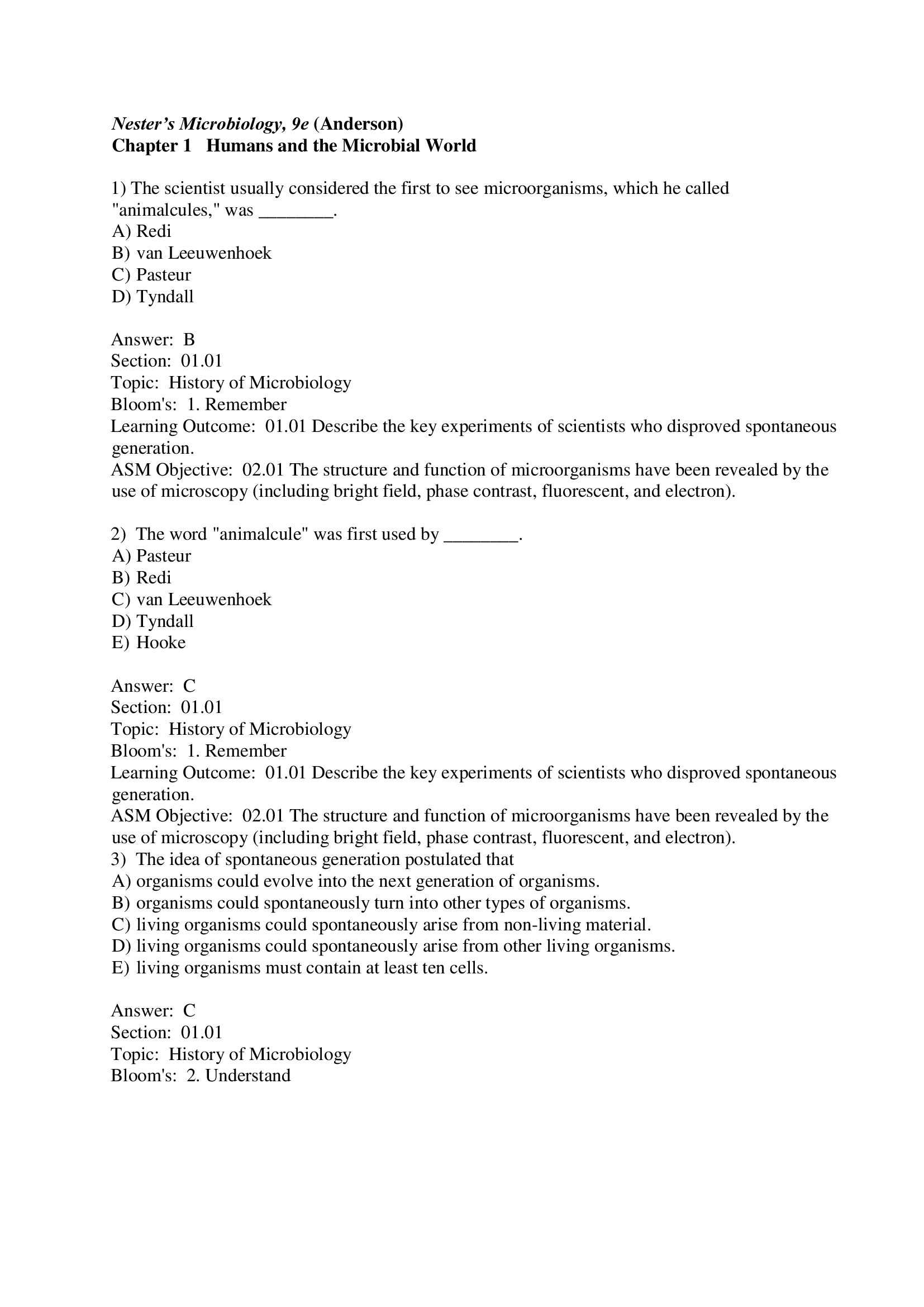
Nester’s Microbiology, 9e (Anderson)

Chapter 1 Humans and the Microbial World

1) The scientist usually considered the first to see microorganisms, which he called

"animalcules," was ________.

A) Redi

B) van Leeuwenhoek

C) Pasteur

D) Tyndall

Answer: B

Section: 01.01

Topic: History of Microbiology

Bloom's: 1. Remember

Learning Outcome: 01.01 Describe the key experiments of scientists who disproved spontaneous

generation.

ASM Objective: 02.01 The structure and function of microorganisms have been revealed by the

use of microscopy (including bright field, phase contrast, fluorescent, and electron).

2) The word "animalcule" was first used by ________.

A) Pasteur

B) Redi

C) van Leeuwenhoek

D) Tyndall

E) Hooke

Answer: C

Section: 01.01

Topic: History of Microbiology

Bloom's: 1. Remember

Learning Outcome: 01.01 Describe the key experiments of scientists who disproved spontaneous

generation.

ASM Objective: 02.01 The structure and function of microorganisms have been revealed by the

use of microscopy (including bright field, phase contrast, fluorescent, and electron).

3) The idea of spontaneous generation postulated that

A) organisms could evolve into the next generation of organisms.

B) organisms could spontaneously turn into other types of organisms.

C) living organisms could spontaneously arise from non-living material.

D) living organisms could spontaneously arise from other living organisms.

E) living organisms must contain at least ten cells.

Answer: C

Section: 01.01

Topic: History of Microbiology

Bloom's: 2. Understand

Learning Outcome: 01.01 Describe the key experiments of scientists who disproved spontaneous

generation.

ASM Objective: 02.01 The structure and function of microorganisms have been revealed by the

use of microscopy (including bright field, phase contrast, fluorescent, and electron).

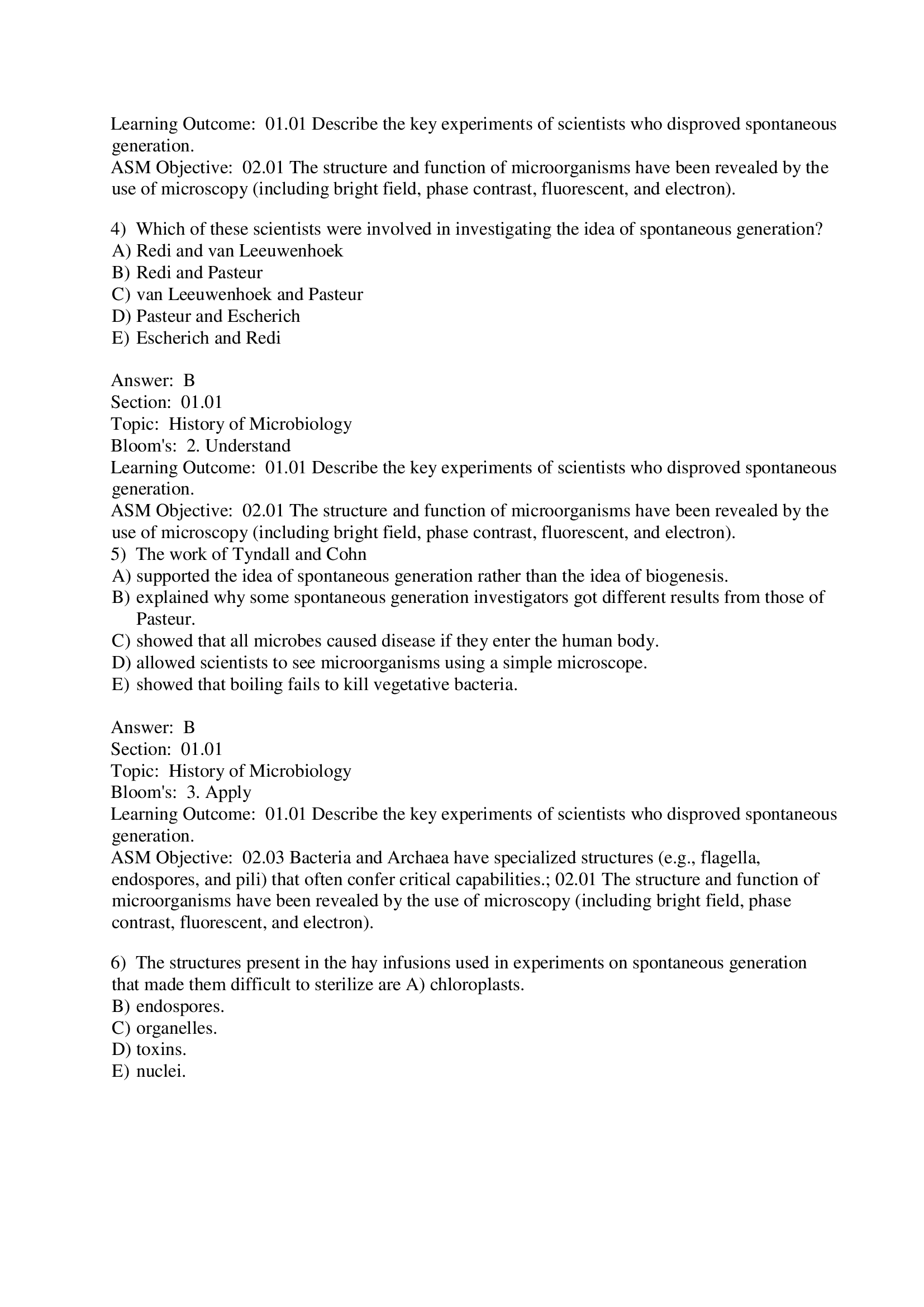
4) Which of these scientists were involved in investigating the idea of spontaneous generation?

A) Redi and van Leeuwenhoek

B) Redi and Pasteur

C) van Leeuwenhoek and Pasteur

D) Pasteur and Escherich

E) Escherich and Redi

Answer: B

Section: 01.01

Topic: History of Microbiology

Bloom's: 2. Understand

Learning Outcome: 01.01 Describe the key experiments of scientists who disproved spontaneous

generation.

ASM Objective: 02.01 The structure and function of microorganisms have been revealed by the

use of microscopy (including bright field, phase contrast, fluorescent, and electron).

5) The work of Tyndall and Cohn

A) supported the idea of spontaneous generation rather than the idea of biogenesis.

B) explained why some spontaneous generation investigators got different results from those of

Pasteur.

C) showed that all microbes caused disease if they enter the human body.

D) allowed scientists to see microorganisms using a simple microscope.

E) showed that boiling fails to kill vegetative bacteria.

Answer: B

Section: 01.01

Topic: History of Microbiology

Bloom's: 3. Apply

Learning Outcome: 01.01 Describe the key experiments of scientists who disproved spontaneous

generation.

ASM Objective: 02.03 Bacteria and Archaea have specialized structures (e.g., flagella,

endospores, and pili) that often confer critical capabilities.; 02.01 The structure and function of

microorganisms have been revealed by the use of microscopy (including bright field, phase

contrast, fluorescent, and electron).

6) The structures present in the hay infusions used in experiments on spontaneous generation

that made them difficult to sterilize are A) chloroplasts.

B) endospores.

C) organelles.

D) toxins.

E) nuclei.

Answer: B

Section: 01.01

Topic: History of Microbiology

Bloom's: 1. Remember

Learning Outcome: 01.01 Describe the key experiments of scientists who disproved spontaneous

generation.

ASM Objective: 02.03 Bacteria and Archaea have specialized structures (e.g., flagella,

endospores, and pili) that often confer critical capabilities.; 02.01 The structure and function of

microorganisms have been revealed by the use of microscopy (including bright field, phase

contrast, fluorescent, and electron).

7) The contradictory results obtained by different scientists apparently doing the same

experiments in investigating spontaneous generation

A) show that experiments should only be done once.

B) show the importance of exactly duplicating experimental conditions.

C) led to further experiments that ultimately proved spontaneous generation.

D) could not be explained by anyone involved in the work.

E) led to the development of swan-necked flasks.

Answer: B

Section: 01.01

Topic: History of Microbiology

Bloom's: 3. Apply

Learning Outcome: 01.01 Describe the key experiments of scientists who disproved spontaneous

generation.; 01.03 Describe the scientific method, using Pasteur's swan-necked flask experiment

as an example.

ASM Objective: 02.03 Bacteria and Archaea have specialized structures (e.g., flagella,

endospores, and pili) that often confer critical capabilities.; 02.01 The structure and function of

microorganisms have been revealed by the use of microscopy (including bright field, phase

contrast, fluorescent, and electron).

8) If Pasteur had done his experiments investigating spontaneous generation in a horse stable,

A) the results would probably have supported the idea of spontaneous generation.

B) the results would probably not have supported the idea of spontaneous generation.

C) the results would probably been the same as those obtained in a laboratory.

D) the results would probably have supported the idea of spontaneous biogenesis.

E) it would probably have taken several years to obtain any results.

Answer: A

Section: 01.01

Topic: History of Microbiology; Prokaryotes

Bloom's: 3. Apply

Learning Outcome: 01.01 Describe the key experiments of scientists who disproved spontaneous

generation.; 01.03 Describe the scientific method, using Pasteur's swan-necked flask experiment

as an example.

ASM Objective: 02.03 Bacteria and Archaea have specialized structures (e.g., flagella,

endospores, and pili) that often confer critical capabilities.; 02.01 The structure and function of 

microorganisms have been revealed by the use of microscopy (including bright field, phase

contrast, fluorescent, and electron).

9) Cellulose is a major component of plants and is only directly digested by

A) carnivores.

B) termites.

C) herbivores.

D) microorganisms.

E) birds.

Answer: D

Section: 01.02

Topic: Environmental Microbiology; Prokaryotes

Bloom's: 2. Understand

Learning Outcome: 01.02 Explain how the successful challenge to the idea of spontaneous

generation led to the Golden Age of Microbiology.

ASM Objective: 02.01 The structure and function of microorganisms have been revealed by the

use of microscopy (including bright field, phase contrast, fluorescent, and electron).; 03.03 The

survival and growth of any microorganism in a given environment depends on its metabolic

characteristics.; 05.04 Microorganisms, cellular and viral, can interact with both human and

nonhuman hosts in beneficial, neutral or detrimental ways.; 06.01 Microbes are essential for life

as we know it and the processes that support life (e.g., in biogeochemical cycles and plant and/or

animal microflora).

10) Plants are dependent on microorganisms for

A) providing oxygen in a usable form.

B) providing water.

C) changing atmospheric nitrogen to a usable form.

D) providing simple carbohydrates.

E) providing complex proteins.

Answer: C

Section: 01.02

Topic: Environmental Microbiology; Prokaryotes

Bloom's: 3. Apply

Learning Outcome: 01.04 Explain the importance of microorganisms in the health of humans

and the surrounding environment.

ASM Objective: 03.01 Bacteria and Archaea exhibit extensive, and often unique, metabolic

diversity (e.g., nitrogen fixation, methane production, anoxygenic photosynthesis).; 05.03

Microorganisms and their environment interact with and modify each other.; 05.04

Microorganisms, cellular and viral, can interact with both human and nonhuman hosts in

beneficial, neutral or detrimental ways.

11) Microorganisms are involved in

A) causing disease.

B) curing/treating disease.

C) preparing food.

D) cleaning up pollutants.

E) All of the answer choices are correct.

Answer: E

Section: 01.02

Topic: Applied and Industrial Microbiology

Bloom's: 2. Understand

Learning Outcome: 01.04 Explain the importance of microorganisms in the health of humans

and the surrounding environment.; 01.05 List three commercial benefits of microorganisms.

ASM Objective: 03.03 The survival and growth of any microorganism in a given environment

depends on its metabolic characteristics.; 05.03 Microorganisms and their environment interact

with and modify each other.; 05.04 Microorganisms, cellular and viral, can interact with both

human and nonhuman hosts in beneficial, neutral or detrimental ways.; 06.03 Humans utilize and

harness microorganisms and their products.

12) Bacteria have been used to help produce or modify all of the following food products

EXCEPT

A) cheeses.

B) beer and wine.

C) pickled products.

D) bread.

E) peanuts.

Answer: E

Section: 01.02

Topic: Applied and Industrial Microbiology

Bloom's: 1. Remember

Learning Outcome: 01.05 List three commercial benefits of microorganisms.

ASM Objective: 05.04 Microorganisms, cellular and viral, can interact with both human and

nonhuman hosts in beneficial, neutral or detrimental ways.; 06.03 Humans utilize and harness

microorganisms and their products.

13) Microorganisms are involved in all of the following EXCEPT

A) production of medicinal products.

B) converting oxygen to a form useful to plants.

C) food production.

D) pollution cleanup.

E) converting nitrogen to a form useful to plants.

Answer: B

Section: 01.02

Topic: Applied and Industrial Microbiology

Bloom's: 3. Apply

Learning Outcome: 01.04 Explain the importance of microorganisms in the health of humans

and the surrounding environment.; 01.05 List three commercial benefits of microorganisms.

ASM Objective: 06.01 Microbes are essential for life as we know it and the processes that

support life (e.g., in biogeochemical cycles and plant and/or animal microflora).; 06.03 Humans

utilize and harness microorganisms and their products.

14) Bioremediation refers to

A) rehabilitating wayward bacteria.

B) using bacteria to clean up pollutants.

C) development of new vaccines.

D) monitoring newly discovered disease organisms.

E) destroying organisms causing emerging infectious diseases.

Answer: B

Section: 01.02

Topic: Applied and Industrial Microbiology

Bloom's: 2. Understand

Learning Outcome: 01.04 Explain the importance of microorganisms in the health of humans

and the surrounding environment.; 01.05 List three commercial benefits of microorganisms.

ASM Objective: 05.01 Microorganisms are ubiquitous and live in diverse and dynamic

ecosystems.; 05.04 Microorganisms, cellular and viral, can interact with both human and

nonhuman hosts in beneficial, neutral or detrimental ways.; 06.03 Humans utilize and harness

microorganisms and their products.

15) Which of the following about the Golden Age of Medical Microbiology is FALSE?

A) It started with the development of the first microscopes.

B) It occurred during the late 1800s to the early 1900s.

C) It is a time when the knowledge of bacteria and work with them expanded.

D) It was during this time that people realized that diseases could be caused by invisible agents.

E) It was a time when several major advances were made in microbiology.

Answer: A

Section: 01.02

Topic: History of Microbiology

Bloom's: 3. Apply

Learning Outcome: 01.02 Explain how the successful challenge to the idea of spontaneous

generation led to the Golden Age of Microbiology.; 01.04 Explain the importance of

microorganisms in the health of humans and the surrounding environment.

ASM Objective: 05.04 Microorganisms, cellular and viral, can interact with both human and

nonhuman hosts in beneficial, neutral or detrimental ways.; 06.03 Humans utilize and harness

microorganisms and their products.

16) Which of the following statements about newly emerging or reemerging diseases is FALSE?

A) They may be caused by changing lifestyles.

B) Examples include Lyme disease and toxic shock syndrome.

C) They may result from a breakdown in sanitation and social order.

D) They are all caused by drug-resistant pathogens.

E) They may result when microbes evolve and develop new characteristics.

Answer: D

Section: 01.02

Topic: Infection and Disease

Bloom's: 2. Understand

Contact the Seller

Please Sign In to contact this seller.


  • 👎  Report Copyright Violation

Frequently Asked Questions

What Do I Get When I Buy This Study Material?

+

When you buy a study material on Passing Grades, an instant download link will be sent directly to your email, giving you access to the file anytime after payment is completed.

Is Passing Grades a Trusted Platform?

+

Yes, Passing Grades is a reputable students’ marketplace with a secure payment system and reliable customer support. You can trust us to ensure a safe and seamless transaction experience.

Will I Be Stuck with a Subscription?

+

No, all purchases on Passing Grades are one-time transactions. You only pay for the notes you choose to buy, with no subscriptions or hidden fees attached.

Who Am I Buying These Study Materials From?

+

Passing Grades is a marketplace, which means you are purchasing the document from an individual vendor, not directly from us. We facilitate the payment and delivery process between you and the vendor.

Does Passing Grades Offer Free Study Materials?

+

Yes, sellers on Passing Grades have uploaded numerous free test banks, exams, practice questions, and class notes that can be downloaded at no cost.

Pasinggrades - Quality Study Materials

USD 15

    • Quality checked by Pasing Grades
    • 100% satisfaction guarantee
    • Seller: mentor2000
Buy PDF $15

Seller Information

mentor2000

Member since April 2021

  • icon
  • icon
View Profile
  • total sales

    0
  • Favourites

    0
  • Comments

    0
    ( 0 Ratings )

Item Information

  • Uploaded

    22 May 2022

  • Updated

    05 May 2025

  • Category

    Nursing

  • Item Type

    test bank

  • Tags

    TEST BANK FOR NESTER’S MICROBIOLOGY A HUMAN PERSPECTIVE 9TH EDITION BY ANDERSON

Related Exam Prep Guides by mentor2000

Test Bank for Essentials for Nursing Practice 8th Edition by Potter | All Chapters
View Document

Test Bank for Essent...

  • mentor2000

    mentor2000

  • test bank

Master nursing concepts with this study material; Test Bank for Essentials for Nursing Practice, 8th...

15 USD

0

0

A &P 1 MA278 BSC2 Final Module II Questions & Answers 2026 Update
View Document

A &P 1 MA278 BSC2 Fi...

  • mentor2000

    mentor2000

  • test bank

Prepare for success with A&P 1 MA278 BSC2 Final Module II 2024 Q&A. Boost your grades with this comp...

15 USD

0

0

ATI Comprehensive Predictor Exam 2026
View Document

ATI Comprehensive Pr...

  • mentor2000

    mentor2000

  • test bank

Prepare for success with the ATI Comprehensive Predictor Exam 2026. Access key practice questions to...

15 USD

0

0

Purchase

Download link will be sent to this email immediately after purchase.

IMPORTANT LINKS

  • How To Upload Class Notes
  • Selling Tips
  • Passing Grades's Study Materials
  • Scholarships for International Students 2025

POPULAR CATEGORIES

  • Law
  • Accounting
  • English
  • Psychology
  • Business
  • Nursing
  • Computer Science
  • General

View Document

  • Blog
  • Contact
  • Delivery Policy
  • Latest Scholarships Around the World
  • How to Pass Bar Exams: Passing Grades’ Strategies
  • How to Study and Pass the CPA Exam
  • All Test Banks
  • Faq
  • Copyright Claims
  • Privacy Policy
  • Terms of Use

KNOWLEDGE BASE

  • How to Write A+ Grade Good Research Paper
  • How to Manage Stress During Exam Period
  • Best Time to Study
  • How to Pass NCLEX-RN Exam
  • How To Effectively Utilize Test Banks
  • Popular Shadow Health Exam Assessments
  • Popular HESI Case Studies
  • How to Prepare for a Nursing Career
  • The Importance Of Summaries in Exam Revisvion

© 2026 Pasing Grades. All rights reserved.