Pasing Grades
  • Start Selling
  • Blog
  • Contact
  • 0

    Your cart is empty!

English

  • English
  • Spanish
  • Arabic
Create Account Sign In
  • Library
    • New Prep Guides
    • Featured Prep Guides
    • Free Exam Prep Guides
    • Best sellers
  • General
  • Nursing
    • Research Paper
    • Case Study
    • Discussion Post
    • Assignment
    • Exam
    • Practice Questions and Answers
    • Test Bank
    • solutions manual
  • Accounting
    • Case Study
    • Thesis
    • Study Guide
    • Summary
    • Research Paper
    • test bank
  • English
    • Creative Writing
    • Research Paper
    • Summary
    • Rhetorics
    • Literature
    • Journal
    • Exam
    • Grammar
    • Discussion Post
    • Essay
  • Psychology
    • Hesi
    • Presentation
    • Essay
    • Summary
    • Study Guide
    • Essay
    • Solution Manual
    • Final Exam Review
    • Class Notes
    • test bank
  • Business
    • Lecture Notes
    • Solution Manual
    • Presentation
    • Business Plan
    • Class Notes
    • Experiment
    • Summary
    • Practice Questions
    • Study Guide
    • Case Study
    • test bank
    • Exam
  • More
    • Computer Science
    • Economics
    • Statistics
    • Engineering
    • Biology
    • Religious Studies
    • Physics
    • Chemistry
    • Mathematics
    • History
    • Sociology
    • Science
    • Philosophy
    • Law
  • Pages
    • About Us
    • Selling Tips
    • Delivery Policy
    • Faq
    • Privacy Policy
  • Flash Sale
  • Home
  • Test Bank for Medical Terminology for Healthcare Professionals 10th Edition by Rice

Test Bank for Medical Terminology for Healthcare Professionals 10th Edition by Rice

Preview page 1 Preview page 2 Preview page 3
Add To Favorites

Share this item Share this item

  • Item Details
  • Comments (0)
  • Reviews (0)
  • Contact Seller

Test Bank for Medical Terminology for Healthcare Professionals 10th Edition by Rice

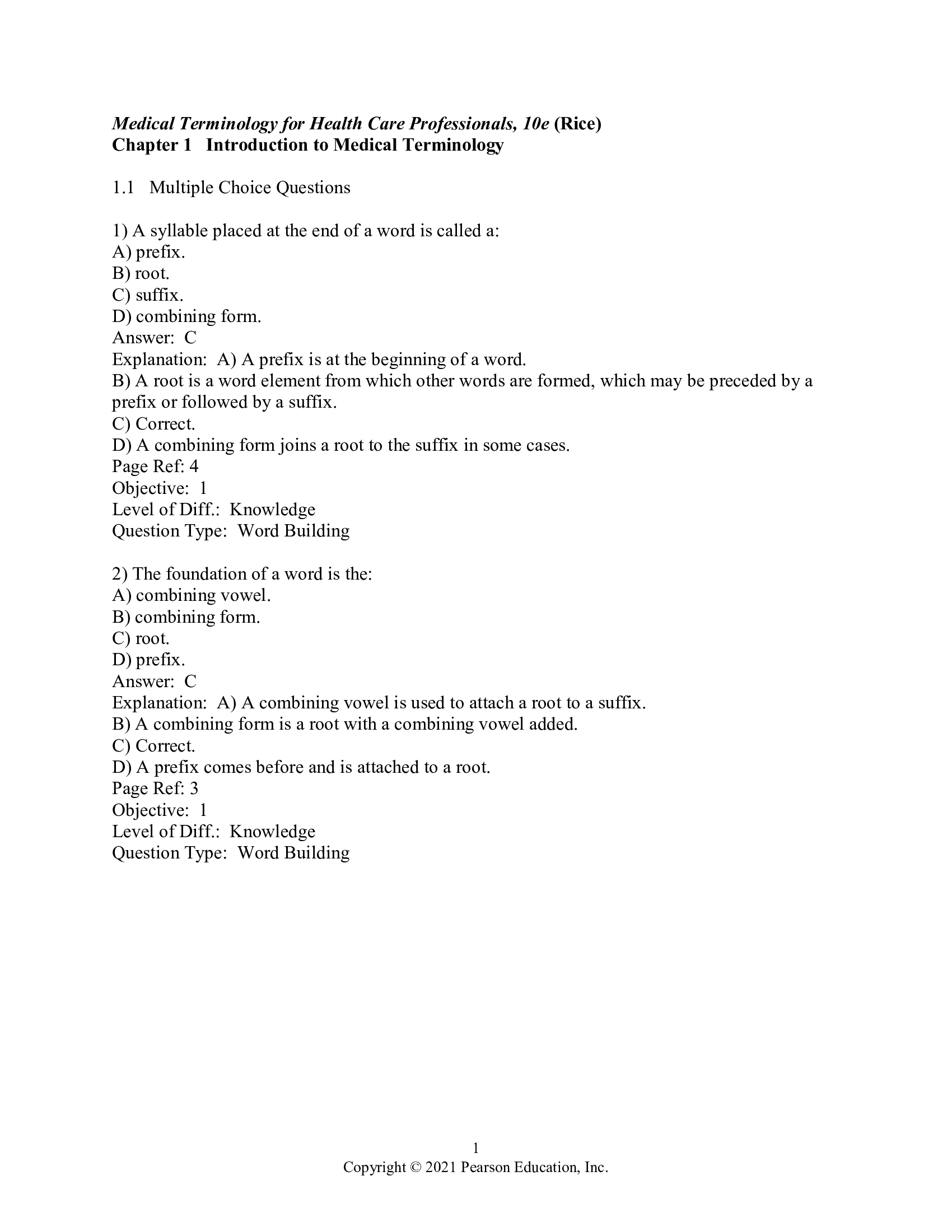
Medical Terminology for Health Care Professionals, 10e (Rice) Chapter 1   Introduction to Medical Terminology


1.1   Multiple Choice Questions


1) A syllable placed at the end of a word is called a: A) prefix.

B)   root.

C)   suffix.

D)  combining form.

Answer:  C

Explanation:  A) A prefix is at the beginning of a word.

B) A root is a word element from which other words are formed, which may be preceded by a prefix or followed by a suffix. C) Correct.

D) A combining form joins a root to the suffix in some cases.

Page Ref: 4

Objective:  1

Level of Diff.:  Knowledge

Question Type:  Word Building


2) The foundation of a word is the: A) combining vowel.

B)   combining form.

C)   root.

D)  prefix.

Answer:  C

Explanation:  A) A combining vowel is used to attach a root to a suffix. B) A combining form is a root with a combining vowel added.

C)   Correct.

D)  A prefix comes before and is attached to a root.

Page Ref: 3

Objective:  1

Level of Diff.:  Knowledge

Question Type:  Word Building


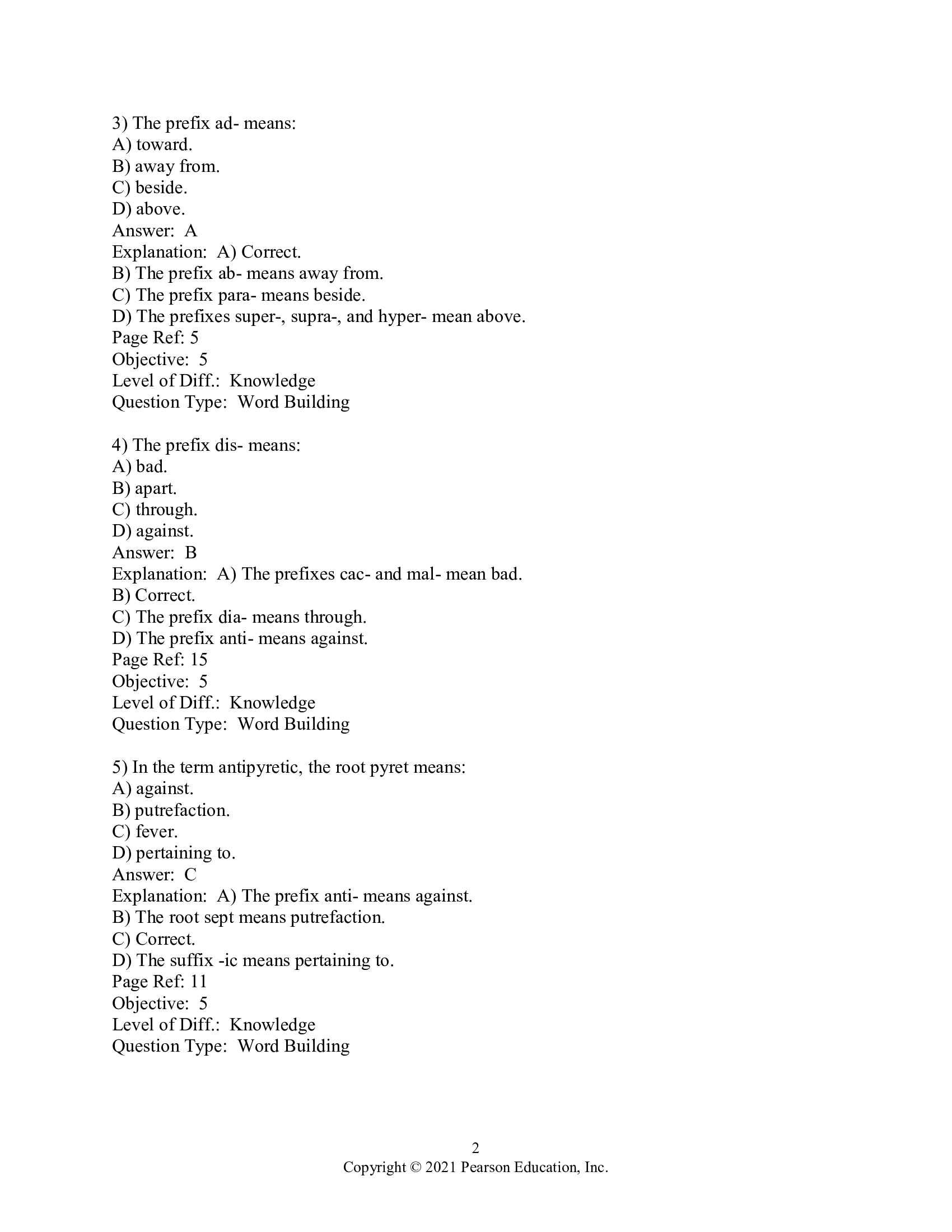
3) The prefix ad- means: A) toward.

B)   away from.

C)   beside.

D)  above.

Answer:  A

Explanation:  A) Correct.

B)   The prefix ab- means away from.

C)   The prefix para- means beside.

D)  The prefixes super-, supra-, and hyper- mean above.

Page Ref: 5

Objective:  5

Level of Diff.:  Knowledge

Question Type:  Word Building


4) The prefix dis- means: A) bad.

B)   apart.

C)   through.

D)  against.

Answer:  B

Explanation:  A) The prefixes cac- and mal- mean bad. B) Correct.

C)   The prefix dia- means through.

D)  The prefix anti- means against.

Page Ref: 15

Objective:  5

Level of Diff.:  Knowledge

Question Type:  Word Building


5) In the term antipyretic, the root pyret means: A) against.

B)   putrefaction.

C)   fever.

D)  pertaining to.

Answer:  C

Explanation:  A) The prefix anti- means against. B) The root sept means putrefaction.

C)   Correct.

D)  The suffix -ic means pertaining to.

Page Ref: 11

Objective:  5

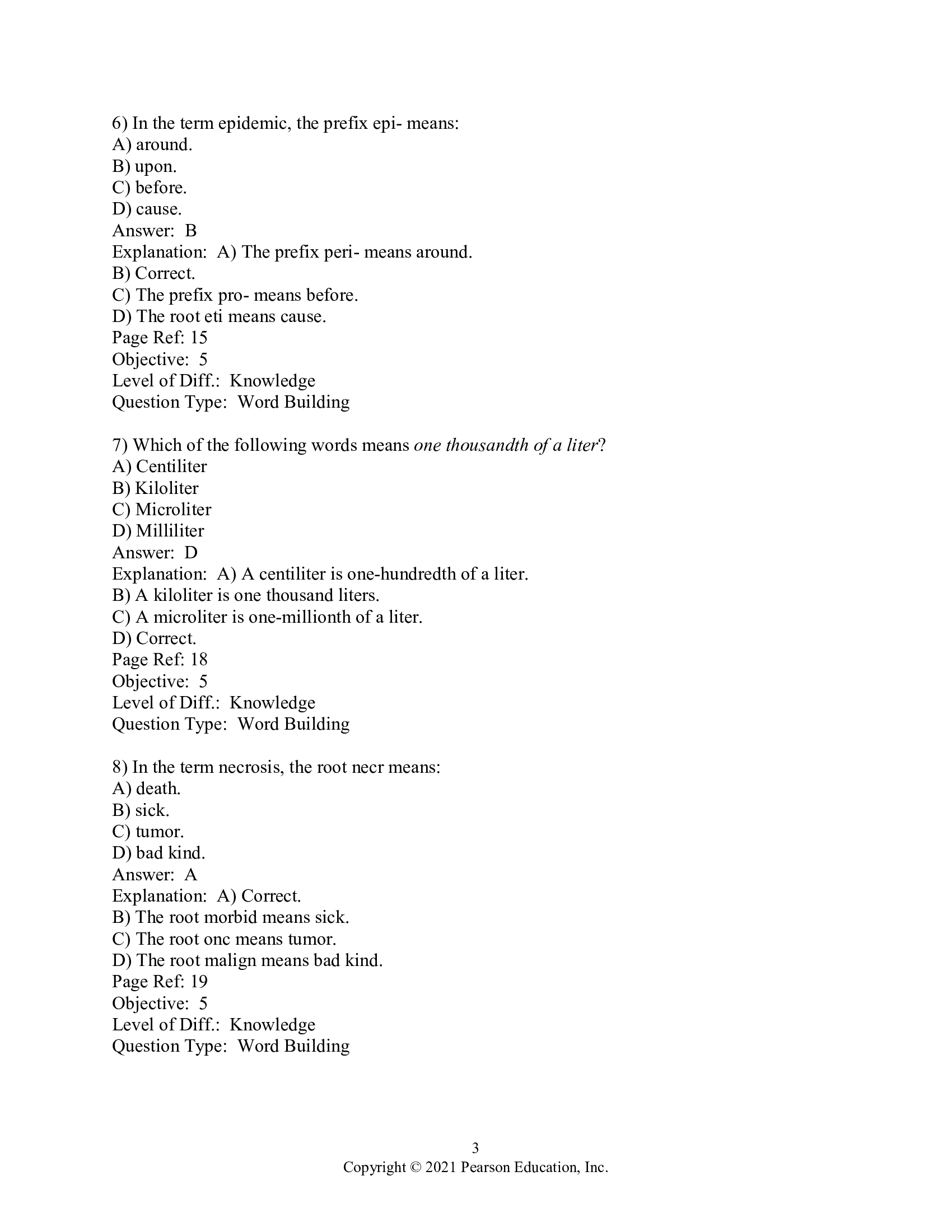
6) In the term epidemic, the prefix epi- means: A) around.

B)   upon.

C)   before.

D)  cause.

Answer:  B

Explanation:  A) The prefix peri- means around. B) Correct.

C)   The prefix pro- means before.

D)  The root eti means cause.

Page Ref: 15

Objective:  5

Level of Diff.:  Knowledge

Question Type:  Word Building


7) Which of the following words means one thousandth of a liter?

A)  Centiliter

B)   Kiloliter

C)   Microliter

D)  Milliliter

Answer:  D

Explanation:  A) A centiliter is one-hundredth of a liter. B) A kiloliter is one thousand liters.

C)   A microliter is one-millionth of a liter.

D)  Correct.

Page Ref: 18

Objective:  5

Level of Diff.:  Knowledge

Question Type:  Word Building


8) In the term necrosis, the root necr means: A) death.

B)   sick.

C)   tumor.

D)  bad kind.

Answer:  A

Explanation:  A) Correct.

B)   The root morbid means sick.

C)   The root onc means tumor.

D)  The root malign means bad kind.

Page Ref: 19

Objective:  5

9) In the word microscope, the suffix -scope means:

A)  shape

B)   glass lens

C)   instrument for examining

D)  view

Answer:  C

Explanation:  A) The suffix -form means shape. B) There is no suffix meaning glass lens.

C)   Correct.

D)  The suffix -opsy means to view.

Page Ref: 5

Objective:  5

Level of Diff.:  Knowledge

Question Type:  Word Building


10) The process of being stuck together is: A) excision.

B)   incision.

C)   abhesion.

D)  adhesion.

Answer:  D

Explanation:  A) Excision is the process of cutting out. B) Incision is the process of cutting into.

C)   This is not a real word. The prefix ab- means away from.

D)  Correct.

Page Ref: 12

Objective:  5

Level of Diff.:  Comprehension

Question Type:  Word Building


11) The combining form eti/o means: A) cause.

B)   before.

C)   between.

D)  within.

Answer:  A

Explanation:  A) Correct.

B)   The prefix pro- means before.

C)   The prefix inter- means between.

D)  The prefix intra- means within.

Page Ref: 11

Objective:  5


12) In the term radiology, the suffix -logy means: A) knowledge.

B)   study of.

C)   condition.

D)  pertaining to.

Answer:  B

Explanation:  A) The suffix -gnosis means knowledge. B) Correct.

C)   The suffix -osis means condition.

D)  There are many suffixes that mean pertaining to, such as -al, -ar, and -ic.

Page Ref: 19

Objective:  5

Level of Diff.:  Knowledge

Question Type:  Word Building


13) In the term malignant, the suffix -ant means: A) forming.

B)   pertaining to.

C)   condition.

D)  produce.

Answer:  A

Explanation:  A) Correct.

B)   There are many suffixes that means pertaining to, such as -al, -ar, and -ic.

C)   The suffix -osis means condition.

D)  The suffix -genic means produce.

Page Ref: 17

Objective:  5

Level of Diff.:  Knowledge

Question Type:  Word Building


14) The correct spelling for the suffix that means knowledge is: A) -gosis.

B)  -gnosis.

C)  -gnosos. D) -gnoses.

Answer:  B

Explanation:  A) -gosis is not a suffix. B) Correct.

C) -gnosos is not a suffix. D) -gnoses is not a suffix.

Page Ref: 14

Objective:  5

Level of Diff.:  Knowledge

Question Type:  Spelling

15) The combining form onc/o means: A) chemical.

B)   tumor.

C)   large.

D)  death.

Answer:  B

Explanation:  A) The combining form chem/o means chemical. B) Correct.

C)   The combining form macr/o means large.

D)  The root necr means death.

Page Ref: 11

Objective:  5

Level of Diff.:  Knowledge

Question Type:  Word Building


16) Which of the following is concerned with the use of chemical agents to treat disease?

A)  Chemotherapy

B)   Etiology

C)   Oncology

D)  Triage

Answer:  A

Explanation:  A) Correct.

B)   This is the study of the causes of disease.

C)   This is the study of tumors.

D)  This is a system of classifying patient injuries to determent treatment priority.

Page Ref: 14

Objective:  5

Level of Diff.:  Knowledge

Question Type:  Word Building


17) The suffix -centesis means: A) surgical puncture.

B)   surgical incision.

C)   surgical excision.

D)  surgical repair.

Answer:  A

Explanation:  A) Correct.

B)   The suffix -tomy means a surgical incision.

C)   The suffix -ectomy means a surgical excision.

D)  The suffix -rrhaphy means a surgical repair or suture.

Page Ref: 19 Objective:  5

Level of Diff.:  Knowledge

Question Type:  Word Building

18) What does the prefix dis- mean in the word disinfectant?

A)  Through

B)   Upon

C)   Death D) Apart

Answer:  D

Explanation:  A) The prefix dia- means through. B) The prefix epi- means upon.

C)   The root necr means death.

D)  Correct.

Page Ref: 15

Objective:  5

Level of Diff.:  Knowledge

Question Type:  Word Building


19) In the term maximal, the root maxim means: A) large.

B)   greatest.

C)   least.

D)  small.

Answer:  B

Explanation:  A) The root macr means large. B) Correct.

C)   The root minim means least.

D)  The root micr means small.

Page Ref: 17

Objective:  5

Level of Diff.:  Knowledge

Question Type:  Word Building


20) Which of the following combining forms means intestine?

A)  Eti/o

B)   Cardi/o

C)   Gastr/o

D)  Enter/o

Answer:  D

Explanation:  A) This combining form means cause. B) This combining form means heart.

C)   This combining form means stomach.

D)  Correct.

Page Ref: 6

Objective:  5

Level of Diff.:  Analysis

21) A syllable placed at the beginning of a word is called a: A) root.

B)  combining form.

C)  prefix. D) suffix.

Answer:  C

Explanation:  A) The root is the word foundation.

B)   A combining form is a root plus a combining vowel.

C)   Correct.

D)  A suffix is placed at the end of a word.

Page Ref: 3

Objective:  1

Level of Diff.:  Knowledge

Question Type:  Word Building


22) The study of the cause of disease is called: A) diagnosis.

B)   etiology.

C)   prognosis.

D)  oncology.

Answer:  B

Explanation:  A) Diagnosis means a determination of a disease. B) Correct.

C)   A prognosis is a prediction of a course of disease.

D)  This is the study of cancer.

Page Ref: 16

Objective:  5

Level of Diff.:  Knowledge

Question Type:  Word Building


23) A relationship of understanding between two individuals, especially between the patient and the physician, is called: A) empathy.

B)   afferent.

C)   apathy.

D)  rapport.

Answer:  D

Explanation:  A) This is feeling what another feels. B) Afferent means carrying impulses to a center.

C)   Apathy is lack of feeling.

D)  Correct.

Page Ref: 19

Objective:  5

Level of Diff.:  Comprehension

Question Type:  Communication


24) To lead away from the middle is: A) abduct.

B)   efferent.

C)   afferent.

D)  adduct.

Answer:  A

Explanation:  A) Correct.

B)   Efferent means to send impulses away from the center.

C)   Afferent means to send impulses toward the center.

D)  This means to lead toward the middle.

Page Ref: 5

Objective:  5

Level of Diff.:  Knowledge

Question Type:  Word Building


25) The term febrile means: A) pertaining to fever.

B)   forming a disease.

C)   condition of heat.

D)  process of becoming ill.

Answer:  A

Explanation:  A) Correct.

B)   Febrile does not mean forming a disease.

C)   Febrile does not mean condition of heat.

D)  Febrile does not mean process of becoming ill.

Page Ref: 16

Objective:  5

Level of Diff.:  Knowledge

Question Type:  Word Building


26) ________ means sudden, sharp, and severe.

A)  Acute

B)   Triage

C)   Chronic D) Abate

Answer:  A

Explanation:  A) Correct.

B)   Triage is a system of prioritizing the severity of patients' injuries.

C)   Chronic refers to an illness that changes little over time.

D)  Abate means to lessen, decrease, or cease.

Page Ref: 12

Objective:  5

27) A combination of signs and symptoms occurring together that characterizes a specific disease is called a/an: A) prognosis.

B)   etiology.

C)   diagnosis.

D)  syndrome.

Answer:  D

Explanation:  A) Prognosis is a prediction of the course of a disease. B) Etiology is the study of the cause of an illness.

C)   Diagnosis is a determination of the nature and cause of a disease.

D)  Correct.

Page Ref: 20

Objective:  5

Level of Diff.:  Knowledge

Question Type:  Word Building


28) The correct spelling for the medical term for profuse sweating is: A) diphoresis.

B)   dyphoresis.

C)   diaphoresis.

D)  dyaphoresis.

Answer:  C

Explanation:  A) This is not the correct spelling. B) This is not the correct spelling.

C)   Correct.

D)  This is not the correct spelling.

Page Ref: 15

Objective:  5

Level of Diff.:  Knowledge

Question Type:  Spelling


29) The process of cutting out is called: A) incision.

B)   excision.

C)   biopsy.

D)  incise.

Answer:  B

Explanation:  A) Incision means to cut into. B) Correct.

C)   Biopsy means to take a sample of tissue.

D)  Incise means to cut.

Page Ref: 16

Objective:  5

Level of Diff.:  Knowledge

Question Type:  Word Building


30) In the term maximal, the suffix -al means: A) pertaining to.

B)  condition.

C)  process.

D)  forming. Answer:  A

Explanation:  A) Correct.

B)   The suffix -osis, among others, means condition.

C)   The suffix -ion means process.

D)  The suffix -ant means forming.

Page Ref: 17

Objective:  5

Level of Diff.:  Knowledge

Question Type:  Word Building


31) In the term prophylactic, the root prophylact means: A) people.

B)   shaping

C)   guarding.

D)  rule.

Answer:  C

Explanation:  A) The root dem means people. B) The root format means shaping.

C)   Correct.

D)  The root norm means rule.

Page Ref: 19

Objective:  5

Level of Diff.:  Knowledge

Question Type:  Word Building


32) The prefix is ________ of a word.

A)  at the beginning

B)   the root

C)   at the end

D)  the vowel attached to the root

Answer:  A

Explanation:  A) Correct.

B)   The prefix is attached to the root.

C)   A suffix is at the end.

D)  The vowel makes a combining form.

Page Ref: 3

Objective:  1


33) What is the purpose of a prefix?

A)  To combine a root and a suffix 

B)   To be the foundation of the word

C)   To alter the meaning of a root

D)  To shorten a lengthy word or phrase

Answer:  C

Explanation:  A) The vowel added to a root to combine it with a suffix is the combining form. B) The root is the foundation of a word.

C)   Correct.

D)  An abbreviation is a shortened word or phrase.

Page Ref: 3

Objective:  1

Level of Diff.:  Comprehension

Question Type:  Word Building


34) The foundation of the word is the: A) combining form.

B)   root.

C)   suffix.

D)  prefix.

Answer:  B

Explanation:  A) A combining form is a root plus a vowel. B) Correct.

C)   This is a modifier that comes after the root.

D)  This is a modifier that comes before the root.

Page Ref: 3

Objective:  1

Level of Diff.:  Knowledge

Question Type:  Word Building


35) The root format means: A) forming.

B)   examining.

C)   shaping.

D)  processing.

Answer:  C

Explanation:  A) The suffix -ant means forming. B) The root scop means examining.

C)   Correct.

D)  The suffix -ion means process.

Page Ref: 3

Objective:  5

Level of Diff.:  Knowledge

36) In building medical terms, the combining vowel most often used is: A) a.

B)   e.

C)   i.

D)  o.

Answer:  D

Explanation:  A) a is not the most often used combining vowel. B) e is not the most often used combining vowel.

C)   i is occasionally used, but not most often.

D)  Correct.

Page Ref: 3

Objective:  1

Level of Diff.:  Knowledge

Question Type:  Word Building


37) When giving the meaning of the word, you usually begin with the: A) prefix.

B)   root.

C)   suffix.

D)  combining form.

Answer:  C

Explanation:  A) You do not usually begin with the prefix when giving the meaning of a word. B) You do not usually begin with the root when giving the meaning of a word.

C)  Correct.

D)  You do not usually begin with the combining form when giving the meaning of a word. Page Ref: 4

Objective:  1

Level of Diff.:  Knowledge

Question Type:  Word Building


38) The suffix -poiesis means: A) spitting.

B)   prolapse.

C)   before.

D)  formation.

Answer:  D

Explanation:  A) The suffix -ptysis means spitting.

B)   The suffix -ptosis means prolapsed or drooping.

C)   The prefix pre- means before.

D)  Correct.

Page Ref: 6

Objective:  5

39) The abbreviation Bx means: A) before.

B)   blood pressure.

C)   biopsy.

D)  beside.

Answer:  C

Explanation:  A) The prefix pre- means before. B) The abbreviation BP means blood pressure.

C)   Correct.

D)  The prefix para- mean beside.

Page Ref: 14

Objective:  9

Level of Diff.:  Knowledge

Question Type:  Abbreviations


40) The prefix in abnormal means: A) condition.

B)   pertaining to.

C)   destruction.

D)  away from.

Answer:  D

Explanation:  A) The suffix -osis means condition.

B)   Many suffixes mean pertaining to, such as -al or -ic.

C)   The suffix -tripsy means to crush or destroy.

D)  Correct.

Page Ref: 11

Objective:  5

Level of Diff.:  Knowledge

Question Type:  Word Building


41) The medical term antipyretic means an agent that is: A) against cough.

B)   against disease or pregnancy.

C)   against fever.

D)  against sepsis.

Answer:  C

Explanation:  A) An antitussive is against cough.

B)   A prophylactic protects against disease or pregnancy.

C)   Correct.

D)  The term antiseptic means against sepsis or infection.

Page Ref: 12

Objective:  5

Level of Diff.:  Comprehension

42) The term cachexia means: A) pertaining to the armpit.

B)   surgical incision.

C)   condition of ill health.

D)  carried through sweat glands.

Answer:  C

Explanation:  A) Axillary means pertaining to the armpit.

B)   The suffix -tomy means the surgical removal of tissue.

C)   Correct.

D)  Diaphoresis means carried through sweat glands.

Page Ref: 14

Objective:  5

Level of Diff.:  Knowledge

Question Type:  Word Building


43) The suffix -hexia means: A) burst forth.

B)   condition.

C)   knowledge.

D)  treatment.

Answer:  B

Explanation:  A) The suffix -rrhage means to burst forth. B) Correct.

C)   The suffix -gnosis means knowledge.

D)  The suffix -therapy means treatment.

Page Ref: 14

Objective:  5

Level of Diff.:  Knowledge

Question Type:  Word Building


44) The prefix in diagnosis means: A) around.

B)   through.

C)   many.

D)  alongside.

Answer:  B

Explanation:  A) The prefix peri- means around. B) Correct.

C)   The prefixes multi- or poly- mean many.

D)  The prefix para- means alongside.

Page Ref: 14

Objective:  5


45) The prefix in epidemic means: A) above.

B)   through.

C)   around.

D)  upon.

Answer:  D

Explanation:  A) The prefixes hyper- and super- mean above. B) The prefix dia- means through.

C)   The prefix peri- means around.

D)  Correct.

Page Ref: 15

Objective:  5

Level of Diff.:  Knowledge

Question Type:  Word Building


46) The prefix in heterogeneous means: A) different.

B)   formation.

C)   produce.

D)  pertaining to.

Answer:  A

Explanation:  A) Correct.

B)   The root gene means formation.

C)   The root gene also means produce.

D)  Many suffixes mean pertaining to, such as -al or -ar.

Page Ref: 16

Objective:  5

Level of Diff.:  Knowledge

Question Type:  Word Building


47) A kilogram is equal to: A) 10 g.

B)   100 g.

C)   1000 g.

D)  10,000 g.

Answer:  C

Explanation:  A) A kilogram does not equal 10 g. B) A kilogram does not equal 100 g.

C)   Correct.

D)  A kilogram does not equal 10,000 g.

Page Ref: 17

Objective:  5

48) In the terms milligram and milliliter, the prefix milli- means: A) one tenth.

B)   one hundredth.

C)   one thousandth.

D)  one millionth.

Answer:  C

Explanation:  A) One tenth is deci-. B) One hundredth is centi-.

C)   Correct.

D)  One millionth is micro-.

Page Ref: 18

Objective:  5

Level of Diff.:  Knowledge

Question Type:  Word Building


49) The definition of pallor is: A) pertaining to fever.

B)   a lack of color.

C)   palm of the hand.

D)  a diseased state.

Answer:  B


Explanation:  A) Diagnosis combines the prefix dia- with the suffix -gnosis. B) Etiology combines the combining form eti/o with the suffix -logy.

C)   Pyrogenic combines the combining form pyr/o with the suffix -genic.

D)  Correct.

Page Ref: 6

Objective:  2

Level of Diff.:  Knowledge

Question Type:  Word Building


63) The spelling of which of these medical words follows the guideline for adding a suffix that begins with a consonant to a combining form?

A)  Cardiac

B)   Oncology

C)   Prognosis

D)  Prophylactic

Answer:  B

Explanation:  A) Cardiac drops the o from the combining form cardi/o before adding the suffix ac.

B)   Correct.

C)   Prognosis combines the prefix pro- with the suffix -gnosis.

D)  Prophylactic combines the root prophylact with the suffix -ic.

Page Ref: 6

Objective:  2

Level of Diff.:  Knowledge

Question Type:  Word Building


64) The spelling of which of these medical words follows the guideline for adding the combining form to a suffix that begins with a consonant?

A)  Abnormal

B)   Oncology

C)   Antitussive D) Epidemic

Answer:  B

Explanation:  A) Abnormal combines the prefix ab-, the root norm, and the suffix -al. B) Correct.

C)   Antitussive combines the prefix anti-, the root tuss, and the suffix -ive.

D)  Epidemic combines the prefix epi-, the root dem, and the suffix -ic.

Page Ref: 6

Objective:  2

Level of Diff.:  Knowledge

Question Type:  Word Building


65) Why is correct spelling extremely important in medical terminology? A) SOAP notes are considered incomplete if they contain spelling errors.

B)   The ICD-10-CM has very strict guidelines related to the proper spelling of medical words.

C)   The addition or omission of a single letter can change the meaning of a word.

D)  Many electronic health records will not accept records if they contain misspellings.

Answer:  C

Explanation:  A) Spelling errors do not impact the completion of SOAP notes. B) The ICD-10-CM provides diagnosis codes, not spelling guidance.

C)  Correct.

D)  Most electronic health records will accept records even if they contain spelling errors. Page Ref: 5

Objective:  3

Level of Diff.:  Knowledge

Question Type:  Word Building


66) Gwen needs to use a word that means to lead toward the middle. She writes down abduct. Is this the correct spelling of the word Gwen needed? A) No; Gwen should have used adduct.

B)   No; Gwen should have used apduct.

C)   No; Gwen should have used acduct.

D)  Yes, this is the correct word for Gwen to use.

Answer:  A

Explanation:  A) Correct.

B)  Apduct is not the correct spelling; it is not a word.

C)  Acduct is not the correct spelling; it is not a word.

D)  Abduct is not the correct spelling; it means to lead away from the middle. Page Ref: 5

Objective:  3

Level of Diff.:  Knowledge

Question Type:  Word Building


67) Charles needs to use a word to describe inflammation of a joint. He writes down arthritis. Is this the correct spelling of the word Charles needed? A) No; Charles should have used artteritis.

B)  No; Charles should have used arteritis.

C)  No; Charles should have used arhritis.

D)  Yes, this is the correct word for Charles to use. Answer:  D

Explanation:  A) Artteritis is not the correct spelling; it is not a word.

B)   Arteritis is not the correct spelling; it means inflammation of an artery.

C)   Arhritis is not the correct spelling; it is not a word.

D)  Correct.

Page Ref: 5

Objective:  3

Level of Diff.:  Knowledge

Question Type:  Word Building


68) Quinn needs to use a word to describe a bacterial infection of the lungs. She writes down neumonia. What did Quinn leave out of this word?

A)  The silent e at the end of the word

B)   The silent p at the beginning of the word

C)   The double m in the middle of the word

D)  She did not leave anything out

Answer:  B

Explanation:  A) There is no silent e in this word. B) Correct.

C)   There is no double m in this word.

D)  There is a silent p at the beginning of the word.

Page Ref: 5

Objective:  3

Level of Diff.:  Knowledge

Question Type:  Word Building


69) Which of the following words contains a silent letter that often results in misspelling?

A)  Phlegm

B)   Diagnosis

C)   Abduct

D)  Etiology

Answer:  A

Explanation:  A) Correct.

B)   There are no silent letters in diagnosis.

C)   There are no silent letters in abduct.

D)  There are no silent letters in etiology.

Page Ref: 5

Objective:  3

Level of Diff.:  Knowledge

Question Type:  Word Building


70) How does an initialism differ from an acronym?

A)                An initialism is more likely to be misinterpreted than an acronym because it can have more than one meaning.

B)                The individual letters are pronounced in an initialism rather than being read as a word like an acronym.

C)                An initialism includes periods between the letters in the abbreviation while an acronym does not include periods.

D)                Initialisms are frowned upon by the Institute for Safe Medication Practices while acronyms are acceptable to this group.

Answer:  B

Explanation:  A) Any abbreviation with more than one potential meaning can be misinterpreted, regardless of type. B) Correct.

C)                Periods are typically not used in any abbreviation unless that is the accepted norm for that abbreviation.

D)                The Institute for Safe Medication Practices has a list of all types of abbreviations that it recommends organizations avoid; the list is not limited to a specific type of abbreviation. Page Ref: 8

Objective:  4

Level of Diff.:  Knowledge

Question Type:  Word Building


71) Which of the following is an example of an acronym?

A)  Dx

B)   DOB

C)   SOAP

D)  Derm

Answer:  C

Explanation:  A) Dx is the abbreviation for diagnosis and each letter is pronounced. B) DOB is the abbreviation for date of birth and each letter is pronounced.

C)  Correct.

D)  Derm is the abbreviation for the word dermatology and is made by shortening the word. Page Ref: 8

Objective:  4

Level of Diff.:  Knowledge

Question Type:  Word Building


72) Which of the following is an example of an initialism?

A)  HIPAA

B)   TJC

C)   Neuro D) Wt

Answer:  B

Explanation:  A) HIPAA is the acronym for the Health Insurance Portability and Accountability Act and is read like a word. B) Correct.

C)   Neuro is a shortened version of the word neurology.

D)  Wt is a shortened version of the word weight.

Page Ref: 8

Objective:  4

Level of Diff.:  Knowledge

Question Type:  Word Building


73) Which of the following abbreviations has more than one potential meaning?

A)  CDC

B)   GYN

C)   g

D)  PA

Answer:  D

Explanation:  A) CDC stands for Centers for Disease Control and Prevention. B) GYN stands for gynecology.

C)  g stands for gram.

D)  Correct; it can mean physician assistant, posteroanterior, or pernicious anemia. Page Ref: 7

Objective:  4

Level of Diff.:  Knowledge

Question Type:  Word Building


74) What should you do if you believe an abbreviation has the potential to be misinterpreted?

A)  Use the abbreviation and include a footnote in the document indicating the correct meaning.

B)   Use a different abbreviation for the word or phrase in question.

C)   Attach an appendix stating the definition of each abbreviation used in the document.

D)  Spell out the word or phrase and avoid using the abbreviation.

Answer:  D

Explanation:  A) Footnotes are not typically used in this way. B) Many words have only one potential abbreviation.

C)   Appendices are not typically used in this way.

D)  Correct

Page Ref: 7

Objective:  4

Level of Diff.:  Knowledge

Question Type:  Word Building


1.2   Matching Questions


Match the following terms.


A)  a unit of weight

B)   the study of the cause(s) of disease

C)   pertaining to the armpit

D)  profuse sweating

E)   identification of a disease

F)    having 100 steps or degrees

G)  an agent that works against coughing


1)  antitussive

Page Ref: 13

Objective:  5

Level of Diff.:  Knowledge

Question Type:  Word Building


2)  axillary

Page Ref: 13

Objective:  5

Level of Diff.:  Knowledge

Question Type:  Word Building


3)  centigrade

Page Ref: 14

Objective:  5

Level of Diff.:  Knowledge

Question Type:  Word Building


4)  diagnosis

Page Ref: 14

Objective:  5

Level of Diff.:  Knowledge

Question Type:  Word Building


5)  diaphoresis

Page Ref: 15

Objective:  5

Level of Diff.:  Knowledge

Question Type:  Word Building


6)  gram

Page Ref: 16

Objective:  5

Level of Diff.:  Knowledge

Question Type:  Word Building


7)  etiology

Page Ref: 16

Objective:  5

Level of Diff.:  Knowledge

Question Type:  Word Building


Answers: 1) G 2) C 3) F 4) E 5) D 6) A 7) B Match the following terms.


A)  an instrument used to measure degree of heat

B)   a feeling of discomfort or uneasiness

C)   sudden, sharp, severe

D)  abnormal condition of tissue death

E)   a prediction of the course of a disease

F)    something that is harmful or cancerous

G)  the prioritizing and classifying of injuries


8)      necrosis

Page Ref: 19

Objective:  5

Level of Diff.:  Knowledge

Question Type:  Word Building


9)      prognosis

Page Ref: 19

Objective:  5

Level of Diff.:  Knowledge

Question Type:  Word Building


10)  thermometer

Page Ref: 20

Objective:  5

Level of Diff.:  Knowledge

Question Type:  Word Building


11)  triage

Page Ref: 20

Objective:  5

Level of Diff.:  Knowledge

Question Type:  Word Building


12)  acute

Page Ref: 12

Objective:  5

Level of Diff.:  Knowledge

Question Type:  Word Building


13)  malaise

Page Ref: 17

Objective:  5

Level of Diff.:  Knowledge

Question Type:  Word Building


14)  malignant

Page Ref: 17

Objective:  5

Level of Diff.:  Knowledge

Question Type:  Word Building


Answers: 8) D 9) E 10) A 11) G 12) C 13) B 14) F Match the word part with its meaning.


A)  before

B)   without, not

C)   beside

D)  bad

E)   many, much

F)    against

G)  away from

H)  through

I)     small


15)              a- Page Ref: 13

Objective:  5

Level of Diff.:  Knowledge

Question Type:  Word Building


16)              ab- Page Ref: 11

Objective:  5

Level of Diff.:  Knowledge

Question Type:  Word Building


17)              anti- Page Ref: 6

Objective:  5

Level of Diff.:  Knowledge

Question Type:  Word Building


18)              dia- Page Ref: 14

Objective:  5

Level of Diff.:  Knowledge

Question Type:  Word Building


19)              mal- Page Ref: 3

Objective:  5

Level of Diff.:  Knowledge

Question Type:  Word Building


20)              micro- Page Ref: 5

Objective:  5

Level of Diff.:  Knowledge

Question Type:  Word Building


21)              multi- Page Ref: 19

Objective:  5

Level of Diff.:  Knowledge

Question Type:  Word Building


22)              para- Page Ref: 6

Objective:  5

Level of Diff.:  Knowledge

Question Type:  Word Building


23)              pro- Page Ref: 6

Objective:  5

Level of Diff.:  Knowledge

Question Type:  Word Building


Answers: 15) B 16) G 17) F 18) H 19) D 20) I 21) E 22) C 23) A Match the word part with its meaning.


A)  one thousandth

B)   large

C)   chemical

D)  together

E)   armpit

F)    nature of

G)  stuck to

H)  pertaining to

I)     heat, fire

J)     process


24)  syn- Page Ref: 20

Objective:  5

Level of Diff.:  Knowledge

Question Type:  Word Building


25)  adhes

Page Ref: 12

Objective:  5

Level of Diff.:  Knowledge

Question Type:  Word Building


26)  milli- Page Ref: 18

Objective:  5

Level of Diff.:  Knowledge

Question Type:  Word Building


27)  axill

Page Ref: 11

Objective:  5

Level of Diff.:  Knowledge

Question Type:  Word Building


28)  chem/o

Page Ref: 11

Objective:  5

Level of Diff.:  Knowledge

Question Type:  Word Building


29)  macr/o

Page Ref: 11

Objective:  5

Level of Diff.:  Knowledge

Question Type:  Word Building


30)  pyr/o

Page Ref: 11

Objective:  5

Level of Diff.:  Knowledge

Question Type:  Word Building


31)  -al

Page Ref: 11

Objective:  5

Level of Diff.:  Knowledge

Question Type:  Word Building


32)  -ive

Page Ref: 13

Objective:  5

Level of Diff.:  Knowledge

Question Type:  Word Building


33)  -ion

Page Ref: 16

Objective:  5

Level of Diff.:  Knowledge

Question Type:  Word Building


Answers: 24) D 25) G 26) A 27) E 28) C 29) B 30) I 31) H 32) F 33) J


1.3   True/False Questions


1)  A combining form is a word root to which a vowel has been added.

Answer:  TRUE

Explanation:  The combining form is used when it is followed by another root or combining form or suffix that begins with a consonant.

Page Ref: 3

Objective:  1

Level of Diff.:  Knowledge

Question Type:  Word Building


2)  French is the origin for many medical terms. Answer:  FALSE

Explanation:  Greek and Latin are the origins for many medical terms.

Page Ref: 4

Objective:  1

Level of Diff.:  Knowledge

Question Type:  Word Origins


3)  Adduct means to lead away from the middle.

Answer:  FALSE

Explanation:  Abduct means to lead away from the middle.

Page Ref: 5

Objective:  5

Level of Diff.:  Knowledge

Question Type:  Word Building


4)  Arteritis is an inflammation of an artery.

Answer:  TRUE

Page Ref: 5

Objective:  5

Level of Diff.:  Knowledge

Question Type:  Word Building


5)  The plural of bursa is bursus. Answer:  FALSE

Explanation:  The plural of bursa is bursae.

Page Ref: 7

Objective:  5

Level of Diff.:  Knowledge

Question Type:  Spelling


6)  The singular of appendices is appendix.

Answer:  TRUE

Page Ref: 7

Objective:  5

Level of Diff.:  Knowledge

Question Type:  Spelling


7)  The term adhesion means being stuck together.

Answer:  TRUE

Page Ref: 12

Objective:  5

Level of Diff.:  Knowledge

Question Type:  Word Building


8)  Centimeter is 100 steps or degrees. Answer:  FALSE

Explanation:  A centimeter is one hundredth of a meter.

Page Ref: 14

Objective:  5

Level of Diff.:  Knowledge

Question Type:  Word Building


9)  Afferent means to carry impulses away from a center. Answer:  FALSE

Explanation:  Afferent means to carry impulses toward a center.

Page Ref: 12

Objective:  5

Level of Diff.:  Knowledge

Question Type:  Word Building


10)              Etiology is the study of the cause of disease. Answer:  TRUE

Explanation:  Eti/o means cause, and -logy means study of.

Page Ref: 16

Objective:  5

Level of Diff.:  Knowledge

Question Type:  Word Building

Contact the Seller

Please Sign In to contact this seller.


  • 👎  Report Copyright Violation

Frequently Asked Questions

What Do I Get When I Buy This Study Material?

+

When you buy a study material on Passing Grades, an instant download link will be sent directly to your email, giving you access to the file anytime after payment is completed.

Is Passing Grades a Trusted Platform?

+

Yes, Passing Grades is a reputable students’ marketplace with a secure payment system and reliable customer support. You can trust us to ensure a safe and seamless transaction experience.

Will I Be Stuck with a Subscription?

+

No, all purchases on Passing Grades are one-time transactions. You only pay for the notes you choose to buy, with no subscriptions or hidden fees attached.

Who Am I Buying These Study Materials From?

+

Passing Grades is a marketplace, which means you are purchasing the document from an individual vendor, not directly from us. We facilitate the payment and delivery process between you and the vendor.

Does Passing Grades Offer Free Study Materials?

+

Yes, sellers on Passing Grades have uploaded numerous free test banks, exams, practice questions, and class notes that can be downloaded at no cost.

Pasinggrades - Quality Study Materials

USD 15

    • Quality checked by Pasing Grades
    • 100% satisfaction guarantee
    • Seller: mentor2000
Buy PDF $15

Seller Information

mentor2000

Member since April 2021

  • icon
  • icon
View Profile
  • total sales

    0
  • Favourites

    0
  • Comments

    0
    ( 0 Ratings )

Item Information

  • Uploaded

    22 May 2022

  • Updated

    16 May 2025

  • Category

    Nursing

  • Item Type

    test bank

  • Tags

    Test Bank for Medical Terminology for Healthcare Professionals 10th Edition by Rice

Related Exam Prep Guides by mentor2000

Test Bank for Essentials for Nursing Practice 8th Edition by Potter | All Chapters
View Document

Test Bank for Essent...

  • mentor2000

    mentor2000

  • test bank

Master nursing concepts with this study material; Test Bank for Essentials for Nursing Practice, 8th...

15 USD

0

0

A &P 1 MA278 BSC2 Final Module II Questions & Answers 2026 Update
View Document

A &P 1 MA278 BSC2 Fi...

  • mentor2000

    mentor2000

  • test bank

Prepare for success with A&P 1 MA278 BSC2 Final Module II 2024 Q&A. Boost your grades with this comp...

15 USD

0

0

ATI Comprehensive Predictor Exam 2026
View Document

ATI Comprehensive Pr...

  • mentor2000

    mentor2000

  • test bank

Prepare for success with the ATI Comprehensive Predictor Exam 2026. Access key practice questions to...

15 USD

0

0

Purchase

Download link will be sent to this email immediately after purchase.

IMPORTANT LINKS

  • How To Upload Class Notes
  • Selling Tips
  • Passing Grades's Study Materials
  • Scholarships for International Students 2025

POPULAR CATEGORIES

  • Law
  • Accounting
  • English
  • Psychology
  • Business
  • Nursing
  • Computer Science
  • General

View Document

  • Blog
  • Contact
  • Delivery Policy
  • Latest Scholarships Around the World
  • How to Pass Bar Exams: Passing Grades’ Strategies
  • How to Study and Pass the CPA Exam
  • All Test Banks
  • Faq
  • Copyright Claims
  • Privacy Policy
  • Terms of Use

KNOWLEDGE BASE

  • How to Write A+ Grade Good Research Paper
  • How to Manage Stress During Exam Period
  • Best Time to Study
  • How to Pass NCLEX-RN Exam
  • How To Effectively Utilize Test Banks
  • Popular Shadow Health Exam Assessments
  • Popular HESI Case Studies
  • How to Prepare for a Nursing Career
  • The Importance Of Summaries in Exam Revisvion

© 2026 Pasing Grades. All rights reserved.