Pasing Grades
  • Start Selling
  • Blog
  • Contact
  • 0

    Your cart is empty!

English

  • English
  • Spanish
  • Arabic
Create Account Sign In
  • Library
    • New Prep Guides
    • Featured Prep Guides
    • Free Exam Prep Guides
    • Best sellers
  • General
  • Nursing
    • Research Paper
    • Case Study
    • Discussion Post
    • Assignment
    • Exam
    • Practice Questions and Answers
    • Test Bank
    • solutions manual
  • Accounting
    • Case Study
    • Thesis
    • Study Guide
    • Summary
    • Research Paper
    • test bank
  • English
    • Creative Writing
    • Research Paper
    • Summary
    • Rhetorics
    • Literature
    • Journal
    • Exam
    • Grammar
    • Discussion Post
    • Essay
  • Psychology
    • Hesi
    • Presentation
    • Essay
    • Summary
    • Study Guide
    • Essay
    • Solution Manual
    • Final Exam Review
    • Class Notes
    • test bank
  • Business
    • Lecture Notes
    • Solution Manual
    • Presentation
    • Business Plan
    • Class Notes
    • Experiment
    • Summary
    • Practice Questions
    • Study Guide
    • Case Study
    • test bank
    • Exam
  • More
    • Computer Science
    • Economics
    • Statistics
    • Engineering
    • Biology
    • Religious Studies
    • Physics
    • Chemistry
    • Mathematics
    • History
    • Sociology
    • Science
    • Philosophy
    • Law
  • Pages
    • About Us
    • Selling Tips
    • Delivery Policy
    • Faq
    • Privacy Policy
  • Flash Sale
  • Home
  • Test Bank for Medical Terminology Complete 4th Edition by Wingerd

Test Bank for Medical Terminology Complete 4th Edition by Wingerd

Preview page 1 Preview page 2 Preview page 3
Add To Favorites

Share this item Share this item

  • Item Details
  • Comments (0)
  • Reviews (0)
  • Contact Seller

Test Bank for Medical Terminology Complete 4th Edition by Wingerd

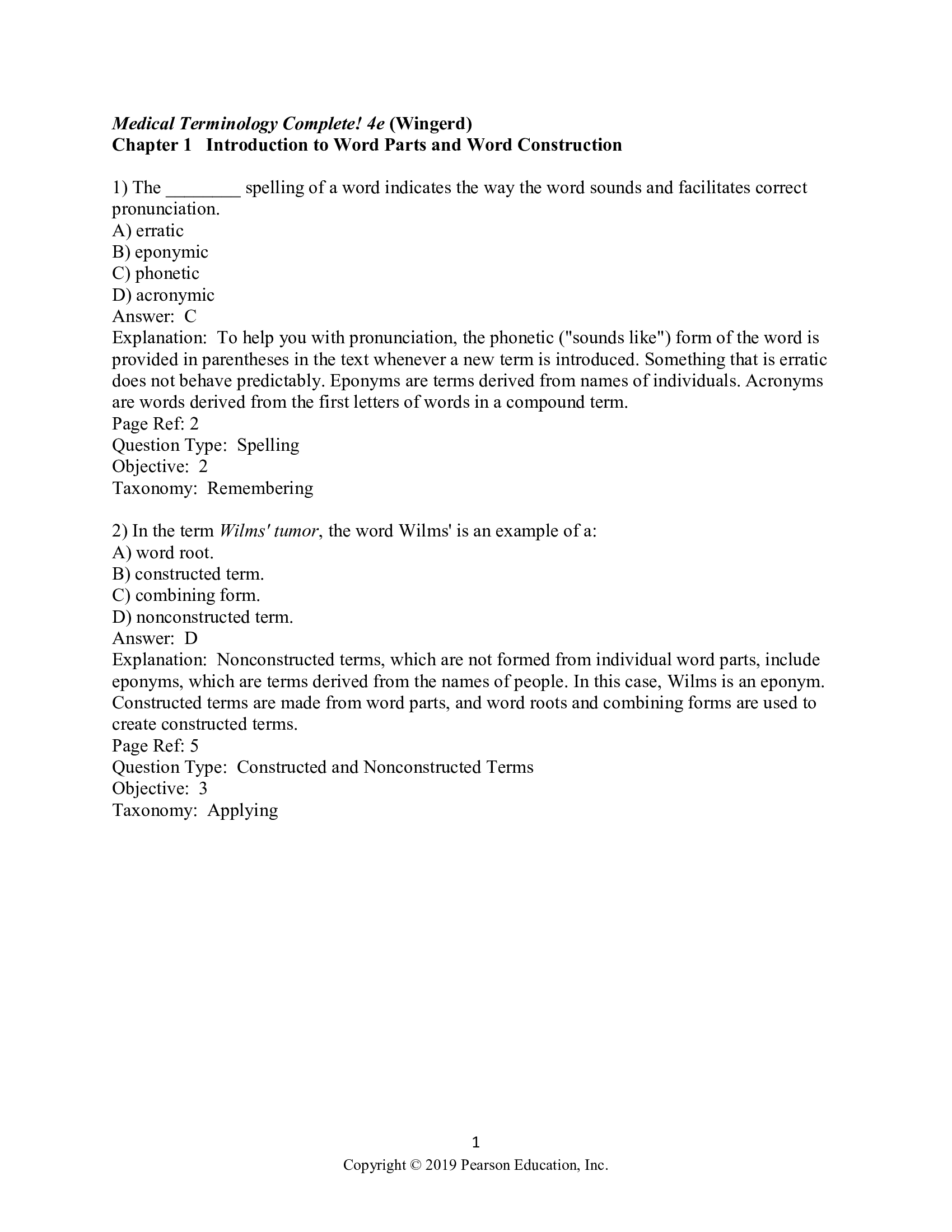
Medical Terminology Complete! 4e (Wingerd)

Chapter 1   Introduction to Word Parts and Word Construction


1) The ________ spelling of a word indicates the way the word sounds and facilitates correct pronunciation. A) erratic

B)   eponymic

C)   phonetic

D)  acronymic

Answer:  C

Explanation:  To help you with pronunciation, the phonetic ("sounds like") form of the word is provided in parentheses in the text whenever a new term is introduced. Something that is erratic does not behave predictably. Eponyms are terms derived from names of individuals. Acronyms are words derived from the first letters of words in a compound term.

Page Ref: 2

Question Type:  Spelling

Objective:  2

Taxonomy:  Remembering


2) In the term Wilms' tumor, the word Wilms' is an example of a: A) word root.

B)   constructed term.

C)   combining form.

D)  nonconstructed term.

Answer:  D

Explanation:  Nonconstructed terms, which are not formed from individual word parts, include eponyms, which are terms derived from the names of people. In this case, Wilms is an eponym. Constructed terms are made from word parts, and word roots and combining forms are used to create constructed terms.

Page Ref: 5

Question Type:  Constructed and Nonconstructed Terms

Objective:  3

Taxonomy:  Applying


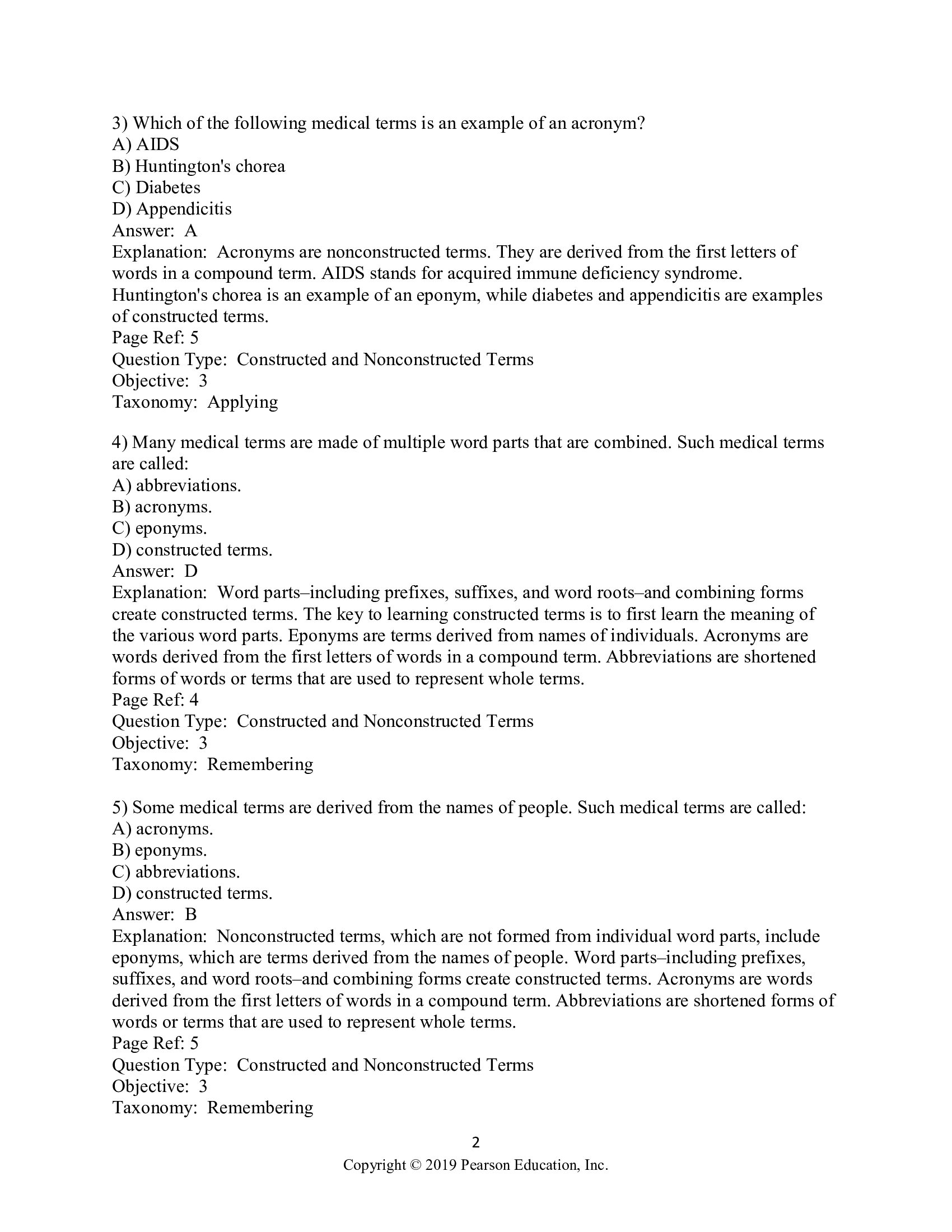
3) Which of the following medical terms is an example of an acronym?

A)  AIDS

B)   Huntington's chorea

C)   Diabetes

D)  Appendicitis

Answer:  A

Explanation:  Acronyms are nonconstructed terms. They are derived from the first letters of words in a compound term. AIDS stands for acquired immune deficiency syndrome.

Huntington's chorea is an example of an eponym, while diabetes and appendicitis are examples of constructed terms.

Page Ref: 5

Question Type:  Constructed and Nonconstructed Terms

Objective:  3

Taxonomy:  Applying

4) Many medical terms are made of multiple word parts that are combined. Such medical terms are called:

A)  abbreviations.

B)   acronyms.

C)   eponyms.

D)  constructed terms.

Answer:  D

Explanation:  Word parts–including prefixes, suffixes, and word roots–and combining forms create constructed terms. The key to learning constructed terms is to first learn the meaning of the various word parts. Eponyms are terms derived from names of individuals. Acronyms are words derived from the first letters of words in a compound term. Abbreviations are shortened forms of words or terms that are used to represent whole terms.

Page Ref: 4

Question Type:  Constructed and Nonconstructed Terms

Objective:  3

Taxonomy:  Remembering


5) Some medical terms are derived from the names of people. Such medical terms are called: A) acronyms.

B)   eponyms.

C)   abbreviations.

D)  constructed terms.

Answer:  B

Explanation:  Nonconstructed terms, which are not formed from individual word parts, include eponyms, which are terms derived from the names of people. Word parts–including prefixes, suffixes, and word roots–and combining forms create constructed terms. Acronyms are words derived from the first letters of words in a compound term. Abbreviations are shortened forms of words or terms that are used to represent whole terms.

Page Ref: 5

Question Type:  Constructed and Nonconstructed Terms

Objective:  3

Taxonomy:  Remembering

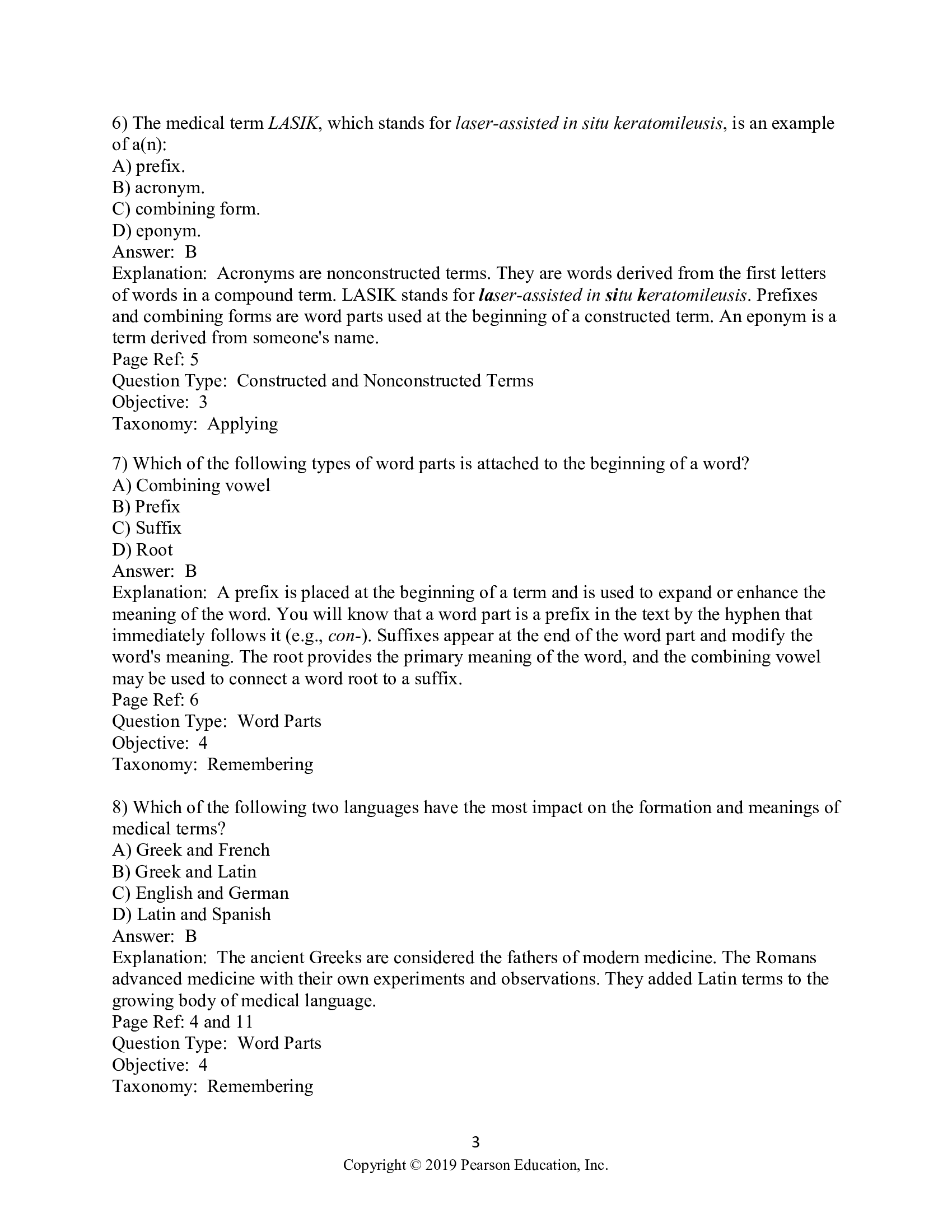
6) The medical term LASIK, which stands for laser-assisted in situ keratomileusis, is an example of a(n):

A)  prefix.

B)   acronym.

C)   combining form.

D)  eponym.

Answer:  B

Explanation:  Acronyms are nonconstructed terms. They are words derived from the first letters of words in a compound term. LASIK stands for laser-assisted in situ keratomileusis. Prefixes and combining forms are word parts used at the beginning of a constructed term. An eponym is a term derived from someone's name.

Page Ref: 5

Question Type:  Constructed and Nonconstructed Terms

Objective:  3

Taxonomy:  Applying

7) Which of the following types of word parts is attached to the beginning of a word?

A)  Combining vowel

B)   Prefix

C)   Suffix

D)  Root

Answer:  B

Explanation:  A prefix is placed at the beginning of a term and is used to expand or enhance the meaning of the word. You will know that a word part is a prefix in the text by the hyphen that immediately follows it (e.g., con-). Suffixes appear at the end of the word part and modify the word's meaning. The root provides the primary meaning of the word, and the combining vowel may be used to connect a word root to a suffix.

Page Ref: 6

Question Type:  Word Parts

Objective:  4

Taxonomy:  Remembering


8) Which of the following two languages have the most impact on the formation and meanings of medical terms? A) Greek and French

B)   Greek and Latin

C)   English and German

D)  Latin and Spanish

Answer:  B

Explanation:  The prefix neo- means "new." The root nat means "birth." The suffix -al means "pertaining to."

Page Ref: 15

Question Type:  Forming Words from Word Parts

Objective:  6

Taxonomy:  Evaluating

19) Which of the following prefixes means to come before?

A) Pre- B) Anti- C) Epi- D) Post- Answer:  A

Explanation:  Pre- means "to come before." Anti- means "against, opposite of." Epi- means "upon, over, above, on top." Post- means "to follow after."

Page Ref: 15

Question Type:  Forming Words from Word Parts

Objective:  4

Taxonomy:  Remembering


20) "Study of the skin" is the definition of which of the following medical terms?

A)  Dermatology

B)   Neurology

C)   Hepatopathy D) Biology

Answer:  A

Explanation:  The combining form dermat/o means "skin." The suffix -logy means "study of." The combining form is utilized in this case because the suffix begins with a consonant.

Page Ref: 15

Question Type:  Forming Words from Word Parts

Objective:  6

Taxonomy:  Evaluating


21) Which of the following medical terms means "pertaining to the brain"?

A)  Hepatic

B)   Psychic

C)   Cerebral

D)  Pancreatic

Answer:  C

Explanation:  The root cerebr means "cerebrum," which is the largest part of the brain. The suffix -al means "pertaining to." No combining vowel is needed, as the root ends with a consonant and the suffix starts with a vowel.

Page Ref: 15

Question Type:  Forming Words from Word Parts

Objective:  6

Taxonomy:  Evaluating


22) Which of the following medical terms has two word roots?

A)  Electrocardiogram

B)   Hysterectomy

C)   Microhepatic D) Cardiopathy

Answer:  A

Explanation:  The constructed medical term uses combining vowels to unite two word roots, electr and cardi, with the suffix -gram.

Page Ref: 15

Question Type:  Forming Words from Word Parts

Objective:  5

Taxonomy:  Applying

23) What is the definition of the medical term psychology?

A)  Study of the mind

B)   A brain specialty

C)   Inflammation of the brain

D)  Disease of the mind

Answer:  A

Explanation:  The combining form psych/o means "mind." The suffix -logy means "study of." Note the o is part of the combining form as the suffix being added, -logy, starts with a consonant.

Page Ref: 15

Question Type:  Forming Words from Word Parts

Objective:  6

Taxonomy:  Applying


24) What is the definition of the suffix -scope?

A)  An instrument used for viewing

B)   Study of instruments

C)   Use of an instrument for viewing

D)  Pertaining to instruments

Answer:  A

Explanation:  The suffix -scope refers to an instrument for viewing. Note the subtle difference: scopy means "use of an instrument for viewing" and -scope is the suffix denoting the actual instrument. For example, a physician performing an arthroscopy (viewing inside a joint) will utilize an arthroscope to perform the procedure.

Page Ref: 15

Question Type:  Forming Words from Word Parts

Objective:  4

Taxonomy:  Remembering


25) Which of the following medical terms is spelled correctly?

A)  Osteoitis

B)   Hepatology

C)   Cardiapathy

D)  Artarioscope

Answer:  B

Explanation:  The combining vowel o is utilized to connect the suffix -logy because it starts with a consonant. The other terms add combining vowels that are not necessary and make the terms difficult to pronounce.

Page Ref: 8 and 15

Question Type:  Word Parts

Objective:  5

Taxonomy:  Applying

26) Which types of word parts make up the medical term proctoscopy?

A)  Prefix, word root, combining vowel, suffix

B)   Word root, combining vowel, suffix

C)   Prefix, combining vowel, word root

D)  Prefix, word root, suffix

Answer:  B

Explanation:  Proct is the root requiring the combining vowel o to connect to the suffix -scopy, which starts with a consonant.

Page Ref: 15

Question Type:  Forming Words from Word Parts

Objective:  4

Taxonomy:  Applying


27) Which of the following combining forms means "nose"?

A)  Nat/o

B)   Rhin/o

C)   Narc/o D) Vas/o

Answer:  B

Explanation:  Rhin/o means "nose." Nat/o means "birth." Narc/o means "numbness." Vas/o means "vessel."

Page Ref: 15

Question Type:  Word Parts

Objective:  4

Taxonomy:  Remembering


28) Which of the following suffixes means "surgical repair"?

A)  -scopy

B)   -logy

C)   -lepsy

D)  -plasty

Answer:  D

Explanation:  The suffix -plasty means "surgical repair." The suffix -scopy means "the process of viewing." The suffix -logy means "the study of." The suffix -lepsy means "seizure." 

Page Ref: 15

Question Type:  Word Parts

Objective:  4

Taxonomy:  Remembering


29) What is the meaning of the prefix anti-?

A)  Under

B)   Away from

C)   Excess

D)  Against

Answer:  D

Explanation:  The prefix anti- means against or opposite of. 

Page Ref: 15

Question Type:  Word Parts

Objective:  4

Taxonomy:  Remembering

30) Identify the suffix in the term cardiology.

A)  cardi/o

B)   cardi

C)   o

D)  -logy

Answer:  D

Explanation:  The suffix is located at the end of the word to indicate the part of speech and modify the meaning. In this case, the suffix is -logy, which means "the study or science of." Page Ref: 13 and 15

Question Type:  Word Parts

Objective:  4

Taxonomy:  Applying


31) Identify the combining form in the term dermatology.

A)  -logy

B)   dermat

C)   o

D)  dermat/o Answer:  D

Explanation:  The combining form is the root dermat plus the combining vowel o, or dermat/o.

Page Ref: 10 and 15

Question Type:  Word Parts

Objective:  5

Taxonomy:  Applying


32) Identify the combining form in the term laryngoscopy.

A)  o

B)   laryng/o

C)   -scopy D) laryng

Answer:  B

Explanation:  The combining form is the root laryng with the combining vowel o, or laryng/o.

Page Ref: 15

Question Type:  Word Parts

Objective:  5

Taxonomy:  Applying


33) Identify the suffix in the term hepatitis.

A)  o

B)   -itis

C)   hepat/o D) hepat

Answer:  B

Explanation:  The suffix is at the end of the term to indicate the part of speech and modify the meaning. In this case, the suffix is -itis, which means "inflammation."

Page Ref: 15

Question Type:  Word Parts

Objective:  4

Taxonomy:  Applying

34) Identify the prefix in the term antibiotic.

A)  bi

B)   anti-

C)   bi/o D) -tic

Answer:  B

Explanation:  The prefix is at the start of the term to expand or enhance the meaning. In this case, the prefix is anti-, which means "against, opposite of."

Page Ref: 15

Question Type:  Word Parts

Objective:  4

Taxonomy:  Applying


35) Identify the combining form in the term antibiotic.

A)  anti-

B)   bi

C)   bi/o D) -tic

Answer:  C

Explanation:  The root bi along with the vowel o is the combining form, or bi/o. In this case, the suffix -tic begins with a consonant, so the combining form is necessary to ease pronunciation of the term. Page Ref: 15

Question Type:  Word Parts

Objective:  5

Taxonomy:  Applying


36) Identify the suffix in the term antibiotic.

A)  bi/o

B)   anti-

C)   bi

D)  -tic

Answer:  D

Explanation:  The suffix is at the end of the term to indicate the part of speech or clarify the meaning. In this case, the suffix is -tic, which means "pertaining to."

Page Ref: 15

Question Type:  Word Parts

Objective:  4

Taxonomy:  Applying


37) Identify the suffix in the term mastectomy.

A)  mast/o

B)   -ectomy

C)   o

D)  mast

Answer:  B

Explanation:  The suffix is at the end of the term to identify the part of speech or clarify the meaning. In this case, the suffix is -ectomy, which means "surgical excision/removal." Do not confuse -ectomy with -tomy, which means "incision/cut."

Page Ref: 15

Question Type:  Word Parts

Objective:  4

Taxonomy:  Applying

38) Identify the combining form in the term mammogram.

A)  mamm

B)   mamm/o

C)   -gram D) o

Answer:  B

Explanation:  The combining form is utilized as the vowel o is required to connect the root mamm to form mamm/o. The combining form is necessary in this case to connect the root to the suffix -gram, which starts with a consonant. 

Page Ref: 15

Question Type:  Word Parts

Objective:  5

Taxonomy:  Applying


39) Identify the combining form in the term psychology.

A)  psych/o

B)   -logy

C)   psych D) o

Answer:  A

Explanation:  The combining form is the root psych with the vowel o added, or psych/o. This is required to connect the suffix -logy, which begins with a consonant.

Page Ref: 15

Question Type:  Word Parts

Objective:  5

Taxonomy:  Applying


40) Choose the combining form that means "heart."

A)  Cardi/o

B)   Hem/o

C)   Psych/o

D)  Dermat/o

Answer:  A

Explanation:  The combining form cardi/o refers to the heart. Hem/o refers to the blood. Psych/o refers to the mind. Dermat/o refers to the skin.

Page Ref: 15

Question Type:  Word Parts

Objective:  5

Taxonomy:  Remembering


41) Choose the combining form that means "white."

A)  Electr/o

B)   Rhin/o

C)   Path/o

D)  Leuk/o

Answer:  D

Explanation:  Specific word parts identifying colors are utilized to create terms. Leuk/o means white as in leukoderma, a condition where the skin becomes lighter or whiter. Electr/o means electricity. Rhin/o means nose. Path/o means disease. 

Page Ref: 15

Question Type:  Word Parts

Objective:  5

Taxonomy:  Remembering

42) Choose the suffix that means "surgical excision (removal)."

A)  -ectomy

B)   -emia

C)   -logy

D)  -scopy

Answer:  A

Explanation:  The suffix -ectomy means "surgical excision." Do not confuse -ectomy with -tomy, "incision/cut." The suffix -emia means "condition of blood." The suffix -logy means "study or science of." The suffix -scopy means "the process of viewing."

Page Ref: 15

Question Type:  Word Parts

Objective:  4

Taxonomy:  Remembering


43) Choose the suffix that means "study of."

A)  -plasty

B)   -logy

C)   -ectomy D) -scopy

Answer:  B

Explanation:  The suffix -logy means "study or science of." Note that this suffix meaning "the study of" starts with the consonant l. When constructing terms utilizing -logy, you will often need to add the combining vowel o, as in neurology. The suffix -plasty means "surgical repair." The suffix -ectomy means "surgical excision." The suffix -scopy means "the process of viewing." Page Ref: 15

Question Type:  Word Parts

Objective:  4

Taxonomy:  Remembering


44) Choose the suffix that means "surgical repair."

A)  -plasty

B)   -gram

C)   -logy

D)  -scopy

Answer:  A

Explanation:  The suffix -plasty means "surgical repair." The suffix -gram means "a record or image." The suffix -logy means "study or science of." The suffix -scopy means "the process of viewing." Page Ref: 15

Question Type:  Word Parts

Objective:  4

Taxonomy:  Remembering

45) Choose the prefix that means "slow."

A) Anti- B) Micro-

C) Brady- D) Hyper- Answer:  C

Explanation:  The prefix brady- means "slow." The prefix anti- means "against." The prefix micro- means "small." The prefix hyper means "excessive."

Page Ref: 15

Question Type:  Word Parts

Objective:  4

Taxonomy:  Remembering


46) Choose the prefix that means "small."

A) Anti- B) Micro-

C) Epi- D) Neo- Answer:  B

Explanation:  Micro- means "small." Anti- means "against." Epi- means "above." Neo- means "new."

Page Ref: 11

Question Type:  Word Parts

Objective:  4

Taxonomy:  Remembering


47) Choose the prefix that means "against."

A)  Micro-

B)   Hyper-

C)   Brady- D) Anti- Answer:  D

Explanation:  Anti- means "against." Micro- means "small." Hyper- means "excessive, abnormally high, above." Brady- means "slow."

Page Ref: 15

Question Type:  Word Parts

Objective:  4

Taxonomy:  Remembering


48) Choose the suffix that means pertaining to.

A)  -ic

B)   -ia

C)   -itis

D)  -iatry

Answer:  D

Explanation:  The suffix -ic is one of several that means "pertaining to." The suffix -ia means "condition of." The suffix -itis means "inflammation." The suffix -iatry means "treatment, specialty." Page Ref: 15

Question Type:  Word Parts

Objective:  4

Taxonomy:  Remembering

49) This type of word part comes before a word root.

A)  Combining vowel

B)   Suffix

C)   Prefix

D)  Combining form

Answer:  C

Explanation:  The prefix is at the beginning of the word to expand or enhance the meaning of the word. The suffix appears at the end of the word. The combining vowel comes at the end of the root. The combining form includes the root.

Page Ref: 6

Question Type:  Word Parts

Objective:  4

Taxonomy:  Remembering


50) Which of the following cannot come after a word root?

A)  Prefix

B)   Suffix

C)   Another root

D)  Combining vowel

Answer:  A

Explanation:  The prefix is at the beginning of the word to expand or enhance the meaning of the word. A suffix, another root, or a combining vowel can all come after a root. Page Ref: 6

Question Type:  Word Parts

Objective:  4

Taxonomy:  Remembering


51)      A(n) ________ is a medical term derived from the name of a person.

Answer:  eponym

Page Ref: 5

Question Type:  Constructed and Nonconstructed Terms

Objective:  3

Taxonomy:  Remembering

52)      A(n) ________ is a word part attached to the beginning of a word.

Answer:  prefix

Page Ref: 6

Question Type:  Word Parts

Objective:  4

Taxonomy:  Remembering


53)      A(n) ________ is a word part attached to the end of a word.

Answer:  suffix

Page Ref: 6

Question Type:  Word Parts

Objective:  4

Taxonomy:  Remembering

54)      A word ________ is a word part that provides the primary meaning of a word. Answer:  root

Page Ref: 6

Question Type:  Word Parts

Objective:  4

Taxonomy:  Remembering


55)      A(n) ________ is added to a root to assist with pronunciation when combining with other word parts. (two words) Answer:  combining vowel

Page Ref: 8

Question Type:  Word Parts

Objective:  5

Taxonomy:  Remembering


56)      A combining form is made of a(n) ________ and a combining vowel.

Answer:  root

Page Ref: 9

Question Type:  Word Parts

Objective:  5

Taxonomy:  Remembering


57)      The most common combining vowel is the letter ________.

Answer:  o

Page Ref: 8

Question Type:  Word Parts

Objective:  5

Taxonomy:  Remembering


58)      In the constructed term mast/o/plasty, the combining vowel is ________.

Answer:  o

Page Ref: 10

Question Type:  Word Parts

Objective:  5

Taxonomy:  Applying


59)      In the constructed term brady/cardi/a, the prefix is ________.

Answer:           brady-, brady

Page Ref: 15

Question Type:  Word Parts

Objective:  4

Taxonomy:  Applying


60)      What does the prefix micro- mean?

Answer:  small

Page Ref: 11

Question Type:  Word Parts

Objective:  4

Taxonomy:  Remembering

61)      In the medical term laryngectomy, what is the word root?

Answer:  laryng

Page Ref: 15

Question Type:  Word Parts

Objective:  6

Taxonomy:  Applying


62)      The medical term hepatic means "pertaining to disease of the ________."

Answer:  liver

Page Ref: 15

Question Type:  Word Parts

Objective:  6

Taxonomy:  Applying


63)      The medical term hepatitis means "inflammation of the ________."

Answer:  liver

Page Ref: 15

Question Type:  Word Parts

Objective:  6

Taxonomy:  Applying


64)      The medical term that means "treatment of the mind" is ________.

Answer:  psychiatry

Page Ref: 15

Question Type:  Word Parts

Objective:  6

Taxonomy:  Remembering


65)      The definition of pathology is "the study of ________."

Answer:  disease

Page Ref: 15

Question Type:  Word Parts

Objective:  6

Taxonomy:  Remembering


66)      The meaning of gastritis is "inflammation of the ________."

Answer:  stomach

Page Ref: 15

Question Type:  Word Parts

Objective:  6

Taxonomy:  Applying


67)      The definition of encephalogram is "a recording of the ________."

Answer:  brain

Page Ref: 15

Question Type:  Word Parts

Objective:  6

Taxonomy:  Applying

68)      In the constructed term leuk/emia, the suffix is ________.

Answer:           -emia, emia

Page Ref: 15

Question Type:  Word Parts

Objective:  4

Taxonomy:  Applying


69)      In the constructed term rhin/o/plasty, the combining form is ________.

Answer:           rhin/o, rhino

Page Ref: 15

Question Type:  Word Parts

Objective:  5

Taxonomy:  Applying


70)      In the constructed term electr/o/cardi/o/gram, the first combining form is ________.

Answer:           electr/o, electro

Page Ref: 15

Question Type:  Word Parts

Objective:  5

Taxonomy:  Applying


71)      In the constructed term electr/o/cardi/o/gram, the suffix is ________.

Answer:           -gram, gram

Page Ref: 15

Question Type:  Word Parts

Objective:  4

Taxonomy:  Applying


72)      In the constructed term endo/cardi/al, the prefix is ________.

Answer:           endo-, endo

Page Ref: 15

Question Type:  Word Parts

Objective:  4

Taxonomy:  Applying


73)      In the constructed term endo/cardi/al, the suffix is ________.

Answer:           -al, al

Page Ref: 15

Question Type:  Word Parts

Objective:  4

Taxonomy:  Applying


74)      In the constructed term mast/o/plasty, the suffix is ________.

Answer:           -plasty, plasty

Page Ref: 15

Question Type:  Word Parts

Objective:  4

Taxonomy:  Applying

75)      In the constructed term laryng/itis, the suffix is ________.

Answer:           -itis, itis

Page Ref: 15

Question Type:  Word Parts

Objective:  4

Taxonomy:  Applying


76)      In the constructed term hyster/ectomy, the suffix is ________.

Answer:           -ectomy, ectomy

Page Ref: 15

Question Type:  Word Parts

Objective:  4

Taxonomy:  Applying


77)      In the constructed term micro/scope, the suffix is ________.

Answer:           -scope, scope

Page Ref: 15

Question Type:  Word Parts

Objective:  4

Taxonomy:  Applying


78)      In the constructed term hem/o/philia, the combining form is ________.

Answer:           hem/o, hemo

Page Ref: 15

Question Type:  Word Parts

Objective:  5

Taxonomy:  Applying


79)      In the constructed term hem/o/philia, the combining vowel is ________.

Answer:  o

Page Ref: 10

Question Type:  Word Parts

Objective:  5

Taxonomy:  Applying


80)      In the constructed term psych/o/logy, the word root is ________.

Answer:  psych

Page Ref: 15

Question Type:  Word Parts

Objective:  4

Taxonomy:  Applying


81)      In the constructed term psych/o/logy, the suffix is ________.

Answer:           -logy, logy

Page Ref: 15

Question Type:  Word Parts

Objective:  4

Taxonomy:  Applying

82)      In the constructed term ment/al, the suffix is ________.

Answer:           -al, al

Page Ref: 15

Question Type:  Word Parts

Objective:  4

Taxonomy:  Applying


83)      In the constructed term tonsill/ectomy, the word root is ________.

Answer:  tonsill

Page Ref: 15

Question Type:  Word Parts

Objective:  4

Taxonomy:  Applying


84)      In the constructed term tonsill/ectomy, the suffix is ________.

Answer:           -ectomy, ectomy

Page Ref: 15

Question Type:  Word Parts

Objective:  4

Taxonomy:  Applying


85)      In the constructed term neur/o/logy, the suffix is ________.

Answer:           -logy, logy

Page Ref: 15

Question Type:  Word Parts

Objective:  4

Taxonomy:  Applying


86)      In the constructed term path/o/logy, the combining form is ________.

Answer:           path/o, patho

Page Ref: 15

Question Type:  Word Parts

Objective:  5

Taxonomy:  Applying


87)      In the constructed term psych/iatry, the suffix is ________.

Answer:           -iatry, iatry

Page Ref: 15

Question Type:  Word Parts

Objective:  4

Taxonomy:  Applying


88)      Two languages that had an important impact on medical terminology are ________ and Latin.

Answer:  Greek

Page Ref: 11

Question Type:  Word Parts

Objective:  4

Taxonomy:  Remembering

Define the following combining forms, roots, prefixes, and suffixes.


89)      The combining form cardi/o means " ________."

Answer:  heart

Page Ref: 15

Question Type:  Word Parts

Objective:  4

Taxonomy:  Remembering


90)      The combining form dermat/o means " ________."

Answer:  skin

Page Ref: 15

Question Type:  Word Parts

Objective:  4

Taxonomy:  Remembering


91)      The combining form hepat/o means " ________."

Answer:  liver

Page Ref: 15

Question Type:  Word Parts

Objective:  4

Taxonomy:  Remembering


92)      The suffix meaning "surgical excision or removal" is ________. Answer:         -ectomy, ectomy

Page Ref: 15

Question Type:  Word Parts

Objective:  4

Taxonomy:  Remembering


93)      The prefix meaning "against or opposite of" is ________.

Answer:           anti-, anti

Page Ref: 15

Question Type:  Word Parts

Objective:  4

Taxonomy:  Remembering


94)      The combining form psych/o means " ________."

Answer:  mind

Page Ref: 15

Question Type:  Word Parts

Objective:  4

Taxonomy:  Remembering


95)      The combining form rhin/o means " ________."

Answer:  nose

Page Ref: 15

Question Type:  Word Parts

Objective:  4

Taxonomy:  Remembering

96)      The suffix -plasty means "surgical ________."

Answer:  repair

Page Ref: 15

Question Type:  Word Parts

Objective:  4

Taxonomy:  Remembering


97)      In the medical term cardiologist, the first o sound is pronounced as "ahl."

Answer:  TRUE

Page Ref: 3

Question Type:  Pronunciation

Objective:  2

Taxonomy:  Applying


98)      An acronym is a two- or three-letter abbreviation for a word.

Answer:  FALSE

Explanation:  Acronyms are words derived from the first letters of the words in a compound term and may contain more than two or three letters. as the term LASIK (for laser-assisted in situ keratomileusis) is an example.

Page Ref: 5

Question Type:  Constructed and Nonconstructed Terms

Objective:  3

Taxonomy:  Remembering


99)      A prefix is the word part attached to the end of a medical term. Answer:  FALSE

Explanation:  The prefix is attached to the beginning of a term to expand or enhance its meaning.

Page Ref: 6

Question Type:  Word Parts

Objective:  4

Taxonomy:  Remembering


100)  When a medical term is constructed from word parts, its definition usually starts with the definition of the suffix.

Answer:  TRUE

Page Ref: 7

Question Type:  Word Parts

Objective:  4

Taxonomy:  Applying


101)  A medical term must have four parts: a prefix, a word root, a combining vowel, and a suffix.

Answer:  FALSE

Explanation:  Some terms are nonconstructed such as eponyms or acronyms, and others can utilize two word roots or sometimes none.

Page Ref: 8

Question Type:  Word Parts

Objective:  3

Taxonomy:  Remembering

102)  The combining vowel is used between a prefix and a word root to ease pronunciation.

Answer:  FALSE

Explanation:  The combining vowel is used to connect a word root to a suffix that begins with a consonant. Page Ref: 8 and 13

Question Type:  Word Parts

Objective:  5

Taxonomy:  Applying


103)  The suffix -ist means "inflammation."

Answer:  FALSE

Explanation:  The suffix -ist means "one who specializes." The suffix -itis means "inflammation."

Page Ref: 15

Question Type:  Word Parts

Objective:  4

Taxonomy:  Remembering


104)  The meaning of rhinoplasty is "surgical repair of the nose."

Answer:  TRUE

Page Ref: 15

Question Type:  Word Parts

Objective:  6

Taxonomy:  Applying


105)  The definition of cardiology is "the study of the heart."

Answer:  TRUE

Page Ref: 13

Question Type:  Word Parts

Objective:  6

Taxonomy:  Applying


106)  Medical terminology is a language that is built on mostly Greek and Latin word parts. Answer:  TRUE

Page Ref: 11

Question Type:  Word Parts

Objective:  4

Taxonomy:  Remembering


107)  Because medical terminology is the universal language of medicine, its terms must be understood by speakers of many languages in many parts of the world, especially in our age of globalization. Answer:  TRUE

Page Ref: 4

Question Type:  Programmed Learning Approach

Objective:  2

Taxonomy:  Remembering


108)  Medical terms are created from building blocks called word parts, and include word roots, prefixes, suffixes, and combining forms.

Answer:  TRUE

Page Ref: 7

Question Type:  Programmed Learning Approach

Objective:  2

Taxonomy:  Remembering

109)  gastr is a word root that means "stomach."

Answer:  TRUE

Page Ref: 15

Question Type:  Word Parts

Objective:  4

Taxonomy:  Remembering


110)  a- is a prefix that means " presence of."

Answer:  FALSE

Explanation:  a- is a prefix that means "without or absence of."

Page Ref: 8

Question Type:  Word Parts

Objective:  4

Taxonomy:  Remembering


111)  In the term cardiology, the combining form is cardi/a and the suffix is -logy. Answer:  FALSE

Explanation:  The combining form is cardi/o; in most cases, the combining vowel is the letter o.

Page Ref: 13

Question Type:  Word Parts

Objective:  4

Taxonomy:  Applying


Match the combining form with the correct definition.


A)  stone

B)   heart

C)   electricity

D)  skin

E)   tonsil

F)    vessel

G)  muscle

H)  life

I)     disease

J)     stomach


112)  bi/o           


113)  cardi/o      


114)  dermat/o 


115)  electr/o 


116)  gastr/o      


117)  lith/o         


118)  muscul/o 


119)  path/o       


120)  tonsill/o 


121)  vas/o         


Answers: 112) H 113) B 114) D 115) C 116) J 117) A 118) G 119) I 120) E 121) F

Contact the Seller

Please Sign In to contact this seller.


  • 👎  Report Copyright Violation

Frequently Asked Questions

What Do I Get When I Buy This Study Material?

+

When you buy a study material on Passing Grades, an instant download link will be sent directly to your email, giving you access to the file anytime after payment is completed.

Is Passing Grades a Trusted Platform?

+

Yes, Passing Grades is a reputable students’ marketplace with a secure payment system and reliable customer support. You can trust us to ensure a safe and seamless transaction experience.

Will I Be Stuck with a Subscription?

+

No, all purchases on Passing Grades are one-time transactions. You only pay for the notes you choose to buy, with no subscriptions or hidden fees attached.

Who Am I Buying These Study Materials From?

+

Passing Grades is a marketplace, which means you are purchasing the document from an individual vendor, not directly from us. We facilitate the payment and delivery process between you and the vendor.

Does Passing Grades Offer Free Study Materials?

+

Yes, sellers on Passing Grades have uploaded numerous free test banks, exams, practice questions, and class notes that can be downloaded at no cost.


Pasinggrades - Quality Study Materials

USD 15

    • Quality checked by Pasing Grades
    • 100% satisfaction guarantee
    • Seller: mentor2000
Buy PDF $15

Seller Information

mentor2000

Member since April 2021

  • icon
  • icon
View Profile
  • total sales

    0
  • Favourites

    0
  • Comments

    0
    ( 0 Ratings )

Item Information

  • Uploaded

    22 May 2022

  • Updated

    16 May 2025

  • Category

    Nursing

  • Item Type

    test bank

  • Tags

    Test Bank for Medical Terminology Complete 4th Edition by Wingerd

Related Exam Prep Guides by mentor2000

Test Bank for Essentials for Nursing Practice 8th Edition by Potter | All Chapters
View Document

Test Bank for Essent...

  • mentor2000

    mentor2000

  • test bank

Master nursing concepts with this study material; Test Bank for Essentials for Nursing Practice, 8th...

15 USD

0

0

A &P 1 MA278 BSC2 Final Module II Questions & Answers 2026 Update
View Document

A &P 1 MA278 BSC2 Fi...

  • mentor2000

    mentor2000

  • test bank

Prepare for success with A&P 1 MA278 BSC2 Final Module II 2024 Q&A. Boost your grades with this comp...

15 USD

0

0

ATI Comprehensive Predictor Exam 2026
View Document

ATI Comprehensive Pr...

  • mentor2000

    mentor2000

  • test bank

Prepare for success with the ATI Comprehensive Predictor Exam 2026. Access key practice questions to...

15 USD

0

0

Purchase

Download link will be sent to this email immediately after purchase.

IMPORTANT LINKS

  • How To Upload Class Notes
  • Selling Tips
  • Passing Grades's Study Materials
  • Scholarships for International Students 2025

POPULAR CATEGORIES

  • Law
  • Accounting
  • English
  • Psychology
  • Business
  • Nursing
  • Computer Science
  • General

View Document

  • Blog
  • Contact
  • Delivery Policy
  • Latest Scholarships Around the World
  • How to Pass Bar Exams: Passing Grades’ Strategies
  • How to Study and Pass the CPA Exam
  • All Test Banks
  • Faq
  • Copyright Claims
  • Privacy Policy
  • Terms of Use

KNOWLEDGE BASE

  • How to Write A+ Grade Good Research Paper
  • How to Manage Stress During Exam Period
  • Best Time to Study
  • How to Pass NCLEX-RN Exam
  • How To Effectively Utilize Test Banks
  • Popular Shadow Health Exam Assessments
  • Popular HESI Case Studies
  • How to Prepare for a Nursing Career
  • The Importance Of Summaries in Exam Revisvion

© 2026 Pasing Grades. All rights reserved.