Pasing Grades
  • Start Selling
  • Blog
  • Contact
  • 0

    Your cart is empty!

English

  • English
  • Spanish
  • Arabic
Create Account Sign In
  • Library
    • New Prep Guides
    • Featured Prep Guides
    • Free Exam Prep Guides
    • Best sellers
  • General
  • Nursing
    • Research Paper
    • Case Study
    • Discussion Post
    • Assignment
    • Exam
    • Practice Questions and Answers
    • Test Bank
    • solutions manual
  • Accounting
    • Case Study
    • Thesis
    • Study Guide
    • Summary
    • Research Paper
    • test bank
  • English
    • Creative Writing
    • Research Paper
    • Summary
    • Rhetorics
    • Literature
    • Journal
    • Exam
    • Grammar
    • Discussion Post
    • Essay
  • Psychology
    • Hesi
    • Presentation
    • Essay
    • Summary
    • Study Guide
    • Essay
    • Solution Manual
    • Final Exam Review
    • Class Notes
    • test bank
  • Business
    • Lecture Notes
    • Solution Manual
    • Presentation
    • Business Plan
    • Class Notes
    • Experiment
    • Summary
    • Practice Questions
    • Study Guide
    • Case Study
    • test bank
    • Exam
  • More
    • Computer Science
    • Economics
    • Statistics
    • Engineering
    • Biology
    • Religious Studies
    • Physics
    • Chemistry
    • Mathematics
    • History
    • Sociology
    • Science
    • Philosophy
    • Law
  • Pages
    • About Us
    • Selling Tips
    • Delivery Policy
    • Faq
    • Privacy Policy
  • Flash Sale
  • Home
  • Test Bank for Medical Terminology An Accelerated Approach by Jones

Test Bank for Medical Terminology An Accelerated Approach by Jones

Preview page 1 Preview page 2 Preview page 3
Add To Favorites

Share this item Share this item

  • Item Details
  • Comments (0)
  • Reviews (0)
  • Contact Seller

Test Bank for Medical Terminology An Accelerated Approach by Jones

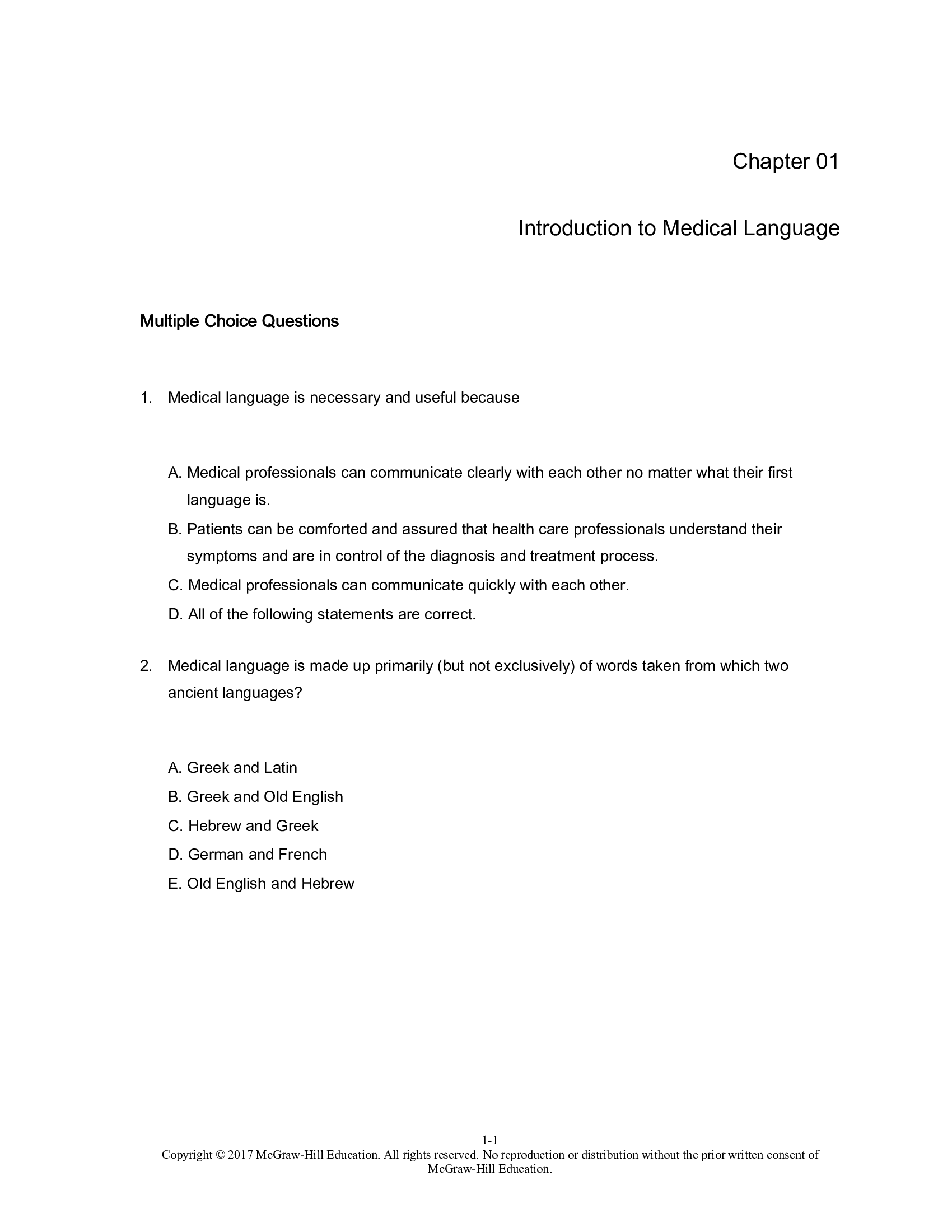
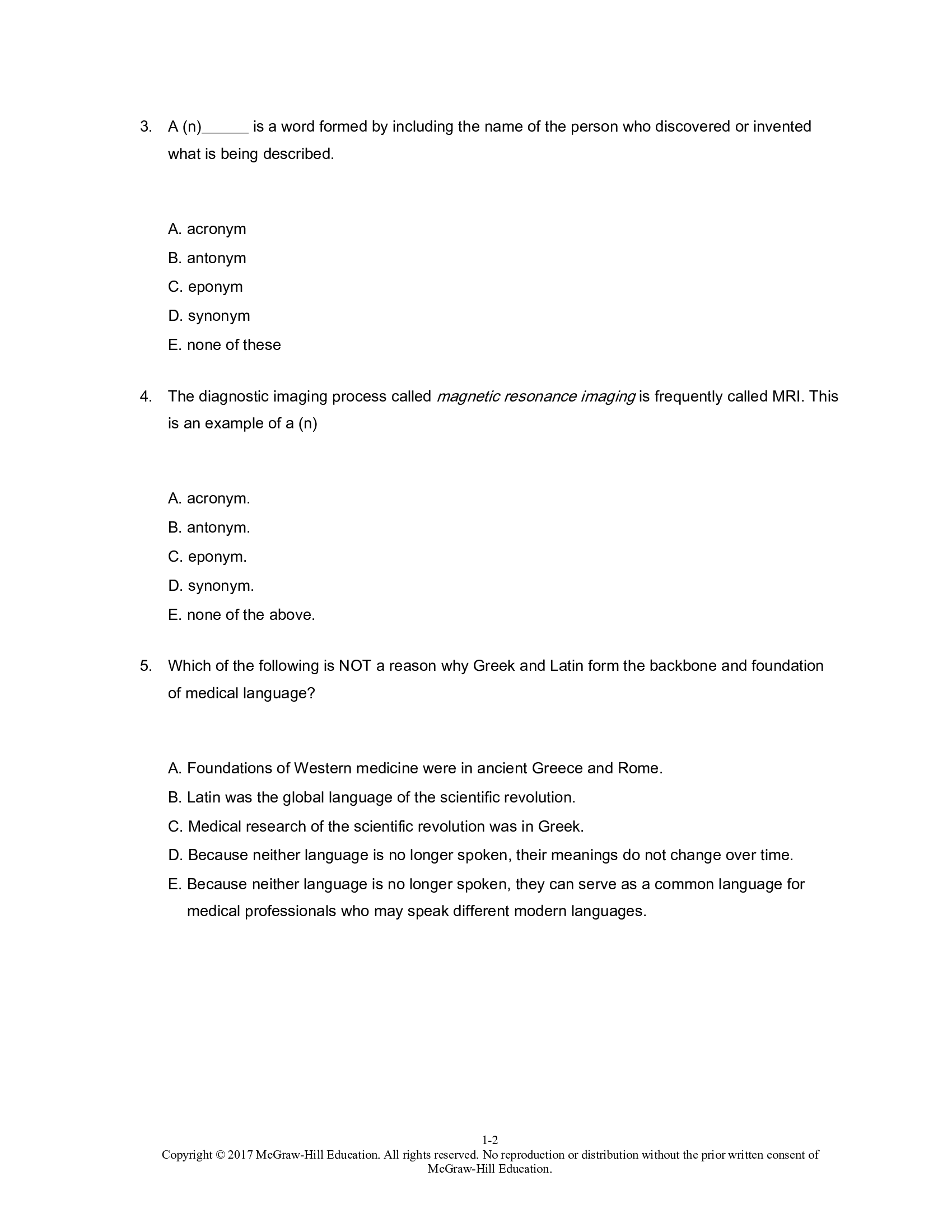
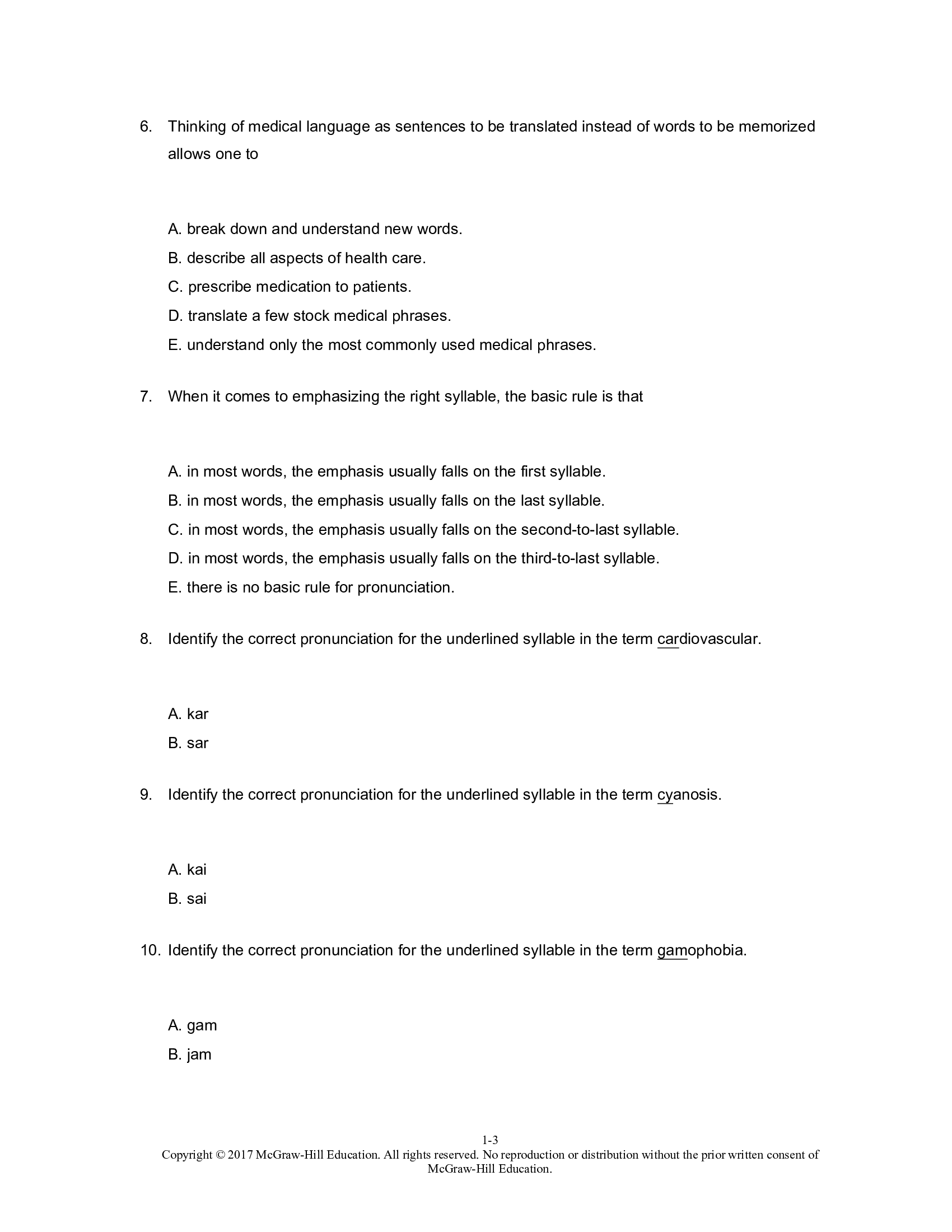
Chapter 01 Introduction to Medical Language Test Bank

Multiple Choice Questions  

1.     Medical language is necessary and useful because      

A.  Medical professionals can communicate clearly with each other no matter what their first language is.  

B.  Patients can be comforted and assured that health care professionals understand their symptoms and are in control of the diagnosis and treatment process.  

C.  Medical professionals can communicate quickly with each other. 

D.  All of the following statements are correct.

2.     Medical language is made up primarily (but not exclusively) of words taken from which two ancient languages?      A.  Greek and Latin
B.  Greek and Old English
C.  Hebrew and Greek
D.  German and French E. Old English and Hebrew

3.     A (n)______ is a word formed by including the name of the person who discovered or invented what is being described.      A.  acronym
B.  antonym
C.  eponym
D.  synonym E. none of these

4.     The diagnostic imaging process called magnetic resonance imaging is frequently called MRI. This is an example of a (n)      A.  acronym.
B.  antonym.
C.  eponym.
D.  synonym. E. none of the above.
  5.     Which of the following is NOT a reason why Greek and Latin form the backbone and foundation of medical language?      A.  Foundations of Western medicine were in ancient Greece and Rome.
B.  Latin was the global language of the scientific revolution.
C.  Medical research of the scientific revolution was in Greek.
D.  Because neither language is no longer spoken, their meanings do not change over time.
E.  Because neither language is no longer spoken, they can serve as a common language for medical professionals who may speak different modern languages.  
  6.     Thinking of medical language as sentences to be translated instead of words to be memorized allows one to      A.  break down and understand new words.
B.  describe all aspects of health care.
C.  prescribe medication to patients.
D.  translate a few stock medical phrases. E. understand only the most commonly used medical phrases.
  7.     When it comes to emphasizing the right syllable, the basic rule is that      A.  in most words, the emphasis usually falls on the first syllable.
B.  in most words, the emphasis usually falls on the last syllable.
C.  in most words, the emphasis usually falls on the second-to-last syllable.
D.  in most words, the emphasis usually falls on the third-to-last syllable. E. there is no basic rule for pronunciation.
  8.     Identify the correct pronunciation for the underlined syllable in the term cardiovascular.      A.  kar B. sar
  9.     Identify the correct pronunciation for the underlined syllable in the term cyanosis.      A.  kai B. sai
  10.   Identify the correct pronunciation for the underlined syllable in the term gamophobia.      A.  gam B. jam
  11.   Identify the correct pronunciation for the underlined syllable in the term glycogen.      A.  gen B. jen
  12.   Identify the correct pronunciation for the underlined syllable in the term pharynx.      A.  fair B. pair
  13.   Identify the correct pronunciation for the underlined syllable in the term pneumothorax.      A.  noo B. puh-noo
  14.   Identify the correct pronunciation for the underlined syllable in the term pterygium.      A.  puh-te B. tuh
  15.   Identify the correct pronunciation for the underlined syllables in the term steatorrhea.      A.  ree-uh
B.  ruh-hee-ai
C.  r-hee-ay D.  r-hay
  16.   Identify the correct pronunciation for the underlined syllables in the term xiphoid process.      A.  eks-foid
B.  eks-poid
C.  zih-foid D.  zih-poid
  17.   Which of the following is the proper syllabic breakdown for the word cardiac arrest?      A.  card/iac a/rrest
B.  card/iac arr/est
C.  car/di/ac a/rrest D.  car/di/ac arr/est
  18.   Which of the following is the proper syllabic breakdown for the word catheter?      A.  ca/th/e/ter
B.  ca/thet/er
C.  cat/het/er D.  cath/e/ter
  19.   Which syllable is emphasized when pronouncing the word hypotonia?      A.  HAI-poh-toh-nee-yah (first syllable)
B.  hai-POH-toh-nee-yah (second syllable)
C.  hai-poh-TOH-nee-yah (third syllable)
D.  hai-poh-toh-NEE-yah (fourth syllable) E. hai-poh-toh-nee-YAH (fifth syllable)
  20.   Which syllable is emphasized when pronouncing the word myodynia?      A.  MIE-oh-dih-nee-ah (first syllable)
B.  mie-OH-dih-nee-ah (second syllable)
C.  mie-oh-DIH-nee-ah (third syllable)
D.  mie-oh-dih-NEE-ah (fourth syllable) E. mie-oh-dih-nee-AH (fifth syllable)
  21.   Which syllable is emphasized when pronouncing the word arthroscope?      A.  AR-throh-skohp (first syllable)
B.  ar-THROH-skohp (second syllable) C.  ar-throh-SKOHP (last syllable)
  22.   In medical terminology, what is the definition of a root?      A.  A beginning that gives essential meaning to the term
B.  An ending that gives essential meaning to the term
C.  The foundation or subject of the term
D.  The part of the word added to the beginning of a term when needed to further modify the foundation of the term  
  23.   Which of the following statements regarding prefixes and suffixes is NOT correct?      A.  A prefix is located at the beginning of the term and a suffix is located at the end of the term.
B.  A suffix is located at the beginning of the term and a prefix is located at the end of a term.
C.  A prefix is used to further modify the root.
D.  A suffix often gives essential meaning to the term. E. A medical word can have more than one prefix and suffix.
  24.   All of the following are roots meaning skin EXCEPT      A.  cutane/o
B.  dermat/o
C.  derm/o D.  my/o
  25.   The root enter/o means      A.  joint.
B.  liver.
C.  nerve.
D.  small intestine. E. stomach.
  26.   Which root would be used in medical terms that pertain to blood?      A.  arthr/o
B.  hemat/o
C.  hepat/o
D.  pulmon/o E. xen/o
  27.   Which root would be used in medical terms that pertain to suffering or disease?      A.  gen/o
B.  morph/o
C.  path/o
D.  troph/o E. xer/o
  28.   All of the following suffixes mean pertaining to EXCEPT      A.  -ac.
B.  -al.
C.  -algia.
D.  -ar. E. -ary.
  29.   All of the following suffixes mean small EXCEPT      A.  -ic.
B.  -icle.
C.  -ole.
D.  -ule. E. -ula.
  30.   Which of the following roots mean the same thing?      A.  arthr/o and angi/o
B.  cardi/o and vascul/o
C.  enter/o and gastr/o
D.  hem/o and vas/o E. my/o and muscul/o
  31.   Which of the following pairs of prefixes have opposite meanings?      A.  anti-, contra-
B.  brady-, tachy-
C.  circum-, peri-
D.  mono-, uni-
E.  poly-, multi-


32.   Which of the following pair of prefixes have opposite meanings?      A.  ab-, de-
B.  exo-, extra-
C.  hyper-, hypo-
D.  pre-, pro- E. sym-, syn-
  33.   Identify the root in the term tachycardia.      A.  a
B.  cardi
C.  card
D.  ta E. tachy
  34.   Identify the root in the term polyneuropathy.      A.  neuro
B.  path
C.  pathy
D.  poly E. y
  35.   The root hepat/o means      A.  fungus
B.  liver
C.  lung  narrowing blood36.   The root pneumon/o means      A.  fungus
B.  liver
C.  lung
D.  muscle E. air
  37.   The root myc/o means      A.  fungus
B.  liver
C.  lung
D.  muscle E. pus
  38.   The root pneum/o means      A.  fungus
B.  liver
C.  lung
D.  muscle E. air
  39.   The root morph/o means      A.  cause
B.  change
C.  eat  straight suffering, disease40.   What is the meaning of the root hydr/o?      A.  Air
B.  Blood
C.  Formation
D.  Generation, cause E. Water
  41.   What is the meaning of the root troph/o?      A.  Change
B.  Eat
C.  Foreign
D.  Generation, cause E. Nourishment, development
  42.   What is the meaning of the root xen/o?      A.  Dry
B.  Foreign
C.  Hard
D.  Soft E. Water
  43.   Identify and define the root in the term arthoscope.      A.  arthr/o- joint
B.  arthr/o- vessel
C.  scope       - instrument used to look scope                 - process of looking thosc/o - chest44.   Identify and define the root in the term subcutaneous.      A.  cutane/o– stomach
B.  cutan– skin
C.  cutane–  skin
D.  ous–         pertaining to E. sub– beneath
  45.   Identify and define the root in the term necrosis.      A.  is– small
B.  necr– death
C.  necr/o–    kidney
D.  crosis–     condition E. osis– presence of
  46.   Identify and define the root in the term pyemia.      A.  emia– blood condition
B.  pyem– pus
C.  ia–             condition
D.  py/e–        eat E. py– pus
  47.   The prefix ante- means      A.  after.
B.  again.
C.  before.  against. slow.


48.   The prefix oligo- means      A.  all.
B.  few.
C.  large.
D.  many. E. small.
  49.   The prefixes a- and an- both mean      A.  away.
B.  in, inside.
C.  not.
D.  out, outside. E. without.
  50.   The prefixes e-, ec-, and ex- all mean      A.  outside.
B.  beneath.
C.  in, inside.
D.  out. E. through.
  51.   Which of the following pairs of prefixes are synonyms that mean in, inside?      A.  a-, an-
B.  con-, syn-
C.  en-, endo-
D.  ex-, exo-
E.  inter-, intra-52.   Which of the following pairs of prefixes are synonyms that mean around?      A.  circum-, trans-
B.  circum-, peri-
C.  circum-, dia-
D.  contra-, peri- E. dia-, peri-
  53.   What is the meaning of the prefix contra-?      A.  Against
B.  Bad
C.  Down
D.  Around E. With
  54.   What is the meaning of the prefix poly-?      A.  Few
B.  Half
C.  Many
D.  No, none E. One
  55.   What is the meaning of the prefix syn-?      A.  Against
B.  Before, on behalf of
C.  Between ThroughWith, together56.   Identify and define the prefix in the term antigen.      A.  an - across
B.  anti- against
C.  anti           - before
D.  gen          - creation, cause E. gen- suffering, disease
  57.   Identify and define the root in the term eugenic.      A.  eu– bad
B.  gen– generation, cause
C.  eu             – good
D.  eugen     – cause E. ic– pertaining to
  58.   Identify and define the prefix in the term transdermal.      A.  al - across
B.  al - pertaining to
C.  derm       - skin
D.  trans        - across E. trans - pertaining to
  59.   Identify and define the prefix in the term heminephrectomy.      A.  hemi- half
B.  hemi- out
C.  nephr      - kidney tomy      - incision ectomy - removal60.   Identify and define the prefix in the term hypertrophic.      A.  hyper– over
B.  hyper– under
C.  ic - condition
D.  ic  - pertaining to E. troph - nourishment, development
  61.   The suffixes -algia and -dynia both mean      A.  abnormal softening.
B.  inflammation.
C.  pain.
D.  presence of. E. resembling.
  62.   The suffix –logy means      A.  medical science.
B.  specialist in medicine of.
C.  specialist.
D.  specialist in the study of. E. study of.
  63.   The suffix –graph means      A.  instrument used to look.
B.  instrument used to produce a record.
C.  process of recording.  process of looking. written record.64.   The suffix —emia means      A.  blood condition.
B.  flow.
C.  process of measuring.
D.  rupture. E. tissue, structure.
  65.   What is the meaning of the suffix -oid?      A.  Involuntary contraction
B.  Resembling
C.  Rupture
D.  Suture E. Tumor
  66.   What is the meaning of the suffix -oma?      A.  Involuntary contraction
B.  Resembling
C.  Rupture
D.  Suture E. Tumor
  67.   What is the meaning of the suffix -rrhaphy?      A.  Excessive flow
B.  Resembling
C.  Rupture SutureTumor68.   What is the meaning of the suffix -rrhexis?      A.  Involuntary contraction
B.  Resembling
C.  Rupture
D.  Suture E. Excessive flow
  69.   What is the meaning of the suffix -spasm?      A.  Involuntary contraction
B.  Drooping
C.  Rupture
D.  Suture E. Narrowing
  70.   Identify and define the suffix in the term craniostomy.      A.  cranios- bone
B.  cranio- skull
C.  ostomy   - bone
D.  stomy      - creation of an opening E. tomy- incision
  71.   Identify and define the suffix in the term cardiomalacia.      A.  cardio– heart
B.  acia– condition
C.  malacia – hernia mal        – bad malacia– abnormal softening72.   Identify and define the suffix in the term costochondritis.      A.  chondr– cartilage
B.  chondrit– cartilage
C.  itis             – deficiency
D.  itis             – inflammation E. is– condition
  73.   Identify and define the suffix in the term dysmenorrhea.      A.  dys– bad
B.  dys– not
C.  meno      – menstruation
D.  rrhea       – flow E. rrhea– rupture
  74.   Select the correct plural form of the word diagnosis.      A.  Diagnosa
B.  Diagnosae
C.  Diagnoses
D.  Diagnosi E. Diagnosies
  75.   Select the correct plural form of the word nucleus.      A.  Nucleae
B.  Nuclei
C.  Nuclemata NuclesNuclices


76.   When combining word parts, a combining vowel is used      A.  to join a root to any suffix beginning with a consonant.
B.  to join two roots together.
C.  to join two roots together even when the second root begins with a vowel.
D.  All of these statements are correct. E. None of these statements is correct.
  77.   When combining word parts, a combining vowel is NOT used      A.  to join a root to a suffix that begins with a vowel.
B.  to join a root to a suffix beginning with a consonant.
C.  to join two roots together.
D.  to join two roots together even when a second root begins with a vowel. E. All of these statements are correct.
  78.   Which of the following terms includes a combining vowel?      A.  Bradycardia
B.  Endocardium
C.  Gastric
D.  Gastritis E. Neuropathy
  79.   Which of the following represents a medical term built with the roots gastr/o and esophag/o and the suffix -eal?      A.  Gastroesophageal
B.  Gastresophageal
C.  Gastroesophagoeal
D.  Gastresophagoeal80.   Which of these words correctly represents a medical term built with the root vas/o and the suffix spasm?      A.  Vasspasm
B.  Vaspasm C.  Vasospasm
  81.   Which of these words represents a medical term built with the prefix hypo-, the root glyc/o and the suffix -emia?      A.  Hypglycoemia
B.  Hypoglycemia
C.  Hypoglycoemia D.  Hypglycemia
  82.   Which of these words represents a medical term built with the roots cardi/o and my/o and the suffix -pathy?      A.  Cardimyopathy
B.  Cardiomyopathy
C.  Cardimypathy D.  Cardiomypathy
  83.   When translating a medical term, one can usually figure out the definition by interpreting the      A.  prefix first, then the root or roots, and finally the suffix.
B.  roots first, then the prefix, and finally the suffix.
C.  roots first, then the suffix, and finally the prefix. D.  suffix first, then the prefix, and finally the root or roots.
  84.   Which of the following is the proper breakdown of the word parts in the term dialysis?      A.  dia/lysis
B.  dia/lys/is
C.  di/al/ysis
D.  di/al/y/sis E. dia/ly/sis
  85.   Which of the following is the proper breakdown of the word parts in the term pathogenic?      A.  patho/genic
B.  patho/gen/ic
C.  path/o/genic
D.  path/o/gen/ic E. pa/tho/gen/ic
  86.   Which of the following is the proper breakdown of the word parts in the term hemarthrosis?      A.  hemarthr/osis
B.  hem/arthr/osis
C.  hem/arthros/is
D.  hem/arthr/o/sis E. hem/arth/ros/is
  87.   Which of the following is the proper breakdown of the word parts in the term polyneuropathy?      A.  poly/neuropathy
B.  polyneuro/pathy
C.  poly/neuro/pathy  poly/neur/opath/y poly/neur/o/pathy


88.   Which of the following is the proper translation of the term subdural?      A.  Condition above the dura
B.  Condition beneath the dura
C.  Pertaining to above the dura
D.  Pertaining to around the dura E. Pertaining to beneath the dura
  89.   Which of the following is the proper translation of the term gastritis?      A.  Disease of the heart
B.  Disease of the stomach
C.  Inflammation of the heart
D.  Inflammation of the muscles E. Inflammation of the stomach
  90.   Which of the following is the proper translation of the term cardiomegaly?      A.  Abnormal hardening of the heart
B.  Abnormal softening of the heart
C.  Deficiency of the heart
D.  Enlargement of the heart E. Inflammation of the heart
  91.   Which of the following is the proper translation of the term angiogram?      A.  Instrument used to produce a record of the blood vessels
B.  Instrument used to produce a record of the heart
C.  Record of the blood Written record of vesselsRecord of the heart92.   Which of the following is the proper translation of the term polyneuropathy?      A.  Condition affecting one nerve
B.  Deficiency of the brain
C.  Disease of many nerves
D.  Involuntary contraction of the nerves in the brain E. Structure of many brain cells
  93.   Which of the following is the proper translation of the term cardiomyotomy?      A.  Incision into the heart
B.  Incision into the heart muscle
C.  Reconstruction of the heart
D.  Removal of the heart muscle E. Surgical fixation of the heart
  94.   Which of the following is the proper translation of the term mycodermatitis?      A.  Condition of the muscles in the skin.
B.  Condition of the skin caused by fungus.
C.  Inflammation of the skin caused by fungus.
D.  Inflammation of the muscles of the skin. E. Pertaining to the muscle of the skin.
  95.   Which of the following terms means process of looking into a joint?      A.  Arthroclasia
B.  Arthrogram
C.  Arthrography Arthroscopy Arthroscope96.   Which of the following terms means surgical reconstruction of a vessel?      A.  Angiopexy
B.  Angioplasty
C.  Angiopoieses
D.  Angiorrhaphy E. Angiosclerosis
  97.   Which of the following terms means deficiency of sugar?      A.  Glycemia
B.  Glycodesis
C.  Glycomalacia
D.  Glycopenia E. Glycorrhea
  98.   Which of the following terms means condition of bad movement?      A.  Akinesia
B.  Akinesial
C.  Dyskinesia
D.  Dyskinesial E. Eukinesia
  99.   Which of the following terms means pertaining to inside the skin?      A.  Atopic
B.  Epidermal
C.  Intradermal PachydermalTransdermal100. Which of the following terms means condition of nerve hardening?      A.  Neurolysis
B.  Neuroma
C.  Neurosclerosis
D.  Neurosis E. Neurotomy
  101. Which of the following terms means after birth?      A.  Antepartum
B.  Intrapartum
C.  Perinatal
D.  Postpartum E. Prenatal
  102. In the medical term hematoma, the suffix means      A.  discharge, flow.
B.  excessive discharge.
C.  tumor.
D.  blood. E. liver.
  103. Which of the following words means incision into the lung?      A.  pneumonopathy
B.  pneumonectomy
C.  pneumonostomy pulmonotomy pneumotomy104. The correct term that translates into pertaining to beneath the skin is      A.  hypocutaneous.
B.  epidermic.
C.  subdermatary.
D.  subcutaneous. E. hypodermatic.
  105. To make a medical word that means pertaining to between the ribs, the correct prefix to use is      A.  intra.
B.  inter.
C.  peri.
D.  hemi. E. hypo.
  106. A patient with hemiplegia is paralyzed      A.  in all four extremities.
B.  only in one arm.
C.  in the upper extremities only.
D.  only in one leg. E. in an arm and leg on the same side.
  107. A patient with oligomenorrhea has a menstrual flow that is      A.  light or scanty.
B.  irregular.
C.  heavy. painful. malodorous.108. The medical term that means deficiency of all cells is      A.  cytopenia.
B.  hypocytopenia.
C.  pancytopenia.
D.  oligocytopenia. E. multicytopenia.
  109. A patient witheupnea is breathing      A.  normally.
B.  rapidly.
C.  slowly.
D.  deeply. E. shallowly.
  110. A patient with aphagia has a condition of      A.  eating too much.
B.  eating too little.
C.  not eating.
D.  not speaking. E. bad speaking.
  111. The medical term arteriosclerosis translates as a      A.  condition of artery narrowing.
B.  condition of artery hardening.
C.  process of vessel hardening. blockage of arteries. condition of vessel narrowing.112. The suffix in the term psychologist means      A.  medical science.
B.  specialist in medicine of.
C.  study of.
D.  specialist in the study of. E. specialist.
  113. The suffix in the termpediatrics means      A.  study of.
B.  medical science.
C.  specialist in medicine of.
D.  specialist. E. specialist in the study of.
  114. In the medical term hydrocele, the suffix means      A.  hernia.
B.  water.
C.  discharge, flow.
D.  puncture. E. softening.
  115. Which of the following is the correct term that means inflammation of a joint?      A.  arthralgia
B.  arthroitis
C.  arthroplasty arthritis arthrorrhexis116. The suffix in the medical term hemolysis means      A.  blood.
B.  hernia.
C.  loosen, break down.
D.  drooping. E. deficiency.
  117. A patient with nephroptosis had a      A.  removal of the kidney.
B.  repair of the kidney.
C.  suture of the kidney.
D.  drooping of the kidney. E. tumor of the kidney.
  118. The suffix that means excessive flow is      A.  -rrhea.
B.  -rrhexis.
C.  - rrhagia.
D.  -rrhaphy. E. -penia.
  119. A patient is scheduled for an arthrocentesis. This means the patient will have a (n)      A.  surgical repair of the joint.
B.  puncture of the joint.
C.  removal of the joint. suture of the joint. opening into the joint.120. The suffix -ectomy means      A.  removal.
B.  incision.
C.  creating an opening.
D.  inflammation. E. puncture.
  121. Which of the following terms means instrument used to measure body temperature?      A.  Thermoscopy
B.  Thermoscope
C.  Thermometer
D.  Thermometry E. Thermography
  122. The suffix that means process of recording is      A.  -scopy.
B.  -gram
C.  -graph.
D.  -graphy. E. -metry.
  123. A patient is scheduled for an arthrodesis. In this procedure, the joint will be      A.  removed.
B.  repaired.
C.  sutured.bound, fixed in place. reconstructed.124. A patient is scheduled for a retinopexy. In this procedure, the retina of the eye is      A.  removed.
B.  reconstructed.
C.  surgical fixation.
D.  sutured. E. punctured.
  125. The plural form of the word carcinoma is      A.  carcinomas.
B.  carcinomae.
C.  carcinomum.
D.  carcinomata. E. carcinomaces.
  126. The plural form of the word ovum is      A.  ovums.
B.  ova.
C.  oves.
D.  ovis. E. ovae.
  127. The correct plural form of the word vertebra is      A.  vertebras.
B.  vertebres.
C.  vertebrae. vertebrum. vertebraces.128. The prefix in the medical term rehabilitation means      A.  down, away from.
B.  after.
C.  before, on behalf of.
D.  again. E. before.
  129. The prefix in the term dehydration means      A.  before.
B.  down, away from.
C.  before, on behalf of.
D.  through. E. against.
  130. The prefix in the term probiotic means      A.  before.
B.  after.
C.  again.
D.  before, on behalf of. E. down, away from.
  131. A patient with bradycardia has a condition of      A.  an irregular heart beat.
B.  a fast heart beat.
C.  a slow heart beat. a weak heart beat. the heart not beating.132. A patient with tachypnea is      A.  breathing rapidly.
B.  breathing slowly.
C.  breathing badly.
D.  breathing deeply. E. breathing shallowly.
  133. When a patient adducts his arm, the arm is      A.  rotated 360 degrees.
B.  flexed.
C.  moved away from the body.
D.  moved toward the body. E. extended.
  134. The medical term epidermis translates as      A.  skin beneath.
B.  skin upon.
C.  skin between.
D.  skin over. E. skin through.
  135. A patient with macrotia has a condition of      A.  small ears.
B.  no ears.
C.  misshapen ears. large ears. half an ear.


136. A patient with microdontia has a condition of      A.  small teeth.
B.  large teeth.
C.  crooked teeth.
D.  no teeth. E. few teeth.
  
Chapter 01 Introduction to Medical Language Answer Key  
Multiple Choice Questions  1.                                                                                                                             Medical language is necessary and useful because      A.   Medical professionals can communicate clearly with each other no matter what their first language is.  
B.   Patients can be comforted and assured that health care professionals understand their symptoms and are in control of the diagnosis and treatment process.  
C.   Medical professionals can communicate quickly with each other.
D.   All of the following statements are correct.Medical language enables health care professionals to communicate quickly and easily no matter what their specific specialty or native language. Using medical language reassures patients that health care professionals know what is going on and are in control.     Accessibility: Keyboard NavigationBlooms: Remember Difficulty: 1 EasyEst Time: 0-1 minuteLearning Outcome: 01.01Topic: The Purpose of Medical Language

2.                                                                                                                             Medical language is made up primarily (but not exclusively) of words taken from which two ancient languages?      A.  Greek and Latin
B.   Greek and Old English
C.   Hebrew and Greek
D.   German and French
E.   Old English and HebrewMedical language is made up primarily (but not exclusively) of words taken from Greek and Latin.    Accessibility: Keyboard NavigationBlooms: Remember Difficulty: 1 EasyEst Time: 0-1 minuteLearning Outcome: 01.02Topic: The Origins of Medical Language

3.                                                                                                                             A (n)______ is a word formed by including the name of the person who discovered or invented what is being described.      A.  acronym
B.   antonym C.  eponym
D.   synonym
E.   none of theseAn eponym is a word formed by including the name of the person who discovered or invented what is being described, for example, Alzheimer disease. It can also describe the disease’s first or most noteworthy diagnosed victim, such as Lou Gehry’s Disease (amyotrophic lateral sclerosis).    Accessibility: Keyboard NavigationBlooms: RememberDifficulty: 1 EasyEst Time: 0-1 minuteLearning Outcome: 01.02Topic: The Origins of Medical Language

4.                                                                                                                             The diagnostic imaging process called magnetic resonance imaging is frequently called MRI. This is an example of a (n)      A.  acronym.
B.   antonym.
C.   eponym.
D.   synonym.
E.   none of the above.An acronym is a word made up of the first letters of each of the words that make up a phrase.  Accessibility: Keyboard NavigationBlooms: UnderstandDifficulty: 1 EasyEst Time: 0-1 minuteLearning Outcome: 01.02Topic: The Origins of Medical Language

5.                                                                                                                             Which of the following is NOT a reason why Greek and Latin form the backbone and foundation of medical language?      A.  Foundations of Western medicine were in ancient Greece and Rome.
B.   Latin was the global language of the scientific revolution. C.  Medical research of the scientific revolution was in Greek.
D.   Because neither language is no longer spoken, their meanings do not change over time.
E.   Because neither language is no longer spoken, they can serve as a common language for medical professionals who may speak different modern languages.  Latin was the language of scholarly discussion during the scientific revolution.     Accessibility: Keyboard Navigation Blooms: UnderstandDifficulty: 1 EasyEst Time: 0-1 minuteLearning Outcome: 01.02Topic: The Origins of Medical Language

6.                                                                                                                             Thinking of medical language as sentences to be translated instead of words to be memorized allows one to      A.  break down and understand new words.
B.   describe all aspects of health care.
C.   prescribe medication to patients.
D.   translate a few stock medical phrases.
E.   understand only the most commonly used medical phrases.If one understands the way the language works, one will be able to know the meaning of a few individual words and also break down and understand words one has never seen before.    Accessibility: Keyboard NavigationBlooms: Remember Difficulty: 1 EasyEst Time: 0-1 minuteLearning Outcome: 01.03Topic: The Principles of Medical Language

7.                                                                                                                             When it comes to emphasizing the right syllable, the basic rule is that      A.  in most words, the emphasis usually falls on the first syllable.
B.   in most words, the emphasis usually falls on the last syllable.
C.   in most words, the emphasis usually falls on the second-to-last syllable. D.  in most words, the emphasis usually falls on the third-to-last syllable.
E.  there is no basic rule for pronunciation.When it comes to emphasizing the right syllable, the basic rule is that in most words, the emphasis usually falls on the third-to-last syllable.    Accessibility: Keyboard NavigationBlooms: Remember Difficulty: 1 EasyEst Time: 0-1 minuteLearning Outcome: 01.04Topic: How to Pronounce Terms Associated with Medical Language

8.                                                                                                                             Identify the correct pronunciation for the underlined syllable in the term cardiovascular.      A.   kar
B.   sarC is hard (/k/) before a, o, or u.    Accessibility: Keyboard NavigationBlooms: UnderstandDifficulty: 1 EasyEst Time: 0-1 minuteLearning Outcome: 01.04Topic: How to Pronounce Terms Associated with Medical Language

9.                                                                                                                             Identify the correct pronunciation for the underlined syllable in the term cyanosis.      A.   kai
B.   saiC is soft (/s/) before e, i, or y.    Accessibility: Keyboard NavigationBlooms: UnderstandDifficulty: 1 EasyEst Time: 0-1 minuteLearning Outcome: 01.04Topic: How to Pronounce Terms Associated with Medical Language
10.                                                                                                                           Identify the correct pronunciation for the underlined syllable in the term gamophobia.      A.  gam
B.   jamG is hard (/g/) before a, o, or u.    Accessibility: Keyboard NavigationBlooms: UnderstandDifficulty: 1 EasyEst Time: 0-1 minuteLearning Outcome: 01.04Topic: How to Pronounce Terms Associated with Medical Language

11.                                                                                                                           Identify the correct pronunciation for the underlined syllable in the term glycogen.      A.   gen
B.   jenG is soft (/j/) before e, i, or y.    Accessibility: Keyboard NavigationBlooms: UnderstandDifficulty: 1 EasyEst Time: 0-1 minuteLearning Outcome: 01.04Topic: How to Pronounce Terms Associated with Medical Language

12.                                                                                                                           Identify the correct pronunciation for the underlined syllable in the term pharynx.      A.  fair
B.   pair"Ph" is pronounced /f/.    Accessibility: Keyboard NavigationBlooms: UnderstandDifficulty: 1 EasyEst Time: 0-1 minuteLearning Outcome: 01.04Topic: How to Pronounce Terms Associated with Medical Language

13.                                                                                                                           Identify the correct pronunciation for the underlined syllable in the term pneumothorax.      A.   noo
B.   puh-noo"Pn" is pronounced /n/.    Accessibility: Keyboard NavigationBlooms: UnderstandDifficulty: 1 EasyEst Time: 0-1 minuteLearning Outcome: 01.04Topic: How to Pronounce Terms Associated with Medical Language

14.                                                                                                                           Identify the correct pronunciation for the underlined syllable in the term pterygium.      A.  puh-te
B.   tuh"Pt" is pronounced /t/.    Accessibility: Keyboard NavigationBlooms: UnderstandDifficulty: 1 EasyEst Time: 0-1 minuteLearning Outcome: 01.04Topic: How to Pronounce Terms Associated with Medical Language
15.                                                                                                                           Identify the correct pronunciation for the underlined syllables in the term steatorrhea.      A.  ree-uh
B.   ruh-hee-ai
C.   r-hee-ay
D.   r-hay"Rrh" is pronounced /r/.    Accessibility: Keyboard NavigationBlooms: UnderstandDifficulty: 2 MediumEst Time: 0-1 minuteLearning Outcome: 01.04Topic: How to Pronounce Terms Associated with Medical Language

16.                                                                                                                           Identify the correct pronunciation for the underlined syllables in the term xiphoid process.      A.  eks-foid
B.   eks-poid C.  zih-foid
D.  zih-poidAn initial "x" is pronounced /z/; "ph" is pronounced /f/.    Accessibility: Keyboard NavigationBlooms: UnderstandDifficulty: 2 MediumEst Time: 0-1 minuteLearning Outcome: 01.04Topic: How to Pronounce Terms Associated with Medical Language
17.                                                                                                                           Which of the following is the proper syllabic breakdown for the word cardiac arrest?      A.   card/iac a/rrest
B.   card/iac arr/est C.  car/di/ac a/rrest
D.  car/di/ac arr/est car/di/ac a/rrest is the proper syllabic breakdown for the term cardiac arrest.    Accessibility: Keyboard NavigationBlooms: AnalyzeDifficulty: 2 MediumEst Time: 0-1 minuteLearning Outcome: 01.04Topic: How to Pronounce Terms Associated with Medical Language

18.                                                                                                                           Which of the following is the proper syllabic breakdown for the word catheter?      A.  ca/th/e/ter
B.   ca/thet/er
C.   cat/het/er
D.   cath/e/ter cath/e/ter is the proper syllabic breakdown for the term catheter.    Accessibility: Keyboard NavigationBlooms: AnalyzeDifficulty: 2 MediumEst Time: 0-1 minuteLearning Outcome: 01.04Topic: How to Pronounce Terms Associated with Medical Language
19.                                                                                                                           Which syllable is emphasized when pronouncing the word hypotonia?      A.   HAI-poh-toh-nee-yah (first syllable)
B.   hai-POH-toh-nee-yah (second syllable) C.  hai-poh-TOH-nee-yah (third syllable)
D.   hai-poh-toh-NEE-yah (fourth syllable)
E.   hai-poh-toh-nee-YAH (fifth syllable)In most words, the emphasis usually falls on the third-to-last syllable, therefore hai-poh-TOHnee-yah is correct.    Accessibility: Keyboard NavigationBlooms: ApplyDifficulty: 2 MediumEst Time: 0-1 minuteLearning Outcome: 01.04Topic: How to Pronounce Terms Associated with Medical Language

20.                                                                                                                           Which syllable is emphasized when pronouncing the word myodynia?      A.  MIE-oh-dih-nee-ah (first syllable)
B.   mie-OH-dih-nee-ah (second syllable) C.  mie-oh-DIH-nee-ah (third syllable)
D.   mie-oh-dih-NEE-ah (fourth syllable)
E.   mie-oh-dih-nee-AH (fifth syllable)In most words, the emphasis usually falls on the third-to-last syllable, therefore mie-oh-DIHnee-ah is the correct answer.    Accessibility: Keyboard NavigationBlooms: ApplyDifficulty: 2 MediumEst Time: 0-1 minuteLearning Outcome: 01.04Topic: How to Pronounce Terms Associated with Medical Language
21.                                                                                                                           Which syllable is emphasized when pronouncing the word arthroscope?      A.  AR-throh-skohp (first syllable)
B.   ar-THROH-skohp (second syllable)
C.   ar-throh-SKOHP (last syllable)In most words, the emphasis usually falls on the third-to-last syllable therefore AR-throh-skohp is the correct answer.    Accessibility: Keyboard NavigationBlooms: ApplyDifficulty: 2 MediumEst Time: 0-1 minuteLearning Outcome: 01.04Topic: How to Pronounce Terms Associated with Medical Language

22.                                                                                                                           In medical terminology, what is the definition of a root?      A.   A beginning that gives essential meaning to the term
B.   An ending that gives essential meaning to the term C.  The foundation or subject of the term
D.  The part of the word added to the beginning of a term when needed to further modify the foundation of the term  A root is defined as the foundation or subject of the term.    Accessibility: Keyboard NavigationBlooms: Remember Difficulty: 1 EasyEst Time: 0-1 minuteLearning Outcome: 01.05Topic: Parts Used to Build Medical Language


23.                                                                                                                           Which of the following statements regarding prefixes and suffixes is NOT correct?      A.  A prefix is located at the beginning of the term and a suffix is located at the end of the term. B.  A suffix is located at the beginning of the term and a prefix is located at the end of a term.
C.   A prefix is used to further modify the root.
D.   A suffix often gives essential meaning to the term.
E.   A medical word can have more than one prefix and suffix.A prefix is located at the beginning of the term and a suffix is located at the end of the term. All other answers are correct.    Accessibility: Keyboard NavigationBlooms: Remember Difficulty: 1 EasyEst Time: 0-1 minuteLearning Outcome: 01.05Topic: Parts Used to Build Medical Language

24.                                                                                                                           All of the following are roots meaning skin EXCEPT      A.  cutane/o
B.   dermat/o
C.   derm/o
D.   my/oCutane/o, dermat/o, and derm/o all mean skin; my/o means muscle.    Accessibility: Keyboard NavigationBlooms: Remember Difficulty: 1 EasyEst Time: 0-1 minute Learning Outcome: 01.0525.                                                                                                                           The root enter/o means      A.  joint.
B.   liver.
C.   nerve. D.  small intestine.
E.  stomach.The root enter/o means small intestine.    Accessibility: Keyboard NavigationBlooms: Remember Difficulty: 1 EasyEst Time: 0-1 minuteLearning Outcome: 01.05Topic: Parts Used to Build Medical Language

26.                                                                                                                           Which root would be used in medical terms that pertain to blood?      A.  arthr/o B.  hemat/o
C.   hepat/o
D.   pulmon/o
E.   xen/oThe root hemat/o means blood.    Accessibility: Keyboard NavigationBlooms: Remember Difficulty: 1 EasyEst Time: 0-1 minute Learning Outcome: 01.0527.                                                                                                                           Which root would be used in medical terms that pertain to suffering or disease?      A.  gen/o
B.   morph/o C.  path/o
D.   troph/o
E.   xer/oThe root path/o means suffering or disease.    Accessibility: Keyboard NavigationBlooms: Remember Difficulty: 1 EasyEst Time: 0-1 minuteLearning Outcome: 01.05Topic: Parts Used to Build Medical Language

28.                                                                                                                           All of the following suffixes mean pertaining to EXCEPT      A.   -ac.
B.   -al. C.  -algia.
D.   -ar.
E.   -ary.-algia is a suffix that means pain; all the other suffixes mean pertaining to.     Accessibility: Keyboard NavigationBlooms: Remember Difficulty: 1 EasyEst Time: 0-1 minute Learning Outcome: 01.0529.                                                                                                                           All of the following suffixes mean small EXCEPT      A.  -ic.
B.   -icle.
C.   -ole.
D.   -ule.
E.   -ula.-ic is a suffix that means pertaining to; all the other suffixes means small.     Accessibility: Keyboard NavigationBlooms: Remember Difficulty: 1 EasyEst Time: 0-1 minuteLearning Outcome: 01.05Topic: Parts Used to Build Medical Language

30.                                                                                                                           Which of the following roots mean the same thing?      A.  arthr/o and angi/o
B.   cardi/o and vascul/o
C.   enter/o and gastr/o
D.   hem/o and vas/o
E.   my/o and muscul/oMy/o and muscul/o both mean muscle.    Accessibility: Keyboard NavigationBlooms: Remember Difficulty: 1 EasyEst Time: 0-1 minute Learning Outcome: 01.0531.                                                                                                                           Which of the following pairs of prefixes have opposite meanings?      A.  anti-, contra- B.  brady-, tachy-
C.   circum-, peri-
D.   mono-, uni-
E.   poly-, multi-Brady- means slow; tachy means fast.    Accessibility: Keyboard NavigationBlooms: UnderstandDifficulty: 1 EasyEst Time: 0-1 minuteLearning Outcome: 01.05Topic: Parts Used to Build Medical Language

32.                                                                                                                           Which of the following pair of prefixes have opposite meanings?      A.  ab-, de-
B.   exo-, extra- C.  hyper-, hypo-
D.   pre-, pro-
E.   sym-, syn-Hyper- means over; hypo means under.    Accessibility: Keyboard NavigationBlooms: UnderstandDifficulty: 1 EasyEst Time: 0-1 minute Learning Outcome: 01.05


33.                                                                                                                           Identify the root in the term tachycardia.      A.   a
B.   cardi C.  card
D.   ta
E.   tachyTachycardia breaks down into the suffix -ia (condition), prefix tachy- (fast), and a root card (heart).    Accessibility: Keyboard NavigationBlooms: ApplyDifficulty: 2 MediumEst Time: 0-1 minuteLearning Outcome: 01.05Topic: Parts Used to Build Medical Language

34.                                                                                                                           Identify the root in the term polyneuropathy.      A.   neuro
B.   path
C.   pathy
D.   poly
E.   yPolyneuropathy breaks down into the suffix -pathy (disease, suffering), prefix poly- (many) and a root neur/o (nerve).    Accessibility: Keyboard NavigationBlooms: ApplyDifficulty: 2 MediumEst Time: 0-1 minuteLearning Outcome: 01.05Topic: Parts Used to Build Medical Language
35.                                                                                                                           hepat/o means   fungus B. liver
C.   lung
D.   narrowing
E.   bloodHepat/o is the root meaning liver.     Accessibility: Keyboard NavigationBlooms: Remember Difficulty: 1 EasyEst Time: 0-1 minuteLearning Outcome: 01.05Topic: Parts Used to Build Medical Language

36.                                                                                                                           The root pneumon/o means      A.  fungus
B.   liver C.  lung
D.   muscle
E.   airPneumon/o is the root meaning lung.     Accessibility: Keyboard NavigationBlooms: Remember Difficulty: 1 EasyEst Time: 0-1 minute Learning Outcome: 01.0537.                                                                                                                           myc/o means   fungus

B.   liver
C.   lung
D.   muscle
E.   pusMyc/o is the root meaning fungus.     Accessibility: Keyboard NavigationBlooms: Remember Difficulty: 1 EasyEst Time: 0-1 minuteLearning Outcome: 01.05Topic: Parts Used to Build Medical Language

38.                                                                                                                           The root pneum/o means      A.  fungus
B.   liver C.  lung
D.   muscle
E.   airPneum/o is the root meaning lung.    Accessibility: Keyboard NavigationBlooms: Remember Difficulty: 1 EasyEst Time: 0-1 minuteLearning Outcome: 01.05Topic: Parts Used to Build Medical Language39.                                                                                                                           morph/o means   cause B. change
C.   eat
D.   straight
E.   suffering, diseaseMorph/o is the root meaning change.     Accessibility: Keyboard NavigationBlooms: Remember Difficulty: 1 EasyEst Time: 0-1 minuteLearning Outcome: 01.05Topic: Parts Used to Build Medical Language

40.                                                                                                                           What is the meaning of the root hydr/o?      A.   Air
B.   Blood
C.   Formation
D.   Generation, cause
E.   WaterThe root hydr/o means water.    Accessibility: Keyboard NavigationBlooms: Remember Difficulty: 1 EasyEst Time: 0-1 minute Learning Outcome: 01.05


41.                                                                                                                           What is the meaning of the root troph/o?      A.   Change
B.   Eat
C.   Foreign
D.   Generation, cause
E.   Nourishment, developmentThe root troph/o means nourishment, development.    Accessibility: Keyboard NavigationBlooms: Remember Difficulty: 1 EasyEst Time: 0-1 minuteLearning Outcome: 01.05Topic: Parts Used to Build Medical Language

42.                                                                                                                           What is the meaning of the root xen/o?      A.  Dry B.  Foreign
C.   Hard
D.   Soft
E.   WaterThe root xen/o means foreign.    Accessibility: Keyboard NavigationBlooms: Remember Difficulty: 1 EasyEst Time: 0-1 minute Learning Outcome: 01.0543.                                                                                                                           Identify and define the root in the term arthoscope.      A.  arthr/o- joint
B.   arthr/o- vessel
C.   scope - instrument used to look
D.   scope- process of looking
E.   thosc/o - chestArthroscope breaks down into the suffix -scope (instrument used to look) and the root arthr/o(joint)    Accessibility: Keyboard NavigationBlooms: ApplyDifficulty: 2 MediumEst Time: 0-1 minuteLearning Outcome: 01.05Topic: Parts Used to Build Medical Language

44.                                                                                                                           Identify and define the root in the term subcutaneous.      A.  cutane/o– stomach
B.   cutan– skin C.  cutane– skin
D.  ous– pertaining to
E.  sub– beneathSubcutaneous breaks down into the suffix –ous, prefix sub- (beneath), and the root cutane (skin)    Accessibility: Keyboard NavigationBlooms: ApplyDifficulty: 2 MediumEst Time: 0-1 minuteLearning Outcome: 01.05Topic: Parts Used to Build Medical Language
45.                                                                                                                           Identify and define the root in the term necrosis.      A.  is– small B.  necr– death
C.  necr/o– kidney
D.  crosis– condition
E.  osis– presence ofNecrosisbreaks down into the suffix -osis (condition) and the root necr (death)     Accessibility: Keyboard NavigationBlooms: ApplyDifficulty: 2 MediumEst Time: 0-1 minuteLearning Outcome: 01.05Topic: Parts Used to Build Medical Language

46.                                                                                                                           Identify and define the root in the term pyemia.      A.  emia– blood condition
B.   pyem– pus
C.   ia– condition
D.   py/e– eat
E.   py– pusPyemia breaks down into the suffix -emia (blood condition) and the root py (pus)     Accessibility: Keyboard NavigationBlooms: ApplyDifficulty: 2 MediumEst Time: 0-1 minute Learning Outcome: 01.05


47.                                                                                                                           The prefix ante- means      A.  after.
B.   again. C.  before.
D.   against.
E.   slow.The prefix ante- means before.     Accessibility: Keyboard NavigationBlooms: Remember Difficulty: 1 EasyEst Time: 0-1 minuteLearning Outcome: 01.05Topic: Parts Used to Build Medical Language

48.                                                                                                                           The prefix oligo- means      A.  all. B.  few.
C.   large.
D.   many.
E.   small.The prefix oligo- means few.     Accessibility: Keyboard NavigationBlooms: Remember Difficulty: 1 EasyEst Time: 0-1 minute Learning Outcome: 01.0549.                                                                                                                           The prefixes a- and an- both mean      A.  away.
B.   in, inside. C.  not.
D.   out, outside.
E.   without.The prefixes a- and an- both mean not.    Accessibility: Keyboard NavigationBlooms: Remember Difficulty: 1 EasyEst Time: 0-1 minuteLearning Outcome: 01.05Topic: Parts Used to Build Medical Language

50.                                                                                                                           The prefixes e-, ec-, and ex- all mean      A.  outside.
B.   beneath.
C.   in, inside. D.  out.
E.  through.The prefixes e-, ec-, and ex- all mean out.     Accessibility: Keyboard NavigationBlooms: Remember Difficulty: 1 EasyEst Time: 0-1 minute Learning Outcome: 01.0551.                                                                                                                           Which of the following pairs of prefixes are synonyms that mean in, inside?      A.   a-, an-
B.   con-, syn- C.  en-, endo-
D.   ex-, exo-
E.   inter-, intra-En- and endo- both mean in, inside.    Accessibility: Keyboard NavigationBlooms: ApplyDifficulty: 2 MediumEst Time: 0-1 minuteLearning Outcome: 01.05Topic: Parts Used to Build Medical Language

52.                                                                                                                           Which of the following pairs of prefixes are synonyms that mean around?      A.  circum-, trans- B.  circum-, peri-
C.   circum-, dia-
D.   contra-, peri-
E.   dia-, peri-Circum- and peri- both mean around.    Accessibility: Keyboard NavigationBlooms: ApplyDifficulty: 2 MediumEst Time: 0-1 minute Learning Outcome: 01.0553.                                                                                                                           What is the meaning of the prefix contra-?      A.  Against
B.   Bad
C.   Down
D.   Around
E.   WithThe prefix contra- means against.    Accessibility: Keyboard NavigationBlooms: Remember Difficulty: 1 EasyEst Time: 0-1 minuteLearning Outcome: 01.05Topic: Parts Used to Build Medical Language

54.                                                                                                                           What is the meaning of the prefix poly-?      A.   Few
B.   Half C.  Many
D.   No, none
E.   OneThe prefix poly- means many.    Accessibility: Keyboard NavigationBlooms: Remember Difficulty: 1 EasyEst Time: 0-1 minute Learning Outcome: 01.0555.                                                                                                                           What is the meaning of the prefix syn-?      A.   Against
B.   Before, on behalf of
C.   Between
D.   Through
E.   With, togetherThe prefix syn- means with, together.    Accessibility: Keyboard NavigationBlooms: Remember Difficulty: 1 EasyEst Time: 0-1 minuteLearning Outcome: 01.05Topic: Parts Used to Build Medical Language

56.                                                                                                                           Identify and define the prefix in the term antigen.      A.  an - across B.  anti- against
C.  anti- before
D.  gen- creation, cause
E.  gen- suffering, diseaseAntigen breaks down into the prefix anti- (against) and the root gen (generation, cause).    Accessibility: Keyboard NavigationBlooms: ApplyDifficulty: 2 MediumEst Time: 0-1 minute Learning Outcome: 01.05


57.                                                                                                                           Identify and define the root in the term eugenic.      A.  eu– bad B.  gen– generation, cause
C.  eu– good
D.  eugen– cause
E.  ic– pertaining toEugenic breaks down into the suffix -ic (pertaining to), prefix eu- (good), and the root gen (generation, cause)     Accessibility: Keyboard NavigationBlooms: ApplyDifficulty: 2 MediumEst Time: 0-1 minuteLearning Outcome: 01.05Topic: Parts Used to Build Medical Language

58.                                                                                                                           Identify and define the prefix in the term transdermal.      A.  al - across
B.   al - pertaining to
C.   derm- skin D.  trans- across
E.  trans - pertaining toTransdermal breaks down into the suffix -al (pertaining to), prefix trans- (across), and the root derm (skin).    Accessibility: Keyboard NavigationBlooms: ApplyDifficulty: 2 MediumEst Time: 0-1 minuteLearning Outcome: 01.05Topic: Parts Used to Build Medical Language
59.                                                                                                                           Identify and define the prefix in the term heminephrectomy.      A.  hemi- half
B.   hemi- out
C.   nephr- kidney
D.   tomy - incision
E.   ectomy - removalHeminephrectomy breaks down into the suffix -ectomy (removal of), prefix hemi- (half), and the root nephr (kidney).    Accessibility: Keyboard NavigationBlooms: ApplyDifficulty: 2 MediumEst Time: 0-1 minuteLearning Outcome: 01.05Topic: Parts Used to Build Medical Language

60.                                                                                                                           Identify and define the prefix in the term hypertrophic.      A.  hyper– over
B.   hyper– under
C.   ic- condition
D.   ic - pertaining to
E.   troph - nourishment, developmentHypertrophic breaks down into the suffix -ic (pertaining to), prefix hyper- (over), and the root troph (nourishment, development).    Accessibility: Keyboard NavigationBlooms: ApplyDifficulty: 2 MediumEst Time: 0-1 minuteLearning Outcome: 01.05Topic: Parts Used to Build Medical Language
61.                                                                                                                           The suffixes -algia and -dynia both mean      A.   abnormal softening.
B.   inflammation. C.  pain.
D.   presence of.
E.   resembling.The suffixes -algia and -dynia both mean pain.    Accessibility: Keyboard NavigationBlooms: Remember Difficulty: 1 EasyEst Time: 0-1 minuteLearning Outcome: 01.05Topic: Parts Used to Build Medical Language

62.                                                                                                                           The suffix –logy means      A.  medical science.
B.   specialist in medicine of.
C.   specialist.
D.   specialist in the study of.
E.   study of.The suffix -logy means the study of.     Accessibility: Keyboard NavigationBlooms: Remember Difficulty: 1 EasyEst Time: 0-1 minute Learning Outcome: 01.05


63.                                                                                                                           The suffix –graph means      A.  instrument used to look. B.  instrument used to produce a record.
C.   process of recording.
D.   process of looking.
E.   written record.The suffix -graph means instrument used to produce a record.     Accessibility: Keyboard NavigationBlooms: Remember Difficulty: 1 EasyEst Time: 0-1 minuteLearning Outcome: 01.05Topic: Parts Used to Build Medical Language

64.                                                                                                                           The suffix —emia means      A.  blood condition.
B.   flow.
C.   process of measuring.
D.   rupture.
E.   tissue, structure.The suffix -emia means blood condition.     Accessibility: Keyboard NavigationBlooms: Remember Difficulty: 1 EasyEst Time: 0-1 minute Learning Outcome: 01.0565.                                                                                                                           -oid?   Involuntary contraction B. Resembling
C.   Rupture
D.   Suture
E.   TumorThe suffix -oid means resembling.    Accessibility: Keyboard NavigationBlooms: Remember Difficulty: 1 EasyEst Time: 0-1 minuteLearning Outcome: 01.05Topic: Parts Used to Build Medical Language

66.                                                                                                                           What is the meaning of the suffix -oma?      A.  Involuntary contraction
B.   Resembling
C.   Rupture
D.   Suture
E.   TumorThe suffix -oma means tumor.    Accessibility: Keyboard NavigationBlooms: Remember Difficulty: 1 EasyEst Time: 0-1 minute Learning Outcome: 01.0567.                                                                                                                           -rrhaphy?   Excessive flow
B.   Resembling
C.   Rupture D.  Suture
E.  TumorThe suffix -rrhaphy means suture.    Accessibility: Keyboard NavigationBlooms: Remember Difficulty: 1 EasyEst Time: 0-1 minuteLearning Outcome: 01.05Topic: Parts Used to Build Medical Language

68.                                                                                                                           What is the meaning of the suffix -rrhexis?      A.  Involuntary contraction
B.   Resembling C.  Rupture
D.   Suture
E.   Excessive flowThe suffix -rrhexis means rupture.    Accessibility: Keyboard NavigationBlooms: Remember Difficulty: 1 EasyEst Time: 0-1 minute Learning Outcome: 01.05


69.                                                                                                                           -spasm?   Involuntary contraction

B.   Drooping
C.   Rupture
D.   Suture
E.   NarrowingThe suffix -spasm means involuntary contraction.     Accessibility: Keyboard NavigationBlooms: Remember Difficulty: 1 EasyEst Time: 0-1 minuteLearning Outcome: 01.05Topic: Parts Used to Build Medical Language

70.                                                                                                                           Identify and define the suffix in the term craniostomy.      A.  cranios- bone
B.   cranio- skull
C.   ostomy- bone D.  stomy- creation of an opening
E.  tomy- incisionCraniostomy breaks down into the suffix -stomy (creation of an opening) and the root crani/o(skull).    Accessibility: Keyboard NavigationBlooms: ApplyDifficulty: 2 MediumEst Time: 0-1 minuteLearning Outcome: 01.05Topic: Parts Used to Build Medical Language
71.                                                                                                                           Identify and define the suffix in the term cardiomalacia.      A.  cardio– heart
B.  acia– condition
C.  malacia– hernia
D.  mal– bad
E.  malacia– abnormal softeningCardiomalacia breaks down into the suffix -malacia (abnormal softening) and the root cardi/o (heart).    Accessibility: Keyboard NavigationBlooms: ApplyDifficulty: 2 MediumEst Time: 0-1 minuteLearning Outcome: 01.05Topic: Parts Used to Build Medical Language

72.                                                                                                                           Identify and define the suffix in the term costochondritis.      A.  chondr– cartilage
B.   chondrit– cartilage
C.   itis– deficiency D.  itis– inflammation
E.  is– conditionCostochondritis breaks down into the suffix -itis (inflammation), the root cost/o (rib), and the root chondr (cartilage).     Accessibility: Keyboard NavigationBlooms: ApplyDifficulty: 2 MediumEst Time: 0-1 minuteLearning Outcome: 01.05Topic: Parts Used to Build Medical Language
73.                                                                                                                           Identify and define the suffix in the term dysmenorrhea.      A.  dys– bad
B.  dys– not
C.  meno– menstruation D.  rrhea– flow
E.  rrhea– ruptureDysmenorrhea breaks down into the suffix -rrhea (flow), prefix dys- (bad), and the root men/o (menstruation).    Accessibility: Keyboard NavigationBlooms: ApplyDifficulty: 2 MediumEst Time: 0-1 minuteLearning Outcome: 01.05Topic: Parts Used to Build Medical Language

74.                                                                                                                           Select the correct plural form of the word diagnosis.      A.  Diagnosa
B.   Diagnosae C.  Diagnoses
D.   Diagnosi
E.   DiagnosiesThe correct plural form of the term diagnosis is diagnoses. To change a singular word ending in is to a plural, drop is and add es.    Accessibility: Keyboard NavigationBlooms: ApplyDifficulty: 2 MediumEst Time: 0-1 minuteLearning Outcome: 01.05Topic: Parts Used to Build Medical Language
75.                                                                                                                           Select the correct plural form of the word nucleus.      A.  Nucleae B.  Nuclei
C.   Nuclemata
D.   Nucles
E.   NuclicesThe correct plural form of the term nucleus is nuclei. To change a singular word ending in us to a plural, drop us and add i.    Accessibility: Keyboard NavigationBlooms: ApplyDifficulty: 2 MediumEst Time: 0-1 minuteLearning Outcome: 01.05Topic: Parts Used to Build Medical Language

76.                                                                                                                           When combining word parts, a combining vowel is used      A.  to join a root to any suffix beginning with a consonant.
B.   to join two roots together.
C.   to join two roots together even when the second root begins with a vowel. D.  All of these statements are correct.
E.  None of these statements is correct.When combining word parts, a combining vowel is used to join a root to any suffix beginning with a consonant, to join two roots together, and to join two roots together even when the second root begins with a vowel.     Accessibility: Keyboard NavigationBlooms: Remember Difficulty: 1 EasyEst Time: 0-1 minuteLearning Outcome: 01.06Topic: How to Put Together Medical Terms

77.                                                                                                                           When combining word parts, a combining vowel is NOT used      A.  to join a root to a suffix that begins with a vowel.
B.   to join a root to a suffix beginning with a consonant.
C.   to join two roots together.
D.   to join two roots together even when a second root begins with a vowel.
E.   All of these statements are correct.When putting medical terms together, do not use a combining vowel to join a root to a suffix that begins with a vowel.     Accessibility: Keyboard NavigationBlooms: Remember Difficulty: 1 EasyEst Time: 0-1 minuteLearning Outcome: 01.06Topic: How to Put Together Medical Terms

78.                                                                                                                           Which of the following terms includes a combining vowel?      A.  Bradycardia
B.   Endocardium
C.   Gastric
D.   Gastritis
E.   NeuropathyUse a combining vowel to join a root (neur/o) to a suffix beginning with a consonant (-pathy).    Accessibility: Keyboard NavigationBlooms: ApplyDifficulty: 2 MediumEst Time: 0-1 minuteLearning Outcome: 01.06Topic: How to Put Together Medical Terms
79.                                                                                                                           Which of the following represents a medical term built with the roots gastr/o and esophag/o and the suffix -eal?      A.  Gastroesophageal
B.   Gastresophageal
C.   Gastroesophagoeal
D.   GastresophagoealA combining vowel is used to join two roots, regardless of whether the second root begins with a vowel. Do not use a combining vowel to join a suffix that begins with a vowel. The correct term is gastroesophageal.    Accessibility: Keyboard NavigationBlooms: ApplyDifficulty: 2 MediumEst Time: 0-1 minuteLearning Outcome: 01.06Topic: How to Put Together Medical Terms

80.                                                                                                                           Which of these words correctly represents a medical term built with the root vas/o and the suffix -spasm?      A.  Vasspasm
B.   Vaspasm
C.   VasospasmA combining vowel is used to join a root (vas/o) to a suffix that begins with a consonant (spasm). Notice that the second "s" is dropped when joining the word parts. The correct word isvasospasm.    Accessibility: Keyboard NavigationBlooms: ApplyDifficulty: 2 MediumEst Time: 0-1 minuteLearning Outcome: 01.06Topic: How to Put Together Medical Terms
81.                                                                                                                           Which of these words represents a medical term built with the prefix hypo-, the root glyc/o and the suffix -emia?      A.  Hypglycoemia B.  Hypoglycemia
C.   Hypoglycoemia
D.   HypglycemiaA combining vowel is not used to join a root (glyc) with a suffix that begins with a vowel (emia). The correct word is hypoglycemia.    Accessibility: Keyboard NavigationBlooms: ApplyDifficulty: 2 MediumEst Time: 0-1 minuteLearning Outcome: 01.06Topic: How to Put Together Medical Terms

82.                                                                                                                           Which of these words represents a medical term built with the roots cardi/o and my/o and the suffix -pathy?      A.  Cardimyopathy B.  Cardiomyopathy
C.   Cardimypathy
D.   CardiomypathyA combining vowel is used to join two roots together (cardi/o and my/o); a combining vowel is needed to join a root with a suffix beginning with a consonant (-pathy). The correct answer is cardiomyopathy.    Accessibility: Keyboard NavigationBlooms: ApplyDifficulty: 2 MediumEst Time: 0-1 minuteLearning Outcome: 01.06Topic: How to Put Together Medical Terms
83.                                                                                                                           When translating a medical term, one can usually figure out the definition by interpreting the      A.   prefix first, then the root or roots, and finally the suffix.
B.   roots first, then the prefix, and finally the suffix.
C.   roots first, then the suffix, and finally the prefix.
D.   suffix first, then the prefix, and finally the root or roots.When translating a medical term, one can usually figure out the definition by interpreting the suffix first, then the prefix, and finally the root or roots.    Accessibility: Keyboard NavigationBlooms: Remember Difficulty: 1 EasyEst Time: 0-1 minuteLearning Outcome: 01.07Topic: How Medical Terms Are Translated

84.                                                                                                                           Which of the following is the proper breakdown of the word parts in the term dialysis?      A.   dia/lysis
B.   dia/lys/is
C.   di/al/ysis
D.   di/al/y/sis
E.   dia/ly/sisThe term dialysis means to loosen, break down through. It breaks down into the suffix -lyis (loosen, break down) and the prefix dia- (through).    Accessibility: Keyboard NavigationBlooms: ApplyDifficulty: 2 MediumEst Time: 0-1 minuteLearning Outcome: 01.07Topic: How Medical Terms Are Translated


85.                                                                                                                           Which of the following is the proper breakdown of the word parts in the term pathogenic?      A.  patho/genic B.  patho/gen/ic
C.   path/o/genic
D.   path/o/gen/ic
E.   pa/tho/gen/icThe term pathogenic means pertaining to disease causing. It breaks down into the suffix -ic (pertaining to), the root path/o (suffering, disease), and the root gen (generation, cause).    Accessibility: Keyboard NavigationBlooms: ApplyDifficulty: 2 MediumEst Time: 0-1 minuteLearning Outcome: 01.07Topic: How Medical Terms Are Translated

86.                                                                                                                           Which of the following is the proper breakdown of the word parts in the term hemarthrosis?      A.  hemarthr/osis B.  hem/arthr/osis
C.   hem/arthros/is
D.   hem/arthr/o/sis
E.   hem/arth/ros/isThe term hemarthrosis means a condition of blood in a joint. It breaks down into the suffix osis (condition) and the roots hem (blood) and arthr (joint).    Accessibility: Keyboard NavigationBlooms: ApplyDifficulty: 2 MediumEst Time: 0-1 minute Learning Outcome: 01.0787.                                                                                                                           Which of the following is the proper breakdown of the word parts in the term polyneuropathy?      A.   poly/neuropathy
B.   polyneuro/pathy C.  poly/neuro/pathy
D.   poly/neur/opath/y
E.   poly/neur/o/pathyThe term polyneuropathy means a disease of many nerves and breaks down into the suffix pathy (disease), prefix poly- (many), and the root neur/o (nerve).    Accessibility: Keyboard NavigationBlooms: ApplyDifficulty: 2 MediumEst Time: 0-1 minuteLearning Outcome: 01.07Topic: How Medical Terms Are Translated

88.                                                                                                                           Which of the following is the proper translation of the term subdural?      A.  Condition above the dura
B.   Condition beneath the dura
C.   Pertaining to above the dura
D.   Pertaining to around the dura
E.   Pertaining to beneath the duraThe term subdural means pertaining to beneath the dura (mater). The term breaks down into the suffix -al (pertaining to), prefix sub- (beneath), and the root dur (dura mater).    Accessibility: Keyboard NavigationBlooms: Analyze Difficulty: 2 Medium89.                                                                                                                           gastritis?   Disease of the heartDisease of the stomach
C.   Inflammation of the heart
D.   Inflammation of the muscles
E.   Inflammation of the stomachThe term gastritis means inflammation of the stomach. The word breaks down into the suffix – itis (inflammation) and the root gastr (stomach).    Accessibility: Keyboard NavigationBlooms: AnalyzeDifficulty: 2 MediumEst Time: 0-1 minuteLearning Outcome: 01.07Topic: How Medical Terms Are Translated

90.                                                                                                                           Which of the following is the proper translation of the term cardiomegaly?      A.  Abnormal hardening of the heart
B.   Abnormal softening of the heart
C.   Deficiency of the heart D.  Enlargement of the heart
E.  Inflammation of the heartThe term cardiomegaly means enlargement of the heart. The word breaks down into the suffix –megaly (enlargement) and the root cardi/o (heart).    Accessibility: Keyboard NavigationBlooms: Analyze Difficulty: 2 Medium


91.                                                                                                                           angiogram?   Instrument used to produce a record of the blood vessels Instrument used to produce a record of the heart
C.  Record of the blood D.  Written record of vessels
E.  Record of the heartThe term angiogram means written record of vessels. It breaks down into the suffix -gram (written record) and the root angi/o (vessel).    Accessibility: Keyboard NavigationBlooms: AnalyzeDifficulty: 2 MediumEst Time: 0-1 minuteLearning Outcome: 01.07Topic: How Medical Terms Are Translated

92.                                                                                                                           Which of the following is the proper translation of the term polyneuropathy?      A.  Condition affecting one nerve
B.   Deficiency of the brain C.  Disease of many nerves
D.   Involuntary contraction of the nerves in the brain
E.   Structure of many brain cellsPolyneuropathy means a disease of many nerves. It breaks down into the suffix -pathy (disease), prefix poly- (many), and the root neur/o (nerve).    Accessibility: Keyboard NavigationBlooms: AnalyzeDifficulty: 3 Hard

93.

Incision into the heartIncision into the heart muscle

cardiomyotomy?   


C.   Reconstruction of the heart
D.   Removal of the heart muscle
E.   Surgical fixation of the heartCardiomyotomy means incision into the heart muscle. It breaks down into the suffix -tomy (incision), the root cardi/o (heart) and the root my/o (muscle).    Accessibility: Keyboard NavigationBlooms: AnalyzeDifficulty: 3 HardEst Time: 0-1 minuteLearning Outcome: 01.07Topic: How Medical Terms Are Translated

94.        Which of the following is the proper translation of the term mycodermatitis?      A.  Condition of the muscles in the skin.
B.  Condition of the skin caused by fungus. C.  Inflammation of the skin caused by fungus.
D.   Inflammation of the muscles of the skin.
E.   Pertaining to the muscle of the skin.Mycodermatitis means inflammation of the skin caused by a fungus. It breaks down into the suffix -itis (inflammation), the root myc/o (fungus), and the root dermat (skin).    Accessibility: Keyboard NavigationBlooms: AnalyzeDifficulty: 3 Hard95.        Which of the following terms means process of looking into a joint?      A.   Arthroclasia
B.   Arthrogram
C.   Arthrography D.  Arthroscopy
E.  ArthroscopeArthroscopy is a process of looking inside a joint. The word breaks down into the suffix -scopy (process of looking) and the root arthr/o (joint).    Accessibility: Keyboard NavigationBlooms: CreateDifficulty: 3 HardEst Time: 0-1 minuteLearning Outcome: 01.07Topic: How Medical Terms Are Translated

96.        Which of the following terms means surgical reconstruction of a vessel?      A.  Angiopexy B.  Angioplasty
C.   Angiopoieses
D.   Angiorrhaphy
E.   AngiosclerosisThe medical term for surgical reconstruction of a vessel is angioplasty. The word breaks down into the suffix -plasty (surgical reconstruction) and the root angi/o (vessel).    Accessibility: Keyboard NavigationBlooms: CreateDifficulty: 3 HardEst Time: 0-1 minute Learning Outcome: 01.07


97.        Which of the following terms means deficiency of sugar?   


A.   Glycemia


B.   Glycodesis


C.   Glycomalacia

 D.  Glycopenia


E.  Glycorrhea

The medical term for deficiency of sugar is glycopenia. The word breaks down into the suffix penia (deficiency) and the root glyc/o (sugar).  


Accessibility: Keyboard Navigation

Blooms: Create

Difficulty: 3 Hard

Est Time: 0-1 minute

Learning Outcome: 01.07

Topic: How Medical Terms Are Translated


98.        Which of the following terms means condition of bad movement?   

   A.  Akinesia


B.  Akinesial

 C.  Dyskinesia


D.   Dyskinesial


E.   Eukinesia

The medical term for condition of bad movement is dyskinesia. The word breaks down into the suffix -ia (condition), prefix dys- (bad), and the root kines (movement).  


Accessibility: Keyboard Navigation

Blooms: Create

Difficulty: 3 Hard

Est Time: 0-1 minute Learning Outcome: 01.07

99.        Which of the following terms means pertaining to inside the skin?   

   A.  Atopic


B.  Epidermal

 C.  Intradermal


D.   Pachydermal


E.   Transdermal

The medical term for pertaining to inside the skin is intradermal. The word breaks down into the suffix -al (pertaining to), prefix intra- (inside), and the root derm (skin).  


Accessibility: Keyboard Navigation

Blooms: Create

Difficulty: 3 Hard

Est Time: 0-1 minute

Learning Outcome: 01.07

Topic: How Medical Terms Are Translated


100.      Which of the following terms means condition of nerve hardening?   

   A.  Neurolysis


B.  Neuroma

 C.  Neurosclerosis


D.   Neurosis


E.   Neurotomy

The term that means condition of nerve hardening is neurosclerosis.  


Accessibility: Keyboard Navigation

Blooms: Create

Difficulty: 3 Hard

Est Time: 0-1 minute

Learning Outcome: 01.07


101.      Which of the following terms means after birth?   


A.   Antepartum


B.   Intrapartum


C.   Perinatal

 D.  Postpartum


E.  Prenatal

The word that means after birth is postpartum. The meaning of -partum is (birth) NOT (pertaining to birth).  


Accessibility: Keyboard Navigation

Blooms: Create

Difficulty: 3 Hard

Est Time: 0-1 minute

Learning Outcome: 01.07

Topic: How Medical Terms Are Translated


102.      In the medical term hematoma, the suffix means   

   A.  discharge, flow.


B.  excessive discharge.

 C.  tumor.


D.   blood.


E.   liver.

The medical term hematoma breaks down into the suffix -oma (tumor) and the root hemat (blood).   


Accessibility: Keyboard Navigation

Blooms: Create

Difficulty: 3 Hard

Est Time: 0-1 minute

Learning Outcome: 01.05

Topic: How Medical Terms Are Translated


103.      Which of the following words means incision into the lung?   


A.   pneumonopathy


B.   pneumonectomy


C.   pneumonostomy


D.   pulmonotomy


E.   pneumotomy

An incision into the lung is called a pneumotomy. The term breaks down into the suffix -tomy (incision) and the root pneum/o (lung).  


Accessibility: Keyboard Navigation

Blooms: Create

Difficulty: 3 Hard

Est Time: 0-1 minute

Learning Outcome: 01.07

Topic: How Medical Terms Are Translated


104.      The correct term that translates into pertaining to beneath the skin is   

   A.  hypocutaneous.


B.   epidermic.


C.   subdermatary.

 D.  subcutaneous.


E.  hypodermatic.

The term subcutaneous translates as pertaining to beneath the skin. The word breaks down into the suffix -ous (pertaining to), prefix sub- (beneath), and the root cutane (skin).  


Accessibility: Keyboard Navigation

Blooms: Create

Difficulty: 3 Hard

Est Time: 0-1 minute

Learning Outcome: 01.06

Topic: How Medical Terms Are Translated


105.      To make a medical word that means pertaining to between the ribs, the correct prefix to use is


A.   intra.

 B.  inter.


C.   peri.


D.   hemi.


E.   hypo.

The medical term that means pertaining to between the ribs is intercostal. The word breaks down into the suffix -al (pertaining to), prefix inter- (between), and the root cost (ribs).  


Accessibility: Keyboard Navigation

Blooms: Create

Difficulty: 3 Hard

Est Time: 0-1 minute

Learning Outcome: 01.06

Topic: How Medical Terms Are Translated


106.      A patient with hemiplegia is paralyzed   

   A.  in all four extremities.


B.   only in one arm.


C.   in the upper extremities only.


D.   only in one leg.


E.   in an arm and leg on the same side.

A.   patient with hemiplegia is paralyzed in an arm and leg on the same side of the body. The word breaks down into the suffix -ia (condition), prefix hemi- (half), and root pleg (paralysis). Paralysis from the waist down is called paraplegia and paralysis in all four extremities is called quadriplegia.  


Accessibility: Keyboard Navigation

Blooms: Create

Difficulty: 3 Hard Est Time: 0-1 minute Learning Outcome: 01.07

Topic: How Medical Terms Are Translated


107.      A patient with oligomenorrhea has a menstrual flow that is   

   A.  light or scanty.


B.   irregular.


C.   heavy.


D.   painful.


E.   malodorous.

Oligomenorrhea translates to discharge, flow of few menses. The word breaks down into the suffix -rrhea (discharge, flow), prefix oligo- (few), and the root men/o (menses).  


Accessibility: Keyboard Navigation

Blooms: Create

Difficulty: 3 Hard

Est Time: 0-1 minute

Learning Outcome: 01.07

Topic: How Medical Terms Are Translated


108.      The medical term that means deficiency of all cells is   

   A.  cytopenia.


B.  hypocytopenia.

 C.  pancytopenia.


D.   oligocytopenia.


E.   multicytopenia.

Pancytopenia translates into a deficiency of all cells. The word breaks down into the suffix penia (deficiency), prefix pan- (all), and the root cyt/o (cell).  


Accessibility: Keyboard Navigation

Blooms: Create

Difficulty: 3 Hard

Est Time: 0-1 minute Learning Outcome: 01.07 Topic: How Medical Terms Are Translated


109.      A patient witheupnea is breathing   

   A.  normally.


B.   rapidly.


C.   slowly.


D.   deeply.


E.   shallowly.

A.   patient with eupnea is breathing normally. The word breaks down into the suffix -pnea (breathing) and the prefix eu- (good, normal).  


Accessibility: Keyboard Navigation

Blooms: Create

Difficulty: 3 Hard

Est Time: 0-1 minute

Learning Outcome: 01.07

Topic: How Medical Terms Are Translated


110.      A patient with aphagia has a condition of   


A.   eating too much.


B.   eating too little.

 C.  not eating.


D.   not speaking.


E.   bad speaking.

Aphagia translates into a condition of not eating. The word breaks down into the suffix -ia (condition), prefix a- (not), and the root phag (eating).  


Accessibility: Keyboard Navigation

Blooms: Create

Difficulty: 3 Hard

Est Time: 0-1 minute

Learning Outcome: 01.07 Topic: How Medical Terms Are Translated


111.      The medical term arteriosclerosis translates as a   

   A.  condition of artery narrowing.

 B.  condition of artery hardening.


C.   process of vessel hardening.


D.   blockage of arteries.


E.   condition of vessel narrowing.

Arteriosclerosis translates into a condition of artery hardening. The word breaks down into the suffix -osis (condition, and roots arteri/o (artery) and scler (hard).  


Accessibility: Keyboard Navigation

Blooms: Create

Difficulty: 3 Hard

Est Time: 0-1 minute

Learning Outcome: 01.07

Topic: How Medical Terms Are Translated


112.      The suffix in the term psychologist means   

   A.  medical science.


B.   specialist in medicine of.


C.   study of.

 D.  specialist in the study of.


E.  specialist.

A.   psychologist is a specialist in the study of the mind. The word breaks down into the suffix logist (specialist in the study of) and the root psych/o (mind).  


Accessibility: Keyboard Navigation

Blooms: Create

Difficulty: 3 Hard

Est Time: 0-1 minute

Learning Outcome: 01.07

Topic: How Medical Terms Are Translated


113.      The suffix in the termpediatrics means   


A.   study of.

 B.  medical science.


C.   specialist in medicine of.


D.   specialist.


E.   specialist in the study of.

Pediatrics is the medical science of children. The word breaks down into the suffix -iatrics (medical science) and the root ped (child, foot).  


Accessibility: Keyboard Navigation

Blooms: Create

Difficulty: 3 Hard

Est Time: 0-1 minute

Learning Outcome: 01.07

Topic: How Medical Terms Are Translated


114.      In the medical term hydrocele, the suffix means   


A.   hernia.


B.   water.


C.   discharge, flow.


D.   puncture.


E.   softening.

The term hydrocele translates as a hernia of water. The word breaks down into the suffix -cele (hernia) and the root hydr/o (water).  


Accessibility: Keyboard Navigation

Blooms: Create

Difficulty: 3 Hard

Est Time: 0-1 minute

Learning Outcome: 01.07

Topic: How Medical Terms Are Translated


115.      Which of the following is the correct term that means inflammation of a joint?   


A.   arthralgia


B.   arthroitis


C.   arthroplasty

 D.  arthritis


E.  arthrorrhexis

The correct term that means inflammation of a joint is arthritis. The word breaks down into the suffix -itis (inflammation) and the root arthr (joint).  


Accessibility: Keyboard Navigation

Blooms: Create

Difficulty: 3 Hard

Est Time: 0-1 minute

Learning Outcome: 01.06

Topic: How Medical Terms Are Translated


116.      The suffix in the medical term hemolysis means   


A.   blood.


B.   hernia.

 C.  loosen, break down.


D.   drooping.


E.   deficiency.

The medical term hemolysis translates as loosen, break down blood. The word breaks down into the suffix -lysis (loosen, break down) and the root hem/o (blood).  


Accessibility: Keyboard Navigation

Blooms: Create

Difficulty: 3 Hard

Est Time: 0-1 minute

Learning Outcome: 01.05

Topic: How Medical Terms Are Translated


117.      A patient with nephroptosis had a   


A.   removal of the kidney.


B.   repair of the kidney.


C.   suture of the kidney.

 D.  drooping of the kidney.


E.  tumor of the kidney.

Nephroptosis translates as drooping of the kidney. The word breaks down into the suffix ptosis (drooping) and the root nephr/o (kidney).  


Accessibility: Keyboard Navigation

Blooms: Create

Difficulty: 3 Hard

Est Time: 0-1 minute

Learning Outcome: 01.07

Topic: How Medical Terms Are Translated


118.      The suffix that means excessive flow is   

   A.  -rrhea.


B.  -rrhexis.

 C.  - rrhagia.


D.   -rrhaphy.


E.   -penia.

The suffixes that mean excessive flow are -rrhage and -rrhagia.  


Accessibility: Keyboard Navigation

Blooms: Create

Difficulty: 3 Hard

Est Time: 0-1 minute

Learning Outcome: 01.05 Topic: How Medical Terms Are Translated

119.      A patient is scheduled for an arthrocentesis. This means the patient will have a (n)   


A.   surgical repair of the joint.

 B.  puncture of the joint.


C.   removal of the joint.


D.   suture of the joint.


E.   opening into the joint.

Arthrocentesis translates as a puncture of a joint. The word breaks down into the suffix centesis (puncture) and the root arthr/o (joint).   


Accessibility: Keyboard Navigation

Blooms: Create

Difficulty: 3 Hard

Est Time: 0-1 minute

Learning Outcome: 01.07

Topic: How Medical Terms Are Translated


120.      The suffix -ectomy means   

   A.  removal.


B.   incision.


C.   creating an opening.


D.   inflammation.


E.   puncture.

The suffix -ectomy means removal.   


Accessibility: Keyboard Navigation

Blooms: Create

Difficulty: 3 Hard

Est Time: 0-1 minute

Learning Outcome: 01.05 Topic: How Medical Terms Are Translated

121.      Which of the following terms means instrument used to measure body temperature?   


A.   Thermoscopy


B.   Thermoscope

 C.  Thermometer


D.   Thermometry


E.   Thermography

Thermometer translates into instrument used to measure body temperature. The word breaks down into the suffix -meter (instrument used to measure) and the root therm/o (temperature).  


Accessibility: Keyboard Navigation

Blooms: Create

Difficulty: 3 Hard

Est Time: 0-1 minute

Learning Outcome: 01.07

Topic: How Medical Terms Are Translated


122.      The suffix that means process of recording is   

   A.  -scopy.


B.   -gram


C.   -graph.

 D.  -graphy.


E.  -metry.

The suffix which means process of recording is -graphy.   


Accessibility: Keyboard Navigation

Blooms: Create

Difficulty: 3 Hard

Est Time: 0-1 minute

Learning Outcome: 01.05 Topic: How Medical Terms Are Translated

123.      A patient is scheduled for an arthrodesis. In this procedure, the joint will be   


A.   removed.


B.   repaired.


C.   sutured.

 D.  bound, fixed in place.


E.  reconstructed.

Arthrodesis translates as binding, fixation of a joint. The word breaks down into the suffix desis (binding, fixation) and the root arthr/o (joint).  


Accessibility: Keyboard Navigation

Blooms: Create

Difficulty: 3 Hard

Est Time: 0-1 minute

Learning Outcome: 01.07

Topic: How Medical Terms Are Translated


124.      A patient is scheduled for a retinopexy. In this procedure, the retina of the eye is   

   A.  removed.


B.  reconstructed.

 C.  surgical fixation.


D.   sutured.


E.   punctured.

Retinopexy translates as surgical fixation of the retina. The word breaks down into the suffixpexy (surgical fixation) and the root retin/o (retina).   


Accessibility: Keyboard Navigation

Blooms: Create

Difficulty: 3 Hard

Est Time: 0-1 minute

Learning Outcome: 01.07

Topic: How Medical Terms Are Translated


125.      The plural form of the word carcinoma is   


A.   carcinomas.


B.   carcinomae.


C.   carcinomum.

 D.  carcinomata.


E.  carcinomaces.

The plural form of the word carcinoma is carcinomata.   


Accessibility: Keyboard Navigation

Blooms: Create

Difficulty: 2 Medium

Est Time: 0-1 minute

Learning Outcome: 01.03

Topic: How Medical Terms Are Translated


126.      The plural form of the word ovum is   

   A.  ovums.

 B.  ova.


C.   oves.


D.   ovis.


E.   ovae.

The plural form of the word ovum is ova. To change a singular word ending in um to a plural, remove um and add a.   


Accessibility: Keyboard Navigation

Blooms: Create

Difficulty: 2 Medium

Est Time: 0-1 minute

Learning Outcome: 01.03

Topic: How Medical Terms Are Translated


127.      The correct plural form of the word vertebra is   


A.   vertebras.


B.   vertebres.

 C.  vertebrae.


D.   vertebrum.


E.   vertebraces.

The correct plural form of the word vertebra is vertebrae. To change a singular word ending in a to a plural, add an e.   


Accessibility: Keyboard Navigation

Blooms: Create

Difficulty: 2 Medium

Est Time: 0-1 minute

Learning Outcome: 01.03

Topic: How Medical Terms Are Translated


128.      The prefix in the medical term rehabilitation means   

   A.  down, away from.


B.   after.


C.   before, on behalf of.

 D.  again.


E.  before.

The prefix in the term rehabilitation is re- and its meaning is again.   


Accessibility: Keyboard Navigation

Blooms: Create

Difficulty: 2 Medium

Est Time: 0-1 minute

Learning Outcome: 01.05

Topic: How Medical Terms Are Translated


129.      The prefix in the term dehydration means   


A.   before.

 B.  down, away from.


C.   before, on behalf of.


D.   through.


E.   against.

The prefix in the medical term dehydration is de- and its meaning is down, away from.  


Accessibility: Keyboard Navigation

Blooms: Create

Difficulty: 3 Hard

Est Time: 0-1 minute

Learning Outcome: 01.05

Topic: How Medical Terms Are Translated


130.      The prefix in the term probiotic means   

   A.  before.


B.   after.


C.   again.

 D.  before, on behalf of.


E.  down, away from.

The prefix in the term probiotic is pro- and its meaning is before, on behalf of.  


Accessibility: Keyboard Navigation

Blooms: Create

Difficulty: 3 Hard

Est Time: 0-1 minute

Learning Outcome: 01.05

Topic: How Medical Terms Are Translated


131.      A patient with bradycardia has a condition of   


A.   an irregular heart beat.


B.   a fast heart beat.

 C.  a slow heart beat.


D.   a weak heart beat.


E.   the heart not beating.

Bradycardia translates into a condition of a slow heart. The word breaks down into the suffix ia (condition), prefix brady- (slow) and the root card (heart).   


Accessibility: Keyboard Navigation

Blooms: Create

Difficulty: 3 Hard

Est Time: 0-1 minute

Learning Outcome: 01.07

Topic: How Medical Terms Are Translated


132.      A patient with tachypnea is   

   A.  breathing rapidly.


B.   breathing slowly.


C.   breathing badly.


D.   breathing deeply.


E.   breathing shallowly.

Tachypnea translates into breathing rapidly. The word breaks down into the suffix -pnea (breathing) and the prefix tachy- (rapid).  


Accessibility: Keyboard Navigation

Blooms: Create

Difficulty: 3 Hard

Est Time: 0-1 minute

Learning Outcome: 01.07

Topic: How Medical Terms Are Translated


133.      When a patient adducts his arm, the arm is   


A.   rotated 360 degrees.


B.   flexed.


C.   moved away from the body.

 D.  moved toward the body.


E.  extended.

The term adduct translates to moving, leading toward the body. The word breaks down into the root duct (move, lead) and the prefix ad- (toward).  


Accessibility: Keyboard Navigation

Blooms: Create

Difficulty: 3 Hard

Est Time: 0-1 minute

Learning Outcome: 01.07

Topic: How Medical Terms Are Translated


134.      The medical term epidermis translates as   

   A.  skin beneath.

 B.  skin upon.


C.   skin between.


D.   skin over.


E.   skin through.

The medical term epidermis translates as skin upon. The word breaks down into the suffix dermis (skin) and the prefix epi- (upon).  


Accessibility: Keyboard Navigation

Blooms: Create

Difficulty: 2 Medium

Est Time: 0-1 minute

Learning Outcome: 01.07

Topic: How Medical Terms Are Translated


135.      A patient with macrotia has a condition of   


A.   small ears.


B.   no ears.


C.   misshapen ears.

 D.  large ears.


E.  half an ear.

The medical term macrotia translates as condition of large ears. The word breaks down into the suffix -ia (condition), prefix macro- (large), and the root ot (ear). Notice that the "o" in macro is dropped when combined with the root ot.  


Accessibility: Keyboard Navigation

Blooms: Create

Difficulty: 3 Hard

Est Time: 0-1 minute

Learning Outcome: 01.07

Topic: How Medical Terms Are Translated


136.      A patient with microdontia has a condition of   

   A.  small teeth.


B.   large teeth.


C.   crooked teeth.


D.   no teeth.


E.   few teeth.

Microdontia translates as condition of small teeth. The word breaks down into the suffix -ia (condition), prefix micro- (small), and the root odont (teeth). Notice that the "o" is dropped from the prefix micro when attached to the root odont.  

Accessibility: Keyboard Navigation

Blooms: Create

Difficulty: 3 Hard

Est Time: 0-1 minute Learning Outcome: 01.07 Topic: How Medical Terms Are Translated 

Contact the Seller

Please Sign In to contact this seller.


  • 👎  Report Copyright Violation

Frequently Asked Questions

What Do I Get When I Buy This Study Material?

+

When you buy a study material on Passing Grades, an instant download link will be sent directly to your email, giving you access to the file anytime after payment is completed.

Is Passing Grades a Trusted Platform?

+

Yes, Passing Grades is a reputable students’ marketplace with a secure payment system and reliable customer support. You can trust us to ensure a safe and seamless transaction experience.

Will I Be Stuck with a Subscription?

+

No, all purchases on Passing Grades are one-time transactions. You only pay for the notes you choose to buy, with no subscriptions or hidden fees attached.

Who Am I Buying These Study Materials From?

+

Passing Grades is a marketplace, which means you are purchasing the document from an individual vendor, not directly from us. We facilitate the payment and delivery process between you and the vendor.

Does Passing Grades Offer Free Study Materials?

+

Yes, sellers on Passing Grades have uploaded numerous free test banks, exams, practice questions, and class notes that can be downloaded at no cost.


Pasinggrades - Quality Study Materials

USD 15

    • Quality checked by Pasing Grades
    • 100% satisfaction guarantee
    • Seller: mentor2000
Buy PDF $15

Seller Information

mentor2000

Member since April 2021

  • icon
  • icon
View Profile
  • total sales

    0
  • Favourites

    0
  • Comments

    0
    ( 0 Ratings )

Item Information

  • Uploaded

    22 May 2022

  • Updated

    18 May 2025

  • Category

    Nursing

  • Item Type

    test bank

  • Tags

    Test Bank for Medical Terminology An Accelerated Approach by Jones

Related Exam Prep Guides by mentor2000

Test Bank for Essentials for Nursing Practice 8th Edition by Potter | All Chapters
View Document

Test Bank for Essent...

  • mentor2000

    mentor2000

  • test bank

Master nursing concepts with this study material; Test Bank for Essentials for Nursing Practice, 8th...

15 USD

0

0

A &P 1 MA278 BSC2 Final Module II Questions & Answers 2026 Update
View Document

A &P 1 MA278 BSC2 Fi...

  • mentor2000

    mentor2000

  • test bank

Prepare for success with A&P 1 MA278 BSC2 Final Module II 2024 Q&A. Boost your grades with this comp...

15 USD

0

0

ATI Comprehensive Predictor Exam 2026
View Document

ATI Comprehensive Pr...

  • mentor2000

    mentor2000

  • test bank

Prepare for success with the ATI Comprehensive Predictor Exam 2026. Access key practice questions to...

15 USD

0

0

Purchase

Download link will be sent to this email immediately after purchase.

IMPORTANT LINKS

  • How To Upload Class Notes
  • Selling Tips
  • Passing Grades's Study Materials
  • Scholarships for International Students 2025

POPULAR CATEGORIES

  • Law
  • Accounting
  • English
  • Psychology
  • Business
  • Nursing
  • Computer Science
  • General

View Document

  • Blog
  • Contact
  • Delivery Policy
  • Latest Scholarships Around the World
  • How to Pass Bar Exams: Passing Grades’ Strategies
  • How to Study and Pass the CPA Exam
  • All Test Banks
  • Faq
  • Copyright Claims
  • Privacy Policy
  • Terms of Use

KNOWLEDGE BASE

  • How to Write A+ Grade Good Research Paper
  • How to Manage Stress During Exam Period
  • Best Time to Study
  • How to Pass NCLEX-RN Exam
  • How To Effectively Utilize Test Banks
  • Popular Shadow Health Exam Assessments
  • Popular HESI Case Studies
  • How to Prepare for a Nursing Career
  • The Importance Of Summaries in Exam Revisvion

© 2026 Pasing Grades. All rights reserved.