Pasing Grades
  • Start Selling
  • Blog
  • Contact
  • 0

    Your cart is empty!

English

  • English
  • Spanish
  • Arabic
Create Account Sign In
  • Library
    • New Prep Guides
    • Featured Prep Guides
    • Free Exam Prep Guides
    • Best sellers
  • General
  • Nursing
    • Research Paper
    • Case Study
    • Discussion Post
    • Assignment
    • Exam
    • Practice Questions and Answers
    • Test Bank
    • solutions manual
  • Accounting
    • Case Study
    • Thesis
    • Study Guide
    • Summary
    • Research Paper
    • test bank
  • English
    • Creative Writing
    • Research Paper
    • Summary
    • Rhetorics
    • Literature
    • Journal
    • Exam
    • Grammar
    • Discussion Post
    • Essay
  • Psychology
    • Hesi
    • Presentation
    • Essay
    • Summary
    • Study Guide
    • Essay
    • Solution Manual
    • Final Exam Review
    • Class Notes
    • test bank
  • Business
    • Lecture Notes
    • Solution Manual
    • Presentation
    • Business Plan
    • Class Notes
    • Experiment
    • Summary
    • Practice Questions
    • Study Guide
    • Case Study
    • test bank
    • Exam
  • More
    • Computer Science
    • Economics
    • Statistics
    • Engineering
    • Biology
    • Religious Studies
    • Physics
    • Chemistry
    • Mathematics
    • History
    • Sociology
    • Science
    • Philosophy
    • Law
  • Pages
    • About Us
    • Selling Tips
    • Delivery Policy
    • Faq
    • Privacy Policy
  • Flash Sale
  • Home
  • Test Bank for Medical Terminology A Living Language 7th Edition by Fremgen

Test Bank for Medical Terminology A Living Language 7th Edition by Fremgen

Preview page 1 Preview page 2 Preview page 3
Add To Favorites

Share this item Share this item

  • Item Details
  • Comments (0)
  • Reviews (0)
  • Contact Seller

Test Bank for Medical Terminology A Living Language 7th Edition by Fremgen

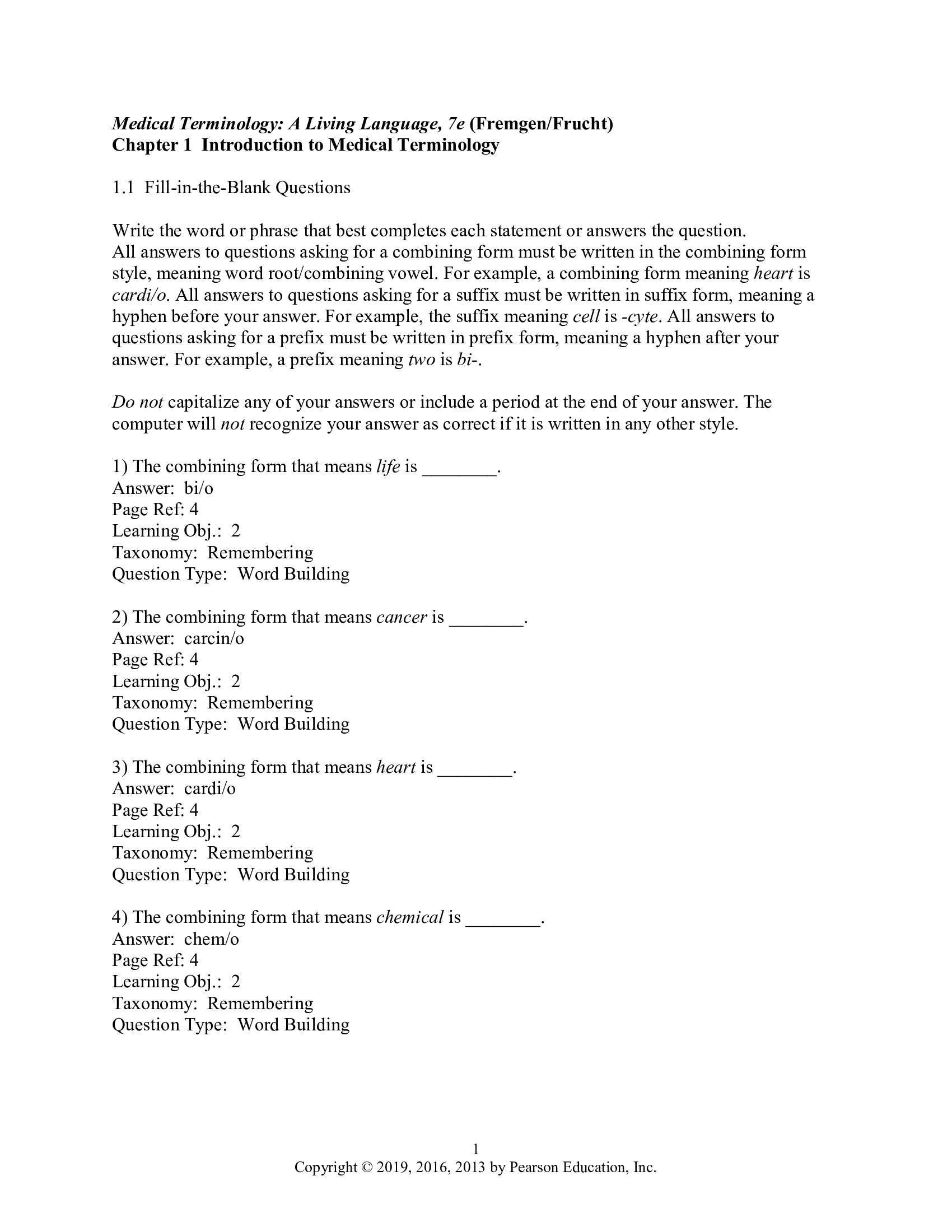
Medical Terminology: A Living Language, 7e (Fremgen/Frucht) Chapter 1  Introduction to Medical Terminology


1.1  Fill-in-the-Blank Questions


Write the word or phrase that best completes each statement or answers the question. All answers to questions asking for a combining form must be written in the combining form style, meaning word root/combining vowel. For example, a combining form meaning heart is cardi/o. All answers to questions asking for a suffix must be written in suffix form, meaning a hyphen before your answer. For example, the suffix meaning cell is -cyte. All answers to questions asking for a prefix must be written in prefix form, meaning a hyphen after your answer. For example, a prefix meaning two is bi-.


Do not capitalize any of your answers or include a period at the end of your answer. The computer will not recognize your answer as correct if it is written in any other style.


1)      The combining form that means life is ________.

Answer:  bi/o

Page Ref: 4

Learning Obj.:  2

Taxonomy:  Remembering

Question Type:  Word Building


2)      The combining form that means cancer is ________.

Answer:  carcin/o

Page Ref: 4

Learning Obj.:  2

Taxonomy:  Remembering

Question Type:  Word Building


3)      The combining form that means heart is ________.

Answer:  cardi/o

Page Ref: 4

Learning Obj.:  2

Taxonomy:  Remembering

Question Type:  Word Building


4)      The combining form that means chemical is ________.

Answer:  chem/o

Page Ref: 4

Learning Obj.:  2

Taxonomy:  Remembering

Question Type:  Word Building


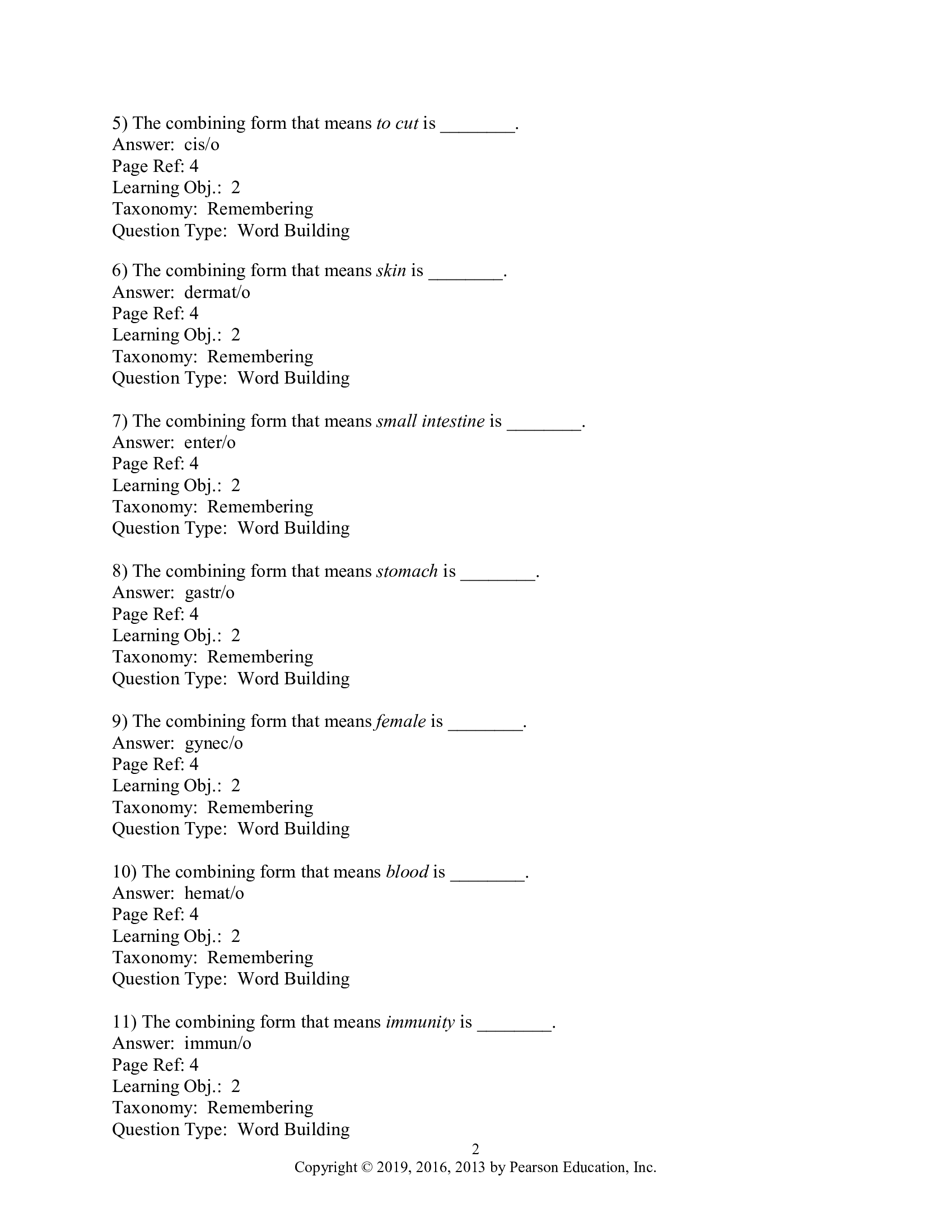
5)      The combining form that means to cut is ________.

Answer:  cis/o

Page Ref: 4

Learning Obj.:  2

Taxonomy:  Remembering

Question Type:  Word Building

6)      The combining form that means skin is ________.

Answer:  dermat/o

Page Ref: 4

Learning Obj.:  2

Taxonomy:  Remembering

Question Type:  Word Building


7)      The combining form that means small intestine is ________.

Answer:  enter/o

Page Ref: 4

Learning Obj.:  2

Taxonomy:  Remembering

Question Type:  Word Building


8)      The combining form that means stomach is ________.

Answer:  gastr/o

Page Ref: 4

Learning Obj.:  2

Taxonomy:  Remembering

Question Type:  Word Building


9)      The combining form that means female is ________.

Answer:  gynec/o

Page Ref: 4

Learning Obj.:  2

Taxonomy:  Remembering

Question Type:  Word Building


10)  The combining form that means blood is ________.

Answer:  hemat/o

Page Ref: 4

Learning Obj.:  2

Taxonomy:  Remembering

Question Type:  Word Building


11)  The combining form that means immunity is ________.

Answer:  immun/o

Page Ref: 4

Learning Obj.:  2

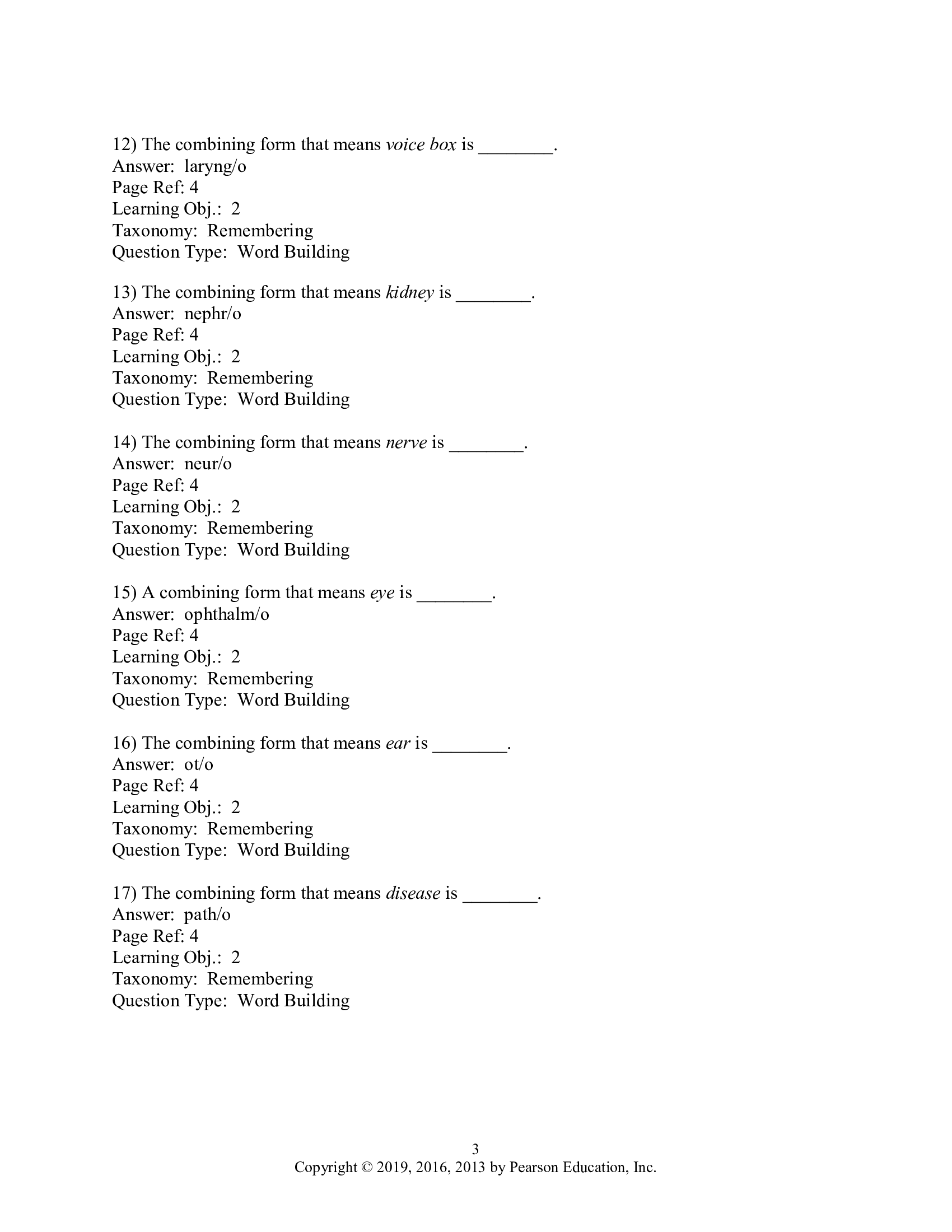
12)  The combining form that means voice box is ________.

Answer:  laryng/o

Page Ref: 4

Learning Obj.:  2

Taxonomy:  Remembering

Question Type:  Word Building

13)  The combining form that means kidney is ________.

Answer:  nephr/o

Page Ref: 4

Learning Obj.:  2

Taxonomy:  Remembering

Question Type:  Word Building


14)  The combining form that means nerve is ________.

Answer:  neur/o

Page Ref: 4

Learning Obj.:  2

Taxonomy:  Remembering

Question Type:  Word Building


15)  A combining form that means eye is ________.

Answer:  ophthalm/o

Page Ref: 4

Learning Obj.:  2

Taxonomy:  Remembering

Question Type:  Word Building


16)  The combining form that means ear is ________.

Answer:  ot/o

Page Ref: 4

Learning Obj.:  2

Taxonomy:  Remembering

Question Type:  Word Building


17)  The combining form that means disease is ________.

Answer:  path/o

Page Ref: 4

Learning Obj.:  2

Taxonomy:  Remembering

Question Type:  Word Building


18)  The combining form that means lung is ________.

Answer:  pulmon/o

Page Ref: 4

Learning Obj.:  2

Taxonomy:  Remembering

Question Type:  Word Building


19)  The combining form that means nose is ________.

Answer:  rhin/o

Page Ref: 4

Learning Obj.:  2

Taxonomy:  Remembering

Question Type:  Word Building

20)  A prefix that means fast is ________.

Answer:  tachy-

Page Ref: 6

Learning Obj.:  3

Taxonomy:  Remembering

Question Type:  Word Building


21)  A prefix that means against is ________.

Answer:  anti-

Page Ref: 5

Learning Obj.:  3

Taxonomy:  Remembering

Question Type:  Word Building


22)  A prefix that means self is ________.

Answer:  auto-

Page Ref: 5

Learning Obj.:  3

Taxonomy:  Remembering

Question Type:  Word Building


23)  A prefix that means slow is ________.

Answer:  brady-

Page Ref: 5

Learning Obj.:  3

Taxonomy:  Remembering

Question Type:  Word Building


24)  A prefix that means painful or difficult is ________.

Answer:  dys-

Page Ref: 5

25)  A prefix that means within or inner is ________.

Answer:  endo-

Page Ref: 6

Learning Obj.:  3

Taxonomy:  Remembering

Question Type:  Word Building


26)  A prefix that means above is ________.

Answer:  epi-

Page Ref: 6

Learning Obj.:  3

Taxonomy:  Remembering

Question Type:  Word Building

27)  A prefix that means normal is ________.

Answer:  eu-

Page Ref: 6

Learning Obj.:  3

Taxonomy:  Remembering

Question Type:  Word Building


28)  A prefix that means outward is ________.

Answer:  ex-

Page Ref: 6

Learning Obj.:  3

Taxonomy:  Remembering

Question Type:  Word Building


29)  A prefix that means outside of is ________.

Answer:  extra-

Page Ref: 6

Learning Obj.:  3

Taxonomy:  Remembering

Question Type:  Word Building


30)  A prefix that means different is ________.

Answer:  hetero-

Page Ref: 6

Learning Obj.:  3

Taxonomy:  Remembering

Question Type:  Word Building

31)  A prefix that means same is ________.

Answer:  homo-

Page Ref: 6

Learning Obj.:  3

Taxonomy:  Remembering

Question Type:  Word Building


32)  A prefix that means between is ________.

Answer:  inter-

Page Ref: 6

Learning Obj.:  3

Taxonomy:  Remembering

Question Type:  Word Building


33)  A prefix that means within is ________.

Answer:           intra-; endo-

Page Ref: 6

Learning Obj.:  3

Taxonomy:  Remembering Question Type:  Word Building

34)  A prefix that means large is ________.

Answer:  macro-

Page Ref: 6

Learning Obj.:  3

Taxonomy:  Remembering

Question Type:  Word Building


35)  A prefix that means new is ________.

Answer:  neo-

Page Ref: 6

Learning Obj.:  3

Taxonomy:  Remembering

Question Type:  Word Building


36)  A prefix that means after is ________.

Answer:  post-

Page Ref: 6

Learning Obj.:  3

Taxonomy:  Remembering

Question Type:  Word Building


37)  A prefix that means false is ________.

Answer:  pseudo-

Page Ref: 6

38)  A prefix that means across is ________.

Answer:  trans-

Page Ref: 6

Learning Obj.:  3

Taxonomy:  Remembering

Question Type:  Word Building


39)  A prefix that means two is ________.

Answer:  bi-

Page Ref: 7

Learning Obj.:  3

Taxonomy:  Remembering

Question Type:  Word Building


40)  A prefix that means four is ________.

Answer:           quadri-; tetra- Page Ref: 7

Learning Obj.:  3

Taxonomy:  Remembering

Question Type:  Word Building

41)  A prefix that means three is ________.

Answer:  tri-

Page Ref: 7

Learning Obj.:  3

Taxonomy:  Remembering

Question Type:  Word Building


42)  A prefix that means none is ________.

Answer:  nulli-

Page Ref: 7

Learning Obj.:  3

Taxonomy:  Remembering

Question Type:  Word Building


43)  A prefix that means small is ________.

Answer:  micro-

Page Ref: 6

Learning Obj.:  3

Taxonomy:  Remembering

Question Type:  Word Building

44)  A prefix that means all is ________.

Answer:  pan-

Page Ref: 7

Learning Obj.:  3

Taxonomy:  Remembering

Question Type:  Word Building


45)  A suffix that means enlarged is ________.

Answer:  -megaly

Page Ref: 8

Learning Obj.:  3

Taxonomy:  Remembering

Question Type:  Word Building


46)  A suffix that means protrusion is ________.

Answer:  -cele

Page Ref: 8

Learning Obj.:  3

Taxonomy:  Remembering

Question Type:  Word Building


47)  A suffix that means pain is ________.

Answer:           -dynia; -algia

Page Ref: 8

Learning Obj.:  3

Taxonomy:  Remembering

Question Type:  Word Building

48)  A suffix that means cell is ________.

Answer:  -cyte

Page Ref: 8

Learning Obj.:  3

Taxonomy:  Remembering

Question Type:  Word Building


49)  A suffix that means dilation is ________.

Answer:  -ectasis

Page Ref: 8

Learning Obj.:  3

Taxonomy:  Remembering

Question Type:  Word Building


50)  A suffix that means inflammation is ________.

Answer:  -itis

Page Ref: 8

51)  A suffix that means one who studies is ________.

Answer:  -logist

Page Ref: 8

Learning Obj.:  3

Taxonomy:  Remembering

Question Type:  Word Building


52)  A suffix that means study of is ________.

Answer:  -logy

Page Ref: 8

Learning Obj.:  3

Taxonomy:  Remembering

Question Type:  Word Building


53)  A suffix that means destruction is ________.

Answer:  -lytic

Page Ref: 8

Learning Obj.:  3

Taxonomy:  Remembering

Question Type:  Word Building


54)  A suffix that means abnormal softening is ________.

Answer:  -malacia

Page Ref: 8

Learning Obj.:  3

Taxonomy:  Remembering

Question Type:  Word Building

55)  A suffix that means tumor or mass is ________.

Answer:  -oma

Page Ref: 8

Learning Obj.:  3

Taxonomy:  Remembering

Question Type:  Word Building


56)  A suffix that means disease is ________.

Answer:  -pathy

Page Ref: 8

Learning Obj.:  3

Taxonomy:  Remembering

Question Type:  Word Building

57)  A suffix that means drooping is ________.

Answer:  -ptosis

Page Ref: 8

Learning Obj.:  3

Taxonomy:  Remembering

Question Type:  Word Building


58)  A suffix that means rupture is ________.

Answer:  -rrhexis

Page Ref: 8

Learning Obj.:  3

Taxonomy:  Remembering

Question Type:  Word Building


59)  A suffix that means hardening is ________.

Answer:  -sclerosis

Page Ref: 9

Learning Obj.:  3

Taxonomy:  Remembering

Question Type:  Word Building


60)  A suffix that means narrowing is ________.

Answer:  -stenosis

Page Ref: 9

Learning Obj.:  3

Taxonomy:  Remembering

Question Type:  Word Building


61)  A suffix that means treatment is ________.

Answer:  -therapy

Page Ref: 9

Learning Obj.:  3

Taxonomy:  Remembering

Question Type:  Word Building

62)  A suffix that means puncture to withdraw fluid is ________.

Answer:  -centesis

Page Ref: 9

Learning Obj.:  3

Taxonomy:  Remembering

Question Type:  Word Building


63)  A suffix that means surgical removal is ________.

Answer:  -ectomy

Page Ref: 9

64)  A suffix that means surgically create an opening is ________.

Answer:  -ostomy

Page Ref: 9

Learning Obj.:  3

Taxonomy:  Remembering

Question Type:  Word Building


65)  A suffix that means cutting into is ________.

Answer:  -otomy

Page Ref: 9

Learning Obj.:  3

Taxonomy:  Remembering

Question Type:  Word Building


66)  A suffix that means surgical fixation is ________.

Answer:  -pexy

Page Ref: 10

Learning Obj.:  3

Taxonomy:  Remembering

Question Type:  Word Building


67)  A suffix that means surgical repair is ________.

Answer:  -plasty

Page Ref: 10

Learning Obj.:  3

Taxonomy:  Remembering

Question Type:  Word Building


68)  A suffix that means suture is ________.

Answer:  -rrhaphy

Page Ref: 10

Learning Obj.:  3

Taxonomy:  Remembering

Question Type:  Word Building

69)  A suffix that means record or picture is ________.

Answer:  -gram

Page Ref: 10

Learning Obj.:  3

Taxonomy:  Remembering

Question Type:  Word Building


70)  A suffix that means process of recording is ________.

Answer:  -graphy

Page Ref: 10

Learning Obj.:  3

Taxonomy:  Remembering

Question Type:  Word Building


71)  A suffix that means instrument for measuring is ________.

Answer:  -meter

Page Ref: 10

Learning Obj.:  3

Taxonomy:  Remembering

Question Type:  Word Building


72)  A suffix that means process of measuring is ________.

Answer:  -metry

Page Ref: 10

Learning Obj.:  3

Taxonomy:  Remembering

Question Type:  Word Building


73)  A suffix that means instrument for viewing is ________.

Answer:  -scope

Page Ref: 10

Learning Obj.:  3

Taxonomy:  Remembering

Question Type:  Word Building


74)  A suffix that means process of visually examining is ________.

Answer:  -scopy

Page Ref: 10

Learning Obj.:  3

Taxonomy:  Remembering

Question Type:  Word Building


75)  A suffix that means pertaining to visually examining is ________.

Answer:  -scopic

Page Ref: 10

Learning Obj.:  3

Taxonomy:  Remembering

Question Type:  Word Building

1.2  True/False Questions


1)      A combining form consists of a word root and combining vowel.

Answer:  TRUE

Page Ref: 4

Learning Obj.:  1

Taxonomy:  Remembering

Question Type:  Word Building


2)      The prefix often indicates the body system or organ being discussed.

Answer:  FALSE

Explanation:  The prefix often indicates the location of an organ, the number of parts, or the time (frequency). The word root often indicates the body system or organ being discussed.

Page Ref: 5

Learning Obj.:  1

Taxonomy:  Remembering

Question Type:  Word Building


3)      Combining vowels make medical terms easier to pronounce.

Answer:  TRUE

Page Ref: 3

Learning Obj.:  1

Taxonomy:  Remembering

Question Type:  Word Building


4)      Prefixes are placed before a word root.

Answer:  TRUE

Page Ref: 5

Learning Obj.:  1

Taxonomy:  Remembering

Question Type:  Word Building


5)      All medical terms must have a prefix. Answer:  FALSE

Explanation:  Every medical term must have a suffix. It is the only required word part.

Page Ref: 5

Learning Obj.:  1

Taxonomy:  Remembering

Question Type:  Word Building


6)      Adjective suffixes convert a word root into an adjective.

Answer:  TRUE

Page Ref: 9

Learning Obj.:  1

Taxonomy:  Remembering

Question Type:  Word Building


7)      Different pronunciations of medical terms are acceptable.

Answer:  TRUE

Page Ref: 11

Learning Obj.:  4

Taxonomy:  Remembering

Question Type:  Word Building

8)      Different spellings of medical terms are acceptable. Answer:  FALSE

Explanation:  It is okay to pronounce terms differently, but correct spelling is critical. Page Ref: 11

Learning Obj.:  5

Taxonomy:  Remembering

Question Type:  Spelling


9)      Terms ending in -a are pluralized by simply adding an -e to the end of the term.

Answer:  TRUE

Page Ref: 12

Learning Obj.:  6

Taxonomy:  Remembering

Question Type:  Spelling


10)  Terms ending in -um are pluralized by simply adding an -s to the end of the term. Answer:  FALSE

Explanation:  Terms ending in -um are pluralized by dropping the -um and adding an -a.

Page Ref: 12

Learning Obj.:  6

Taxonomy:  Remembering

Question Type:  Spelling


11)  Abbreviations are an important part of learning medical terminology.

Answer:  TRUE

Page Ref: 13

Learning Obj.:  7

Taxonomy:  Remembering

Question Type:  Abbreviations


12)  A History and Physical is written each time a specialist evaluates a patient.

Answer:  FALSE

Explanation:  A History and Physical is written by the admitting physician and details the patient's history, results of physician's examination, initial diagnoses, and physician's plan of treatment. A consultation report is written by a specialist.

Page Ref: 14

Learning Obj.:  8

Taxonomy:  Remembering

Question Type:  Medical Record


13)  Ancillary Reports are written by the anesthesiologist and surgeon.

Answer:  FALSE

Explanation:  An ancillary report is a report from various therapies and treatments the patient has received, such as rehabilitation, social services, or respiratory therapy. An anesthesiologist writes an anesthesiologist's report, and a surgeon writes an operative report.

Page Ref: 14

Learning Obj.:  8

Taxonomy:  Remembering

Question Type:  Medical Record

14)  A Pathologist's Report gives the results of the examination of tissue removed from a patient. Answer:  TRUE

Page Ref: 14

Learning Obj.:  8

Taxonomy:  Remembering

Question Type:  Medical Record


15)  The results from the lab and X-rays are given in a Diagnostic Report.

Answer:  TRUE

Page Ref: 14

Learning Obj.:  8

Taxonomy:  Remembering

Question Type:  Medical Record


16)  The Informed Consent must be signed by a patient voluntarily.

Answer:  TRUE

Page Ref: 14

Learning Obj.:  8

Taxonomy:  Remembering

Question Type:  Medical Record


17)  A psychiatric hospital is an example of an ambulatory care center. Answer:  FALSE

Explanation:  A psychiatric hospital is an example of a specialty care hospital. Page Ref: 15

Learning Obj.:  9

Taxonomy:  Remembering

Question Type:  Healthcare Settings


18)  Rehabilitation centers provide supportive care for terminal patients.

Answer:  FALSE

Explanation:  Hospice provides supportive care for terminal patients. Rehabilitation centers provide intensive physical and occupational therapy.

Page Ref: 15

Learning Obj.:  9

Taxonomy:  Remembering

Question Type:  Healthcare Settings


19)  Home health care provides nursing, therapy, and personal care in the patient's home.

Answer:  TRUE

Page Ref: 15

Learning Obj.:  9

Taxonomy:  Remembering

Question Type:  Healthcare Settings


20)  Ambulatory care and outpatient clinics both provide services that do not require overnight hospitalization. Answer:  TRUE

Page Ref: 15

Learning Obj.:  9

Taxonomy:  Remembering

Question Type:  Healthcare Settings

21)  The suffix -gram means a record or picture.

Answer:  TRUE

Page Ref: 10

Learning Obj.:  3

Taxonomy:  Remembering

Question Type:  Word Building


22)  The suffix -scope means instrument for measuring.

Answer:  FALSE

Explanation:  The suffix -scope means instrument for viewing; the suffix -meter means instrument for measuring.

Page Ref: 10

Learning Obj.:  3

Taxonomy:  Remembering

Question Type:  Word Building


23)  The suffix -tome means instrument to cut.

Answer:  TRUE

Page Ref: 10

Learning Obj.:  3

Taxonomy:  Remembering

Question Type:  Word Building


24)  The suffix -ectomy means to surgically repair.

Answer:  FALSE

Explanation:  The suffix -ectomy means to surgically remove; the suffix -plasty means to surgically repair. Page Ref: 9

Learning Obj.:  3

Taxonomy:  Remembering

Question Type:  Word Building


25)  The suffix -pexy means surgical fixation.

Answer:  TRUE

Page Ref: 10

Learning Obj.:  3

Taxonomy:  Remembering

Question Type:  Word Building


26)  The suffix -otomy means to surgically remove.

Answer:  FALSE

Explanation:  The suffix -otomy means to surgically cut into; the suffix -ectomy means to surgically remove. Page Ref: 9

Learning Obj.:  3

Taxonomy:  Remembering

Question Type:  Word Building


27)  The suffix -osis means abnormal condition.

Answer:  TRUE

Page Ref: 8

Learning Obj.:  3

Taxonomy:  Remembering

Question Type:  Word Building

28)  The suffix -trophy means treatment. Answer:  FALSE

Explanation:  The suffix -trophy means development; the suffix -therapy means treatment. Page Ref: 9

Learning Obj.:  3

Taxonomy:  Remembering

Question Type:  Word Building


29)  The suffix -genic means producing.

Answer:  TRUE

Page Ref: 8

Learning Obj.:  3

Taxonomy:  Remembering

Question Type:  Word Building


30)  The suffix -megaly means abnormal softening. Answer:  FALSE

Explanation:  The suffix -megaly means enlarged; the suffix -malacia means abnormal softening. Page Ref: 8

Learning Obj.:  3

Taxonomy:  Remembering

Question Type:  Word Building


31)  The prefix mono- means one.

Answer:  TRUE

Page Ref: 7

Learning Obj.:  3

Taxonomy:  Remembering

Question Type:  Word Building


32)  The prefix multi- means none. Answer:  FALSE

Explanation:  The prefix multi- means many; the prefix nulli- means none.

Page Ref: 7

Learning Obj.:  3

Taxonomy:  Remembering

Question Type:  Word Building


33)  The prefixes quadri- and tetra- have the same meaning.

Answer:  TRUE

Page Ref: 7

Learning Obj.:  3

Taxonomy:  Remembering

Question Type:  Word Building


34)  The prefix per- means beside. Answer:  FALSE

Explanation:  The prefix per- means through; the prefix para- means beside.

Page Ref: 6

Learning Obj.:  3

Taxonomy:  Remembering Question Type:  Word Building

35)  The prefix pseudo- means above. Answer:  FALSE

Explanation:  The prefix pseudo- means false; the prefix epi- means above.

Page Ref: 6

Learning Obj.:  3

Taxonomy:  Remembering

Question Type:  Word Building


36)  The suffixes -iasis and -osis have the same meaning.

Answer:  TRUE

Page Ref: 8

Learning Obj.:  3

Taxonomy:  Remembering

Question Type:  Word Building


37)  The suffixes -rrhea and -rrhexis have the same meaning. Answer:  FALSE

Explanation:  The suffix -rrhea means discharge; the suffix -rrhexis means rupture. Page Ref: 8

Learning Obj.:  3

Taxonomy:  Remembering

Question Type:  Word Building


38)  The prefix eu- means painful or difficult. Answer:  FALSE

Explanation:  The prefix eu- means normal; the prefix dys- means painful or difficult. Page Ref: 6

Learning Obj.:  3

Taxonomy:  Remembering

Question Type:  Word Building


39)  The prefixes a- and an- have the same meaning.

Answer:  TRUE

Page Ref: 5

Learning Obj.:  3

Taxonomy:  Remembering

Question Type:  Word Building


40)  The prefix brady- means fast. Answer:  FALSE

Explanation:  The prefix brady- means slow; the prefix tachy- means fast.

Page Ref: 5

Learning Obj.:  3

Taxonomy:  Remembering

Question Type:  Word Building


41)  The combining form bi/o means life.

Answer:  TRUE

Page Ref: 4

Learning Obj.:  2

Taxonomy:  Remembering

Question Type:  Word Building

42)  The combining form gynec/o means beginning.

Answer:  FALSE

Explanation:  The combining form gynec/o means female.

Page Ref: 4

Learning Obj.:  2

Taxonomy:  Remembering

Question Type:  Word Building


43)  The combining form hemat/o means blood.

Answer:  TRUE

Page Ref: 4

Learning Obj.:  2

Taxonomy:  Remembering

Question Type:  Word Building


44)  The combining form nephr/o means nerve.

Answer:  FALSE

Explanation:  The combining form nephr/o means kidney; the combining form neur/o means nerve. Page Ref: 4

Learning Obj.:  2

Taxonomy:  Remembering

Question Type:  Word Building


45)  The combining form cardi/o means heart.

Answer:  TRUE

Page Ref: 4

Learning Obj.:  2

Taxonomy:  Remembering

Question Type:  Word Building


46)  The combining form carcin/o means disease.

Answer:  FALSE

Explanation:  The combining form carcin/o means cancer; the combining form path/o means disease. Page Ref: 4

Learning Obj.:  2

Taxonomy:  Remembering

Question Type:  Word Building


47)  The combining form ot/o means eye.

Answer:  FALSE

Explanation:  The combining form ot/o means ear; the combining form ophthalm/o means eye. Page Ref: 4

Learning Obj.:  2

Taxonomy:  Remembering

Question Type:  Word Building


48)  The combining form dermat/o means skin.

Answer:  TRUE

Page Ref: 4

Learning Obj.:  2

Taxonomy:  Remembering

Question Type:  Word Building

49)  The combining form enter/o means inside. Answer:  FALSE

Explanation:  The combining form enter/o means small intestine.

Page Ref: 4

Learning Obj.:  2

Taxonomy:  Remembering

Question Type:  Word Building


50)  The combining form gastr/o means stomach.

Answer:  TRUE

Page Ref: 4

Learning Obj.:  2

Taxonomy:  Remembering

Question Type:  Word Building


51)  A drug's brand name is also its proprietary name.

Answer:  TRUE

Page Ref: 16

Learning Obj.:  11

Taxonomy:  Remembering

Question Type:  Pharmacology


52)  OTC drugs require a prescription. Answer:  FALSE

Explanation:  OTC drugs are over-the-counter drugs, which do not require a prescription. Page Ref: 17

Learning Obj.:  11

Taxonomy:  Remembering

Question Type:  Pharmacology


53)  The abbreviation tid means three times a day.

Answer:  TRUE

Page Ref: 18

Learning Obj.:  12

Taxonomy:  Remembering

Question Type:  Abbreviations


1.3  Multiple Choice Questions


1) Which is NOT one of the word parts in a medical term?

A)  combining vowel

B)   word root

C)   combining form

D)  suffix

Answer:  C

Explanation:  The combining form is not part of a medical term; it is used to write a word root by itself. Combining vowel, word root, and suffix are all parts of a medical term. Page Ref: 3

Learning Obj.:  1

Taxonomy:  Remembering

Question Type:  Word Building

2) Which medical terminology word part provides the general meaning of the word?

A)  combining vowel

B)   word root

C)   suffix

D)  prefix

Answer:  B

Explanation:  The word root provides the general meaning of the word. The combining vowel makes it possible to pronounce long medical terms and to combine parts. The suffix is added to the end of a term to add meaning, such as a condition, disease, or procedure. The prefix is added to the beginning of the term and gives us information such as the location of an organ, the number of parts, or the time (frequency).

Page Ref: 3

Learning Obj.:  1

Taxonomy:  Remembering

Question Type:  Word Building


3) In which situation is a combining vowel never used?

A)  between two word roots

B)   between a word root and the suffix when the suffix begins with a consonant

C)   between a prefix and word root

D)  all of the above

Answer:  C

Explanation:  A combining vowel is never used between a prefix and a word root. A combining vowel is used between two word roots or between a word root and suffix when the suffix begins with a consonant. Page Ref: 3, 4

Learning Obj.:  1

Taxonomy:  Remembering

Question Type:  Word Building


4) Which of the following is NOT the type of information provided by a prefix?

A)  procedure

B)   location of an organ

C)   number of parts

D)  time

Answer:  A

Explanation:  A suffix provides information such as a procedure. A prefix provides information such as the location of an organ, number of parts, or time.

Page Ref: 5

Learning Obj.:  1

Taxonomy:  Remembering

Question Type:  Word Building

5) Which of the following is the type of information provided by a suffix?

A)  procedure

B)   location of an organ

C)   number of parts

D)  time

Answer:  A

Explanation:  A suffix provides information such as a procedure. Information such as the location of an organ, number of parts, and time are provided by a prefix.

Page Ref: 7

Learning Obj.:  1

Taxonomy:  Remembering

Question Type:  Word Building


6) Which of the following statements regarding abbreviations is NOT correct? A) Abbreviations are commonly used.

B)   Using your personal abbreviations is acceptable if approved by your supervisor.

C)   Use of abbreviations can be confusing.

D)  Spell out abbreviations if confusion is a possibility.

Answer:  B

Explanation:  Using personal abbreviations is never acceptable. The other answers are correct regarding abbreviations.

Page Ref: 13

Learning Obj.:  7

Taxonomy:  Remembering

Question Type:  Abbreviations


7) Which of the following healthcare specialists do NOT report information regarding a patient in an Ancillary Report?

A)  rehabilitation

B)   social services

C)   respiratory therapy

D)  nurses

Answer:  D

Explanation:  Nurses report information regarding a patient in the Nurse's Notes. Rehabilitation, social services, and respiratory therapy all use an Ancillary Report.

Page Ref: 14

Learning Obj.:  8

Taxonomy:  Remembering

Question Type:  Medical Record

8) Which of the following records the patient's care throughout the day?

A)  Physician's Orders

B)   Discharge Summary

C)   Nurse's Notes

D)  History and Physical

Answer:  C

Explanation:  Nurse's Notes are used to record the patient's care throughout the day. The

Physician's Orders are a complete list of care, medications, tests, and treatments for the patient. The Discharge Summary is a comprehensive outline of the patient's entire hospital stay. The History and Physical is written or dictated by the admitting physician and details the patient's history, results of physician's examination, initial diagnoses, and physician's plan of treatment. Page Ref: 14

Learning Obj.:  8

Taxonomy:  Remembering

Question Type:  Medical Record


9) A surgeon reports the details of a surgery in a(n): A) Operative Report.

B)   Anesthesiologist's Report.

C)   Informed Consent.

D)  Physician's Orders.

Answer:  A

Explanation:  The Operative Report is written by the surgeon giving the details of the surgery. The Anesthesiologist's Report is written by the anesthesiologist and details substances given to the patient, the patient's response to anesthesia, and vital signs during the surgery. The Informed Consent is a document voluntarily signed by the patient or a responsible party that clearly describes the purpose, methods, procedures, benefits, and risks of a diagnostic or treatment procedure. The Physician's Orders are a complete list of care, medications, tests, and treatments for the patient. Page Ref: 14

Learning Obj.:  8

Taxonomy:  Remembering

Question Type:  Medical Record


10) The ________ is a comprehensive outline of the patient's entire hospital stay.

A)  Nurse's Notes

B)   Discharge Summary

C)   Consultation Report

D)  History and Physical

Answer:  B

Explanation:  The Discharge Summary is a comprehensive outline of the patient's entire hospital stay. The Nurse's Notes are a record of the patient's care throughout the day. The Consultation Report is a report given by a specialist who has been asked by the physician to evaluate the patient. The History and Physical is written by the admitting physician and details the patient's history, results of the physician's examination, initial diagnoses, and physician's plan of treatment. Page Ref: 14

Learning Obj.:  8

Taxonomy:  Remembering

Question Type:  Medical Record

11) Which healthcare setting provides treatment in a private office setting?

A)  ambulatory care

B)   specialty care

C)   hospice

D)  physician's office

Answer:  D

Explanation:  The physician's office provides treatment in a private office setting. Ambulatory care provides services not requiring overnight hospitalization. Specialty care provides care for very specific types of diseases. Hospice provides supportive treatment for terminally ill patients. Page Ref: 15

Learning Obj.:  9

Taxonomy:  Remembering

Question Type:  Healthcare Settings


12) Which healthcare setting provides supportive treatment for terminally ill patients?

A)  hospice

B)   rehabilitation center

C)   health maintenance organization

D)  specialty care hospital

Answer:  A

Explanation:  Hospice provides supportive treatment for terminally ill patients. A rehabilitation center provides intensive physical and occupational therapy. A health maintenance organization provides a wide range of services by a group of primary-care physicians, specialists, and other healthcare professionals in a prepaid system. A specialty care hospital provides care for very specific types of diseases.

Page Ref: 15

Learning Obj.:  9

Taxonomy:  Remembering

Question Type:  Healthcare Settings


13) Which healthcare setting provides care for patients who need extra time to recover from an illness or who can no longer care for themselves?

A)  specialty care hospital

B)   health maintenance organization

C)   nursing home

D)  general hospital

Answer:  C

Explanation:  A nursing home provides care for patients who need extra time to recover from an illness or who can no longer care for themselves. A specialty care hospital provides care for a very specific disease. A health maintenance organization provides a wide range of services by a group of primary-care physicians, specialists, and other healthcare professionals in a prepaid system. A general hospital provides services to diagnose (laboratory, diagnostic imaging) and treat (surgery, medications, therapy) diseases for a short period of time; in addition, they usually provide emergency and obstetrical care.

Page Ref: 15

Learning Obj.:  9

Taxonomy:  Remembering

Question Type:  Healthcare Settings

14) Which healthcare setting provides services in a prepaid system?

A)  physician's office

B)   health maintenance organization

C)   specialty care hospital

D)  home health care

Answer:  B

Explanation:  A health maintenance organization provides services in a prepaid system. A physician's office provides services in a private office setting. A specialty care hospital provides care for a very specific disease. Home health care provides nursing, therapy, personal care, or housekeeping services in a patient's home.

Page Ref: 15

Learning Obj.:  9

Taxonomy:  Remembering

Question Type:  Healthcare Settings


15) Which combining form means heart?

A)  cardi/o

B)   carcin/o

C)   gastr/o

D)  cis/o

Answer:  A

Explanation:  The combining form cardi/o means heart. Carcin/o means cancer, gastr/o means stomach, and cis/o means to cut.

Page Ref: 4

Learning Obj.:  2

Taxonomy:  Remembering

Question Type:  Word Building


16) Which combining form is spelled incorrectly?

A)  gastr/o

B)   carcen/o

C)   immun/o D) nephr/o

Answer:  B

Explanation:  The correct spelling of the combining form meaning cancer is carcin/o. The other combining forms are spelled correctly.

Page Ref: 4

Learning Obj.:  2

Taxonomy:  Remembering

Question Type:  Spelling


17) Which combining form is spelled incorrectly?

A)  nuer/o

B)   bi/o

C)   rhin/o

D)  path/o

Answer:  A

Explanation:  The correct spelling of the combining form meaning nerve is neur/o. The other combining forms are spelled correctly.

Page Ref: 4

Learning Obj.:  2

Taxonomy:  Remembering Question Type:  Spelling

18) Which combining form is spelled incorrectly?

A)  dermat/o

B)   hemat/o

C)   nephr/o

D)  opthalm/o

Answer:  D

Explanation:  The correct spelling of the combining form meaning eye is ophthalm/o. The other combining forms are spelled correctly.

Page Ref: 4

Learning Obj.:  2

Taxonomy:  Remembering

Question Type:  Spelling


19) Which combining form is spelled incorrectly?

A)  gynic/o

B)   carcin/o

C)   laryng/o D) nephr/o

Answer:  A

Explanation:  The correct spelling of the combining form meaning female is gynec/o. The other combining forms are spelled correctly.

Page Ref: 4

Learning Obj.:  2

Taxonomy:  Remembering

Question Type:  Spelling


20) Which combining form means female?

A)  gastr/o

B)   nephr/o

C)   neur/o

D)  gynec/o

Answer:  D

Explanation:  The combining form meaning female is gynec/o. Gastr/o means stomach, nephr/o means kidney, and neur/o means nerve.

Page Ref: 4

Learning Obj.:  2

Taxonomy:  Remembering

Question Type:  Word Building


21) Which combining form means skin?

A) dermat/o B) gynec/o

C) immun/o D) rhin/o

Answer:  A

Explanation:  The combining form meaning skin is dermat/o. Gynec/o means female, immun/o means immunity, and rhin/o means nose.

Page Ref: 4

Learning Obj.:  2

Taxonomy:  Remembering

Question Type:  Word Building

22) Which combining form means nose?

A)  pulmon/o

B)   ot/o

C)   rhin/o

D)  laryng/o

Answer:  C

Explanation:  The combining form meaning nose is rhin/o. Pulmon/o means lung, ot/o means ear, and laryng/o means voice box.

Page Ref: 4

Learning Obj.:  2

Taxonomy:  Remembering

Question Type:  Word Building


23) Which combining form means to cut?

A)  enter/o

B)   path/o

C)   bi/o

D)  cis/o

Answer:  D

Explanation:  The combining form cis/o means to cut. Enter/o means small intestine, path/o means disease, and bi/o means life.

Page Ref: 4

Learning Obj.:  2

Taxonomy:  Remembering

Question Type:  Word Building


24) Which combining form means stomach?

A)  cardi/o

B)   gastr/o

C)   enter/o

D)  nephr/o

Answer:  B

Explanation:  The combining form meaning stomach is gastr/o. Cardi/o means heart, enter/o means small intestine, and nephr/o means kidney.

Page Ref: 4

Learning Obj.:  2

Taxonomy:  Remembering

Question Type:  Word Building


25) Which prefix means before?

A)  anti-

B)   pre- C) retro- D) in-

Answer:  B

Explanation:  The prefix pre- means before. The prefix anti- means against, retro- means backward or behind, and in- means not or inward.

Page Ref: 6

Learning Obj.:  3

Taxonomy:  Remembering Question Type:  Word Building

26) Which prefix means outside of?

A)  homo-

B)   intra- C) extra- D) hyper- Answer:  C

Explanation:  The prefix extra- means outside of. The prefix homo- means same, intra- means within, and hyper- means excessive.

Page Ref: 6

Learning Obj.:  3

Taxonomy:  Remembering

Question Type:  Word Building


27) Which prefix does NOT stand for a number?

A) bi- B) per- C) quadri- D) tri-

Answer:  B

Explanation:  The prefix per- means through. The prefix bi- means two, quadri- means four, and tri- means three. Page Ref: 7

Learning Obj.:  3

Taxonomy:  Remembering

Question Type:  Word Building


28) Which prefix means half?

A)  mono-

B)   poly-

C)   peri- D) hemi- Answer:  D

Explanation:  The prefix hemi- means half. The prefix mono- means one, poly- means many, and peri- means around. Page Ref: 7

Learning Obj.:  3

Taxonomy:  Remembering

Question Type:  Word Building


29) Which prefix means within?

A) intra- B) extra-

C) inter- D) retro- Answer:  A

Explanation:  The prefix intra- means within. The prefix extra- means outside of, inter- means between, and retro- means backward or behind.

Page Ref: 6

Learning Obj.:  3

Taxonomy:  Remembering Question Type:  Word Building

30) Which prefix means normal?

A) eu- B) neo-

C) an- D) dys- Answer:  A

Explanation:  The prefix eu- means normal. The prefix neo- means new, an- means without, and dys- means difficult or painful.

Page Ref: 6

Learning Obj.:  3

Taxonomy:  Remembering

Question Type:  Word Building


31) Which prefix means many?

A)  nulli-

B)   un- C) poly- D) pan- Answer:  C

Explanation:  The prefix poly- means many. The prefix nulli- means none, un- means not, and pan- means all. Page Ref: 7

Learning Obj.:  3

Taxonomy:  Remembering

Question Type:  Word Building


32) Which prefix means fast?

A)  pseudo-

B)   brady-

C)   endo- D) tachy- Answer:  D

Explanation:  The prefix tachy- means fast. The prefix pseudo- means false, brady- means slow, and endo- means within or inner.

Page Ref: 6

Learning Obj.:  3

Taxonomy:  Remembering

Question Type:  Word Building


33) Which prefix means small?

A)  pan-

B)   micro-

C)   ultra- D) macro- Answer:  B

Explanation:  The prefix micro- means small. The prefix pan- means all, ultra- means beyond, and macro- means large.

Page Ref: 6

Learning Obj.:  3

Taxonomy:  Remembering

Question Type:  Word Building

34) Which prefix means none?

A)  nulli-

B)   neo- C) mono- D) sub- Answer:  A

Explanation:  The prefix nulli- means none. The prefix neo- means new, mono- means one, and sub- means under. Page Ref: 7

Learning Obj.:  3

Taxonomy:  Remembering

Question Type:  Word Building


35) Which suffix means pain?

A)  -cele

B)   -algia

C)   -ectasis D) -oma

Answer:  B

Explanation:  The suffix -algia means pain. The suffix -cele means protrusion, -ectasis means dilation, and -oma means tumor or mass.

Page Ref: 8

Learning Obj.:  3

Taxonomy:  Remembering

Question Type:  Word Building


36) Which suffix means hardening?

A)  -trophy

B)   -sclerosis

C)   -plasm

D)  -ptosis

Answer:  B

Explanation:  The suffix -sclerosis means hardening. The suffix -trophy means development, plasm means formation, and -ptosis means drooping.

Page Ref: 9

Learning Obj.:  3

Taxonomy:  Remembering

Question Type:  Word Building


37) Which suffix means tumor or mass?

A)  -itis

B)   -iasis

C)   -oma D) -osis

Answer:  C

Explanation:  The suffix -oma means tumor or mass. The suffix -itis means inflammation. The suffixes -iasis and -osis mean abnormal condition.

Page Ref: 8

Learning Obj.:  3

Taxonomy:  Remembering

Question Type:  Word Building

38) Which suffix means excessive, abnormal flow?

A)  -rrhea

B)   -rrhage

C)   -rrhexis

D)  -rrhaphy

Answer:  B

Explanation:  The suffix -rrhage means excessive, abnormal flow. The suffix -rrhea means discharge, -rrhexis means rupture, and -rrhaphy means suture.

Page Ref: 8

Learning Obj.:  3

Taxonomy:  Remembering

Question Type:  Word Building


39) Which of the following suffixes is NOT an adjective suffix?

A)  -iac

B)   -ia

C)   -ory D) -tic

Answer:  B

Explanation:  The suffix -ia means state or condition. The suffixes -iac, -ory, and -tic are adjective suffixes. Page Ref: 9

Learning Obj.:  3

Taxonomy:  Remembering

Question Type:  Word Building


40) Which of the following suffixes is NOT an adjective suffix?

A)  -ac

B)   -eal

C)   -iac

D)  -ism

Answer:  D

Explanation:  The suffix -ism means state of. The suffixes -ac, -eal, and -iac are adjective suffixes. Page Ref: 9

Learning Obj.:  3

Taxonomy:  Remembering

Question Type:  Word Building


41) Which of the following suffixes refers to an instrument?

A)  -gram

B)   -graphy

C)   -metry D) -scope

Answer:  D

Explanation:  The suffix -scope means instrument for viewing. The suffix -gram means record or picture, -graphy means process of recording, and -metry means process of measuring.

Page Ref: 10

Learning Obj.:  3

Taxonomy:  Remembering

Question Type:  Word Building

42) Which of the following suffixes means process of measuring?

A)  -graphy

B)   -scopy

C)   -metry

D)  -otomy

Answer:  C

Explanation:  The suffix -metry means process of measuring. The suffix -graphy means process of recording, -scopy means process of visually examining, and -otomy means cutting into. Page Ref: 10

Learning Obj.:  3

Taxonomy:  Remembering

Question Type:  Word Building


43) Which of the following suffixes does NOT refer to a surgical procedure?

A)  -megaly

B)   -ectomy

C)   -plasty

D)  -ostomy

Answer:  A

Explanation:  The suffix -megaly means enlarged. The suffixes -ectomy, -plasty, and -ostomy all refer to a surgical procedure.

Page Ref: 8

Learning Obj.:  3

Taxonomy:  Remembering

Question Type:  Word Building


44) Which of the following suffixes means enlarged?

A)  -malacia

B)   -ectasis

C)   -megaly D) -algia

Answer:  C

Explanation:  The suffix -megaly means enlarged. The suffix -malacia means abnormal softening, -ectasis means dilation, and -algia means pain.

Page Ref: 8

Learning Obj.:  3

Taxonomy:  Remembering

Question Type:  Word Building


45) Which of the following suffixes means puncture to withdraw fluid?

A)  -centesis

B)   -ostomy

C)   -otomy D) -plasty

Answer:  A

Explanation:  The suffix -centesis means puncture to withdraw fluid. The suffix -ostomy means to surgically create an opening, -otomy means cutting into, and -plasty means to surgically repair. Page Ref: 9

Learning Obj.:  3

Taxonomy:  Remembering

Question Type:  Word Building

46) Which of the following suffixes means protrusion?

A)  -lytic

B)   -cele

C)   -cyte D) -gen

Answer:  B

Explanation:  The suffix -cele means protrusion. The suffix -lytic means destruction, -cyte means cell, and -gen means that which produces.

Page Ref: 8

Learning Obj.:  3

Taxonomy:  Remembering

Question Type:  Word Building


47) Which of the following suffixes means inflammation?

A)  -ia

B)   -iasis

C)   -ism D) -itis

Answer:  D

Explanation:  The suffix -itis means inflammation. The suffix -ia means state or condition, -iasis means abnormal condition, and -ism means state of.

Page Ref: 8

Learning Obj.:  3

Taxonomy:  Remembering

Question Type:  Word Building


48) Which of the following suffixes means narrowing?

A)  -sclerosis

B)   -rrhexis

C)   -stenosis D) -ptosis

Answer:  C

Explanation:  The suffix -stenosis means narrowing. The suffix -sclerosis means hardening, rrhexis means rupture, and -ptosis means drooping.

Page Ref: 9

Learning Obj.:  3

Taxonomy:  Remembering

Question Type:  Word Building


49) Which of the following suffixes means drooping?

A)  -ptosis

B)   -plasm

C)   -pathy

D)  -trophy

Answer:  A

Explanation:  The suffix -ptosis means drooping. The suffix -plasm means formation, -pathy means disease, and -trophy means development.

Page Ref: 8

Learning Obj.:  3

Taxonomy:  Remembering

Question Type:  Word Building

50) Which of the following suffixes means destruction?

A)  -rrhea

B)   -lytic

C)   -cyte

D)  -megaly Answer:  B

Explanation:  The suffix -lytic means destruction. The suffix -rrhea means discharge, -cyte means cell, and -megaly means enlarged.

Page Ref: 8

Learning Obj.:  3

Taxonomy:  Remembering

Question Type:  Word Building


51) Which of the following categories of drugs is another name for a drug's trademark name? A) brand name

B)   generic name

C)   chemical name

D)  nonproprietary name

Answer:  A

Explanation:  The brand name is also the trademark name. The generic or nonproprietary name is the official name for a drug. The chemical name describes the chemical formula or molecular structure of the drug. Page Ref: 16

Learning Obj.:  11

Taxonomy:  Remembering

Question Type:  Pharmacology


52) Which of the following abbreviations means label as follows?

A)  top

B)   OTC

C)   Sig

D)  NPO

Answer:  C

Explanation:  Sig stands for label as follows; top stands for topical. OTC stands for over the counter; NPO stands for nothing by mouth.

Page Ref: 18

Learning Obj.:  12

Taxonomy:  Remembering

Question Type:  Abbreviations

1.4  Matching Questions


Choose the item in column 2 that best matches each item in column 1.


A)    lung

B)    hardening

C)    connects two word roots

D)    heart

E)     used to indicate time

F)     stomach

G)    cell

H)    foundation of a medical term

I)       report of treatments and therapies

J)       does not require overnight hospitalization

K)    backward

L)     surgical removal

M)   used to indicate a procedure

N)    destruction

O)    provides supportive treatment for terminally ill

P)     also called a general hospital

Q)    slow

R)    written by a surgeon

S)     written by the admitting physician

T)     record of a patient's care throughout the day

U)    after

V)    word root + combining vowel

W)  provide physical and occupational therapy

X)    false

Y)    kidney


1)      combining vowel 

Page Ref: 3, 4

Learning Obj.:  2          

Taxonomy:  Remembering

Question Type:  Word Building           


2)      word root  

Page Ref: 3

Learning Obj.:  2          

Taxonomy:  Remembering

Question Type:  Word Building           


3)      suffix         

Page Ref: 7, 8

Learning Obj.:  3          

Taxonomy:  Remembering

Question Type:  Word Building           

4)      prefix

Page Ref: 5       

Learning Obj.:  3

Taxonomy:  Remembering

Question Type:  Word Building           


5)      combining form     

Page Ref: 4

Learning Obj.:  2          

Taxonomy:  Remembering

Question Type:  Word Building           


6)      Nurse's Notes

Page Ref: 14

Learning Obj.:  8          

Taxonomy:  Remembering

Question Type:  Medical Record         


7)      Ancillary Report

Page Ref: 14                 

Learning Obj.:  8          

Taxonomy:  Remembering

Question Type:  Medical Record         


8)      History and Physical

Page Ref: 14 

Learning Obj.:  8          

Taxonomy:  Remembering

Question Type:  Medical Record

9)      Operative Report  

Page Ref: 14

Learning Obj.:  8

Taxonomy:  Remembering

Question Type:  Medical Record


10)  acute care hospital             

Page Ref: 15 

Learning Obj.:  9

Taxonomy:  Remembering

Question Type:  Healthcare Settings


11)  ambulatory care

Page Ref: 15

Learning Obj.:  9

Taxonomy:  Remembering

Question Type:  Healthcare Settings 12) rehabilitation center

Page Ref: 15

Learning Obj.:  9

Taxonomy:  Remembering

Question Type:  Healthcare Settings


13)  hospice

Page Ref: 15

Learning Obj.:  9

Taxonomy:  Remembering

Question Type:  Healthcare Settings


14)  cardi/o

Page Ref: 4

Learning Obj.:  2

Taxonomy:  Remembering

Question Type:  Word Building


15)  gastr/o

Page Ref: 4

Learning Obj.:  2

Taxonomy:  Remembering

Question Type:  Word Building


16)  nephr/o Page Ref: 4

Learning Obj.:  2

Taxonomy:  Remembering

Question Type:  Word Building


17)  pulmon/o

Page Ref: 4

Learning Obj.:  2

Taxonomy:  Remembering

Question Type:  Word Building

18)  brady- Page Ref: 5

Learning Obj.:  3

Taxonomy:  Remembering

Question Type:  Word Building


19)  pseudo-

Page Ref: 6

Learning Obj.:  3

Taxonomy:  Remembering

Question Type:  Word Building

20)  retro- Page Ref: 6

Learning Obj.:  3

Taxonomy:  Remembering

Question Type:  Word Building


21)  post- Page Ref: 6

Learning Obj.:  3

Taxonomy:  Remembering

Question Type:  Word Building


22)  -cyte

Page Ref: 8

Learning Obj.:  3

Taxonomy:  Remembering

Question Type:  Word Building


23)  -sclerosis

Page Ref: 9

Learning Obj.:  3

Taxonomy:  Remembering

Question Type:  Word Building


24)  -lytic

Page Ref: 8

Learning Obj.:  3

Taxonomy:  Remembering

Question Type:  Word Building


25)  -ectomy

Page Ref: 9

Learning Obj.:  3

Taxonomy:  Remembering

Question Type:  Word Building


Answers: 1) C 2) H 3) M 4) E 5) V 6) T 7) I 8) S 9) R 10) P 11) J 12) W 13) O 14) D 15) F 16) Y 17) A 18) Q 19) X 20) K 21) U 22) G 23) B 24) N 25) L


1.5  Short Answer Questions


1) List and describe the four word parts used to build medical terms.

Answer:  

1. Word root

•  foundation of a medical term

•  often indicates the body system or part of the body that is being discussed

2. Prefix

•  added to the front of the term

•  indicates the location of an organ, the number of parts, or the time (frequency)

3. Suffix

•  added to the end of the term

•  all medical terms must have a suffix

•  indicates condition, disease, or procedure

4. Combining vowel

•  usually an o

•  connects two word roots

•  connects word root and suffix if the suffix begins with a consonant

Page Ref: 3

Learning Obj.:  1

Taxonomy:  Remembering

Question Type:  Word Building


2) Describe the parts of the Medical Record.

Answer:  • History and Physical—details the patient's history, results of the physician's examination, initial diagnoses, and physician's plan of treatment

•  Physician's Orders—a complete list of the care, medications, tests, and treatments the physician orders for the patient

•  Nurse's Notes—record of the patient's care throughout the day

•  Physician's Progress Notes—the physician's daily record of the patient's condition, results of the physician's examinations, summary of test results, updated assessment and diagnoses, and further plans for the patient's care

•  Consultation Report—the report given by a specialist whom the physician has asked to evaluate the patient

•  Ancillary Reports—reports from various treatments and therapies the patient has received

•  Diagnostic Reports—results of all diagnostic tests performed on the patient

•  Informed Consent—a document voluntarily signed by the patient or a responsible party that clearly describes the purpose, methods, procedures, benefits, and risks of a diagnostic or treatment procedure

•  Operative Report—report from the surgeon detailing an operation

•  Anesthesiologist's Report—relates the details regarding the drugs given to a patient, the patient's response to anesthesia, and vital signs during surgery

•  Pathologist's Report—the report given by a pathologist who studies tissue removed from the patient

•  Discharge Summary—a comprehensive outline of the patient's entire hospital stay Page Ref: 14

Learning Obj.:  8

Taxonomy:  Remembering

Question Type:  Medical Record

Contact the Seller

Please Sign In to contact this seller.


  • 👎  Report Copyright Violation

Frequently Asked Questions

What Do I Get When I Buy This Study Material?

+

When you buy a study material on Passing Grades, an instant download link will be sent directly to your email, giving you access to the file anytime after payment is completed.

Is Passing Grades a Trusted Platform?

+

Yes, Passing Grades is a reputable students’ marketplace with a secure payment system and reliable customer support. You can trust us to ensure a safe and seamless transaction experience.

Will I Be Stuck with a Subscription?

+

No, all purchases on Passing Grades are one-time transactions. You only pay for the notes you choose to buy, with no subscriptions or hidden fees attached.

Who Am I Buying These Study Materials From?

+

Passing Grades is a marketplace, which means you are purchasing the document from an individual vendor, not directly from us. We facilitate the payment and delivery process between you and the vendor.

Does Passing Grades Offer Free Study Materials?

+

Yes, sellers on Passing Grades have uploaded numerous free test banks, exams, practice questions, and class notes that can be downloaded at no cost.


Pasinggrades - Quality Study Materials

USD 16

    • Quality checked by Pasing Grades
    • 100% satisfaction guarantee
    • Seller: mentor2000
Buy PDF $16

Seller Information

mentor2000

Member since April 2021

  • icon
  • icon
View Profile
  • total sales

    0
  • Favourites

    0
  • Comments

    0
    ( 0 Ratings )

Item Information

  • Uploaded

    22 May 2022

  • Updated

    16 May 2025

  • Category

    Nursing

  • Item Type

    test bank

  • Tags

    Test Bank for Medical Terminology A Living Language 7th Edition by Fremgen

Related Exam Prep Guides by mentor2000

Test Bank for Essentials for Nursing Practice 8th Edition by Potter | All Chapters
View Document

Test Bank for Essent...

  • mentor2000

    mentor2000

  • test bank

Master nursing concepts with this study material; Test Bank for Essentials for Nursing Practice, 8th...

16 USD

0

0

A &P 1 MA278 BSC2 Final Module II Questions & Answers 2026 Update
View Document

A &P 1 MA278 BSC2 Fi...

  • mentor2000

    mentor2000

  • test bank

Prepare for success with A&P 1 MA278 BSC2 Final Module II 2024 Q&A. Boost your grades with this comp...

16 USD

0

0

ATI Comprehensive Predictor Exam 2026
View Document

ATI Comprehensive Pr...

  • mentor2000

    mentor2000

  • test bank

Prepare for success with the ATI Comprehensive Predictor Exam 2026. Access key practice questions to...

16 USD

0

0

Purchase

Download link will be sent to this email immediately after purchase.

IMPORTANT LINKS

  • How To Upload Class Notes
  • Selling Tips
  • Passing Grades's Study Materials
  • Scholarships for International Students 2025

POPULAR CATEGORIES

  • Law
  • Accounting
  • English
  • Psychology
  • Business
  • Nursing
  • Computer Science
  • General

View Document

  • Blog
  • Contact
  • Delivery Policy
  • Latest Scholarships Around the World
  • How to Pass Bar Exams: Passing Grades’ Strategies
  • How to Study and Pass the CPA Exam
  • All Test Banks
  • Faq
  • Copyright Claims
  • Privacy Policy
  • Terms of Use

KNOWLEDGE BASE

  • How to Write A+ Grade Good Research Paper
  • How to Manage Stress During Exam Period
  • Best Time to Study
  • How to Pass NCLEX-RN Exam
  • How To Effectively Utilize Test Banks
  • Popular Shadow Health Exam Assessments
  • Popular HESI Case Studies
  • How to Prepare for a Nursing Career
  • The Importance Of Summaries in Exam Revisvion

© 2026 Pasing Grades. All rights reserved.