Pasing Grades
  • Start Selling
  • Blog
  • Contact
  • 0

    Your cart is empty!

English

  • English
  • Spanish
  • Arabic
Create Account Sign In
  • Library
    • New Prep Guides
    • Featured Prep Guides
    • Free Exam Prep Guides
    • Best sellers
  • General
  • Nursing
    • Research Paper
    • Case Study
    • Discussion Post
    • Assignment
    • Exam
    • Practice Questions and Answers
    • Test Bank
    • solutions manual
  • Accounting
    • Case Study
    • Thesis
    • Study Guide
    • Summary
    • Research Paper
    • test bank
  • English
    • Creative Writing
    • Research Paper
    • Summary
    • Rhetorics
    • Literature
    • Journal
    • Exam
    • Grammar
    • Discussion Post
    • Essay
  • Psychology
    • Hesi
    • Presentation
    • Essay
    • Summary
    • Study Guide
    • Essay
    • Solution Manual
    • Final Exam Review
    • Class Notes
    • test bank
  • Business
    • Lecture Notes
    • Solution Manual
    • Presentation
    • Business Plan
    • Class Notes
    • Experiment
    • Summary
    • Practice Questions
    • Study Guide
    • Case Study
    • test bank
    • Exam
  • More
    • Computer Science
    • Economics
    • Statistics
    • Engineering
    • Biology
    • Religious Studies
    • Physics
    • Chemistry
    • Mathematics
    • History
    • Sociology
    • Science
    • Philosophy
    • Law
  • Pages
    • About Us
    • Selling Tips
    • Delivery Policy
    • Faq
    • Privacy Policy
  • Flash Sale
  • Home
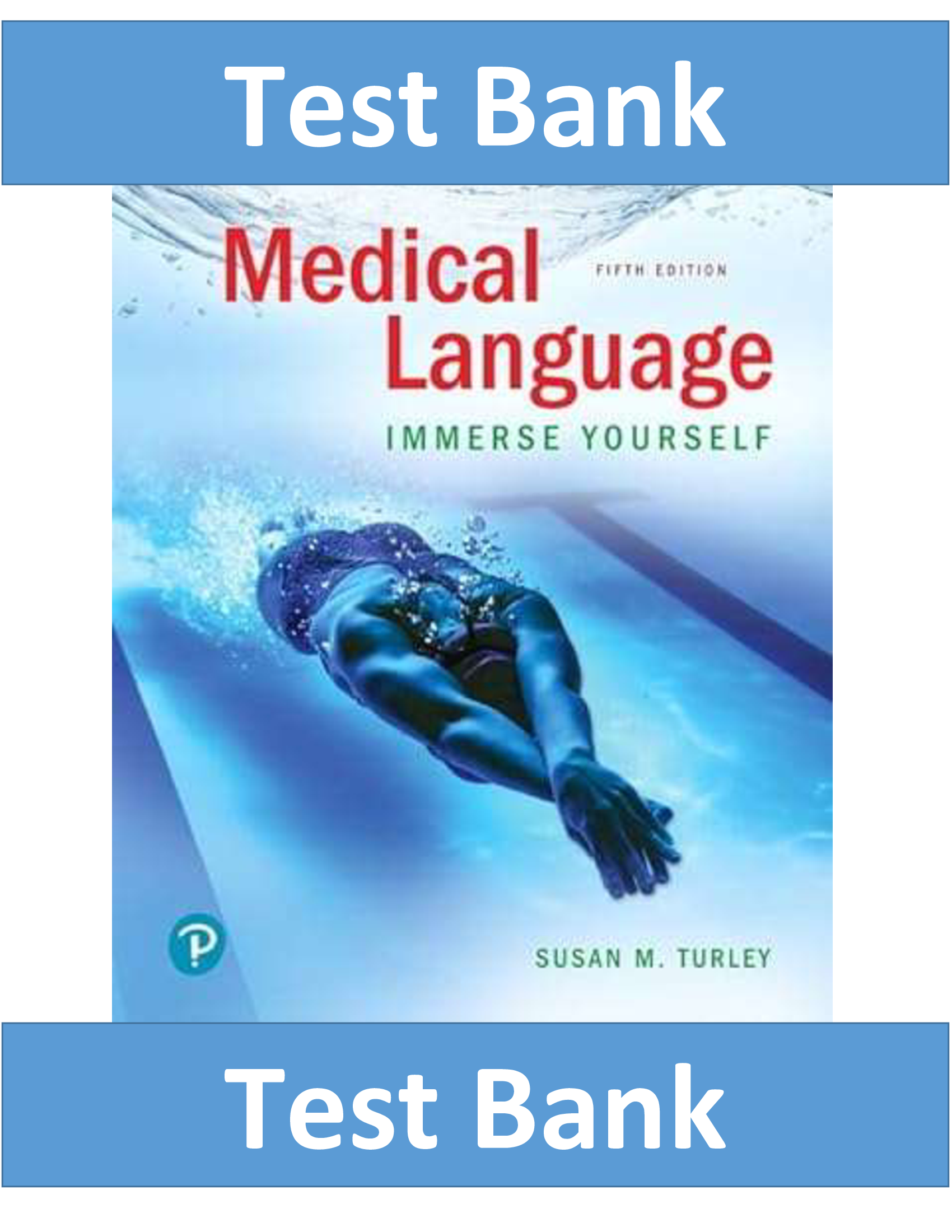
  • Test Bank for Medical Language Immerse Yourself 5th Edition by Turley

Test Bank for Medical Language Immerse Yourself 5th Edition by Turley

Preview page 1 Preview page 2 Preview page 3
Add To Favorites

Share this item Share this item

  • Item Details
  • Comments (0)
  • Reviews (0)
  • Contact Seller

Test Bank for Medical Language Immerse Yourself 5th Edition by Turley

Medical Language, 5e (Turley)

Chapter 1   Medical Language and Health Care Today


1.1   Multiple Choice Questions


1) Select the abbreviation that would NOT appear in a history and physical examination report. A) ROS

B)   CC

C)   HIPAA

D)  HPI

Answer:  C

Explanation:  A) ROS does appear in a history and physical examination report. B) CC does appear in a history and physical examination report.

C)   Correct! HIPAA would not be found in a history and physical examination report.

D)  HPI does appear in a history and physical examination report.

Page Ref: 47

Learning Outcome:  1.16

LOD:  Comprehension

Question Type:  Health Care Today


2) Anesthesia is defined as ________.

A)  state of unawareness

B)   state of unconsciousness

C)   condition of being without sensation

D)  condition without pain

Answer:  C

Explanation:  A) Based on its word part meanings, this is not the correct definition of anesthesia. B) Based on its word part meanings, this is not the correct definition of anesthesia.

C)   Correct! An- is a suffix meaning "not; without." Esthes/o- is a combining form meaning

"feeling; sensation." The suffix -ia means "condition; state; thing." Therefore, anesthesia means

"condition of being without sensation."

D)  Based on its word part meanings, this is not the correct definition of anesthesia.

Page Ref: 11

Learning Outcome:  1.7

LOD:  Knowledge

Question Type:  Medical Words: Divide, Build, Spell, and Pronounce


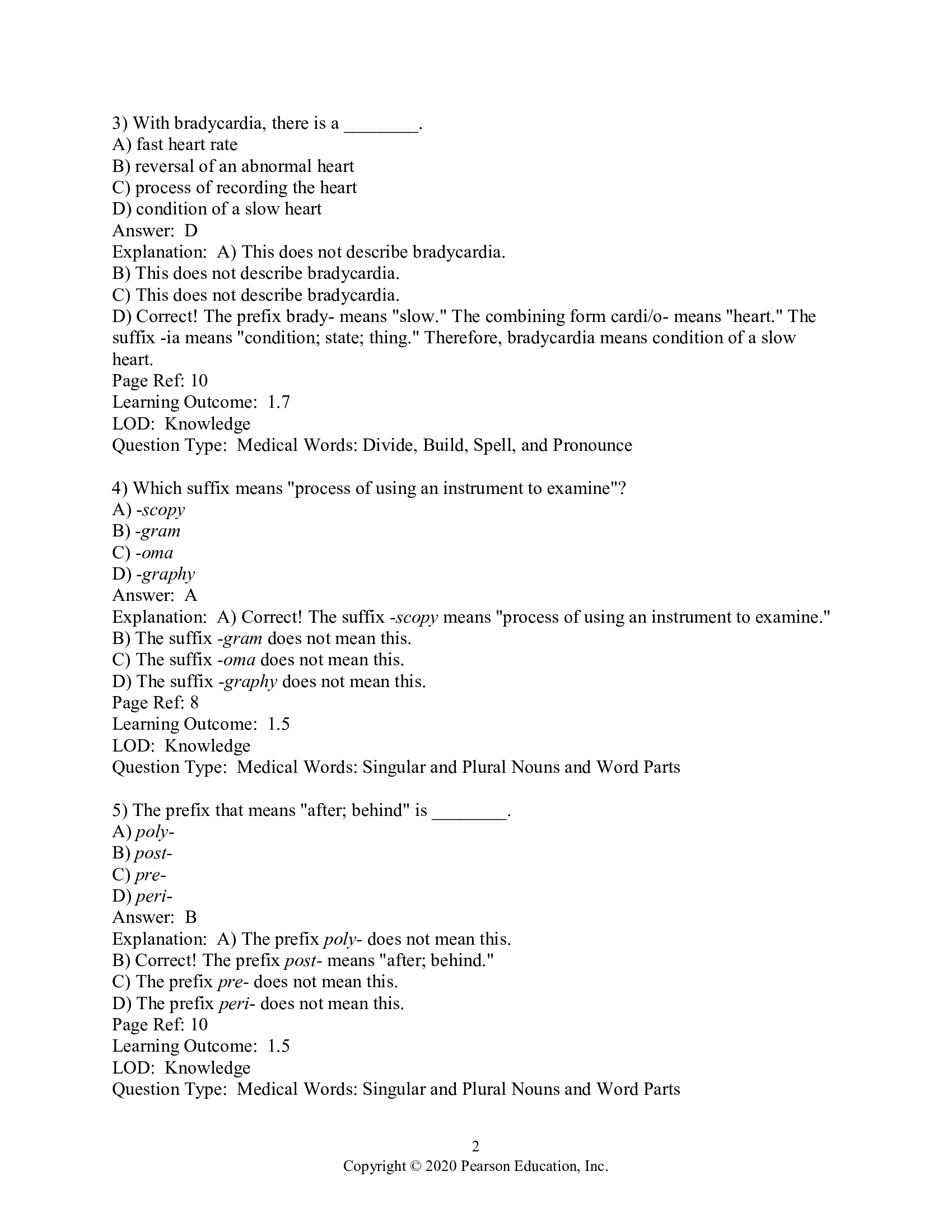
3) With bradycardia, there is a ________.

A)  fast heart rate

B)   reversal of an abnormal heart

C)   process of recording the heart

D)  condition of a slow heart

Answer:  D

Explanation:  A) This does not describe bradycardia. B) This does not describe bradycardia.

C)  This does not describe bradycardia.

D)  Correct! The prefix brady- means "slow." The combining form cardi/o- means "heart." The suffix -ia means "condition; state; thing." Therefore, bradycardia means condition of a slow heart.

Page Ref: 10

Learning Outcome:  1.7

LOD:  Knowledge

Question Type:  Medical Words: Divide, Build, Spell, and Pronounce


4) Which suffix means "process of using an instrument to examine"?

A)  -scopy

B)   -gram

C)   -oma

D)  -graphy

Answer:  A

Explanation:  A) Correct! The suffix -scopy means "process of using an instrument to examine." B) The suffix -gram does not mean this.

C)   The suffix -oma does not mean this.

D)  The suffix -graphy does not mean this.

Page Ref: 8

Learning Outcome:  1.5

LOD:  Knowledge

Question Type:  Medical Words: Singular and Plural Nouns and Word Parts


5) The prefix that means "after; behind" is ________.

A)  poly-

B)   post-

C)   pre- D) peri- Answer:  B

Explanation:  A) The prefix poly- does not mean this. B) Correct! The prefix post- means "after; behind."

C)   The prefix pre- does not mean this.

D)  The prefix peri- does not mean this.

Page Ref: 10

Learning Outcome:  1.5

LOD:  Knowledge

Question Type:  Medical Words: Singular and Plural Nouns and Word Parts


6) Which word means "inflammation of the lung"?

A)  Neuritis

B)   Hepatitis

C)   Pneumonitis D) Laryngitis

Answer:  C

Explanation:  A) Neuritis is inflammation of a nerve. B) Hepatitis is inflammation of the liver.

C)   Correct! Pneumonitis is inflammation of the lung.

D)  Laryngitis is inflammation of the larynx.

Page Ref: 8

Learning Outcome:  1.5

LOD:  Comprehension

Question Type:  Medical Words: Divide, Build, Spell, and Pronounce


7) Vertebrae means ________.

A)  one bone of the spine

B)   more than one bone of the spine

C)   pertaining to the spine

D)  in the direction of the spine

Answer:  B

Explanation:  A) Vertebrae is the plural form—more than one bone of the spine. B) Correct! Vertebrae is the plural form—more than one bone of the spine.

C)   Vertebrae is a noun, not an adjective.

D)  Vertebrae does not mean in the direction of the spine.

Page Ref: 6

Learning Outcome:  1.3

LOD:  Knowledge

Question Type:  Medical Words: Singular and Plural Nouns and Word Parts


8) Which is the plural form of apex?

A)  Apexs

B)   Apices

C)   Apis

D)  Apae

Answer:  B

Explanation:  A) This is not the plural of apex. B) Correct! Apices is the plural form of apex.

C)   This is not the plural of apex.

D)  This is not the plural of apex.

Page Ref: 6

Learning Outcome:  1.3

LOD:  Knowledge

Question Type:  Medical Words: Singular and Plural Nouns and Word Parts


9) The medical word intrahepatic means "________ the liver."

A)  between

B)   below

C)   beside

D)  within

Answer:  D

Explanation:  A) The prefix intra- does not mean this. B) The prefix intra- does not mean this.

C)   The prefix intra- does not mean this.

D)  Correct! The prefix intra- means "within."

Page Ref: 10

Learning Outcome:  1.5

LOD:  Knowledge

Question Type:  Medical Words: Singular and Plural Nouns and Word Parts


10) The surgeon performed a laryngectomy on the ________.

A)  skin

B)   lungs

C)   voice box

D)  nose

Answer:  C

Explanation:  A) Laryng/o- does not mean this. B) Laryng/o- does not mean this.

C)   Correct! Laryng/o- means "larynx; voice box."

D)  Laryng/o- does not mean this.

Page Ref: 30

Learning Outcome:  1.11

LOD:  Comprehension

Question Type:  The Body in Health and Disease


11) Pericardial means "pertaining to ________ the heart."

A)  within

B)   below

C)   around

D)  in front of

Answer:  C

Explanation:  A) The prefix peri- does not mean "within."

B) The prefix peri- does not mean "below." C) Correct! The prefix peri- means "around."

D) The prefix peri- does not mean "in front of."

Page Ref: 10

Learning Outcome:  1.5

LOD:  Comprehension

Question Type:  Medical Words: Singular and Plural Nouns and Word Parts 12) The plural of the Latin noun bronchus is ________.

A)  bronchi

B)   bronchae

C)   bronches D) broncha

Answer:  A

Explanation:  A) Correct! The -us is changed to -i to form the plural noun bronchi. B) This is not the plural of bronchus.

C)   This is not the plural of bronchus.

D)  This is not the plural of bronchus.

Page Ref: 6

Learning Outcome:  1.3

LOD:  Knowledge

Question Type:  Medical Words: Singular and Plural Nouns and Word Parts


13) A gastroscopy is the ________.

A)  process of using an instrument to examine the stomach

B)   process of recording the activity of the stomach

C)   process of measuring the stomach

D)  process of surgically removing part of the stomach

Answer:  A

Explanation:  A) Correct! The suffix -scopy means "process of using an instrument to examine," and the

B)   This is not the meaning of gastroscopy.

C)   This is not the meaning of gastroscopy.

D)  This is not the meaning of gastroscopy.

Page Ref: 8

Learning Outcome:  1.6

LOD:  Knowledge

Question Type:  Medical Words: Divide, Build, Spell, and Pronounce


14) The definition of tachycardia is ________.

A)  infection behind the heart

B)   condition of a painful heart

C)   picture within the heart

D)  condition of a fast heart

Answer:  D

Explanation:  A) This is not the definition of tachycardia. B) This is not the definition of tachycardia.

C)  This is not the definition of tachycardia.

D)  Correct! The prefix tachy- means "fast." The combining form cardi/o- means "heart." The suffix -ia means "condition; state; thing." Therefore, tachycardia means condition of a fast heart. Page Ref: 10

Learning Outcome:  1.6

LOD:  Knowledge

Question Type:  Medical Words: Divide, Build, Spell, and Pronounce


15) HIPAA assures the patient that his or her medical information is ________.

A)  legible

B)   accurate

C)   documented in a certain format

D)  secure

Answer:  D

Explanation:  A) HIPAA says nothing about medical information being legible. B) HIPAA says nothing about medical information being accurate.

C) HIPAA says nothing about medical information being documented in a certain format. D) Correct! HIPAA states that healthcare settings must assure patients that their medical information is secure. Page Ref: 48

Learning Outcome:  1.16

LOD:  Knowledge

Question Type:  Health Care Today


16) The word part sub- is a ________.

A)  root

B)   suffix

C)   prefix

D)  combining form

Answer:  C

Explanation:  A) Sub- is not a root. B) Sub- is not a suffix.

C)   Correct! Sub- is a prefix.

D)  Sub- is not a combining form.

Page Ref: 10

Learning Outcome:  1.4

LOD:  Knowledge

Question Type:  Medical Words: Singular and Plural Nouns and Word Parts


17) Five separate language skills are critical to communication. Which skill involves the processing of medical language?

A)  Thinking and analyzing

B)   Reading

C)   Listening

D)  Speaking

Answer:  A

Explanation:  A) Correct! Thinking, analyzing, and understanding medical words involves processing medical language.

B)   This skill does not involve processing information.

C)   This skill does not involve processing information.

D)  This skill does not involve processing information.

Page Ref: 4

Learning Outcome:  1.1

LOD:  Knowledge

Question Type:  Medical Language


18) Which of the following is the skill that involves relaying the medical language?

A)  Thinking and analyzing

B)   Reading

C)   Typing

D)  Listening

Answer:  C

Explanation:  A) This skill does not involve relaying information. B) This skill does not involve relaying information.

C)   Correct! Typing involves relaying medical language.

D)  This skill does not involve relaying information.

Page Ref: 4

Learning Outcome:  1.1

LOD:  Knowledge

Question Type:  Medical Language


19) The study of word origins is ________.

A)  etymology

B)   medicology

C)   logistics

D)  Greekology

Answer:  A

Explanation:  A) Correct! Etymology is the study of word origins. B) There is no such word.

C)   This does not pertain to word origins.

D)  There is no such word.

Page Ref: 4

Learning Outcome:  1.2

LOD:  Knowledge

Question Type:  Medical Language


20) Which is the foundation of a medical word?

A)  Prefix

B)   Combining vowel

C)   Suffix

D)  Combining form

Answer:  D

Explanation:  A) The prefix is not the foundation. B) The combining vowel is not the foundation.

C)   The suffix is not the foundation.

D)  Correct! The combining form is the foundation of a medical word.

Page Ref: 6

Learning Outcome:  1.4

LOD:  Knowledge

Question Type:  Medical Words: Singular and Plural Nouns and Word Parts


21) All of the following are TRUE about a medical record EXCEPT ________.

A)  it is a medicolegal record

B)   it contains medical documents

C)   it has more extensive documentation in the physician's office than in the hospital

D)  it can be used in a court of law

Answer:  C

Explanation:  A) This is a true statement. B) This is a true statement.

C)   Correct! Hospitals use more extensive documentation than physician's offices.

D)  This is a true statement.

Page Ref: 47—48

Learning Outcome:  1.16

LOD:  Knowledge

Question Type:  Health Care Today


22) The combining form mamm/o- means "________."

A)  nose

B)   retina

C)   face

D)  breast

Answer:  D

Explanation:  A) Mamm/o- does not mean this. B) Mamm/o- does not mean this.

C)   Mamm/o- does not mean this.

D)  Correct! Mamm/o- means "breast."

Page Ref: 7

Learning Outcome:  1.5

LOD:  Knowledge

Question Type:  Medical Words: Singular and Plural Nouns and Word Parts


23) The combining form hepat/o- means "________."

A)  blood

B)   liver

C)   kidney D) urine

Answer:  B

Explanation:  A) Hepat/o- does not mean this. B) Correct! Hepat/o- means "liver."

C)   Hepat/o- does not mean this.

D)  Hepat/o- does not mean this.

Page Ref: 7

Learning Outcome:  1.25

LOD:  Knowledge

Question Type:  Medical Words: Singular and Plural Nouns and Word Parts

24) The suffix -oma means "________."

A)  mass; tumor

B)   enlargement

C)   cancer

D)  disease

Answer:  A

Explanation:  A) Correct! The suffix -oma means "mass; tumor." B) The suffix -oma does not mean this.

C)   The suffix -oma does not mean this.

D)  The suffix -oma does not mean this.

Page Ref: 8

Learning Outcome:  1.5

LOD:  Knowledge

Question Type:  Medical Words: Singular and Plural Nouns and Word Parts


25) Which is the plural form for the Latin word testis?

A)  Testes

B)   Testium

C)   Testises

D)  Testices

Answer:  A

Explanation:  A) Correct! The -is is changed to -es. B) This is not the plural form.

C)   This is not the plural form.

D)  This is not the plural form.

Page Ref: 6

Learning Outcome:  1.3

LOD:  Knowledge

Question Type:  Medical Words: Singular and Plural Nouns and Word Parts


26) The abbreviation EHR means ________.

A)  electronic health record

B)   electronic patient report

C)   elective paper record

D)  elective health record

Answer:  A

Explanation:  A) Correct! The abbreviation for electronic health record is EHR. B) EHR does not mean this.

C)  EHR does not mean this.

D)  EHR does not mean this. Page Ref: 47

Learning Outcome:  1.16

LOD:  Knowledge

Question Type:  Health Care Today

27) The abbreviation CC means ________.

A)  clinical copy

B)   central complaint

C)   chief complaint

D)  computerized copy

Answer:  C

Explanation:  A) This is not the meaning of the abbreviation CC. B) This is not the meaning of the abbreviation CC.

C)   Correct! Chief complaint is abbreviated CC.

D)  This is not the meaning of the abbreviation CC.

Page Ref: 47

Learning Outcome:  1.16

LOD:  Knowledge

Question Type:  Health Care Today


28) The plural form for the word phalanx is ________.

A)  phalanxs

B)   phalanices

C)   phalanges

D)  phalanx

Answer:  C

Explanation:  A) This is not the plural form. B) This is not the plural form.

C)  Correct! The -nx is changed to -nges.

D)  This is not the plural form. Page Ref: 6

Learning Outcome:  1.3

LOD:  Knowledge

Question Type:  Medical Words: Singular and Plural Nouns and Word Parts


29) The combining form ven/o- means "________."

A)  vein

B)   artery

C)   blood vessel D) leg

Answer:  A

Explanation:  A) Correct! The combining form ven/o- means "vein." B) The combining form ven/o- does not mean this.

C)   The combining form ven/o- does not mean this.

D)  The combining form ven/o- does not mean this.

Page Ref: 7

Learning Outcome:  1.5

LOD:  Knowledge

Question Type:  Medical Words: Singular and Plural Nouns and Word Parts 30) The suffix -gram means "________."

A)  process of recording

B)   picture; record

C)   x-ray

D)  instrument used to examine

Answer:  B

Explanation:  A) The suffix -gram does not mean this. B) Correct! The suffix -gram means "picture; record."

C)   The suffix -gram does not mean this.

D)  The suffix -gram does not mean this.

Page Ref: 8

Learning Outcome:  1.5

LOD:  Knowledge

Question Type:  Medical Words: Singular and Plural Nouns and Word Parts


31) Which word means "enlargement of the liver"?

A)  Hepatomegaly

B)   Cardiomegaly

C)   Intestinomegaly

D)  Mammomegaly

Answer:  A

Explanation:  A) Correct! The suffix -megaly means "enlargement" and the combining form hepat/o- means "liver."

B)   Cardiomegaly means "enlargement of the heart."

C)   There is no such medical word.

D)  There is no such medical word.

Page Ref: 7, 8

Learning Outcome:  1.7

LOD:  Comprehension

Question Type:  Medical Words: Divide, Build, Spell, and Pronounce


32) The prefix brady- means "________."

A)  enlargement

B)   fast

C)   many

D)  slow

Answer:  D

Explanation:  A) The prefix brady- does not mean this. B) The prefix brady- does not mean this.

C)   The prefix brady- does not mean this.

D)  Correct! The prefix brady- means "slow."

Page Ref: 10

Learning Outcome:  1.5

LOD:  Knowledge

Question Type:  Medical Words: Singular and Plural Nouns and Word Parts


33) The prefix dys- means "________."

A)  bad; inadequate

B)   below; underneath

C)   abnormal; difficult; painful

D)  before; in front of

Answer:  C

Explanation:  A) The prefix dys- does not mean this. B) The prefix dys- does not mean this.

C)   Correct! The prefix dys- means "abnormal; difficult; painful."

D)  The prefix dys- does not mean this.

Page Ref: 11

Learning Outcome:  1.5

LOD:  Knowledge

Question Type:  Medical Words: Singular and Plural Nouns and Word Parts


34) Which describes the CORRECT order of word parts in a medical word? A) The prefix is joined to the beginning of the combining form.

B)   The prefix is joined to the end of the combining form.

C)   The suffix comes at the beginning of the combining form.

D)  Hyphens are added when word parts are joined.

Answer:  A

Explanation:  A) Correct! The prefix is always before the combining form. B) This is not the correct order of word parts.

C)   This is not the correct order for word parts.

D)  Hyphens are deleted when word parts are joined.

Page Ref: 17

Learning Outcome:  1.6

LOD:  Knowledge

Question Type:  Medical Words: Divide, Build, Spell, and Pronounce


35) The origin of medical language is in ________.

A)  Latin

B)   Greek

C)   Latin and Greek

D)  many languages, including Latin and Greek

Answer:  D

Explanation:  A) This is true but it is not the only language. B) This is true but it is not the only language.

C)  These are not the only languages.

D)  Correct! Latin and Greek are the primary languages used for medical words, both other languages are also used as the origins of medical language.

Page Ref: 4

Learning Outcome:  1.2

LOD:  Knowledge

Question Type:  Medical Language

36) The word part that gives a medical word its meaning is the ________.

A)  prefix

B)   suffix

C)   hyphen

D)  combining form

Answer:  D

Explanation:  A) The prefix does not give the word its meaning. B) The suffix does not give the word its meaning.

C)   The hyphen is not a word part.

D)  Correct! The combining form is the foundation of the medical word.

Page Ref: 6

Learning Outcome:  1.4

LOD:  Knowledge

Question Type:  Medical Words: Singular and Plural Nouns and Word Parts


37) The combining form in the word pneumonia means "________."

A)  mind

B)   air; lung

C)   condition; state; thing

D)  surgical removal

Answer:  B

Explanation:  A) The combining form pneumon/o- does not mean this. B) Correct! The combining form pneumon/o- means "air; lung."

C)   The combining form pneumon/o- does not mean this.

D)  The combining form pneumon/o- does not mean this.

Page Ref: 8

Learning Outcome:  1.5

LOD:  Comprehension

Question Type:  Medical Words: Singular and Plural Nouns and Word Parts


38) The skill that involves receiving medical language is ________.

A)  spelling medical words

B)   analyzing medical words

C)   pronouncing medical words

D)  reading medical words

Answer:  D

Explanation:  A) Spelling medical words involves relaying medical language. B) Analyzing medical words involves processing medical language.

C)   Pronouncing medical words involves relaying medical language.

D)  Correct! Reading medical words involves receiving medical language.

Page Ref: 4

Learning Outcome:  1.1

LOD:  Knowledge

Question Type:  Medical Language


39) Two parts of a combining form include a ________.

A)  root and a suffix

B)   prefix and a hyphen

C)   root and the combining vowel D) suffix and a combining vowel

Answer:  C

Explanation:  A) A combining form does not include this. B) A combining form does not include this.

C)   Correct! A combining form includes the root and combining vowel.

D)  A combining form does not include this.

Page Ref: 7

Learning Outcome:  1.4

LOD:  Knowledge

Question Type:  Medical Words: Singular and Plural Nouns and Word Parts


40) Which of the following is an example of a combining form?

A) intra- B) -ectomy

C) ven/o- D) poly- Answer:  C

Explanation:  A) This is a prefix, not a combining form. B) This is a suffix, not a combining form.

C)   Correct! Combining forms can be distinguished by their forward slash and combining vowel.

D)  This is a prefix, not a combining form.

Page Ref: 7

Learning Outcome:  1.4

LOD:  Knowledge

Question Type:  Medical Words: Singular and Plural Nouns and Word Parts


41) Which of the following is an example of a suffix?

A)  -ia

B)   post-

C)   dys- D) nas/o- Answer:  A

Explanation:  A) Correct! Suffixes can be distinguished by the hyphen at the beginning of the word part.

B)   This is a prefix, not a suffix.

C)   This is a prefix, not a suffix.

D)  This is a combining form, not a suffix.

Page Ref: 8

Learning Outcome:  1.4

LOD:  Knowledge

Question Type:  Medical Words: Singular and Plural Nouns and Word Parts

42) Suffixes such as -iatry, -ist, and -logy are related to ________.

A)  medical specialties or specialists

B)   procedures or instruments

C)   diseases

D)  processes

Answer:  A

Explanation:  A) Correct! These suffixes are related to medical specialties or specialists. B) These suffixes are not related to procedures or instruments.

C)   These suffixes are not related to diseases.

D)  These suffixes are not related to processes.

Page Ref: 9

Learning Outcome:  1.5

LOD:  Knowledge

Question Type:  Medical Words: Singular and Plural Nouns and Word Parts


43) Prefixes such as hypo- and poly- indicate ________.

A)  degree or quality

B)   an adjective

C)   amount, number, or speed

D)  weight

Answer:  C

Explanation:  A) These prefixes do not indicate degree or quality. B) These prefixes do not indicate an adjective.

C)   Correct! These prefixes refer to an amount, number, or speed.

D)  These prefixes do not indicate a weight.

Page Ref: 10

Learning Outcome:  1.5

LOD:  Knowledge

Question Type:  Medical Words: Singular and Plural Nouns and Word Parts


44) The prefixes anti- and dys- belong to a category that describes ________.

A)  degree or quality

B)   amount, number, or speed

C)   location or direction

D)  an adjective

Answer:  A

Explanation:  A) Correct! These prefixes refer to degree or quality. B) These prefixes do not describe amount, number, or speed.

C)   These prefixes do not describe location or direction.

D)  These prefixes do not describe an adjective.

Page Ref: 11

Learning Outcome:  1.5

LOD:  Knowledge

Question Type:  Medical Words: Singular and Plural Nouns and Word Parts


45) Which suffix means "process of recording"?

A)  -pathy

B)   -graphy

C)   -ation D) -iatry

Answer:  B

Explanation:  A) The suffix -pathy does not mean this.

B)   Correct! The suffix -graphy means "process of recording."

C)   The suffix -ation does not mean this.

D)  The suffix -iatry does not mean this.

Page Ref: 8

Learning Outcome:  1.5

LOD:  Knowledge

Question Type:  Medical Words: Singular and Plural Nouns and Word Parts


46) After you divide a medical word into its word parts, you get the definition of the word by beginning with the meaning of the ________.

A)  prefix

B)   combining form

C)   suffix

D)  Latin singular

Answer:  C

Explanation:  A) The definition does not begin with the meaning of the prefix. B) The definition does not begin with the meaning of the combining form.

C)   Correct! The definition begins with the meaning of the suffix.

D)  The Latin singular is not related to defining a medical word.

Page Ref: 14

Learning Outcome:  1.6

LOD:  Knowledge

Question Type:  Medical Words: Divide, Build, Spell, and Pronounce


47) Which word is an example of a Latin singular noun?

A)  Diagnoses

B)   Phalanx

C)   Carcinoma

D)  Bronchus

Answer:  D

Explanation:  A) This is a Latin plural noun. B) This is a Greek singular noun.

C)   This is a Greek singular noun.

D)  Correct! This is a Latin singular noun.

Page Ref: 6

Learning Outcome:  1.3

LOD:  Knowledge

Question Type:  Medical Words: Singular and Plural Nouns and Word Parts

48) Which word is an example of a Greek singular noun?

A)  Ganglion

B)   Atrium

C)   Bronchi D) Testis

Answer:  A

Explanation:  A) Correct! This is a Greek singular noun. B) This is a Latin singular noun.

C)   This is a Latin plural noun.

D)  This is a Latin singular noun.

Page Ref: 6

Learning Outcome:  1.3

LOD:  Knowledge

Question Type:  Medical Words: Singular and Plural Nouns and Word Parts


49) The medical word diverticulum is a Latin noun. You would make the plural form by changing the word ending -um to ________.

A)  -a

B)   -ices

C)   -us

D)  -ae

Answer:  A

Explanation:  A) Correct! If a Latin singular noun ends in -um, it is made plural by changing the -um to -a.

B)   This is not the correct plural form for this Latin noun.

C)   This is a singular, not a plural, form.

D)  This is not the correct plural form for this Latin noun.

Page Ref: 6

Learning Outcome:  1.3

LOD:  Knowledge

Question Type:  Medical Words: Singular and Plural Nouns and Word Parts


50) Which of the following is a disadvantage of the paper medical record? A) It can be accessed by several people at once.

B)   It can become lost.

C)   It can be accessed by anyone with a computer.

D)  It can be erased.

Answer:  B

Explanation:  A) Paper medical records can only be accessed by one person at a time. B) Correct! Paper medical records can become lost or damaged.

C)   er medical records are not accessed by computer.

D)  Electronic medical records are more at risk of being erased than paper medical records.

Page Ref: 47

Learning Outcome:  1.16

LOD:  Knowledge

Question Type:  Health Care Today


51) The combining form arthr/o- means "________."

A)  artery

B)   abdomen

C)   bone D) joint

Answer:  D

Explanation:  A) The combining form arthr/o- does not mean this. B) The combining form arthr/o- does not mean this.

C)   The combining form arthr/o- does not mean this.

D)  Correct! The combining form arthr/o- means "joint."

Page Ref: 7

Learning Outcome:  1.5

LOD:  Knowledge

Question Type:  Medical Words: Singular and Plural Nouns and Word Parts


52) The combining form cardi/o- means "________."

A)  chest

B)   heart

C)   lungs

D)  rib

Answer:  B

Explanation:  A) The combining form cardi/o- does not mean this. B) Correct! The combining form cardi/o- means "heart."

C)   The combining form cardi/o- does not mean this.

D)  The combining form cardi/o- does not mean this.

Page Ref: 7

Learning Outcome:  1.5

LOD:  Knowledge

Question Type:  Medical Words: Singular and Plural Nouns and Word Parts


53) The combining form communicat/o- means "________."

A)  communication

B)   impart; transmit

C)   hearing; listening

D)  speech

Answer:  B

Explanation:  A) Communicat/o- does not mean this.

B)   Correct! The combining form communicat/o- means "impart; transmit."

C)   Communicat/o- does not mean this.

D)  Communicat/o- does not mean this.

Page Ref: 4

Learning Outcome:  1.1

LOD:  Knowledge

Question Type:  Medical Language

54) The combining form cutane/o-, as in the word subcutaneous, means "________."

A)  mass; tumor

B)   medicine

C)   skin

D)  underneath

Answer:  C

Explanation:  A) Cutane/o- does not mean this. B) Cutane/o- does not mean this.

C)   Correct! The combining form cutane/o- means "skin."

D)  The prefix sub- means "underneath."


Page Ref: 10

Learning Outcome:  1.5

LOD:  Knowledge

Question Type:  Medical Words: Singular and Plural Nouns and Word Parts


55) The combining form esthes/o- means "________."

A)  drug; medicine

B)   feeling; sensation

C)   surgery

D)  touch

Answer:  B

Explanation:  A) Esthes/o- does not mean this.

B)   Correct! The combining form esthes/o- means "feeling; sensation."

C)   Esthes/o- does not mean this.

D)  Esthes/o- does not mean this.

Page Ref: 11

Learning Outcome:  1.5

LOD:  Knowledge

Question Type:  Medical Words: Singular and Plural Nouns and Word Parts


56) The combining form gastr/o- means "________."

A)  abdomen

B)   gas

C)   nerve

D)  stomach

Answer:  D

Explanation:  A) Gastr/o- does not mean this. B) Gastr/o- does not mean this.

C)   Gastr/o- does not mean this.

D)  Correct! The combining form gastr/o- means "stomach."

Page Ref: 7

Learning Outcome:  1.5

LOD:  Knowledge

Question Type:  Medical Words: Singular and Plural Nouns and Word Parts


57) The combining form laryng/o- means "________."

A)  breast

B)   larynx; voice box

C)   abdomen

D)  digestion

Answer:  B

Explanation:  A) Laryng/o- does not mean this.

B)   Correct! The combining form laryng/o- means "larynx; voice box."

C)   Laryng/o- does not mean this.

D)  Laryng/o- does not mean this.

Page Ref: 30

Learning Outcome:  1.11

LOD:  Knowledge

Question Type:  The Body in Health and Disease


58) The combining form medic/o- means "________."

A)  nourishment

B)   drug; prescription

C)   health

D)  medicine

Answer:  D

Explanation:  A) Medic/o- does not mean this. B) Medic/o- does not mean this.

C)   Medic/o- does not mean this.

D)  Correct! The combining form medic/o- means "medicine."

Page Ref: 3

Learning Outcome:  1.1

LOD:  Knowledge

Question Type:  Medical Language


59) The combining form neur/o- means "________."

A)  nerve

B)   feeling; sensation

C)   pressure D) pain

Answer:  A

Explanation:  A) Correct! The combining form neur/o- means "nerve." B) Neur/o- does not mean this.

C)   Neur/o- does not mean this.

D)  Neur/o- does not mean this.

Page Ref: 8

Learning Outcome:  1.5

LOD:  Knowledge

Question Type:  Medical Words: Singular and Plural Nouns and Word Parts 60) The combining form pneumon/o- means "________."

A)  breathe

B)   eating; swallowing

C)   paralysis D) air; lung

Answer:  D

Explanation:  A) Pneumon/o- does not mean this. B) Pneumon/o- does not mean this.

C)   Pneumon/o- does not mean this.

D)  Correct! The combining form pneumon/o- means "air; lung."

Page Ref: 8

Learning Outcome:  1.5

LOD:  Knowledge

Question Type:  Medical Words: Singular and Plural Nouns and Word Parts


61) The combining form psych/o- means "________."

A)  brain

B)   head

C)   mind

D)  thinking

Answer:  C

Explanation:  A) Psych/o- does not mean this. B) Psych/o- does not mean this.

C)   Correct! The combining form psych/o- means "mind."

D)  Psych/o- does not mean this.

Page Ref: 9

Learning Outcome:  1.5

LOD:  Knowledge

Question Type:  Medical Words: Singular and Plural Nouns and Word Parts


62) The combining form thyroid/o- means "________."

A)  thyroid gland

B)   joint

C)   gallbladder D) therapy

Answer:  A

Explanation:  A) Correct! The combining form thyroid/o- means "thyroid gland." B) Thyroid/o- does not mean this.

C)   Thyroid/o- does not mean this.

D)  Thyroid/o- does not mean this.

Page Ref: 7

Learning Outcome:  1.5

LOD:  Knowledge

Question Type:  Medical Words: Singular and Plural Nouns and Word Parts


63) The combining form tonsill/o- means "________."

A)  infection

B)   mouth

C)   throat D) tonsil

Answer:  D

Explanation:  A) Tonsill/o- does not mean this. B) Tonsill/o- does not mean this.

C)   Tonsill/o- does not mean this.

D)  Correct! The combining form tonsill/o- means "tonsil."

Page Ref: 7

Learning Outcome:  1.5

LOD:  Knowledge

Question Type:  Medical Words: Singular and Plural Nouns and Word Parts


64) The combining form urin/o- means "________."

A)  urinary system

B)   urine

C)   urine; urinary system

D)  kidney

Answer:  C

Explanation:  A) This is true but it is not the only correct answer. B) This is true but it is not the only correct answer.

C) Correct! The combining form urin/o- means "urine; urinary system." D) Urin/o- does not mean "kidney."

Page Ref: 8

Learning Outcome:  1.5

LOD:  Knowledge

Question Type:  Medical Words: Singular and Plural Nouns and Word Parts


65) Communication in any language consists of ________.

A)  two language skills

B)   three language skills

C)   four language skills

D)  five language skills

Answer:  D

Explanation:  A) This is not correct. B) This is not correct.

C)   This is not correct.

D)  Correct! Communication consists of five language skills.

Page Ref: 4

Learning Outcome:  1.1

LOD:  Knowledge

Question Type:  Medical Language

66) Which of the following is NOT a medical word part?

A)  Combining form

B)   Plural

C)   Prefix

D)  Suffix

Answer:  B

Explanation:  A) A combining form is a word part.

B)  Correct! Plural indicates more than one. It is not a medical word part.

C)  A prefix is a word part. D) A suffix is a word part.

Page Ref: 5—6

Learning Outcome:  1.4

LOD:  Knowledge

Question Type:  Medical Words: Singular and Plural Nouns and Word Parts


67) If a medical word has a suffix, the suffix is found ________.

A)  at the beginning of the medical word

B)   at the end of the medical word

C)   in the middle of the medical word

D)  anywhere in the medical word

Answer:  B

Explanation:  A) A suffix is not at the beginning of the medical word. B) Correct! A suffix is a word ending.

C)   A suffix is not in the middle of the medical word.

D)  A suffix cannot be just anywhere in the medical word.

Page Ref: 6

Learning Outcome:  1.4

LOD:  Knowledge

Question Type:  Medical Words: Singular and Plural Nouns and Word Parts


68) Combining forms ________.

A)  modify the meaning of the prefix and the suffix

B)   modify the meaning of the prefix

C)   modify the meaning of the suffix

D)  provide the medical meaning of the word

Answer:  D

Explanation:  A) Prefixes and suffixes modify the meaning of the combining form, not the other way around.

B)  Prefixes modify the meaning of the combining form, not the other way around.

C)  Suffixes modify the meaning of the combining form, not the other way around.

D)  Correct! Combining forms give a medical words its main medical meaning. Page Ref: 7

Learning Outcome:  1.4

LOD:  Knowledge

Question Type:  Medical Words: Singular and Plural Nouns and Word Parts


69) A suffix ________.

A)  is usually a group of letters

B)   can be placed anywhere in the medical word

C)   must be a single letter

D)  modifies the meaning of the prefix in the word

Answer:  A

Explanation:  A) Correct! A suffix is usually more than one letter. B) A suffix is only found at the end of a medical word.

C)   A suffix is usually a group of letters.

D)  A suffix does not modify the meaning of the prefix.

Page Ref: 8

Learning Outcome:  1.4

LOD:  Knowledge

Question Type:  Medical Words: Singular and Plural Nouns and Word Parts


70) The suffix -ac means "________."

A)  condition

B)   disease

C)   pertaining to

D)  process

Answer:  C

Explanation:  A) This suffix -ac does not mean this. B) This suffix -ac does not mean this.

C)   Correct! The suffix -ac means "pertaining to."

D)  This suffix -ac does not mean this.

Page Ref: 8

Learning Outcome:  1.4

LOD:  Knowledge

Question Type:  Medical Words: Singular and Plural Nouns and Word Parts


71) The suffix -al means "________."

A)  enlargement

B)   pertaining to

C)   state

D)  surgical removal

Answer:  B

Explanation:  A) The suffix -al does not mean this. B) Correct! The suffix -al means "pertaining to."

C)   This suffix -al does not mean this.

D)  The suffix -al does not mean this.

Page Ref: 8

Learning Outcome:  1.4

72) The suffix -metry means "________."

A)  process of measuring

B)   person who specializes in

C)   many; much D) process

Answer:  A

Explanation:  A) Correct! The suffix -metry means "process of measuring." B) The suffix -metry does not mean this.

C)   The suffix -metry does not mean this.

D)  The suffix -metry does not mean this.

Page Ref: 8

Learning Outcome:  1.5

LOD:  Knowledge

Question Type:  Medical Words: Singular and Plural Nouns and Word Parts


73) The suffix -ation means "________."

A)  being; having; process

B)   disease

C)   infection of; inflammation of

D)  pertaining to

Answer:  A

Explanation:  A) Correct! The suffix -ation means "being; having; process." B) The suffix -ation does not mean this.

C)   The suffix -ation does not mean this.

D)  The suffix -ation does not mean this.

Page Ref: 8

Learning Outcome:  1.5

LOD:  Knowledge

Question Type:  Medical Words: Singular and Plural Nouns and Word Parts


74) The suffix -ion means "________."

A)  instrument used to examine

B)   knowledge

C)   action; condition

D)  instrument used to record

Answer:  C

Explanation:  A) The suffix -ion does not mean this. B) This suffix -ion does not mean this.

C)   Correct! The suffix -ion means "action; condition."

D)  The suffix -ion does not mean this.

Page Ref: 8

Learning Outcome:  1.5

75) The suffix -ous means "________."

A)  within

B)   breathe; coil

C)   action; condition

D)  pertaining to

Answer:  D

Explanation:  A) The suffix -ous does not mean this. B) The suffix -ous does not mean this.

C)   The suffix -ous does not mean this.

D)  Correct! The suffix -ous means "pertaining to."

Page Ref: 8

Learning Outcome:  1.5

LOD:  Knowledge

Question Type:  Medical Words: Singular and Plural Nouns and Word Parts


76) The suffix -ia means "________."

A)  medical treatment

B)   condition; state; thing

C)   being; having; process

D)  picture; record

Answer:  B

Explanation:  A) The suffix -ia does not mean this.

B)   Correct! The suffix -ia means "condition; state; thing."

C)   The suffix -ia does not mean this.

D)  The suffix -ia does not mean this.

Page Ref: 8

Learning Outcome:  1.5

LOD:  Knowledge

Question Type:  Medical Words: Singular and Plural Nouns and Word Parts


77) The suffix -ism means "________."

A)  many; much

B)   person who specializes in

C)   disease from a specific cause; process

D)  study of Answer:  C

Explanation:  A) The suffix -ism does not mean this. B) The suffix -ism does not mean this.

C)   Correct! The suffix -ism means "disease from a specific cause; process."

D)  The suffix -ism does not mean this.

Page Ref: 8

Learning Outcome:  1.5

78) The suffix -itis means "________."

A)  infection of; inflammation of

B)   medical treatment

C)   disease

D)  swelling

Answer:  A

Explanation:  A) Correct! The suffix -itis means "infection of; inflammation of." B) The suffix -itis does not mean this.

C)   The suffix -itis does not mean this.

D)  This suffix -itis does not mean this.

Page Ref: 8

Learning Outcome:  1.5

LOD:  Knowledge

Question Type:  Medical Words: Singular and Plural Nouns and Word Parts


79) The suffix -megaly means "________."

A)  infection of; inflammation of

B)   enlargement

C)   swelling

D)  process of recording

Answer:  B

Explanation:  A) The suffix -megaly does not mean this. B) Correct! The suffix -megaly means "enlargement."

C)   This suffix -megaly does not mean this.

D)  The suffix -megaly does not mean this.

Page Ref: 8

Learning Outcome:  1.5

LOD:  Knowledge

Question Type:  Medical Words: Singular and Plural Nouns and Word Parts


80) Which of the following statements is TRUE?

A) Cost/o- and muscul/o- both mean "muscle." B) Lapar/o- and dermat/o- both mean "abdomen."

C)   Gastr/o- and hepat/o- both mean "stomach."

D)  Enter/o- and intestin/o- both mean "intestine."

Answer:  D

Explanation:  A) Only muscul/o- means "muscle." B) Only lapar/o- means "abdomen."

C)   Only gastr/o- means "stomach."

D)  Correct! Enter/o- and intestin/o- both mean "intestine."

Page Ref: 7

Learning Outcome:  1.5

81) The suffix -osis means "________."

A)  abnormal condition; process

B)   enlargement

C)   condition; state; thing

D)  pertaining to

Answer:  A

Explanation:  A) Correct! The suffix -osis means "abnormal condition; process." B) The suffix -osis does not mean this.

C)   The suffix -osis does not mean this.

D)  The suffix -osis does not mean this.

Page Ref: 8

Learning Outcome:  1.5

LOD:  Knowledge

Question Type:  Medical Words: Singular and Plural Nouns and Word Parts


82) The suffix -pathy means "________."

A)  many; much

B)   disease

C)   infection of; inflammation of

D)  abnormal condition; process

Answer:  B

Explanation:  A) The suffix -pathy does not mean this. B) Correct! The suffix -pathy means "disease."

C)   The suffix -pathy does not mean this.

D)  The suffix -pathy does not mean this.

Page Ref: 8

Learning Outcome:  1.5

LOD:  Knowledge

Question Type:  Medical Words: Singular and Plural Nouns and Word Parts


83) The suffix -ectomy means "________."

A)  instrument

B)   pertaining to

C)   operation

D)  surgical removal

Answer:  D

Explanation:  A) The suffix -ectomy does not mean this. B) The suffix -ectomy does not mean this.

C)   The suffix -ectomy does not mean this.

D)  Correct! The suffix -ectomy means "surgical removal."

Page Ref: 8

Learning Outcome:  1.5

84) The suffix -graphy means "________."

A)  process of recording

B)   medical treatment

C)   process of measuring

D)  action; condition

Answer:  A

Explanation:  A) Correct! The suffix -graphy means "process of recording." B) The suffix -graphy does not mean this.

C)   The suffix -graphy does not mean this.

D)  The suffix -graphy does not mean this.

Page Ref: 8

Learning Outcome:  1.5

LOD:  Knowledge

Question Type:  Medical Words: Singular and Plural Nouns and Word Parts


85) The suffix -iatry means "________."

A)  person who specializes in

B)   process of using an instrument to examine

C)   medical treatment

D)  pertaining to

Answer:  C

Explanation:  A) The suffix -iatry does not mean this. B) The suffix -iatry does not mean this.

C)   Correct! The suffix -iatry means "medical treatment."

D)  This suffix -iatry does not mean this.

Page Ref: 9

Learning Outcome:  1.5

LOD:  Knowledge

Question Type:  Medical Words: Singular and Plural Nouns and Word Parts


86) The suffix -logy means "________."

A)  knowledge

B)   mind

C)   process of measuring

D)  study of

Answer:  D

Explanation:  A) The suffix -logy does not mean this. B) The suffix -logy does not mean this.

C)   The suffix -logy does not mean this.

D)  Correct! The suffix -logy means "study of."

Page Ref: 9

Learning Outcome:  1.5

87) The suffix -scope means "________."

A)  instrument used to examine

B)   process of measuring

C)   process of recording

D)  instrument used to record

Answer:  A

Explanation:  A) Correct! The suffix -scope means "instrument used to examine." B) The suffix -scope does not mean this.

C)   The suffix -scope does not mean this.

D)  The suffix -scope does not mean this.

Page Ref: 8

Learning Outcome:  1.5

LOD:  Knowledge

Question Type:  Medical Words: Singular and Plural Nouns and Word Parts


88) Which of the following statements regarding prefixes is TRUE? A) All medical words must contain at least one prefix.

B)   A medical word cannot contain more than one prefix.

C)   Not every medical word contains a prefix; it is an optional medical word part.

D)  Prefixes are found at the end of a medical word.

Answer:  C

Explanation:  A) Some medical words do not contain a prefix. B) Some medical words contain two prefixes.

C)   Correct! Not every medical word contains a prefix.

D)  Suffixes, not prefixes, are found at the end of a medical word.

Page Ref: 10

Learning Outcome:  1.4

LOD:  Knowledge

Question Type:  Medical Words: Singular and Plural Nouns and Word Parts


89) Which of the following statements concerning prefixes is FALSE? A) All medical words must have a prefix.

B)   Prefixes are at the beginning of the medical word.

C)   Prefixes can be a single letter.

D)  Prefixes modify the meaning of the combining form.

Answer:  A

Explanation:  A) Correct! Not all medical words have a prefix. B) This is a true statement.

C)   This is a true statement.

D)  This is a true statement.

Page Ref: 10

Learning Outcome:  1.4

90) Which of the following statements about prefixes is TRUE? A) A prefix can be found anywhere in the medical word.

B)   A prefix can be found at the end of a medical word.

C)   A prefix can be found at the beginning of a medical word.

D)  A prefix can be found in the middle of a medical word.

Answer:  C

Explanation:  A) This statement is not true. B) This statement is not true.

C)   Correct! Prefixes are found at the beginning of a medical word.

D)  This statement is not true.

Page Ref: 10

Learning Outcome:  1.4

LOD:  Knowledge

Question Type:  Medical Words: Singular and Plural Nouns and Word Parts


91) A prefix ________.

A)  has its own meaning as the foundation of the medical word

B)   modifies the meaning of the combining form

C)   modifies the meaning of the second prefix, if two prefixes are present

D)  modifies the meaning of the suffix

Answer:  B

Explanation:  A) A prefix is not the foundation of the medical word.

B)   Correct! A prefix modifies or clarifies the meaning of the combining form.

C)   A prefix modifies the combining form.

D)  A prefix modifies the combining form.

Page Ref: 10

Learning Outcome:  1.4

LOD:  Knowledge

Question Type:  Medical Words: Singular and Plural Nouns and Word Parts


92) The prefix intra- means "________."

A)  before; in front of

B)   pertaining to

C)   between D) within

Answer:  D

Explanation:  A) The prefix intra- does not mean this. B) This prefix intra- does not mean this.

C)   The prefix intra- does not mean this.

D)  Correct! The prefix intra- means "within."

Page Ref: 10

Learning Outcome:  1.5

93) The prefix peri- means "________."

A)  around

B)   away from; without

C)   within

D)  not; without

Answer:  A

Explanation:  A) Correct! The prefix peri- means "around." B) The prefix peri- does not mean this.

C)   The prefix peri- does not mean this.

D)  The prefix peri- does not mean this.

Page Ref: 10

Learning Outcome:  1.5

LOD:  Knowledge

Question Type:  Medical Words: Singular and Plural Nouns and Word Parts


94) The prefix sub- means "________."

A)  above; more than normal

B)   after; behind

C)   below; underneath; less than

D)  innermost; within

Answer:  C

Explanation:  A) The prefix sub- does not mean this. B) The prefix sub- does not mean this.

C)   Correct! The prefix sub- means "below; underneath; less than."

D)  The prefix sub- does not mean this.

Page Ref: 10

Learning Outcome:  1.5

LOD:  Knowledge

Question Type:  Medical Words: Singular and Plural Nouns and Word Parts


95) The prefix an- means "________."

A)  away from; without

B)   pertaining to

C)   reversal of; without

D)  not; without

Answer:  D

Explanation:  A) The prefix an- does not mean this. B) The prefix an- does not mean this.

C)   The prefix an- does not mean this.

D)  Correct! The prefix an- means "not; without."

Page Ref: 11

Learning Outcome:  1.5

96) The prefix hyper- means "________."

A)  above; more than normal

B)   after; behind

C)   below; deficient

D)  many; much

Answer:  A

Explanation:  A) Correct! The prefix hyper- means "above; more than normal." B) The prefix hyper- does not mean this.

C)   The prefix hyper- does not mean this.

D)  The prefix hyper- does not mean this.

Page Ref: 10

Learning Outcome:  1.5

LOD:  Knowledge

Question Type:  Medical Words: Singular and Plural Nouns and Word Parts


97) The prefix hypo- means "________."

A)  bad; inadequate

B)   after; behind

C)   below; deficient

D)  slow

Answer:  C

Explanation:  A) The prefix hypo- does not mean this. B) The prefix hypo- does not mean this.

C)   Correct! The prefix hypo- means "below; deficient."

D)  The prefix hypo- does not mean this.

Page Ref: 10

Learning Outcome:  1.5

LOD:  Knowledge

Question Type:  Medical Words: Singular and Plural Nouns and Word Parts


98) The prefix poly- means "________."

A)  four

B)   abnormal; difficult; painful

C)   three

D)  many; much

Answer:  D

Explanation:  A) The prefix poly- does not mean this. B) The prefix poly- does not mean this.

C)   The prefix poly- does not mean this.

D)  Correct! The prefix poly- means "many; much."

Page Ref: 10

Learning Outcome:  1.5


99) All of the following combining forms are related to structures located in the head or neck EXCEPT ________.

A)  laryng/o-

B)   nas/o- C) psych/o- D) hepat/o-

Answer:  D

Explanation:  A) Laryng/o- means "larynx; voice box" in the neck. B) Nas/o- means "nose" in the head.

C)   Psych/o- means "mind" in the head.

D)  Correct! Hepat/o- means "liver" in the abdomen.

Page Ref: 7, 9, 30

Learning Outcome:  1.5

LOD:  Knowledge

Question Type:  Medical Words: Singular and Plural Nouns and Word Parts


100) The prefix re- means "________."

A)  again and again; backward; unable to

B)   many; much C) reversal of; without

D) across; through.

Answer:  A

Explanation:  A) Correct! The prefix re- means "again and again; backward; unable to." B) The prefix re- does not mean this.

C)   The prefix re- does not mean this.

D)  The prefix re- does not mean this.

Page Ref: 11

Learning Outcome:  1.5

LOD:  Knowledge

Question Type:  Medical Words: Singular and Plural Nouns and Word Parts


101) The prefix post- means "________."

A)  after; behind

B)   before; in front of

C)   above; upon

D)  against

Answer:  A

Explanation:  A) Correct! The prefix post- means "after; behind." B) The prefix post- does not mean this.

C)   The prefix post- does not mean this.

D)  The prefix post- does not mean this.

Page Ref: 10

Learning Outcome:  1.5

LOD:  Knowledge

Question Type:  Medical Words: Singular and Plural Nouns and Word Parts


102) The prefix tachy- means "________."

A)  fast

B)   pertaining to

C)   slow

D)  three

Answer:  A

Explanation:  A) Correct! The prefix tachy- means "fast." B) The prefix tachy- does not mean this.

C)   The prefix tachy- does not mean this.

D)  The prefix tachy- does not mean this.

Page Ref: 10

Learning Outcome:  1.5

LOD:  Knowledge

Question Type:  Medical Words: Singular and Plural Nouns and Word Parts


103) All of the following prefixes are related to a number EXCEPT ________.

A)  quadri-

B)   bi- C) tri- D) epi- Answer:  D

Explanation:  A) The prefix quadri- means "four."

B)   The prefix bi- means "two."

C)   The prefix tri- means "three."

D)  Correct! The prefix epi- means "above; upon."

Page Ref: 10

Learning Outcome:  1.5

LOD:  Knowledge

Question Type:  Medical Words: Singular and Plural Nouns and Word Parts


104) The prefix anti- means "________."

A)  against

B)   between

C)   around

D)  across; through

Answer:  A

Explanation:  A) Correct! The prefix anti- means "against." B) The prefix anti- does not mean this.

C)   The prefix anti- does not mean this.

D)  The prefix anti- does not mean this.

Page Ref: 11

Learning Outcome:  1.5

LOD:  Knowledge

Question Type:  Medical Words: Singular and Plural Nouns and Word Parts 105) Which of the following pairs of prefixes have an opposite meaning?

A)  sub-, post-

B)   bi-, intra- C) anti-, poly- D) brady-, tachy-

Answer:  D

Explanation:  A) These do not have an opposite meaning. B) These do not have an opposite meaning.

C)   These do not have an opposite meaning.

D)  Correct! Brady- means "slow" and tachy- means "fast."

Page Ref: 10

Learning Outcome:  1.5

LOD:  Analysis

Question Type:  Medical Words: Singular and Plural Nouns and Word Parts


106) Suffixes and their meanings can be grouped into all of these categories EXCEPT ________. A) a disease

B)   a location or direction

C)   a medical specialty or specialist

D)  a procedure

Answer:  B

Explanation:  A) This is a category of suffixes.

B)   Correct! A location or direction is a category of prefixes.

C)   This is a category of suffixes.

D)  This is a category of suffixes.

Page Ref: 8—10

Learning Outcome:  1.4

LOD:  Knowledge

Question Type:  Medical Words: Singular and Plural Nouns and Word Parts


107) Prefixes and their meanings can be grouped into all of these categories EXCEPT ________. A) amount, number, or speed

B)   location or direction

C)   medical specialties

D)  degree or quality

Answer:  C

Explanation:  A) This is a category of prefixes. B) This is a category of prefixes.

C)   Correct! Medical specialties is a category of suffixes.

D)  This is a category of prefixes.

Page Ref: 9—11

Learning Outcome:  1.4

LOD:  Knowledge

Question Type:  Medical Words: Singular and Plural Nouns and Word Parts


108) Which word parts do you need to build a medical word that means "condition of a fast heart"?

A)  -ion, brady-, intestin/o-

B)   -itis, poly-, arthr/o- C) -logy, dys-, muscul/o- D) -ia, tachy-, card/i- Answer:  D

Explanation:  A) These word parts do not mean "condition of a fast heart."

B)   These word parts do not mean "condition of a fast heart."

C)   These word parts do not mean "condition of a fast heart."

D)  Correct! Tachycardia means "condition of a fast heart."

Page Ref: 10

Learning Outcome:  1.7

LOD:  Analysis

Question Type:  Medical Words: Divide, Build, Spell, and Pronounce


109) Which word parts do you need to build a medical word that means "disease of the joint"? A) -itis, append/o- B) -pathy, arthr/o- C) -scope, colon/o- D) -graphy, mamm/o- Answer:  B

Explanation:  A) These word parts do not mean "disease of the joint."

B)   Correct! Arthropathy means "disease of the joint."

C)   These word parts do not mean "disease of the joint."

D)  These word parts do not mean "disease of the joint."

Page Ref: 8

Learning Outcome:  1.7

LOD:  Analysis

Question Type:  Medical Words: Divide, Build, Spell, and Pronounce


110) Which word parts do you need to build a medical word that means "process of making an incision in the abdomen"? A) -tomy, lapar/o- B) -ectomy, intestin/o- C) -scopy, gastr/o- D) -osis, spir/o-

Answer:  A

Explanation:  A) Correct! Laparotomy means "process of making an incision in the abdomen." B) These word parts do not mean that.

C)   These word parts do not mean that.

D)  These word parts do not mean that.

Page Ref: 8

Learning Outcome:  1.7

LOD:  Analysis

Question Type:  Medical Words: Divide, Build, Spell, and Pronounce


111) Which word parts do you need to build a medical word that means "medical treatment for the mind"?

A) -ist, therap/o- B) -ia, de-, ment/o-

C) -iatry, psych/o- D) -ia, an-, esthes/o- Answer:  C

Explanation:  A) These word parts do not mean "medical treatment for the mind."

B)   These word parts do not mean "medical treatment for the mind."

C)   Correct! Psychiatry means "medical treatment for the mind."

D)  These word parts do not mean "medical treatment for the mind."

Page Ref: 9

Learning Outcome:  1.7

LOD:  Analysis

Question Type:  Medical Words: Divide, Build, Spell, and Pronounce


112) Which word parts do you need to build a medical word that means "picture of the breast"? A) -itis, enter/o- B) -oma, hepat/o- C) -gram, mamm/o- D) -ectomy, laryng/o- Answer:  C

Explanation:  A) These word parts do not mean "picture of the breast."

B)   These word parts do not mean "picture of the breast."

C)   Correct! Mammogram means "picture of the breast."

D)  These word parts do not mean "picture of the breast."

Page Ref: 8

Learning Outcome:  1.7

LOD:  Analysis

Question Type:  Medical Words: Divide, Build, Spell, and Pronounce


113) Which word means "pertaining to the heart"?

A)  cardive

B)   cardious

C)   cardiac

D)  cardiary

Answer:  C

Explanation:  A) This is misspelled. B) This is misspelled.

C)  Correct! Cardiac means "pertaining to the heart."

D)  This is misspelled. Page Ref: 8

Learning Outcome:  1.8

LOD:  Knowledge

Question Type:  Medical Words: Divide, Build, Spell, and Pronounce


114) Which word means "pertaining to the muscle"?

A)  muscular

B)   musculal

C)   musculive

D)  musculary

Answer:  A

Explanation:  A) Correct! Muscular means "pertaining to the muscle." B) This is misspelled.

C)   This is misspelled.

D)  This is misspelled.

Page Ref: 8

Learning Outcome:  1.8

LOD:  Knowledge

Question Type:  Medical Words: Divide, Build, Spell, and Pronounce


115) Which syllable is the primary accented syllable in the medical word urinary? A) yoor

B)   ih

C)   nair

D)  ee

Answer:  A

Explanation:  A) Correct! The first syllable is the primary accented syllable. B) This is not the primary accented syllable.

C)   This is not the primary accented syllable.

D)  This is not the primary accented syllable.

Page Ref: 29

Learning Outcome:  1.8

LOD:  Analysis

Question Type:  Medical Words: Divide, Build, Spell, and Pronounce


116) Which combining form is related to a structure that might cause pain when you take a step? A) hepat/o-

B)  arthr/o-

C)  enter/o- D) cost/o- Answer:  B

Explanation:  A) The liver (hepat/o-) does not cause pain when you take a step. B) Correct! Joints (arthr/o-) may cause pain when you take a step.

C)   The intestine (enter/o-) does not cause pain when you take a step.

D)  The rib (cost/o-) does not cause pain when you take a step.

Page Ref: 7

Learning Outcome:  1.5

LOD:  Knowledge

Question Type:  Medical Words: Singular and Plural Nouns and Word Parts

117) During an interview with a patient, the healthcare provider documents the abbreviation CC in the patient's medical record. The abbreviation CC as used here means ________.

A)  chief complaint

B)   complete blood count

C)   coronary concerns

D)  cubic centimeter

Answer:  A

Explanation:  A) Correct! CC is the abbreviation for chief complaint. B) The abbreviation CC does not mean this.

C)   The abbreviation CC does not mean this.

D)  As used here, CC does not mean this.

Page Ref: 47

Learning Outcome:  1.16

LOD:  Knowledge

Question Type:  Health Care Today


118) For a patient who is ready to be sent home from the hospital, the doctor dictates a DS. The abbreviation DS as used here means ________.

A)  delirium seizures

B)   dental surgery

C)   dietary schedule

D)  discharge summary

Answer:  D

Explanation:  A) The abbreviation DS does not mean this. B) The abbreviation DS does not mean this.

C)   The abbreviation DS does not mean this.

D)  Correct! The abbreviation DS means discharge summary.

Page Ref: 47

Learning Outcome:  1.16

LOD:  Knowledge

Question Type:  Health Care Today


119) The abbreviation for diagnosis is ________.

A)  DG

B)   DN

C)   Ds

D)  Dx

Answer:  D

Explanation:  A) This is not the abbreviation for diagnosis. B) This is not the abbreviation for diagnosis.

C)   This is not the abbreviation for diagnosis.

D)  Correct! The abbreviation for diagnosis is Dx.

Page Ref: 47

Learning Outcome:  1.16

LOD:  Knowledge

Question Type:  Health Care Today


120) The abbreviation H&P means ________.

A)  hemoglobin and hematocrit

B)   herniated nucleus pulposus

C)   history and physical examination

D)  history of pain

Answer:  C

Explanation:  A) The abbreviation H&P does not mean this. B) The abbreviation H&P does not mean this.

C)   Correct! The abbreviation H&P means history and physical examination.

D)  The abbreviation H&P does not mean this.

Page Ref: 47

Learning Outcome:  1.16

LOD:  Knowledge

Question Type:  Health Care Today


121) The abbreviation HPI, if seen on a patient's medical record, stands for ________.

A)  health patient inquiry

B)   history and physical examination

C)   history of present illness

D)  human and pork insulin

Answer:  C

Explanation:  A) The abbreviation HPI does not mean this. B) The abbreviation HPI does not mean this.

C)   Correct! The abbreviation HPI means history of present illness.

D)  The abbreviation HPI does not mean this.

Page Ref: 47

Learning Outcome:  1.16

LOD:  Knowledge

Question Type:  Health Care Today


122) The abbreviation for physical examination is ________.

A)  P&E

B)   PA

C)   PE D) Px.

Answer:  C

Explanation:  A) This is not the abbreviation for physical examination. B) This is not the abbreviation for physical examination.

C)   Correct! The abbreviation for physical examination is PE.

D)  This is not the abbreviation for physical examination.

Page Ref: 47

Learning Outcome:  1.16

LOD:  Knowledge

Question Type:  Health Care Today

123) The abbreviation PMH might be seen in ________.

A)  an EHR

B)   progress notes

C)   billing reports

D)  an immunization record

Answer:  A

Explanation:  A) Correct! A patient's PMH, or past medical (and surgical) history, would typically be seen in the patient's electronic health record. B) The PMH is not usually recorded in progress notes.

C)  The PMH is not usually found in billing reports.

D)  An immunization record might be found in the PMH, but not the other way around. Page Ref: 47

Learning Outcome:  1.16

LOD:  Comprehension

Question Type:  Health Care Today


124) The abbreviation for review of systems is ________.

A)  R&S

B)   ROS

C)   RS

D)  SR

Answer:  B

Explanation:  A) This is not the abbreviation for review of systems. B) Correct! The abbreviation for review of systems is ROS.

C)   This is not the abbreviation for review of systems.

D)  This is not the abbreviation for review of systems.

Page Ref: 47

Learning Outcome:  1.16

LOD:  Knowledge

Question Type:  Health Care Today


125) If the abbreviation SH is found as a heading in a patient's medical record, it means ________.

A)  skilled health care

B)   social history

C)   subjective health

D)  suicidal history

Answer:  B

Explanation:  A) The abbreviation SH does not mean this. B) Correct! The abbreviation SH means social history.

C)   The abbreviation SH does not mean this.

D)  The abbreviation SH does not mean this.

Page Ref: 47

Learning Outcome:  1.16

LOD:  Knowledge

Question Type:  Health Care Today


126) Which of the following pairs shows a MISSPELLED plural noun?

A)  epididymis, epididymides

B)   carcinoma, carcinomata

C)   diagnosis, diagnoses

D)  vertebra, vertebrides

Answer:  D

Explanation:  A) These singular and plural nouns are spelled correctly. B) These singular and plural nouns are spelled correctly.

C)   These singular and plural nouns are spelled correctly.

D)  Correct! The plural noun should be vertebrae.

Page Ref: 6

Learning Outcome:  1.3

LOD:  Knowledge

Question Type:  Medical Words: Singular and Plural Nouns and Word Parts


127) Which of the following pairs shows a MISSPELLED plural noun?

A)  bronchus, bronches

B)   sclera, sclerae

C)   ovum, ova

D)  testis, testes

Answer:  A

Explanation:  A) Correct! The plural noun should be bronchi. B) These singular and plural nouns are spelled correctly.

C)   These singular and plural nouns are spelled correctly.

D)  These singular and plural nouns are spelled correctly.

Page Ref: 6

Learning Outcome:  1.3

LOD:  Knowledge

Question Type:  Medical Words: Singular and Plural Nouns and Word Parts


128) The plural of the word bronchus is ________.

A)  bronchi

B)   bronchae

C)   bronchus D) broncha

Answer:  A

Explanation:  A) Correct! The plural of the word bronchus is bronchi. B) This is not the plural of bronchus.

C)   This is not the plural of bronchus.

D)  This is not the plural of bronchus.

Page Ref: 6

Learning Outcome:  1.3

LOD:  Knowledge

Question Type:  Medical Words: Singular and Plural Nouns and Word Parts 129) Which suffix indicates a surgical procedure?

A)  -osis

B)   tachy- C) -pathy

D) -ectomy

Answer:  D

Explanation:  A) The suffix -osis does not mean this. B) This is a prefix, not a suffix.

C)   The suffix -pathy does not mean this.

D)  Correct! The suffix -ectomy means "surgical removal."

Page Ref: 8

Learning Outcome:  1.5

LOD:  Knowledge

Question Type:  Medical Words: Singular and Plural Nouns and Word Parts


130) The combining vowel is usually the letter ________.

A)  i

B)   a

C)   ae

D)  o

Answer:  D

Explanation:  A) An "i" is sometimes, but not usually, a combining vowel. B) An "a" is sometimes, but not usually, a combining vowel.

C)   The letters "ae" are a Latin plural noun ending, not a combining vowel.

D)  Correct! The most common combining vowel is "o."

Page Ref: 7

Learning Outcome:  1.4

LOD:  Knowledge

Question Type:  Medical Words: Singular and Plural Nouns and Word Parts


131) On the x-ray, Irene Rainer's spine shows several ________ that are misaligned.

A)  vertebra

B)   vertebras

C)   vertebri

D)  vertebrae

Answer:  D

Explanation:  A) This is the singular form; the sentence requires a plural form. B) This is not the plural form.

C)   This is not the plural form.

D)  Correct! Vertebrae is the plural form of vertebra.

Page Ref: 6

Learning Outcome:  1.3

LOD:  Knowledge

Question Type:  Medical Words: Singular and Plural Nouns and Word Parts

132) What two medical word parts combine to make a medical word that means "study of the mind"?

A)  pneumon/o-, -itis

B)   psych/o-, -logy

C)   neur/o-, -pathy

D)  pre-, -graphy

Answer:  B

Explanation:  A) These word parts do not have that meaning.

B)   Correct! The term psychology means "study of the mind."

C)   These word parts do not have that meaning.

D)  This prefix and suffix do not make a medical word.

Page Ref: 9

Learning Outcome:  1.7

LOD:  Analysis

Question Type:  Medical Words: Divide, Build, Spell, and Pronounce


133) Which prefix means the opposite of hypo-?

A) pre- B) poly- C) hyper- D) sub- Answer:  C

Explanation:  A) The prefix pre- is not the opposite of hypo-. B) The prefix poly- is not the opposite of hypo-.

C)   Correct! The prefix hyper- is the opposite of hypo-.

D)  The prefix sub- is not the opposite of hypo-.

Page Ref: 10

Learning Outcome:  1.5

LOD:  Analysis

Question Type:  Medical Words: Singular and Plural Nouns and Word Parts


134) In what order should you put the meanings of the word parts in order to get the definition of the entire medical word?

A)  Combining form, combining form, prefix

B)   Suffix, combining form, prefix

C)   Prefix, suffix, combining form

D)  Suffix, prefix, combining form

Answer:  D

Explanation:  A) This order will not give you the correct definition of the medical word. B) This order will not give you the correct definition of the medical word.

C)   This order will not give you the correct definition of the medical word.

D)  Correct! Put the meaning of the suffix first, then the prefix, then the combining form.

Page Ref: 14

Learning Outcome:  1.7

LOD:  Analysis

Question Type:  Medical Words: Divide, Build, Spell, and Pronounce

135) The medical word drug originated from the ________ language.

A)  French

B)   Latin

C)   Greek

D)  Dutch

Answer:  D

Explanation:  A) The word drug is not French in origin. B) The word drug is not Latin in origin.

C)   The word drug is not Greek in origin.

D)  Correct! The word drug is Dutch in origin.

Page Ref: 4

Learning Outcome:  1.2

LOD:  Knowledge

Question Type:  Medical Language


136) The two skills involved in receiving medical language are ________.

A)  typing and spelling

B)   analyzing and understanding

C)   reading and listening

D)  listening and pronouncing

Answer:  C

Explanation:  A) These involve relaying medical language. B) These involve processing medical language.

C)   Correct! Reading and listening involve receiving medical language.

D)  Only listening is the skill of receiving medical language.

Page Ref: 4

Learning Outcome:  1.1

LOD:  Knowledge

Question Type:  Medical Language


137) Which word part ends in a hyphen?

A)  Prefix

B)   Combining form

C)   Suffix

D)  Prefix and combining form

Answer:  D

Explanation:  A) This is true, but it is not the complete answer. B) This is true, but it is not the complete answer.

C)   A suffix begins with a hyphen.

D)  Correct! Both the prefix and the combining form ends in a hyphen.

Page Ref: 7, 10

Learning Outcome:  1.4

LOD:  Knowledge

Question Type:  Medical Words: Singular and Plural Nouns and Word Parts 138) The word pelvic contains what word parts?

A)  Combining form and suffix

B)   Combining form

C)   Prefix and suffix

D)  Prefix and combining form

Answer:  A

Explanation:  A) Correct! The word pelvic is made of the combining form pelv/o- and the suffix ic.

B)   This is true, but it is not the complete answer.

C)   It does not contain a prefix.

D)  It does not contain a prefix.

Page Ref: 8

Learning Outcome:  1.5

LOD:  Knowledge

Question Type:  Medical Words: Singular and Plural Nouns and Word Parts


139) The word mammogram contains what word parts?

A)  Combining form and suffix

B)   Combining form

C)   Prefix and suffix

D)  Prefix and combining form

Answer:  A

Explanation:  A) Correct! Correct! The word mammogram is made of the combining form mamm/o- and the suffix -gram.

B)   This is true, but it is not the complete answer.

C)   It does not contain a prefix.

D)  It does not contain a prefix.

Page Ref: 8

Learning Outcome:  1.5

LOD:  Knowledge

Question Type:  Medical Words: Singular and Plural Nouns and Word Parts


140) Which of these word part pairs has an opposite meaning?

A)  anti- and sub-

B)   -gram and -graphy

C)   -ectomy and -pathy

D)  pre- and post- Answer:  D

Explanation:  A) Anti- means "against," and sub- means "below; underneath." B) These do not have an opposite meaning.

C)  These do not have an opposite meaning.

D)  Correct! Pre- means "before; in front of" and post- means "after; behind." Page Ref: 10

Learning Outcome:  1.5

LOD:  Knowledge

Question Type:  Medical Words: Singular and Plural Nouns and Word Parts

141) Which of these word part pairs has the same meaning?

A)  -scope and -scopy

B)   -al and -ic

C)   -ectomy and -pathy

D)  pre- and post-

Answer:  B

Explanation:  A) These have similar, but not the same, meanings.

B)   Correct! Both mean "pertaining to."

C)   These do not have the same meaning.

D)  These do not have the same meaning.

Page Ref: 8

Learning Outcome:  1.5

LOD:  Knowledge

Question Type:  Medical Words: Singular and Plural Nouns and Word Parts


142) The word tonsillitis divides into what word parts?

A)  ton/o- and sill/o- and -itis

B)   tonsill/o- and it/o- and -is

C)   tonsill/o- and -itis

D)  to- and nosill/o- and -itis

Answer:  C

Explanation:  A) There is no combining form sill/o-. B) There is no combining form it/o-.

C)   Correct! Tonsillitis divides into the combining form tonsill/o- and the suffix -itis.

D)  There is no combining form nosill/o-.

Page Ref: 8

Learning Outcome:  1.6

LOD:  Knowledge

Question Type:  Medical Words: Divide, Build, Spell, and Pronounce


143) The plane that divides the body into upper and lower sections is the ________ plane. A) frontal

B)   transverse

C)   coronal

D)  midsagittal

Answer:  B

Explanation:  A) The frontal plane divides the body into front and back sections.

B)   Correct! The transverse plane divides the body into upper and lower sections.

C)   The coronal plane divides the body into front and back sections.

D)  The midsagittal plane divides the body into right and left sections.

Page Ref: 24

Learning Outcome:  1.10

LOD:  Knowledge

Question Type:  The Body in Health and Disease

144) A patient with a cancerous tumor may seek treatment from a physician whose specialty is ________. A) geriatrics

B)   neonatology

C)   radiology

D)  oncology

Answer:  D

Explanation:  A) Geriatrics is the knowledge and practice of treating older adults. B) Neonatology is the study of newborn babies.

C)   Radiology is the study of x-rays and radiation.

D)  Correct! Oncology is the study of masses and tumors.

Page Ref: 30

Learning Outcome:  1.11

LOD:  Knowledge

Question Type:  The Body in Health and Disease


145) The integumentary system includes diseases of the ________.

A)  bones, cartilage, joints

B)   ovaries, uterine tubes, uterus

C)   skin, hair, nails, subcutaneous tissue

D)  gallbladder, liver, stomach

Answer:  C

Explanation:  A) The integumentary system does not include these. B) The integumentary system does not include these.

C)   Correct! The integumentary system includes the structures of the skin, hair, nails, and subcutaneous tissue.

D)  The integumentary system does not include these.

Page Ref: 28

Learning Outcome:  1.11

LOD:  Knowledge

Question Type:  The Body in Health and Disease


146) The predicted outcome of a disease is the ________.

A)  prognosis

B)   diagnosis

C)   etiology

D)  exacerbation

Answer:  A

Explanation:  A) Correct! The prognosis is the predicted outcome of a disease. B) The diagnosis identifies the cause of the disease.

C)   The etiology is the cause of the disease.

D)  Exacerbation is a sudden worsening in the symptoms.

Page Ref: 33

Learning Outcome:  1.12

LOD:  Knowledge

Question Type:  The Body in Health and Disease

147) The front of the body is known as the anterior or ________ section.

A)  dorsal

B)   supine

C)   prone

D)  ventral

Answer:  D

Explanation:  A) Dorsal refers to the back of the body. B) Supine is a position of lying on the back.

C)   Prone is a position of lying face down.

D)  Correct! The front of the body is the anterior or ventral section.

Page Ref: 23

Learning Outcome:  1.10

LOD:  Knowledge

Question Type:  The Body in Health and Disease


148) The word lateral means "pertaining to the ________" of the body, an organ, or a structure. A) front

B)   side

C)   back

D)  head or top

Answer:  B

Explanation:  A) Anterior pertains to the front of a structure. B) Correct! Lateral pertains to the side of a structure.

C)   Posterior or dorsal pertains to the back of a structure.

D)  Superior or cephalad pertains to the top of a structure.

Page Ref: 22

Learning Outcome:  1.10

LOD:  Knowledge

Question Type:  The Body in Health and Disease


149) The ________ internally divides the thoracic cavity from the abdominal cavity. A) spinal canal

B)   umbilicus

C)   sternum

D)  diaphragm

Answer:  D

Explanation:  A) The spinal canal is another term for the spinal cavity. B) The umbilicus is on the surface of the abdomen.

C)   The sternum, or breastbone, is at the anterior surface of the thoracic cavity.

D)  Correct! The thoracic cavity is separated from the abdominal cavity by the diaphragm.

Page Ref: 26

Learning Outcome:  1.10

LOD:  Knowledge

Question Type:  The Body in Health and Disease

150) The ________ region on the surface of the abdominopelvic cavity is inferior to the umbilical region and medial to the inguinal regions.

A)  hypochondriac

B)   hypogastric

C)   lumbar

D)  epigastric

Answer:  B

Explanation:  A) The hypochondriac regions are superior and to the left and right of the umbilical region.

B)   Correct! The hypogastric region is inferior to the umbilical region and medial to the inguinal regions.

C)   The lumbar regions are to the right and left of the umbilical region.

D)  The epigastric region is centered but is superior to the umbilical region.

Page Ref: 27

Learning Outcome:  1.10

LOD:  Knowledge

Question Type:  The Body in Health and Disease


151) Lying on the back is being in the ________ position.

A)  caudad

B)   distal

C)   dorsal supine D) prone

Answer:  C

Explanation:  A) Caudad is a direction, not a position. B) Distal is a direction, not a position.

C)   Correct! Lying on the back is being in the dorsal supine position.

D)  Prone is lying face down on the anterior part of the body.

Page Ref: 23

Learning Outcome:  1.10

LOD:  Knowledge

Question Type:  The Body in Health and Disease


152) A disease having no identifiable or confirmed cause is called ________.

A)  nosocomial

B)   idiopathic

C)   degenerative D) iatrogenic

Answer:  B

Explanation:  A) A nosocomial disease has an identifiable cause.

B)   Correct! A disease with no identifiable cause is called idiopathic.

C)   A degenerative disease has an identifiable cause.

D)  An iatrogenic disease has an identifiable cause.

Page Ref: 32

Learning Outcome:  1.12

LOD:  Knowledge

Question Type:  The Body in Health and Disease


153) If an infant is born with cerebral palsy, this disease is categorized as ________.

A)  hereditary

B)   degenerative

C)   congenital

D)  environmental

Answer:  C

Explanation:  A) Cerebral palsy is not a hereditary disease. B) Cerebral palsy is not a degenerative disease.

C)   Correct! Cerebral palsy is a congenital disease.

D)  Cerebral palsy is not an environmental disease.

Page Ref: 31

Learning Outcome:  1.12

LOD:  Knowledge

Question Type:  The Body in Health and Disease


154) A stethoscope would be used to perform which part of the physical examination?

A)  Palpation

B)   Percussion

C)   Inspection

D)  Auscultation

Answer:  D

Explanation:  A) Palpation uses the hands, not a stethoscope. B) Percussion uses the fingers, not a stethoscope.

C)   Inspection or viewing uses the eyes, not a stethoscope.

D)  Correct! Auscultation uses a stethoscope.

Page Ref: 46

Learning Outcome:  1.15

LOD:  Knowledge

Question Type:  Health Care Today


155) Which is an example of a physician extender?

A)  Licensed practical nurse

B)   Physical therapist

C)   Nurse practitioner

D)  Pharmacist

Answer:  C

Explanation:  A) A licensed practical nurse is an allied health professional, not a physician extender.

B)   A physical therapist is an allied health professional, not a physician extender.

C)   Correct! A nurse practitioner is a physician extender.

D)  A pharmacist is a physician, not a physician extender.

Page Ref: 43

Learning Outcome:  1.13

LOD:  Knowledge

Question Type:  Health Care Today


156) An example of a symptom would be ________.

A)  pain felt in the joints

B)   vomiting

C)   coughing up blood

D)  a fever of 102 degrees

Answer:  A

Explanation:  A) Correct! A symptom is a deviation from health that is experienced or felt by the patient but cannot be observed by others.

B)   Vomiting is a sign because it can be seen by others.

C)   Coughing up blood is a sign because it can be seen by others.

D)  A fever of 102 degrees is a sign because it can be seen by others.

Page Ref: 32

Learning Outcome:  1.12

LOD:  Knowledge

Question Type:  The Body in Health and Disease


157) Moving toward the tailbone is going in a ________ direction.

A)  cephalad

B)   coronal

C)   caudad

D)  cranial

Answer:  C

Explanation:  A) Cephalad is moving toward the head. B) Coronal is a body plane, not a direction.

C)   Correct! Moving toward the tailbone is going in a caudad direction.

D)  Cranial is not a direction.

Page Ref: 24

Learning Outcome:  1.10

LOD:  Knowledge

Question Type:  The Body in Health and Disease


158) The opposite direction from distal is ________.

A)  superficial

B)   deep

C)   superior

D)  proximal

Answer:  D

Explanation:  A) Superficial is the opposite of deep. B) Deep is the opposite of superficial.

C)   Superior is the opposite of inferior.

D)  Correct! Proximal is moving from the end of an arm or leg to the point of attachment.

Page Ref: 25

Learning Outcome:  1.10

LOD:  Knowledge

Question Type:  The Body in Health and Disease


159) Otolaryngology is a branch of medicine specializing in diseases of the ________.

A)  spinal cord, nerves, spinal fluid

B)   ureters, bladder, urethra

C)   testes, epididymis, penis

D)  ears, nose, throat

Answer:  D

Explanation:  A) Neurology deals with the spinal cord, nerves, and spinal fluid. B) Urology deals with the ureters, bladder, and urethra.

C)   Male reproductive medicine deals with the testes, epididymis, and penis.

D)  Correct! Otolaryngology specializes in diseases of the ears, nose, and throat.

Page Ref: 30

Learning Outcome:  1.11

LOD:  Knowledge

Question Type:  The Body in Health and Disease


160) Palliative care would be the goal in a/an ________.

A)  ambulatory surgery center

B)   hospice

C)   emergency department

D)  clinic

Answer:  B

Explanation:  A) The goal of an ambulatory surgery center is not palliative care. B) Correct! Hospice services include palliative care.

C)   The goal of an emergency department is not palliative care.

D)  The goal of a clinic is not palliative care.

Page Ref: 45

Learning Outcome:  1.14

LOD:  Knowledge

Question Type:  Health Care Today


161) A mass in the inguinal region would be located ________.

A)  in the groin

B)   around the umbilicus

C)   directly above the stomach

D)  below the ribs

Answer:  A

Explanation:  A) Correct! Inguinal means pertaining to the groin. B) The umbilicus is in the umbilical area.

C)   The inguinal area is not above the stomach.

D)  The hypochondriac region is below the ribs.

Page Ref: 27

Learning Outcome:  1.10

LOD:  Comprehension

Question Type:  The Body in Health and Disease


162) Dietetics is the knowledge and practice of ________.

A)  nutrients in the intestines

B)   diet and foods

C)   the teeth

D)  drugs and medicine

Answer:  B

Explanation:  A) Dietetics is not the knowledge of the intestines.

B)   Correct! Dietetics is the knowledge and practice of diet and foods.

C)   Dentistry deals with the teeth.

D)  Pharmacology is the study of drugs and medicine.

Page Ref: 30

Learning Outcome:  1.11

LOD:  Knowledge

Question Type:  The Body in Health and Disease


163) Which doctor's practice is limited to treating diseases of the feet? A) D.P.M.

B)   D.O.

C)   D.D.S.

D)  D.C.

Answer:  A

Explanation:  A) Correct! A Doctor of Podiatric Medicine treats only the feet. B) A D.O. is a doctor of osteopathy who can treat all diseases.

C)  A D.D.S. is a dentist who can only treat the teeth.

D)  A D.C. is a Doctor of Chiropractic who can only treat the alignment of the bones, muscles, and nerves. Page Ref: 42

Learning Outcome:  1.13

LOD:  Knowledge

Question Type:  Health Care Today


164) The suffixes -ic and -al mean "________."

A)  study of

B)   knowledge; practice

C)   pertaining to

D)  in the direction of; toward

Answer:  C

Explanation:  A) The suffix -logy means "study of."

B)   The suffix -ics means "knowledge; practice."

C)   Correct! The suffixes -ic and -al mean "pertaining to."

D)  The suffix -ad means "in the direction of; toward."

Page Ref: 8

Learning Outcome:  1.5

LOD:  Knowledge

Question Type:  Medical Words: Singular and Plural Nouns and Word Parts


165) Which is a body cavity?

A)  Thoracic

B)   Umbilical

C)   Epigastric D) Quadrant

Answer:  A

Explanation:  A) Correct! The thoracic cavity contains the heart and lungs. B) Umbilical is a region, not a body cavity.

C)   Epigastric is a region, not a body cavity.

D)  Quadrant is not a body cavity.

Page Ref: 26

Learning Outcome:  1.10

LOD:  Knowledge

Question Type:  The Body in Health and Disease


166) The patient has had mild joint pain for the past three years without any increase in severity. This means that her symptoms are ________.

A)  chronic

B)   acute

C)   exacerbated

D)  in remission Answer:  A

Explanation:  A) Correct! Chronic means the patient has had symptoms for 3 months or more. B) Mild joint pain is not acute.

C)   Mild joint pain that has not increased in severity is not exacerbated.

D)  Mild joint pain that has not increased in severity but is still present is not in remission.

Page Ref: 32

Learning Outcome:  1.12

LOD:  Knowledge

Question Type:  The Body in Health and Disease


167) All of the following are body planes EXCEPT ________.

A)  coronal

B)   dorsal supine

C)   sagittal

D)  transverse

Answer:  B

Explanation:  A) Coronal is a body plane.

B)  Correct! Dorsal supine is a position, not a body plane.

C)  Sagittal is a body plane.

D)  Transverse is a body plane. Page Ref: 22—24

Learning Outcome:  1.10

LOD:  Knowledge

Question Type:  The Body in Health and Disease


168) Which body plane divides the body into right and left sections?

A)  Coronal

B)   Ventral

C)   Sagittal

D)  Transverse

Answer:  C

Explanation:  A) The coronal plane divides the body into front and back sections. B) Ventral refers to the front of the body.

C)   Correct! The sagittal plane divides the body into right and left sections.

D)  The transverse plane divides the body into upper and lower sections.

Page Ref: 22

Learning Outcome:  1.10

LOD:  Knowledge

Question Type:  The Body in Health and Disease


169) Which body plane is also called the frontal plane?

A)  Coronal

B)   Inguinal

C)   Sagittal

D)  Transverse

Answer:  A

Explanation:  A) Correct! The coronal plane is also called the frontal plane. B) Inguinal is a region, not a body plane.

C)   The midsagittal plane has no other name.

D)  The transverse plane has no other name.

Page Ref: 23

Learning Outcome:  1.10

LOD:  Knowledge

Question Type:  The Body in Health and Disease


170) Which is the only horizontal plane that divides the body?

A)  Coronal

B)   Dorsal

C)   Midsagittal D) Transverse

Answer:  D

Explanation:  A) The coronal plane is a vertical plane. B) Dorsal is a position, not a body plane.

C)   Midsagittal is a vertical plane.

D)  Correct! The transverse plane is a horizontal plane.

Page Ref: 24

Learning Outcome:  1.10

LOD:  Knowledge

Question Type:  The Body in Health and Disease


171) Moving toward the head is moving in a ________ direction.

A)  cephalad

B)   proximal

C)   caudad D) medial

Answer:  A

Explanation:  A) Correct! Moving toward the head is the cephalad direction. B) Proximal is moving toward where a limb is attached to the body.

C)   Caudad is moving toward the tailbone.

D)  Medial is moving toward the middle of the body.

Page Ref: 24

Learning Outcome:  1.10

LOD:  Knowledge

Question Type:  The Body in Health and Disease


172) Moving from the trunk of the body toward the end of a limb is moving in a/an ________ direction. A) inferior

B)   proximal

C)   distal

D)  superior

Answer:  C

Explanation:  A) Inferior pertains to the lower section of the body, not a direction. B) Proximal means moving toward the body where the limb is attached.

C)   Correct! Distal means moving toward the end of the arm or leg.

D)  Superior pertains to the upper section of the body, not a direction.

Page Ref: 25

Learning Outcome:  1.10

LOD:  Knowledge

Question Type:  The Body in Health and Disease


173) Which body cavity is a continuation of the cranial cavity and travels down the midline of the back? A) Spinal

B)  Abdominal

C)  Thoracic D) Pelvic

Answer:  A

Explanation:  A) Correct! The spinal cavity is a continuation of the cranial cavity. B) The abdominal cavity is not a continuation of the cranial cavity.

C)   The thoracic cavity is not a continuation of the cranial cavity.

D)  The pelvic cavity is not a continuation of the cranial cavity.

Page Ref: 26

Learning Outcome:  1.10

LOD:  Knowledge

Question Type:  The Body in Health and Disease


174) Patients who are acutely ill and require medical or surgical care for longer than 24 hours are treated at a ________.

A)  hospital

B)   consultant

C)   hospice

D)  long-term care facility

Answer:  A

Explanation:  A) Correct! Hospitals care for patients who are acutely ill and need care for more than 24 hours.

B)   Seriously ill patients are not sent to a consultant.

C)   Seriously ill patients are not sent to a hospice.

D)  Seriously ill patients are not sent to a long-term care facility.

Page Ref: 43

Learning Outcome:  1.14

LOD:  Knowledge

Question Type:  Health Care Today


175) Which body system contains the nose, throat, larynx, trachea, bronchi, and lungs?

A)  Cardiovascular

B)   Respiratory

C)   Gastrointestinal

D)  Hematology

Answer:  B

Explanation:  A) The cardiovascular system does not contain these structures. B) Correct! The respiratory system contains structures for breathing.

C)   The gastrointestinal system does not contain these structures.

D)  The medical specialty of hematology does not contain these structures.

Page Ref: 28

Learning Outcome:  1.11

LOD:  Knowledge

Question Type:  The Body in Health and Disease


176) Which body system circulates the blood throughout the body?

A)  Cardiovascular

B)   Respiratory

C)   Gastrointestinal

D)  Hematology

Answer:  A

Explanation:  A) Correct! The cardiovascular system transports blood throughout the body. B) The respiratory system does not circulate the blood.

C)  The gastrointestinal system does not circulate the blood.

D)  Hematology is the study of the blood as a medical specialty. It is not the body system that circulates the blood.

Page Ref: 28

Learning Outcome:  1.11

LOD:  Knowledge

Question Type:  The Body in Health and Disease

177) Which medical specialty deals with newborn babies with medical problems? A) Pediatrics

B)  Geriatrics

C)  Neonatology

D)  Obstetrics Answer:  C

Explanation:  A) Pediatrics is the knowledge and practice of children, not just newborn babies. B) Geriatrics is the knowledge and practice of persons of old age.

C)  Correct! Neonatology deals with newborn babies with medical problems.

D)  Obstetrics is the knowledge and practice of labor and childbirth from the point of view of the mother, not the newborn baby.

Page Ref: 30

Learning Outcome:  1.11

LOD:  Knowledge

Question Type:  The Body in Health and Disease


178) Which medical specialty deals with the female genital and reproductive system?

A)  Hematology

B)   Urology

C)   Gynecology

D)  Oncology

Answer:  C

Explanation:  A) Hematology deals with the blood.

B)   Urology deals with the kidneys, ureters, bladder, and urethra.

C)   Correct! Gynecology and obstetrics deal with the female genital and reproductive system.

D)  Oncology deals with cancerous tumors and masses.

Page Ref: 29

Learning Outcome:  1.11

LOD:  Knowledge

Question Type:  The Body in Health and Disease


179) A disease caused by medicine or treatment given to the patient is called ________. A) congenital

B)   iatrogenic

C)   hereditary

D)  environmental

Answer:  B

Explanation:  A) A congenital disease is not caused by medicine or treatment given to the patient.

B)   Correct! An iatrogenic disease is caused by medicine or treatment given to the patient.

C)   A hereditary disease is not caused by medicine or treatment given to the patient.

D)  An environmental disease is not caused by medicine or treatment given to the patient.

Page Ref: 31

Learning Outcome:  1.12

LOD:  Knowledge

Question Type:  The Body in Health and Disease

180) An infection that occurs due to exposure to a disease-causing agent while in the hospital is an example of a/an ________ disease.

A)  idiopathic

B)   nutritional

C)   nosocomial

D)  symptomatic

Answer:  C

Explanation:  A) An idiopathic infection has no identifiable cause. B) There is no such thing as a nutritional infection.

C)   Correct! A nosocomial infection is caused by exposure to a disease-causing agent while the patient is in the hospital.

D)  There is no disease category called symptomatic.

Page Ref: 31

Learning Outcome:  1.12

LOD:  Knowledge

Question Type:  The Body in Health and Disease


181) When a patient is asymptomatic, this means that the patient ________.

A)  shows no symptoms or signs of disease

B)   has a hospital-acquired infection

C)   should be in a hospice facility

D)  shows severe symptoms or signs

Answer:  A

Explanation:  A) Correct! Asymptomatic means without signs or symptoms.

B)   A patient who is asymptomatic probably does not have a hospital-acquired infection.

C)   Hospice is not for patients who are asymptomatic.

D)  Patients who are asymptomatic do not show severe symptoms or signs.

Page Ref: 32

Learning Outcome:  1.12

LOD:  Comprehension

Question Type:  The Body in Health and Disease


182) Listening to the sounds of the heart, lungs, or intestines is the process of ________. A) palpation

B)  exacerbation

C)  auscultation D) inspection

Answer:  C

Explanation:  A) Palpation does not involve listening. B) Exacerbation does not involve listening.

C)   Correct! Ausculation is the process of listening to the sounds of the heart, lungs, or intestines.

D)  Inspection does not involve listening.

Page Ref: 46

Learning Outcome:  1.15

LOD:  Knowledge

Question Type:  Health Care Today

183) An abnormal condition or complication that is caused by the original disease and remains after the original disease has resolved is called ________.

A)  remission

B)   sequela

C)   exacerbation

D)  relapse

Answer:  B

Explanation:  A) This does not describe a remission.

B)   Correct! A sequela is a complication that is caused by the original disease and remains after the original disease has resolved.

C)   This does not describe an exacerbation.

D)  This does not describe a relapse.

Page Ref: 32

Learning Outcome:  1.12

LOD:  Knowledge

Question Type:  The Body in Health and Disease


184) A physician who is on the medical staff of a hospital and admits a patient to the hospital is the ________. A) consulting physician

B)   attending physician

C)   physician extender

D)  primary care physician

Answer:  B

Explanation:  A) A consulting physician does not admit a patient to the hospital.

B)   Correct! An attending physician is on the medical staff at a hospital and admits patients, directs their care, and discharges them.

C)   A physician extender is not a physician.

D)  A primary care physician sees patients in the office setting.

Page Ref: 42

Learning Outcome:  1.13

LOD:  Knowledge

Question Type:  Health Care Today


185) Which indicates a disease that does NOT respond well to treatment?

A) Remission B) Sequela

C)   Refractory

D)  Recuperation

Answer:  C

Explanation:  A) This does not describe remission. B) This does not describe sequela.

C)   Correct! A refractory disease does not respond to treatment.

D)  This does not describe recuperation.

Page Ref: 32

Learning Outcome:  1.12

LOD:  Knowledge

Question Type:  The Body in Health and Disease


186) Which of the following is NOT an approach for studying the body?

A)  Diseases approach

B)   Anatomy and physiology approach

C)   Medical specialties approach

D)  Body systems approach

Answer:  A

Explanation:  A) Correct! When studying the body, disease is not an approach. The study of the body is approached from a point of wellness.

B)   This is an approach for studying the body.

C)   This is an approach for studying the body.

D)  This is an approach for studying the body.

Page Ref: 22

Learning Outcome:  1.9

LOD:  Knowledge

Question Type:  The Body in Health and Disease


187) Planes divide the body into all of the following sections EXCEPT ________.

A)  right and left

B)   top and bottom

C)   front and back

D)  inside and outside

Answer:  D

Explanation:  A) The midsagittal plane divides the body into right and left sections. B) The transverse plane divides the body into top and bottom sections.

C)   The coronal plane divides the body into front and back sections.

D)  Correct! There is no plane that divides the body into inside and outside sections.

Page Ref: 22—24

Learning Outcome:  1.10

LOD:  Knowledge

Question Type:  The Body in Health and Disease


188) A category of disease caused by progressive destruction of cells due to disease or the aging process is called ________.

A)  idiopathic

B)   iatrogenic

C)   degenerative

D)  environmental

Answer:  C

Explanation:  A) Idiopathic disease does not have an identified cause. B) Iatrogenic disease is caused by the physician or treatment.

C)   Correct! Degenerative diseases are caused by progressive destruction of cells due to disease or the aging process.

D)  Environmental disease is caused by something in the environment.

Page Ref: 31

Learning Outcome:  1.12

LOD:  Knowledge

Question Type:  The Body in Health and Disease


189) Sudden worsening in severity of symptoms or signs is called ________.

A)  subacute

B)   remission

C)   exacerbation

D)  sequela

Answer:  C

Explanation:  A) Subacute does not involve a sudden worsening. B) Remission does not involve a sudden worsening.

C)   Correct! An exacerbation is a sudden worsening in the severity of symptoms or signs.

D)  A sequela is not always related to a sudden worsening.

Page Ref: 32

Learning Outcome:  1.12

LOD:  Knowledge

Question Type:  The Body in Health and Disease


190) A disease that does NOT respond to treatment is called ________.

A)  refractory

B)   prognosis

C)   therapeutic D) remission

Answer:  A

Explanation:  A) Correct! A refractory disease does not respond to treatment. B) Prognosis does not refer to treatment.

C)   Therapeutic has a positive response to treatment.

D)  Remission does not always refer to treatment.

Page Ref: 32

Learning Outcome:  1.12

LOD:  Knowledge

Question Type:  The Body in Health and Disease


191) Which is the most frequently used healthcare setting?

A)  Outpatient surgery center

B)   Ambulatory care center

C)   Physician's office

D)  Long-term care facility

Answer:  C

Explanation:  A) This is not the most frequently used healthcare setting. B) This is not the most frequently used healthcare setting.

C)   Correct! A physician's office is the most frequently used healthcare setting.

D)  This is not the most frequently used healthcare setting.

Page Ref: 44

Learning Outcome:  1.14

LOD:  Knowledge

Question Type:  Health Care Today


192) To understand the patient's symptoms and signs, a physician first ________.

A)  performs an H&P

B)   completes a CRNA

C)   refers the patient to an LVN

D)  performs PT

Answer:  A

Explanation:  A) Correct! H&P stands for "history and physical examination." B) The physician does not refer the patient to a licensed vocational nurse first.

D) The physician does not perform PT (physical therapy) first.

Page Ref: 47

Learning Outcome:  1.16

LOD:  Knowledge

Question Type:  Health Care Today


193) What types of professionals support the physician and perform specific services ordered by the physician? A) Chiropractors

B)   Allied health professionals

C)   CRNAs

D)  Gynecologists

Answer:  B

Explanation:  A) Chiropractors are physicians.

B)   Correct! These include nurses, technologists, technicians, and therapists.

C)   CRNAs are physician extenders.

D)  Gynecologists are physicians.

Page Ref: 43

Learning Outcome:  1.13

LOD:  Knowledge

Question Type:  Health Care Today


194) Which combining form means "lower back"?

A) lumb/o- B) cephal/o-

C)  ur/o-

D)  intern/o- Answer:  A

Explanation:  A) Correct! Lumb/o- means "lower back."

B)   Cephal/o- means "head."

C)   Ur/o- means "urinary system; urine."

D)  Intern/o- means "inside."

Page Ref: 27

Learning Outcome:  1.11

LOD:  Knowledge

Question Type:  The Body in Health and Disease


195) The cavity that is surrounded by the breastbone (sternum), ribs, and bones of the spine is the ________ cavity.

A)  viscera

B)   supine

C)   transverse plane

D)  thoracic

Answer:  D

Explanation:  A) The viscera are large internal organs, not an area. B) Supine is a position, not an area.

C)  Transverse plane is not an area.

D)  Correct! The thoracic cavity is surrounded by the breastbone, ribs, and spine. Page Ref: 26

Learning Outcome:  1.10

LOD:  Knowledge

Question Type:  The Body in Health and Disease


196) The medical specialty that is the study of medicines and drugs is called ________.

A)  pharmacology

B)   dermatology

C)   dietetics

D)  oncology

Answer:  A

Explanation:  A) Correct! Pharmacology is the study of medicine and drugs. B) Dermatology is the medical specialty for the skin.

C)   Dietetics is the medical specialty for diet and foods.

D)  Oncology is the medical specialty for cancer.

Page Ref: 30

Learning Outcome:  1.11

LOD:  Knowledge

Question Type:  The Body in Health and Disease


197) Endocrinology is the medical specialty that studies the ________.

A)  ears, nose, and throat

B)   testes, ovaries, adrenal glands, pancreas, thymus, thyroid, parathyroid, pituitary, and pineal glands

C)   breasts, ovaries, uterine tubes, uterus, vagina, and external genitalia

D)  scrotum, testes, epididymis, vas deferens, seminal vesicles, prostate gland, urethra, and penis Answer:  B

Explanation:  A) Endocrinology does not study these structures.

B)   Correct! Endocrinology studies the structures of the endocrine system.

C)   Endocrinology does not study these structures.

D)  Endocrinology does not study these structures.

Page Ref: 30

Learning Outcome:  1.11

LOD:  Knowledge

Question Type:  The Body in Health and Disease


198) Dermatology is the medical specialty that studies the ________.

A)  respiratory system

B)   integumentary system

C)   lymphatic system D) endocrine system

Answer:  B

Explanation:  A) Dermatology does not study the respiratory system. B) Correct! Integumentary means "pertaining to the skin."

C) Dermatology does not study the lymphatic system. D) Dermatology does not study the endocrine system.

Page Ref: 28

Learning Outcome:  1.11

LOD:  Knowledge

Question Type:  The Body in Health and Disease


199) The function of the gastrointestinal system is to ________.

A)  digest food

B)   circulate blood

C)   inhale and exhale gases

D)  recognize and destroy disease-causing organisms

Answer:  A

Explanation:  A) Correct! The gastrointestinal system functions to digest food. B) This is the function of the cardiovascular system.

C)   This is the function of the respiratory system.

D)  This is the function of the lymphatic system and the blood.

Page Ref: 28

Learning Outcome:  1.11

LOD:  Knowledge

Question Type:  The Body in Health and Disease


200) The coronal plane is named for a ________.

A)  body system

B)   quadrant

C)   suture

D)  medical specialty

Answer:  C

Explanation:  A) It is not named for a body system. B) It is not named for a quadrant.

C)   Correct! The coronal plane is named for the coronal suture in the cranium.

D)  The coronal plane is not named for a medical specialty.

Page Ref: 23

Learning Outcome:  1.10

LOD:  Knowledge

Question Type:  The Body in Health and Disease


201) The word dorsal means "pertaining to the ________."

A)  anterior

B)   front

C)   side

D)  back

Answer:  D

Explanation:  A) Dorsal does not mean this. B) Dorsal does not mean this.

C)   Dorsal does not mean this.

D)  Correct! Dorsal means "pertaining to the back."

Page Ref: 23

Learning Outcome:  1.10

LOD:  Knowledge

Question Type:  The Body in Health and Disease


202) Two of the imaginary planes that divide the body derive their names from ________.

A)  prefixes

B)   suture lines on the cranium

C)   anatomical positions

D)  body cavities

Answer:  B

Explanation:  A) These planes do not derive their names from prefixes.

B)   Correct! The sagittal and coronal planes derive their names from suture lines on the cranium.

C)   These planes do not derive their names from anatomical positions.

D)  These planes do not derive their names from body cavities.

Page Ref: 23

Learning Outcome:  1.10

LOD:  Knowledge

Question Type:  The Body in Health and Disease


203) The orientation of the coronal suture in the cranium corresponds to the orientation of the ________.

A)  prone position

B)   midsagittal plane

C)   medial direction

D)  frontal plane

Answer:  D

Explanation:  A) The coronal suture is not related to the prone position. B) The coronal suture is not related to the midsagittal plane.

C)   The coronal suture is not related to the medial direction.

D)  Correct! The coronal plane is also known as the frontal plane.

Page Ref: 23

Learning Outcome:  1.10

LOD:  Knowledge

Question Type:  The Body in Health and Disease


204) Which word is MISSPELLED?

A)  Proximally

B)   Posterioanterior

C)   Auscultation

D)  Refractory

Answer:  B

Explanation:  A) This is spelled correctly.

B)   Correct! The correct spelling is posteroanterior.

C)   This is spelled correctly.

D)  This is spelled correctly.

Page Ref: 51

Learning Outcome:  1.38

LOD:  Knowledge

Question Type:  Medical Words: Divide, Build, Spell, and Pronounce


205) The proximal end of the humerus (upper arm) is located next to the ________. A) spine

B)   elbow

C)   wrist

D)  shoulder

Answer:  D

Explanation:  A) The humerus is not next to the spine. B) The proximal end is not next to the elbow.

C)  The proximal end is not next to the wrist.

D)  Correct! The proximal end of the upper arm is located next to the shoulder. Page Ref: 25

Learning Outcome:  1.10

LOD:  Knowledge

Question Type:  The Body in Health and Disease


206) To move from the body to the end of a limb is to move ________.

A)  distally

B)   proximally

C)   caudally

D)  superiorly

Answer:  A

Explanation:  A) Correct! Moving from the trunk of the body to the end of an arm or leg is to move distally.

B)   Proximally is moving toward the body.

C)   Caudally is moving toward the tailbone.

D)  Superiorly is moving in an upward direction on the trunk of the body, not on a limb.

Page Ref: 25

Learning Outcome:  1.10

LOD:  Knowledge

Question Type:  The Body in Health and Disease


207) The ________ contains the lungs, heart, and related structures.

A)  cranial cavity

B)   thoracic cavity

C)   abdominal cavity

D)  pelvic cavity

Answer:  B

Explanation:  A) These are not in the cranial cavity.

B)   Correct! The lungs, heart, and related structures are in the thoracic cavity.

C)   These are not in the abdominal cavity.

D)  These are not in the pelvic cavity.

Page Ref: 26

Learning Outcome:  1.10

LOD:  Knowledge

Question Type:  The Body in Health and Disease


208) The abdominal cavity is ________ to the thoracic cavity.

A)  lateral

B)   inferior

C)   superior

D)  posterior

Answer:  B

Explanation:  A) The abdominal cavity is not lateral to the thoracic cavity. B) Correct! The abdominal cavity is inferior to the thoracic cavity.

C)   The abdominal cavity is not superior to the thoracic cavity.

D)  The abdominal cavity is not posterior to the thoracic cavity.

Page Ref: 24, 26

Learning Outcome:  1.10

LOD:  Knowledge

Question Type:  The Body in Health and Disease


209) Cardiology involves the study, diagnosis, and treatment of diseases of the ________.

A)  stomach and intestines

B)   bones, cartilage, ligaments, and joints

C)   skin, hair, and nails

D)  heart, arteries, veins, and capillaries

Answer:  D

Explanation:  A) This is the study of gastroenterology. B) This is the study of orthopedics.

C)   This is the study of dermatology.

D)  Correct! Cardiology is the study of the heart, arteries, veins, and capillaries.

Page Ref: 28

Learning Outcome:  1.11

LOD:  Knowledge

Question Type:  The Body in Health and Disease


210) The endocrine system is composed of various organs and glands that ________.

A)  form a covering for the body

B)   coordinate movement

C)   secrete hormones

D)  produce urine

Answer:  C

Explanation:  A) The integumentary system forms a covering for the body. B) The nervous system coordinates movement of the body.

C)   Correct! The endocrine system secretes hormones.

D)  The urinary system produces urine.

Page Ref: 30

Learning Outcome:  1.11

LOD:  Knowledge

Question Type:  The Body in Health and Disease


211) Ophthalmology studies the ________.

A)  skin

B)   eyes

C)   ears

D)  female genital and reproductive organs

Answer:  B

Explanation:  A) Dermatology studies the skin. B) Correct! Ophthalmology studies the eyes.

C)   Otolaryngology studies the ears.

D)  Gynecology studies the female genital and reproductive system.

Page Ref: 30

Learning Outcome:  1.11

212) The knowledge and practice of persons of old age and their medical treatment is known as ________. A) pediatrics

B)   psychiatry

C)   neonatology

D)  geriatrics

Answer:  D

Explanation:  A) Pediatrics is the medical specialty for children. B) Psychiatry is a medical specialty for patients of all ages.

C)   Neonatology is the medical specialty for newborns.

D)  Correct! Geriatrics is the medical specialty for persons of old age.

Page Ref: 30

Learning Outcome:  1.11

LOD:  Knowledge

Question Type:  The Body in Health and Disease


213) The study and treatment of a (cancerous) mass or tumor is ________.

A)  pharmacology

B)   geriatrics

C)   oncology

D)  dietetics

Answer:  C

Explanation:  A) Pharmacology is the study of drugs. B) Geriatrics is concerned with older adults.

C)   Correct! Oncology is the study of a cancerous mass or tumor.

D)  Dietetics is concerned with diet and foods.

Page Ref: 30

Learning Outcome:  1.11

LOD:  Knowledge

Question Type:  The Body in Health and Disease


214) Any change in the normal structure or function of the body is ________.

A)  physiology

B)   hereditary

C)   disease

D)  anatomy

Answer:  C

Explanation:  A) Physiology is the normal function, not a change. B) Not all changes are hereditary.

C)   Correct! Disease is any change in the normal structure or function of the body.

D)  Anatomy is the normal structure, not a change.

Page Ref: 31

Learning Outcome:  1.12

LOD:  Knowledge

Question Type:  The Body in Health and Disease


215) The cause or origin of any disease is ________.

A)  the etiology

B)   a symptom

C)   a pathogen

D)  an exacerbation

Answer:  A

Explanation:  A) Correct! The etiology is the cause or origin of a disease. B) A symptom is not a cause.

C)   A pathogen can cause a specific disease, but not all disease.

D)  An exacerbation is not the cause of a disease.

Page Ref: 31

Learning Outcome:  1.12

LOD:  Knowledge

Question Type:  The Body in Health and Disease


216) Disease associated with an abnormality in the fetus is said to be ________.

A)  degenerative

B)   neoplastic

C)   congenital

D)  infectious

Answer:  C

Explanation:  A) A fetus does not have degenerative disease. B) A fetus does not have neoplastic disease.

C)   Correct! Congenital diseases are caused by an abnormality in the fetus.

D)  An abnormality in the fetus is not necessarily an infectious disease.

Page Ref: 31

Learning Outcome:  1.12

LOD:  Knowledge

Question Type:  The Body in Health and Disease


217) A patient cannot recover from an illness that is ________.

A)  therapeutic

B)   terminal

C)   chronic

D)  infectious

Answer:  B

Explanation:  A) There is no such thing as a therapeutic illness. B) Correct! A terminal illness always results in death.

C)   A patient can recover from a chronic illness.

D)  A patient can recover from an infectious illness.

Page Ref: 33

Learning Outcome:  1.12

218) Which healthcare professional treats the alignment of the bones, muscles, and nerves? A) Chiropractor

B)  Optometrist

C)  Dentist

D)  Podiatrist Answer:  A

Explanation:  A) Correct! A chiropractor treats the alignment of the bones, muscles, and nerves. B) An optometrist treats diseases of the eye.

C)   A dentist treats diseases of the teeth.

D)  A podiatrist treats diseases of the feet.

Page Ref: 42

Learning Outcome:  1.13

LOD:  Knowledge

Question Type:  Health Care Today


219) The suffix -ician means "________."

A)  medical treatment

B)   disease

C)   skilled expert; skilled professional

D)  present at birth

Answer:  C

Explanation:  A) The suffix -ician does not mean this. B) The suffix -ician does not mean this.

C)   Correct! The suffix -ician means "skilled expert; skilled professional."

D)  The combining form congenit/o- means "present at birth."

Page Ref: 42

Learning Outcome:  1.13

LOD:  Knowledge

Question Type:  Health Care Today


220) Which of the following is TRUE of hospice care? A) It provides care for patients with acute illnesses.

B)   It provides rehabilitation services.

C)   It provides palliative care and counseling.

D)  It provides basic services like treating minor injuries.

Answer:  C

Explanation:  A) Hospice provides care for patients with terminal illnesses, not acute illnesses. B) Long-term care facilities often provide rehabilitation services for patients.

C)   Correct! Hospice provides palliative care and counseling.

D)  Walk-in clinics provide basic services such as treating minor injuries.

Page Ref: 45

Learning Outcome:  1.14

LOD:  Knowledge

Question Type:  Health Care Today

221) People who visit a clinic are known as ________.

A)  inpatients

B)   clients

C)   residents

D)  outpatients

Answer:  D

Explanation:  A) Clinic patients are not known as inpatients. B) Clinic patients are not known as clients.

C)   Clinic patients are not known as residents.

D)  Correct! Clinic patients are known as outpatients.

Page Ref: 44

Learning Outcome:  1.14

LOD:  Knowledge

Question Type:  Health Care Today


222) The combining form abdomin/o- means "________."

A)  abdomen

B)   intestine

C)   gastric

D)  stomach

Answer:  A

Explanation:  A) Correct! The combining form abdomin/o- means "abdomen." B) Abdomin/o- does not mean this.

C)   There are no medical word parts that mean gastric.

D)  Abdomin/o- does not mean this.

Page Ref: 7

Learning Outcome:  1.5

LOD:  Knowledge

Question Type:  Medical Words: Singular and Plural Nouns and Word Parts


223) The combining form anter/o- means "________."

A)  back part

B)   plane

C)   before; front part

D)  pertaining to

Answer:  C

Explanation:  A) Anter/o- does not mean this. B) Anter/o- does not mean this.

C)   Correct! The combining form anter/o- means "before; front part."

D)  Only suffixes have a definition of pertaining to.

Page Ref: 23

Learning Outcome:  1.10


224) The combining form caud/o- means "________."

A)  across; through

B)   cause of disease

C)   head

D)  tailbone

Answer:  D

Explanation:  A) Caud/o- does not mean this. B) Caud/o- does not mean this.

C)   Caud/o- does not mean this.

D)  Correct! The combining form caud/o- means "tailbone."

Page Ref: 24

Learning Outcome:  1.10

LOD:  Knowledge

Question Type:  The Body in Health and Disease


225) The combining form cav/o- means "________."

A)  cavity

B)   hold together

C)   hollow space

D)  back part

Answer:  C

Explanation:  A) Cav/o- does not mean this. B) Cav/o- does not mean this.

C)  Correct! The combining form cav/o- means "hollow space."

D)  Cav/o- does not mean this. Page Ref: 26

Learning Outcome:  1.10

LOD:  Knowledge

Question Type:  The Body in Health and Disease


226) The combining form congenit/o- means "________."

A)  entry point

B)   gene

C)   man

D)  present at birth

Answer:  D

Explanation:  A) Congenit/o- does not mean this. B) Congenit/o- does not mean this.

C)   Congenit/o- does not mean this.

D)  Correct! The combining form congenit/o- means "present at birth."

Page Ref: 31

Learning Outcome:  1.10

227) The combining form coron/o- means "________."

A)  end

B)   going from front to back

C)   head

D)  structure that encircles like a crown

Answer:  D

Explanation:  A) Coron/o- does not mean this. B) Coron/o- does not mean this.

C)  Coron/o- does not mean this.

D)  Correct! The combining form coron/o- means "structure that encircles like a crown." Page Ref: 23

Learning Outcome:  1.10

LOD:  Knowledge

Question Type:  The Body in Health and Disease


228) The combining form crani/o- means "cranium; ________."

A)  top part of the skull

B)   front of the face

C)   top part of the head

D)  mind

Answer:  A

Explanation:  A) Correct! The combining form crani/o- means "cranium; top part of the skull." B) Crani/o- does not mean this.

C)   Crani/o- does not mean this.

D)  Crani/o- does not mean this.

Page Ref: 26

Learning Outcome:  1.10

LOD:  Knowledge

Question Type:  The Body in Health and Disease


229) The combining form dist/o- means "________."

A)  process of using an instrument to examine

B)   away from the center or point of origin

C)   near the center or point of origin

D)  process of making an incision

Answer:  B

Explanation:  A) The combining form dist/o- does not mean this.

B)   Correct! The combining form dist/o- means "away from the center or point of origin."

C)   The combining form dist/o- does not mean this.

D)  The combining form dist/o- does not mean this.

Page Ref: 25

Learning Outcome:  1.10

230) The combining form eti/o- means "________."

A)  middle

B)   genetic inheritance

C)   tapping

D)  cause of disease

Answer:  D

Explanation:  A) The combining form medi/o- means this. B) The combining form heredit/o- means this.

C)   The combining form percuss/o- means this.

D)  Correct! The combining form eti/o- means "cause of disease."

Page Ref: 31

Learning Outcome:  1.10

LOD:  Knowledge

Question Type:  The Body in Health and Disease


231) The combining form extern/o- means "________."

A)  inside

B)   middle

C)   outside

D)  side

Answer:  C

Explanation:  A) The combining form inter/o- means this. B) The combining form medi/o- means this.

C)   Correct! The combining form extern/o- means "outside."

D)  The combining form later/o- means this.

Page Ref: 25

Learning Outcome:  1.10

LOD:  Knowledge

Question Type:  The Body in Health and Disease


232) The combining form front/o- means "________."

A)  back

B)   face

C)   going from front to back

D)  front

Answer:  D

Explanation:  A) The combining form dors/o- means this. B) The combining form front/o- does not mean this.

C)   The combining form sagitt/o- means this.

D)  Correct! The combining form front/o- means "front."

Page Ref: 23

Learning Outcome:  1.10

233) The combining form ________ means "knowledge."

A)  cephal/o-

B)   gnos/o- C) know/o- D) symptomat/o-

Answer:  B

Explanation:  A) The combining form cephal/o- means "head." B) Correct! The combining form gnos/o- means "knowledge."

C)   This is not a combining form.

D)  The combining form symptomat/o- means "collection of symptoms."

Page Ref: 33

Learning Outcome:  1.11

LOD:  Knowledge

Question Type:  The Body in Health and Disease


234) The combining form heredit/o- means "________."

A)  "gene"

B)   genetic inheritance

C)   genetic mutation

D)  present at birth

Answer:  B

Explanation:  A) The combining form heredit/o- does not mean this.

B)   Correct! The combining form heredit/o- means "genetic inheritance."

C)   The combining form heredit/o- does not mean this.

D)  The combining form congenit/o- means "present at birth."

Page Ref: 31

Learning Outcome:  1.11

LOD:  Knowledge

Question Type:  The Body in Health and Disease


235) The combining form iatr/o- means "________."

A)  collection of symptoms

B)   drug; medicine

C)   blood vessel

D)  medical treatment; physician

Answer:  D

Explanation:  A) The combining form symptomat/o- means "collection of symptoms."

B) The combining form pharmac/o- means "drug; medicine." C) The combining form vascul/o- means "blood vessel."

D) Correct! The combining form iatr/o- means "medical treatment; physician."

Page Ref: 31

Learning Outcome:  1.12

236) The combining form idi/o- means "________."

A)  individual; unknown

B)   therapy; treatment

C)   accessory; servant

D)  cause of disease

Answer:  A

Explanation:  A) Correct! The combining form idi/o- means "individual; unknown." B) The combining form therapeut/o- means "treatment."

C)   The combining form ancill/o- means "accessory; servant."

D)  The combining form eti/o- means "cause of disease."

Page Ref: 32

Learning Outcome:  1.12

LOD:  Knowledge

Question Type:  The Body in Health and Disease


237) The combining form infect/o- means "________."

A)  collection of symptoms

B)   disease within

C)   hospital

D)  disability

Answer:  B

Explanation:  A) The combining form infect/o- does not mean "collection of symptoms."

B) Correct! The combining form infect/o- means "disease within." C) The combining form infect/o- does not mean "hospital."

D) The combining form infect/o- does not mean "disability."

Page Ref: 32

Learning Outcome:  1.12

LOD:  Knowledge

Question Type:  The Body in Health and Disease


238) The combining form intern/o- means "________."

A)  inside

B)   above

C)   outside D) middle

Answer:  A

Explanation:  A) Correct! The combining form intern/o- means "inside." B) The combining form intern/o- does not mean this.

C)   The combining form intern/o- does not mean this.

D)  The combining form intern/o- does not mean this.

Page Ref: 25

Learning Outcome:  1.12


239) The combining form later/oA) back

B)  front

C)  middle D) side

Answer:  D

Explanation:  A) The combining form later/o- does not mean this. B) The combining form later/o- does not mean this.

C)   The combining form later/o- does not mean this.

D)  Correct! The combining form later/o- means "side."

Page Ref: 10

Learning Outcome:  1.5

LOD:  Knowledge

Question Type:  Medical Words: Singular and Plural Nouns and Word Parts


240) The combining form lumb/o- means "________."

A)  lower back

B)   back part

C)   back; dorsum

D)  spine

Answer:  A

Explanation:  A) Correct! The combining form lumb/o- means "lower back."

B)   The combining form dors/o- means "back."

C)   The combining form dors/o- means "back."

D)  The combining form spin/o- means "spine."

Page Ref: 27

Learning Outcome:  1.10

LOD:  Knowledge

Question Type:  The Body in Health and Disease


241) The combining form ________ means "medicine."

A) hemat/o- B) symptomat/o-

C) medic/o- D) path/o- Answer:  C

Explanation:  A) The combining form hemat/o- means "blood."

B)   The combining form symptomat/o- means "collection of symptoms."

C)   Correct! The combining form medic/o- means "medicine."

D)  The combining form path/o- means "disease."

Page Ref: 3

Learning Outcome:  1.1

LOD:  Knowledge

Question Type:  Medical Language

242) The combining form medi/o- means "________."

A)  mediastinum

B)   medicine

C)   medium D) middle

Answer:  D

Explanation:  A) The combining form medi/o- does not mean this. B) The combining form medi/o- does not mean this.

C)   The combining form medi/o- does not mean this.

D)  Correct! The combining form medi/o- means "middle."

Page Ref: 22

Learning Outcome:  1.10

LOD:  Knowledge

Question Type:  The Body in Health and Disease


243) The combining form palliat/o- means "________."

A)  large internal organs

B)   give ability

C)   child

D)  reduce the severity

Answer:  D

Explanation:  A) The combining form viscer/o- means this. B) The combining form habilitat/o- means this.

C)   The combining form ped/o- means this.

D)  Correct! The combining form palliat/o- means "reduce the severity."

Page Ref: 45

Learning Outcome:  1.14

LOD:  Knowledge

Question Type:  Health Care Today


244) The combining form path/o- means "________."

A)  disease

B)   drug; medicine

C)   mind

D)  medicine

Answer:  A

Explanation:  A) Correct! The combining form path/o- means "disease." B) The combining form pharmac/o- means this.

C)   The combining form psych/o- means this.

D)  The combining form medic/o- means this.

Page Ref: 32

Learning Outcome:  1.13

245) The combining form pelv/oA) lung

B)   straight

C)   hip bone; pelvis; renal pelvis

D)  child

Answer:  C

Explanation:  A) The combining form pulmon/o- means this. B) The combining form orth/o- means this.

C)   Correct! The combining form pelv/o- means "hip bone; pelvis; renal pelvis."

D)  The combining form ped/o- means this.

Page Ref: 8

Learning Outcome:  1.5

LOD:  Knowledge

Question Type:  Medical Words: Singular and Plural Nouns and Word Parts


246) The combining form physi/o- means "________."

A)  hospital

B)   physical function

C)   stomach

D)  birth

Answer:  B

Explanation:  A) The combining form nosocomi/o- means this.

B)   Correct! The combining form physi/o- means "physical function."

C)   The combining form gastr/o- means this.

D)  The combining form nat/o- means this.

Page Ref: 28

Learning Outcome:  1.13

LOD:  Knowledge

Question Type:  The Body in Health and Disease


247) The combining form proxim/o- means "________."

A)  away from the center or point of origin

B)   side

C)   bend; break up

D)  near the center or point of origin

Answer:  D

Explanation:  A) The combining form dist/o- means this. B) The combining form later/o- means this.

C)  The combining form fract/o- means this.

D)  Correct! The combining form proxim/o- means "near the center or point of origin." Page Ref: 25

Learning Outcome:  1.10

248) The combining form pulmon/o- means "________."

A)  air

B)   breathe

C)   respiration D) lung

Answer:  D

Explanation:  A) The combining form pulmon/o- does not mean this.

B) The combining form spir/o- means "breathe." C) The combining form pulmon/o- does not mean this.

D) Correct! The combining form pulmon/o- means "lung."

Page Ref: 28

Learning Outcome:  1.11

LOD:  Knowledge

Question Type:  The Body in Health and Disease


249) The combining form sagitt/o- means "________."

A)  away from the center or point of origin

B)   front to back

C)   outside

D)  side

Answer:  B

Explanation:  A) The combining form dist/o- means this.

B)   Correct! The combining form sagitt/o- means "front to back."

C)   The combining form extern/o- means this.

D)  The combining form later/o- means this.

Page Ref: 22

Learning Outcome:  1.10

LOD:  Knowledge

Question Type:  The Body in Health and Disease


250) The combining form spin/o- means "________."

A)  back

B)   prone

C)   skin

D)  backbone; spine

Answer:  D

Explanation:  A) The combining form spin/o- does not mean this. B) There are no medical word parts that mean "prone."

C)   The combining form spin/o- does not mean this.

D)  Correct! The combining form spin/o- means "backbone; spine."

Page Ref: 26

Learning Outcome:  1.10

251) The combining form spir/oA) breathe; coil

B)   spine

C)   muscle

D)  air; lung

Answer:  A

Explanation:  A) Correct! The combining form spir/o- means "breathe; coil." B) The combining form spir/o- does not mean this.

C)   The combining form spir/o- does not mean this.

D)  The combining form spir/o- does not mean this.

Page Ref: 11

Learning Outcome:  1.5

LOD:  Knowledge

Question Type:  Medical Words: Singular and Plural Nouns and Word Parts


252) The combining form super/o- means "________."

A)  above

B)   below

C)   far

D)  head

Answer:  A

Explanation:  A) Correct! The combining form super/o- means "above." B) The combining form super/o- does not mean this.

C)   There are no medical word parts that mean far.

D)  The combining form super/o- does not mean this.

Page Ref: 24

Learning Outcome:  1.10

LOD:  Knowledge

Question Type:  The Body in Health and Disease


253) The combining form surg/o- means "________."

A)  operative procedure

B)   treatment

C)   knowledge

D)  make an incision

Answer:  A

Explanation:  A) Correct! The combining form surg/o- means "operative procedure." B) The combining form surg/o- does not mean this.

C)   The combining form surg/o- does not mean this.

D)  The combining form surg/o- does not mean this.

Page Ref: 32

Learning Outcome:  1.11

254) The combining form symptomat/o- means "________."

A)  collection of symptoms

B)   disease

C)   formation; growth

D)  hospital

Answer:  A

Explanation:  A) Correct! The combining form symptomat/o- means "collection of symptoms." B) The combining form symptomat/o- does not mean this.

C)   The combining form symptomat/o- does not mean this.

D)  The combining form symptomat/o- does not mean this.

Page Ref: 32

Learning Outcome:  1.12

LOD:  Knowledge

Question Type:  The Body in Health and Disease


255) The combining form therap/o- means "________."

A)  body

B)   drug; medicine

C)   recover

D)  treatment

Answer:  D

Explanation:  A) The combining form therap/o- does not mean this. B) The combining form therap/o- does not mean this.

C)   The combining form therap/o- does not mean this.

D)  Correct! The combining form therap/o- means "treatment."

Page Ref: 9

Learning Outcome:  1.5

LOD:  Knowledge

Question Type:  Medical Words: Singular and Plural Nouns and Word Parts


256) The combining form thorac/o- means "________."

A)  abdomen

B)   breathe

C)   chest; thorax D) lung

Answer:  C

Explanation:  A) The combining form abdomin/o- means "abdomen."

B)   The combining form spir/o- means "breathe."

C)   Correct! The combining form thorac/o- means "chest; thorax."

D)  The combining form pulmon/o- means "lung."

Page Ref: 26

Learning Outcome:  1.10


257) The combining form tom/o- in the word anatomical means "________."

A)  hollow space

B)   cut; layer; slice

C)   tailbone

D)  pregnancy and childbirth

Answer:  B

Explanation:  A) The combining form cav/o- means this.

B)   Correct! The combining form tom/o- means "cut; layer; slice."

C)   The combining form caud/o- means this.

D)  The combining form obstetr/o- means this.

Page Ref: 22

Learning Outcome:  1.11

LOD:  Knowledge

Question Type:  The Body in Health and Disease


258) The combining form umbilic/o- means "________."

A)  epigastric region

B)   cell

C)   stomach

D)  navel; umbilicus

Answer:  D

Explanation:  A) The combining form umbilic/o- does not mean this. B) The combining form umbilic/o- does not mean this.

C)   The combining form umbilic/o- does not mean this.

D)  Correct! The combining form umbilic/o- means "navel; umbilicus."

Page Ref: 27

Learning Outcome:  1.10

LOD:  Knowledge

Question Type:  The Body in Health and Disease


259) Which of these combining forms means "front"?

A)  abdomin/o- and dors/o-

B)   anter/o- and crani/o- C) ventr/o- and front/o- D) dist/o- and dors/o- Answer:  C

Explanation:  A) These combining forms do not mean "front."

B)   These combining forms do not mean "front."

C)   Correct! The combining forms ventr/o- and front/o- both mean "front."

D)  These combining forms do not mean "front."

Page Ref: 23

Learning Outcome:  1.10

260) The pelvic cavity is a continuation of the ________.

A)  spinal cavity

B)   abdominal cavity

C)   thoracic cavity

D)  cranial cavity

Answer:  B

Explanation:  A) The pelvic cavity is not a continuation of the spinal cavity. B) Correct! The pelvic cavity is a continuation of the abdominal cavity.

C)   The pelvic cavity is not a continuation of the thoracic cavity.

D)  The pelvic cavity is not a continuation of the cranial cavity.

Page Ref: 26

Learning Outcome:  1.10

LOD:  Knowledge

Question Type:  The Body in Health and Disease


261) The human body can be studied by dividing the anterior surface of the abdomen into ________.

A)  four quadrants and four regions

B)   four quadrants and nine regions

C)   nine quadrants and four regions

D)  nine quadrants and nine regions

Answer:  B

Explanation:  A) These are not the correct numbers.

B)   Correct! The abdomen can be divided into four quadrants or nine regions.

C)   These are not the correct numbers.

D)  These are not the correct numbers.

Page Ref: 27

Learning Outcome:  1.10

LOD:  Knowledge

Question Type:  The Body in Health and Disease


262) In the medical word genital, the suffix means "________."

A)  condition

B)   genitalia

C)   groin

D)  pertaining to

Answer:  D

Explanation:  A) The suffix -al does not mean this. B) The suffix -al does not mean this.

C)   The suffix -al does not mean this.

D)  Correct! The suffix -al means "pertaining to."

Page Ref: 29

Learning Outcome:  1.11

LOD:  Knowledge

Question Type:  The Body in Health and Disease


263) A pulmonologist is a doctor who specializes in treating diseases of the ________.

A)  abdomen

B)   chest

C)   heart

D)  lungs

Answer:  D

Explanation:  A) Gastroenterology concerns the abdomen. B) Pulmonology is not directly related to just the chest.

C)   Cardiology concerns the heart.

D)  Correct! Pulmonology concerns the lungs.

Page Ref: 28

Learning Outcome:  1.11

LOD:  Knowledge

Question Type:  The Body in Health and Disease


264) The medical specialty that deals with the blood is called ________.

A)  cardiology

B)   hematology

C)   immunology

D)  vasculology

Answer:  B

Explanation:  A) Cardiology is the study of the heart. B) Correct! Hematology is the study of blood.

C)   Immunology is the study of the immune response.

D)  There is no such medical specialty as vasculology.

Page Ref: 29

Learning Outcome:  1.11

LOD:  Knowledge

Question Type:  The Body in Health and Disease


265) The medical specialty of immunology focuses on the ________.

A)  blood

B)   heart<

Contact the Seller

Please Sign In to contact this seller.


  • 👎  Report Copyright Violation

Frequently Asked Questions

What Do I Get When I Buy This Study Material?

+

When you buy a study material on Passing Grades, an instant download link will be sent directly to your email, giving you access to the file anytime after payment is completed.

Is Passing Grades a Trusted Platform?

+

Yes, Passing Grades is a reputable students’ marketplace with a secure payment system and reliable customer support. You can trust us to ensure a safe and seamless transaction experience.

Will I Be Stuck with a Subscription?

+

No, all purchases on Passing Grades are one-time transactions. You only pay for the notes you choose to buy, with no subscriptions or hidden fees attached.

Who Am I Buying These Study Materials From?

+

Passing Grades is a marketplace, which means you are purchasing the document from an individual vendor, not directly from us. We facilitate the payment and delivery process between you and the vendor.

Does Passing Grades Offer Free Study Materials?

+

Yes, sellers on Passing Grades have uploaded numerous free test banks, exams, practice questions, and class notes that can be downloaded at no cost.

Pasinggrades - Quality Study Materials

USD 16

    • Quality checked by Pasing Grades
    • 100% satisfaction guarantee
    • Seller: mentor2000
Buy PDF $16

Seller Information

mentor2000

Member since April 2021

  • icon
  • icon
View Profile
  • total sales

    0
  • Favourites

    0
  • Comments

    0
    ( 0 Ratings )

Item Information

  • Uploaded

    22 May 2022

  • Updated

    11 January 2025

  • Category

    Nursing

  • Item Type

    test bank

  • Tags

    Test Bank for Medical Language Immerse Yourself 5th Edition by Turley

Related Exam Prep Guides by mentor2000

Test Bank for Essentials for Nursing Practice 8th Edition by Potter | All Chapters
View Document

Test Bank for Essent...

  • mentor2000

    mentor2000

  • test bank

Master nursing concepts with this study material; Test Bank for Essentials for Nursing Practice, 8th...

16 USD

0

0

A &P 1 MA278 BSC2 Final Module II Questions & Answers 2026 Update
View Document

A &P 1 MA278 BSC2 Fi...

  • mentor2000

    mentor2000

  • test bank

Prepare for success with A&P 1 MA278 BSC2 Final Module II 2024 Q&A. Boost your grades with this comp...

16 USD

0

0

ATI Comprehensive Predictor Exam 2026
View Document

ATI Comprehensive Pr...

  • mentor2000

    mentor2000

  • test bank

Prepare for success with the ATI Comprehensive Predictor Exam 2026. Access key practice questions to...

16 USD

0

0

Purchase

Download link will be sent to this email immediately after purchase.

IMPORTANT LINKS

  • How To Upload Class Notes
  • Selling Tips
  • Passing Grades's Study Materials
  • Scholarships for International Students 2025

POPULAR CATEGORIES

  • Law
  • Accounting
  • English
  • Psychology
  • Business
  • Nursing
  • Computer Science
  • General

View Document

  • Blog
  • Contact
  • Delivery Policy
  • Latest Scholarships Around the World
  • How to Pass Bar Exams: Passing Grades’ Strategies
  • How to Study and Pass the CPA Exam
  • All Test Banks
  • Faq
  • Copyright Claims
  • Privacy Policy
  • Terms of Use

KNOWLEDGE BASE

  • How to Write A+ Grade Good Research Paper
  • How to Manage Stress During Exam Period
  • Best Time to Study
  • How to Pass NCLEX-RN Exam
  • How To Effectively Utilize Test Banks
  • Popular Shadow Health Exam Assessments
  • Popular HESI Case Studies
  • How to Prepare for a Nursing Career
  • The Importance Of Summaries in Exam Revisvion

© 2026 Pasing Grades. All rights reserved.