Pasing Grades
  • Start Selling
  • Blog
  • Contact
  • 0

    Your cart is empty!

English

  • English
  • Spanish
  • Arabic
Create Account Sign In
  • Library
    • New Prep Guides
    • Featured Prep Guides
    • Free Exam Prep Guides
    • Best sellers
  • General
  • Nursing
    • Research Paper
    • Case Study
    • Discussion Post
    • Assignment
    • Exam
    • Practice Questions and Answers
    • Test Bank
    • solutions manual
  • Accounting
    • Case Study
    • Thesis
    • Study Guide
    • Summary
    • Research Paper
    • test bank
  • English
    • Creative Writing
    • Research Paper
    • Summary
    • Rhetorics
    • Literature
    • Journal
    • Exam
    • Grammar
    • Discussion Post
    • Essay
  • Psychology
    • Hesi
    • Presentation
    • Essay
    • Summary
    • Study Guide
    • Essay
    • Solution Manual
    • Final Exam Review
    • Class Notes
    • test bank
  • Business
    • Lecture Notes
    • Solution Manual
    • Presentation
    • Business Plan
    • Class Notes
    • Experiment
    • Summary
    • Practice Questions
    • Study Guide
    • Case Study
    • test bank
    • Exam
  • More
    • Computer Science
    • Economics
    • Statistics
    • Engineering
    • Biology
    • Religious Studies
    • Physics
    • Chemistry
    • Mathematics
    • History
    • Sociology
    • Science
    • Philosophy
    • Law
  • Pages
    • About Us
    • Selling Tips
    • Delivery Policy
    • Faq
    • Privacy Policy
  • Flash Sale
  • Home
  • Test Bank for Medical Insurance 7th Edition by Valerius

Test Bank for Medical Insurance 7th Edition by Valerius

Preview page 1 Preview page 2 Preview page 3
Add To Favorites

Share this item Share this item

  • Item Details
  • Comments (0)
  • Reviews (0)
  • Contact Seller

Test Bank for Medical Insurance 7th Edition by Valerius

Chapter 01 Introduction to the Revenue Cycle Test Bank

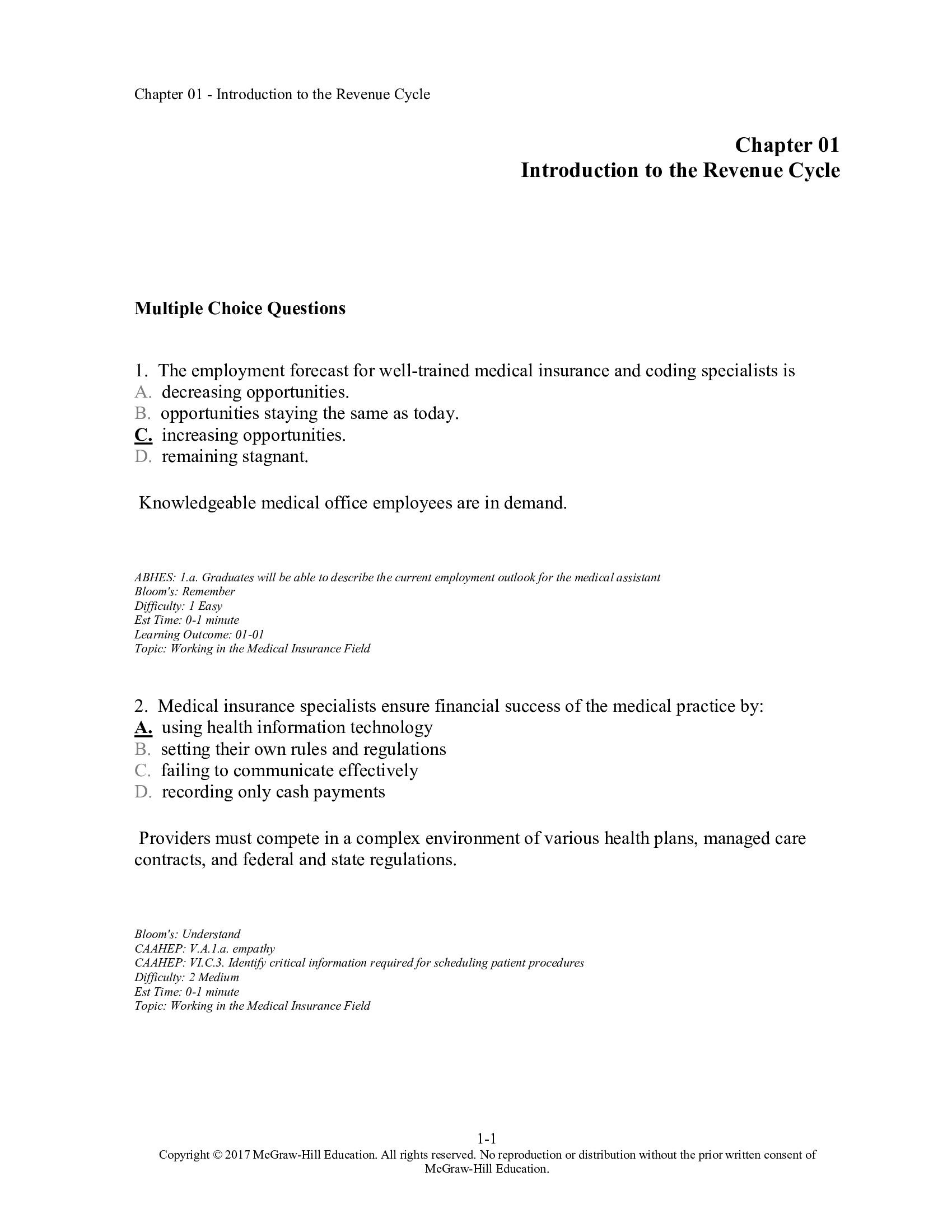
Multiple Choice Questions

1.  The employment forecast for well-trained medical insurance and coding specialists is   A.  decreasing opportunities. 

B.     opportunities staying the same as today. 

C.     increasing opportunities. 

D.    remaining stagnant. 

 Knowledgeable medical office employees are in demand. 

ABHES: 1.a. Graduates will be able to describe the current employment outlook for the medical assistant Bloom's: Remember

Difficulty: 1 Easy

Est Time: 0-1 minute

Learning Outcome: 01-01

Topic: Working in the Medical Insurance Field

2.  Medical insurance specialists ensure financial success of the medical practice by:  

A.    using health information technology 

B.     setting their own rules and regulations 

C.    failing to communicate effectively 

D.    recording only cash payments 

 Providers must compete in a complex environment of various health plans, managed care contracts, and federal and state regulations. 

Bloom's: Understand

CAAHEP: V.A.1.a. empathy

CAAHEP: VI.C.3. Identify critical information required for scheduling patient procedures Difficulty: 2 Medium

Est Time: 0-1 minute

Topic: Working in the Medical Insurance Field

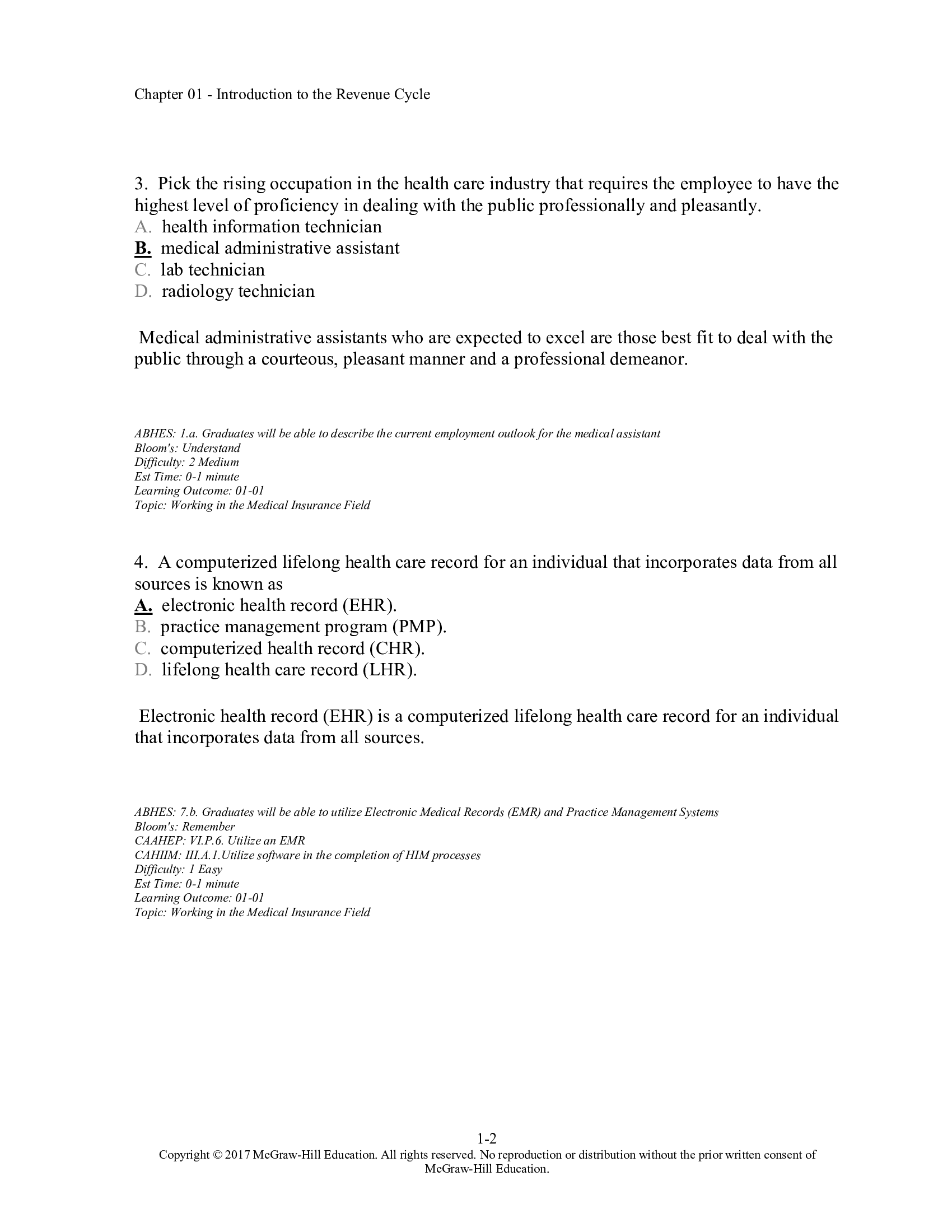
3.  Pick the rising occupation in the health care industry that requires the employee to have the highest level of proficiency in dealing with the public professionally and pleasantly.  

A.    health information technician 

B.     medical administrative assistant 

C.     lab technician 

D.    radiology technician 

 Medical administrative assistants who are expected to excel are those best fit to deal with the public through a courteous, pleasant manner and a professional demeanor. 

ABHES: 1.a. Graduates will be able to describe the current employment outlook for the medical assistant Bloom's: Understand

Difficulty: 2 Medium

Est Time: 0-1 minute

Learning Outcome: 01-01

Topic: Working in the Medical Insurance Field

4.  A computerized lifelong health care record for an individual that incorporates data from all sources is known as  

A.    electronic health record (EHR). 

B.     practice management program (PMP). 

C.    computerized health record (CHR). 

D.    lifelong health care record (LHR). 

 Electronic health record (EHR) is a computerized lifelong health care record for an individual that incorporates data from all sources.

ABHES: 7.b. Graduates will be able to utilize Electronic Medical Records (EMR) and Practice Management Systems

Bloom's: Remember

CAAHEP: VI.P.6. Utilize an EMR

CAHIIM: III.A.1.Utilize software in the completion of HIM processes

Difficulty: 1 Easy

Est Time: 0-1 minute

Learning Outcome: 01-01

Topic: Working in the Medical Insurance Field

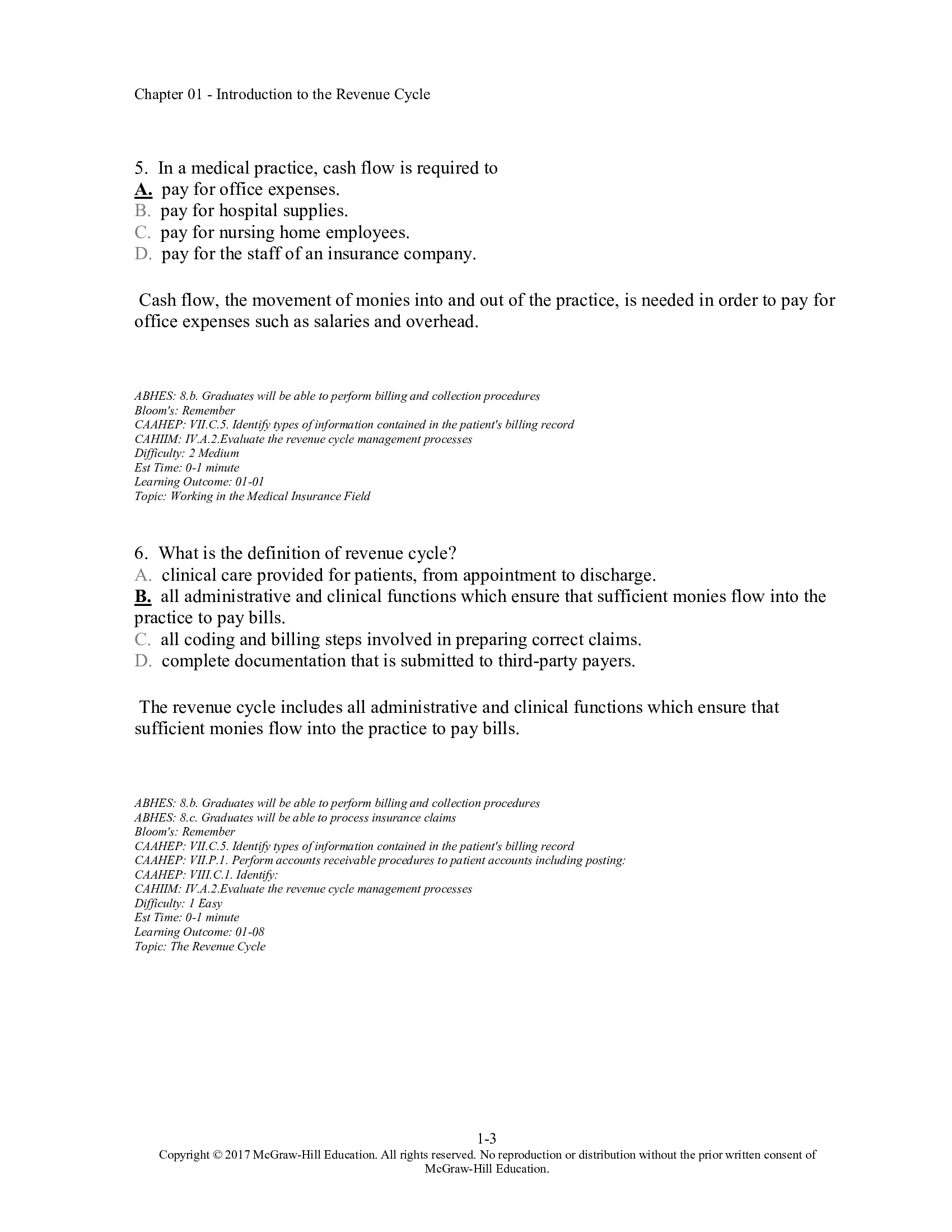
5.  In a medical practice, cash flow is required to   A.  pay for office expenses. 

B.     pay for hospital supplies. 

C.     pay for nursing home employees. 

D.    pay for the staff of an insurance company. 

 Cash flow, the movement of monies into and out of the practice, is needed in order to pay for office expenses such as salaries and overhead.

ABHES: 8.b. Graduates will be able to perform billing and collection procedures

Bloom's: Remember

CAAHEP: VII.C.5. Identify types of information contained in the patient's billing record CAHIIM: IV.A.2.Evaluate the revenue cycle management processes

Difficulty: 2 Medium

Est Time: 0-1 minute

Learning Outcome: 01-01

Topic: Working in the Medical Insurance Field

6.  What is the definition of revenue cycle?  

A.    clinical care provided for patients, from appointment to discharge. 

B.     all administrative and clinical functions which ensure that sufficient monies flow into the practice to pay bills. 

C.     all coding and billing steps involved in preparing correct claims. 

D.    complete documentation that is submitted to third-party payers. 

 The revenue cycle includes all administrative and clinical functions which ensure that sufficient monies flow into the practice to pay bills.

ABHES: 8.b. Graduates will be able to perform billing and collection procedures

ABHES: 8.c. Graduates will be able to process insurance claims

Bloom's: Remember

CAAHEP: VII.C.5. Identify types of information contained in the patient's billing record

CAAHEP: VII.P.1. Perform accounts receivable procedures to patient accounts including posting:

CAAHEP: VIII.C.1. Identify:

CAHIIM: IV.A.2.Evaluate the revenue cycle management processes Difficulty: 1 Easy

Est Time: 0-1 minute

Learning Outcome: 01-08 Topic: The Revenue Cycle

7.  Medical insurance specialists use practice management programs to   A.  schedule patients. 

B.     collect data on patients’ diagnoses and services. 

C.     record payments from insurance companies. 

D.    All of these are correct. 

 Expertise in the use of practice management programs is an important skill in the medical practice. Medical insurance specialists use them to

•  Schedule patients

•  Organize patient and insurance information

•  Collect data on patients’ diagnoses and services

•  Generate, transmit, and report on the status of health care claims

•  Record payments from insurance companies

•  Generate patients’ statements, post payments, and update accounts      · Create financial and productivity reports 

ABHES: 7.b. Graduates will be able to utilize Electronic Medical Records (EMR) and Practice Management Systems Bloom's: Remember

CAAHEP: VI.P.6. Utilize an EMR

CAHIIM: III.A.1.Utilize software in the completion of HIM processes

Difficulty: 1 Easy

Est Time: 0-1 minute

Learning Outcome: 01-01

Topic: Working in the Medical Insurance Field

8.  Examine the list of services and determine which one would most likely be considered a noncovered service.   A.  emergency medical care 

B.     employment-related injuries 

C.    surgical procedures 

D.    annual physical examinations 

 Most medical insurance policies do not cover employment-related injuries; emergency care and surgical procedures are generally covered services, while annual physical examinations are often covered as preventive medical services. 


ABHES: 8.c. Graduates will be able to process insurance claims

Bloom's: Remember

CAAHEP: VII.C.3. Identify precautions for accepting the following types of payments:

CAAHEP: VIII.P.2. Verify eligibility for services including documentation

CAHIIM: IV.A.1.Apply policies and procedures for the use of data required in health care reimbursement

Copy of CAHIIM: IV.A.1.Apply policies and procedures for the use of data required in health care reimbursement Difficulty: 2 Medium

Est Time: 0-1 minute

Learning Outcome: 01-02

Topic: Medical Insurance Basics


9.  What kind of medical services are annual physical examinations and routine screening procedures?   A.  covered 

B.    preventive 

C.    noncovered  D.  surgical 

 Annual physicals and screening procedures are examples of preventive medical services. 


ABHES: 8.a. Graduates will be able to gather and process documents

Bloom's: Remember

CAAHEP: VIII.P.2. Verify eligibility for services including documentation

CAHIIM: IV.A.1.Apply policies and procedures for the use of data required in health care reimbursement

Copy of CAHIIM: IV.A.1.Apply policies and procedures for the use of data required in health care reimbursement

Difficulty: 1 Easy

Est Time: 0-1 minute

Learning Outcome: 01-02 Topic: Medical Insurance Basics

10.  Under an insurance contract, the patient is the first party and the physician is the second party. Who is third party?  

A.    provider 

B.     PCP 

C.     insurance plan 

D.    federal government 

 The payer, or insurance plan, is the third party under an insurance contract.

Bloom's: Understand

CAAHEP: VIII.C.1.a. Identify types of third party plans

CAHIIM: IV.A.1.Apply policies and procedures for the use of data required in health care reimbursement

Copy of CAHIIM: IV.A.1.Apply policies and procedures for the use of data required in health care reimbursement

Difficulty: 2 Medium

Est Time: 0-1 minute

Learning Outcome: 01-02 Topic: Medical Insurance Basics

11.  In what ways can insurance policies be written?  

A.    an individual or group 

B.     only group 

C.    only individual 

D.    only workers 

 A group or individual can be insured. 


Bloom's: Understand

CAAHEP: VIII.C.1.a. Identify types of third party plans

CAHIIM: IV.A.1.Apply policies and procedures for the use of data required in health care reimbursement

Copy of CAHIIM: IV.A.1.Apply policies and procedures for the use of data required in health care reimbursement

Difficulty: 2 Medium

Est Time: 0-1 minute

Learning Outcome: 01-02 Topic: Medical Insurance Basics

12.  Medical insurance is a(n) __________ between a policyholder and a health plan.   A.  verbal agreement 

B.  written agreement  C.  informal agreement  D.  exchange of money 

 Medical insurance is a written policy that states the terms of an agreement between a policyholder (an individual) and a health plan (an insurance).

Bloom's: Remember

CAAHEP: VIII.C.1.a. Identify types of third party plans

CAHIIM: IV.A.1.Apply policies and procedures for the use of data required in health care reimbursement

Copy of CAHIIM: IV.A.1.Apply policies and procedures for the use of data required in health care reimbursement

Difficulty: 1 Easy

Est Time: 0-1 minute

Learning Outcome: 01-02 Topic: Medical Insurance Basics


13.  Determine which of the following entities is not considered a provider.  

A.    nurse practitioners 

B.     long-term care facilities 

C.     insurance companies 

D.    medical supply companies 

 Providers include physicians, nurse-practitioners, physician assistants, therapists, hospitals, laboratories, long-term care facilities, and suppliers such as pharmacies and medical supply companies.

Bloom's: Understand

CAAHEP: VII.C.1.a. charges

CAHIIM: IV.A.1.Apply policies and procedures for the use of data required in health care reimbursement

Copy of CAHIIM: IV.A.1.Apply policies and procedures for the use of data required in health care reimbursement

Difficulty: 2 Medium

Est Time: 0-1 minute

Learning Outcome: 01-02 Topic: Medical Insurance Basics

14.  Dependents of a policyholder may include his/her:  

A.    spouse and children 

B.     only spouse 

C.    only children  D.  physician 

 A policyholder's dependents, customarily the spouse and children, may also be covered for an additional cost. 

ABHES: 8.c. Graduates will be able to process insurance claims

Bloom's: Remember

CAAHEP: VIII.C.1.b. information required to file a third party claim

CAAHEP: VIII.C.3.a. verification of eligibility for services

CAAHEP: VIII.P.2. Verify eligibility for services including documentation

CAHIIM: IV.A.1.Apply policies and procedures for the use of data required in health care reimbursement

Copy of CAHIIM: IV.A.1.Apply policies and procedures for the use of data required in health care reimbursement

Difficulty: 1 Easy

Est Time: 0-1 minute

Learning Outcome: 01-02 Topic: Medical Insurance Basics


15.  Identify the type of service that is not considered to be a preventive medical service.   A.  pediatric and adolescent immunizations 

B.     prenatal care 

C.     outpatient surgery 

D.    routine screening procedures 

 Many health plans cover preventive medical services, such as annual physical examinations, pediatric and adolescent immunizations, prenatal care, and routine screening procedures; primary care is generally a covered service. 


Bloom's: Analyze

CAAHEP: VIII.C.3.a. verification of eligibility for services

CAHIIM: IV.A.1.Apply policies and procedures for the use of data required in health care reimbursement

Copy of CAHIIM: IV.A.1.Apply policies and procedures for the use of data required in health care reimbursement

Difficulty: 2 Medium

Est Time: 0-1 minute

Learning Outcome: 01-02 Topic: Medical Insurance Basics


16.  The key to receiving coverage and payment from a payer is the payer's definition of:   A.  provider 

B.     medical necessity 

C.    policyholder 

D.    medical insurance 

 A payer's definition of medical necessity is the key to coverage and payment. 


ABHES: 8.a. Graduates will be able to gather and process documents ABHES: 8.c. Graduates will be able to process insurance claims

Bloom's: Remember

CAAHEP: VIII.C.3.a. verification of eligibility for services

CAAHEP: VIII.P.2. Verify eligibility for services including documentation

CAAHEP: VIII.P.3. Obtain precertification or preauthorization including documentation

CAHIIM: IV.A.1.Apply policies and procedures for the use of data required in health care reimbursement

Copy of CAHIIM: IV.A.1.Apply policies and procedures for the use of data required in health care reimbursement Difficulty: 1 Easy

Est Time: 0-1 minute

Learning Outcome: 01-02

Topic: Medical Insurance Basics


17.  Determine which of the following types of services a health plan will not pay for   A.  noncovered services. 

B.     covered services. 

C.     preventive medical services. 

D.    hospitalization. 

 Medical insurance policies describe noncovered services, those for which they do not pay. 


ABHES: 8.c. Graduates will be able to process insurance claims

Bloom's: Understand

CAAHEP: VIII.C.3.a. verification of eligibility for services

CAAHEP: VIII.P.2. Verify eligibility for services including documentation

CAHIIM: IV.A.1.Apply policies and procedures for the use of data required in health care reimbursement

Copy of CAHIIM: IV.A.1.Apply policies and procedures for the use of data required in health care reimbursement

Difficulty: 2 Medium

Est Time: 0-1 minute

Learning Outcome: 01-02 Topic: Medical Insurance Basics


18.  Where do medical insurance companies summarize the payments they may make for medically necessary medical services?   A.  medical necessity document 

B.     workers' compensation document 

C.     schedule of benefits document 

D.    encounter form 

 Medical insurance policies contain a schedule of benefits that summarizes the payments that may be made for medically necessary medical services that policyholders receive. 


ABHES: 8.a. Graduates will be able to gather and process documents Bloom's: Remember

CAAHEP: VIII.C.1.b. information required to file a third party claim CAAHEP: VIII.C.3. Describe processes for:

CAHIIM: IV.A.1.Apply policies and procedures for the use of data required in health care reimbursement

Copy of CAHIIM: IV.A.1.Apply policies and procedures for the use of data required in health care reimbursement Difficulty: 1 Easy

Est Time: 0-1 minute

Learning Outcome: 01-02

Topic: Medical Insurance Basics


19.  In general, how do the cost of policies written for groups compare to those written for individuals?  

A.    policies written for groups are cheaper 

B.     policies written for individuals are cheaper 

C.    policies written for individuals and groups cost the same 

D.    policies written for groups are more expensive 

 In general, policies that are written for groups costs policyholders less than those written for individuals. 


Bloom's: Remember

CAAHEP: VII.P.2 Apply third party guidelines

CAAHEP: VIII.C.1.a. Identify types of third party plans

CAHIIM: IV.A.1.Apply policies and procedures for the use of data required in health care reimbursement

Copy of CAHIIM: IV.A.1.Apply policies and procedures for the use of data required in health care reimbursement

Difficulty: 1 Easy

Est Time: 0-1 minute

Learning Outcome: 01-02 Topic: Medical Insurance Basics


20.  Review the choices below and select the most appropriate definition for health plan benefits, as defined by American's Health Insurance Plans (AHIP).  

A.    advantages offered to policyholders 

B.     provider services 

C.     payments for medical services 

D.    list of network providers 

 Health plans provide benefits, which are defined by AHIP as payments for medical services. 


Bloom's: Understand

CAHIIM: IV.A.1.Apply policies and procedures for the use of data required in health care reimbursement

Copy of CAHIIM: IV.A.1.Apply policies and procedures for the use of data required in health care reimbursement Difficulty: 2 Medium

Est Time: 0-1 minute

Learning Outcome: 01-02

Topic: Medical Insurance Basics


21.  Compare the choices below to determine which type of provider service would most likely NOT be covered by a health plan.  

A.    a medical procedure that is not included in a plan's benefits 

B.     an illness that started after the insurance coverage began 

C.    a surgery performed on an outpatient basis 

D.    all elective procedures performed in the hospital 

 Medical insurance policies describe noncovered services that they do not cover, which include excluded services. 


ABHES: 8.c. Graduates will be able to process insurance claims

Bloom's: Analyze

CAAHEP: VIII.C.3. Describe processes for:

CAAHEP: VIII.P.2. Verify eligibility for services including documentation

CAAHEP: VIII.P.3. Obtain precertification or preauthorization including documentation

CAHIIM: IV.A.1.Apply policies and procedures for the use of data required in health care reimbursement

Copy of CAHIIM: IV.A.1.Apply policies and procedures for the use of data required in health care reimbursement Difficulty: 3 Hard

Est Time: 0-1 minute

Learning Outcome: 01-02

Topic: Medical Insurance Basics


22.  What type of insurance reimburses income lost because of a person's inability to work?  

A.  disability insurance  B.  standard medical insurance 

C.     medical necessity coverage 

D.    self-insured coverage 

 Patients may have disability insurance that provides reimbursement for income lost because of a person's inability to work. 


Bloom's: Remember

CAAHEP: VIII.C.1.a. Identify types of third party plans

CAHIIM: IV.A.1.Apply policies and procedures for the use of data required in health care reimbursement

Copy of CAHIIM: IV.A.1.Apply policies and procedures for the use of data required in health care reimbursement

Difficulty: 1 Easy

Est Time: 0-1 minute

Learning Outcome: 01-02 Topic: Medical Insurance Basics


23.  Under a written insurance contract, the policyholder pays a premium, and the insurance company provides:  

A.    payments for covered medical services 

B.     preventive medical services 

C.    surgery 

D.    copayments 

 A written insurance contract requires the policyholder to pay a premium, in exchange for which the insurance company provides payments for covered medical services. 


ABHES: 8.c. Graduates will be able to process insurance claims

Bloom's: Analyze

CAAHEP: VIII.C.1.b. information required to file a third party claim

CAAHEP: VIII.P.4. Complete an insurance claim form

CAHIIM: IV.A.1.Apply policies and procedures for the use of data required in health care reimbursement

Copy of CAHIIM: IV.A.1.Apply policies and procedures for the use of data required in health care reimbursement Difficulty: 3 Hard

Est Time: 0-1 minute

Learning Outcome: 01-03

Topic: Health care Plans


24.  Out-of-pocket expenses must be paid by:  

A.    the provider 

B.     the insured 

C.     the health plan 

D.    the insurance company 

 Insured individuals pay out-of-pocket expenses before receiving benefits. 


ABHES: 8.b. Graduates will be able to perform billing and collection procedures

Bloom's: Remember

CAAHEP: VII.C.5. Identify types of information contained in the patient's billing record

CAAHEP: VII.P.1. Perform accounts receivable procedures to patient accounts including posting:

CAHIIM: IV.A.1.Apply policies and procedures for the use of data required in health care reimbursement

Copy of CAHIIM: IV.A.1.Apply policies and procedures for the use of data required in health care reimbursement Difficulty: 1 Easy

Est Time: 0-1 minute

Learning Outcome: 01-03

Topic: Health care Plans


25.  Which of the following conditions must be met before payment is made under an indemnity plan?  

A.    payment of premium, deductible, and coinsurance 

B.     payment of the copayment 

C.    payment of the premium and coinsurance 

D.    payment of the deductible 

 Before a payment is made to an insured person under an indemnity plan, payments of the premium, deductible, and coinsurance must be up to date. 


ABHES: 8.c. Graduates will be able to process insurance claims

Bloom's: Remember CAAHEP: VIII.C.1. Identify:

CAHIIM: IV.A.1.Apply policies and procedures for the use of data required in health care reimbursement

Copy of CAHIIM: IV.A.1.Apply policies and procedures for the use of data required in health care reimbursement

Difficulty: 1 Easy

Est Time: 0-1 minute

Learning Outcome: 01-03

Topic: Health care Plans


26.  Under an indemnity plan, typically a patient may use the services of:  

A.    only HMO network providers 

B.     any affiliated provider 

C.     any provider 

D.    only out-of-network providers 

 Under indemnity plans, patients are free to choose their providers. 


Bloom's: Understand

CAAHEP: VIII.C.1.a. Identify types of third party plans

Difficulty: 2 Medium

Est Time: 0-1 minute

Learning Outcome: 01-03

Topic: Health care Plans


27.  Under a fee-for-service plan, the third-party payer makes a payment:  

A.    before medical services are provided 

B.     after medical services are provided 

C.     at the time of the visit 

D.    once a month under a PMPM 

 Fee-for-service plans pay retroactive. 


Bloom's: Remember

CAAHEP: VIII.C.1.a. Identify types of third party plans

Difficulty: 1 Easy

Est Time: 0-1 minute

Learning Outcome: 01-03

Topic: Health care Plans


28.  Calculate the amount of money a patient would owe for a covered service costing $1,200 if their indemnity policy has a coinsurance rate of 75-25, and they have already met their deductible.   A.  $0 

B.     $300 

C.    $900 

D.    $1,200 

 The patient must pay an out-of-pocket expense of $300 ($1,200 x 0.25 = $300) for this service. 


ABHES: 8.b.1. Accounts payable and accounts receivable

Bloom's: Analyze

CAAHEP: VII.C.1. Define the following bookkeeping terms:

CAAHEP: VII.P.1. Perform accounts receivable procedures to patient accounts including posting:

Difficulty: 3 Hard

Est Time: 0-1 minute

Learning Outcome: 01-03

Topic: Health care Plans


29.  Calculate the amount of money a patient would owe for a noncovered service costing $900 if their indemnity policy has a coinsurance rate of 80-20, and they have already met their deductible.   A.  $0 

B.     $180 

C.     $720 

D.    $900 

 The patient would owe the entire cost of $900, as insurance policies do not pay for noncovered services. 


ABHES: 8.b.1. Accounts payable and accounts receivable

Bloom's: Analyze

CAAHEP: VII.C.1. Define the following bookkeeping terms:

CAAHEP: VII.P.1. Perform accounts receivable procedures to patient accounts including posting:

Difficulty: 3 Hard

Est Time: 0-1 minute

Learning Outcome: 01-03

Topic: Health care Plans


30.  Calculate the amount of money a patient would owe for a covered service costing $1,800 if their indemnity policy has a $400 deductible (which has not been met) and their coinsurance rate is 80-20.   A.  $280 

B.  $680  C.  $1,400 

D.  $1,800 

 The patient must pay an out-of-pocket expense of $680 ($1,800 - $400 = $1,400; $1,400 x 0.20 = $280; $280 + $400 deductible = $680) for this service. 


ABHES: 8.b.1. Accounts payable and accounts receivable

Bloom's: Analyze

CAAHEP: VII.C.1. Define the following bookkeeping terms:

CAAHEP: VII.P.1. Perform accounts receivable procedures to patient accounts including posting:

Difficulty: 3 Hard

Est Time: 0-1 minute

Learning Outcome: 01-03

Topic: Health care Plans


31.  When is a deductible paid?  

A.    before benefits begin 

B.     at the end of the year 

C.    after benefits begin  D.  never 

 A deductible is an amount of money that the insured pays on covered services before benefits begin. 


ABHES: 8.b.1. Accounts payable and accounts receivable

Bloom's: Remember

CAAHEP: VII.C.1. Define the following bookkeeping terms:

CAAHEP: VII.P.1. Perform accounts receivable procedures to patient accounts including posting:

Difficulty: 1 Easy

Est Time: 0-1 minute

Learning Outcome: 01-03

Topic: Health care Plans


32.  How is coinsurance defined?  

A.    the periodic payment the insured is required to make to keep a policy in effect 

B.     the amount that the insured pays on covered services before benefits begin 

C.     the percentage of each claim that the insured pays 

D.    a prepayment covering provider's services for a plan member for a specified period 

 Coinsurance is the portion of charges an insured person must pay for health care services after the deductible. 


Bloom's: Remember

CAAHEP: VIII.C.1.a. Identify types of third party plans

Difficulty: 1 Easy

Est Time: 0-1 minute

Learning Outcome: 01-03

Topic: Health care Plans


33.  What is a premium?  

A.    the periodic payment the insured is required to make to keep a policy in effect 

B.     the amount that the insured pays on covered services before benefits begin 

C.    the percentage of each claim that the insured pays 

D.    a prepayment covering provider's services for a plan member for a specified period 

 A premium is money the insured pays to a health plan for a policy. 


Bloom's: Remember

CAAHEP: VIII.C.1.a. Identify types of third party plans

Difficulty: 1 Easy

Est Time: 0-1 minute

Learning Outcome: 01-03

Topic: Health care Plans


34.  Calculate the amount of money the insurance company would owe on a covered service costing $850 if there is a $500 deductible (which has not yet been met) and no coinsurance.   A.  $0 

B.     $150 

C.     $350 

D.    $500 

 The health plan would owe $350 ($850 - $500 = $350). 


ABHES: 8.c. Graduates will be able to process insurance claims

Bloom's: Analyze

CAAHEP: VIII.C.1.b. information required to file a third party claim CAAHEP: VIII.P.4. Complete an insurance claim form

Difficulty: 3 Hard

Est Time: 0-1 minute

Learning Outcome: 01-03

Topic: Health care Plans


35.  In how many managed care plans may a physician participate?  

A.    physicians are not permitted to participate in managed care plans 

B.     one 

C.     two 

D.    physicians may participate in many managed care plans 

 A physician may choose to participate in many managed care plans. 


Bloom's: Remember

CAAHEP: VIII.C.1.a. Identify types of third party plans

Difficulty: 1 Easy

Est Time: 0-1 minute

Learning Outcome: 01-03

Topic: Health care Plans


36.  Identify the advantages offered to patients in managed care plans, as compared to indemnity insurance.  

A.    lower premiums and charges 

B.     higher premiums 

C.     higher deductibles 

D.    lower premiums,charges, and deductibles 

 Managed care offers a more restricted choice of (and access to) providers and treatments in exchange for lower premiums, deductibles, and other charges than traditional indemnity insurance. 


Bloom's: Remember

CAAHEP: VIII.C.1.a. Identify types of third party plans

Difficulty: 1 Easy

Est Time: 0-1 minute

Learning Outcome: 01-03

Topic: Health care Plans


37.  Choose the entity(ies) that may form agreements with an MCO.  

A.    the patient and provider 

B.     the provider 

C.    the health plan 

D.    the provider and health plan 

 Instead of only the patient having a policy with the health plan, both the patient and the provider have agreements with the MCO. 


Bloom's: Understand

CAAHEP: VIII.C.1.a. Identify types of third party plans

Difficulty: 2 Medium

Est Time: 0-1 minute

Learning Outcome: 01-03

Topic: Health care Plans


38.  Name a benefit a provider usually gets from participation with a health plan.  

A.    an increased number of patients 

B.     a decreased number of patients 

C.    more contractual duties 

D.    no contractual duties 

 Participation brings providers benefits, such as more patients, as well as contractual duties, and usually, reduced fees. 


Bloom's: Remember

CAAHEP: VIII.C.1.a. Identify types of third party plans

Difficulty: 1 Easy

Est Time: 0-1 minute

Learning Outcome: 01-03

Topic: Health care Plans


39.  Health care claims report data to payers about __________ and __________.  

A.    the patient; the physician’s income taxes 

B.     the patient; the services provided by the physician 

C.     the physician; the services provided by the physician 

D.    the service; the deductible 

 Health care claims report data about the patient and the services provided by the physician. 


ABHES: 8.c. Graduates will be able to process insurance claims

Bloom's: Remember CAAHEP: VIII.C.1. Identify:

CAAHEP: VIII.P.4. Complete an insurance claim form

CAHIIM: IV.A.1.Apply policies and procedures for the use of data required in health care reimbursement

Copy of CAHIIM: IV.A.1.Apply policies and procedures for the use of data required in health care reimbursement

Difficulty: 1 Easy

Est Time: 0-1 minute

Learning Outcome: 01-03

Topic: Health care Plans


40.  An indemnity policy states that that the coinsurance rate is 80-20.  Which of the following is the payer’s portion?  

A.    20 

B.     60 

C.     80 

D.    100 

 The first number in the coinsurance rate is the payer's portion; the second is the insured's.  In this case, the payer’s portion is 80% and the insured’s portion is 20%. 


ABHES: 8.c. Graduates will be able to process insurance claims

Bloom's: Remember CAAHEP: VIII.C.1. Identify:

CAAHEP: VIII.P.4. Complete an insurance claim form

CAHIIM: IV.A.1.Apply policies and procedures for the use of data required in health care reimbursement

Copy of CAHIIM: IV.A.1.Apply policies and procedures for the use of data required in health care reimbursement Difficulty: 1 Easy

Est Time: 0-1 minute

Learning Outcome: 01-03

Topic: Health care Plans


41.  In what format are health care claims sent?  

A.    only electronic 

B.     only hard copy 

C.     electronic or hard copy 

D.    claims do not need to be sent 

 Health care claims are sent to payers in either electronic or hard copy format. 


ABHES: 8.c. Graduates will be able to process insurance claims

Bloom's: Remember

CAAHEP: VIII.C.1.b. information required to file a third party claim

CAAHEP: VIII.P.4. Complete an insurance claim form

CAHIIM: IV.A.1.Apply policies and procedures for the use of data required in health care reimbursement

Copy of CAHIIM: IV.A.1.Apply policies and procedures for the use of data required in health care reimbursement Difficulty: 1 Easy

Est Time: 0-1 minute

Learning Outcome: 01-03

Topic: Health care Plans


42.  What is the formula for calculating an insurance company payment in an indemnity plan?


A.    charge - deductible 

B.     deductible - coinsurance 

C.     deductible + coinsurance 

D.    charge - deductible - coinsurance 

 The formula for calculating an indemnity insurance payment is charge minus deductible minus coinsurance. 


ABHES: 8.c. Graduates will be able to process insurance claims

Bloom's: Understand CAAHEP: VIII.C.1. Identify:

CAAHEP: VIII.P.4. Complete an insurance claim form

CAHIIM: IV.A.1.Apply policies and procedures for the use of data required in health care reimbursement

Copy of CAHIIM: IV.A.1.Apply policies and procedures for the use of data required in health care reimbursement Difficulty: 2 Medium

Est Time: 0-1 minute

Learning Outcome: 01-03

Topic: Health care Plans


43.  A capitated payment amount is called a   A.  copayment. 

B.     coinsurance payment. 

C.     retroactive payment. 

D.    prospective payment. 

 Capitated payments are paid prospectively, or in advance of services. 


ABHES: 8.c. Graduates will be able to process insurance claims

Bloom's: Remember

CAAHEP: VII.C.1. Define the following bookkeeping terms:

CAAHEP: VII.P.1.b. payments

CAAHEP: VIII.C.1.a. Identify types of third party plans

CAHIIM: IV.A.1.Apply policies and procedures for the use of data required in health care reimbursement

Copy of CAHIIM: IV.A.1.Apply policies and procedures for the use of data required in health care reimbursement Difficulty: 1 Easy

Est Time: 0-1 minute

Learning Outcome: 01-04

Topic: Health Maintenance Organizations


44.  Identify the type of HMO cost-containment method that limits members to receiving services from the HMO's physician network.  

A.    cost-sharing 

B.     restricting patients' choice of providers  C.  requiring preauthorization for services 

D.  controlling drug costs 

 In order to restrict patients' choice of providers, HMOs require members to receive services from their network of physicians, hospitals, and other providers. 


Bloom's: Understand

CAAHEP: VIII.C.1.a. Identify types of third party plans

Difficulty: 2 Medium

Est Time: 0-1 minute

Learning Outcome: 01-04

Topic: Health Maintenance Organizations


45.  Identify the type of HMO cost-containment method that requires providers to use a formulary.   A.  cost-sharing 

B.     restricting patients' choice of providers 

C.     requiring preauthorization for services 

D.    controlling drug costs 

 In controlling drug costs, HMOs requires providers to prescribe drugs for patients only from the HMO's formulary. 


Bloom's: Understand

CAAHEP: VIII.C.1.a. Identify types of third party plans

Difficulty: 2 Medium

Est Time: 0-1 minute

Learning Outcome: 01-04

Topic: Health Maintenance Organizations


46. Identify the type of HMO cost-containment method that requires the patient to pay a copayment.  A. cost-sharing

B.   restricting patients' choice of providers

C.   requiring preauthorization for services

D.  controlling drug costs

In the cost-sharing method of cost-containment, HMOs required patients to pay a specified charge called a copayment when they see a provider.


Bloom's: Understand CAAHEP: VIII.C.1. Identify:

Difficulty: 2 Medium

Est Time: 0-1 minute

Learning Outcome: 01-04

Topic: Health Maintenance Organizations


47. Identify the type of HMO cost-containment method that requires patients to obtain approval for services before they receive the treatment. 

A.  cost-sharing

B.   restricting patients' choice of providers

C.   requiring preauthorization for services

D.  controlling drug costs

Requiring patients to obtain preauthorization before they receive many types of services is an HMO cost-containment method.


ABHES: 8.c. Graduates will be able to process insurance claims

Bloom's: Understand

CAAHEP: VIII.C.3.c. preauthorization

CAAHEP: VIII.P.3. Obtain precertification or preauthorization including documentation

CAHIIM: IV.A.1.Apply policies and procedures for the use of data required in health care reimbursement

Copy of CAHIIM: IV.A.1.Apply policies and procedures for the use of data required in health care reimbursement

Difficulty: 2 Medium

Est Time: 0-1 minute

Learning Outcome: 01-04

Topic: Health Maintenance Organizations


48.  If a POS HMO member elects to receive medical services from out-of-network providers they usually  

A.    pay an additional cost. 

B.     need only pay the standard copayment. 

C.    will receive inferior treatment. 

D.    pay less than in-network benefits. 

 POS members who receive medical services from out-of-network providers that they choose usually pay an additional cost. 


ABHES: 8.c. Graduates will be able to process insurance claims

Bloom's: Understand CAAHEP: VIII.C.1. Identify:

CAAHEP: VIII.P.4. Complete an insurance claim form

CAHIIM: IV.A.1.Apply policies and procedures for the use of data required in health care reimbursement

Copy of CAHIIM: IV.A.1.Apply policies and procedures for the use of data required in health care reimbursement Difficulty: 2 Medium

Est Time: 0-1 minute

Learning Outcome: 01-04

Topic: Health Maintenance Organizations


49.  Correctly relating a patient's condition and treatment refers to   A.  medical etiquette. 

B.     medical networks. 

C.     medical necessity. 

D.    medical ethics. 

 Medical necessity means that there is a logical, reasonable connection between the patient's medical condition and the treatment provided. 


Bloom's: Remember

CAAHEP: VIII.A.1. Interact professionally with third party representatives

CAAHEP: VIII.A.3. Show sensitivity when communicating with patients regarding third party requirements

CAAHEP: VIII.C.1.b. information required to file a third party claim

CAAHEP: VIII.P.2. Verify eligibility for services including documentation

CAHIIM: IV.A.1.Apply policies and procedures for the use of data required in health care reimbursement

Copy of CAHIIM: IV.A.1.Apply policies and procedures for the use of data required in health care reimbursement Difficulty: 1 Easy

Est Time: 0-1 minute

Learning Outcome: 01-04

Topic: Health Maintenance Organizations


50. Which of the following is required when an HMO patient is admitted to the hospital for nonemergency treatment? 

A.  referral

B.   coinsurance

C.   preauthorization

D.  utilization

Patients must secure preauthorization for nonemergency hospitalizations.


Bloom's: Understand

CAAHEP: VIII.C.3.c. preauthorization

CAAHEP: VIII.P.3. Obtain precertification or preauthorization including documentation Difficulty: 2 Medium

Est Time: 0-1 minute

Learning Outcome: 01-04

Topic: Health Maintenance Organizations


51. One of the advantages of an HMO for patients who face difficult treatments is Disease/Case Management by assigning a: 

A.  gatekeeper

B.   PCP

C.   copayment

D.  caseworker

HMOs often assign case managers to work with patients who face difficult treatments.


Bloom's: Understand

CAAHEP: VII.A.1. Demonstrate professionalism when discussing patient's billing record

CAAHEP: VIII.A.3. Show sensitivity when communicating with patients regarding third party requirements CAAHEP: VIII.C.1.a. Identify types of third party plans

Difficulty: 2 Medium

Est Time: 0-1 minute

Learning Outcome: 01-04

Topic: Health Maintenance Organizations


52. Under a capitated rate for each plan member, which of the following does a provider share with the third party payer? 

A.  payments

B.   risk

C.   services

D.  the premium

In a capitated plan, providers and payers share the risk of increased demand for medical services.


Bloom's: Understand

CAAHEP: VIII.C.1.a. Identify types of third party plans

Difficulty: 2 Medium

Est Time: 0-1 minute

Learning Outcome: 01-04

Topic: Health Maintenance Organizations


53. The capitated rate per member per month covers: 

A.  all medical services

B.   services listed on the schedule of benefits

C.   the episode of care

D.  all members' premiums

The capitated rate of prepayment covers only services listed on the schedule of benefits.


Bloom's: Understand

CAAHEP: VIII.C.1.a. Identify types of third party plans

Difficulty: 2 Medium

Est Time: 0-1 minute

Learning Outcome: 01-04

Topic: Health Maintenance Organizations


54. To be fully covered, patients who enroll in an HMO may use the services of: 

A.  only HMO network providers

B.   any provider within 50 miles

C.  only out-of-network providers

D.  any provider

HMOs require their members to see only network providers in order to be fully covered.


Bloom's: Remember

CAAHEP: VIII.C.1.a. Identify types of third party plans

CAAHEP: VIII.C.3.a. verification of eligibility for services

CAAHEP: VIII.P.2. Verify eligibility for services including documentation

CAHIIM: IV.A.1.Apply policies and procedures for the use of data required in health care reimbursement

Copy of CAHIIM: IV.A.1.Apply policies and procedures for the use of data required in health care reimbursement Difficulty: 1 Easy

Est Time: 0-1 minute

Learning Outcome: 01-04

Topic: Health Maintenance Organizations


55.  For a patient insured by an HMO, the phrase “out-of-network” means providers who are   A.  not under contract with the payer. 

B.     only acting as a specialist. 

C.     whose offices are more than 50 miles from the patient. 

D.    licensed by the state. 

 Out-of-network providers do not have any agreement with the patient's health plan. 


Bloom's: Remember

CAAHEP: VIII.C.1.a. Identify types of third party plans

Difficulty: 1 Easy

Est Time: 0-1 minute

Learning Outcome: 01-04

Topic: Health Maintenance Organizations


56. Patients who enroll in a point-of-service type of HMO may use the services of: 

A.  only HMO network providers

B.   any affiliated provider

C.   only out-of-network providers

D.  HMO network or out-of-network providers

POS plans expand patients' options to include out-of-network providers.


Bloom's: Remember

CAAHEP: VIII.C.1.a. Identify types of third party plans

Difficulty: 1 Easy

Est Time: 0-1 minute

Learning Outcome: 01-04

Topic: Health Maintenance Organizations


57. When a POS option is elected under a health maintenance organization, the patient may? 

A.  choose providers only from the HMO's network

B.   choose providers who are not in the HMO's network

C.   choose any provider without additional expense

D.  choose providers only from the IPA's network

POS plans provide patients with the option of using non-network providers.


Bloom's: Understand

CAAHEP: VIII.C.1.a. Identify types of third party plans

Difficulty: 2 Medium

Est Time: 0-1 minute

Learning Outcome: 01-04

Topic: Health Maintenance Organizations


58. Identify another name for a point-of-service (POS) plan. 

A.  closed HMO

B.   open HMO

C.   free HMO

D.  restricted HMO

A point-of-service (POS) plan is also called an open HMO.


Bloom's: Remember

CAAHEP: VIII.C.1.a. Identify types of third party plans

Difficulty: 1 Easy

Est Time: 0-1 minute

Learning Outcome: 01-04

Topic: Health Maintenance Organizations


59. Calculate the monthly capitation payment a provider should receive from a health plan if they have 80 contracted patients and a capitated payment of $40 per month. 

A.  $1,200

B.   $2,400

C.   $3,200

D.  $4,000

The monthly capitation payment would total $3,200 (80 x $40 = $3,200).


Bloom's: Analyze

CAAHEP: VII.C.1.b. payments

CAAHEP: VII.P.1. Perform accounts receivable procedures to patient accounts including posting:

CAAHEP: VIII.C.1.a. Identify types of third party plans

Difficulty: 3 Hard

Est Time: 0-1 minute

Learning Outcome: 01-04

Topic: Health Maintenance Organizations


60.  A physician has a contract to receive a $2,000 monthly capitation fee, based on a fee of $50 for 40 patients who are in the plan. If only 10 patients visited the practice in the last month, the capitation payment will be   A.  $500. 

B.     $1,000. 

C.     $2,000. 

D.    $4,000. 

 The monthly capitation fee is $2,000, regardless of the number of patients who visit the physician. 


Bloom's: Understand

CAAHEP: VII.C.1.b. payments

CAAHEP: VII.P.1. Perform accounts receivable procedures to patient accounts including posting: CAAHEP: VIII.C.1.a. Identify types of third party plans

Difficulty: 2 Medium

Est Time: 0-1 minute

Learning Outcome: 01-04

Topic: Health Maintenance Organizations


61.  Describe the role of a primary care physician (PCP) in an HMO.  

A.  coordinating patients' overall care  B.  ensuring that some services are necessary 

C.     providing health care services for the patient 

D.    admitting the patient to the hospital regardless of the condition 

 A PCP coordinates patient's overall care to ensure that all services are, in the PCP's judgment, necessary. 


Bloom's: Understand

CAAHEP: VIII.C.1.a. Identify types of third party plans

Difficulty: 2 Medium

Est Time: 0-1 minute

Learning Outcome: 01-04

Topic: Health Maintenance Organizations


62. Another term used for a primary care physician (PCP) is: 

A.  controller

B.   practitioner

C.   gatekeeper

D.  specialist

A primary care physician (PCP) may also be called a gatekeeper.


Bloom's: Remember

CAAHEP: VIII.C.1.a. Identify types of third party plans

Difficulty: 1 Easy

Est Time: 0-1 minute

Learning Outcome: 01-04

Topic: Health Maintenance Organizations


63. On what is the PMPM rate usually based? 

A.  health-related characteristics of the enrollees

B.   a restricted choice of providers

C.  the health plan's formulary

D.  fee for service

The capitated rate, called PMPM, is usually based on the health-related characteristics of the enrollees, such as age and gender.


Bloom's: Remember

CAAHEP: VIII.C.1.a. Identify types of third party plans

Difficulty: 1 Easy

Est Time: 0-1 minute

Learning Outcome: 01-04

Topic: Health Maintenance Organizations


64. Higher copayments may be charged for patient visits to/for:  A. preventive services

B. the office of a specialist C. their primary care physician

D. medical necessary services

A higher copayment may be required for a visit to the office of a specialist or for the use of emergency department services.


ABHES: 8.c. Graduates will be able to process insurance claims

Bloom's: Remember CAAHEP: VII.P.1.a. charges CAAHEP: VIII.C.1. Identify:

CAHIIM: IV.A.1.Apply policies and procedures for the use of data required in health care reimbursement

Copy of CAHIIM: IV.A.1.Apply policies and procedures for the use of data required in health care reimbursement Difficulty: 1 Easy

Est Time: 0-1 minute

Learning Outcome: 01-04

Topic: Health Maintenance Organizations


65. In a preferred provider organization (PPO) plan, referrals to specialists are: 

A.  required

B.   not required C. more expensive

D. less expensive

PPOs do not usually demand a referral for a specialist visit.


Bloom's: Remember CAAHEP: VIII.C.1. Identify:

CAAHEP: VIII.C.3.c. preauthorization

CAAHEP: VIII.P.3. Obtain precertification or preauthorization including documentation

Difficulty: 1 Easy

Est Time: 0-1 minute

Learning Outcome: 01-05

Topic: Preferred Provider Organizations


66. What do providers participating in a PPO generally receive in exchange for accepting lower fees?  A. more patient visits B. capitation payments

C.   less patient visits

D.  increased hospitalization rates

In exchange for accepting lower fees, providers generally see more patients.


Bloom's: Remember

CAAHEP: VIII.C.1.a. Identify types of third party plans

Difficulty: 1 Easy

Est Time: 0-1 minute

Learning Outcome: 01-05

Topic: Preferred Provider Organizations


67. PPO members who use out-of-network providers may be subjected to: 

A.  higher copayments

B.   lower copayments

C.  lower insurance rates

D.  decreased deductibles

PPO members may use out-of-network providers, usually for higher copayments, increased deductibles, or both.


Bloom's: Remember

CAAHEP: VII.P.1.a. charges

CAAHEP: VIII.C.1.a. Identify types of third party plans

Difficulty: 1 Easy

Est Time: 0-1 minute

Learning Outcome: 01-05

Topic: Preferred Provider Organizations


68.  Imagine you are a patient who wants to regulate your health care expenses on your own; what type of insurance plan would you use?  

A.    health maintenance organization 

B.     preferred provider organization 

C.     consumer-driven health plan 

D.    point-of-service plan 

 Cost containment in consumer-driven health plans begins with consumerism, which is the idea that patients who themselves pay for health care services become more careful consumers. 


Bloom's: Apply

CAAHEP: VIII.C.1.a. Identify types of third party plans

Difficulty: 3 Hard

Est Time: 0-1 minute

Learning Outcome: 01-06

Topic: Consumer-Driven Health Plans


69.  Consumer-driven health plans combine a health plan with a special “savings account” that is used to pay what before the deductible is met?  

A.    coinsurance 

B.     medical bills 

C.     excluded services 

D.    non medically necessary services 

 Consumer-driven health plans combine a health plan with a special “savings account” that is used to pay medical bills before the deductible is met. 


Bloom's: Remember

CAAHEP: VIII.C.1.a. Identify types of third party plans

Difficulty: 1 Easy

Est Time: 0-1 minute

Learning Outcome: 01-06

Topic: Consumer-Driven Health Plans


70.  Name the two components of a consumer-driven health plan (CDHP).  

A.    a health plan and a gatekeeper 

B.     a health plan and a special “savings account”  C.  a gatekeeper and a special “savings account” 

D.  a gatekeeper and a formulary 

 Consumer-driven health plans (CDHPs) combine a health plan, usually a PPO with a high deductible and low premiums, with a special “savings account” used to pay medical bills before the deductible has been met. 


Bloom's: Remember

CAAHEP: VIII.C.1.a. Identify types of third party plans

Difficulty: 2 Medium

Est Time: 0-1 minute

Learning Outcome: 01-06

Topic: Consumer-Driven Health Plans


71. Employers that offer health plans to employees without using an insurance carrier are: 

A.  third-party payers

B.   third-party administrators

C.   independent contractors

D.  self-funded (insured) health plans

Self-funded (insured) health plans offer health plans directly to employees.


Bloom's: Remember

CAAHEP: VIII.C.1.a. Identify types of third party plans

Difficulty: 1 Easy

Est Time: 0-1 minute

Learning Outcome: 01-07

Topic: Medical Insurance Payers


72. Determine which method a self-funded health plan is most likely to use in setting up its provider network. 

A.  hire a PCP to provide a network

B.   set up their own provider network

C.   buy the use of existing networks from managed care organizations

D.  are not required to set up a network

Self-funded health plan most often buy the use of existing networks from managed care organizations.


Bloom's: Remember

CAAHEP: VIII.C.1.a. Identify types of third party plans

Difficulty: 1 Easy

Est Time: 0-1 minute

Learning Outcome: 01-07

Topic: Medical Insurance Payers


73. Which of the following is an example of a private-sector payer? 

A.  Medicare

B.   Medicaid

C.   workers' compensation insurance

D.  insurance company

An insurance company is considered a private-sector payer, as opposed to government programs such as Medicare.


Bloom's: Remember

CAAHEP: VIII.C.1.a. Identify types of third party plans

Difficulty: 1 Easy

Est Time: 0-1 minute

Learning Outcome: 01-07

Topic: Medical Insurance Payers


74. Which of the following covers patients who are over age 65? 

A.  Medicare

B.   Medicaid

C.  TRICARE

D.  CHAMPUS

Medicare covers the over-65 population.


Bloom's: Remember

CAAHEP: VIII.C.1.a. Identify types of third party plans

Difficulty: 1 Easy

Est Time: 0-1 minute

Learning Outcome: 01-07

Topic: Medical Insurance Payers


75. Which of the following programs covers people who cannot otherwise afford medical care? 

A.  Medicare

B.   Medicaid C. TRICARE

D. CHAMPUS

Medicaid covers people who otherwise could not afford medical care.


Bloom's: Remember

CAAHEP: VIII.C.1.a. Identify types of third party plans

Difficulty: 1 Easy

Est Time: 0-1 minute

Learning Outcome: 01-07

Topic: Medical Insurance Payers


76.  Scheduling appointments is part of which revenue cycle step?  

A.    Step 1, preregister patients 

B.     Step 10, follow up on patient payments 

C.    Step 8, monitor patient adjudication 

D.    Step 5, review coding compliance 

 Scheduling appointments is the first step in the revenue cycle. 


ABHES: 8.d. Graduates will be able to apply scheduling principles

Bloom's: Remember

CAAHEP: VI.P.1. Manage appointment schedule using established priorities Difficulty: 1 Easy

Est Time: 0-1 minute

Learning Outcome: 01-08

Topic: The Revenue Cycle


77.  Collecting copayments is part of which revenue cycle step?   A.  Step 3, check in patients. 

B.     Step 10, follow up patient payments. 

C.     Step 8, monitor patient adjudication. 

D.    Step 5, review coding compliance. 

 Collecting copayments is done during patient check-in. 


ABHES: 8.b. Graduates will be able to perform billing and collection procedures

Bloom's: Remember

CAAHEP: VII.C.1. Define the following bookkeeping terms:

CAAHEP: VII.P.1. Perform accounts receivable procedures to patient accounts including posting:

CAHIIM: IV.A.1.Apply policies and procedures for the use of data required in health care reimbursement

Copy of CAHIIM: IV.A.1.Apply policies and procedures for the use of data required in health care reimbursement Difficulty: 1 Easy

Est Time: 0-1 minute

Learning Outcome: 01-08

Topic: The Revenue Cycle


78. When medical insurance specialists work with patient billing programs, they need? 

A. computer skills B. communication skills

C.   knowledge of anatomy

D.  flexibility

Working with billing programs requires computer skills.


ABHES: 7.b. Graduates will be able to utilize Electronic Medical Records (EMR) and Practice Management Systems

Bloom's: Understand

CAAHEP: VI.P.6. Utilize an EMR

Difficulty: 2 Medium

Est Time: 0-1 minute

Learning Outcome: 01-08

Topic: The Revenue Cycle


79. A patient ledger records: 

A.  the patient's illnesses

B.   the patient's financial transactions

C.   the patient's relatives

D.  the day's appointments and payments

A patient ledger is a record of a particular patient's financial transactions with the practice.


Bloom's: Remember

CAAHEP: VII.C.1. Define the following bookkeeping terms:

CAAHEP: VII.C.5. Identify types of information contained in the patient's billing record

Difficulty: 1 Easy

Est Time: 0-1 minute

Learning Outcome: 01-08

Topic: The Revenue Cycle


80. Imagine you are a medical insurance specialist; illustrate the impact your ability to prepare accurate, timely claims can have on the practice. 

A.  preparing accurate and timely claims generally leads to full and timely reimbursement from the health plan

B.   preparing accurate and timely claims generally leads to a higher capitation payment

C.  preparing accurate and timely claims generally leads to a higher coinsurance rate

D.  preparing accurate and timely claims generally leads to more patients

When medical insurance specialists prepare accurate, timely claims, the practice is most likely to receive full and timely reimbursement from the health plan.


ABHES: 8.b. Graduates will be able to perform billing and collection procedures

Bloom's: Apply

CAAHEP: VII.P.1. Perform accounts receivable procedures to patient accounts including posting:

CAAHEP: VIII.C.5. Differentiate between fraud and abuse

CAHIIM: IV.A.1.Apply policies and procedures for the use of data required in health care reimbursement

Copy of CAHIIM: IV.A.1.Apply policies and procedures for the use of data required in health care reimbursement Difficulty: 3 Hard

Est Time: 0-1 minute

Learning Outcome: 01-08

Topic: The Revenue Cycle


81. What step is used when patient payments are later than permitted under the financial policy? 

A.  step 3, check in patients

B.   step 10, follow up patient payments and collections

C.   step 2, establish financial responsibility for the visit

D.  step 4, review coding compliance

A collection process is often started when patient payments are later than permitted under the practice's financial policy.


ABHES: 8.b. Graduates will be able to perform billing and collection procedures

Bloom's: Remember

CAAHEP: VII.P.1. Perform accounts receivable procedures to patient accounts including posting:

CAAHEP: VIII.A.1. Interact professionally with third party representatives

CAAHEP: VIII.A.3. Show sensitivity when communicating with patients regarding third party requirements

CAHIIM: IV.A.1.Apply policies and procedures for the use of data required in health care reimbursement

Copy of CAHIIM: IV.A.1.Apply policies and procedures for the use of data required in health care reimbursement Difficulty: 1 Easy

Est Time: 0-1 minute

Learning Outcome: 01-08

Topic: The Revenue Cycle


82.  Verifying insurance is part of which revenue cycle step?   A.  Step 3, check in patients. 

B.     Step 10, follow up patient payments. 

C.     Step 2, establish financial responsibility for the visit. 

D.    Step 4, review coding compliance. 

 Verifying insurance is part of establishing financial responsibility for a visit. 


Bloom's: Remember

CAAHEP: VIII.C.3.a. verification of eligibility for services

CAAHEP: VIII.P.2. Verify eligibility for services including documentation Difficulty: 1 Easy

Est Time: 0-1 minute

Learning Outcome: 01-08

Topic: The Revenue Cycle


83.  Describe the process of adjudication.  

A.    the practice's monitoring of the money that is needed to run the practice 

B.     the payer's process of putting a claim through a series of steps designed to judge whether it should be paid 

C.     the process of appealing a rejected claim 

D.    the practice's comparison of each payment sent with a claim 

 A health plan's process of examining claims and determining benefits is adjudication. 


ABHES: 8.c. Graduates will be able to process insurance claims

Bloom's: Understand CAAHEP: VIII.C.1. Identify:

CAAHEP: VIII.P.4. Complete an insurance claim form

CAHIIM: IV.A.1.Apply policies and procedures for the use of data required in health care reimbursement

Copy of CAHIIM: IV.A.1.Apply policies and procedures for the use of data required in health care reimbursement Difficulty: 2 Medium

Est Time: 0-1 minute

Learning Outcome: 01-08

Topic: The Revenue Cycle


84.  In what step does the medical insurance specialist verify that charges are in compliance with insurance guidelines?   A.  step 3, check in patients 

B.     step 10, follow up patient payments 

C.     step 2, establish financial responsibility for the visit 

D.    step 5, review billing compliance 

 Medical insurance specialists apply their knowledge of payer guidelines to analyze what can be billed on health care claims. 


ABHES: 8.c. Graduates will be able to process insurance claims

Bloom's: Remember

CAAHEP: VIII.A.1. Interact professionally with third party representatives CAAHEP: VIII.C.1. Identify:

CAAHEP: VIII.P.4. Complete an insurance claim form

CAHIIM: IV.A.1.Apply policies and procedures for the use of data required in health care reimbursement

Copy of CAHIIM: IV.A.1.Apply policies and procedures for the use of data required in health care reimbursement

Difficulty: 1 Easy

Est Time: 0-1 minute

Learning Outcome: 01-08 Topic: The Revenue Cycle


85.  What term is used to describe the action of satisfying official requirements?  

A.    adjudication 

B.     compliance 

C.     accounts receivable (A/R) 

D.    accounts payable (A/P) 

 Compliance means actions that satisfy official requirements, such as the proper assigning of codes. 


ABHES: 8.c. Graduates will be able to process insurance claims

Bloom's: Remember

CAAHEP: VIII.A.1. Interact professionally with third party representatives CAAHEP: VIII.C.1. Identify:

CAAHEP: VIII.P.4. Complete an insurance claim form

CAHIIM: IV.A.1.Apply policies and procedures for the use of data required in health care reimbursement

Copy of CAHIIM: IV.A.1.Apply policies and procedures for the use of data required in health care reimbursement

Difficulty: 1 Easy

Est Time: 0-1 minute

Learning Outcome: 01-08 Topic: The Revenue Cycle


86.  What adds up to form a practice's accounts receivable?  

A.    money due from health plans 

B.     money due from patients 

C.     money due from both health plans and patients 

D.    money owed to patients 

 The money due from plans, as well as payments due from patients, add up to form the practice's accounts receivable (A/R). 


ABHES: 8.b. Graduates will be able to perform billing and collection procedures

Bloom's: Remember

CAAHEP: VII.C.1.c. accounts receivable

CAAHEP: VII.P.1. Perform accounts receivable procedures to patient accounts including posting:

Difficulty: 1 Easy

Est Time: 0-1 minute

Learning Outcome: 01-08 Topic: The Revenue Cycle


87.  Practice management programs may be used for:   

A.    scheduling appointments and financial record keeping 

B.     financial record keeping and billing 

C.     billing only 

D.    scheduling appointments, financial record keeping, and billing 

 PMPs are used for scheduling appointments, billing, and financial record keeping. 


ABHES: 7.b. Graduates will be able to utilize Electronic Medical Records (EMR) and Practice Management Systems Bloom's: Remember

CAAHEP: VI.P.6. Utilize an EMR

Difficulty: 1 Easy

Est Time: 0-1 minute

Learning Outcome: 01-08

Topic: The Revenue Cycle


88. Which of the following characteristics should medical insurance specialists use when working with patients' records and handling finances? 

A.  able to work as a team member

B.   honesty and integrity

C.   knowledge of medical terms

D.  communication skills

Handling financial matters requires honesty and integrity.


ABHES: 4.a. Graduates will be able to follow documentation guidelines

ABHES: 4.g. Graduates will be able to display compliance with Code of Ethics of the profession Bloom's: Apply

CAAHEP: VII.A.1. Demonstrate professionalism when discussing patient's billing record CAAHEP: VII.A.2. Display sensitivity when requesting payment for services rendered

CAHIIM: IV.A.1.Apply policies and procedures for the use of data required in health care reimbursement

Copy of CAHIIM: IV.A.1.Apply policies and procedures for the use of data required in health care reimbursement

Difficulty: 3 Hard

Est Time: 0-1 minute

Learning Outcome: 01-09

Topic: Achieving Success


89.  The statement that “coding professionals should not change codes. . .to increase billings” is an example of:   A.  professional ethics  B.  professional services 

C.     professional etiquette 

D.    personal ethics 

 Professional ethics requires coders to avoid changing codes for any billing reason. 


ABHES: 4.a. Graduates will be able to follow documentation guidelines

ABHES: 4.g. Graduates will be able to display compliance with Code of Ethics of the profession Bloom's: Apply

CAAHEP: VII.A.1. Demonstrate professionalism when discussing patient's billing record CAAHEP: VII.A.2. Display sensitivity when requesting payment for services rendered

CAHIIM: IV.A.1.Apply policies and procedures for the use of data required in health care reimbursement

Copy of CAHIIM: IV.A.1.Apply policies and procedures for the use of data required in health care reimbursement

Difficulty: 3 Hard

Est Time: 0-1 minute

Learning Outcome: 01-09

Topic: Achieving Success


90. Courteous treatment of patients who visit the medical practice is an example of medical:  A. ethics

B.   etiquette

C.  coding

D.  insurance

Medical etiquette requires courteous treatment of patients.


ABHES: 4.g. Graduates will be able to display compliance with Code of Ethics of the profession

ABHES: 5.c. Graduates will be able to intervene on behalf of the patient regarding issues/concerns that may arise, i.e. insurance policy information, medical bills, physician/provider orders, etc.

Bloom's: Remember

CAAHEP: VII.A.1. Demonstrate professionalism when discussing patient's billing record CAAHEP: VII.A.2. Display sensitivity when requesting payment for services rendered Difficulty: 1 Easy

Est Time: 0-1 minute

Learning Outcome: 01-09

Topic: Achieving Success


91. In large medical practices, a medical insurance specialist is more likely to: 

A.  need to use professionalism

B.   handle a variety of billing and collections tasks

C.   have more specialized duties

D.  have less specialized duties

In large medical practices, the duties of medical insurance specialists may be more specialized.


Bloom's: Remember

CAAHEP: X.C.1. Differentiate between scope of practice and standards of care for medical assistants

Difficulty: 1 Easy

Est Time: 0-1 minute

Learning Outcome: 01-09

Topic: Achieving Success


92. The most important characteristic for a medical insurance specialist to possess is: 

A.  professionalism

B.   punctuality

C.  friendliness

D.  quickness

The most important characteristic that medical insurance specialists should evidence is professionalism.


ABHES: 4.g. Graduates will be able to display compliance with Code of Ethics of the profession Bloom's: Remember

CAAHEP: XI.A.1. Recognize the impact personal ethics and morals have on the delivery of health care Difficulty: 1 Easy

Est Time: 0-1 minute

Learning Outcome: 01-09

Topic: Achieving Success


93.  What skills and attributes are required for successful mastery of the tasks of a medical insurance specialist?  

A.    professional appearance and  attention to detail 

B.     courtesy and good attendance 

C.     initiative and communication skills 

D.    attention to detail and ability to work as a team member 

 A number of skills and attributes are required for successful mastery of the tasks of amedical insurance specialist,  including knowledge of medical terminology, anatomy, physiology, and medical coding; communication skills; attention to detail; flexibility; health information technology skills; honesty and integrity; and ability to work as a team member. 


ABHES: 4.g. Graduates will be able to display compliance with Code of Ethics of the profession Bloom's: Remember

CAAHEP: XI.A.1. Recognize the impact personal ethics and morals have on the delivery of health care Difficulty: 1 Easy

Est Time: 0-1 minute

Learning Outcome: 01-09

Topic: Achieving Success


94. What resource may medical insurance specialists access to review the correct behavior expected of them? 

A.  the practice's financial policy

B.   the practice's employee policy and procedure manual

C.   the practice accounts receivable (A/R)

D.  the practice accounts payable (A/P)

Correct behavior in a medical practice is generally covered in the practice's employee policy and procedure manual.


ABHES: 4.f. Graduates will be able to comply with federal, state, and local health laws and regulations as they relate to health care settings Bloom's: Remember

CAAHEP: XI.A.1. Recognize the impact personal ethics and morals have on the delivery of health care CAAHEP: XI.C.3. Identify the effect of personal morals on professional performance Difficulty: 1 Easy

Est Time: 0-1 minute

Learning Outcome: 01-09

Topic: Achieving Success


95. Professional organizations generally have a(n) __________ that its members should follow/possess. 

A.  employee policy and procedure manual

B.   list of attributes C. code of ethics

D. financial policy

Each professional organization has a code of ethics that is to be followed by its membership.


ABHES: 4.g. Graduates will be able to display compliance with Code of Ethics of the profession Bloom's: Remember

CAAHEP: XI.A.1. Recognize the impact personal ethics and morals have on the delivery of health care

CAAHEP: XI.C.2. Differentiate between personal and professional ethics

CAAHEP: XI.C.3. Identify the effect of personal morals on professional performance Difficulty: 1 Easy

Est Time: 0-1 minute

Learning Outcome: 01-09

Topic: Achieving Success


96.  The designation of Registered Medical Assistant (RMA) is awarded by   A.  AAMA. 

B.     AAPC. 

C.     AMT. 

D.    AHIMA. 

 The RMA is awarded by the AMT. 


ABHES: 1.c. Graduates will be able to describe medical assistant credentialing requirements and the process to obtain the credential.

Comprehend the importance of credentialing

Bloom's: Remember

CAAHEP: X.C.5. Discuss licensure and certification as they apply to health care providers Difficulty: 1 Easy

Est Time: 0-1 minute

Learning Outcome: 01-10

Topic: Moving Ahead


97.  Certification as a Certified Professional Coder (CPC) is awarded by   A.  AAMA. 

B.     AAPC. 

C.    AMT. 

D.    AHIMA. 

 The American Academy of Professional Coders grants the Certified Professional Coder. 


ABHES: 1.c. Graduates will be able to describe medical assistant credentialing requirements and the process to obtain the credential.

Comprehend the importance of credentialing

Bloom's: Remember

CAAHEP: X.C.5. Discuss licensure and certification as they apply to health care providers Difficulty: 1 Easy

Est Time: 0-1 minute

Learning Outcome: 01-10

Topic: Moving Ahead


98.  The titles of Certified Coding Specialist (CCS) and Certified Coding Specialist– Physician-based (CCS-P) are awarded by   A.  AMA. 

B.     CNN. 

C.     ABC. 

D.    AHIMA. 

 The CCS and CCS-P certifications are awarded by AHIMA. 


ABHES: 1.c. Graduates will be able to describe medical assistant credentialing requirements and the process to obtain the credential.

Comprehend the importance of credentialing

Bloom's: Remember

CAAHEP: X.C.5. Discuss licensure and certification as they apply to health care providers Difficulty: 1 Easy

Est Time: 0-1 minute

Learning Outcome: 01-10

Topic: Moving Ahead


99. Pick the most accurate definition of certification. 

A.  recognition of professionalism

B.   recognition of a superior level of skill by an official organization

C.   recognition of a successful career

D.  recognition of higher level of degree of schooling

Certification is recognition of a superior level of skill by an official organization.


ABHES: 1.c. Graduates will be able to describe medical assistant credentialing requirements and the process to obtain the credential.

Comprehend the importance of credentialing

Bloom's: Understand

CAAHEP: X.C.5. Discuss licensure and certification as they apply to health care providers Difficulty: 2 Medium

Est Time: 0-1 minute

Learning Outcome: 01-10

Topic: Moving Ahead


100. What is typically required of professional organizations? 

A.  good attendance

B.   continuing education sessions

C.   membership in more than one organization

D.  there are no requirements

Most professional organizations require certified members to keep up-to-date by taking annual training courses.


ABHES: 1.c. Graduates will be able to describe medical assistant credentialing requirements and the process to obtain the credential.

Comprehend the importance of credentialing

Bloom's: Remember

CAAHEP: X.C.5. Discuss licensure and certification as they apply to health care providers Difficulty: 1 Easy

Est Time: 0-1 minute

Learning Outcome: 01-10

Topic: Moving Ahead

Contact the Seller

Please Sign In to contact this seller.


  • 👎  Report Copyright Violation

Frequently Asked Questions

What Do I Get When I Buy This Study Material?

+

When you buy a study material on Passing Grades, an instant download link will be sent directly to your email, giving you access to the file anytime after payment is completed.

Is Passing Grades a Trusted Platform?

+

Yes, Passing Grades is a reputable students’ marketplace with a secure payment system and reliable customer support. You can trust us to ensure a safe and seamless transaction experience.

Will I Be Stuck with a Subscription?

+

No, all purchases on Passing Grades are one-time transactions. You only pay for the notes you choose to buy, with no subscriptions or hidden fees attached.

Who Am I Buying These Study Materials From?

+

Passing Grades is a marketplace, which means you are purchasing the document from an individual vendor, not directly from us. We facilitate the payment and delivery process between you and the vendor.

Does Passing Grades Offer Free Study Materials?

+

Yes, sellers on Passing Grades have uploaded numerous free test banks, exams, practice questions, and class notes that can be downloaded at no cost.


Pasinggrades - Quality Study Materials

USD 15

    • Quality checked by Pasing Grades
    • 100% satisfaction guarantee
    • Seller: mentor2000
Buy PDF $15

Seller Information

mentor2000

Member since April 2021

  • icon
  • icon
View Profile
  • total sales

    0
  • Favourites

    0
  • Comments

    0
    ( 0 Ratings )

Item Information

  • Uploaded

    22 May 2022

  • Updated

    18 May 2025

  • Category

    Nursing

  • Item Type

    test bank

  • Tags

    Test Bank for Medical Insurance 7th Edition by Valerius

Related Exam Prep Guides by mentor2000

Test Bank for Essentials for Nursing Practice 8th Edition by Potter | All Chapters
View Document

Test Bank for Essent...

  • mentor2000

    mentor2000

  • test bank

Master nursing concepts with this study material; Test Bank for Essentials for Nursing Practice, 8th...

15 USD

0

0

A &P 1 MA278 BSC2 Final Module II Questions & Answers 2026 Update
View Document

A &P 1 MA278 BSC2 Fi...

  • mentor2000

    mentor2000

  • test bank

Prepare for success with A&P 1 MA278 BSC2 Final Module II 2024 Q&A. Boost your grades with this comp...

15 USD

0

0

ATI Comprehensive Predictor Exam 2026
View Document

ATI Comprehensive Pr...

  • mentor2000

    mentor2000

  • test bank

Prepare for success with the ATI Comprehensive Predictor Exam 2026. Access key practice questions to...

15 USD

0

0

Purchase

Download link will be sent to this email immediately after purchase.

IMPORTANT LINKS

  • How To Upload Class Notes
  • Selling Tips
  • Passing Grades's Study Materials
  • Scholarships for International Students 2025

POPULAR CATEGORIES

  • Law
  • Accounting
  • English
  • Psychology
  • Business
  • Nursing
  • Computer Science
  • General

View Document

  • Blog
  • Contact
  • Delivery Policy
  • Latest Scholarships Around the World
  • How to Pass Bar Exams: Passing Grades’ Strategies
  • How to Study and Pass the CPA Exam
  • All Test Banks
  • Faq
  • Copyright Claims
  • Privacy Policy
  • Terms of Use

KNOWLEDGE BASE

  • How to Write A+ Grade Good Research Paper
  • How to Manage Stress During Exam Period
  • Best Time to Study
  • How to Pass NCLEX-RN Exam
  • How To Effectively Utilize Test Banks
  • Popular Shadow Health Exam Assessments
  • Popular HESI Case Studies
  • How to Prepare for a Nursing Career
  • The Importance Of Summaries in Exam Revisvion

© 2026 Pasing Grades. All rights reserved.