
Pasing Grades
  • Start Selling
  • Blog
  • Contact
  • 0

    Your cart is empty!

English

  • English
  • Spanish
  • Arabic
Create Account Sign In
  • Library
    • New Prep Guides
    • Featured Prep Guides
    • Free Exam Prep Guides
    • Best sellers
  • General
  • Nursing
    • Research Paper
    • Case Study
    • Discussion Post
    • Assignment
    • Exam
    • Practice Questions and Answers
    • Test Bank
    • solutions manual
  • Accounting
    • Case Study
    • Thesis
    • Study Guide
    • Summary
    • Research Paper
    • test bank
  • English
    • Creative Writing
    • Research Paper
    • Summary
    • Rhetorics
    • Literature
    • Journal
    • Exam
    • Grammar
    • Discussion Post
    • Essay
  • Psychology
    • Hesi
    • Presentation
    • Essay
    • Summary
    • Study Guide
    • Essay
    • Solution Manual
    • Final Exam Review
    • Class Notes
    • test bank
  • Business
    • Lecture Notes
    • Solution Manual
    • Presentation
    • Business Plan
    • Class Notes
    • Experiment
    • Summary
    • Practice Questions
    • Study Guide
    • Case Study
    • test bank
    • Exam
  • More
    • Computer Science
    • Economics
    • Statistics
    • Engineering
    • Biology
    • Religious Studies
    • Physics
    • Chemistry
    • Mathematics
    • History
    • Sociology
    • Science
    • Philosophy
    • Law
  • Pages
    • About Us
    • Selling Tips
    • Delivery Policy
    • Faq
    • Privacy Policy
  • Flash Sale
  • Home
  • Test Bank for Marketing Management, 15th Edition by Kotler and Keller

Test Bank for Marketing Management, 15th Edition by Kotler and Keller

Preview page 1 Preview page 2 Preview page 3
Add To Favorites

Share this item Share this item

  • Item Details
  • Comments (0)
  • Reviews (0)
  • Contact Seller

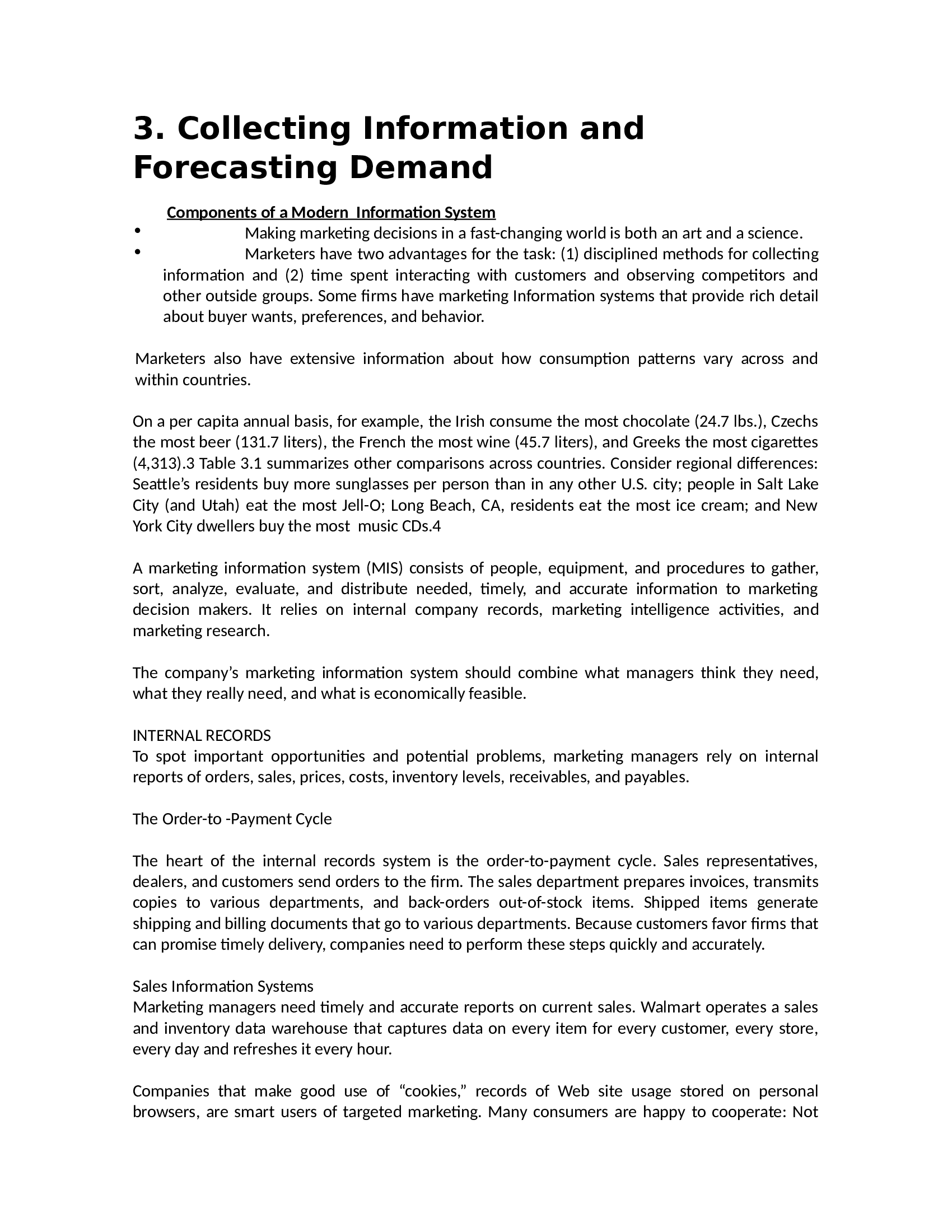
Components of a Modern Information System

ď‚· Making marketing decisions in a fast-changing world is both an art and a science.

ď‚· Marketers have two advantages for the task: (1) disciplined methods for collecting

information and (2) time spent interacting with customers and observing competitors and

other outside groups. Some firms have marketing Information systems that provide rich detail

about buyer wants, preferences, and behavior.

Marketers also have extensive information about how consumption patterns vary across and

within countries.

On a per capita annual basis, for example, the Irish consume the most chocolate (24.7 lbs.), Czechs

the most beer (131.7 liters), the French the most wine (45.7 liters), and Greeks the most cigarettes

(4,313).3 Table 3.1 summarizes other comparisons across countries. Consider regional differences:

Seattle’s residents buy more sunglasses per person than in any other U.S. city; people in Salt Lake

City (and Utah) eat the most Jell-O; Long Beach, CA, residents eat the most ice cream; and New

York City dwellers buy the most music CDs.4

A marketing information system (MIS) consists of people, equipment, and procedures to gather,

sort, analyze, evaluate, and distribute needed, timely, and accurate information to marketing

decision makers. It relies on internal company records, marketing intelligence activities, and

marketing research.

The company’s marketing information system should combine what managers think they need,

what they really need, and what is economically feasible.

INTERNAL RECORDS

To spot important opportunities and potential problems, marketing managers rely on internal

reports of orders, sales, prices, costs, inventory levels, receivables, and payables.

The Order-to -Payment Cycle

The heart of the internal records system is the order-to-payment cycle. Sales representatives,

dealers, and customers send orders to the firm. The sales department prepares invoices, transmits

copies to various departments, and back-orders out-of-stock items. Shipped items generate

shipping and billing documents that go to various departments. Because customers favor firms that

can promise timely delivery, companies need to perform these steps quickly and accurately.

Sales Information Systems

Marketing managers need timely and accurate reports on current sales. Walmart operates a sales

and inventory data warehouse that captures data on every item for every customer, every store,

every day and refreshes it every hour.

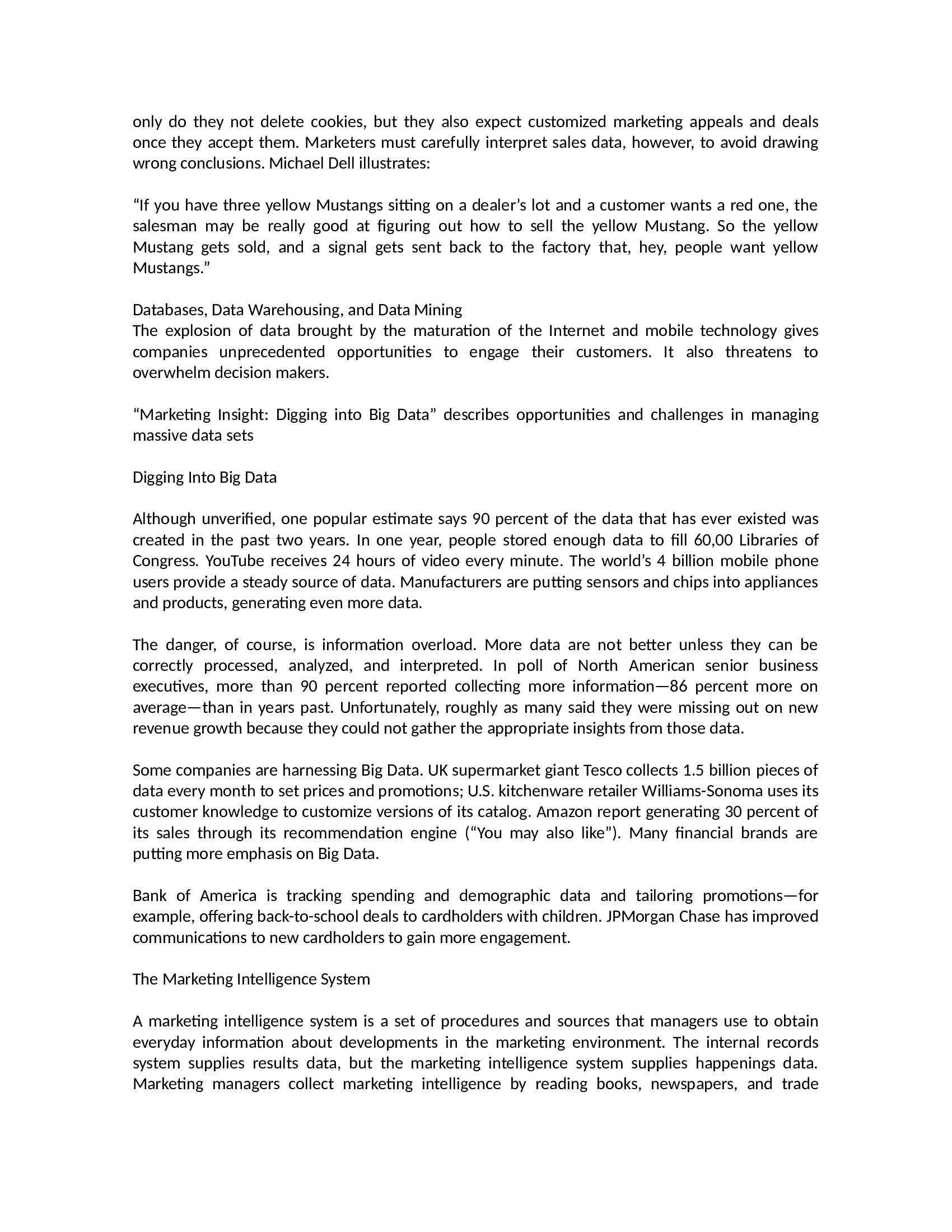
Companies that make good use of “cookies,” records of Web site usage stored on personal

browsers, are smart users of targeted marketing. Many consumers are happy to cooperate: Not

only do they not delete cookies, but they also expect customized marketing appeals and deals

once they accept them. Marketers must carefully interpret sales data, however, to avoid drawing

wrong conclusions. Michael Dell illustrates:

“If you have three yellow Mustangs sitting on a dealer’s lot and a customer wants a red one, the

salesman may be really good at figuring out how to sell the yellow Mustang. So the yellow

Mustang gets sold, and a signal gets sent back to the factory that, hey, people want yellow

Mustangs.”

Databases, Data Warehousing, and Data Mining

The explosion of data brought by the maturation of the Internet and mobile technology gives

companies unprecedented opportunities to engage their customers. It also threatens to

overwhelm decision makers.

“Marketing Insight: Digging into Big Data” describes opportunities and challenges in managing

massive data sets

Digging Into Big Data

Although unverified, one popular estimate says 90 percent of the data that has ever existed was

created in the past two years. In one year, people stored enough data to fill 60,00 Libraries of

Congress. YouTube receives 24 hours of video every minute. The world’s 4 billion mobile phone

users provide a steady source of data. Manufacturers are putting sensors and chips into appliances

and products, generating even more data.

The danger, of course, is information overload. More data are not better unless they can be

correctly processed, analyzed, and interpreted. In poll of North American senior business

executives, more than 90 percent reported collecting more information—86 percent more on

average—than in years past. Unfortunately, roughly as many said they were missing out on new

revenue growth because they could not gather the appropriate insights from those data.

Some companies are harnessing Big Data. UK supermarket giant Tesco collects 1.5 billion pieces of

data every month to set prices and promotions; U.S. kitchenware retailer Williams-Sonoma uses its

customer knowledge to customize versions of its catalog. Amazon report generating 30 percent of

its sales through its recommendation engine (“You may also like”). Many financial brands are

putting more emphasis on Big Data.

Bank of America is tracking spending and demographic data and tailoring promotions—for

example, offering back-to-school deals to cardholders with children. JPMorgan Chase has improved

communications to new cardholders to gain more engagement.

The Marketing Intelligence System

A marketing intelligence system is a set of procedures and sources that managers use to obtain

everyday information about developments in the marketing environment. The internal records

system supplies results data, but the marketing intelligence system supplies happenings data.

Marketing managers collect marketing intelligence by reading books, newspapers, and trade

publications; talking to customers, suppliers, distributors, and other company managers; and

monitoring online social media.

Marketing intelligence gathering must be legal and ethical.

A company can take eight possible actions to improve the quantity and quality of its marketing

intelligence. After describing the first seven, we devote special attention to the eighth: collecting

marketing intelligence on the Internet.

Train and motivate the sales force to spot and report new developments.

Motivate distributors, retailers, and other intermediaries to pass along important intelligence

Hire external experts to collect intelligence.

Network internally and externally (as read competitors' publichsed reports…)

Set up a customer advisory panel (Members of advisory panels might include the company’s

largest, most outspoken, most sophisticated, or most representative customers. GlaxoSmithKline

sponsored an online community devoted to weight loss, where marketers felt they learned far

more than they could have gleaned from focus groups on topics from packaging its weight-loss pill

to where to place in-store marketing)

Take advantage of government-related data resources. The U.S. Census Bureau provides an indepth look at the population swings, demographic groups, regional migrations, and changing

family structure of the more than 311,591,917 people in the United States. Census marketer

Nielsen Claritas SiteReports cross-references census figures with consumer surveys and its own

grassroots research for clients such as The Weather Channel, BMW, and Sovereign Bank.

SiteReports offers more than 50 reports and maps that help companies analyze markets, select site

locations, and target customers effectively

Purchase information from outside research firms and vendors.

Collecting Marketing Intelligence on the Internet

Online customer review boards, discussion forums, chat rooms, and blogs can distribute one

customer’s experiences or evaluation to other potential buyers and, of course, to marketers

seeking information. Here are five places to find competitors’ product strengths and weaknesses

online.

Independent customer goods and service review forums. Independent forums include Web sites

such as Epinions.com, RateItAll.com, ConsumerReview.com, and Bizrate.com. Bizrate.com collects

millions of consumer reviews of stores and products each year from two sources: its 1.3 million

volunteer members and feedback from stores that allow Bizrate.com to collect it directly from

customers as they buy.

Distributor or sales agent feedback sites. Feedback sites offer positive and negative product or

service reviews, but the stores or distributors have built the sites themselves. Amazon.com offers

an interactive feedback opportunity through which buyers, readers, editors, and others can review

all products on the site, especially books.

Combo sites offering customer reviews and expert opinions. Combination sites are concentrated in

financial services and high-tech products that require professional knowledge. ZDNet.com offers

customer and expert evaluations of technology products based on ease of use, features, and

stability.

Customer complaint sites. Customer complaint forums are designed mainly for dissatisfied

customers.

PlanetFeedback.com allows customers to voice unfavorable experiences with specific companies.

Public blogs. Tens of millions of blogs and social networks offer personal opinions, reviews, ratings,

and recommendationson virtually any topic—and their numbers continue to grow. Nielsen’s

BuzzMetrics analyzes blogs and social networks for insights into consumer sentiment and threats

to the brand that may emerge online.

Given the speed of the Internet, it is important to act quickly on information gleaned online

Analyzing the Macroenvironment

Successful companies recognize and respond profitably to unmet needs and trends.

Needs and Trends

Let’s distinguish among fads, trends, and megatrends.

• A fad is “unpredictable, short-lived, and without social, economic, and political significance.”

• A direction or sequence of events with momentum and durability, a trend is more

predictable and durable than a fad; trends reveal the shape of the future and can provide

strategic direction. A A megatrend is a “large social, economic, political, and technological

change [that] is slow to form, and once in place, influences us for some time—between seven

and ten years, or longer

Identifying the Major Forces

Firms must monitor six major forces in the broad environment: demographic, economic,

social-cultural, natural, technological, and political-legal. We’ll describe them separately, but

remember their interactions will lead to new opportunities and threats. For example,

explosive population growth (demographic) leads to more resource depletion and pollution

(natural), which leads consumers to call for more laws (political-legal), which stimulate new

technologica solutions and products (technological) that, if they are affordable (economic),

may actually change attitudes and behavior (social-cultural).

The Demographic Environment

The main demographic factor marketers monitor is population, including the size and growth

rate of population in cities, regions, and nations; age distribution and ethnic mix; educational

levels; and household patterns.

World population growth is explosive: The world’s population on July 1, 2012, was estimated

at 7,027,349,193, forecasted to rise to 8.82 billion by 2040 and exceed 9 billion by 2045.22

Table 3.3 offers an interesting perspective. Population growth is highest in countries and

communities that can least afford it. Developing regions of the world house 84 percent of the

world’s population and are growing at 1 percent to 2 percent per year; developed countries’

populations are growing at only 0.3 percent.24 In developing countries, modern medicine is

lowering the death rate, but birthrates remain fairly stable.

A growing population does not mean growing markets unless there is sufficient purchasing

power. Education can raise the standard of living but is difficult to accomplish in most

developing countries.

Mexico has a very young population and rapid population growth. Italy, at the other extreme,

has one of the world’s oldest populations. Milk, diapers, school supplies, and toys will be more

important products in Mexico than in Italy.

Contact the Seller

Please Sign In to contact this seller.


  • 👎  Report Copyright Violation

Frequently Asked Questions

What Do I Get When I Buy This Study Material?

+

When you buy a study material on Passing Grades, an instant download link will be sent directly to your email, giving you access to the file anytime after payment is completed.

Is Passing Grades a Trusted Platform?

+

Yes, Passing Grades is a reputable students’ marketplace with a secure payment system and reliable customer support. You can trust us to ensure a safe and seamless transaction experience.

Will I Be Stuck with a Subscription?

+

No, all purchases on Passing Grades are one-time transactions. You only pay for the notes you choose to buy, with no subscriptions or hidden fees attached.

Who Am I Buying These Study Materials From?

+

Passing Grades is a marketplace, which means you are purchasing the document from an individual vendor, not directly from us. We facilitate the payment and delivery process between you and the vendor.

Does Passing Grades Offer Free Study Materials?

+

Yes, sellers on Passing Grades have uploaded numerous free test banks, exams, practice questions, and class notes that can be downloaded at no cost.


Pasinggrades - Quality Study Materials

USD 15

    • Quality checked by Pasing Grades
    • 100% satisfaction guarantee
    • Seller: mentor2000
Buy PDF $15

Seller Information

mentor2000

Member since April 2021

  • icon
  • icon
View Profile
  • total sales

    0
  • Favourites

    0
  • Comments

    0
    ( 0 Ratings )

Item Information

  • Uploaded

    20 August 2024

  • Updated

    01 October 2025

  • Category

    Business

  • Item Type

    test bank

  • Tags

    TEST BANK FOR MARKETING MANAGEMENT 15TH EDITION BY KOTLER AND KELLER

Related Exam Prep Guides by mentor2000

Test Bank for Essentials for Nursing Practice 8th Edition by Potter | All Chapters
View Document

Test Bank for Essent...

  • mentor2000

    mentor2000

  • test bank

Master nursing concepts with this study material; Test Bank for Essentials for Nursing Practice, 8th...

15 USD

0

0

A &P 1 MA278 BSC2 Final Module II Questions & Answers 2026 Update
View Document

A &P 1 MA278 BSC2 Fi...

  • mentor2000

    mentor2000

  • test bank

Prepare for success with A&P 1 MA278 BSC2 Final Module II 2024 Q&A. Boost your grades with this comp...

15 USD

0

0

ATI Comprehensive Predictor Exam 2026
View Document

ATI Comprehensive Pr...

  • mentor2000

    mentor2000

  • test bank

Prepare for success with the ATI Comprehensive Predictor Exam 2026. Access key practice questions to...

15 USD

0

0

Purchase

Download link will be sent to this email immediately after purchase.

IMPORTANT LINKS

  • How To Upload Class Notes
  • Selling Tips
  • Passing Grades's Study Materials
  • Scholarships for International Students 2025

POPULAR CATEGORIES

  • Law
  • Accounting
  • English
  • Psychology
  • Business
  • Nursing
  • Computer Science
  • General

View Document

  • Blog
  • Contact
  • Delivery Policy
  • Latest Scholarships Around the World
  • How to Pass Bar Exams: Passing Grades’ Strategies
  • How to Study and Pass the CPA Exam
  • All Test Banks
  • Faq
  • Copyright Claims
  • Privacy Policy
  • Terms of Use

KNOWLEDGE BASE

  • How to Write A+ Grade Good Research Paper
  • How to Manage Stress During Exam Period
  • Best Time to Study
  • How to Pass NCLEX-RN Exam
  • How To Effectively Utilize Test Banks
  • Popular Shadow Health Exam Assessments
  • Popular HESI Case Studies
  • How to Prepare for a Nursing Career
  • The Importance Of Summaries in Exam Revisvion

© 2026 Pasing Grades. All rights reserved.