Pasing Grades
  • Start Selling
  • Blog
  • Contact
  • 0

    Your cart is empty!

English

  • English
  • Spanish
  • Arabic
Create Account Sign In
  • Library
    • New Prep Guides
    • Featured Prep Guides
    • Free Exam Prep Guides
    • Best sellers
  • General
  • Nursing
    • Research Paper
    • Case Study
    • Discussion Post
    • Assignment
    • Exam
    • Practice Questions and Answers
    • Test Bank
    • solutions manual
  • Accounting
    • Case Study
    • Thesis
    • Study Guide
    • Summary
    • Research Paper
    • test bank
  • English
    • Creative Writing
    • Research Paper
    • Summary
    • Rhetorics
    • Literature
    • Journal
    • Exam
    • Grammar
    • Discussion Post
    • Essay
  • Psychology
    • Hesi
    • Presentation
    • Essay
    • Summary
    • Study Guide
    • Essay
    • Solution Manual
    • Final Exam Review
    • Class Notes
    • test bank
  • Business
    • Lecture Notes
    • Solution Manual
    • Presentation
    • Business Plan
    • Class Notes
    • Experiment
    • Summary
    • Practice Questions
    • Study Guide
    • Case Study
    • test bank
    • Exam
  • More
    • Computer Science
    • Economics
    • Statistics
    • Engineering
    • Biology
    • Religious Studies
    • Physics
    • Chemistry
    • Mathematics
    • History
    • Sociology
    • Science
    • Philosophy
    • Law
  • Pages
    • About Us
    • Selling Tips
    • Delivery Policy
    • Faq
    • Privacy Policy
  • Flash Sale
  • Home
  • Test Bank for LeMone and Burkes Medical Surgical Nursing 7th Edition by Bauldoff

Test Bank for LeMone and Burkes Medical Surgical Nursing 7th Edition by Bauldoff

Preview page 1 Preview page 2 Preview page 3
Add To Favorites

Share this item Share this item

  • Item Details
  • Comments (0)
  • Reviews (0)
  • Contact Seller

Test Bank for LeMone and Burkes Medical Surgical Nursing 7th Edition by Bauldoff

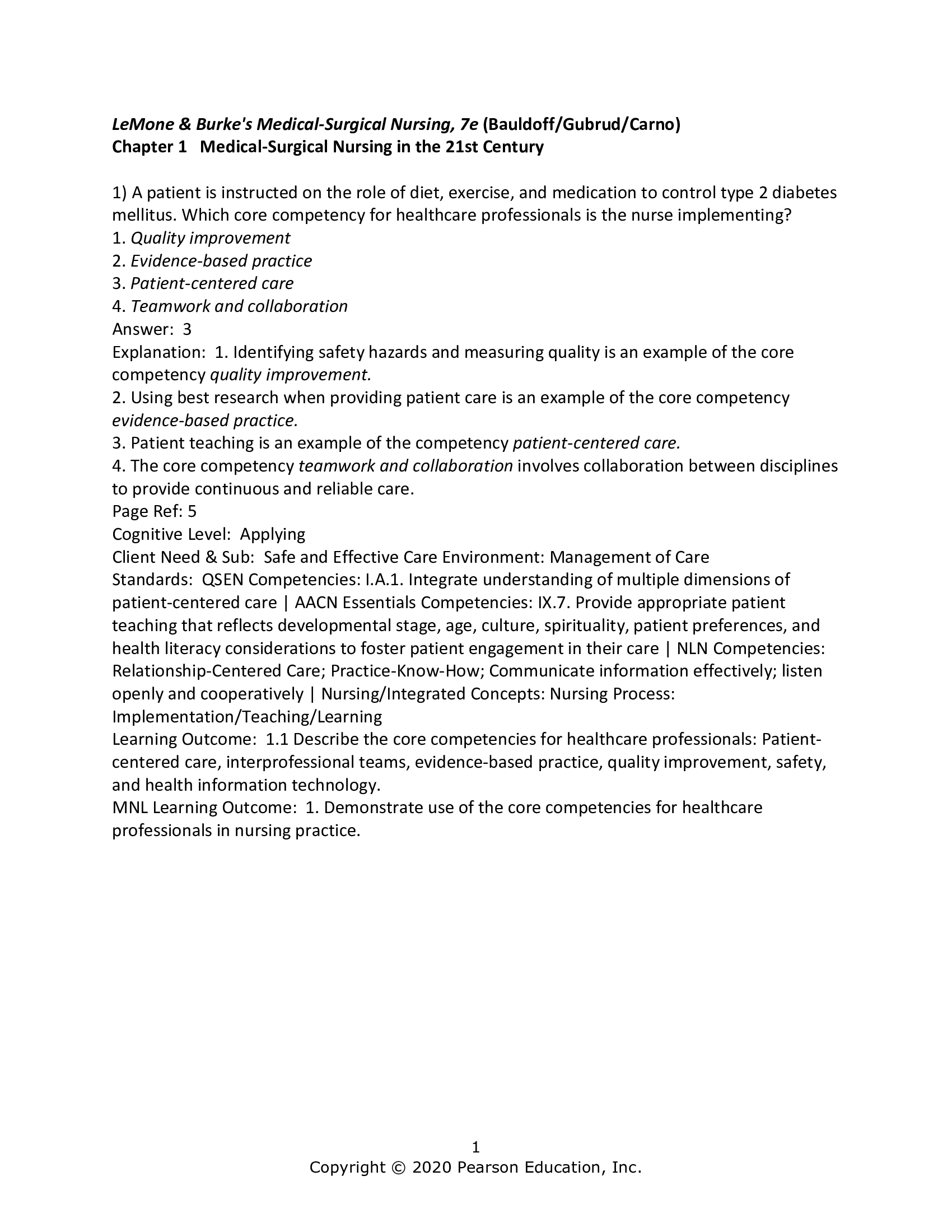
LeMone & Burke's Medical-Surgical Nursing, 7e (Bauldoff/Gubrud/Carno) Chapter 1   Medical-Surgical Nursing in the 21st Century


1) A patient is instructed on the role of diet, exercise, and medication to control type 2 diabetes mellitus. Which core competency for healthcare professionals is the nurse implementing?

1.  Quality improvement

2.  Evidence-based practice

3.  Patient-centered care

4.  Teamwork and collaboration

Answer:  3

Explanation:  1. Identifying safety hazards and measuring quality is an example of the core competency quality improvement.

2.  Using best research when providing patient care is an example of the core competency evidence-based practice.

3.  Patient teaching is an example of the competency patient-centered care.

4.  The core competency teamwork and collaboration involves collaboration between disciplines to provide continuous and reliable care.

Page Ref: 5

Cognitive Level:  Applying

Client Need & Sub:  Safe and Effective Care Environment: Management of Care

Standards:  QSEN Competencies: I.A.1. Integrate understanding of multiple dimensions of patient-centered care | AACN Essentials Competencies: IX.7. Provide appropriate patient teaching that reflects developmental stage, age, culture, spirituality, patient preferences, and health literacy considerations to foster patient engagement in their care | NLN Competencies: Relationship-Centered Care; Practice-Know-How; Communicate information effectively; listen openly and cooperatively | Nursing/Integrated Concepts: Nursing Process:

Implementation/Teaching/Learning

Learning Outcome:  1.1 Describe the core competencies for healthcare professionals: Patientcentered care, interprofessional teams, evidence-based practice, quality improvement, safety, and health information technology.

MNL Learning Outcome:  1. Demonstrate use of the core competencies for healthcare professionals in nursing practice.


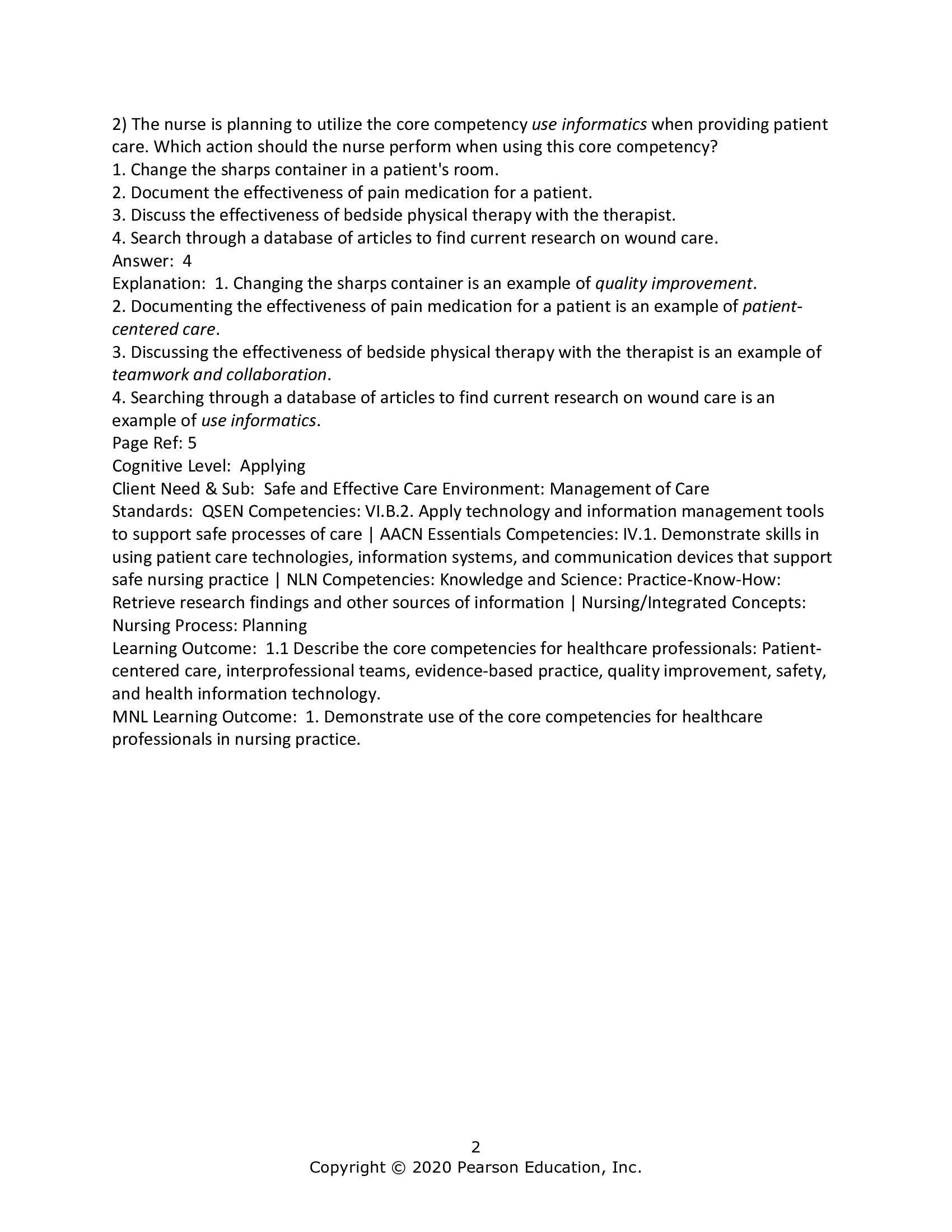
2) The nurse is planning to utilize the core competency use informatics when providing patient care. Which action should the nurse perform when using this core competency?

1.  Change the sharps container in a patient's room.

2.  Document the effectiveness of pain medication for a patient.

3.  Discuss the effectiveness of bedside physical therapy with the therapist.

4.  Search through a database of articles to find current research on wound care.

Answer:  4

these vital signs.

3.  The nurse is not accountable for these vital signs.

4.  The nurse is responsible for re-measuring all the vital signs.

Answer:  1

Explanation:  1. When the nurse delegates nursing care activities to another person, that person is authorized to act in the place of the nurse, while the nurse retains accountability for the activities performed.

2.  The nurse retains responsibility/accountability for the vital signs.

3.  The nurse is accountable for reviewing the data collected and ensuring it is done appropriately.

4.  The purpose of delegation is to share tasks appropriately, not to increase the workload of the primary nurse.

Page Ref: 17

Cognitive Level:  Applying

Client Need & Sub:  Safe and Effective Care Environment: Management of Care

Standards:  QSEN Competencies: II.B.5. Assume role of team member or leader based on the situation | AACN Essentials Competencies: VI.1. Compare/contrast the roles and perspectives of the nursing profession with other care professionals on the healthcare team (i.e., scope of discipline, education, and licensure requirements) | NLN Competencies: Teamwork; Knowledge; Scope of practice, roles, and responsibilities of healthcare team members, including overlaps | Nursing/Integrated Concepts: Nursing Process: Implementation

Learning Outcome:  1.4 Explain the activities and characteristics of the nurse as caregiver, educator, advocate, leader and manager, and researcher.

MNL Learning Outcome:  4. Consider the various role of the nurse as in medical-surgical nursing practice.


27) The nurse manager completes chart audits for a specific group of patients. What should the manager do with this information?

1.  Create an action plan to address any negative findings.

2.  Share it with the hospital administrator.

3.  Submit it to the agency's accrediting body.

4.  Place it in a file to compare with the next set of audits.

Answer:  1

Explanation:  1. The results of quality assurance audits can be used to develop a plan of action to resolve differences or issues with patient care. Nurses use the information if it will have a positive impact on the nursing practice.

2.  There is no real purpose to sharing the results of a quality assurance audit with the hospital administrator.

3.  While the accrediting body of an institution may encourage quality improvement activities, there is no reason to provide the chart audit results.

4.  Nurses use the information if it will have a positive impact on the nursing practice.

Page Ref: 5

Cognitive Level:  Applying

Client Need & Sub:  Safe and Effective Care Environment: Management of Care

Standards:  QSEN Competencies: IV.B.5. Use quality measures to understand performance | AACN Essentials Competencies: II.10. Use improvement methods, based on data from the outcomes of care processes, to design and test changes to continuously improve the quality and safety of healthcare | NLN Competencies: Knowledge and Science; Practice; Translate research into practice in order to promote quality and improve practices | Nursing/Integrated

Concepts: Nursing Process: Implementation

Learning Outcome:  1.1 Describe the core competencies for healthcare professionals: Patientcentered care, interprofessional teams, evidence-based practice, quality improvement, safety, and health information technology.

MNL Learning Outcome:  1. Demonstrate use of the core competencies for healthcare professionals in nursing practice.


28) The nurse reviews the role of advocacy with a group of new graduate nurse employees.

Which statement by a graduate nurse indicates the need for further education?

1.  "Patient advocates have the authority to make decisions for the patient."

2.  "Being a patient advocate entails making efforts to improve patient outcomes." 3. "Providing education to the patient and family is a key way to be a positive patient advocate."

4. "Communicating patient needs to the members of the healthcare team is a role of the patient advocate." Answer:  1

Explanation:  1. The nurse who serves as a patient advocate may assist and support the patient in decision making. The nurse cannot make decisions for the patient.

2. This is an element of being a successful patient advocate. 3. This is an element of being a successful patient advocate.

4. This is an element of being a successful patient advocate.

Page Ref: 16

Cognitive Level:  Analyzing

Client Need & Sub:  Safe and Effective Care Environment: Management of Care Standards:  QSEN Competencies: I.B.2. Communicate patient values, preferences, and expressed needs to other members of healthcare team | AACN Essentials Competencies: VI.2. Use inter- and intraprofessional communication and collaborative skills to deliver evidencebased, patient-centered care | NLN Competencies: Knowledge and Science; Practice-KnowHow; Translate research into practice in order to promote quality and improve practices |

Nursing/Integrated Concepts: Nursing Process: Evaluation/Teaching/Learning

Learning Outcome:  1.4 Explain the activities and characteristics of the nurse as caregiver, educator, advocate, leader and manager, and researcher.

MNL Learning Outcome:  4. Consider the various role of the nurse as in medical-surgical nursing practice.


29) The director of nursing is reviewing situations that require attention. Which situation is an ethical dilemma that might need to be analyzed by the hospital Ethics Committee?

1.  A 20-year-old male patient with an opportunistic disease is HIV positive and does not want to share this information with sexual partners.

2.  The nurse-patient ratio is 5:1 on a medical-surgical care area.

3.  A nurse inexperienced with electrocardiogram interpretation was assigned to the telemetry unit to provide care.

4.  Nursing staff provide medication to patients after doses are dropped on the floor.

Answer:  1

Explanation:  1. A dilemma is a choice between two unpleasant, ethically troubling alternatives. Nurses who provide medical-surgical nursing care face dilemmas almost daily. Many commonly experienced dilemmas involve confidentiality, patient rights, and issues of dying and death. Nurses respect the right to confidentiality of patient information found in the patient's record or secured during interviews. An individual's right to privacy and confidentiality creates a dilemma when it conflicts with the nurse's right to information that may affect personal safety. The law in most states mandates that HIV test results can be given to another person only with the patient's written consent. Many healthcare providers believe that this law violates their own right to personal safety.

2.  This situation is not a dilemma but may violate standards of care or standards of practice.

3.  This situation is not a dilemma but may violate standards of care or standards of practice. 4. This situation is not a dilemma but may violate standards of care, codes of ethics, or standards of practice. Page Ref: 13-14

Cognitive Level:  Analyzing

Client Need & Sub:  Safe and Effective Care Environment: Management of Care Standards:  QSEN Competencies: I.A.7. Explore ethical and legal implications of patientcentered care | AACN Essentials Competencies: VIII.12. Act to prevent unsafe, illegal or unethical care practices | NLN Competencies: Context and Environment; Knowledge; Code of Ethics; regulatory and professional standards | Nursing/Integrated Concepts: Nursing Process:

Assessment

Learning Outcome:  1.3 Explain the importance of nursing and interprofessional codes of ethics, standards of practice, and legal and ethical issues as guidelines for clinical nursing practice. MNL Learning Outcome:  3. Integrate nursing and interprofessional codes of ethics, standards of practice, and legal and ethical guidelines in clinical practice.


30) The nurse accepts tickets to a sporting event from a patient in exchange for free home care for 1 week. Which standards did the nurse violate? Select all that apply.

1.  HIPAA

2.  ANA standards

3.  Professional boundaries

4.  State nurse practice acts

5.  Standards pertinent to specific hospital protocols

Answer:  3, 4

Explanation:  1. HIPAA involves violations of patient confidentiality.

2.  A violation of ethics in the ANA Standards of Care would not apply here.

3.  Professional boundaries are the borders between the vulnerability of the patient and the power of the nurse. It is vital that nurses recognize this relationship and establish boundaries to safely and effectively meet the patient's needs. Confusion between the needs of the nurse and those of the patient can result in boundary violations.

4.  Professional boundaries are outlined in individual state nurse practice acts.

5.  Hospital protocols are not identified in the question; however, the nurse's action violates a professional boundary.

Page Ref: 13

Cognitive Level:  Analyzing

Client Need & Sub:  Safe and Effective Care Environment: Management of Care Standards:  QSEN Competencies: I.A.7. Explore ethical and legal implications of patientcentered care | AACN Essentials Competencies: VIII.1. Demonstrate the professional standards of moral, ethical, and legal conduct | NLN Competencies: Context and Environment; Knowledge; Code of Ethics; regulatory and professional standards | Nursing/Integrated

Concepts: Nursing Process: Evaluation

Learning Outcome:  1.3 Explain the importance of nursing and interprofessional codes of ethics, standards of practice, and legal and ethical issues as guidelines for clinical nursing practice. MNL Learning Outcome:  3. Integrate nursing and interprofessional codes of ethics, standards of practice, and legal and ethical guidelines in clinical practice.


31) A seasoned nurse does not want to assist nursing students during clinical rotations and often obstructs the students' learning process. Which standard is this nurse violating?

1.  ICN Code of Ethics

2.  ANA Standards of Professional Performance

3.  ANA Code of Ethics

4.  State practice acts

Answer:  2

Explanation:  1. The ICN Code of Ethics for Nurses helps guide nurses in setting priorities, making judgments, and taking action when they face ethical dilemmas in clinical practice.

2.  The nurse is violating the standards of leadership and collaboration by refusing to assist the students during the learning process.

3.  The nurse is not violating the Code of Ethics.

4.  The nurse is not violating the state nurse practice act.

Page Ref: 13

Cognitive Level:  Analyzing

Client Need & Sub:  Safe and Effective Care Environment: Management of Care

Standards:  QSEN Competencies: II.C.6. Value teamwork and the relationships upon which it is based | AACN Essentials Competencies: VIII.1. Demonstrate the professional standards of moral, ethical, and legal conduct | NLN Competencies: Context and Environment; Knowledge; Code of Ethics; regulatory and professional standards | Nursing/Integrated Concepts: Nursing Process: Evaluation

Learning Outcome:  1.3 Explain the importance of nursing and interprofessional codes of ethics, standards of practice, and legal and ethical issues as guidelines for clinical nursing practice. MNL Learning Outcome:  3. Integrate nursing and interprofessional codes of ethics, standards of practice, and legal and ethical guidelines in clinical practice.


32) The nurse attends interprofessional meetings to discuss the plan of care for a trauma patient who has been transferred to the medical-surgical unit. In what role is this nurse functioning? 1. Caregiver

2.  Team leader

3.  Delegate

4.  Advocate Answer:  4

Explanation:  1. The caregiver works independently and collaboratively with the patient.

2.  Team leaders are nurses who are participating in roles of leadership in that they manage time, people, resources, and the environment to ensure that staff is able to provide the proper care.

3.  Delegates are nurses who are responsible for completing care as assigned.

4.  The nurse as advocate actively promotes the patient's rights to autonomy and free choice. The nurse will communicate with other healthcare team members and assist and support patient decision making.

Page Ref: 16

Cognitive Level:  Applying

Client Need & Sub:  Safe and Effective Care Environment: Management of Care Standards:  QSEN Competencies: I.B.2. Communicate patient values, preferences, and expressed needs to other members of healthcare team | AACN Essentials Competencies: VI.2. Use inter- and intraprofessional communication and collaborative skills to deliver evidencebased, patient-centered care | NLN Competencies: Knowledge and Science; Practice-KnowHow; Translate research into practice in order to promote quality and improve practices |

Nursing/Integrated Concepts: Nursing Process: Implementation

Learning Outcome:  1.4 Explain the activities and characteristics of the nurse as caregiver, educator, advocate, leader and manager, and researcher.

MNL Learning Outcome:  4. Consider the various role of the nurse as in medical-surgical nursing practice.


33) The director of nursing is planning an initiative to improve the quality and safety of patient care. After reviewing the Triple Aim approach, which action should the director recommend? Select all that apply.

1.  Improve the patient care experience.

2.  Maximize positive outcomes.

3.  Reduce the per capita costs of healthcare.

4.  Implement evidence-based practice.

5.  Support nursing continuing education plans.

Answer:  1, 2, 3

Explanation:  1. The Institute of Health Improvement Triple Aim has three objectives. Improve patient care experience is one of these objectives.

2.  The Institute of Health Improvement Triple Aim has three objectives. Maximize positive outcomes is one of these objectives.

3.  The Institute of Health Improvement Triple Aim has three objectives. Contain costs is one of these objectives.

4.  Implementing evidence-based practice is not a Triple Aim objective.

5.  Supporting nursing continuing education plans is not a Triple Aim objective. Page Ref: 17

Cognitive Level:  Applying

Client Need & Sub:  Safe and Effective Care Environment: Management of Care

Standards:  QSEN Competencies: IV.B.5. Use quality measures to understand performance | AACN Essentials Competencies: II.11. Employ principles of quality improvement, healthcare policy, and cost-effectiveness to assist in the development and initiation of effective plans for the microsystem and/or system-wide practice improvements that will improve the quality of healthcare delivery | NLN Competencies: Quality and Safety; Knowledge; Current best practices

| Nursing/Integrated Concepts: Nursing Process: Implementation

Learning Outcome:  1.4 Explain the activities and characteristics of the nurse as caregiver, educator, advocate, leader and manager, and researcher.

MNL Learning Outcome:  4. Consider the various role of the nurse as in medical-surgical nursing practice.


34) The nurse would like to do a research project that focuses on vending machine choices that patients prefer. What should the nurse question before proceeding with this research study?

1.  Is the research valid?

2.  Will this promote patient independence?

3.  Is this a project that would add value to the hospital experience?

4.  Does this research contribute to patient care?

Answer:  4

Explanation:  1. To be relevant, nursing research must have a goal to improve the care that nurses provide patients. This means that all nurses must consider the researcher role to be integral to nursing practice. The research might be valid; however, it does not improve patient care.

2. To be relevant, nursing research must have a goal to improve the care that nurses provide patients. This means that all nurses must consider the researcher role to be integral to nursing practice. The research might promote patient independence but may not improve patient care. 3. To be relevant, nursing research must have a goal to improve the care that nurses provide patients. This means that all nurses must consider the researcher role to be integral to nursing practice. The research might add value to the hospital experience but may not improve patient care.

4. To be relevant, nursing research must have a goal to improve the care that nurses provide patients. This means that all nurses must consider the researcher role to be integral to nursing practice. Page Ref: 20

Cognitive Level:  Applying

Client Need & Sub:  Safe and Effective Care Environment: Management of Care

Standards:  QSEN Competencies: III.B.1. Participate effectively in appropriate data collection and other research activities | AACN Essentials Competencies: III.2. Demonstrate an understanding of the basic elements of the research process and models for applying evidence to clinical practice | NLN Competencies: Knowledge and Science; Knowledge; Relationships between knowledge/science and quality and safe patient care | Nursing/Integrated Concepts:

Nursing Process: Assessment

Learning Outcome:  1.4 Explain the activities and characteristics of the nurse as caregiver, educator, advocate, leader and manager, and researcher.

MNL Learning Outcome:  4. Consider the various role of the nurse as in medical-surgical nursing practice.


35) The nurse is identifying nursing diagnoses for a patient's care. In which order should the nurse complete this process? Place in order the steps of the process.

Choice 1. Draw conclusions about the present health status.

Choice 2. Determine etiologies and categorize problems.

Choice 3. Cluster cues and identify data gaps.

Choice 4. Verify the problem or diagnoses.

Choice 5. Recognize significant cues.

Answer:  5, 3, 1, 2, 4

Explanation:  Choice 1. Based upon the data clusters and gaps identified, the patient's health status can be determined.

Choice 2. Once the patient's present health status is determined, the etiology of problems can be identified and then categorized.

Choice 3. After cues are identified, they are to be clustered so that data gaps can be identified. Choice 4: The final step is to verify the patient's problems and finalize the appropriate diagnoses.

Choice 5. When identifying nurse diagnoses, significant cues should be identified first.

Page Ref: 9

Cognitive Level:  Applying

Client Need & Sub:  Safe and Effective Care Environment: Management of Care

Standards:  QSEN Competencies: I.A.1. Integrate understanding of multiple dimensions of patient-centered care | AACN Essentials Competencies: III.6. Integrate evidence, clinical judgment, interprofessional perspectives, and patient preferences in planning, implementing, and evaluating outcomes of care | NLN Competencies: Knowledge and Science; Practice-KnowHow; Translate research into practice in order to promote quality and improve practices |

Nursing/Integrated Concepts: Nursing Process: Diagnosis

Learning Outcome:  1.2 Apply the attitudes, mental habits, and skills necessary for clinical reasoning when using the nursing process in patient care.

MNL Learning Outcome:  2. Recognize the skills necessary for clinical reasoning when using the nursing process in patient care.


36) The nurse is hired to coordinate care in a community health clinic that opened after the implementation of the Affordable Care Act. Which types of care should the nurse expect to provide? Select all that apply.

1.  Health promotion

2.  Disease prevention

3.  Chronic disease management

4.  Rehabilitation 5. Palliative care Answer:  1, 2, 3

Explanation:  1. The original intent of the ACA continues to influence healthcare policy and reimbursement, and it is changing provider practice and the environment. The nursing profession is well positioned to respond to demands of a transitioning healthcare system that emphasize health promotion.

2.  The original intent of the ACA continues to influence healthcare policy and reimbursement, and it is changing provider practice and the environment. The nursing profession is well positioned to respond to demands of a transitioning healthcare system that emphasize disease prevention.

3.  The original intent of the ACA continues to influence healthcare policy and reimbursement, and it is changing provider practice and the environment. The nursing profession is well positioned to respond to demands of a transitioning healthcare system that emphasize management of chronic disease.

4.  Rehabilitation is not a new model of care that will be provided in a community health clinic.

5.  Palliative care is not a new model of care that will be provided in a community health clinic. Page Ref: 2

Cognitive Level:  Applying

Client Need & Sub:  Health Promotion and Maintenance: Health Promotion/Disease Prevention Standards:  QSEN Competencies: I.A.1. Integrate understanding of multiple dimensions of patient-centered care | AACN Essentials Competencies: VII.5. Use evidence-based practices to guide health teaching, health counseling, screening, outreach, disease and outbreak investigation, referral and follow-up throughout the lifespan | NLN Competencies: Context and Environment; Knowledge; Environmental health; health promotion/disease prevention (e.g., transmission of disease, disease patterns, epidemiological principles); chronic disease management; healthcare systems; transcultural approaches to health; family dynamics |

Nursing/Integrated Concepts: Nursing Process: Implementation

Learning Outcome:  1.4 Explain the activities and characteristics of the nurse as caregiver, educator, advocate, leader and manager, and researcher.

MNL Learning Outcome:  4. Consider the various role of the nurse as in medical-surgical nursing practice.


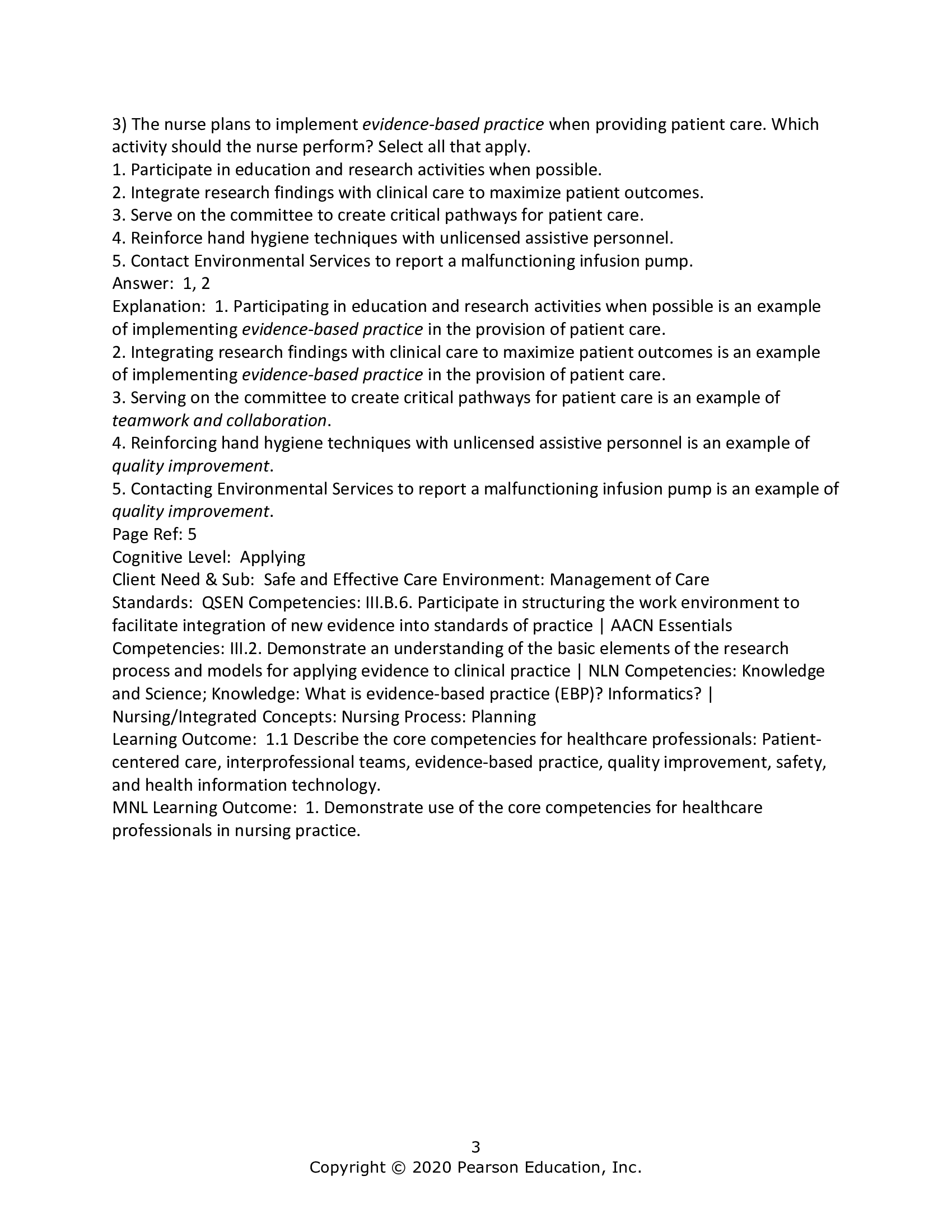
37) The nurse manager is evaluating the use of evidence-based practice guidelines to guide care on a patient care area. Which observation indicates that these guidelines are being used appropriately? Select all that apply.

1.  Guidelines are posted on the staff bulletin board in the break room.

2.  A guideline was quoted in a narrative note in a patient's medical record.

3.  A guideline is placed in the Kardex to support the use of a nursing diagnosis for a patient's health problem.

4.  Guidelines are accessed through the clinical documentation system by nurses prior to writing patient care plans.

5.  A guideline was referenced prior to implementing skin care interventions for a patient prone to pressure ulcer formation. Answer:  2, 3, 4, 5

Explanation:  1. Evidence-based practice integrates best current evidence with clinical expertise and patient/family preferences and values for delivery of optimal healthcare. Posting the guidelines on the staff bulletin board does not indicate that they are being used appropriately. 2. Evidence-based practice integrates best current evidence with clinical expertise and patient/family preferences and values for delivery of optimal healthcare. Basing patient care on an evidence-based guideline indicates that it is being used appropriately.

3.                  Evidence-based practice integrates best current evidence with clinical expertise and patient/family preferences and values for delivery of optimal healthcare. Placing a copy of an evidence-based guideline in the Kardex to support a particular nursing diagnosis indicates that it is being used appropriately.

4.                  Evidence-based practice integrates best current evidence with clinical expertise and patient/family preferences and values for delivery of optimal healthcare. Observing staff access evidence-based guidelines through the clinical documentation system indicates they are being used appropriately.

5.                  Evidence-based practice integrates best current evidence with clinical expertise and patient/family preferences and values for delivery of optimal healthcare. Referring to an evidence-based guideline before planning skin care interventions indicates the guideline is being used appropriately. Page Ref: 5

Cognitive Level:  Applying

Client Need & Sub:  Safe and Effective Care Environment: Management of Care

Standards:  QSEN Competencies: III.B.6. Participate in structuring the work environment to facilitate integration of new evidence into standards of practice | AACN Essentials Competencies: III.2. Demonstrate an understanding of the basic elements of the research process and models for applying evidence to clinical practice | NLN Competencies: Knowledge

and Science; Knowledge; What is evidence-based practice (EBP)? Informatics? |

Nursing/Integrated Concepts: Nursing Process: Evaluation

Learning Outcome:  1.1 Describe the core competencies for healthcare professionals: Patientcentered care, interprofessional teams, evidence-based practice, quality improvement, safety, and health information technology.

MNL Learning Outcome:  1. Demonstrate use of the core competencies for healthcare professionals in nursing practice.

38) An interprofessional team is meeting to create a care bundle to prevent the development of contractures in patients with limb paralysis from neurological health problems. Which action should the committee members include when creating this care bundle? Select all that apply.

1.  Define the patient population

2.  Identify three to five interventions

3.  Ensure the elements of the bundle are independent

4.  Ensure the bundle elements are descriptive

5.  Mandate that the bundle elements are prescriptive

Answer:  1, 2, 3, 4

Explanation:  1. Care bundles are interprofessional care standards that pull together a short list of interventions and treatments that are already recommended and are generally accepted in national guidelines. The bundle is used with a defined patient population in one location. 2. The bundle has three to five interventions (elements), with strong clinician agreements. 3. Each bundle is relatively independent. The bundle is developed so that if one of the interventions of care is not implemented it will not affect whether other bundle elements are implemented.

4.  Bundle elements should be descriptive rather than prescriptive, to allow for local customization and appropriate clinical judgment.

5.  Bundle elements should be descriptive rather than prescriptive.

Page Ref: 11

Cognitive Level:  Applying

Client Need & Sub:  Safe and Effective Care Environment: Management of Care

Standards:  QSEN Competencies: III.B.6. Participate in structuring the work environment to facilitate integration of new evidence into standards of practice | AACN Essentials

Competencies: III.9. Describe mechanisms to resolve identified practice discrepancies between identified standards and practice that may adversely impact patient outcomes | NLN Competencies: Context and Environment; Knowledge; Codes of ethics, regulatory and professional standards, ethical decision-making models, scope of practice considerations, principles of informed consent, confidentiality, patient self-determination | Nursing/Integrated

Concepts: Nursing Process: Planning

Learning Outcome:  1.2 Apply the attitudes, mental habits, and skills necessary for clinical reasoning when using the nursing process in patient care.

MNL Learning Outcome:  2. Recognize the skills necessary for clinical reasoning when using the nursing process in patient care.


39) The nurse is coordinating care for patients within a patient-centered medical home (PCMH). Which action should the nurse prepare to complete when functioning in this role? Select all that apply.

1.  Communicate with the patient after discharge.

2.  Monitor the implementation of the plan of care.

3.  Manage the accuracy, timeliness, and cost of care.

4.  Develop the plan of care with the patient and family.

5.  Collaborate with the patient to implement the plan of care.

Answer:  1, 2, 3, 5

Explanation:  1. The nurse functioning as a care coordinator within a PCMH will be in contact with the patients after discharge to ensure continuity of care and health maintenance.

2.                  The nurse functioning as a care coordinator within a PCMH will monitor the implementation of the patient's plan of care.

3.                  The nurse functioning as a care coordinator within a PCMH manages the quality of care provided, including accuracy, timeliness, and cost.

4.                  The PCMH team is led by the patient's primary care provider, who is responsible for leading the development of the plan of care with the patient and the family.

5.                  The nurse functioning as a care coordinator within a PCMH collaborates with the patient to implement the plan of care.

Page Ref: 17

Cognitive Level:  Applying

Client Need & Sub:  Safe and Effective Care Environment: Management of Care

Standards:  QSEN Competencies: IV.A.1. Describe strategies for learning about the outcomes of care in the setting in which one is engaged in clinical practice | AACN Essentials Competencies: II.11. Employ principles of quality improvement, healthcare policy, and cost-effectiveness to assist in the development and initiation of effective plans for the microsystem and/or systemwide practice improvements that will improve the quality of healthcare delivery | NLN Competencies: Teamwork; Knowledge; Scope of practice, roles, and responsibilities of healthcare team members, including overlaps | Nursing/Integrated Concepts: Nursing Process:

Implementation

Learning Outcome:  1.4 Explain the activities and characteristics of the nurse as caregiver, educator, advocate, leader and manager, and researcher.

MNL Learning Outcome:  4. Consider the various role of the nurse as in medical-surgical nursing practice.


40) The nurse is using clinical reasoning to plan patient care. Which foundational source of knowledge should the nurse use? Select all that apply.

1.  Know the profession

2.  Know self

3.  Know the case

4.  Know the patient

5.  Know the patient's health insurance

Answer:  1, 2, 3, 4

Explanation:  1. Knowing the profession means the nurse has knowledge of standards of practice, scope of practice, competencies, skills, and the role of nurses.

2.  Knowing self means knowledge of one's own strengths, limitations, skills, experience, assumptions, preconceptions, learning, and other needs.

3.  Knowing the case means knowledge of pathophysiology, patterns that exist in typical cases, evidence-based practices relevant to appropriate patient population, predicted trajectory, and predictable patient responses.

4.  Knowing the patient means knowledge of a patient's baseline data, patterns that exist in laboratory or other data, and patterns in physiologic responses to pathology and treatment.

5.  Knowing the patient's health insurance is not a foundational source of knowledge.

Page Ref: 6

Cognitive Level:  Applying

Client Need & Sub:  Safe and Effective Care Environment: Management of Care

Standards:  QSEN Competencies: I.A.1. Integrate understanding of multiple dimensions of patient-centered care | AACN Essentials Competencies: I.7. Integrate the knowledge and methods of a variety of disciplines to inform decision making | NLN Competencies: Context and Environment; Knowledge; Change, uncertainty, complexity theories, impact of continual knowledge explosion and constant evolution of technology, decision making in uncertainty, management of conflicting information, blurring of role boundaries, and the resultant uncertainty about role expectation | Nursing/Integrated Concepts: Nursing Process:

Implementation

Learning Outcome:  1.2 Apply the attitudes, mental habits, and skills necessary for clinical reasoning when using the nursing process in patient care.

MNL Learning Outcome:  2. Recognize the skills necessary for clinical reasoning when using the nursing process in patient care.

Contact the Seller

Please Sign In to contact this seller.


  • 👎  Report Copyright Violation

Frequently Asked Questions

What Do I Get When I Buy This Study Material?

+

When you buy a study material on Passing Grades, an instant download link will be sent directly to your email, giving you access to the file anytime after payment is completed.

Is Passing Grades a Trusted Platform?

+

Yes, Passing Grades is a reputable students’ marketplace with a secure payment system and reliable customer support. You can trust us to ensure a safe and seamless transaction experience.

Will I Be Stuck with a Subscription?

+

No, all purchases on Passing Grades are one-time transactions. You only pay for the notes you choose to buy, with no subscriptions or hidden fees attached.

Who Am I Buying These Study Materials From?

+

Passing Grades is a marketplace, which means you are purchasing the document from an individual vendor, not directly from us. We facilitate the payment and delivery process between you and the vendor.

Does Passing Grades Offer Free Study Materials?

+

Yes, sellers on Passing Grades have uploaded numerous free test banks, exams, practice questions, and class notes that can be downloaded at no cost.

Pasinggrades - Quality Study Materials

USD 15

    • Quality checked by Pasing Grades
    • 100% satisfaction guarantee
    • Seller: mentor2000
Buy PDF $15

Seller Information

mentor2000

Member since April 2021

  • icon
  • icon
View Profile
  • total sales

    0
  • Favourites

    0
  • Comments

    0
    ( 0 Ratings )

Item Information

  • Uploaded

    22 May 2022

  • Updated

    16 May 2025

  • Category

    Nursing

  • Item Type

    test bank

  • Tags

    Test Bank for LeMone and Burkes Medical Surgical Nursing 7th Edition by Bauldoff

Related Exam Prep Guides by mentor2000

Test Bank for Essentials for Nursing Practice 8th Edition by Potter | All Chapters
View Document

Test Bank for Essent...

  • mentor2000

    mentor2000

  • test bank

Master nursing concepts with this study material; Test Bank for Essentials for Nursing Practice, 8th...

15 USD

0

0

A &P 1 MA278 BSC2 Final Module II Questions & Answers 2026 Update
View Document

A &P 1 MA278 BSC2 Fi...

  • mentor2000

    mentor2000

  • test bank

Prepare for success with A&P 1 MA278 BSC2 Final Module II 2024 Q&A. Boost your grades with this comp...

15 USD

0

0

ATI Comprehensive Predictor Exam 2026
View Document

ATI Comprehensive Pr...

  • mentor2000

    mentor2000

  • test bank

Prepare for success with the ATI Comprehensive Predictor Exam 2026. Access key practice questions to...

15 USD

0

0

Purchase

Download link will be sent to this email immediately after purchase.

IMPORTANT LINKS

  • How To Upload Class Notes
  • Selling Tips
  • Passing Grades's Study Materials
  • Scholarships for International Students 2026

POPULAR CATEGORIES

  • Law
  • Accounting
  • English
  • Psychology
  • Business
  • Nursing
  • Computer Science
  • General

View Document

  • Blog
  • Contact
  • Delivery Policy
  • Latest Scholarships Around the World
  • How to Pass Bar Exams: Passing Grades’ Strategies
  • How to Study and Pass the CPA Exam
  • All Test Banks
  • Faq
  • Copyright Claims
  • Privacy Policy
  • Terms of Use

KNOWLEDGE BASE

  • How to Write A+ Grade Good Research Paper
  • How to Manage Stress During Exam Period
  • Best Time to Study
  • How to Pass NCLEX-RN Exam
  • How To Effectively Utilize Test Banks
  • Popular Shadow Health Exam Assessments
  • Popular HESI Case Studies
  • How to Prepare for a Nursing Career
  • The Importance Of Summaries in Exam Revisvion

© 2026 Pasing Grades. All rights reserved.