Pasing Grades
  • Start Selling
  • Blog
  • Contact
  • 0

    Your cart is empty!

English

  • English
  • Spanish
  • Arabic
Create Account Sign In
  • Library
    • New Prep Guides
    • Featured Prep Guides
    • Free Exam Prep Guides
    • Best sellers
  • General
  • Nursing
    • Research Paper
    • Case Study
    • Discussion Post
    • Assignment
    • Exam
    • Practice Questions and Answers
    • Test Bank
    • solutions manual
  • Accounting
    • Case Study
    • Thesis
    • Study Guide
    • Summary
    • Research Paper
    • test bank
  • English
    • Creative Writing
    • Research Paper
    • Summary
    • Rhetorics
    • Literature
    • Journal
    • Exam
    • Grammar
    • Discussion Post
    • Essay
  • Psychology
    • Hesi
    • Presentation
    • Essay
    • Summary
    • Study Guide
    • Essay
    • Solution Manual
    • Final Exam Review
    • Class Notes
    • test bank
  • Business
    • Lecture Notes
    • Solution Manual
    • Presentation
    • Business Plan
    • Class Notes
    • Experiment
    • Summary
    • Practice Questions
    • Study Guide
    • Case Study
    • test bank
    • Exam
  • More
    • Computer Science
    • Economics
    • Statistics
    • Engineering
    • Biology
    • Religious Studies
    • Physics
    • Chemistry
    • Mathematics
    • History
    • Sociology
    • Science
    • Philosophy
    • Law
  • Pages
    • About Us
    • Selling Tips
    • Delivery Policy
    • Faq
    • Privacy Policy
  • Flash Sale
  • Home
  • Test Bank For Introduction to Leadership Concepts and Practice 5th Edition By Peter G. Northouse

Test Bank For Introduction to Leadership Concepts and Practice 5th Edition By Peter G. Northouse

Preview page 1 Preview page 2 Preview page 3
Add To Favorites

Share this item Share this item

  • Item Details
  • Comments (0)
  • Reviews (0)
  • Contact Seller

Test Bank For Introduction to Leadership Concepts and Practice 5th Edition By Peter G. Northouse

Sample 

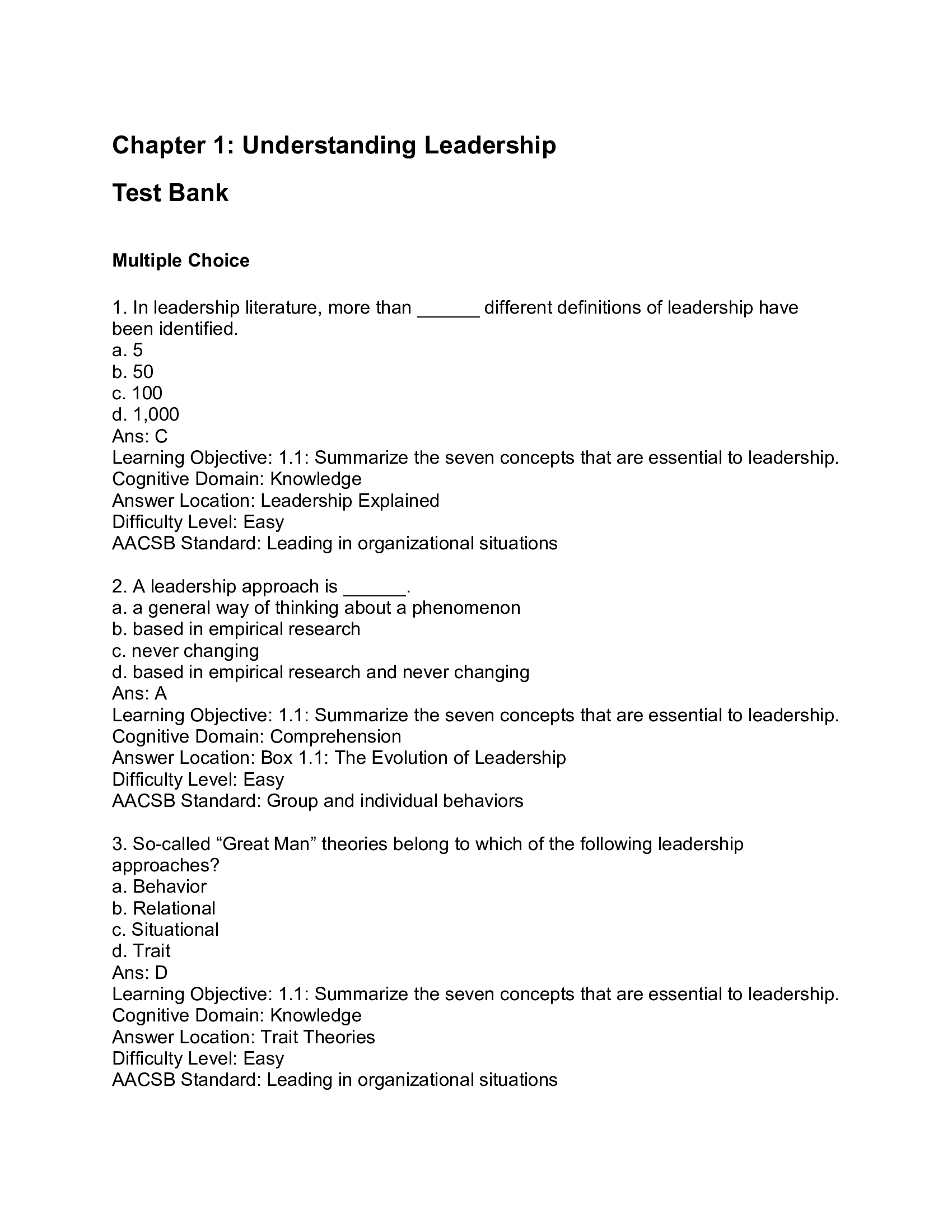
Chapter 1: Understanding Leadership


Test Bank


Multiple Choice


1. In leadership literature, more than ______ different definitions of leadership have been identified.


a. 5


b. 50


c. 100


d. 1,000


Ans: C


Learning Objective: 1.1: Summarize the seven concepts that are essential to leadership.


Cognitive Domain: Knowledge


Answer Location: Leadership Explained


Difficulty Level: Easy


AACSB Standard: Leading in organizational situations


2. A leadership approach is ______.


a. a general way of thinking about a phenomenon


b. based in empirical research


c. never changing


d. based in empirical research and never changing


Ans: A


Learning Objective: 1.1: Summarize the seven concepts that are essential to leadership.


Cognitive Domain: Comprehension


Answer Location: Box 1.1: The Evolution of Leadership


Difficulty Level: Easy


AACSB Standard: Group and individual behaviors


3. So-called “Great Man” theories belong to which of the following leadership approaches?


a. Behavior


b. Relational


c. Situational


d. Trait


Ans: D


Learning Objective: 1.1: Summarize the seven concepts that are essential to leadership.


Cognitive Domain: Knowledge


Answer Location: Trait Theories


Difficulty Level: Easy


AACSB Standard: Leading in organizational situations


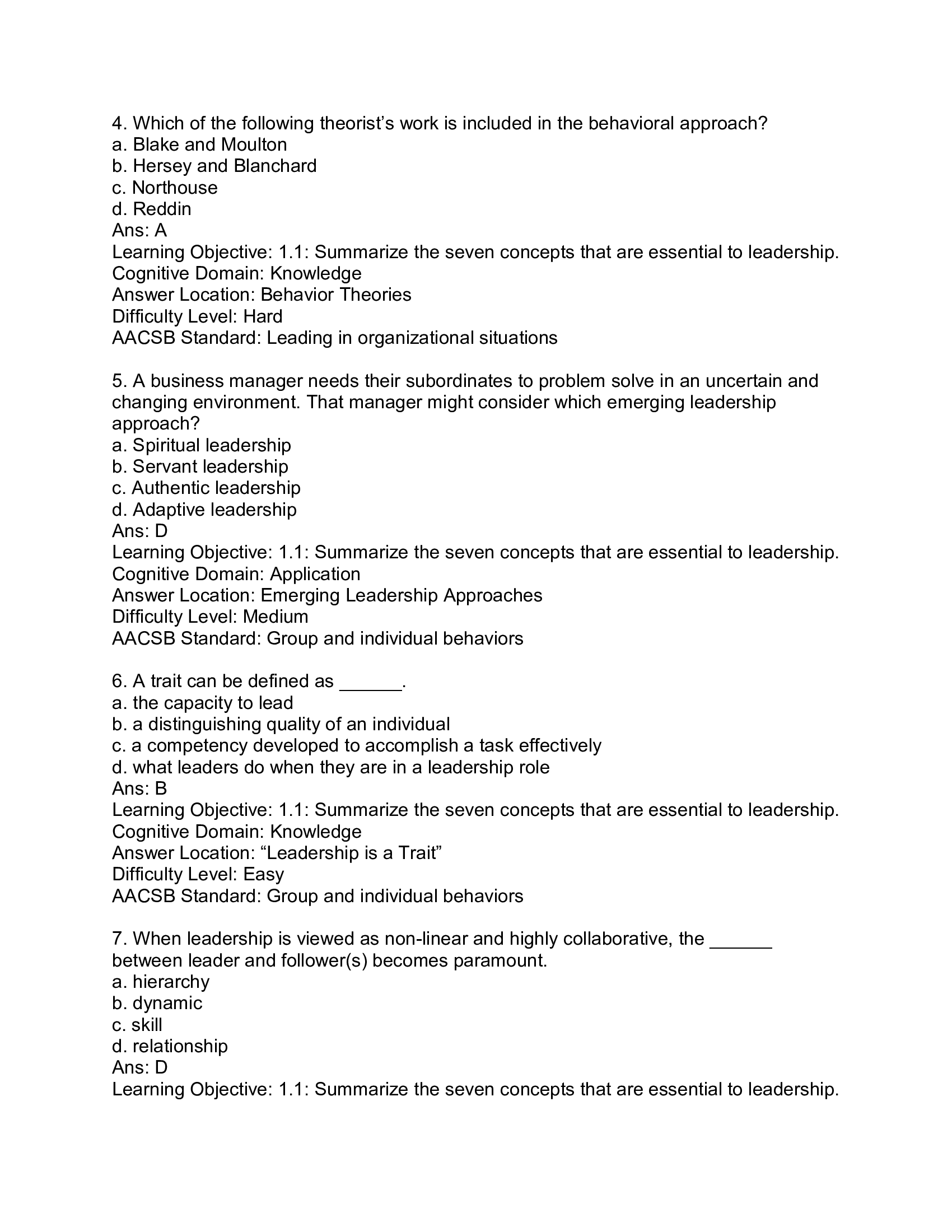
4. Which of the following theorist’s work is included in the behavioral approach?


a. Blake and Moulton


b. Hersey and Blanchard


c. Northouse


d. Reddin


Ans: A


Learning Objective: 1.1: Summarize the seven concepts that are essential to leadership.


Cognitive Domain: Knowledge


Answer Location: Behavior Theories


Difficulty Level: Hard


AACSB Standard: Leading in organizational situations


5. A business manager needs their subordinates to problem solve in an uncertain and changing environment. That manager might consider which emerging leadership approach?


a. Spiritual leadership


b. Servant leadership


c. Authentic leadership


d. Adaptive leadership


Ans: D


Learning Objective: 1.1: Summarize the seven concepts that are essential to leadership.


Cognitive Domain: Application


Answer Location: Emerging Leadership Approaches


Difficulty Level: Medium


AACSB Standard: Group and individual behaviors


6. A trait can be defined as ______.


a. the capacity to lead


b. a distinguishing quality of an individual


c. a competency developed to accomplish a task effectively


d. what leaders do when they are in a leadership role


Ans: B


Learning Objective: 1.1: Summarize the seven concepts that are essential to leadership.


Cognitive Domain: Knowledge


Answer Location: “Leadership is a Trait”


Difficulty Level: Easy


AACSB Standard: Group and individual behaviors


7. When leadership is viewed as non-linear and highly collaborative, the ______ between leader and follower(s) becomes paramount.


a. hierarchy


b. dynamic


c. skill


d. relationship


Ans: D


Learning Objective: 1.1: Summarize the seven concepts that are essential to leadership.


Cognitive Domain: Comprehension


Answer Location: “Leadership is a Relationship”


Difficulty Level: Medium


AACSB Standard: Group and individual behaviors


8. A manager who encourages subordinates to take time off from work to recuperate from stressful projects might be utilizing leadership as a ______.


a. relationship


b. behavior


c. skill


d. task


Ans: A


Learning Objective: 1.1: Summarize the seven concepts that are essential to leadership.


Cognitive Domain: Application


Answer Location: “Leadership is a Relationship”


Difficulty Level: Medium


AACSB Standard: Interpersonal relations and teamwork


9. Influence is central to the process of leadership because leaders affect ______.


a. outcomes


b. goals


c. followers


d. vision


Ans: C


Learning Objective: 1.1: Summarize the seven concepts that are essential to leadership.


Cognitive Domain: Knowledge


Answer Location: “Leadership is an Influence Process”


Difficulty Level: Easy


AACSB Standard: Group and individual behaviors


10. The GLOBE study sought to increase our understanding of the impact ______ has on leadership effectiveness.


a. culture


b. globalization


c. democratization


d. nationalism


Ans: A


Learning Objective: 1.2: Discuss the findings of the Global Leadership and Organizational Behavior Effectiveness studies.


Cognitive Domain: Knowledge


Answer Location: Global Leadership Attributes


Difficulty Level: Easy


AACSB Standard: Diverse and multicultural environments


11. What is a key outcome of toxic leadership according to Lipman-Blumen?


a. Followers are unhappy


b. Followers are stressed


c. Followers are worse off than before the leader emerged


d. Followers are empowered to speak


Ans: C


Learning Objective: 1.3: Identify examples of destructive leadership.


Cognitive Domain: Comprehension


Answer Location: The Dark Side of Leadership


Difficulty Level: Medium


AACSB Standard: Social responsibility


12. Your personal approach to leadership is strongly influenced by your ______.


a. definition and beliefs about leadership


b. leader


c. follower’s competence


d. culture


Ans: A


Learning Objective: 1.1: Summarize the seven concepts that are essential to leadership.


Cognitive Domain: Comprehension


Answer Location: Summary


Difficulty Level: Easy


AACSB Standard: Group and individual behaviors


13. A social entrepreneur who successfully creates new business ventures over the span of their entire career might be judged to have the ______ to lead.


a. knowledge


b. ability


c. thoughtfulness


d. disposition


Ans: B


Learning Objective: 1.1: Summarize the seven concepts that are essential to leadership.


Cognitive Domain: Application


Answer Location: “Leadership is an Ability”


Difficulty Level: Medium


AACSB Standard: Analytical thinking


14. A leader should behave genuinely with their followers and align their behaviors with their values. This is a description of which emerging leadership approach?


a. Adaptive


b. Spiritual


c. Authentic


d. Servant


Ans: Authentic


Learning Objective: 1.1: Summarize the seven concepts that are essential to leadership.


Cognitive Domain: Application


Answer Location: Emerging Leadership Approaches


Difficulty Level: Medium


AACSB Standard: Group and individual behaviors


15. Observable aspects of leadership are known as ______.


a. skills


b. traits


c. abilities


d. behaviors


Ans: D


Learning Objective: 1.1: Summarize the seven concepts that are essential to leadership.


Cognitive Domain: Comprehension


Answer Location: “Leadership is a Behavior”


Difficulty Level: Medium


AACSB Standard: Group and individual behaviors


16. Research on leadership behaviors has identified two general behaviors ______.


a. task and process


b. skill acquisition and process


c. task and charisma


d. work ethic and charisma


Ans: A


Learning Objective: 1.1: Summarize the seven concepts that are essential to leadership.


Cognitive Domain: Knowledge


Answer Location: “Leadership is a Behavior”


Difficulty Level: Easy


AACSB Standard: Group and individual behaviors


17. Leadership is a(n) ______ whereby an individual influences a group of individuals to achieve a common goal.


a. skill


b. trait


c. approach


d. process


Ans: D


Learning Objective: 1.1: Summarize the seven concepts that are essential to leadership.


Cognitive Domain: Knowledge


Answer Location: “Leadership is an Influence Process”


Difficulty Level: Easy


AACSB Standard: Leading in organizational situations


18. A leader who acknowledges followers’ good work and seeks to motivate them to enhance performance is likely using ______.


a. path-goal theory


b. contingency theory


c. leader-member exchange theory


d. transformational leadership theory


Ans: A


Learning Objective: 1.1: Summarize the seven concepts that are essential to leadership.


Cognitive Domain: Comprehension


Answer Location: Situational Theories


Difficulty Level: Hard


AACSB Standard: Interpersonal relations and teamwork


19. A leader who begins each team meeting with a teambuilding activity and has quarterly retreats is focusing on ______.


a. task behaviors


b. process behaviors


c. leader-member exchange


d. skill acquisition


Ans: B


Learning Objective: 1.1: Summarize the seven concepts that are essential to leadership.


Cognitive Domain: Application


Answer Location: “Leadership is a Behavior”


Difficulty Level: Medium


AACSB Standard: Interpersonal relations and teamwork


20. A manager who adheres strictly to their meeting agenda might be focusing on which type of behavior?


a. Process


b. Team building


c. Task


d. Relationship


Ans: C


Learning Objective: 1.1: Summarize the seven concepts that are essential to leadership.


Cognitive Domain: Application


Answer Location: “Leadership is a Behavior”


Difficulty Level: Medium


AACSB Standard: Interpersonal relations and teamwork


21. Mutuality in leadership is stressed in which approach?


a. Relationship


b. Skill


c. Behavior


d. Ability


Ans: A


Learning Objective: 1.1: Summarize the seven concepts that are essential to leadership.


Cognitive Domain: Comprehension


Answer Location: “Leadership is a Relationship”


Difficulty Level: Medium


AACSB Standard: Interpersonal relations and teamwork


22. Which leadership approach focuses on followers’ needs in order to help followers become more autonomous and knowledgeable?


a. Spiritual leadership


b. Authentic leadership


c. Transformational leadership


d. Servant leadership


Ans: D


Learning Objective: 1.1: Summarize the seven concepts that are essential to leadership.


Cognitive Domain: Knowledge


Answer Location: Emerging Leadership Approaches


Difficulty Level: Medium


AACSB Standard: Interpersonal relations and teamwork


23. Leadership is about ______ and management is about ______.


a. people; process


b. power; control


c. seeking constructive change; establishing order


d. influence; delegation


Ans: C


Learning Objective: 1.1: Summarize the seven concepts that are essential to leadership.


Cognitive Domain: Comprehension


Answer Location: “Leadership is an Influence Process”


Difficulty Level: Medium


AACSB Standard: Interpersonal relations and teamwork


24. One who develops their skills through practice probably views leadership as a(n) ______.


a. ability


b. trait


c. behavior


d. relationship


Ans: A


Learning Objective: 1.1: Summarize the seven concepts that are essential to leadership.


Cognitive Domain: Comprehension


Answer Location: “Leadership is an Ability”


Difficulty Level: Easy


AACSB Standard: Group and individual behaviors


25. This leadership theory describes leadership as a process that changes people and organizations.


a. Leader-member exchange theory


b. Path-goal theory


c. Transformational leadership


d. Contingency theory


Ans: C


Learning Objective: 1.1: Summarize the seven concepts that are essential to leadership.


Cognitive Domain: Comprehension


Answer Location: “New Leadership” Approach


Difficulty Level: Easy


AACSB Standard: Interpersonal relations and teamwork


26. Mohandas Gandhi, Abraham Lincoln, Moses, and Joan of Arc were considered very effective leaders. Which leadership approach describes them best?


a. Situational approach


b. Behavior approach


c. Relational approach


d. Trait approach


Ans: D


Learning Objective: 1.1: Summarize the seven concepts that are essential to leadership.


Cognitive Domain: Comprehension


Answer Location: Trait Theories


Difficulty Level: Medium


AACSB Standard: Leading in organizational situations


27. Authority and influence are shared when leadership is a ______.


a. trait


b. relationship


c. skill


d. behavior


Ans: B


Learning Objective: 1.1: Summarize the seven concepts that are essential to leadership.


Cognitive Domain: Comprehension


Answer Location: “Leadership is a Relationship”


Difficulty Level: Medium


AACSB Standard: Group and individual behaviors


28. If you are capable of learning from experience, you can acquire leadership. This statement is a characteristic of leadership as a(n) ______.


a. relationship


b. skill


c. trait


d. ability


Ans: B


Learning Objective: 1.1: Summarize the seven concepts that are essential to leadership.


Cognitive Domain: Comprehension


Answer Location: “Leadership is a Skill”


Difficulty Level: Easy


AACSB Standard: Group and individual behaviors


29. Leaders ______ and ______ followers when leadership is conceptualized as a relationship.


a. criticize; are criticized by


b. change; intimidate


c. accept limitations; ignore


d. affect; are affected by


Ans: D


Learning Objective: 1.1: Summarize the seven concepts that are essential to leadership.


Cognitive Domain: Knowledge


Answer Location: “Leadership is a Relationship”


Difficulty Level: Medium


AACSB Standard: Group and individual behaviors


30. Contingency theory focuses on the match between the leader’s style and ______.


a. followers’ needs


b. specific situational variables


c. specific follower preferences


d. leader’s skills


Ans: B


Learning Objective: 1.1: Summarize the seven concepts that are essential to leadership.


Cognitive Domain: Knowledge


Answer Location: Situational Theories


Difficulty Level: Medium


AACSB Standard: Interpersonal relations and teamwork


31. A leader seeking more positive outcomes should seek to improve high-quality relations is a prediction of what theory?


a. Leader–member exchange


b. Contingency theory


c. Path–goal theory


d. Spiritual approach


Ans: A


Learning Objective: 1.1: Summarize the seven concepts that are essential to leadership.


Cognitive Domain: Application


Answer Location: Relational Theories


Difficulty Level: Medium


AACSB Standard: Interpersonal relations and teamwork


32. The “Big Five” personality factors and emotional intelligence have been researched as a part of which leadership approach?


a. Situational


b. Behavior


c. Relational


d. Trait


Ans: D


Learning Objective: 1.1: Summarize the seven concepts that are essential to leadership.


Cognitive Domain: Knowledge


Answer Location: Trait Theories


Difficulty Level: Easy


AACSB Standard: Group and individual behaviors


33. A leader who changes their style to fit different situations contexts is using which approach to leadership?


a. Relational


b. Behavior


c. Situational


d. New leader


Ans: C


Learning Objective: 1.1: Summarize the seven concepts that are essential to leadership.


Cognitive Domain: Comprehension


Answer Location: Situational Theories


Difficulty Level: Easy


AACSB Standard: Group and individual behaviors


34. Which of the following focuses on helping people feel comfortable in a group?


a. Task behaviors


b. Process behaviors


c. Passive behaviors


d. Introspective behaviors


Ans: B


Learning Objective: 1.1: Summarize the seven concepts that are essential to leadership.


Cognitive Domain: Knowledge


Answer Location: “Leadership is a Behavior”


Difficulty Level: Easy


AACSB Standard: Group and individual behaviors


35. Differences in preferred leadership styles and political viewpoints around the world are the result of what?


a. Authority


b. Culture


c. Democracy


d. None of these


Ans: B


Learning Objective: 1.2: Discuss the findings of the Global Leadership and Organizational Behavior Effectiveness studies.


Cognitive Domain: Application


Answer Location: Global Leadership Attributes


Difficulty Level: Hard


AACSB Standard: Diverse and multicultural work environments


36. Viewed as a skill, leadership can be ______.


a. seen as an inborn quality


b. studied and learned


c. understood as a means to keep people in line


d. all of these


Ans: B


Learning Objective: 1.1: Summarize the seven concepts that are essential to leadership.


Cognitive Domain: Comprehension


Answer Location: “Leadership is a Skill”


Difficulty Level: Easy


AACSB Standard: Group and individual behaviors


37. Stressing mutuality lessens the possibility that leaders might act toward followers in ways that are ______.


a. outside the norms


b. difficult to comprehend


c. beneficial to everyone


d. forced and unethical


Ans: D


Learning Objective: 1.1: Summarize the seven concepts that are essential to leadership.


Cognitive Domain: Application


Answer Location: “Leadership is a Relationship”


Difficulty Level: Medium


AACSB Standard: Ethical understanding and reasoning


38. The relational approach has a(n) ______ overtone because it stresses the need for leaders to work with followers to achieve their mutual purposes.


a. ethical


b. adversarial


c. tactful


d. authoritarian


Ans: A


Learning Objective: 1.1: Summarize the seven concepts that are essential to leadership.


Cognitive Domain: Application


Answer Location: “Leadership is a Relationship”


Difficulty Level: Medium


AACSB Standard: Ethical understanding and reasoning


39. Demand for effective leadership exists at ______.


a. local, community, and national levels


b. personal and interpersonal levels


c. international levels


d. business and non-profit levels


Ans: A


Learning Objective: 1.3: Identify examples of destructive leadership.


Cognitive Domain: Comprehension


Answer Location: The Dark Side of Leadership


Difficulty Level: Hard


AACSB Standard: diverse and multicultural work environments


40. Effective leadership is ______.


a. intended influence that creates change for the greater good


b. focused on the leader


c. leaving the followers worse off


d. making sure people know that the leader is the authority


Ans: A


Learning Objective: 1.3: Identify examples of destructive leadership.


Cognitive Domain: Comprehension


Answer Location: The Dark Side of Leadership


Difficulty Level: Hard


AACSB Standard: Interpersonal relations and teamwork


41. Leadership as a(n) ______ places a great deal of emphasis on the leader and on the leader’s special gifts.


a. relationship


b. ability


c. trait


d. skill


Ans: C


Learning Objective: 1.1: Summarize the seven concepts that are essential to leadership.


Cognitive Domain: Knowledge


Answer Location: “Leadership is a Trait”


Difficulty Level: Easy


AACSB Standard: Group and individual behaviors


42. At what time did scholarly inquiry into leadership become prolific?


a. Ancient times


b. Medieval era


c. Renaissance


d. 20th century


Ans: D


Learning Objective: 1.1: Summarize the seven concepts that are essential to leadership.


Cognitive Domain: Knowledge


Answer Location: Box 1.1: The Evolution of Leadership


Difficulty Level: Hard


AACSB Standard: Leading in organizational situations


43. A leader who utilizes a follower’s belief and sense of calling is using which emerging leadership approach?


a. Adaptive


b. Authentic


c. Spiritual


d. Servant leadership


Ans: C


Learning Objective: 1.1: Summarize the seven concepts that are essential to leadership.


Cognitive Domain: Comprehension


Answer Location: Emerging Leadership Approaches


Difficulty Level: Medium


AACSB Standard: Interpersonal relations and teamwork


44. Leadership approaches experience periods of increased and decreased interest. What happens when an approach’s period of popularity decreaseds?


a. The theory is disused and relegated to textbooks.


b. The theory continues to influence further study and development of new approaches.


c. Researchers ignore the theory.


d. The theory is disused and relegated to textbooks and researchers ignore the theory.


Ans: B


Learning Objective: 1.1: Summarize the seven concepts that are essential to leadership.


Cognitive Domain: Comprehension


Answer Location: Emerging Leadership Approaches


Difficulty Level: Hard


AACSB Standard: Leading in organizational situations


45. The thought that “leaders are born, not made” characterizes leadership as ______.


a. a trait


b. a skill


c. a relationship


d. a behavior


Ans: A


Learning Objective: 1.1: Summarize the seven concepts that are essential to leadership.


Cognitive Domain: Knowledge


Answer Location: “Leadership is a Trait”


Difficulty Level: Easy


AACSB Standard: Group and individual behaviors


46. A leader is brought in to run an effective visioning retreat because they have experience running many successful visioning retreats in their past. This organization is utilizing what approach to leadership in this example?


a. Leadership is a relationship.


b. Leadership is a skill.


c. Leadership is a behavior.


d. Leadership is a trait.


Ans: B


Learning Objective: 1.1: Summarize the seven concepts that are essential to leadership.


Cognitive Domain: Application


Answer Location: “Leadership is a Skill”


Difficulty Level: Medium


AACSB Standard: Interpersonal relations and teamwork


47. When leadership is viewed as an influence process leaders direct their energies towards ______.


a. influencing individuals to achieve something together


b. making all followers feel comfortable in the group


c. teaching individuals skills necessary to succeed


d. correcting followers’ ineffective behaviors


Ans: A


Learning Objective: 1.1: Summarize the seven concepts that are essential to leadership.


Cognitive Domain: Application


Answer Location: “Leadership is an Influence Process”


Difficulty Level: Medium


AACSB Standard: Group and individual behaviors


48. Which of the following is NOT listed as a positive leader attribute by the GLOBE study?


a. trustworthy


b. motivator


c. asocial


d. informed


Ans: C


Learning Objective: 1.2: Discuss the findings of the Global Leadership and Organizational Behavior Effectiveness studies.


Cognitive Domain: Knowledge


Answer Location: Table 1.1: Universal Leadership Attributes


Difficulty Level: Easy


AACSB Standard: Contexts of organizations in a global society


49. A leader who inspires followers to be unethical, untrustworthy, and deceptive can be described as ______.


a. relational


b. susceptible


c. constructive


d. toxic


Ans: D


Learning Objective: 1.3: Identify examples of destructive leadership.


Cognitive Domain: Comprehension


Answer Location: The Dark Side of Leadership


Difficulty Level: Easy


AACSB Standard: Interpersonal relations and teamwork | Group and individual behaviors


50. Authority of position and authority of leadership were conceptualized by which theorist?


a. Susan Komives


b. Chester Barnard


c. Frederick Taylor


d. House


Ans: B


Learning Objective: 1.1: Summarize the seven concepts that are essential to leadership.


Cognitive Domain: Knowledge


Answer Location: “Leadership vs. Management”


Difficulty Level: Easy


AACSB Standard: Group and individual behaviors


51. The 7 C’s of Change Model most closely aligns with which concept of leadership?


a. Leadership is a trait


b. Leadership is a skill


c. Leadership is an influence process


d. Leadership is a relationship


Ans: D


Learning Objective: 1.1: Summarize the seven concepts that are essential to leadership.


Cognitive Domain: Comprehension


Answer Location: “Leadership is a Relationship”


Difficulty Level: Moderate


AACSB Standard: Group and individual behaviors


True/False


1. A leadership approach can provide a predictive framework in analyzing the phenomenon of leadership.


Ans: F


Learning Objective: 1.1: Summarize the seven concepts that are essential to leadership.


Cognitive Domain: Comprehension


Answer Location: Box 1.1: The Evolution of Leadership


Difficulty Level: Easy


AACSB Standard: Analytical thinking


2. A leadership theory is NOT necessarily based on empirical research.


Ans: F


Learning Objective: 1.1: Summarize the seven concepts that are essential to leadership.


Cognitive Domain: knowledge


Answer Location: Box 1.1: The Evolution of Leadership


Difficulty Level: Easy


AACSB Standard: Analytical thinking


3. Servant leadership, spiritual leadership, and LMX theory all belong to the relational approach to leadership.


Ans: F


Learning Objective: 1.1: Summarize the seven concepts that are essential to leadership.


Cognitive Domain: Comprehension


Answer Location: Emerging Leadership Approaches


Difficulty Level: Hard


AACSB Standard: Group and individual behaviors


4. In viewing leadership as a trait, it is important that leaders have the required traits demanded by a particular situation.


Ans: T


Learning Objective: 1.1: Summarize the seven concepts that are essential to leadership.


Cognitive Domain: Comprehension


Answer Location: “Leadership is a Trait”


Difficulty Level: Medium


AACSB Standard: Group and individual behaviors


5. Viewing leadership as an influence process gives leadership an inherent ethical dimension according to the text.


Ans: T


Learning Objective: 1.1: Summarize the seven concepts that are essential to leadership.


Cognitive Domain: Comprehension


Answer Location: “Leadership is an Influence Process”


Difficulty Level: Medium


AACSB Standard: Social responsibility


6. In every situation, there are leadership demands placed on the individual who is the leader.


Ans: T


Learning Objective: 1.1: Summarize the seven concepts that are essential to leadership.


Cognitive Domain: Comprehension


Answer Location: Introduction


Difficulty Level: Easy


AACSB Standard: Interpersonal relations and teamwork


7. A challenge for leaders using the behavior approach is combining task and process behaviors.


Ans: T


Learning Objective: 1.1: Summarize the seven concepts that are essential to leadership.


Cognitive Domain: Comprehension


Answer Location: “Leadership is a Behavior”


Difficulty Level: Medium


AACSB Standard: Interpersonal relations and teamwork


8. When leadership is viewed as a relationship authority is often top down.


Ans: F


Learning Objective: 1.1: Summarize the seven concepts that are essential to leadership.


Cognitive Domain: Comprehension


Answer Location: “Leadership is a Relationship’


Difficulty Level: Easy


AACSB Standard: Interpersonal relations and teamwork


9. Leadership as a skill means it is available only to the few with great ability.


Ans: F


Learning Objective: 1.1: Summarize the seven concepts that are essential to leadership.


Cognitive Domain: Comprehension


Answer Location: “Leadership is a Skill”


Difficulty Level: Easy


AACSB Standard: Group and individual behaviors


10. A leader who views leadership as a relationship can be influenced by their followers.


Ans: T


Learning Objective: 1.1: Summarize the seven concepts that are essential to leadership.


Cognitive Domain: Comprehension


Answer Location: “Leadership is a Relationship”


Difficulty Level: easy


AACSB Standard: Group and individual behaviors


11. Both leadership and management involve influence and goal accomplishment.


Ans: T


Learning Objective: 1.1: Summarize the seven concepts that are essential to leadership.


Cognitive Domain: Comprehension


Answer Location: “Leadership is an Influence Process”


Difficulty Level: Easy


AACSB Standard: Group and individual behaviors


Essay


1. Explain the differences between leadership approaches and theories.


Ans: An approach is a general way of thinking about a phenomenon, not necessarily based on empirical research. Theories usually include a set of hypotheses, principles, or laws that explain a given phenomenon. Theories are more refined and can provide a predictive framework in analyzing the phenomenon.


Learning Objective: 1.1: Summarize the seven concepts that are essential to leadership.


Cognitive Domain: Comprehension


Answer Location: Box 1.1: The Evolution of Leadership


Difficulty Level: Medium


AACSB Standard: Group and individual behaviors


2. Differentiate among Leadership as a trait, ability, skill, and behavior and highlight examples of each from your personal experience.


Ans: Varies


Learning Objective: 1.1: Summarize the seven concepts that are essential to leadership.


Cognitive Domain: Analysis


Answer Location: Leadership Explained


Difficulty Level: Hard


AACSB Standard: Group and individual behaviors


3. Compare and contrast the concepts of leadership is a relationship and leadership is an influence process.


Ans: Varies


Learning Objective: 1.1: Summarize the seven concepts that are essential to leadership.


Cognitive Domain: Analysis


Answer Location: “Leadership is a Relationship” | “Leadership is an Influence Process”


Difficulty Level: Hard


AACSB Standard: Group and individual behaviors


4. Discuss three emerging leadership approaches; which do you most closely identify with?


Ans: Varies


Learning Objective: 1.1: Summarize the seven concepts that are essential to leadership.


Cognitive Domain: Application | Analysis


Answer Location: Emerging Leadership Approaches


Difficulty Level: Medium


AACSB Standard: Group and individual behaviors


5. Approaches to leadership experience periods of increasing and decreasing interest. Discuss three approaches you feel are most interesting in our current global context.


Ans: Varies


Learning Objective: 1.2: Discuss the findings of the Global Leadership and Organizational Behavior Effectiveness studies.


Cognitive Domain: Comprehension | Application | Analysis


Answer Location: Leadership Explained


Difficulty Level: Medium


AACSB Standard: Written and oral communication


6. Differentiate between leadership and management and provide examples for when each are necessary.


Ans: Leadership is about seeking constructive change, and management is about establishing order. For example, it is often said that “managers are people who do things right, and leaders are people who do the right thing.”


Learning Objective: 1.1: Summarize the seven concepts that are essential to leadership.


Cognitive Domain: Application | Analysis


Answer Location: “Leadership is an Influence Process”


Difficulty Level: Hard


AACSB Standard: Group and individual behaviors


7. Choose three of the global positive leader attributes identified by House and discuss why they are universal and not culturally specific.


Ans: Varies


Learning Objective: 1.2: Discuss the findings of the Global Leadership and Organizational Behavior Effectiveness studies.


Cognitive Domain: Application | Analysis


Answer Location: Global Leadership Attributes


Difficulty Level: Hard


AACSB Standard: Diverse and multicultural work environments


8. Based on the behavior approach, describe the two types of leader behaviors and give an example of a situation in which each behavior is used appropriately.


Ans: Varies


Learning Objective: 1.1: Summarize the seven concepts that are essential to leadership.


Cognitive Domain: Comprehension | Application


Answer Location: “Leadership is a Behavior”


Difficulty Level: Medium


AACSB Standard: Written and oral communication


9. Explain how one could apply the 7 C’s of Change Model to accomplish a positive change in a community or campus problem you are aware of.


Ans: Varies


Learning Objective: 1.1: Summarize the seven concepts that are essential to leadership.


Cognitive Domain: Application


Answer Location: “Leadership is a Relationship”


Difficulty Level: Medium


AACSB Standard: Social responsibility


10. Explain how a team marketing project may still be considered an outcome of leadership.


Ans: There may be a designated team leader, but all the idea generation, planning, problem solving, and decision-making might be made jointly. Leadership happens through a mutual influence process, involving both leaders and followers. More than one person can take on a leadership role at a given time.


Learning Objective: 1.1: Summarize the seven concepts that are essential to leadership.


Cognitive Domain: Application


Answer Location: “Leadership is a Relationship”


Difficulty Level: Medium


AACSB Standard: Systems and processes in organizations


Contact the Seller

Please Sign In to contact this seller.


  • 👎  Report Copyright Violation

Frequently Asked Questions

What Do I Get When I Buy This Study Material?

+

When you buy a study material on Passing Grades, an instant download link will be sent directly to your email, giving you access to the file anytime after payment is completed.

Is Passing Grades a Trusted Platform?

+

Yes, Passing Grades is a reputable students’ marketplace with a secure payment system and reliable customer support. You can trust us to ensure a safe and seamless transaction experience.

Will I Be Stuck with a Subscription?

+

No, all purchases on Passing Grades are one-time transactions. You only pay for the notes you choose to buy, with no subscriptions or hidden fees attached.

Who Am I Buying These Study Materials From?

+

Passing Grades is a marketplace, which means you are purchasing the document from an individual vendor, not directly from us. We facilitate the payment and delivery process between you and the vendor.

Does Passing Grades Offer Free Study Materials?

+

Yes, sellers on Passing Grades have uploaded numerous free test banks, exams, practice questions, and class notes that can be downloaded at no cost.

Pasinggrades - Quality Study Materials

USD 12

    • Quality checked by Pasing Grades
    • 100% satisfaction guarantee
    • Seller: GradeA
Buy PDF $12

Seller Information

GradeA

Member since April 2021

  • icon
  • icon
  • icon
View Profile
  • total sales

    0
  • Favourites

    0
  • Comments

    0
    ( 0 Ratings )

Item Information

  • Uploaded

    16 January 2022

  • Updated

    24 October 2025

  • Category

    Nursing

  • Item Type

    test bank

  • Tags

    Test Bank For Introduction to Leadership Concepts and Practice 5th Edition By Peter G. Northouse

Related Exam Prep Guides by GradeA

Test Bank for Fundamentals of Corporate Finance 12th Edition By Stephen Ross and Randolph Westerfield and Bradford Jordan
View Document

Test Bank for Fundam...

  • GradeA

    GradeA

  • test bank

Test Bank for Fundamentals of Corporate Finance 12th Edition By Stephen Ross and Randolph Westerfiel...

12 USD

0

0

[SOLUTION MANUAL) Fundamentals of Corporate Finance 12th Edition By Stephen Ross and Randolph Westerfield and Bradford Jordan
View Document

[SOLUTION MANUAL) Fu...

  • GradeA

    GradeA

  • test bank

[SOLUTION MANUAL) Fundamentals of Corporate Finance 12th Edition By Stephen Ross and Randolph Wester...

12 USD

0

0

QMI1500 Assignment 02 2021 AS PER UPDATED TUTORIAL LETTER
View Document

QMI1500 Assignment 0...

  • GradeA

    GradeA

  • test bank

QMI1500 Assignment 02 2021 AS PER UPDATED TUTORIAL LETTER...

12 USD

0

0

Purchase

Download link will be sent to this email immediately after purchase.

IMPORTANT LINKS

  • How To Upload Class Notes
  • Selling Tips
  • Passing Grades's Study Materials
  • Scholarships for International Students 2025

POPULAR CATEGORIES

  • Law
  • Accounting
  • English
  • Psychology
  • Business
  • Nursing
  • Computer Science
  • General

View Document

  • Blog
  • Contact
  • Delivery Policy
  • Latest Scholarships Around the World
  • How to Pass Bar Exams: Passing Grades’ Strategies
  • How to Study and Pass the CPA Exam
  • All Test Banks
  • Faq
  • Copyright Claims
  • Privacy Policy
  • Terms of Use

KNOWLEDGE BASE

  • How to Write A+ Grade Good Research Paper
  • How to Manage Stress During Exam Period
  • Best Time to Study
  • How to Pass NCLEX-RN Exam
  • How To Effectively Utilize Test Banks
  • Popular Shadow Health Exam Assessments
  • Popular HESI Case Studies
  • How to Prepare for a Nursing Career
  • The Importance Of Summaries in Exam Revisvion

© 2026 Pasing Grades. All rights reserved.