Pasing Grades
  • Start Selling
  • Blog
  • Contact
  • 0

    Your cart is empty!

English

  • English
  • Spanish
  • Arabic
Create Account Sign In
  • Library
    • New Prep Guides
    • Featured Prep Guides
    • Free Exam Prep Guides
    • Best sellers
  • General
  • Nursing
    • Research Paper
    • Case Study
    • Discussion Post
    • Assignment
    • Exam
    • Practice Questions and Answers
    • Test Bank
    • solutions manual
  • Accounting
    • Case Study
    • Thesis
    • Study Guide
    • Summary
    • Research Paper
    • test bank
  • English
    • Creative Writing
    • Research Paper
    • Summary
    • Rhetorics
    • Literature
    • Journal
    • Exam
    • Grammar
    • Discussion Post
    • Essay
  • Psychology
    • Hesi
    • Presentation
    • Essay
    • Summary
    • Study Guide
    • Essay
    • Solution Manual
    • Final Exam Review
    • Class Notes
    • test bank
  • Business
    • Lecture Notes
    • Solution Manual
    • Presentation
    • Business Plan
    • Class Notes
    • Experiment
    • Summary
    • Practice Questions
    • Study Guide
    • Case Study
    • test bank
    • Exam
  • More
    • Computer Science
    • Economics
    • Statistics
    • Engineering
    • Biology
    • Religious Studies
    • Physics
    • Chemistry
    • Mathematics
    • History
    • Sociology
    • Science
    • Philosophy
    • Law
  • Pages
    • About Us
    • Selling Tips
    • Delivery Policy
    • Faq
    • Privacy Policy
  • Flash Sale
  • Home
  • Test Bank for Introduction to Auditory Rehabilitation by Johnson

Test Bank for Introduction to Auditory Rehabilitation by Johnson

Preview page 1 Preview page 2 Preview page 3
Add To Favorites

Share this item Share this item

  • Item Details
  • Comments (0)
  • Reviews (0)
  • Contact Seller

Test Bank for Introduction to Auditory Rehabilitation by Johnson

Chapter 1 Introduction to Aural Rehabilitation Test Bank

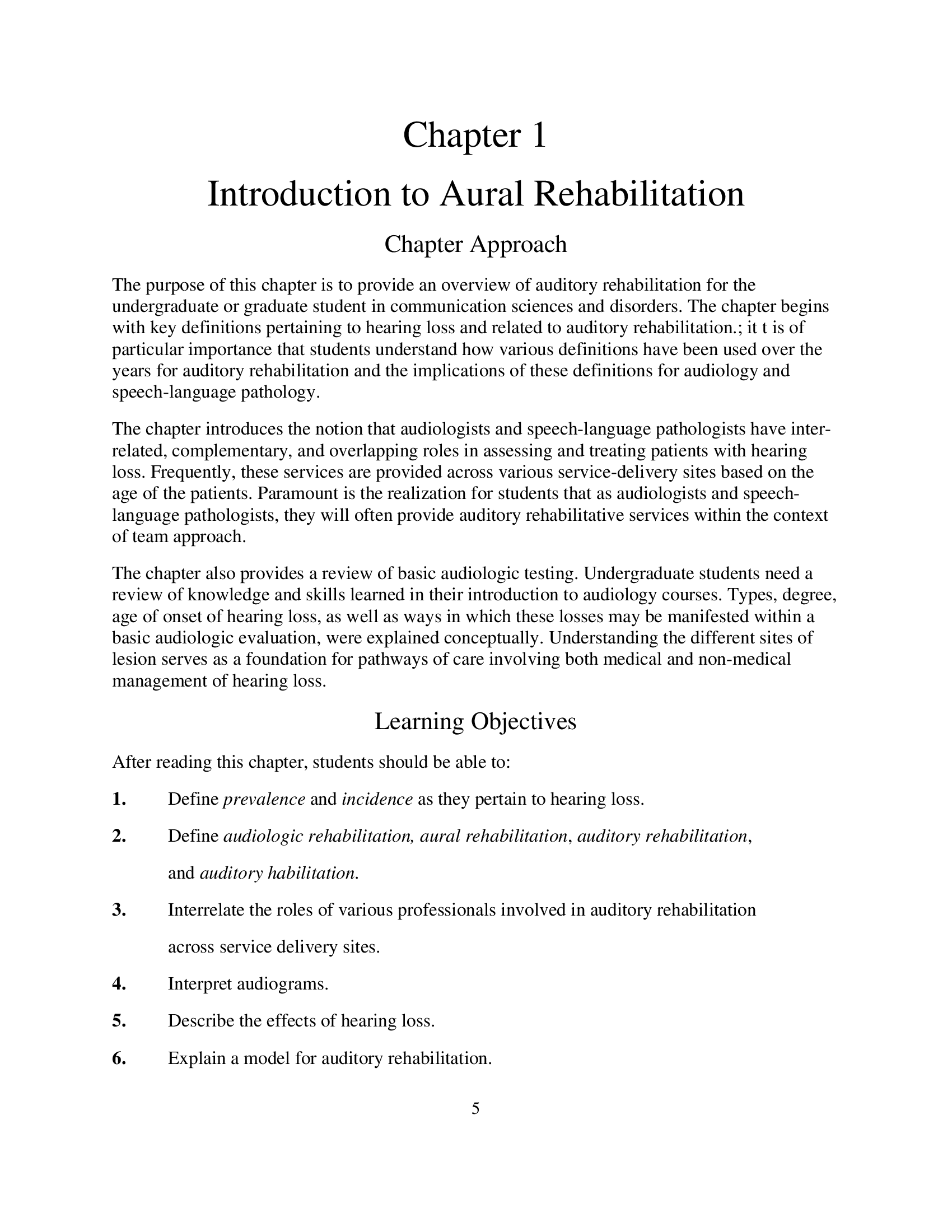
Chapter Approach

The purpose of this chapter is to provide an overview of auditory rehabilitation for the undergraduate or graduate student in communication sciences and disorders. The chapter begins with key definitions pertaining to hearing loss and related to auditory rehabilitation.; it t is of particular importance that students understand how various definitions have been used over the years for auditory rehabilitation and the implications of these definitions for audiology and speech-language pathology.

The chapter introduces the notion that audiologists and speech-language pathologists have interrelated, complementary, and overlapping roles in assessing and treating patients with hearing loss. Frequently, these services are provided across various service-delivery sites based on the age of the patients. Paramount is the realization for students that as audiologists and speechlanguage pathologists, they will often provide auditory rehabilitative services within the context of team approach.

The chapter also provides a review of basic audiologic testing. Undergraduate students need a review of knowledge and skills learned in their introduction to audiology courses. Types, degree, age of onset of hearing loss, as well as ways in which these losses may be manifested within a basic audiologic evaluation, were explained conceptually. Understanding the different sites of lesion serves as a foundation for pathways of care involving both medical and non-medical management of hearing loss. 

Learning Objectives

After reading this chapter, students should be able to:

1.                  Define prevalence and incidence as they pertain to hearing loss.

2.                  Define audiologic rehabilitation, aural rehabilitation, auditory rehabilitation,          and auditory habilitation.

3.                  Interrelate the roles of various professionals involved in auditory rehabilitation       across service delivery sites.

4.                  Interpret audiograms.

5.                  Describe the effects of hearing loss.

6.                  Explain a model for auditory rehabilitation.

7.                  Acknowledge other areas of auditory rehabilitation.

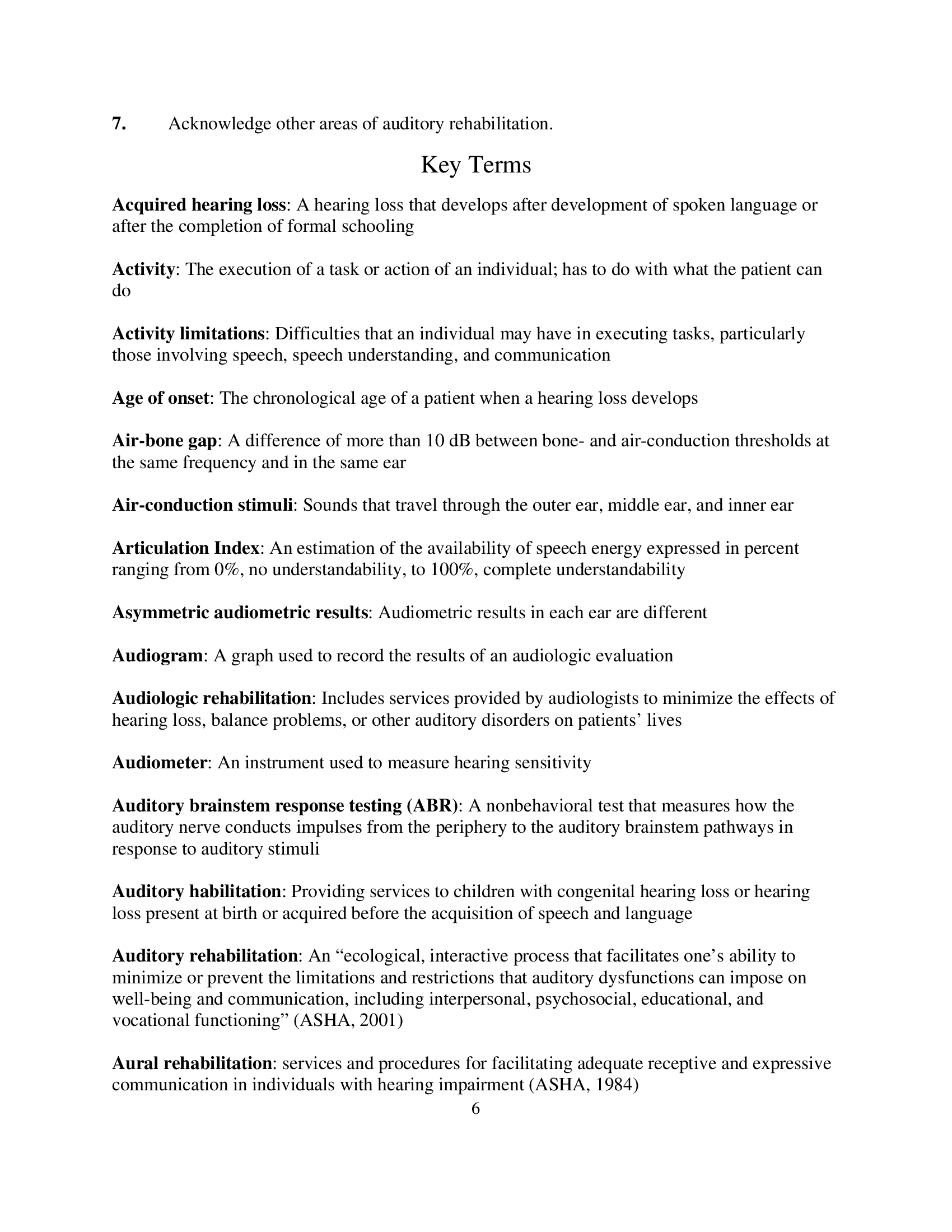
Key Terms

Acquired hearing loss: A hearing loss that develops after development of spoken language or after the completion of formal schooling


Activity: The execution of a task or action of an individual; has to do with what the patient can do


Activity limitations: Difficulties that an individual may have in executing tasks, particularly those involving speech, speech understanding, and communication


Age of onset: The chronological age of a patient when a hearing loss develops


Air-bone gap: A difference of more than 10 dB between bone- and air-conduction thresholds at the same frequency and in the same ear


Air-conduction stimuli: Sounds that travel through the outer ear, middle ear, and inner ear


Articulation Index: An estimation of the availability of speech energy expressed in percent ranging from 0%, no understandability, to 100%, complete understandability


Asymmetric audiometric results: Audiometric results in each ear are different


Audiogram: A graph used to record the results of an audiologic evaluation


Audiologic rehabilitation: Includes services provided by audiologists to minimize the effects of hearing loss, balance problems, or other auditory disorders on patients’ lives


Audiometer: An instrument used to measure hearing sensitivity


Auditory brainstem response testing (ABR): A nonbehavioral test that measures how the auditory nerve conducts impulses from the periphery to the auditory brainstem pathways in response to auditory stimuli


Auditory habilitation: Providing services to children with congenital hearing loss or hearing loss present at birth or acquired before the acquisition of speech and language


Auditory rehabilitation: An “ecological, interactive process that facilitates one’s ability to minimize or prevent the limitations and restrictions that auditory dysfunctions can impose on well-being and communication, including interpersonal, psychosocial, educational, and vocational functioning” (ASHA, 2001)


Aural rehabilitation: services and procedures for facilitating adequate receptive and expressive communication in individuals with hearing impairment (ASHA, 1984)


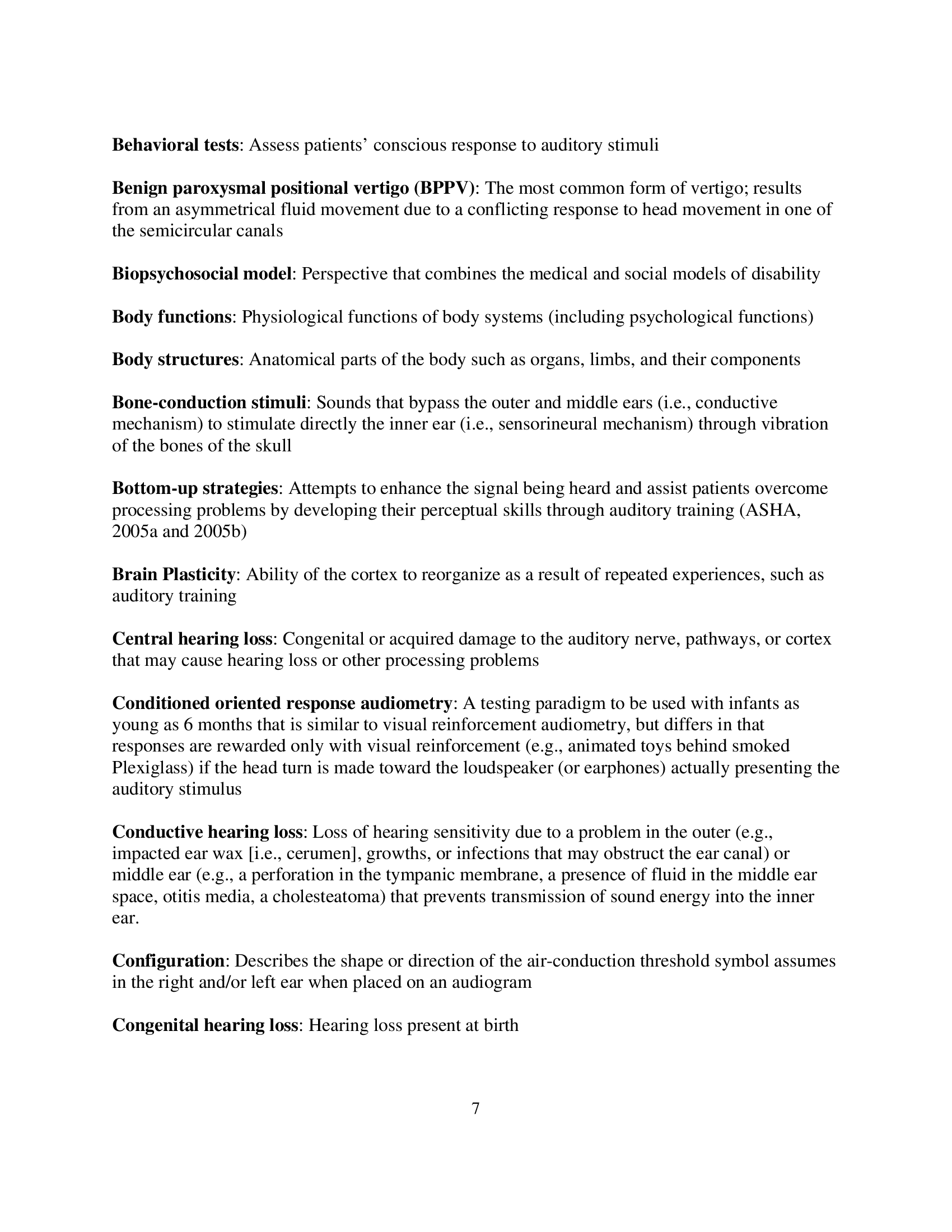
Behavioral tests: Assess patients’ conscious response to auditory stimuli 


Benign paroxysmal positional vertigo (BPPV): The most common form of vertigo; results from an asymmetrical fluid movement due to a conflicting response to head movement in one of the semicircular canals 


Biopsychosocial model: Perspective that combines the medical and social models of disability


Body functions: Physiological functions of body systems (including psychological functions) 


Body structures: Anatomical parts of the body such as organs, limbs, and their components


Bone-conduction stimuli: Sounds that bypass the outer and middle ears (i.e., conductive mechanism) to stimulate directly the inner ear (i.e., sensorineural mechanism) through vibration of the bones of the skull


Bottom-up strategies: Attempts to enhance the signal being heard and assist patients overcome processing problems by developing their perceptual skills through auditory training (ASHA, 2005a and 2005b)


Brain Plasticity: Ability of the cortex to reorganize as a result of repeated experiences, such as auditory training 


Central hearing loss: Congenital or acquired damage to the auditory nerve, pathways, or cortex that may cause hearing loss or other processing problems


Conditioned oriented response audiometry: A testing paradigm to be used with infants as young as 6 months that is similar to visual reinforcement audiometry, but differs in that responses are rewarded only with visual reinforcement (e.g., animated toys behind smoked Plexiglass) if the head turn is made toward the loudspeaker (or earphones) actually presenting the auditory stimulus


Conductive hearing loss: Loss of hearing sensitivity due to a problem in the outer (e.g., impacted ear wax [i.e., cerumen], growths, or infections that may obstruct the ear canal) or middle ear (e.g., a perforation in the tympanic membrane, a presence of fluid in the middle ear space, otitis media, a cholesteatoma) that prevents transmission of sound energy into the inner ear.  


Configuration: Describes the shape or direction of the air-conduction threshold symbol assumes in the right and/or left ear when placed on an audiogram


Congenital hearing loss: Hearing loss present at birth


Count-the-Dot Audiogram: A graph that has 100 dots superimposed onto an audiogram for the purpose of calculating an Articulation or Audibility Index for a patient


Cross-check principle: To confirm behavioral assessments with nonbehavioral results


Deaf: Having PTAs or SRTs in excess of 80 to 90 dB HL and not being able to use residual hearing to understand speech without the use of visual cues even when wearing hearing aids


Degree of hearing loss: The severity of hearing impairment based on predefined categories that may vary among their instructors, clinical supervisors, and textbooks


Diagnostic evaluation: A thorough assessment process; for example, a process that uses a recognized “gold standard” test to confirm the existence and extent of a hearing loss


Disability: An umbrella term for impairments, activity limitations, and participation restrictions


Environmental factors: What make up the physical, social, and attitudinal environment in which people live and conduct their lives


Familiar Sounds on the Audiogram: A tool consisting of an audiogram that has speech and other familiar sounds superimposed at the frequency and hearing level of their approximate spectral energy


Functioning: All body functions, activities, and participation


Hard-of-hearing: Typically having PTAs or SRTs that are less than about 80 dB HL and functionally being able to understand speech without the use of visual cues with assistance from hearing aids


Health: A state of complete physical, mental, and social well-being; not merely the absence of disease or infirmity (World Health Organization, 2001)


Hyperacusis: Hypersensitivity to the loudness of sounds; can co-occur with tinnitus


Impairments: Problems in body function or structure or of a physiological or psychological  function such as a significant deviation or loss


Incidence: The number of new cases of a particular disease during a specified time period


Informational counseling: Providing information related to hearing loss, its diagnosis and management, to patients and their family members (English, 2002)


International Classification of Functioning, Disability, and Health (ICFDH): A classification system and model that provides a standard language and framework for use in describing health and health-related states


Magnetic resonance imaging: A diagnostic procedure in which radio waves are applied to the body so that the nuclear magnetic resonance of atoms produces images of internal organs and tissues on a computer (Merriam-Webster’s Medical Dictionary Online, 2008)


Masking: A procedure used by an audiologist that ensures that the non-test ear does not participate or interfere with audiometric testing


Medical model: Perspective that disability is a characteristic of a person or patient directly caused by disease, trauma, or other health condition requiring medical care provided by a professional


Mixed hearing losses: A loss of hearing sensitivity resulting from problems in both the conductive and sensorineural mechanism


Multidisciplinary screening for central auditory processing disorders: Screening tests administered by professionals in more than one field to identify those who need a comprehensive central auditory processing evaluation


Neural hearing loss: A hearing impairment that occurs due to difficulties that cranial nerve VIII (i.e., statoacoustic nerve) has in transmitting electrical impulses from the peripheral to the central auditory nervous system


Nonbehavioral tests: Tests that measure physiological responses to sound 


Participation: Involvement in life situations


Participation restrictions: Problems an individual may experience, restricting involvement in life situations, particularly in communicating with specific partners in specific situations


Perilingual hearing loss: A hearing loss that develops between 3 and 5 years of age or during the period of rapid speech and language acquisition


Personal adjustment counseling: Efforts to assist patients and their families cope with and solve problems caused by the secondary social and emotional effects of hearing loss


Play audiometry: A testing paradigm for which children complete a motoric task (e.g., dropping blocks in a bucket, putting pegs in a board, etc.) for their response indicating detection of an auditory stimulus


Postlingual hearing loss: A hearing loss that develops after the age of 5 or after speech and language development 


Prelingual hearing loss: A hearing loss that develops before the acquisition of speech and language


Presbycusis: Hearing impairment due to aging


Prevalence: The number of persons afflicted per a segment of the population


Pure-tone average 1 (PTA1): The arithmetic average of the air-conduction thresholds for 500, 1000, and 2000 Hz 


Pure-tone average 2 (PTA2): The arithmetic average of the air-conduction thresholds taken at 1000, 2000, and 4000 Hz


Pure-tone stimuli: Used for audiometric testing; have energy at discrete frequencies presented at various hearing levels


Pure-tone threshold: The softest pure tone, measured in dB HL, that a patient can detect 50% of the time; plotted on the audiogram with special symbols


Retrocochlear (hearing loss): Hearing losses caused by congenital or acquired damage or disease (e.g., tumors) to the auditory nerve and its pathways and reception and processing areas in the cortex


Scope of practice: An official document of a professional organization that specifies appropriate areas of practices for its members


Screening: A short process that serves to identify persons who may have a condition (e.g., hearing loss) needing further evaluation from those who do not


Sensation level (SL): The number of decibels above a certain reference threshold


Sensorineural hearing losses: A loss of hearing sensitivity resulting from a problem in the inner ear, usually the result of hair cell damage as a result of noise exposure, ototoxic drugs, aging, and so on


Sensory hearing loss: A loss of hearing sensitivity resulting from damage to the ear’s inner or outer hair cells


Service delivery site: A place where auditory rehabilitative services are provided


Social model: Perspective that views disability as a socially created problem, not as an attribute of the person


Somatosensory senses: Information provided through skin and muscle receptors


Speech awareness threshold or SAT: The softest hearing level at which the patient can detect the presence of speech

Speech recognition score: The percent of words correctly repeated back when presented at suprasthreshold level


Speech recognition threshold or SRT: The softest hearing threshold level that the patient can repeat back or point to pictures on a board representing spondee words with 50% accuracy


Spondee words: Compound words consisting of two syllables that are of equal stress (e.g., baseball, hot dog, armchair)


Suprathreshold levels: Levels that are above threshold and are usually presented at a comfortable level


Team approach: A group of healthcare professionals collaborate to provide auditory rehabilitation to lessen the effects of hearing impairment on patients and their families


Third-party payers: An entity other than the healthcare provider or patient who reimburses for procedures performed, diagnoses made, and certain devices, supplies, and/or other equipment for patients (ASHA, 1996)


Tinnitus: Noises, and more specifically ringing, in the head


“Top-down” strategies: Focus on the development of compensatory strategies to overcome processing problems relying on central resources of language, memory, and attention (ASHA, 2005a and 2005b)


Two-frequency pure-tone average: The average of the two best air-conduction thresholds at 500, 1000, and 2000 Hz and is used when one of the thresholds is significantly below the other two (e.g., 20 dB HL at 500 Hz, 25 dB HL at 1000 Hz, and 70 dB HL at 2000 Hz)


Vertigo: Sensation of spinning


Visual reinforcement audiometry: A testing paradigm to be used with infants as young as 6 months old; rewards their head-turn responses to auditory stimuli presented through loudspeakers (or earphones) using visual reinforcers (e.g., animated toys behind smoked Plexiglas)


World Health Organization (WHO): The United Nations specialized agency for health


Suggested Learning Activities

Consider having your students:

•              Discuss the Casebook Reflections on pages 2 and 3. How are the patients and their families similar in terms of the feelings surrounding the possible diagnosis of hearing loss? How are they different? What challenges do both patients and their families face?

•              Interview an audiologist and speech-language pathologist regarding the following: 

o   Their roles in auditory rehabilitation in their current positions

o   Their opinions of the greatest challenges facing provision of auditory rehabilitation services

•              Interview a person with hearing loss regarding his or her experiences with auditory rehabilitation.

o   What types of services and hearing instruments did he or she receive?  o What aspects of the rehabilitation were successful? Which were not?

•              Explore the following Websites using search strings such as audiological, aural, and auditory rehabilitation:

o   American Academy of Audiology: www.audiology.org o American Speech, Language, Hearing Association: www.asha.org o American Academy of Rehabilitative Audiology: www.audrehab.org

•              Review audiogram interpretation to include a variety of types and degrees of hearing loss.

•              Observe patients of varying ages in an audiologic clinic. Try to observe patients through diagnostic and intervention processes.

Recommended Materials

Textbooks

 Martin, F.N., & Clark, J.G. (2012). Introduction to audiology, 11th edition. Boston, MA: Pearson, Allyn, & Bacon.

Professional Documents

American Academy of Audiology. (2004). Scope of practice. Retrieved from: http://www.audiology.org/resources/documentlibrary/Pages/ScopeofPractice.aspx

American Speech-Language-Hearing Association. (2001). Knowledge and skills required for the practice of audiologic/aural rehabilitation [Knowledge and Skills]. Retrieved from www.asha.org/policy.

American Speech-Language-Hearing Association. (2004). Scope of practice in audiology [Scope of Practice]. Retrieved from www.asha.org/policy.

American Speech-Language-Hearing Association. (2006). Preferred practice patterns for the profession of audiology [Preferred Practice Patterns]. Retrieved from www.asha.org/policy.

American Speech-Language-Hearing Association. (2007). Scope of practice in speech-language pathology [Scope of Practice]. Retrieved from www.asha.org/policy.

Articles

Beck, D. (2009). World War II, aural rehabilitation, and tinnitus: Interview with Moe Bergmann, Ed.D. Retrieved from: http://www.audiology.org/news/interviews/Pages/20090930a.aspx

Doug Beck, Au.D., interviews one of the founding fathers of auditory rehabilitation. Dr.

Bergman answers questions about noise-induced hearing loss, Grant Fairbanks, Raymond Carhart, Ira Hirsch, and more; students may gain some insight reading Dr Bergman’s account of the history of auditory rehabilitation.

Test Bank

Multiple Choice Questions

Instructions: Please have students select the best answer for each multiple choice problem.

1.                  The number of new cases of a particular condition during a specific time period is known              as __________.

A.                incidence

B.                 prevalence

C.                 epidemic

D.                none of the above

Correct answer: A

Answer found on page: 32 

Level of difficulty: 3


2.                  Which is the most professionally neutral term?

A.                Aural rehabilitation

B.                 Auditory rehabilitation

C.                 Audiologic rehabilitation

D.                None of the above

Correct answer: B

Answer found on page: 5

Level of difficulty: 3

3.                  The roles of audiologists and speech-language pathologists in the provision of auditory      rehabilitation have been described as __________.

A.                complementary

B.                 interrelated

C.                 overlapping

D.                all of the above

E.                 A and B

F.                  B and C

G.                A and C

H.                none of the above

Correct answer: D

Answer found on page: 7

Level of difficulty: 3


4.                  Confirming behavioral results with nonbehavioral results is known as __________.

A.                differential diagnosis

B.                 the cross-check principle

C.                 masking

D.                none of the above

Correct answer: B

Answer found on page: 9

Level of difficulty: 3


5.                  What procedure would most likely be used when conducting an audiologic evaluation on              a 4-year-old child?

A.                Visual reinforcement audiometry

B.                 Play audiometry

C.                 Conditioned oriented response audiometry

D.                None of the above

Correct answer: B

Answer found on page: 10

Level of difficulty: 3


6.                  What does the audiometric symbol “]” mean?

A.                Unmasked air conduction threshold for the right ear

B.                 Masked air-conduction threshold for the left ear

C.                 Mask bone-conduction threshold for the left ear

D.                None of the above

Correct answer: D

Answer found on page: 10 (Figure 1.3)

Level of difficulty: 3


7.                  Moderately severe hearing losses are those that include which of the following ranges of  dB HL?

A.                26 to 40

B.                 41 to 55

C.                 56 to 70

D.                71 to 90

E.                 None of the above

Correct answer: C

Answer found on page: 11 (Table 1.2)

Level of difficulty: 3


8.                  Site of lesion for conductive hearing losses may include __________.

A.                outer ear

B.                 middle ear

C.                 inner ear

D.                A and C

E.                 all of the above

F.                  none of the above

Correct answer: D

Answer found on page: 12

Level of difficulty: 3


9.                  What type of hearing loss is shown on this audiogram?


A.                Conductive

B.                 Sensorineural

C.                 Mixed

D.                None of the above

Correct answer: C

Answer found on page: 13 (Figure 1.6)

Level of difficulty: 3


10.              What type of hearing loss(es) is(are) associated with significant air-bone gaps?

A.                Conductive

B.                 Sensorineural

C.                 Mixed

D.                A and C

E.                 None of the above

Correct answer: D

Answer found on page: 12

Level of difficulty: 3


11.              What type of hearing loss presents on an audiogram with some or all of the air- and boneconduction thresholds falling beyond the range of normal and involves air-bone gaps?

A.                Conductive

B.                 Sensorineural

C.                 Mixed

D.                None of the above

Correct answer: C

Answer found on page: 13

Level of difficulty: 3


12.              What degree of hearing loss does the following audiogram show?


A.                Mild

B.                 Moderate

C.                 Severe

D.                Profound

E.                 None of the above Correct answer: B

Answer found on page: 15 (Figure 1.7)

Level of difficulty: 3


13.              What configuration does the following audiogram display?


A.                Corner

B.                 Flat

C.                 Downward sloping

D.                Reverse cookie bite

E.                 None of the above Correct answer: D.

Answer found on page: 16 (Figure 1.8)

Level of difficulty: 3


14.              The softest hearing level at which the patient can detect the presence of speech 50% of the time is known as __________. A.      speech reception threshold

B.                 speech recognition score

C.                 speech awareness threshold

D.                none of the above

Correct answer: C

Answer found on page: 17

Level of difficulty: 3


15.              If a patient’s speech recognition threshold in the right ear is 30 dB HL and words for        obtaining speech recognition scores are presented at 35 dB SL (re: SRT), the audiometer       attenuator dial would read __________.

A.                30 dB HL

B.                 35 dB HL

C.                 65 dB HL

D.                none of the above

Correct answer: C

Answer found on page: 17

Level of difficulty: 3


16.              A perilingual hearing loss is one that occurs __________.

A.                from birth to 2 years 

B.                 between 3 three and 5 years

C.                 after 5 years of age

D.                none of the above

Correct answer: B

Answer found on page: 19

Level of difficulty: 3


17.              Which of the following terms refers to involvement in life situations?

A.                Impairment

B.                 Activity

C.                 Participation

D.                None of the above

Correct answer: C

Answer found on page: 20

Level of difficulty 3


18.              The WHO International Classification of Functioning, Disabilities, and Health (2001) can             be used to measure __________.

A.                changes in body function and structure

B.                 what a person can do in a standard environment (level of capacity)

C.                 what a person can do in his or her day-to-day environment (level of performance)

D.                all of the above

Correct answer: D

Answer found on page: 19

Level of difficulty: 3

19.              Which of the following is not a major area in auditory rehabilitation?

A.                Sensory aids

B.                 Perceptual training

C.                 Instructions, demonstration, and coaching

D.                Counseling

E.                 None of the above

Correct answer: E

Answer found on pages: 22–23

Level of difficulty: 3


20.              Managing children with (central) auditory processing disorders includes all but which of the following?

A.                Hearing aids

B.                 Environmental modifications and teaching strategies for maximizing patient’s access to auditory information

C.                 Remediation techniques to enhance auditory processing

D.                Use of compensatory strategies

E.                 None of the above

Correct answer: A

Answer found on page: 24

Level of difficulty: 3


21.              Approximately how many people in the United States have tinnitus?

A.                10 million

B.                 30 million

C.                 50 million

D.                70 million

E.                 None of the above

Correct answer: C

Answer found on page: 25

Level of difficulty: 3


22.              Our sense of balance requires gathering information from which of the following senses?

A.                Visual

B.                 Vestibular

C.                 Somatosensory

D.                A and C

E.                 All of the above

Correct answer: D

Answer found on page: 25

Level of difficulty: 3


True and False Questions

Instructions: Please have students put “T” for true or “F” for false for each of the statements below.

1._____ Auditory habilitation refers to serving patients under 18 years of age with hearing loss and their families.

Correct answer: T

Answer found on page: 3

Level of difficulty: 1


2.______Use of the two terms “audiologic/aural rehabilitation” is confusing and has led to difficulties in reimbursement for audiologists.

Correct answer: T

Answer found on page: 5

Level of difficulty: 1


3.______Auditory (re)habilitative services rarely involve a team approach.

Correct answer: F

Answer found on page: 7

Level of difficulty: 1


4.______A diagnostic evaluation is a short testing process that serves to distinguish persons who may have a condition (such a hearing loss) that needs further evaluation from those who do not.

Correct answer: F

Answer found on page: 9

Level of difficulty: 1


5.______ The following audiogram depicts a sensorineural hearing loss.

.

Correct answer: False

Answer found on page: 12 (Figure 1.4)

Level of difficulty: 1


6.______ Retrocochlear and central hearing losses are caused by congenital or acquired damage or disease (e.g., tumors) to the auditory nerve or and its pathways, and reception and processing areas in the cortex.

Correct answer: True

Answer found on page: 13

Level of difficulty: 1


7.______ Configuration of hearing loss is the shape that the symbols on an audiogram make when they are connected. Correct answer: T

Answer found on page: 14

Level of difficulty: 1

8.______ Spondee words consist of single syllables and are used to obtain speech recognition scores.

Correct answer: F

Answer found on pages: 14–16

Level of difficulty: 1


9.______ Presbycusis is hearing impairment due to aging.

Correct answer: T

Answer found on page: 18

Level of difficulty: 1


10.______ The World Health organization (WHO) is the United Nations’ specialized agency for health.

Correct answer: T

Answer found on page: 19

Level of difficulty: 1


11.______The World Health organization International Classification of Functioning, Disability, and Health is based on a purely medical model.

Correct answer: F

Answer found on page: 20

Level of difficulty: 1


12.______Brain plasticity is the ability of the cortex to reorganize as a result of repeated experiences, such as auditory training.

Correct answer: T

Answer found on page: 24

Level of difficulty: 1

13.______ “Top-down” strategies aim to enhance the signal being heard through the use of technology and auditory training developing patients’ perceptual skills.

Correct answer: F

Answer found on page: 24

Level of difficulty: 1

14.______ Somatosensory senses involve providing information about the body’s position using skin and muscle senses. Correct answer: T

Answer found on page: 25

Level of difficulty: 1


15.______ Benign paroxysmal positional vertigo is the most common form of vertigo.

Correct answer: T

Answer found on page: 25

Level of difficulty: 1


Essay Questions

Instructions: Please answer the following questions as completely as you can.

1.                  Define audiologic rehabilitation, aural rehabilitation, and auditory rehabilitation. Explain why the author believes that auditory is a more contemporary and professionally neutral term.

Answer found on pages: 5–6

Level of difficulty: 6

2.                  Compare and contrast sensory, neural, conductive, mixed, retrocochlear, and central hearing losses.

Answer found on pages: 12–14

Level of difficulty: 5

3.                  Describe the World Health Organization’s International Classification of Functioning, Disability, and Health model in relation to hearing loss.

Answer found on pages: 19–21

Level of difficulty: 6

4.                  Describe the model for auditory rehabilitation.

Answer found on pages: 22–23

Level of difficulty: 5

Contact the Seller

Please Sign In to contact this seller.


  • 👎  Report Copyright Violation

Frequently Asked Questions

What Do I Get When I Buy This Study Material?

+

When you buy a study material on Passing Grades, an instant download link will be sent directly to your email, giving you access to the file anytime after payment is completed.

Is Passing Grades a Trusted Platform?

+

Yes, Passing Grades is a reputable students’ marketplace with a secure payment system and reliable customer support. You can trust us to ensure a safe and seamless transaction experience.

Will I Be Stuck with a Subscription?

+

No, all purchases on Passing Grades are one-time transactions. You only pay for the notes you choose to buy, with no subscriptions or hidden fees attached.

Who Am I Buying These Study Materials From?

+

Passing Grades is a marketplace, which means you are purchasing the document from an individual vendor, not directly from us. We facilitate the payment and delivery process between you and the vendor.

Does Passing Grades Offer Free Study Materials?

+

Yes, sellers on Passing Grades have uploaded numerous free test banks, exams, practice questions, and class notes that can be downloaded at no cost.


Pasinggrades - Quality Study Materials

USD 15

    • Quality checked by Pasing Grades
    • 100% satisfaction guarantee
    • Seller: mentor2000
Buy PDF $15

Seller Information

mentor2000

Member since April 2021

  • icon
  • icon
View Profile
  • total sales

    0
  • Favourites

    0
  • Comments

    0
    ( 0 Ratings )

Item Information

  • Uploaded

    22 May 2022

  • Updated

    18 May 2025

  • Category

    Nursing

  • Item Type

    test bank

  • Tags

    Test Bank for Introduction to Auditory Rehabilitation by Johnson

Related Exam Prep Guides by mentor2000

Test Bank for Essentials for Nursing Practice 8th Edition by Potter | All Chapters
View Document

Test Bank for Essent...

  • mentor2000

    mentor2000

  • test bank

Master nursing concepts with this study material; Test Bank for Essentials for Nursing Practice, 8th...

15 USD

0

0

A &P 1 MA278 BSC2 Final Module II Questions & Answers 2026 Update
View Document

A &P 1 MA278 BSC2 Fi...

  • mentor2000

    mentor2000

  • test bank

Prepare for success with A&P 1 MA278 BSC2 Final Module II 2024 Q&A. Boost your grades with this comp...

15 USD

0

0

ATI Comprehensive Predictor Exam 2026
View Document

ATI Comprehensive Pr...

  • mentor2000

    mentor2000

  • test bank

Prepare for success with the ATI Comprehensive Predictor Exam 2026. Access key practice questions to...

15 USD

0

0

Purchase

Download link will be sent to this email immediately after purchase.

IMPORTANT LINKS

  • How To Upload Class Notes
  • Selling Tips
  • Passing Grades's Study Materials
  • Scholarships for International Students 2026

POPULAR CATEGORIES

  • Law
  • Accounting
  • English
  • Psychology
  • Business
  • Nursing
  • Computer Science
  • General

View Document

  • Blog
  • Contact
  • Delivery Policy
  • Latest Scholarships Around the World
  • How to Pass Bar Exams: Passing Grades’ Strategies
  • How to Study and Pass the CPA Exam
  • All Test Banks
  • Faq
  • Copyright Claims
  • Privacy Policy
  • Terms of Use

KNOWLEDGE BASE

  • How to Write A+ Grade Good Research Paper
  • How to Manage Stress During Exam Period
  • Best Time to Study
  • How to Pass NCLEX-RN Exam
  • How To Effectively Utilize Test Banks
  • Popular Shadow Health Exam Assessments
  • Popular HESI Case Studies
  • How to Prepare for a Nursing Career
  • The Importance Of Summaries in Exam Revisvion

© 2026 Pasing Grades. All rights reserved.