Pasing Grades
  • Start Selling
  • Blog
  • Contact
  • 0

    Your cart is empty!

English

  • English
  • Spanish
  • Arabic
Create Account Sign In
  • Library
    • New Prep Guides
    • Featured Prep Guides
    • Free Exam Prep Guides
    • Best sellers
  • General
  • Nursing
    • Research Paper
    • Case Study
    • Discussion Post
    • Assignment
    • Exam
    • Practice Questions and Answers
    • Test Bank
    • solutions manual
  • Accounting
    • Case Study
    • Thesis
    • Study Guide
    • Summary
    • Research Paper
    • test bank
  • English
    • Creative Writing
    • Research Paper
    • Summary
    • Rhetorics
    • Literature
    • Journal
    • Exam
    • Grammar
    • Discussion Post
    • Essay
  • Psychology
    • Hesi
    • Presentation
    • Essay
    • Summary
    • Study Guide
    • Essay
    • Solution Manual
    • Final Exam Review
    • Class Notes
    • test bank
  • Business
    • Lecture Notes
    • Solution Manual
    • Presentation
    • Business Plan
    • Class Notes
    • Experiment
    • Summary
    • Practice Questions
    • Study Guide
    • Case Study
    • test bank
    • Exam
  • More
    • Computer Science
    • Economics
    • Statistics
    • Engineering
    • Biology
    • Religious Studies
    • Physics
    • Chemistry
    • Mathematics
    • History
    • Sociology
    • Science
    • Philosophy
    • Law
  • Pages
    • About Us
    • Selling Tips
    • Delivery Policy
    • Faq
    • Privacy Policy
  • Flash Sale
  • Home
  • Test Bank for Immunology and Serology in Laboratory Medicine 6th Edition by Turgeon

Test Bank for Immunology and Serology in Laboratory Medicine 6th Edition by Turgeon

Preview page 1 Preview page 2 Preview page 3
Add To Favorites

Share this item Share this item

  • Item Details
  • Comments (0)
  • Reviews (0)
  • Contact Seller

Test Bank for Immunology and Serology in Laboratory Medicine 6th Edition by Turgeon 

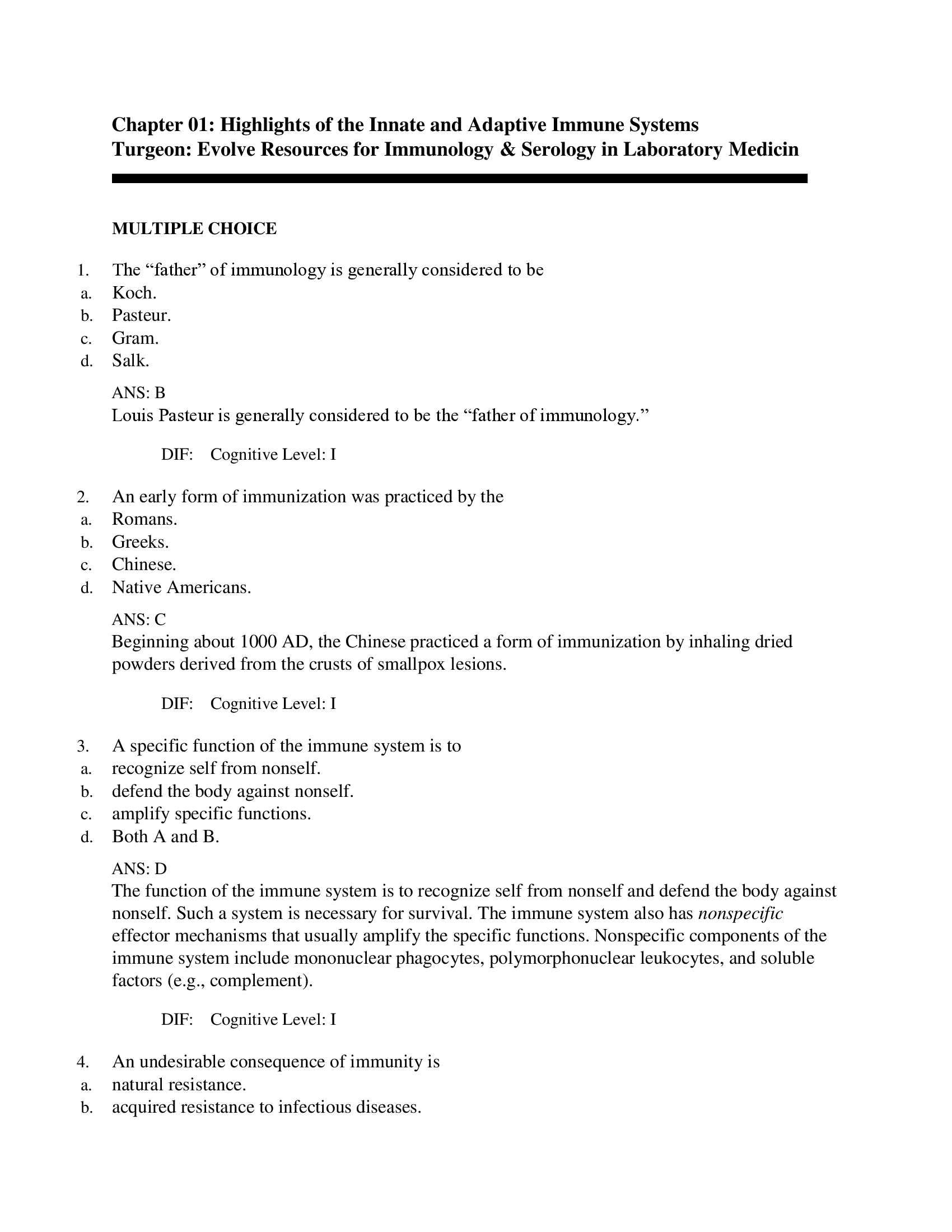
Chapter 01: An Overview of Immunology


MULTIPLE CHOICE


1.   The “father” of immunology is generally considered to be

a.    Koch.

b.    Pasteur.

c.    Gram.

d.    Salk.


ANS:  B

Louis Pasteur is generally considered to be the “father of immunology.”


DIF:   Cognitive Level: I                              REF:   p. 3


2.   An early form of immunization was practiced by the

a.    Romans. b.    Greeks. c.    Chinese.

d.    Native Americans.


ANS:  C

Beginning about 1000 AD, the Chinese practiced a form of immunization by inhaling dried powders derived from the crusts of smallpox lesions.


DIF:   Cognitive Level: I                              REF:   p. 2


3.   A specific function of the immune system is to

a.    recognize self from nonself.

b.    defend the body against nonself.

c.    amplify specific functions.

d.    Both A and B.


ANS:  D

The function of the immune system is to recognize self from nonself and defend the body against nonself. Such a system is necessary for survival. The immune system also has nonspecific effector mechanisms that usually amplify the specific functions. Nonspecific components of the immune system include mononuclear phagocytes, polymorphonuclear leukocytes, and soluble factors (e.g., complement).


DIF:   Cognitive Level: I                              REF:   p. 3


4.   An undesirable consequence of immunity is

a.    natural resistance.

b.    acquired resistance to infectious diseases.

c.    an autoimmune disorder.

d.    recovery from infectious disease.


ANS:  C

The desirable consequences of immunity include natural resistance, recovery, and acquired resistance to infectious disea ses. A deficiency or dysfunction of the immune system can cause many disorders. Undesirable consequences of immunity include allergy, rejection of a transplanted organ, or an autoimmune disorder.


DIF:   Cognitive Level: I                              REF:   p. 3


5.   The first line of defense against infection is a.       unbroken skin or mucous membranes. b.       phagocytosis.

c.    antibody production.

d.    antigen recognition.


ANS:  A

The first line of defense, or first barrier to infection, is unbroken skin and mucosal membrane surfaces.


DIF:   Cognitive Level: I                              REF:   p. 5


6.   If microorganisms penetrate the first line of defense, a second line of                                forms defense mechanisms that become operational.

a.    cellular components b.    humoral components c.    secretions

d.    Both A and B.


ANS:  D

If a microorganism penetrates the skin or mucosal membranes, a second line of cellular and humoral defense mechanisms becomes operational. Secretions are an important component in the first line of defense against microbial invasion.


DIF:   Cognitive Level: I                              REF:   p. 5


7.   A specific component of the adaptive immune system formed in response to antigenic stimulation is

a.    complement.

b.    immunoglobulin.

c.    increased secretion of mucus.

d.    enhanced phagocytosis.


ANS:  B

If specific antibodies have been formed to antigenic stimulation, they are available to protect the body against foreign substances. The recognition of foreign substances and subsequent production of antibodies to these substances defines immunity.


DIF:   Cognitive Level: I                              REF:   p. 7


8.   Acquired immunity can result from

a.    vaccination by injection of an antigen.

b.    contracting a disease.

c.    genetic inheritance.

d.    Both A and B.


ANS:  D

Antibody-mediated immunity to infection can be acquired if the antibodies are formed by the host or if they are received from another source; these two types of acquired immunity are called active immunity and passive immunity, respectively.


DIF:   Cognitive Level: I                              REF:   p. 7


9.   A child who contracts a contagious disease from an older sibling could develop                                      immunity against the disease.

a.    natural active

b.    artificial active

c.    natural passive

d.    artificial passive


ANS:  A

Active immunity can be acquired by natural exposure in response to an infection or natural series of infections, or thro ugh intentional injection of an antigen.


DIF:   Cognitive Level: II                             REF:   p. 7


10.   Preschool children who are vaccinated against specific microorganisms would be expected to develop                                                                                                                                                                  

immunity against those microorganisms.

a.    natural active

b.    artificial active

c.    natural passive

d.    artificial passive


ANS:  B

Vaccination is an effective artificial method of stimulating antibody production and memory (acquired resistance) without contracting the disease.


DIF:   Cognitive Level: I                              REF:   p. 7


11.   Artificial passive immunity is achieved by

a.    vaccination.

b.    contracting a disease.

c.    infusion or injection of preformed specific antibody.

d.    transfer in vivo.


ANS:  C

Artificial passive immunity is achieved by infusion of serum or plasma containing high concentrations of antibody or lymphocytes from an actively immunized individual. Passive immunity via preformed antibodies in serum provides immediate, temporary antibody protection against microorganisms (e.g., hepatitis A) by administering preformed antibodies.


DIF:   Cognitive Level: I                              REF:   p. 7


12.   Cell-mediated immunity is moderated by

a.    B lymphocytes.

b.    T lymphocytes.

c.    monocytes-macrophages.

d.    Both B and C.


ANS:  D

Cell-mediated immunity is moderated by the link between T lymphocytes and phagocytic cells (i.e., monocytes-macrophages).


DIF:   Cognitive Level: I                              REF:   p. 9


13.   B lymphocytes respond to

a.    antigens presented on the surface of an antigen-presenting cell.

b.    antigens on microorganisms or other living cells.

c.    native antigenic determinants of appropriate fit.

d.    antigens floating in body fluids.


ANS:  C

The B type of lymphocyte can probably respond to a native antigenic determinant of the appropriate “fit.”


DIF:   Cognitive Level: I                              REF:   p. 9


14.   T lymphocytes respond to

a.    antigens presented on the surface of an antigen-presenting cell.

b.    antigens on microorganisms or other living cells.

c.    native antigenic determinants of appropriate fit.

d.    antigens floating in body fluids.


ANS:  A

The T type of lymphocyte responds to antigens presented by other cells in the context of major histocompatibility complex (MHC)

proteins.


DIF:   Cognitive Level: I                              REF:   p. 9


15.   Cytokines

a.    are produced by lymphocytes.

b.    act on various elements of the immune system.

c.    are molecular structures.

d.    All of the above.


ANS:  D

Lymphocytes are immunologically active through various types of direct cell-to-cell contact and by the production of sol uble factors. Nonspecific soluble factors are made by, or act on, various elements of the immune system. These molecules are collectively called cytokines.


DIF:   Cognitive Level: I                              REF:   p. 10


16.   Another name for Toll-like receptors is

a.    genome.

b.    pathogen-associated molecular patterns (PAMPs).

c.    pattern-recognition receptors.

d.    complement.


ANS:  C

The number of genes encoded in an organism is called its genome. The innate immune response may not be able to recognize every possible antigen, but rather may focus on a few large groups of microorganisms, called pathogen-associated molecular patterns (PAMPs). The receptors of the innate immune system that recognize these PAMPs are called pattern recognition receptors ( e.g., Toll-like receptors).


DIF:   Cognitive Level: I                              REF:   p. 10


17.   The innate immune system is

a.    the most ancient form of host defense.

b.    divided into two components, each with a different function.

c.    mediated by germline-encoded receptors.

d.    Both A and C.


ANS:  D

The innate immune system is an ancient form of host defense that appeared before the adaptive immune system. Some form of innate immunity probably exists in all multicellular organisms. Innate immune recognition is mediated by germline-encoded receptors, which means that the specificity of each receptor is genetically predetermined. Germline-encoded receptors ev olved by natural selection to have defined specificities for infectious microorganisms.


DIF:   Cognitive Level: II                             REF:   p. 10


18.   Mechanisms of innate immunity

a.    are activated immediately after infection.

b.    quickly begin to control multiplication.

c.    are organized around T and B lymphocytes.

d.    Both A and B.


ANS:  D

Mechanisms of innate immunity (e.g., phagocytes) and the alternate complement pathways are activated immediately after infection and quickly begin to control the multiplication of infecting microorganisms.


DIF:   Cognitive Level: II                             REF:   p. 10


19.   Characteristics of clonal selection include

a.    antigen binding to a unique antigen receptor site.

b.    activation of antigen-bound lymphocytes.

c.    proliferation of antigen-bound lymphocytes.

d.    All of the above.


ANS:  D

The adaptive immune system is organized around two classes of cells, T and B lymphocytes. When an individual lymphocyte encounters an antigen that binds to its unique antigen receptor site, activation and proliferation of that lymphocyte oc cur. This is called clonal selection and is responsible for the basic properties of the adaptive immune system.


DIF:   Cognitive Level: II                             REF:   p. 10 | p. 11


TRUE/FALSE


1.   Immunology is defined as the study of molecules, cells, organs, and systems.


ANS:  T

Immunology is defined as the study of the molecules, cells, organs, and systems responsible for the recognition and disposal of foreign (nonself) material, how body components respond and interact, the desirable and undesirable consequences of immune interactions, and the ways in which the immune system can be advantageously manipulated to protect against or treat disease. Immunologists in the Western Hemisphere generally exclude the relationship among cells during embryonic development from the study of immunology.


DIF:   Cognitive Level: I                              REF:   p. 3


2.   Immunology is defined as the system responsible for the recognition and disposal of foreign (nonself) material.


ANS:  T

Immunology is defined as the study of the molecules, cells, organs, and systems responsible for the recognition and disposal of foreign (nonself) material, how body components respond and interact, the desirable and undesirable consequences of immune interactions, and the ways in which the immune system can be advantageously manipulated to protect against or treat disease. Immunologists in the Western Hemisphere generally exclude the relationship among cells during embryonic development from the study of immunology.


DIF:   Cognitive Level: I                              REF:   p. 3


3.   Immunology is defined as the desirable and undesirable consequences of immune interactions.


ANS:  T

Immunology is defined as the study of the molecules, cells, organs, and systems responsible for the recognition and disposal of foreign (nonself) material, how body components respond and interact, the desirable and undesirable consequences of immune interactions, and the ways in which the immune system can be advantageously manipulated to protect against or treat disease. Immunologists in the Western Hemisphere generally exclude the relationship among cells during embryonic development from the study of immunology.


DIF:   Cognitive Level: I                              REF:   p. 3


4.   Immunology is defined as the relationship among cells during embryonic development.


ANS:  F

Immunology is defined as the study of the molecules, cells, organs, and systems responsible for the recognition and disposal of foreign (nonself) material, how body components respond and interact, the desirable and undesirable consequences of immune interactions, and the ways in which the immune system can be advantageously manipulated to protect against or treat disease. Immunologists in the Western Hemisphere generally exclude the relationship among cells during embryonic development from the study of immunology.


DIF:   Cognitive Level: I                              REF:   p. 3


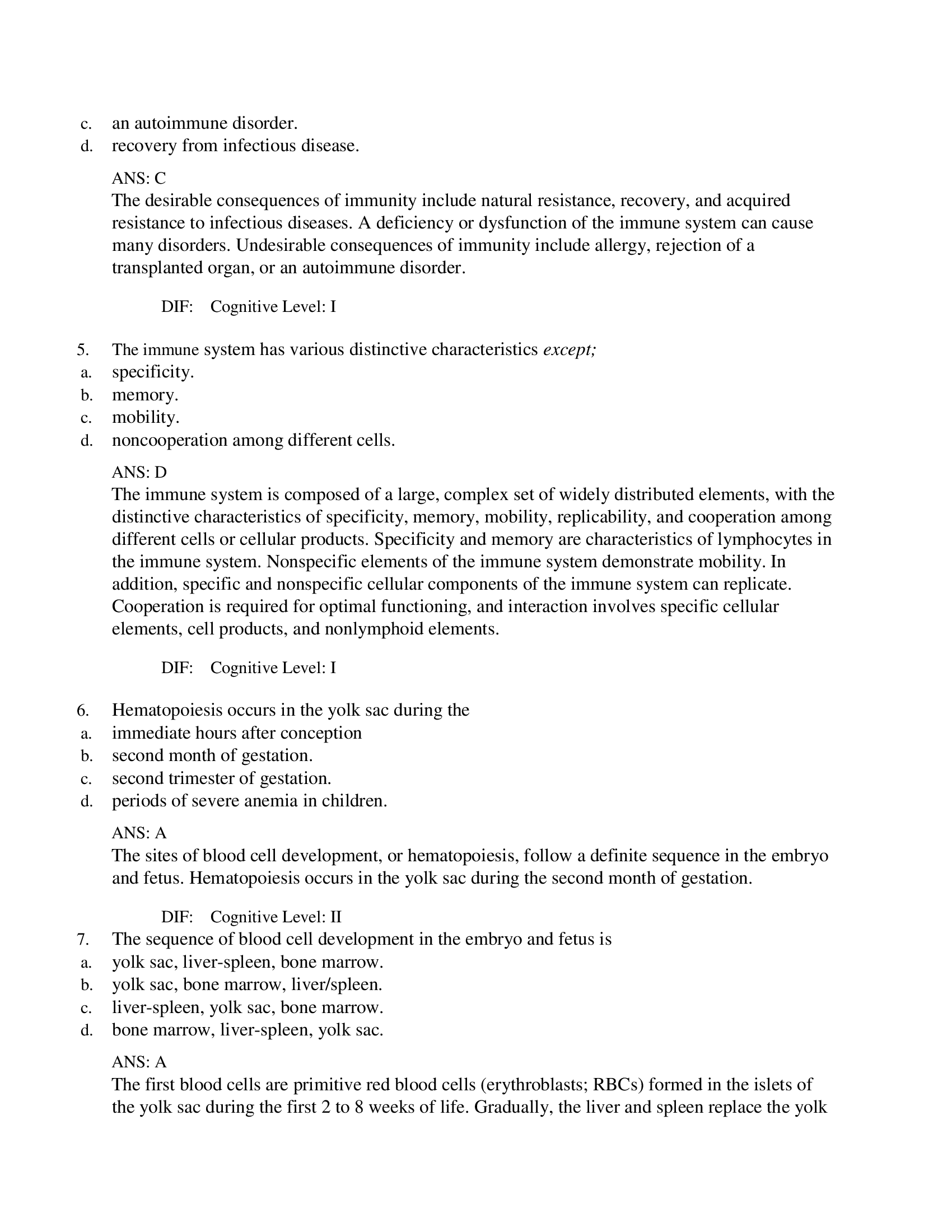
5.   The immune system has distinctive characteristics, such as specificity.


ANS:  T

The immune system is composed of a large, complex set of widely distributed elements, with the distinctive characteristics of specificity, memory, mobility, replicability, and cooperation among different cells or cellular products. Specificity and memory are characteristics of lymphocytes in the immune system. Nonspecific elements of the immune system demonstrate mobility. In addition, specific and nonspecific cellular components of the immune system can replicate. Cooperation is required for optimal functioning, and interaction involves specific cellular elements, cell products, and nonlymphoid elements.


DIF:   Cognitive Level: I                              REF:   p. 3


6.   The immune system has distinctive characteristics, such as memory.


ANS:  T

The immune system is composed of a large, complex set of widely distributed elements, with the distinctive characteristics of specificity, memory, mobility, replicability, and cooperation among different cells or cellular products. Specificity and memory are characteristics of lymphocytes in the immune system. Nonspecific elements of the immune system demonstrate mobility. In addition, specific and nonspecific cellular components of the immune system can replicate. Cooperation is required for optimal functioning, and interaction involves specific cellular elements, cell products, and nonlymphoid elements.


DIF:   Cognitive Level: I                              REF:   p. 3


7.   The immune system has distinctive characteristics, such as immobility.


ANS:  F

The immune system is composed of a large, complex set of widely distributed elements, with the distinctive characteristics of specificity, memory, mobility, replicability, and cooperation among different cells or cellular products. Specificity and memory are characteristics of lymphocytes in the immune system. Nonspecific elements of the immune system demonstrate mobility. In addition, specific and nonspecific cellular components of the immune system can replicate. Cooperation is required for optimal functioning, and interaction involves specific cellular elements, cell products, and nonlymphoid elements.


DIF:   Cognitive Level: I                              REF:   p. 3


8.   The immune system has distinctive characteristics, such as noncooperation among different cells or cellular products.


ANS:  F

The immune system is composed of a large, complex set of widely distributed elements, with the distinctive characteristics of specificity, memory, mobility, replicability, and cooperation among different cells or cellular products. Specificity and memory are characteristics of lymphocytes in the immune system. Nonspecific elements of the immune system demonstrate mobility. In addition, specific and nonspecific cellular components of the immune system can replicate. Cooperation is required for optimal functioning, and interaction involves specific cellular elements, cell products, and nonlymphoid elements.


DIF:   Cognitive Level: I                              REF:   p. 3

Contact the Seller

Please Sign In to contact this seller.


  • 👎  Report Copyright Violation

Frequently Asked Questions

What Do I Get When I Buy This Study Material?

+

When you buy a study material on Passing Grades, an instant download link will be sent directly to your email, giving you access to the file anytime after payment is completed.

Is Passing Grades a Trusted Platform?

+

Yes, Passing Grades is a reputable students’ marketplace with a secure payment system and reliable customer support. You can trust us to ensure a safe and seamless transaction experience.

Will I Be Stuck with a Subscription?

+

No, all purchases on Passing Grades are one-time transactions. You only pay for the notes you choose to buy, with no subscriptions or hidden fees attached.

Who Am I Buying These Study Materials From?

+

Passing Grades is a marketplace, which means you are purchasing the document from an individual vendor, not directly from us. We facilitate the payment and delivery process between you and the vendor.

Does Passing Grades Offer Free Study Materials?

+

Yes, sellers on Passing Grades have uploaded numerous free test banks, exams, practice questions, and class notes that can be downloaded at no cost.


Pasinggrades - Quality Study Materials

USD 15

    • Quality checked by Pasing Grades
    • 100% satisfaction guarantee
    • Seller: Gorski
Buy PDF $15

Seller Information

Gorski

Member since August 2021

  • icon
  • icon
View Profile
  • total sales

    0
  • Favourites

    0
  • Comments

    0
    ( 0 Ratings )

Item Information

  • Uploaded

    16 September 2023

  • Updated

    29 September 2025

  • Category

    Nursing

  • Item Type

    exam

  • Tags

    Test Bank for Immunology and Serology in Laboratory Medicine 6th Edition by Turgeon

Related Exam Prep Guides by Gorski

Test Bank for Phillips’s Manual of I.V. Therapeutics; Evidence-Based Practice for Infusion Therapy 7th Edition Lisa Gorski
View Document

Test Bank for Philli...

  • Gorski

    Gorski

  • exam

Test Bank for Phillips’s Manual of I.V. Therapeutics; Evidence-Based Practice for Infusion Therapy...

15 USD

0

0

Test Bank for Phillips’s Manual of I.V. Therapeutics; Evidence-Based Practice for Infusion Therapy 6th Edition Lisa Gorski
View Document

Test Bank for Philli...

  • Gorski

    Gorski

  • exam

Test Bank for Phillips’s Manual of I.V. Therapeutics; Evidence-Based Practice for Infusion Therapy...

15 USD

0

0

Module 1 Exam HESI Saunders Online Review for the NCLEX-RN Examination 2 Year, 2nd Edition
View Document

Module 1 Exam HESI S...

  • Gorski

    Gorski

  • exam

Module 1 Exam HESI Saunders Online Review for the NCLEX-RN Examination 2 Year, 2nd Edition...

15 USD

0

0

Purchase

Download link will be sent to this email immediately after purchase.

IMPORTANT LINKS

  • How To Upload Class Notes
  • Selling Tips
  • Passing Grades's Study Materials
  • Scholarships for International Students 2025

POPULAR CATEGORIES

  • Law
  • Accounting
  • English
  • Psychology
  • Business
  • Nursing
  • Computer Science
  • General

View Document

  • Blog
  • Contact
  • Delivery Policy
  • Latest Scholarships Around the World
  • How to Pass Bar Exams: Passing Grades’ Strategies
  • How to Study and Pass the CPA Exam
  • All Test Banks
  • Faq
  • Copyright Claims
  • Privacy Policy
  • Terms of Use

KNOWLEDGE BASE

  • How to Write A+ Grade Good Research Paper
  • How to Manage Stress During Exam Period
  • Best Time to Study
  • How to Pass NCLEX-RN Exam
  • How To Effectively Utilize Test Banks
  • Popular Shadow Health Exam Assessments
  • Popular HESI Case Studies
  • How to Prepare for a Nursing Career
  • The Importance Of Summaries in Exam Revisvion

© 2026 Pasing Grades. All rights reserved.