Pasing Grades
  • Start Selling
  • Blog
  • Contact
  • 0

    Your cart is empty!

English

  • English
  • Spanish
  • Arabic
Create Account Sign In
  • Library
    • New Prep Guides
    • Featured Prep Guides
    • Free Exam Prep Guides
    • Best sellers
  • General
  • Nursing
    • Research Paper
    • Case Study
    • Discussion Post
    • Assignment
    • Exam
    • Practice Questions and Answers
    • Test Bank
    • solutions manual
  • Accounting
    • Case Study
    • Thesis
    • Study Guide
    • Summary
    • Research Paper
    • test bank
  • English
    • Creative Writing
    • Research Paper
    • Summary
    • Rhetorics
    • Literature
    • Journal
    • Exam
    • Grammar
    • Discussion Post
    • Essay
  • Psychology
    • Hesi
    • Presentation
    • Essay
    • Summary
    • Study Guide
    • Essay
    • Solution Manual
    • Final Exam Review
    • Class Notes
    • test bank
  • Business
    • Lecture Notes
    • Solution Manual
    • Presentation
    • Business Plan
    • Class Notes
    • Experiment
    • Summary
    • Practice Questions
    • Study Guide
    • Case Study
    • test bank
    • Exam
  • More
    • Computer Science
    • Economics
    • Statistics
    • Engineering
    • Biology
    • Religious Studies
    • Physics
    • Chemistry
    • Mathematics
    • History
    • Sociology
    • Science
    • Philosophy
    • Law
  • Pages
    • About Us
    • Selling Tips
    • Delivery Policy
    • Faq
    • Privacy Policy
  • Flash Sale
  • Home
  • Test Bank for Health Promotion Throughout the Life Span 9th Edition by Edelman

Test Bank for Health Promotion Throughout the Life Span 9th Edition by Edelman

Preview page 1 Preview page 2 Preview page 3
Add To Favorites

Share this item Share this item

  • Item Details
  • Comments (0)
  • Reviews (0)
  • Contact Seller

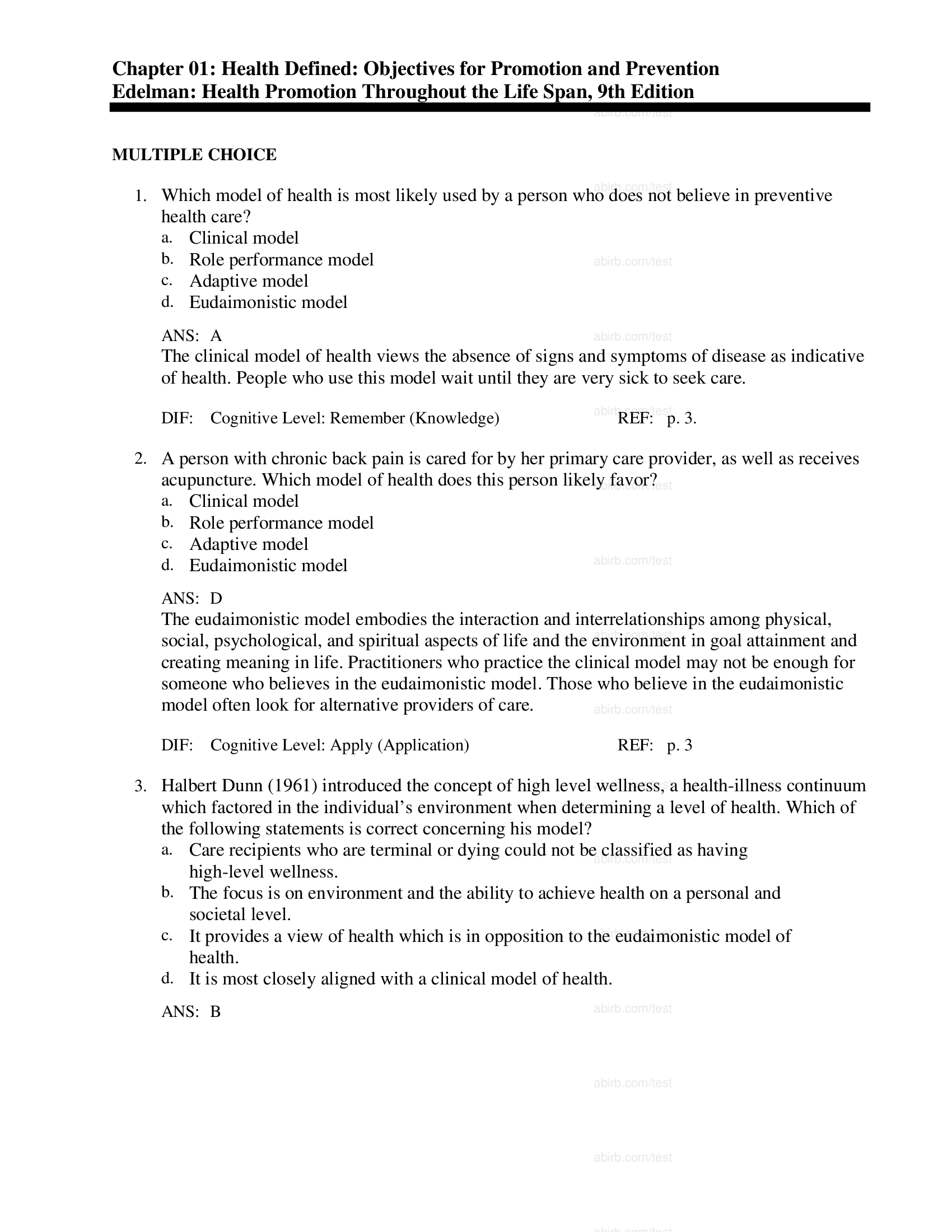
Chapter 01: Health Defined: Objectives for Promotion and Prevention Edelman: Health Promotion Throughout the Life Span, 9th Edition

MULTIPLE CHOICE

1. Which model of health is most likely used by a person whaobidrbo.ceosmn/teostt believe in preventive health care?

a. Clinical model


b. Role performance model

c. Adaptive model

d. Eudaimonistic model

ANS: A


The clinical model of health views the absence of signs and symptoms of disease as indicative of health. People who use this model wait until they are very sick to seek care.


DIF: Cognitive Level: Remember (Knowledge)


abirbR.cEomF/:tespt . 3.


2. A person with chronic back pain is cared for by her primary care provider, as well as receives acupuncture. Which model of health does this person likelaybifrba.vcoomr/?test

a. Clinical model

b. Role performance model

c. Adaptive model


d. Eudaimonistic model

ANS: D

The eudaimonistic model embodies the interaction and interrelationships among physical, social, psychological, and spiritual aspects of life and the eanbivrbi.rcoomn/mtesetnt in goal attainment and creating meaning in life. Practitioners who practice the clinical model may not be enough for someone who believes in the eudaimonistic model. Those who believe in the eudaimonistic


model often look for alternative providers of care.


DIF: Cognitive Level: Apply (Application) REF: p. 3


3. Halbert Dunn (1961) introduced the concept of high level awbierbl.lcnoems/tse,sta health-illness continuum which factored in the individual’s environment when determining a level of health. Which of the following statements is correct concerning his model?

a. Care recipients who are terminal or dying could not beabcilrba.scsoimf/iteesdt as having high-level wellness.

b. The focus is on environment and the ability to achieve health on a personal and societal level.

c. It provides a view of health which is in opposition to thabeirbe.ucodma/itemstonistic model of health.

d. It is most closely aligned with a clinical model of health.


ANS: B


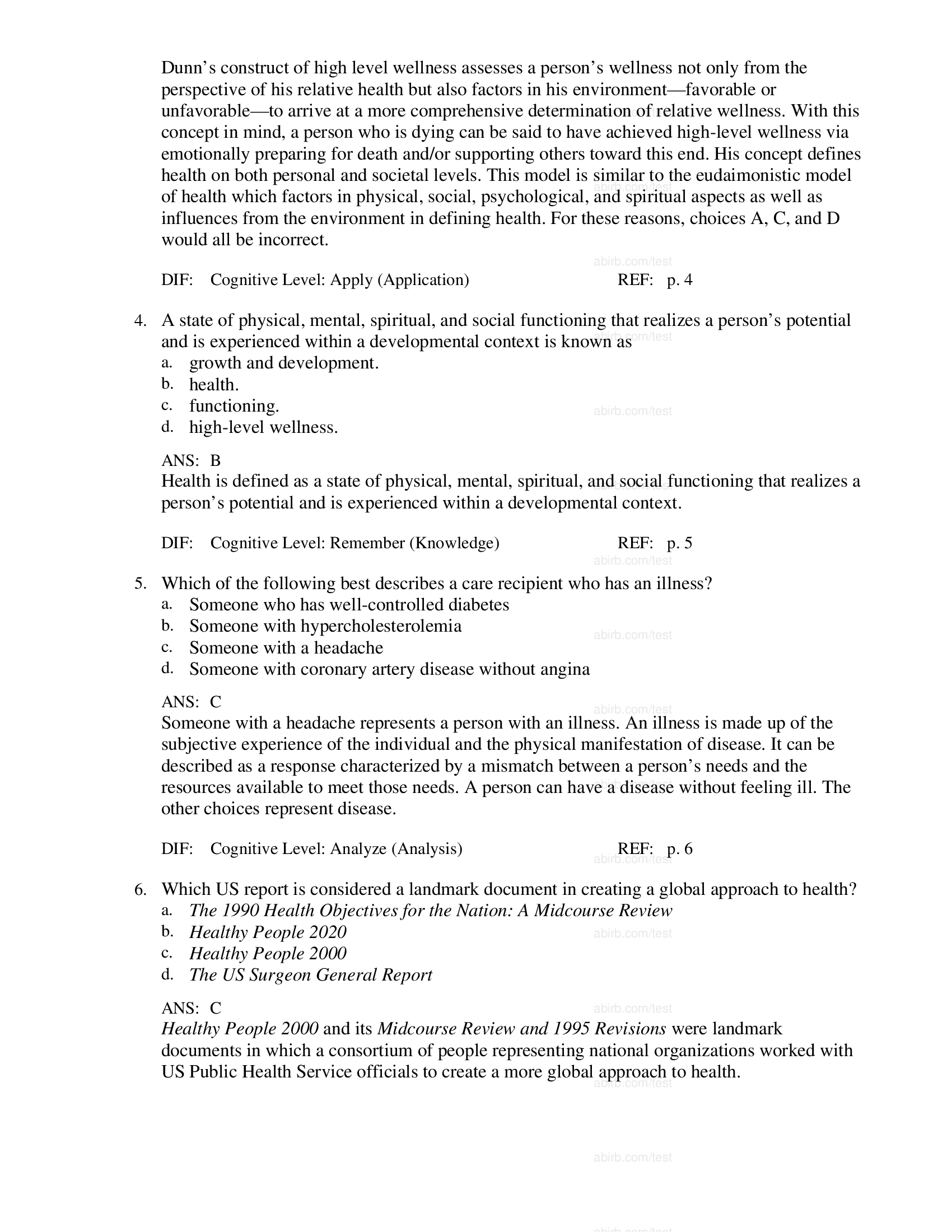
Dunn’s construct of high level wellness assesses a person’s wellness not only from the perspective of his relative health but also factors in his environment—favorable or unfavorable—to arrive at a more comprehensive determinaabtiirob.ncoomf/tersetlative wellness. With this concept in mind, a person who is dying can be said to have achieved high-level wellness via emotionally preparing for death and/or supporting others toward this end. His concept defines health on both personal and societal levels. This model is similar to the eudaimonistic model of health which factors in physical, social, psychological, aabnirdb.csopmir/tietsutal aspects as well as influences from the environment in defining health. For these reasons, choices A, C, and D would all be incorrect.


DIF: Cognitive Level: Apply (Application) REF: p. 4


4. A state of physical, mental, spiritual, and social functioning that realizes a person’s potential and is experienced within a developmental context is knowabnirba.scom/test

a. growth and development.

b. health.


c. functioning.

d. high-level wellness.

ANS: B


Health is defined as a state of physical, mental, spiritual, aanbdirbs.coocmi/atelsft unctioning that realizes a person’s potential and is experienced within a developmental context.


DIF: Cognitive Level: Remember (Knowledge) REF: p. 5


5. Which of the following best describes a care recipient who has an illness?

a. Someone who has well-controlled diabetes


b. Someone with hypercholesterolemia

c. Someone with a headache

d. Someone with coronary artery disease without angina

ANS: C


Someone with a headache represents a person with an illness. An illness is made up of the subjective experience of the individual and the physical manifestation of disease. It can be described as a response characterized by a mismatch between a person’s needs and the resources available to meet those needs. A person can havaebairbd.ciosme/atesset  without feeling ill. The other choices represent disease.


DIF: Cognitive Level: Analyze (Analysis) REF: p. 6


6. Which US report is considered a landmark document in creating a global approach to health?

a. The 1990 Health Objectives for the Nation: A Midcourse Review


b. Healthy People 2020

c. Healthy People 2000

d. The US Surgeon General Report

ANS: C


Healthy People 2000 and its Midcourse Review and 1995 Revisions were landmark documents in which a consortium of people representing national organizations worked with US Public Health Service officials to create a more global approach to health.


DIF: Cognitive Level: Remember (Knowledge) REF: p. 6


7. Which of the following is one of the four overreaching goaablsirbf.ocormH/teesat lthy People 2020 (US Department of Health and Human Services)?

a. Decreased tobacco use in youth throughout the nation

b. Achieve health equality and eliminate disparity for all groups


c. Increased public funding for health insurance

d. Decreased hospital re-admission rates

ANS: B


Healthy people 2020 has four overarching goals to includeabtihrbe.cfooml/lteoswt ing: 1. attain high quality, longer lives free of preventable disease, disability, injury, and premature death. 2. Achieve health equality, eliminate disparities, and improve the health of all groups. 3. Create social and physical environments that promote good healthabfirobr.coamll/.te4st. Promote quality of life, healthy development, and healthy behaviors across all life stages. Choices A, C, and D are possible strategies to achieve the state goals but they do not reflect the actual published overarching goals.


DIF: Cognitive Level: Remember (Knowledge) REF: p. 7


8. Which of the following statements accurately reflect primoabridrbi.aclomp/rteesvt ention?

a. It concerns interventions directed at the fetus while in utero to assure lifelong

health.

b. It is a more modern term used interchangeably with primary prevention.

c. It is a health-promotion strategy which reflects policy-albeivrbe.cloimn/tteesrtventions.

d. It refers administering vaccines to prevent individuals from developing the disease.

ANS: C

Primordial prevention is a fairly new concept which has beabeinrb.acodmd/etedstto the more traditional modalities of primary, secondary, and tertiary prevention. Primordial refers to the time frame before a risk factor develops and before disease occurs. Primordial prevention reflects

policy-level interventions which will serve to prevent diseaabsierb..cSoumc/thespt  revention is typically implemented at the “national, state, or community” levels. Examples of primordial prevention would be state regulations which mandate healthy food for school-based lunch programs or regulations which call for the elimination of trans fats in commercial foods. By contrast, primary prevention are those interventions which are direcatbeirdb.caotmt/hteestindividual in the interest of preventing disease. Vaccinating an individual against disease would be an example of primary prevention as would be education and interventions (exercise, low fat, avoiding excess salt) aimed at preventing cardiovascular disease befaobirrbe.ciotmo/tcecsturs.

DIF: Cognitive Level: Remember (Knowledge) REF:   p. 9


9. Which of the following represents a method of primary preabvirebn.ctoimo/nte?st

a. Informational session about healthy lifestyles

b. Blood pressure screening


c. Interventional cardiac catheterization

d. Diagnostic cardiac catheterization

ANS: A


Primary prevention precedes disease or dysfunction. It includes health promotion and specific protection and encourages increased awareness; thus, education about healthy lifestyles fits this definition. Blood pressure screening does not prevent adbiirsbe.caosme/,tebstut instead identifies it.


DIF: Cognitive Level: Apply (Application) REF: p. 11


10. Which of the following represents a method of secondary apbrierbv.ceonmt/iteosnt ?

a. Self-breast examination education

b. Yearly mammograms


c. Chemotherapy for advanced breast cancer

d. Complete mastectomy for breast cancer

ANS: B


Screening is secondary prevention because the principal gaobairlbo.cfoms/ctersetenings is to identify individuals in an early, detectable stage of the disease process. A mammogram is a screening tool for breast cancer and thus is considered a method of secondary prevention.


DIF: Cognitive Level: Apply (Application)


abirbR.cEomF/:tespt . 13


11. Which of the following represents a method of tertiary prevention?


a. Drunk driving campaign

b. Road blocks for drunk driving


c. Emergency surgery for head trauma after a motor vehicle accident

d. Physical and occupational therapy after a motor vehicle accident with head trauma


ANS: D

Physical therapy and occupational therapy are considered tertiary prevention. Tertiary prevention occurs when a defect or disability is permanent and irreversible. It involves minimizing the effect of disease and disability. The objectaivbierb.ocofmte/tertsitary prevention is to maximize remaining capacities.


DIF: Cognitive Level: Apply (Application) REF: p. 13


12. In reviewing a person’s medical claims, a nurse realizes that the individual with moderate persistent asthma has had several emergency department visits and is not on inhaled steroids

as recommended by the NHLBI asthma management guidaebliirnb.ecsom. T/tehset   nurse discusses this with

the person’s primary care provider. In this scenario, the nurse is acting as a(n)

a. advocate.

b. care manager.


c. consultant.

d. educator.

ANS: B


Care managers act to prevent duplication of service and readbuircb.ecocmo/tsets.t Care managers base recommendation on reliable data sources such as evidence-based practices and protocols.


DIF: Cognitive Level: Apply (Application)


abirbR.cEomF/:tespt . 14


13. During a home visit, a nurse assists an individual to complete an application for disability services. The nurse is acting as a(n)


a. advocate.

b. care manager.


c. consultant.

d. educator.

ANS: A


The advocacy role of the nurse helps individuals obtain what they are entitled to receive from the health care system, tries to make the system more responsive to individuals’ community needs, and assists individuals in developing skills to advocaabtireb.cfoomr /ttehset mselves.


DIF: Cognitive Level: Apply (Application) REF: p. 13


14. During a home visit, a nurse discusses the dangers of smokabinirbg.cwomi/tthesat n individual. In this scenario the nurse is acting as a(n)

a. advocate.


b. care manager.

c. consultant.

d. educator.

ANS: D


Health education is a primary prevention technique available to avoid major causes of disease. Teaching can range from a chance remark to a planned lesson.


DIF: Cognitive Level: Apply (Application)


abirbR.cEomF/:tespt . 14


15. A nurse is asked to provide an expert opinion about the development of an education program for newly diagnosed diabetics. In this scenario, the nurse iasbairbc.tcionmg/teasst  a(n)

a. advocate.

b. care manager.

c. consultant.


d. educator.

ANS: C


Nurses with a specialized area of expertise provide education about health promotion and disease prevention to individuals and groups as consultantasb.irb.com/test


DIF: Cognitive Level: Apply (Application) REF: p. 14


16. A nurse is planning to deliver an educational program to inabdiribv.cidomu/atelsst with diabetes. Which of the following should be the initial action taken by the nurse to ensure the success of the program?


a. Assess the motivation level of the individuals

b. Assess the knowledge level of the individuals

c. Establish teacher–learner goals with the individuals


d. Establish multiple teaching sessions with the individuals


ANS: C

Selection of the methods most likely to succeed involves the establishment of teacher–learner goals. Thus, the first step by the nurse should be establishment of goals.


DIF: Cognitive Level: Analyze (Analysis) REF: p. 14


17. The conscientious, explicit, and judicious use of current beasbitrbe.cvoimd/etensct e in making decisions about the care of individuals is known as


a. health-related quality of life.

b. evidence-based practice.

c. a Healthy People 2020 goal.

d. the ecological model of health.

ANS: B


Evidence-based practice is defined as the conscientious, exabpirlbic.ciotm, /atensdt

best evidence in making decisions about the care of individuals.


judicious use of current


DIF: Cognitive Level: Remember (Knowledge) REF: p. 14


18. Which research methodology should be used to address the question, “What is the difference in the infection rates between individuals who receive twice-a-day dressing changes versus


once-a-day dressing changes?”

a. Evidence-based practice research

b. Qualitative research

c. Quantitative research

d. Clinical judgment research

ANS: C


Quantitative research studies describe situations, correlate different variables related to care, or test causal relationships among variables related to carea.bEirbv.ciodme/ntecset -based practice research and clinical judgment research are not research methodologies; they are used to answer clinical questions.


DIF: Cognitive Level: Apply (Application) REF: p. 15


19. The question, “What is the experience of teenagers who lose a sibling to cancer?” can best be


answered by using which research methodology?

a. Evidence-based practice research

b. Qualitative research

c. Quantitative research

d. Clinical judgment research

ANS: B


Qualitative research studies describe phenomena or defineabthirbe.choims/tteosrtical nature, cultural relevance, or philosophical basis of aspects of nursing care. Evidence-based practice research and clinical judgment research are not research methodologies; they are used to answer

clinical questions.


DIF: Cognitive Level: Apply (Application) REF: p. 15


20. A nurse who uses findings from a randomized, controlled trial on the care of Foley catheters


to change practice at an institution is practicing

a. evidence-based medicine.

b. qualitative research.

c. quantitative research.

d. clinical judgment.

ANS: A


The practice of evidence-based medicine means integratinagbiirnb.dcoimvi/tdeustal clinical expertise with the best available external clinical evidence from systematic research.


DIF: Cognitive Level: Apply (Application) REF: p. 14


21. Which of the following is most influenced by the social and economic environment of a

community?

a. Social health policies


b. Quality of care

c. Evidence-based practice

d. Practice guidelines

ANS: A


Social policies concerning health are influenced by the social and economic environment of a population. Analysis of population trends and projections is necessary to help health


professionals determine changing needs.


DIF: Cognitive Level: Remember (Knowledge) REF: p. 15


22. A major cause of death in the early twentieth century was  

a. cancer.

b. cerebrovascular disease.


c. heart disease.

d. infections.

ANS: D


Infections and acute disease were the major causes of deatahbiirbn.ctohme/teesat rly part of the twentieth century.


DIF: Cognitive Level: Remember (Knowledge) REF: p. 16


23. Which of the following groups of people are likely to show an increase in numbers between the years 2010 to 2030?

a. Persons age 65 and older


b. Persons of White European descent

c. Infants due to rising birth rates

d. Population growth and character are unpredictable

ANS: A


By the year 2050, it is predicted that the majority of people in the United States will not be of White European descent (US Census Bureau, 2010a) addition to changes in the ethnic

and racial distribution within the population, the projectedacbihrba.cnogme/tsesitn age distribution will affect health-promotion practice. Considerable growth is expected in the proportion of the population that is 25 years of age and older. For example, the post-World War II baby boom will increase the number of persons in the 65-and-older age group between the years 2010 and 2030 (US Census Bureau, 2010b). …. there was a drop in abbiirrbt.hcosma/tfetsetr 1960.

DIF: Cognitive Level: Apply (Application) REF: p. 15


24. Which of the following demonstrates a nurse taking action to promote health and prevent

disease?

a. Making a home visit to a person who is recovering from a heart attack

b. Administering medications to a cardiac care recipient ianbirtbh.ceomh/otesspt ital

c. Providing cardiopulmonary resuscitation during a heart attack


d. Educating a person about the advantages of a heart-healthy diet during a home visit

ANS: D

Solutions for health promotion are focused on individual aanbdirbg.coomv/etersntment involvement. To promote health and wellness, an emphasis must be placed on primary prevention. This is often related to actions such as education that influence lifestyle choices. In the preceding example, educating a person about the advantages of a heart-healthyabdiribe.ctodmu/treisnt g a home visit serves to influence lifestyle choices.


DIF: Cognitive Level: Apply (Application) REF: p. 16


25. Which factor may have the most influence in changing the health behavior of a single, adult woman who smokes and is the care provider for her mother, her own children, and


granddaughter?

a. Education regarding effects of smoking on her health


b. The satisfaction that she will not contribute to secondhand smoke

c. The availability of a weekly support group

d. A gift card for $10 to a local grocery store for every waebeirkb.csohme/teisstsmoke free

ANS: D

Motivational factors play a role in influencing attitudinal changes. A financial incentive is an example of a motivating factor. For this woman, who is finabainrbc.cioamll/ytesrtesponsible for the health and well-being of other individuals, finances will likely play a significant role in motivating her actions. Remember that education regarding the benefits of not smoking is not enough.

Thus, the $10 gift card may have the most influence in chaanbigrbi.ncogmh/teesrt health behavior.


DIF: Cognitive Level: Analyze (Analysis) REF: p. 16


MULTIPLE RESPONSE


1. Which of the following “investment” themes has been identified by the National Institute of


Nursing Research? (Select all that apply.)

a. Interprofessional collaboration

b. Improving quality of life

c. End-of-life care

d. Increasing physical activity among Americans

ANS: B, C


The National Institute of Nursing Research has identified faibvireb.ctohme/mtesets that promote health and prevent disease, improve quality of life through symptom management, and support palliative

and end-of-life care, innovation, and nurse scientists.


DIF: Cognitive Level: Remember (Knowledge) abirbR.cEomF/:tespt . 14


2. Which interventions address both the National Institute of Nursing Research themes and the overall goals of the Healthy People 2020 leading health indicators? (Select all that apply.)


a. Establishing a new park with a well-lit track

b. Establishing a smoking cessation campaign


c. Providing reduced-cost transportation passes to senior citizens

d. Providing free condoms at all federally funded health calbiirnbi.ccosm/test


ANS: A, B, D

Establishing a new park with a well-lit track, establishing a smoking cessation campaign, and providing free condoms at all federally funded health cliniacbsirba.lclomad/tedsrtess the National Institute of Nursing Research themes and the Healthy People 2020 leading health indicators. A park, smoking cessation campaign, and free condoms address the themes of promoting health and preventing disease and the goal of increasing quality and years of healthy life. Providing reduced-cost transportation passes to senior citizens may ianbdiribr.ceocmtl/tyesat ffect the health of this population; however, it is not directly related to the themes of the National Institute of Research (promote health and prevent disease, improve quality of life through symptom management, and support palliative and end-of-life care, inabnirob.vcaomti/otens,t  and nurse scientists) or the overall goals of Healthy People 2020 (increase quality and years of healthy life and eliminate health disparities).


DIF: Cognitive Level: Analyze (Analysis)


abirbR.cEomF/:tespt . 14


Contact the Seller

Please Sign In to contact this seller.


  • 👎  Report Copyright Violation

Frequently Asked Questions

What Do I Get When I Buy This Study Material?

+

When you buy a study material on Passing Grades, an instant download link will be sent directly to your email, giving you access to the file anytime after payment is completed.

Is Passing Grades a Trusted Platform?

+

Yes, Passing Grades is a reputable students’ marketplace with a secure payment system and reliable customer support. You can trust us to ensure a safe and seamless transaction experience.

Will I Be Stuck with a Subscription?

+

No, all purchases on Passing Grades are one-time transactions. You only pay for the notes you choose to buy, with no subscriptions or hidden fees attached.

Who Am I Buying These Study Materials From?

+

Passing Grades is a marketplace, which means you are purchasing the document from an individual vendor, not directly from us. We facilitate the payment and delivery process between you and the vendor.

Does Passing Grades Offer Free Study Materials?

+

Yes, sellers on Passing Grades have uploaded numerous free test banks, exams, practice questions, and class notes that can be downloaded at no cost.


Pasinggrades - Quality Study Materials

USD 15

    • Quality checked by Pasing Grades
    • 100% satisfaction guarantee
    • Seller: mentor2000
Buy PDF $15

Seller Information

mentor2000

Member since April 2021

  • icon
  • icon
View Profile
  • total sales

    0
  • Favourites

    0
  • Comments

    0
    ( 0 Ratings )

Item Information

  • Uploaded

    22 May 2022

  • Updated

    24 October 2025

  • Category

    No category

  • Item Type

    test bank

  • Tags

    Test Bank for Health Promotion Throughout the Life Span 9th Edition by Edelman

Related Exam Prep Guides by mentor2000

Test Bank for Essentials for Nursing Practice 8th Edition by Potter | All Chapters
View Document

Test Bank for Essent...

  • mentor2000

    mentor2000

  • test bank

Master nursing concepts with this study material; Test Bank for Essentials for Nursing Practice, 8th...

15 USD

0

0

A &P 1 MA278 BSC2 Final Module II Questions & Answers 2026 Update
View Document

A &P 1 MA278 BSC2 Fi...

  • mentor2000

    mentor2000

  • test bank

Prepare for success with A&P 1 MA278 BSC2 Final Module II 2024 Q&A. Boost your grades with this comp...

15 USD

0

0

ATI Comprehensive Predictor Exam 2026
View Document

ATI Comprehensive Pr...

  • mentor2000

    mentor2000

  • test bank

Prepare for success with the ATI Comprehensive Predictor Exam 2026. Access key practice questions to...

15 USD

0

0

Purchase

Download link will be sent to this email immediately after purchase.

IMPORTANT LINKS

  • How To Upload Class Notes
  • Selling Tips
  • Passing Grades's Study Materials
  • Scholarships for International Students 2025

POPULAR CATEGORIES

  • Law
  • Accounting
  • English
  • Psychology
  • Business
  • Nursing
  • Computer Science
  • General

View Document

  • Blog
  • Contact
  • Delivery Policy
  • Latest Scholarships Around the World
  • How to Pass Bar Exams: Passing Grades’ Strategies
  • How to Study and Pass the CPA Exam
  • All Test Banks
  • Faq
  • Copyright Claims
  • Privacy Policy
  • Terms of Use

KNOWLEDGE BASE

  • How to Write A+ Grade Good Research Paper
  • How to Manage Stress During Exam Period
  • Best Time to Study
  • How to Pass NCLEX-RN Exam
  • How To Effectively Utilize Test Banks
  • Popular Shadow Health Exam Assessments
  • Popular HESI Case Studies
  • How to Prepare for a Nursing Career
  • The Importance Of Summaries in Exam Revisvion

© 2026 Pasing Grades. All rights reserved.