Pasing Grades
  • Start Selling
  • Blog
  • Contact
  • 0

    Your cart is empty!

English

  • English
  • Spanish
  • Arabic
Create Account Sign In
  • Library
    • New Prep Guides
    • Featured Prep Guides
    • Free Exam Prep Guides
    • Best sellers
  • General
  • Nursing
    • Research Paper
    • Case Study
    • Discussion Post
    • Assignment
    • Exam
    • Practice Questions and Answers
    • Test Bank
    • solutions manual
  • Accounting
    • Case Study
    • Thesis
    • Study Guide
    • Summary
    • Research Paper
    • test bank
  • English
    • Creative Writing
    • Research Paper
    • Summary
    • Rhetorics
    • Literature
    • Journal
    • Exam
    • Grammar
    • Discussion Post
    • Essay
  • Psychology
    • Hesi
    • Presentation
    • Essay
    • Summary
    • Study Guide
    • Essay
    • Solution Manual
    • Final Exam Review
    • Class Notes
    • test bank
  • Business
    • Lecture Notes
    • Solution Manual
    • Presentation
    • Business Plan
    • Class Notes
    • Experiment
    • Summary
    • Practice Questions
    • Study Guide
    • Case Study
    • test bank
    • Exam
  • More
    • Computer Science
    • Economics
    • Statistics
    • Engineering
    • Biology
    • Religious Studies
    • Physics
    • Chemistry
    • Mathematics
    • History
    • Sociology
    • Science
    • Philosophy
    • Law
  • Pages
    • About Us
    • Selling Tips
    • Delivery Policy
    • Faq
    • Privacy Policy
  • Flash Sale
  • Home
  • Test Bank for Health Assessment and Physical Examination 2nd Australian and New Zealand Edition by Zastor Estes

Test Bank for Health Assessment and Physical Examination 2nd Australian and New Zealand Edition by Zastor Estes

Preview page 1 Preview page 2 Preview page 3
Add To Favorites

Share this item Share this item

  • Item Details
  • Comments (0)
  • Reviews (0)
  • Contact Seller

Test Bank for Health Assessment and Physical Examination 2nd Australian and New Zealand Edition by Zastor Estes

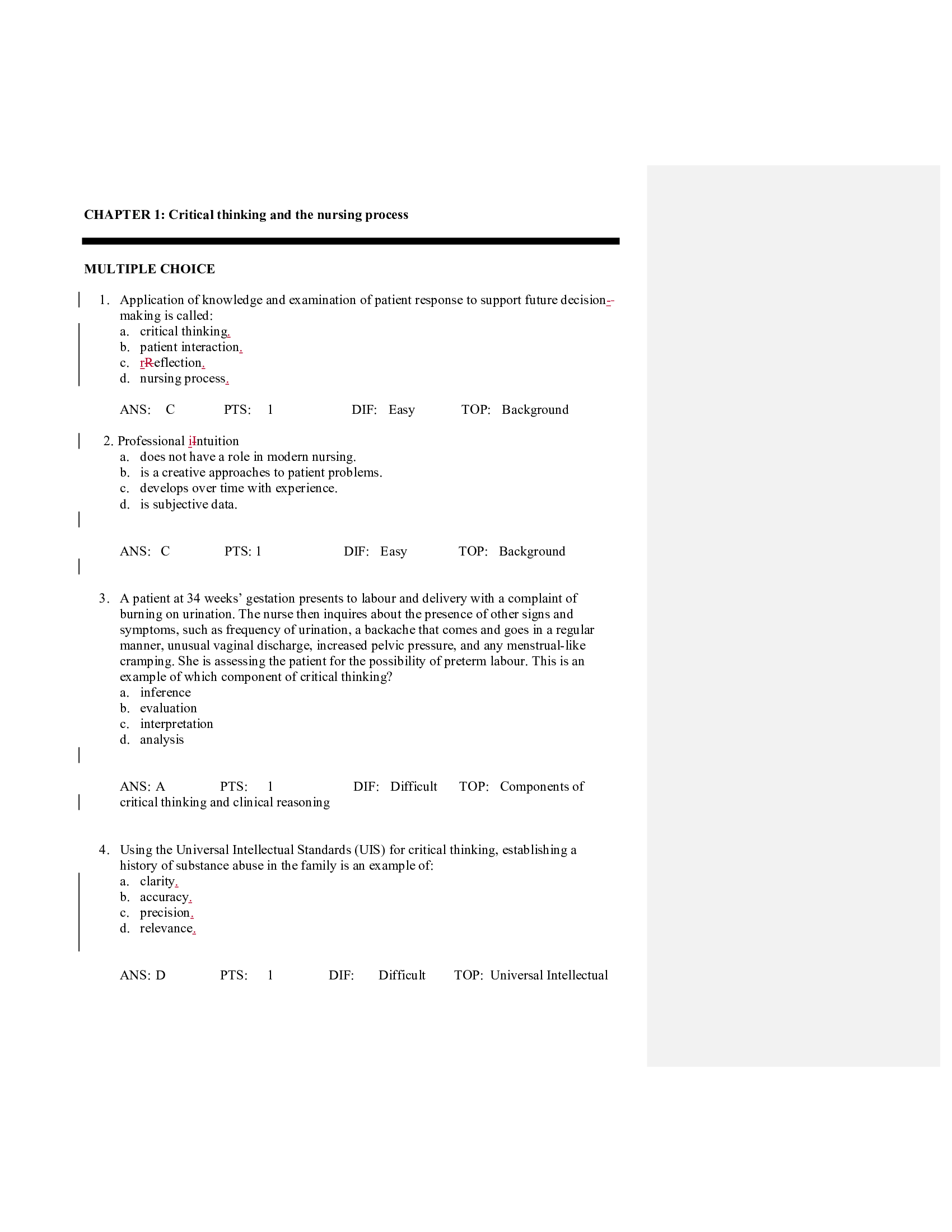
CHAPTER 1: Critical thinking and the nursing process

1.       Application of knowledge and examination of patient response to support future decision- making is called:

a.     critical thinking.

b.     patient interaction.

c.     rReflection.

d.     nursing process.


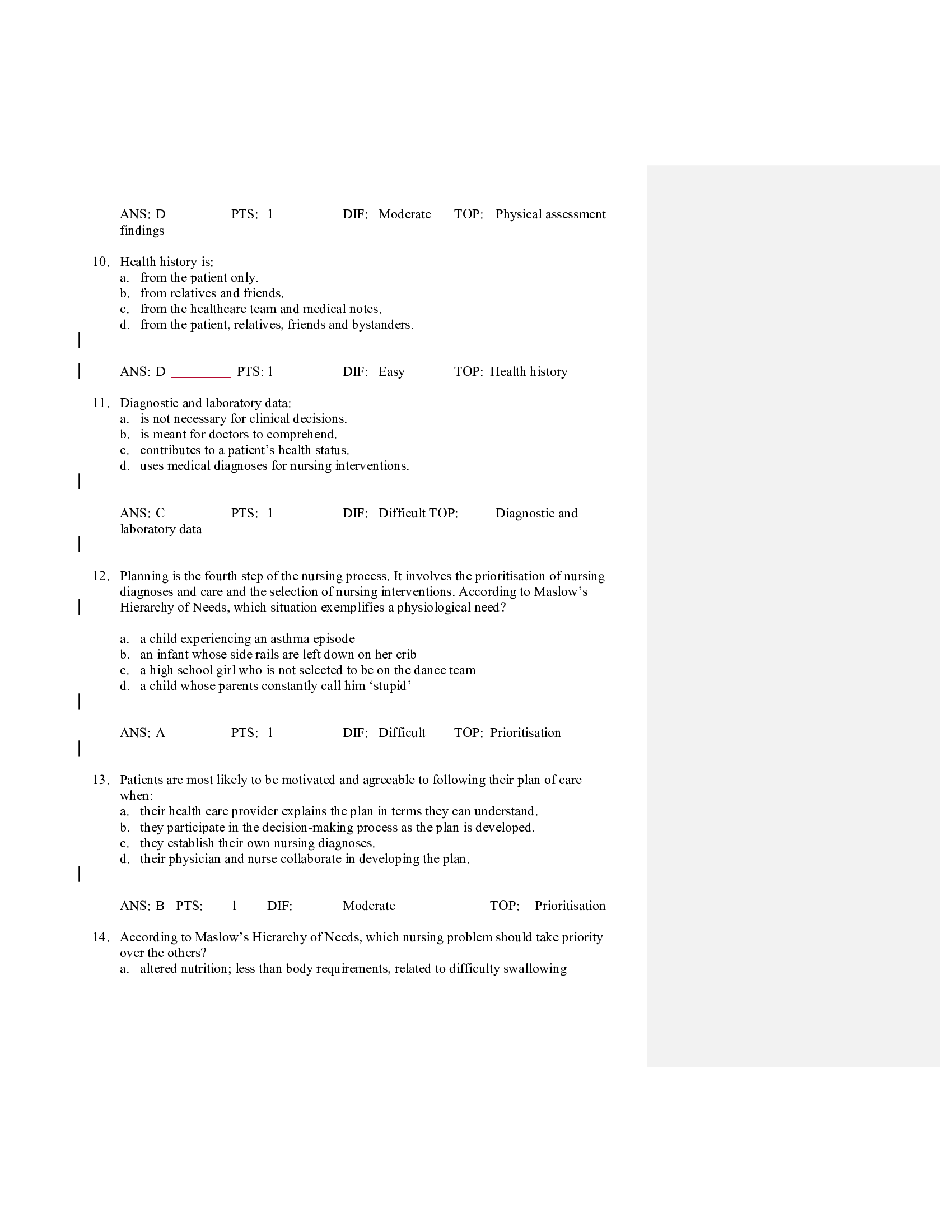
              ANS:  C         PTS:        1                     DIF:  Easy               TOP:  Background


2.       Professional iIntuition

a.     does not have a role in modern nursing.

b.     is a creative approaches to patient problems.

c.     develops over time with experience.

d.     is subjective data.


              ANS: C          PTS: 1                        DIF:  Easy                  TOP:  Background


3.       A patient at 34 weeks’ gestation presents to labour and delivery with a complaint of burning on urination. The nurse then inquires about the presence of other signs and symptoms, such as frequency of urination, a backache that comes and goes in a regular manner, unusual vaginal discharge, increased pelvic pressure, and any menstrual-like cramping. She is assessing the patient for the possibility of preterm labour. This is an example of which component of critical thinking? a. inference

b.     evaluation

c.     interpretation

d.     analysis


ANS: A          PTS:       1                DIF:  Difficult        TOP:  Components of critical thinking and clinical reasoning


4.       Using the Universal Intellectual Standards (UIS) for critical thinking, establishing a history of substance abuse in the family is an example of: a. clarity.

b.     accuracy.

c.     precision.

d.     relevance.


ANS: D          PTS:       1          DIF:            Difficult   TOP: Universal Intellectual Standards for critical thinking


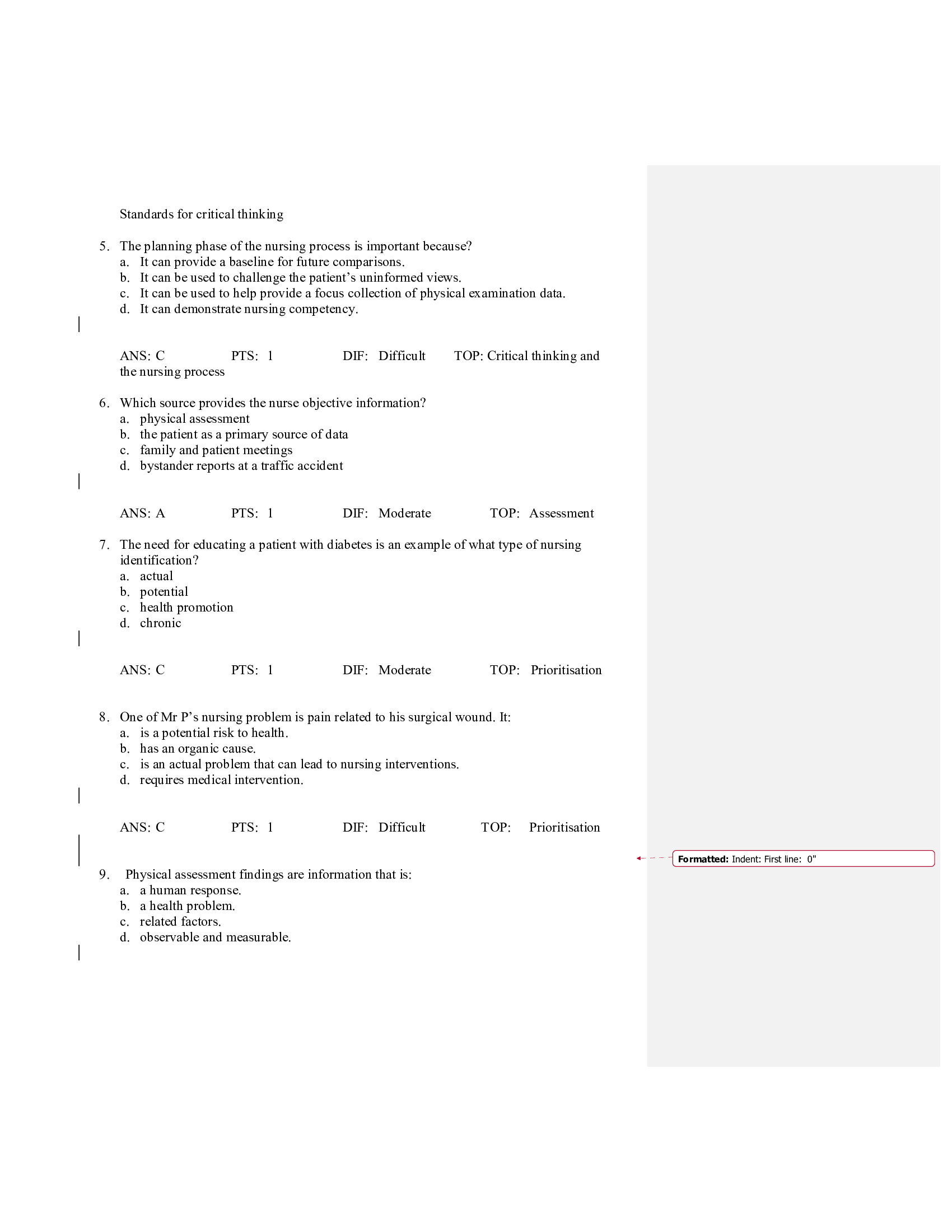
5.       The planning phase of the nursing process is important because?

a.     It can provide a baseline for future comparisons.

b.     It can be used to challenge the patient’s uninformed views.

c.     It can be used to help provide a focus collection of physical examination data.

d.     It can demonstrate nursing competency.


ANS: C PTS: 1 DIF: Difficult TOP: Critical thinking and the nursing process


6.       Which source provides the nurse objective information?

a.     physical assessment

b.     the patient as a primary source of data

c.     family and patient meetings

d.     bystander reports at a traffic accident


          ANS: A                    PTS: 1                     DIF: Moderate                  TOP: Assessment


7.      


The need for educating a patient with diabetes is an example of what type of nursing


identification? a. actual

b.     potential

c.     health promotion

d.     chronic


ANS: C                    PTS: 1

DIF: Moderate


TOP:  Prioritisation


8.       One of Mr P’s nursing problem is pain related to his surgical wound. It: 

a.     is a potential risk to health.

b.     has an organic cause.

c.     is an actual problem that can lead to nursing interventions.

d.     requires medical intervention.


          ANS: C                    PTS: 1                     DIF: Difficult                TOP:      Prioritisation


                                                                                                                                                                        Formatted: Indent: First line:  0"

9.       Physical assessment findings are information that is:

a.     a human response.

b.     a health problem.

c.     related factors.

d.     observable and measurable.


ANS: D         PTS: 1     DIF: Moderate        TOP:  Physical assessment findings


10.    Health history is:

a.     from the patient only. 

b.     from relatives and friends. 

c.     from the healthcare team and medical notes.

d.     from the patient, relatives, friends and bystanders.


          ANS: D                    PTS: 1                     DIF: Easy               TOP: Health history


11.    Diagnostic and laboratory data:

a.     is not necessary for clinical decisions.

b.     is meant for doctors to comprehend.

c.     contributes to a patient’s health status.

d.     uses medical diagnoses for nursing interventions.


ANS: C PTS: 1 DIF: Difficult TOP:  Diagnostic and laboratory data


12.   


Planning is the fourth step of the nursing process. It involves the prioritisation of nursing diagnoses and care and the selection of nursing interventions. According to Maslow’s Hierarchy of Needs, which situation exemplifies a physiological need?


a.     a child experiencing an asthma episode

b.     an infant whose side rails are left down on her crib

c.     a high school girl who is not selected to be on the dance team

d.     a child whose parents constantly call him ‘stupid’


          ANS: A                    PTS: 1                     DIF: Difficult         TOP: Prioritisation


13.    Patients are most likely to be motivated and agreeable to following their plan of care when:

a.     their health care provider explains the plan in terms they can understand.

b.     they participate in the decision-making process as the plan is developed.

c.     they establish their own nursing diagnoses.

d.     their physician and nurse collaborate in developing the plan.


           ANS: B  PTS:        1        DIF:              Moderate                             TOP:  Prioritisation


14.    According to Maslow’s Hierarchy of Needs, which nursing problem should take priority over the others?

a.     altered nutrition; less than body requirements, related to difficulty swallowing

b.     alteration to gas exchange related to pneumonia   

c.     ineffective individual coping related to uncertainty of course of disease and treatment

d.     deficient knowledge related to lack of interest in learning


           ANS: B  PTS:        1        DIF:              Moderate                             TOP:  Prioritisation


15.    A nursing decision to include a specific examination technique as a result of information gathered during the patient and family interview is which part of the nursing process?  a. implementation

b.     assessment

c.     planning

d.     evaluation


           ANS: A  PTS:        1        DIF:              Moderate                            TOP: Evaluation


16.    The sequence of the components of critical thinking according to Wilkinson (2007) are:

a.     self-regulation, inference, explanation

b.     interpretation, analysis, inference, explanation, evaluation and self-regulation

c.     inference, analysis, self-regulation, explanation, interpretation and evaluation

d.     no specific sequence as it is dynamic in nature


ANS: B  PTS:               1              DIF:        Difficult                   TOP: Components of critical thinking and clinical reasoning


17.    The implementation phase of the nursing process is best described as the time in which the nurse:

a.     sequentially executes the planned interventions for each nursing diagnosis.

b.     coordinates the implementation of planned interventions so that all patient outcomes are achieved at the same time.

c.     simultaneously implements the interventions developed for multiple nursing diagnoses and makes modifications as needed.

d.     organises and delegates assignments so that all patient outcomes are met by the established deadline.


           ANS: C  PTS:        1        DIF:              Moderate                            TOP: Implementation


                                                                                                                                                                        Formatted: Indent: First line:  0"

18.    In the care of an intubated ventilated patient the physician has ordered enteral nutrition. The nurse will insert and monitor the nasogastric tube and the dietician will order the required diet. This is an example of:

a.     conducted weekly to monitor the effectiveness of the interventions and progress toward outcomes.

b.     A collaborative patient problem that requires a team approach. c. a 

d. a continual process focused on the progress patients make toward achieving established outcomes.


           ANS: D  PTS:        1        DIF:              Moderate                            TOP: Evaluation


19.    In addition to the nurse, what other key people are involved in the evaluation phase of the nursing process?

a.     the nurse managers

b.     the patient and the family

c.     the patient and the physician

d.     all the health care professionals involved with the patient's care


           ANS: B   PTS:       1        DIF:              Moderate                 TOP: Evaluation


                                                                                                                                                                        Formatted: Indent: First line:  0"

20.    Critical pathways, used in the case management approach, consist of:

a.     rating scales for outcomes.

b.     lists of good and bad outcomes.

c.     maps that show the outcome of predetermined patient goals over a period of time.

d.     recommended activities for achieving patient care goals.


           ANS: C   PTS:       1        DIF:              Moderate                 TOP: Clinical pathways        


21.    A patient complains of feeling hungry but does not eat when the food is served. Which of the following demonstrates that the nurse is using critical thinking skills?

a.     The nurse assesses why the patient is not consuming the meal provided.

b.     The nurse leaves the food with the patient for later. 

c.     The nurse notifies the doctor that a feeding tube may be needed.

d.     The nurse assumes that the patient is not hungry.


ANS: A  PTS: 1 DIF: Moderate  TOP: Components of critical thinking and clinical reasoning


                                                                                                                                                                        Formatted: Indent: First line:  0"

22.    The main purpose of the nursing care plan is to:

a.     apply critical thinking to patient care.

b.     present nursing objectives to the patient and the family.

c.     help the nurse decide which interventions to use.

d.     communicate the patient’s progress in a standard way.


           ANS: D   PTS:       1        DIF:                moderate    TOP: Documenting the nursing

process


COMPLETION


1.    A purposeful, goal-directed process that strives to problem-solve patient care issues through the use of clinical reasoning is called ____________________ thinking.


ANS: critical


PTS: 1 DIF: Moderate TOP: Components of critical thinking and clinical reasoning


2.    The nursing profession use ________ as tool to support furtehrfurther opportunitesopportunities for learning and help develop a personal bodubody of applied knowledge.


      ANS: reflection


           PTS: 1                     DIF: Easy               TOP: Critical thinking and the nursing process


3.   


_______________________ are planned strategies based on scientific rationale and devised by the nurse to assist the patient in meeting the patient outcomes.


ANS:  Interventions

           PTS: 1                     DIF: Easy               TOP: Critical thinking and the nursing process


OTHER


1.    The nursing process used throughout this text includes four phases:                 (1) ____________________, (2) ____________________, (3) ______________________, (4) ______________________.


ANS: 

1.  assessment

2.  planning

3.  implementation

4.  evaluation


           PTS: 1                     DIF: Moderate       TOP: Critical thinking and the nursing process


2.    Collaborative interventions refer to actions that are prescribed by the ____________________ and implemented by the ____________________.


ANS: physician or doctor, nurse


           PTS: 1                     DIF: Difficult         TOP: Intervention selection           


3.    APIE (assessment, planning , intervention, evaluation) is a framework for critical thinking. Such frameworks are also called _________________. . 


  ANS: clinical reasoning


           PTS: 1                     DIF: Moderate        TOP: Critical thinking and reasoning


4.    List four key elements of clinical reasoning.


          ANS: Any four from below.                    

Purpose, find a solution, based on assumptions, a particular point of view, evidenced by data, conceptually expressed, inferential and consequential. 


           PTS: 4                     DIF: Difficult         TOP: Critical thinking and reasoning


5.    What steps are involved in the planning phase of the nursing process?


ANS: Evaluating subjective data, collection and validation of objective data. 


           PTS: 3                     DIF: Difficult         TOP: Critical thinking and reasoning


Contact the Seller

Please Sign In to contact this seller.


  • 👎  Report Copyright Violation

Frequently Asked Questions

What Do I Get When I Buy This Study Material?

+

When you buy a study material on Passing Grades, an instant download link will be sent directly to your email, giving you access to the file anytime after payment is completed.

Is Passing Grades a Trusted Platform?

+

Yes, Passing Grades is a reputable students’ marketplace with a secure payment system and reliable customer support. You can trust us to ensure a safe and seamless transaction experience.

Will I Be Stuck with a Subscription?

+

No, all purchases on Passing Grades are one-time transactions. You only pay for the notes you choose to buy, with no subscriptions or hidden fees attached.

Who Am I Buying These Study Materials From?

+

Passing Grades is a marketplace, which means you are purchasing the document from an individual vendor, not directly from us. We facilitate the payment and delivery process between you and the vendor.

Does Passing Grades Offer Free Study Materials?

+

Yes, sellers on Passing Grades have uploaded numerous free test banks, exams, practice questions, and class notes that can be downloaded at no cost.

Pasinggrades - Quality Study Materials

USD 15

    • Quality checked by Pasing Grades
    • 100% satisfaction guarantee
    • Seller: mentor2000
Buy PDF $15

Seller Information

mentor2000

Member since April 2021

  • icon
  • icon
View Profile
  • total sales

    0
  • Favourites

    0
  • Comments

    0
    ( 0 Ratings )

Item Information

  • Uploaded

    22 May 2022

  • Updated

    16 May 2025

  • Category

    Nursing

  • Item Type

    test bank

  • Tags

    Test Bank for Health Assessment and Physical Examination 2nd Australian and New Zealand Edition by Zastor Estes

Related Exam Prep Guides by mentor2000

Test Bank for Essentials for Nursing Practice 8th Edition by Potter | All Chapters
View Document

Test Bank for Essent...

  • mentor2000

    mentor2000

  • test bank

Master nursing concepts with this study material; Test Bank for Essentials for Nursing Practice, 8th...

15 USD

0

0

A &P 1 MA278 BSC2 Final Module II Questions & Answers 2026 Update
View Document

A &P 1 MA278 BSC2 Fi...

  • mentor2000

    mentor2000

  • test bank

Prepare for success with A&P 1 MA278 BSC2 Final Module II 2024 Q&A. Boost your grades with this comp...

15 USD

0

0

ATI Comprehensive Predictor Exam 2026
View Document

ATI Comprehensive Pr...

  • mentor2000

    mentor2000

  • test bank

Prepare for success with the ATI Comprehensive Predictor Exam 2026. Access key practice questions to...

15 USD

0

0

Purchase

Download link will be sent to this email immediately after purchase.

IMPORTANT LINKS

  • How To Upload Class Notes
  • Selling Tips
  • Passing Grades's Study Materials
  • Scholarships for International Students 2026

POPULAR CATEGORIES

  • Law
  • Accounting
  • English
  • Psychology
  • Business
  • Nursing
  • Computer Science
  • General

View Document

  • Blog
  • Contact
  • Delivery Policy
  • Latest Scholarships Around the World
  • How to Pass Bar Exams: Passing Grades’ Strategies
  • How to Study and Pass the CPA Exam
  • All Test Banks
  • Faq
  • Copyright Claims
  • Privacy Policy
  • Terms of Use

KNOWLEDGE BASE

  • How to Write A+ Grade Good Research Paper
  • How to Manage Stress During Exam Period
  • Best Time to Study
  • How to Pass NCLEX-RN Exam
  • How To Effectively Utilize Test Banks
  • Popular Shadow Health Exam Assessments
  • Popular HESI Case Studies
  • How to Prepare for a Nursing Career
  • The Importance Of Summaries in Exam Revisvion

© 2026 Pasing Grades. All rights reserved.