Pasing Grades
  • Start Selling
  • Blog
  • Contact
  • 0

    Your cart is empty!

English

  • English
  • Spanish
  • Arabic
Create Account Sign In
  • Library
    • New Prep Guides
    • Featured Prep Guides
    • Free Exam Prep Guides
    • Best sellers
  • General
  • Nursing
    • Research Paper
    • Case Study
    • Discussion Post
    • Assignment
    • Exam
    • Practice Questions and Answers
    • Test Bank
    • solutions manual
  • Accounting
    • Case Study
    • Thesis
    • Study Guide
    • Summary
    • Research Paper
    • test bank
  • English
    • Creative Writing
    • Research Paper
    • Summary
    • Rhetorics
    • Literature
    • Journal
    • Exam
    • Grammar
    • Discussion Post
    • Essay
  • Psychology
    • Hesi
    • Presentation
    • Essay
    • Summary
    • Study Guide
    • Essay
    • Solution Manual
    • Final Exam Review
    • Class Notes
    • test bank
  • Business
    • Lecture Notes
    • Solution Manual
    • Presentation
    • Business Plan
    • Class Notes
    • Experiment
    • Summary
    • Practice Questions
    • Study Guide
    • Case Study
    • test bank
    • Exam
  • More
    • Computer Science
    • Economics
    • Statistics
    • Engineering
    • Biology
    • Religious Studies
    • Physics
    • Chemistry
    • Mathematics
    • History
    • Sociology
    • Science
    • Philosophy
    • Law
  • Pages
    • About Us
    • Selling Tips
    • Delivery Policy
    • Faq
    • Privacy Policy
  • Flash Sale
  • Home
  • Test Bank for Health and Physical Assessment In Nursing 4th Edition by Fenske

Test Bank for Health and Physical Assessment In Nursing 4th Edition by Fenske

Preview page 1 Preview page 2 Preview page 3
Add To Favorites

Share this item Share this item

  • Item Details
  • Comments (0)
  • Reviews (0)
  • Contact Seller

Test Bank for Health and Physical Assessment In Nursing 4th Edition by Fenske

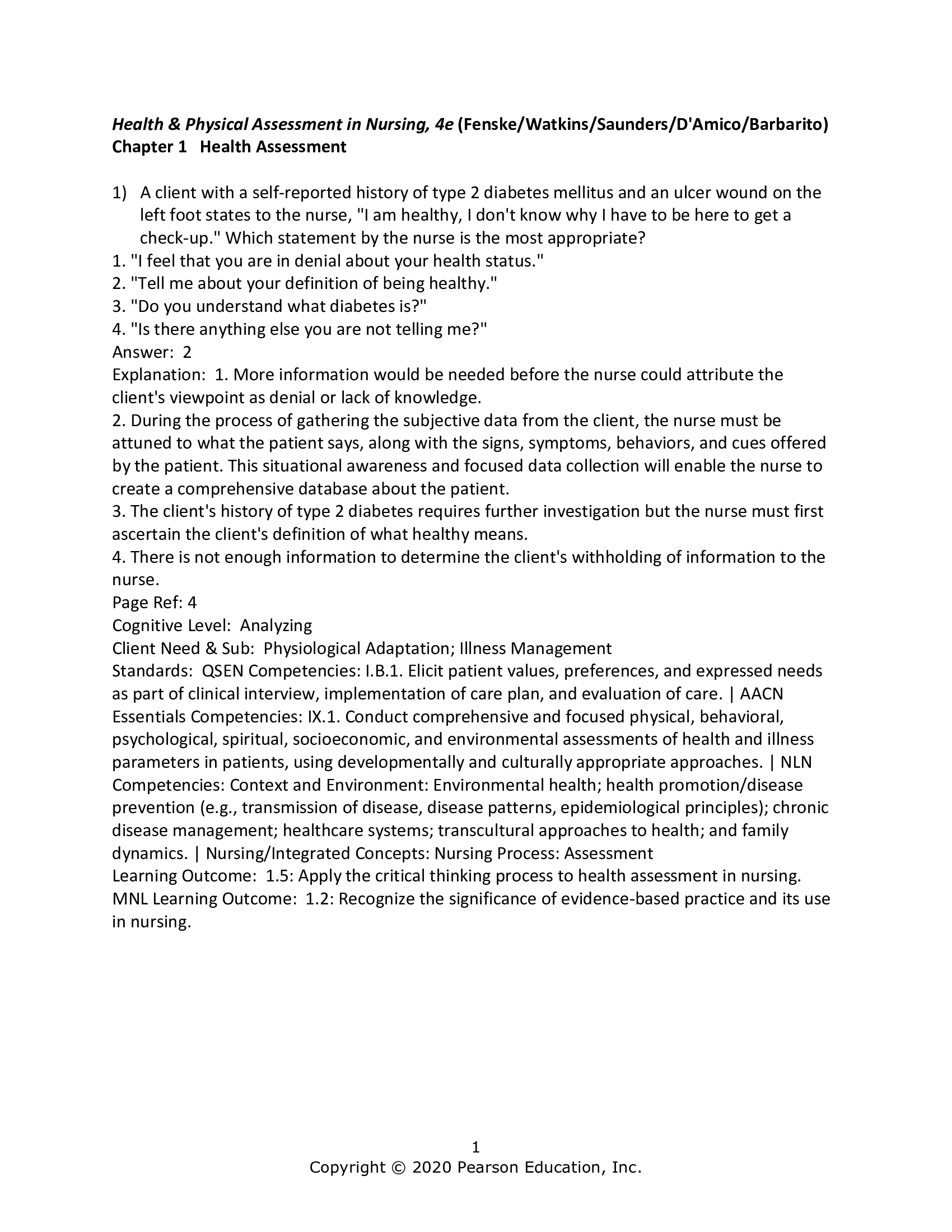
Health & Physical Assessment in Nursing, 4e (Fenske/Watkins/Saunders/D'Amico/Barbarito) Chapter 1   Health Assessment


1) A client with a self-reported history of type 2 diabetes mellitus and an ulcer wound on the left foot states to the nurse, "I am healthy, I don't know why I have to be here to get a check-up." Which statement by the nurse is the most appropriate?

1.  "I feel that you are in denial about your health status."

2.  "Tell me about your definition of being healthy."

3.  "Do you understand what diabetes is?"

4.  "Is there anything else you are not telling me?"

Answer:  2

Explanation:  1. More information would be needed before the nurse could attribute the client's viewpoint as denial or lack of knowledge.

2.                  During the process of gathering the subjective data from the client, the nurse must be attuned to what the patient says, along with the signs, symptoms, behaviors, and cues offered by the patient. This situational awareness and focused data collection will enable the nurse to create a comprehensive database about the patient.

3.                  The client's history of type 2 diabetes requires further investigation but the nurse must first ascertain the client's definition of what healthy means.

4.                  There is not enough information to determine the client's withholding of information to the nurse.

Page Ref: 4

Cognitive Level:  Analyzing

Client Need & Sub:  Physiological Adaptation; Illness Management

Standards:  QSEN Competencies: I.B.1. Elicit patient values, preferences, and expressed needs as part of clinical interview, implementation of care plan, and evaluation of care. | AACN Essentials Competencies: IX.1. Conduct comprehensive and focused physical, behavioral, psychological, spiritual, socioeconomic, and environmental assessments of health and illness parameters in patients, using developmentally and culturally appropriate approaches. | NLN Competencies: Context and Environment: Environmental health; health promotion/disease prevention (e.g., transmission of disease, disease patterns, epidemiological principles); chronic disease management; healthcare systems; transcultural approaches to health; and family dynamics. | Nursing/Integrated Concepts: Nursing Process: Assessment

Learning Outcome:  1.5: Apply the critical thinking process to health assessment in nursing. MNL Learning Outcome:  1.2: Recognize the significance of evidence-based practice and its use in nursing.


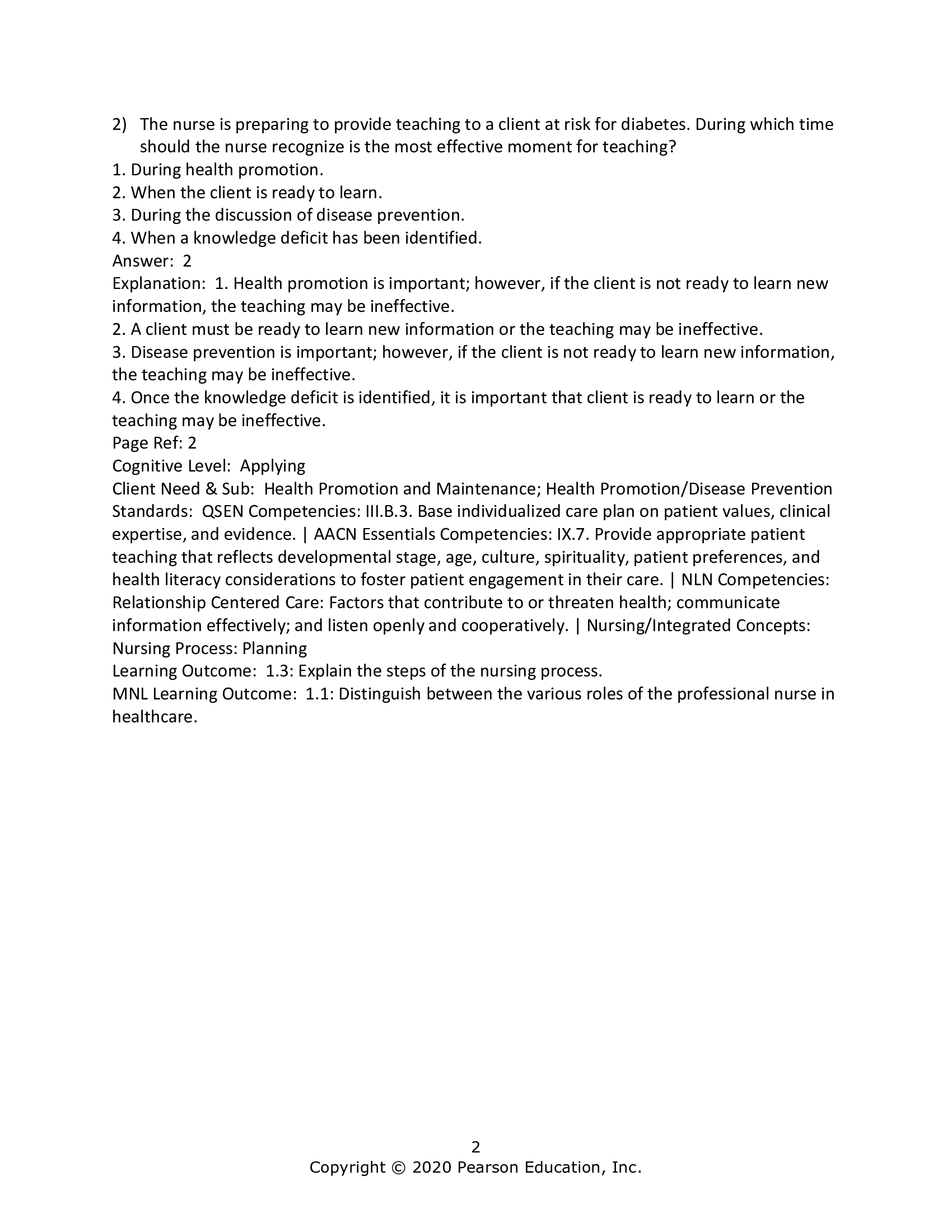
2) The nurse is preparing to provide teaching to a client at risk for diabetes. During which time should the nurse recognize is the most effective moment for teaching?

1.  During health promotion.

2.  When the client is ready to learn.

3.  During the discussion of disease prevention.

4.  When a knowledge deficit has been identified.

Answer:  2

Explanation:  1. Health promotion is important; however, if the client is not ready to learn new information, the teaching may be ineffective.

2.  A client must be ready to learn new information or the teaching may be ineffective.

3.  Disease prevention is important; however, if the client is not ready to learn new information, the teaching may be ineffective.

4.  Once the knowledge deficit is identified, it is important that client is ready to learn or the teaching may be ineffective.

Page Ref: 2

Cognitive Level:  Applying

Client Need & Sub:  Health Promotion and Maintenance; Health Promotion/Disease Prevention Standards:  QSEN Competencies: III.B.3. Base individualized care plan on patient values, clinical expertise, and evidence. | AACN Essentials Competencies: IX.7. Provide appropriate patient teaching that reflects developmental stage, age, culture, spirituality, patient preferences, and health literacy considerations to foster patient engagement in their care. | NLN Competencies: Relationship Centered Care: Factors that contribute to or threaten health; communicate information effectively; and listen openly and cooperatively. | Nursing/Integrated Concepts:

Nursing Process: Planning

Learning Outcome:  1.3: Explain the steps of the nursing process.

MNL Learning Outcome:  1.1: Distinguish between the various roles of the professional nurse in healthcare.


3)   The nurse is conducting a workshop on wellness and health promotion using the initiatives of Healthy People 2020. After the session, which statement by a participant indicates an understanding of the initiatives?

1.  "It will allow healthcare providers to lobby legislators for more funding."

2.  "The primary goal of Healthy People 2020 is to assist healthcare providers in determining risk factors for premature birth."

3.  "Healthy People 2020 seeks to promote health, prevent illness, disability, and premature death."

4.  "The initiatives will outline standards of care for providers in managing diseases." Answer:  3

Explanation:  1. Healthcare providers and other persons interested in programs to promote health have found the document to be a useful source of information in their efforts to gain funding.

2.  The Healthy People 2020 initiative is a 10-year strategy intended to promote health, prevent illness, disability, and premature death. The document identifies leading health indicators that reflect public health concerns. Risk factors for premature birth may be part of those health indicators, but the scope of the document covers broad areas of concern.

3.  The Healthy People 2020 initiative is a 10-year strategy intended to promote health, prevent illness, disability, and premature death.

4.  Standards of care in disease management is not a component of the document.

Page Ref: 7

Cognitive Level:  Applying

Client Need & Sub:  Health Promotion and Maintenance; Health Promotion/Disease Prevention Standards:  QSEN Competencies: I.A.1. Integrate understanding of multiple dimensions of patient centered care; patient/family/community preferences and values; coordination and integration of care; information, communication, and education; physical comfort and emotional support; involvement of family and friends; and transition and continuity. | AACN Essentials Competencies: IX.2. Recognize the relationship of genetics and genomics to health, prevention, screening, diagnostics, prognostics, selection of treatment, and monitoring of treatment effectiveness, using a constructed pedigree from collected family history information as well as standardized symbols and terminology. | NLN Competencies: Teamwork: Adapt communication to the team and situation to share information or solicit input and initiate requests for help when appropriate. | Nursing/Integrated Concepts: Nursing Process:

Assessment

Learning Outcome:  1.6: Describe the concepts of health, wellness, and health disparities. MNL Learning Outcome:  1.2: Recognize the significance of evidence-based practice and its use in nursing.


4)   The nurse is reviewing the advanced practice roles in nursing. Which role should the nurse recognize is most likely to provide indirect patient care?

1.  Nurse Researcher.

2.  Nurse Administrator.

3.  Nurse Educator.

4.  Nurse Anesthetist.

Answer:  2

Explanation:  1. A nurse researcher may provide direct care through their work in a clinic, hospital, or laboratory focusing on patient care outcomes, administering treatments for clinical trial, or collecting data to help understand population based outcomes.

2.                  The nurse administrator does not provide direct patient care but may be utilized for consultation. Other responsibilities vary and could include management of complex patient care areas, staffing, budgets, organizational and staff performance, and ensuring that the goals of the agency are being accomplished.

3.                  The nurse educator is responsible for didactic and clinical teaching, curriculum development, clinical placement, and evaluation of learning. Direct patient care occurs during clinical teaching.

4.                  The nurse anesthetist has direct patient care by providing a full range of anesthesia services. Page Ref: 2

Cognitive Level:  Applying

Client Need & Sub:  Management of Care; Concepts of Management

Standards:  QSEN Competencies: II.B.4. Function competently within own scope of practice as a member of the healthcare team. | AACN Essentials Competencies: VI.1. Compare/contrast the roles and perspectives of the nursing profession with other care professionals on the healthcare team (i.e. scope of discipline, education, and licensure requirements). | NLN Competencies: Teamwork: Clarify roles and integrate the contributions of others who play a role in helping the patient/family achieve health goals; function competently within one's own scope of practice as leader or member of the healthcare team; and manage delegation effectively. |

Nursing/Integrated Concepts: Nursing Process: Assessment

Learning Outcome:  1.1: Explain the roles of the professional nurse in healthcare.

MNL Learning Outcome:  1.1: Distinguish between the various roles of the professional nurse in healthcare.


5)   The nurse conducts a health history while admitting a client to the acute care facility. When collecting primary subjective data, which source should the nurse use?

1.  The client's physical assessment.

2.  The client's self-reports.

3.  The client's healthcare provider.

4.  The client's significant other.

Answer:  2

Explanation:  1. The physical assessment will be recorded as objective data.

2.                  Subjective data are gathered from the interview. The interview includes the health history and focused interview of the patient which is considered primary subjective data.

3.                  The client's healthcare provider and significant other may contribute in the data collection process. The information obtained from friends and family members is considered subjective.

This source of information is termed secondary.

4.                  The client's significant other may contribute in the data collection process but that input is classified as secondary data.

Page Ref: 6

Cognitive Level:  Applying

Client Need & Sub:  Health Promotion and Maintenance; Health Promotion/Disease Prevention Standards:  QSEN Competencies: I.B.1. Elicit patient values, preferences and expressed needs as part of clinical interview, implementation of care plan, and evaluation of care. | AACN Essentials Competencies: IX.1. Conduct comprehensive and focused physical, behavioral, psychological, spiritual, socioeconomic, and environmental assessments of health and illness parameters in patients, using developmentally and culturally appropriate approaches. | NLN Competencies: Relationship Centered Care: Communicate effectively with all members of the healthcare team, including the patient and the patient's support network. | Nursing/Integrated

Concepts: Nursing Process: Assessment

Learning Outcome:  1.2: Explain evidence-based practice and its significance in nursing. MNL Learning Outcome:  1.3: Examine the steps of the nursing process and their association with critical thinking.


6)   The nurse is reviewing a client's medical records. Which should the nurse recognize as subjective data?

1.  The client tells the nurse their abdomen hurts on the left side after eating.

2.  The client's abdomen is tender on the left side during palpation.

3.  The CAT scan reveals a large mass in the left lower quadrant of the abdomen.

4.  The client's hemoglobin is 14.1 gm/dL.

Answer:  1

Explanation:  1. Subjective reports by the client are those feelings or symptoms that cannot be observed by others. The statement "My abdomen hurts," is subjective data.

2.                  Physical examination findings, radiographic findings, and laboratory analysis reports are objective data.

3.                  Physical examination findings, radiographic findings, and laboratory analysis reports are objective data.

4.                  Physical examination findings, radiographic findings, and laboratory analysis reports are objective data.

Page Ref: 6

Cognitive Level:  Applying

Client Need & Sub:  Health Promotion and Maintenance; Health Screening

Standards:  QSEN Competencies: I.B.1. Elicit patient values, preferences, and expressed needs as part of clinical interview, implementation of care plan, and evaluation of care. | AACN Essentials Competencies: IX.1. Conduct comprehensive and focused physical, behavioral, psychological, spiritual, socioeconomic, and environmental assessments of health and illness parameters in patients, using developmentally and culturally appropriate approaches | NLN Competencies: Personal and Professional Development: Identify problems and contribute to assessment of outcome achievement. | Nursing/Integrated Concepts: Nursing Process:

Assessment

Learning Outcome:  1.5: Apply the critical thinking process to health assessment in nursing. MNL Learning Outcome:  1.4: Examine the components of health assessment.


7)   The nurse is reviewing a client's medical record. Which documented data should the nurse recognize is objective?

1.  The client states, "fell and hurt myself."

2.  The client states, "I am six years old."

3.  "Six-year-old child observed holding a towel to her forehead."

4.  "Client states that she was running and fell at the playground."

Answer:  3

Explanation:  1. Statements the client makes are subjective data.

2.  Statements the client makes are subjective data.

3.  Objective data are data that can be observed or measured by the nurse. The nurse can see the child holding the towel to her head.

4.  Statements the client makes are subjective data.

Page Ref: 6

Cognitive Level:  Applying

Client Need & Sub:  Health Promotion and Maintenance; Health Screening

Standards:  QSEN Competencies: I.B.1. Elicit patient values, preferences, and expressed needs as part of clinical interview, implementation of care plan, and evaluation of care. | AACN Essentials Competencies: IX.1. Conduct comprehensive and focused physical, behavioral, psychological, spiritual, socioeconomic, and environmental assessments of health and illness parameters in patients, using developmentally and culturally appropriate approaches. | NLN Competencies: Personal and Professional Development: Identify problems; Contribute to assessment of outcome achievement. | Nursing/Integrated Concepts: Nursing Process:

Assessment

Learning Outcome:  1.5: Apply the critical thinking process to health assessment in nursing. MNL Learning Outcome:  1.4: Examine the components of health assessment.


8)   The nurse is evaluating the plan of care and notes that none of the goals have been met for the client with impaired gas exchange. Which action should the nurse take?

1.  Report the lack of achievement of the goals to the healthcare provider.

2.  Review the data and modify the plan.

3.  Reformulate the nursing diagnosis to a more realistic one.

4.  Request a consult for the client to be seen by a pulmonologist.

Answer:  2

Explanation:  1. Reporting the lack of achievement of the goals to the healthcare provider is not appropriate, though reporting undesirable client physiologic responses may be.

2.  The plan of care should be evaluated periodically at established time frames to determine achievement of the goals. If goals have not been achieved, revisions should be made which may include adding, changing, or discontinuing nursing diagnoses or nursing interventions.

3.  Reformulating the nursing diagnosis to a more realistic one is not the best course of action, as the diagnosis established came from subjective and objective data specific to that diagnosis.

4.  There is no data to support the need for additional medical consultations.

Page Ref: 5

Cognitive Level:  Applying

Client Need & Sub:  Physiological Integrity; Illness Management

Standards:  QSEN Competencies: III.B.3. Base individualized care plan on patient values, clinical expertise, and evidence. | AACN Essentials Competencies: III.6. Integrate evidence, clinical judgment, interprofessional perspectives, and patient preferences in planning, implementing, and evaluating outcomes of care. | NLN Competencies: Personal and Professional Development: Identify problems and contribute to assessment of outcome achievement. | Nursing/Integrated Concepts: Nursing Process: Evaluation

Learning Outcome:  1.3: Explain the steps of the nursing process.

MNL Learning Outcome:  1.3: Examine the steps of the nursing process and their association with critical thinking.


9)   The preceptor has created a teaching plan about the concepts of health and wellness for a new nurse. Which statement by the nurse indicates an understanding of health?

1.  "Health is the absence of illness, disease, and symptoms."

2.  "Health is a state of well-being and when the client feels good."

3.  "Health is the state when a person is viewed as a holistic being."

4.  "Health is a state of complete physical, mental, and social well-being."

Answer:  4

Explanation:  1. Health extends beyond the absence of illness and disease.

2.  Defining health as a state of well-being is limiting as it does not encompass all of the elements of an individual's being.

3.  While health does require a holistic approach, this definition does not explore the context of health.

4.  Health is a physical, psychosocial, and spiritual wellness.

Page Ref: 7

Cognitive Level:  Applying

Client Need & Sub:  Health Promotion and Maintenance; Health Screening

Standards:  QSEN Competencies: III.B.3. Base individualized care plan on patient values, clinical expertise, and evidence. | AACN Essentials Competencies: VII.5; IX.7. Use evidence-based practices to guide health teaching, health counseling, screening, outreach, disease and outbreak investigation, and referral and follow-up throughout the lifespan. Provide appropriate patient teaching that reflects developmental stage, age, culture, spirituality, patient preferences, and health literacy considerations to foster patient engagement in their care. |

NLN Competencies: Knowledge and Practice: Health promotion/disease prevention |

Nursing/Integrated Concepts: Nursing Process: Evaluation

Learning Outcome:  1.5: Apply the critical thinking process to health assessment in nursing. MNL Learning Outcome:  1.2: Recognize the significance of evidence-based practice and its use in nursing.


10) The nurse is caring for a client who is recovering from abdominal surgery. Which goal should the nurse include in this client's plan of care?

1.  The client will verbalize pain relief using an intensity rating in 1 hour.

2.  The client will state that they feel fine in 1 hour.

3.  The nurse will observe fewer signs of pain in the client's every 1 hour.

4.  The nurse will re-evaluate the client's pain level every 1 hour.

Answer:  1

Explanation:  1. The goal s is directly related to the nursing diagnosis. Goals are stated in a positive fashion and have measurable criteria.

2.  This statement is not related directly to the diagnosis and is not measurable.

3.  A goal must be reflective of client activities. This is an incorrect answer because it reflects activities of the nurse and not the client.

4.  A goal must be reflective of the client's activities. This is an incorrect answer because it reflects activities of the nurse and is not client directed. Although there is a time frame listed, it is not correct as it is related to nursing actions.

Page Ref: 5

Cognitive Level:  Applying

Client Need & Sub:  Physiological Integrity; Basic Care and Comfort

Standards:  QSEN Competencies: I.A.3. Demonstrate comprehensive understanding of the concepts of pain and suffering, including physiologic models of pain and comfort. | AACN Essentials Competencies: III.6. Integrate evidence, clinical judgment, interprofessional perspectives, and patient preferences in planning, implementing, and evaluating outcomes of care. | NLN Competencies: Personal and Professional Development: Identify problems and contribute to assessment of outcome achievement. | Nursing/Integrated Concepts: Nursing Process: Planning

Learning Outcome:  1.3: Explain the steps of the nursing process.

MNL Learning Outcome:  1.2: Recognize the significance of evidence-based practice and its use in nursing.


11) The nurse is developing the plan of care for a client who is recovering from abdominal surgery. Which intervention should the nurse implement to address this client's pain?


Explanation:  1. The role of the Nurse Researcher includes the identification of problems in regards to patient care, designing plans of study, and developing tools.

2.                  The Certified Nurse Midwife is an independent practitioner that provides generalized healthcare services, such as family planning, obstetric, and gynecological care.

3.                  The role of the Clinical Nurse Specialist includes the provision of direct patient care, directing and teaching other team members, and providing care and conduct research within an area of specialization.

4.                  The role of the Nurse Practitioner includes combining expertise in diagnosis and illness with a nurse's understanding of health promotion and prevention.

Page Ref: 3

Cognitive Level:  Understanding

Client Need & Sub:  Safe and Effective Care Environment; Concepts of Management

Standards:  QSEN Competencies: II.B.4. Function competently within own scope of practice as a member of the healthcare team. | AACN Essentials Competencies: VI.1. Compare/contrast the roles and perspectives of the nursing profession with other care professionals on the healthcare team (i.e. scope of discipline, education, and licensure requirements). | NLN Competencies: Personal and Professional Development: Identify problems and contribute to assessment of outcome achievement. | Nursing/Integrated Concepts: Nursing Process: Planning Learning Outcome:  1.1: Explain the roles of the professional nurse in healthcare.

MNL Learning Outcome:  1.1: Distinguish between the various roles of the professional nurse in healthcare.


22) The nurse is preparing to conduct a focused interview on an older adult client who is being admitted for a urinary tract infection (UTI). Which initial action should the nurse take?

1.  Obtain a urine sample.

2.  Monitor the client's vital signs.

3.  Assess the client's about dietary preferences.

4.  Assess the characteristics of the client's pain.

Answer:  4

Explanation:  1. The client may need to have a urine specimen but that does not directly relate to obtaining more information about the client's chief complaints.

2.                  The client's vital signs will be taken but they do not directly relate to obtaining more information about the client's chief complaints.

3.                  Dietary preferences of clients are recorded but are not a part of the focused assessment. 4. The focused interview is used to allow for clarification of information from the initial interview. The focused interview is the portion of the interview in which the nurse asks the patient to clarify points, provide missing information, and elucidate information identified in the health history.

Page Ref: 6

Cognitive Level:  Applying

Client Need & Sub:  Physiological Adaptation; Alterations in Body Systems

Standards:  QSEN Competencies: I.B.1. Elicit patient values, preferences, and expressed needs as part of clinical interview, implementation of care plan, and evaluation of care. | AACN Essentials Competencies: IX.1. Conduct comprehensive and focused physical, behavioral, psychological, spiritual, socioeconomic, and environmental assessments of health and illness parameters in patients, using developmentally and culturally appropriate approaches. | NLN Competencies: Personal and Professional Development: Identify problems and contribute to assessment of outcome achievement. | Nursing/Integrated Concepts: Nursing Process:

Assessment

Learning Outcome:  1.5: Apply the critical thinking process to health assessment in nursing. MNL Learning Outcome:  1.4: Examine the components of health assessment.


23) The nurse is preparing to obtain a health history. Which should the nurse understand is the main purpose of obtaining a health history before a physical assessment?

1.  Allows the nurse to gather objective data.

2.  Provides a systematic means of gathering information.

3.  Enables a nursing diagnosis to be generated.

4.  Assists the examiner in accurately conducting a physical assessment.

Answer:  2

Explanation:  1. A purpose of a health history is to obtain information about the client's health in their own words and based on their own perceptions.

2.                  The main purpose of conducting an interview prior to obtaining a physical assessment is to systematically gather information about the client.

3.                  A nursing diagnosis is not generated until both subjective and objective data have been obtained.

4.                  Accurately conducting a physical assessment is based on the nurse's ability to systematically and consistently use evidence-based methods of data collection.

Page Ref: 6

Cognitive Level:  Applying

Client Need & Sub:  Physiological Adaptation; Alterations in Body Systems

Standards:  QSEN Competencies: I.B.1. Elicit patient values, preferences, and expressed needs as part of clinical interview, implementation of care plan, and evaluation of care. | AACN Essentials Competencies: IX.1. Conduct comprehensive and focused physical, behavioral, psychological, spiritual, socioeconomic, and environmental assessments of health and illness parameters in patients, using developmentally and culturally appropriate approaches. | NLN Competencies: Personal and Professional Development: Identify problems and contribute to assessment of outcome achievement. | Nursing/Integrated Concepts: Nursing Process:

Assessment

Learning Outcome:  1.4: Define health assessment and identify key components. MNL Learning Outcome:  1.4: Examine the components of health assessment. 24) The nurse is reviewing the goal statements for a postoperative client. Which goal statements should the nurse recognize needs further development? Select all that apply.

1.  The nurse will assess the vital signs every 2 hours.

2.  The client will ambulate every 6 hours on the first postoperative day.

3.  The client will report feeling better by the end of the day.

4.  The client will begin a clear liquid diet on the first postoperative day.

5.  The nurse will administer oral analgesics as prescribed.

Answer:  1, 3, 5

Explanation:  1. Goal statements are used to provide planned outcomes for the client. Goal statements must be measurable and are reflective of client activities. This statement reflects actions of the nurse, not the client.

2.                  The goal statement is used to provide planned outcomes for the client. Goal statements must be measurable and reflective of client activities. All elements needed for an appropriate goal statement are represented.

3.                  Goal statements must be measurable and reflective of client activities. This statement is vague and does not provide a definitive means for measurement.

4.                  Goal statements are used to provide planned client outcomes. This statement contains the needed elements for a successful goal statement.

5.                  This statement is not a client-centered goal statement. This statement reflects an intervention performed by the healthcare provider.

Page Ref: 5

Cognitive Level:  Applying

Client Need & Sub:  Physiological Adaptation; Alterations in Body Systems

Standards:  QSEN Competencies: I.B.3. Provide patient-centered care with sensitivity and respect for the diversity of human experience. | AACN Essentials Competencies: III.6. Integrate evidence, clinical judgment, interprofessional perspectives, and patient preferences in planning,

implementing, and evaluating outcomes of care. | NLN Competencies: Personal and Professional Development: Identify problems and contribute to assessment of outcome achievement. | Nursing/Integrated Concepts: Nursing Process: Evaluation

Learning Outcome:  1.5: Apply the critical thinking process to health assessment in nursing. MNL Learning Outcome:  1.2: Recognize the significance of evidence-based practice and its use in nursing.


25) The nurse administrator is explaining their role to a new nurse. Which statement made by the new nurse indicates further teaching is required?

1.  "You are available for consultation."

2.  "You will be conducting research."

3.  "You are responsible for staffing."

4.  "You will be monitoring the goals of the organization."

Answer:  2

Explanation:  1. The nurse administrator may function as a consultant.

2.  The nurse administrator is not involved in conducting research.

3.  The nurse administrator may be responsible for staffing.

4.  The nurse administrator monitors the goals of the organization.

Page Ref: 2

Cognitive Level:  Applying

Client Need & Sub:  Safe and Effective Care Environment; Concepts of Management

Standards:  QSEN Competencies: II.B.4 Function competently within own scope of practice as a member of the healthcare team. | AACN Essentials Competencies: VI.1. Compare/contrast the roles and perspectives of the nursing profession with other care professionals on the healthcare team (i.e. scope of discipline, education, and licensure requirements). | NLN Competencies: Teamwork: Function competently within one's own scope of practice as leader or member of the healthcare team and manage delegation effectively. Clarify roles and integrate the contributions of others who play a role in helping the patient/family achieve health goals. |

Nursing/Integrated Concepts: Nursing Process: Evaluation

Learning Outcome:  1.5: Apply the critical thinking process to health assessment in nursing. MNL Learning Outcome:  1.1: Distinguish between the various roles of the professional nurse in healthcare.


26) The new nurse is reviewing a client's plan of care with the preceptor. Which statement made by the nurse should the preceptor be concerned with?

1.  "I have created one goal per nursing diagnosis."

2.  "I have created my goals based on the nursing diagnosis."

3.  "I identified measurable goals during the planning."

4.  "I have written the interventions based on my goals."

Answer:  1

Explanation:  1. A single nursing diagnosis may generate more than one patient goal.

2.  The goals for the client are based on the nursing diagnosis.

3.  Measurable goals are identified during the stage of planning.

4.  Interventions are based on the identified goals.

Page Ref: 5

Cognitive Level:  Applying

Client Need & Sub:  Safe and Effective Care Environment; Assignment, Delegation, and Supervision

Standards:  QSEN Competencies: I.B.3. Provide patient-centered care with sensitivity and respect for the diversity of human experience. | AACN Essentials Competencies: IX.14. Demonstrate clinical judgment and accountability for patient outcomes when delegating to and supervising other members of the healthcare team | NLN Competencies: Teamwork: Adapt communication to the team and situation to share information or solicit input and initiate requests for help when appropriate. | Nursing/Integrated Concepts: Nursing Process:

Evaluation

Learning Outcome:  1.3: Explain the steps of the nursing process.

MNL Learning Outcome:  1.2: Recognize the significance of evidence-based practice and its use in nursing.


27) The nurse is reviewing a client's care plan. Which part of the nursing process should the nurse use to determine if new problems exist?

1.  Assessment.

2.  Evaluation.

3.  Implementation.

4.  Planning. Answer:  2

Explanation:  1. The assessment process begins during the first encounter of the patient or the chart. The collection, organization, and validation of subjective and objective information are obtained during the assessment.

2.  During the evaluation, the nurse determines if a new problem exists.

3.  During the implementation of the nursing process, the nurse carries out relevant nursing interventions specific to the patient.

4.  During the phase of planning, the nurse identifies measurable goals or outcomes, sets priorities, and selects evidence-based nursing interventions that promote achievement of measurable patient goals or outcomes.

Page Ref: 7

Cognitive Level:  Applying

Client Need & Sub:  Safe and Effective Care Environment; Management of Care

Standards:  QSEN Competencies: I.B.3. Provide patient-centered care with sensitivity and respect for the diversity of human experience. | AACN Essentials Competencies: VII.1. Assess protective and predictive factors, including genetics, which influence the health of individuals, families, groups, communities, and populations. | NLN Competencies: Personal and

Professional Development: Identify problems. Apply decision-making skills, particularly in the context of uncertainty and ambiguity. | Nursing/Integrated Concepts: Nursing Process:

Evaluating

Learning Outcome:  1.3: Explain the steps of the nursing process.

MNL Learning Outcome:  1.2: Recognize the significance of evidence-based practice and its use in nursing.


28) The preceptor is assessing a new nurse's ability to critically think. Which should the preceptor include in the assessment? Select all that apply.

1.  Application of logic.

2.  Use of resources.

3.  Ability to problem solving.

4.  Use of the nursing process.

5.  Use of cognitive skills.

Answer:  1, 2, 4, 5

Explanation:  1. Critical thinking is a way to apply logic to the complexities of patient care.

2.  Critical thinking involves the use of resources.

3.  Critical thinking is more than problem solving.

4.  Critical thinking parallels the nursing process.

5.  Critical thinking is a way to apply cognitive skills to the complexities of patient care.

Page Ref: 7

Cognitive Level:  Applying

Client Need & Sub:  Safe and Effective Care Environment; Management of Care

Standards:  QSEN Competencies: II.B.11. Solicit input from other team members to improve individual, as well as team, performance. | AACN Essentials Competencies: I.1. Integrate theories and concepts from liberal education into nursing practice. | NLN Competencies: Personal and Professional Development: Identify problems and apply decision-making skills, particularly in the context of uncertainty and ambiguity. | Nursing/Integrated Concepts:

Nursing Process: Evaluation

Learning Outcome:  1.5: Apply the critical thinking process to health assessment in nursing. MNL Learning Outcome:  1.3: Examine the steps of the nursing process and their association with critical thinking.


29) The nurse is developing a client's plan of care. Which should the nurse base the plan of care on?

1.  The nursing diagnosis.

2.  The objective data.

3.  The subjective data.

4.  Client goals.

Answer:  1

Explanation:  1. The plan of care should be based on the nursing diagnosis.

2.  Objective and subjective data are collected and used to formulate the nursing diagnosis.

3.  Objective and subjective data are collected to formulate the nursing diagnosis.

4.  Client goals are developed to help determine the success of the care delivered.

Page Ref: 5

Cognitive Level:  Remembering

Client Need & Sub:  Safe and Effective Care Environment; Management of Care

Standards:  QSEN Competencies: I.B.3. Provide patient-centered care with sensitivity and respect for the diversity of human experience. | AACN Essentials Competencies: III.6. Integrate evidence, clinical judgment, interprofessional perspectives, and patient preferences in planning,

implementing, and evaluating outcomes of care. | NLN Competencies: Personal and Professional Development: Identify problems and contribute to assessment of outcome

achievement. | Nursing/Integrated Concepts: Nursing Process: Diagnosis Learning Outcome:  1.3: Explain the steps of the nursing process.

MNL Learning Outcome:  1.4: Examine the components of health assessment.


30) The nurse is preparing to focus on the third step of the nursing process. Which should the nurse anticipate obtaining?

1.  Statement of client goals.

2.  Collection of subjective data.

3.  Performance of care activities.

4.  Review of client's achievement of goals.

Answer:  1

Explanation:  1. The third step in the nursing process is the planning phase. During the planning phase, care interventions are determined, priorities are set, and client goals are stated.

2.                  Assessment is the first phase of the nursing process for which collection of subjective data occurs.

3.                  Implementation is the fourth phase of the nursing process for which care activities are implemented.

4.                  The client's progress toward achieving the identified goals is evaluated in the final stage of the nursing process.

Page Ref: 5

Cognitive Level:  Remembering

Client Need & Sub:  Safe and Effective Care Environment; Management of Care

Standards:  QSEN Competencies: I.B.3. Provide patient-centered care with sensitivity and respect for the diversity of human experience. | AACN Essentials Competencies: III.6. Integrate evidence, clinical judgment, interprofessional perspectives, and patient preferences in planning,

implementing, and evaluating outcomes of care. | NLN Competencies: Personal and Professional Development: Identify problems and contribute to assessment of outcome achievement. | Nursing/Integrated Concepts: Nursing Process: Planning Learning Outcome:  1.3: Explain the steps of the nursing process.

MNL Learning Outcome:  1.3: Examine the steps of the nursing process and their association with critical thinking.


31) The nurse is reviewing the client's record for reports of pain. Which should the nurse consider subjective data? Select all that apply.

1.  The client's leg is red and swollen.

2.  The client complains of leg tenderness.

3.  The client's white blood cell count is elevated

4.  The client demonstrates guarding behavior during the assessment

5.  The client states they have leg cramps.

Answer:  2, 5

Explanation:  1. Objective information is observable by the examiner. The examiner is able to visualize the appearance of the extremity.

2.  Subjective information refers to data reported by the client. The client's complaints are an example of subjective data.

3.  The laboratory values are objective data based on measurement.

4.  Objective information is observable such as the patient exhibiting guarding behavior during an assessment.

5.  Subjective information refers to data reported by the client such as in a statement regarding the experience of pain.

Page Ref: 6

Cognitive Level:  Applying

Client Need & Sub:  Physiological Integrity; Basic Care and Comfort

Standards:  QSEN Competencies: I.B.3. Assess presence and extent of pain and suffering. | AACN Essentials Competencies: IX.1. Conduct comprehensive and focused physical, behavioral, psychological, spiritual, socioeconomic, and environmental assessments of health and illness parameters in patients, using developmentally and culturally appropriate approaches. | NLN Competencies: Personal and Professional Development: Identify problems and contribute to assessment of outcome achievement. | Nursing/Integrated Concepts: Nursing Process:

Assessment

Learning Outcome:  1.4: Define health assessment and identify key components. MNL Learning Outcome:  1.4: Examine the components of health assessment. 32) The nurse is evaluating the risk factors for health disparity. Which social determinant should the nurse consider places the clients in the community at risk?

1.  Lack of access to healthcare services.

2.  Nonadherence to health prevention.

3.  Lack of participation in exercise.

4.  Chronic substance abuse.

Answer:  1

Explanation:  1. Lack of access to healthcare services is a social determinant associated with health disparity.

2.  Nonadherence to health prevention is a behavior.

3.  Nonparticipation in exercise is not a health disparity, unless the reason the client cannot participate is due to an unsafe environment or disability.

4.  Chronic substance abuse addiction is a behavior or an addiction.

Page Ref: 7

Cognitive Level:  Applying

Client Need & Sub:  Health Promotion and Maintenance; Health Promotion/Disease Prevention Standards:  QSEN Competencies: I.B.1. Integrate understanding of multiple dimensions of patient centered care: patient/family/community preferences and values; coordination and integration of care; information, communication, and education; physical comfort and emotional support; involvement of family and friends; and transition and continuity. | AACN Essentials Competencies: VII.1. Assess protective and predictive factors, including genetics, which influence the health of individuals, families, groups, communities, and populations. | NLN Competencies: Context of Environment: Environmental health; health promotion/disease prevention (e.g., transmission of disease, disease patterns, epidemiological principles); chronic disease management; healthcare systems; transcultural approaches to health; and family dynamics. | Nursing/Integrated Concepts: Nursing Process: Assessment

Learning Outcome:  1.6: Describe the concepts of health, wellness, and health disparities. MNL Learning Outcome:  1.4: Examine the components of health assessment.


33) Which should the nurse understand is the main focus of the Agency for Health Research and Quality?

1.  Nursing practice guidelines.

2.  Health promotion.

3.  Produce evidence-based reports.

4.  Address healthcare disparity.

Answer:  3

Explanation:  1. The AHRQ produces evidence reports and technology assessments.

2. The AHRQ produces evidence reports and technology assessments. 3. The AHRQ produces evidence reports and technology assessments.

4. The AHRQ produces evidence reports and technology assessments.

Page Ref: 3

Cognitive Level:  Understanding

Client Need & Sub:  Health Promotion and Maintenance; Health Promotion/Disease Prevention Standards:  QSEN Competencies: I.B.1. Integrate understanding of multiple dimensions of patient centered care: patient/family/community preferences and values; coordination and integration of care; information, communication, and education; physical comfort and emotional support; involvement of family and friends; and transition and continuity. | AACN Essentials Competencies: VII.1. Assess protective and predictive factors, including genetics, which influence the health of individuals, families, groups, communities, and populations. | NLN Competencies: Context of Environment: Environmental health; health promotion/disease prevention (e.g., transmission of disease, disease patterns, epidemiological principles); chronic disease management; healthcare systems; transcultural approaches to health; and family dynamics. | Nursing/Integrated Concepts: Nursing Process: Evaluation

Learning Outcome:  1.7: Examine how national health policy is structured to enhance individual and population health.

MNL Learning Outcome:  1.2: Recognize the significance of evidence-based practice and its use in nursing.

Contact the Seller

Please Sign In to contact this seller.


  • 👎  Report Copyright Violation

Frequently Asked Questions

What Do I Get When I Buy This Study Material?

+

When you buy a study material on Passing Grades, an instant download link will be sent directly to your email, giving you access to the file anytime after payment is completed.

Is Passing Grades a Trusted Platform?

+

Yes, Passing Grades is a reputable students’ marketplace with a secure payment system and reliable customer support. You can trust us to ensure a safe and seamless transaction experience.

Will I Be Stuck with a Subscription?

+

No, all purchases on Passing Grades are one-time transactions. You only pay for the notes you choose to buy, with no subscriptions or hidden fees attached.

Who Am I Buying These Study Materials From?

+

Passing Grades is a marketplace, which means you are purchasing the document from an individual vendor, not directly from us. We facilitate the payment and delivery process between you and the vendor.

Does Passing Grades Offer Free Study Materials?

+

Yes, sellers on Passing Grades have uploaded numerous free test banks, exams, practice questions, and class notes that can be downloaded at no cost.

Pasinggrades - Quality Study Materials

USD 15

    • Quality checked by Pasing Grades
    • 100% satisfaction guarantee
    • Seller: mentor2000
Buy PDF $15

Seller Information

mentor2000

Member since April 2021

  • icon
  • icon
View Profile
  • total sales

    0
  • Favourites

    0
  • Comments

    0
    ( 0 Ratings )

Item Information

  • Uploaded

    22 May 2022

  • Updated

    16 May 2025

  • Category

    Nursing

  • Item Type

    test bank

  • Tags

    Test Bank for Health and Physical Assessment In Nursing 4th Edition by Fenske

Related Exam Prep Guides by mentor2000

Test Bank for Essentials for Nursing Practice 8th Edition by Potter | All Chapters
View Document

Test Bank for Essent...

  • mentor2000

    mentor2000

  • test bank

Master nursing concepts with this study material; Test Bank for Essentials for Nursing Practice, 8th...

15 USD

0

0

A &P 1 MA278 BSC2 Final Module II Questions & Answers 2026 Update
View Document

A &P 1 MA278 BSC2 Fi...

  • mentor2000

    mentor2000

  • test bank

Prepare for success with A&P 1 MA278 BSC2 Final Module II 2024 Q&A. Boost your grades with this comp...

15 USD

0

0

ATI Comprehensive Predictor Exam 2026
View Document

ATI Comprehensive Pr...

  • mentor2000

    mentor2000

  • test bank

Prepare for success with the ATI Comprehensive Predictor Exam 2026. Access key practice questions to...

15 USD

0

0

Purchase

Download link will be sent to this email immediately after purchase.

IMPORTANT LINKS

  • How To Upload Class Notes
  • Selling Tips
  • Passing Grades's Study Materials
  • Scholarships for International Students 2025

POPULAR CATEGORIES

  • Law
  • Accounting
  • English
  • Psychology
  • Business
  • Nursing
  • Computer Science
  • General

View Document

  • Blog
  • Contact
  • Delivery Policy
  • Latest Scholarships Around the World
  • How to Pass Bar Exams: Passing Grades’ Strategies
  • How to Study and Pass the CPA Exam
  • All Test Banks
  • Faq
  • Copyright Claims
  • Privacy Policy
  • Terms of Use

KNOWLEDGE BASE

  • How to Write A+ Grade Good Research Paper
  • How to Manage Stress During Exam Period
  • Best Time to Study
  • How to Pass NCLEX-RN Exam
  • How To Effectively Utilize Test Banks
  • Popular Shadow Health Exam Assessments
  • Popular HESI Case Studies
  • How to Prepare for a Nursing Career
  • The Importance Of Summaries in Exam Revisvion

© 2026 Pasing Grades. All rights reserved.