Pasing Grades
  • Start Selling
  • Blog
  • Contact
  • 0

    Your cart is empty!

English

  • English
  • Spanish
  • Arabic
Create Account Sign In
  • Library
    • New Prep Guides
    • Featured Prep Guides
    • Free Exam Prep Guides
    • Best sellers
  • General
  • Nursing
    • Research Paper
    • Case Study
    • Discussion Post
    • Assignment
    • Exam
    • Practice Questions and Answers
    • Test Bank
    • solutions manual
  • Accounting
    • Case Study
    • Thesis
    • Study Guide
    • Summary
    • Research Paper
    • test bank
  • English
    • Creative Writing
    • Research Paper
    • Summary
    • Rhetorics
    • Literature
    • Journal
    • Exam
    • Grammar
    • Discussion Post
    • Essay
  • Psychology
    • Hesi
    • Presentation
    • Essay
    • Summary
    • Study Guide
    • Essay
    • Solution Manual
    • Final Exam Review
    • Class Notes
    • test bank
  • Business
    • Lecture Notes
    • Solution Manual
    • Presentation
    • Business Plan
    • Class Notes
    • Experiment
    • Summary
    • Practice Questions
    • Study Guide
    • Case Study
    • test bank
    • Exam
  • More
    • Computer Science
    • Economics
    • Statistics
    • Engineering
    • Biology
    • Religious Studies
    • Physics
    • Chemistry
    • Mathematics
    • History
    • Sociology
    • Science
    • Philosophy
    • Law
  • Pages
    • About Us
    • Selling Tips
    • Delivery Policy
    • Faq
    • Privacy Policy
  • Flash Sale
  • Home
  • Test Bank for Fundamentals of Nursing 1st Australia and New Zealand Edition by DeLaune

Test Bank for Fundamentals of Nursing 1st Australia and New Zealand Edition by DeLaune

Preview page 1 Preview page 2 Preview page 3
Add To Favorites

Share this item Share this item

  • Item Details
  • Comments (0)
  • Reviews (0)
  • Contact Seller

Test Bank for Fundamentals of Nursing 1st Australia and New Zealand Edition by DeLaune

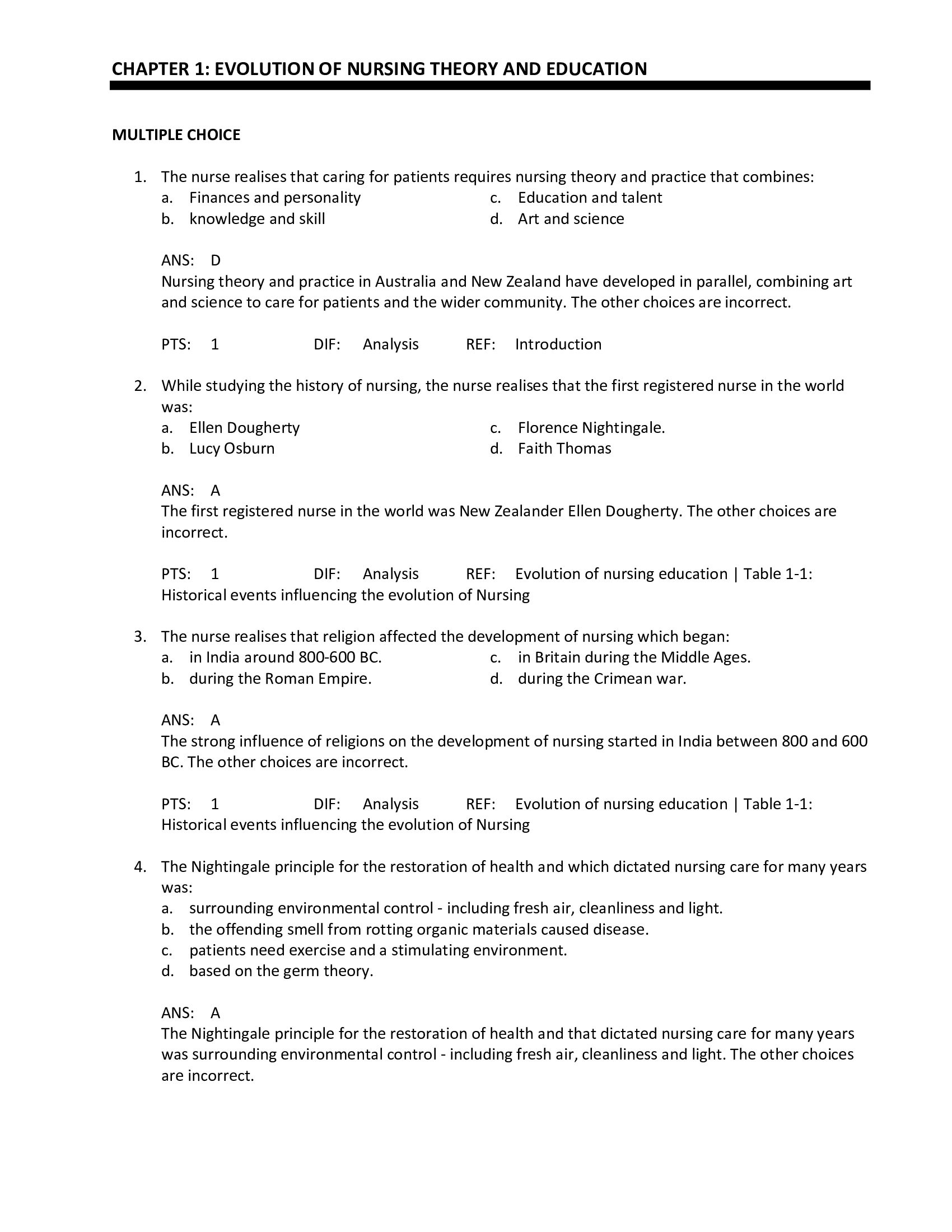
CHAPTER 1: EVOLUTION OF NURSING THEORY AND EDUCATION

MULTIPLE CHOICE

1.          The nurse realises that caring for patients requires nursing theory and practice that combines:

a.       Finances and personality        c.             Education and talent 

b.      knowledge and skill   d. Art and science 


              ANS:     D

Nursing theory and practice in Australia and New Zealand have developed in parallel, combining art and science to care for patients and the wider community. The other choices are incorrect.


              PTS:      1                           DIF:      Analysis             REF:     Introduction


2.          While studying the history of nursing, the nurse realises that the first registered nurse in the world

was: 


a. Ellen Dougherty

c.     Florence Nightingale.

b. Lucy Osburn

d. Faith Thomas


              ANS:     A

The first registered nurse in the world was New Zealander Ellen Dougherty. The other choices are incorrect.


              PTS:      1                           DIF:      Analysis             REF:     Evolution of nursing education | Table 1-1:

Historical events influencing the evolution of Nursing


3.          The nurse realises that religion affected the development of nursing which began: 

a.       in India around 800-600 BC.    c.             in Britain during the Middle Ages.

b.      during the Roman Empire.     d. during the Crimean war.


              ANS:     A

The strong influence of religions on the development of nursing started in India between 800 and 600 BC. The other choices are incorrect.


              PTS:      1                           DIF:      Analysis             REF:     Evolution of nursing education | Table 1-1:

Historical events influencing the evolution of Nursing


4.          The Nightingale principle for the restoration of health and which dictated nursing care for many years was:

a.       surrounding environmental control - including fresh air, cleanliness and light.

b.      the offending smell from rotting organic materials caused disease.

c.       patients need exercise and a stimulating environment.

d.      based on the germ theory.


              ANS:     A

The Nightingale principle for the restoration of health and that dictated nursing care for many years was surrounding environmental control - including fresh air, cleanliness and light. The other choices are incorrect.


              PTS:      1                           DIF:      Analysis             REF: Florence Nightingale (1820-1910)


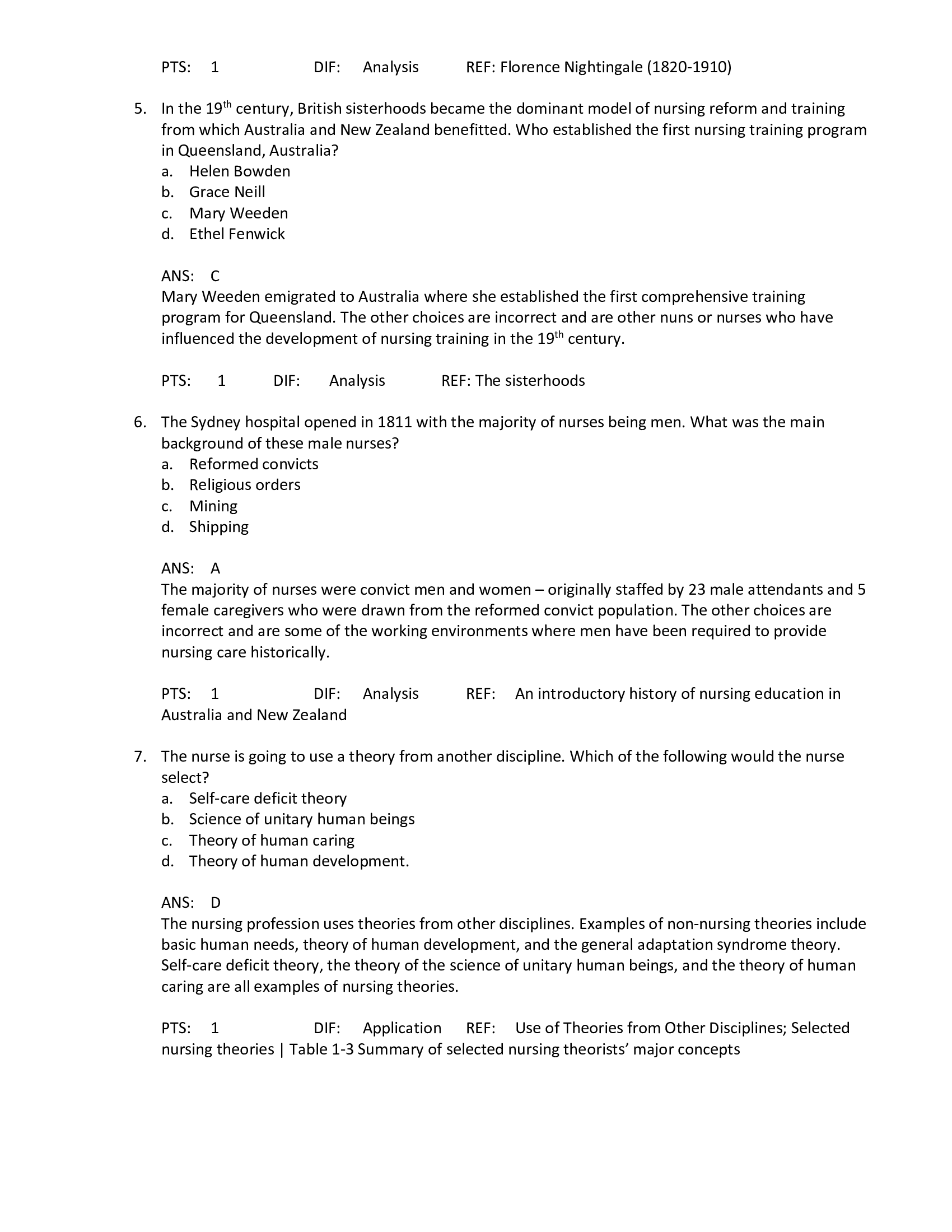
5.          In the 19th century, British sisterhoods became the dominant model of nursing reform and training from which Australia and New Zealand benefitted. Who established the first nursing training program in Queensland, Australia? a. Helen Bowden

b.      Grace Neill

c.       Mary Weeden

d.      Ethel Fenwick


              ANS:    C

Mary Weeden emigrated to Australia where she established the first comprehensive training program for Queensland. The other choices are incorrect and are other nuns or nurses who have influenced the development of nursing training in the 19th century.


              PTS:        1             DIF:        Analysis               REF: The sisterhoods


6.          The Sydney hospital opened in 1811 with the majority of nurses being men. What was the main background of these male nurses? a. Reformed convicts

b.      Religious orders

c.       Mining

d.      Shipping


              ANS:     A

The majority of nurses were convict men and women – originally staffed by 23 male attendants and 5 female caregivers who were drawn from the reformed convict population. The other choices are incorrect and are some of the working environments where men have been required to provide nursing care historically.


              PTS:      1                           DIF:      Analysis             REF:     An introductory history of nursing education in

Australia and New Zealand


7.          The nurse is going to use a theory from another discipline. Which of the following would the nurse select?

a.       Self-care deficit theory

b.      Science of unitary human beings

c.       Theory of human caring

d.      Theory of human development.


              ANS:     D

The nursing profession uses theories from other disciplines. Examples of non-nursing theories include basic human needs, theory of human development, and the general adaptation syndrome theory. Self-care deficit theory, the theory of the science of unitary human beings, and the theory of human caring are all examples of nursing theories.


              PTS:      1                           DIF:      Application       REF:    Use of Theories from Other Disciplines; Selected

nursing theories | Table 1-3 Summary of selected nursing theorists’ major concepts


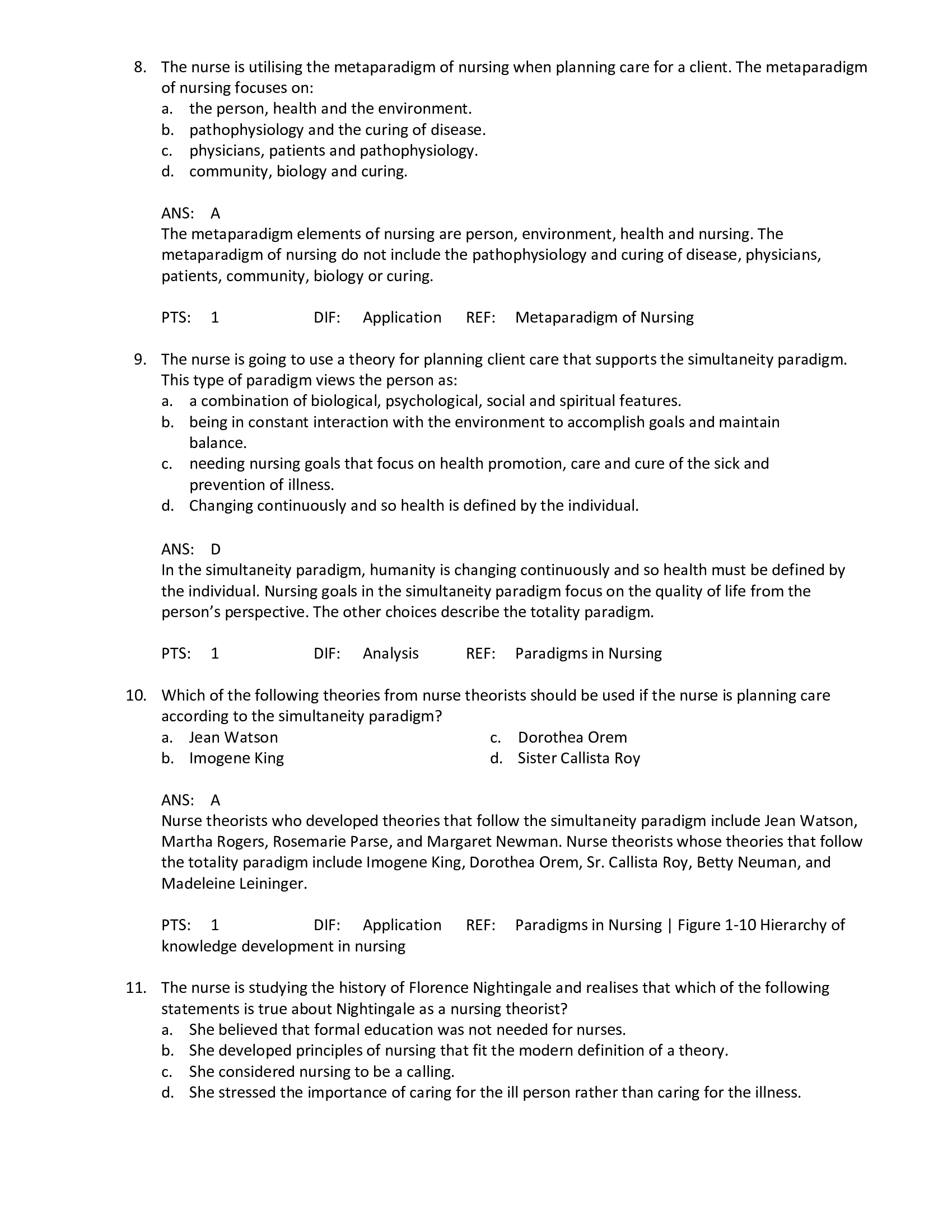
8.          The nurse is utilising the metaparadigm of nursing when planning care for a client. The metaparadigm of nursing focuses on:

a.       the person, health and the environment.

b.      pathophysiology and the curing of disease.

c.       physicians, patients and pathophysiology.

d.      community, biology and curing.


              ANS:     A

The metaparadigm elements of nursing are person, environment, health and nursing. The metaparadigm of nursing do not include the pathophysiology and curing of disease, physicians, patients, community, biology or curing.


              PTS:      1                           DIF:      Application       REF:     Metaparadigm of Nursing


9.          The nurse is going to use a theory for planning client care that supports the simultaneity paradigm.

This type of paradigm views the person as:

a.       a combination of biological, psychological, social and spiritual features.

b.      being in constant interaction with the environment to accomplish goals and maintain balance.

c.       needing nursing goals that focus on health promotion, care and cure of the sick and prevention of illness.

d.      Changing continuously and so health is defined by the individual.


              ANS:     D

In the simultaneity paradigm, humanity is changing continuously and so health must be defined by the individual. Nursing goals in the simultaneity paradigm focus on the quality of life from the person’s perspective. The other choices describe the totality paradigm.


              PTS:      1                           DIF:      Analysis             REF:     Paradigms in Nursing


10.       Which of the following theories from nurse theorists should be used if the nurse is planning care according to the simultaneity paradigm? 

a.       Jean Watson                c.             Dorothea Orem

b.      Imogene King              d. Sister Callista Roy


              ANS:     A

Nurse theorists who developed theories that follow the simultaneity paradigm include Jean Watson, Martha Rogers, Rosemarie Parse, and Margaret Newman. Nurse theorists whose theories that follow the totality paradigm include Imogene King, Dorothea Orem, Sr. Callista Roy, Betty Neuman, and Madeleine Leininger.


PTS:          1              DIF:        Application         REF:       Paradigms in Nursing | Figure 1-10 Hierarchy of knowledge development in nursing


11.       The nurse is studying the history of Florence Nightingale and realises that which of the following statements is true about Nightingale as a nursing theorist?

a.       She believed that formal education was not needed for nurses.

b.      She developed principles of nursing that fit the modern definition of a theory.

c.       She considered nursing to be a calling.

d.      She stressed the importance of caring for the ill person rather than caring for the illness.


              ANS:     D

Nightingale’s writings stressed the importance of caring for the ill person rather than caring for the illness. She considered nursing to be both an art and a science and believed that nurses should be formally educated. Nightingale did not develop a theory of nursing as theory is defined today so her principles do not fit the modern definition of a theory. Nightingale did believe that nursing was a calling; however, this has nothing to do with her being viewed as a nursing theorist.


              PTS:      1                           DIF:      Analysis             REF:     Nightingale’s nursing theory


12.       The nurse is planning to use the nursing theory that defines a person as ‘a biopsychosocial being interacting with a dynamic environment.’ Which nurse theorist created this theory?

a.       Martha Rogers            c.             Jean Watson

b.      Sister Callista Roy       d. Myra Levine


              ANS:    B

Sister Callista Roy defines a person as ‘a biopsychosocial being interacting with a dynamic environment.’ Rogers defines a person as a unified irreducible whole that is more than the sum of the parts. Watson defines the person as possessing three spheres: mind, body and soul. Levine defines the person as being who the person knows himself to be.


              PTS:      1                           DIF:      Analysis             REF:     Selected nursing theorists | Table 1-3 Summary of

Selected Nursing Theorists' Major Concepts


13.       The nurse, studying caring, is particularly interested in the theorist who believes ‘caring is the essence of nursing and the most central and unifying focus of nursing practice’. Which nursing theorist made this statement?

a. Jean Watson

c.     Florence Nightingale

b. Martha Rogers

d. Rosemarie Parse


              ANS:     A

Watson stated that ‘caring is the essence of nursing and the most central and unifying focus of nursing practice’. Rogers believed that health is defined by the culture or the individual. Nightingale identified health as a state of well-being and using one’s powers to the fullest extent. Parse identified health as an open process of becoming that encompasses a lived experience, synthesis of values, and rhythmic process of being or becoming.


PTS:          1              DIF:        Analysis                REF:       Theories for the new worldview of nursing | Jean Watson


14.       The nurse, interested in the concept of energy fields, should study which of the following theorists who views humans and the environment as energy fields?

a.       Hildegard Peplau        c.             Martha Rogers

b.      Jean Watson                d. Myra Levine


              ANS:    C

Rogers defined environment as a pandimensional energy field integral with the human energy field. Watson defined environment as an exchange between internal and external variables. Peplau defined environment as external factors and significant others. Levine defined the environment as being the context in which the person lives her life.


              PTS:      1                           DIF:      Application       REF:     Selected nursing theorists | Table 1-3 Summary of

Selected Nursing Theorists' Major Concepts


15.       The nurse is applying the principles of conservation when providing care to a client. Which theorist identified four principles of conservation?

a.       Myra Levine c.             Martha Rogers

b.      Dorothea Orem          d. Rosemarie Parse


              ANS:     A

According to Levine, there are four principles of conservation. Neither Orem, Rogers nor Parse identified principles of conservation.


              PTS:      1                           DIF:      Analysis             REF:     Contemporary Nursing Theories | Myra Levine


16.       The nurse is utilising Dorothea Orem’s nursing model when planning client care. In this model, the role of the nurse is to:

a.       compensate for what the patient cannot do and help patients develop self-care abilities.

b.      promote the client’s adaptive behaviours by manipulating stimuli.

c.       identify and help the individual respond to stressors.

d.      help clients develop patterns of living that accommodate environmental changes.


              ANS:     A

Dorothea Orem developed the self-care deficit theory of nursing which has three theories: theory of self-care, theory of self-care deficit, and theory of nursing systems. In these models the role of the nurse is to compensate for what the patient cannot do and help patients develop self-care abilities. The other choices are not parts of Orem’s nursing theory.


              PTS:      1                           DIF:      Application       REF:     Contemporary Nursing Theories | Dorothea Orem


17.       The nurse is reviewing a theory for the conceptual framework. A theory is:

a.       A statement that proposes a relationship between concepts.

b.      A complex mental formulations on one’s perceptions of the world

c.       A set of concepts and their relationship to each other that provides explanations and predictions about phenomena.

d.      An observable fact and assists us in formulating a mental image of an object or situation


              ANS:    B

A theory is a set of concepts and their relationship to each other that provides explanations and predictions about phenomena. The other choices are incorrect and describe propositions, concepts and phenomenon.


              PTS:        1             DIF:        Analysis                REF:       Components of the Theoretical Foundation


18.       The nursing activity that best demonstrates Nightingale’s theory of nursing is:

a.       taking the client to the hospital chapel in a wheelchair.

b.      manipulating the client’s energy fields through therapeutic touch.

c.       working with a community group to improve air quality in the city.

d.      working with the client to identify their needs and formulate mutual goals.


              ANS:    C

Nightingale’s theory included the principles of sanitation and the relationship between environment and health. A person’s health was the direct result of environmental influences such as cleanliness, light, pure water, pure air, and efficient drainage. The other choices are not parts of Nightingale’s theory of nursing.


              PTS:      1                           DIF:      Application       REF:      Florence Nightingale (1820-1910)


19.       The nurse is participating in a nursing research study. Nursing research is best defined as a:

a.       concept that provides a framework for thought in which to examine situations.

b.      method of study that clarifies beliefs, values and goals in nursing.

c.       systematic application of formalised methods for generating valid and dependable information about nursing practice.

d.      field of study that includes the biological, physical and behavioural sciences.


              ANS:    C

Nursing research is the systematic application of formalised methods for generating valid and dependable information about the phenomena of concern to the discipline of nursing. A discipline is a field of study that includes the biological, physical and behavioural sciences. A theory can be defined as being either a concept that provides a framework for thought in which to examine situations or a method of study that clarifies beliefs, values and goals in nursing.


              PTS:        1             DIF:        Application         REF:       Importance of nursing theories


20.       The nurse, giving direction to a nursing assistant for client care, realises that which of the following nurse leaders opposed the movement to put untrained nursing aides under the control of physicians during World War I?

a. Clara Barton

c.     Annie Goodrich

b. Isabel Hampton Robb

d. Jane Delano


              ANS:     D

During World War I, Delano was opposed to the aide education plan created by physicians who wanted the Red Cross to put untrained nursing aides at their sides to assist with war casualties. Annie Goodrich was in favour of the physicians’ aide education plan. Robb was a supporter of the rights of nursing students. Clara Barton was a nurse during the Civil War.


              PTS:      1                           DIF:      Analysis             REF:     Nursing Pioneers and Leaders


21.       The nurse is planning to utilise Peplau’s nursing theory since it provides a perspective from which to view complex situations and direct interventions. Peplau’s theory would be considered: 

a.       micro-range theory. c.             nursing theory.

b.      grand theory.               d. middle-range theory.


              ANS:     D

Peplau utilises the middle-range theory which views complex situations more narrowly to help direct interventions. The other choices are incorrect.


              PTS:        1             DIF:        Application         REF:      Scope of Theories | middle-range theories


22.       The nurse, assessing a client for stressors, is implementing which of the following nursing theorists’ hypothesis, which focused on the wellness of the client system in relation to environmental stressors and reactions to stressors?

a. Hilda Peplau

c.    Joyce Travelbee

b. Betty Neuman

d. Sister Callista Roy


              ANS:    B

Betty Neuman’s systems model focuses on the wellness of the client system in relation to environmental stressors and reactions to stressors. Peplau’s theory focused on the development of the nurse-client relationship. Travelbee’s theory focused on existentialism. Roy’s theory focuses on adaptation and coping mechanisms.


              PTS:      1                           DIF:      Application       REF:    Contemporary Nursing Theories | Betty Neuman


23.       The nurse is assisting a client to perform activities that contribute to the client’s health that the client would do unassisted if able. The nurse is implementing the theory of which nursing theorist?

a.       Dorothea Orem          c.             Virginia Henderson

b.      Martha Rogers            d. Hilda Peplau


              ANS:    C

Virginia Henderson believed that the unique function of the nurse is to assist the client in the performance of those activities that contribute to health that would be performed unassisted if the client were able. Peplau’s theory focused on the development of the nurse-client relationship. Orem’s theory focused on self-care and self-care deficits. Rogers’ theory of nursing focused on energy fields.


              PTS:      1                           DIF:      Application       REF:     Early Nursing Theories | Virginia Henderson


24.       The nurse is demonstrating empathy while establishing a rapport with a client. Which nursing theorist was most influenced by the philosophy of existentialism and developed the ideas of empathy and rapport?

a. Joyce Travelbee

c.      Myra Levine

b. Dorothea Orem

d. Jean Watson


              ANS:     A

Travelbee was influenced by the philosophy of existentialism and extensively developed the ideas of sympathy, empathy, and rapport in which the nurse relates to the uniqueness of others. Levine’s theory focused on conservation. Orem’s theory focused on self-care and self-care deficits. Watson’s theory focuses on human caring and can be linked to Travelbee’s theory.


              PTS:      1                           DIF:      Application       REF:     Early Nursing Theories | Joyce Travelbee


25.       The theorists who were influenced by existentialism developed theories that would most likely be

categorised as fitting in with:


a. the nursing process.

c.     the totality paradigm.

b. the simultaneity paradigm.

d. the Unitarian paradigm.


              ANS:    B

Existentialism is defined as a movement that is centred on individual existence in an

incomprehensible world and the role that free will plays in it and searches to find meaning in life’s experiences. In the simultaneity paradigm, whole means unitary and the unitary human has characteristics that are different from the parts and cannot be understood by a knowledge of the parts. Nursing goals in the simultaneity paradigm focus on the quality of life from the person’s perspective. In the totality paradigm, the person is in constant interaction with the environment to accomplish goals and maintain balance. The nursing process consists of assessment, planning, implementation and evaluation. The Unitarian paradigm does not fit into the discipline of nursing.


              PTS:      1                           DIF:      Analysis             REF:     Paradigms in Nursing


26.       The nurse is talking with a client in efforts to strengthen the new relationship. Which nursing theorist defined the concepts and stages involved in the development of the nurse-client relationship?

a.       Madeleine Leininger                 c.             Imogene King

b.      Betty Neuman             d. Hildegard Peplau


              ANS:     D

Peplau defined the concepts and stages involved in the development of the nurse-client relationship. Leininger’s theory focuses on cultural diversity. Neuman’s model focuses on the wellness of the client system in relation to environmental stressors and reactions to stressors. King’s theory focuses on general systems.


              PTS:        1             DIF:        Application         REF:       Early Nursing Theories | Hildegard Peplau


27.       The nurse is providing culturally competent care to a client. Which nursing theorist is best known for emphasising the importance of cultural competency in nursing care?

a.       Hildegard Peplau        c.             Betty Neuman

b.      Madeline Leininger   d. Imogene King


              ANS:    B

Leininger’s theory of cultural care diversity was first published in 1978; it provides specific interventions to assist people of diverse cultures. Peplau’s theory focused on the development of the nurse-client relationship. Neuman’s theory focused on environmental stressors and the reactions to stressors. King’s module focused on general systems.


              PTS:      1                           DIF:         Application  REF:       Contemporary Nursing Theories | Madeline

Leininger


28.       The nurse applying culture care diversity theory, is implementing the concept of repatterning and restructuring. This means the nurse is: 

a.       accepting and complying with the client’s cultural beliefs.

b.      adapting his beliefs and values to the client’s beliefs.

c.       planning and negotiating to accommodate to the client’s food preferences and religious practices.

d.      becoming knowledgeable about the client’s culture to adjust nursing care as needed.


              ANS:     D

Within Leininger’s theory of cultural care diversity, one intervention is cultural care repatterning or restructuring. This means the nurse is knowledgeable about cultural care and develops ways to adjust care as needed. The intervention of cultural care preservation or maintenance means the nurse accepts and complies with the client’s cultural beliefs. The intervention of cultural care

accommodation or negotiation means the nurse plans and negotiates to accommodate to the client’s

food preferences and religious practices. Adapting the nurse’s beliefs and values to the client’s beliefs is not a part of cultural care diversity theory.


              PTS:      1                           DIF:      Application       REF:     Contemporary Nursing Theories | Madeline

Leininger


29.       The nurse is studying client assessment data in efforts to formulate applicable nursing diagnoses. Which nurse theorist was instrumental in defining client problems that served as a foundation for the development of nursing diagnoses?

a. Joyce Travelbee

c.      Virginia Henderson

b. Faye Abdellah

d. Josephine Paterson


              ANS:    B

Abdellah expanded on Henderson’s 14 needs and supported the idea that nursing research would be the key factor in helping nursing to emerge as a true profession. The research done regarding the needs has served as a foundation for the development of what is now known as nursing diagnoses. Travelbee developed the ideas of sympathy, empathy and rapport. Henderson defined basic human needs as the foundation of nursing care. Paterson developed a theory that was based upon the humanistic and existential basis of nursing practice. Paterson’s theory was not popular and did not gain application in nursing.


              PTS:      1                           DIF:      Application       REF:     Early Nursing Theories | Faye Abdellah


30.       The nurse is helping a client adapt to stressors that have caused ineffective coping. Which nursing theorist sees the person as an adaptive system who may need assistance with adaptation when stressors and ineffective coping occur?

a.       Martha Rogers            c.             Sister Callista Roy

b.      Betty Neuman             d. Faye Abdellah


              ANS:    C

Roy’s theory defines a person as an adaptive system that is in constant interaction with the environment. Nursing provides the assistance with adaptation when stressors and ineffective coping occur. Abdellah supported nursing research and studied client needs that serve as the foundation for the development of nursing diagnoses. Neuman’s model focuses on environmental stressors and reactions to stressors. Roger’s theory identifies the person as an energy field.


              PTS:      1                           DIF:      Application       REF:     Theories for the New Worldview of Nursing


31.       The nurse is assessing a client for her current quality of life. Which nurse theorist defined the concept of quality of life? 

a. Rosemarie Parse

c.     Hildegard Peplau

b. Virginia Henderson

d. Madeline Leininger


              ANS:     A

Parse’s theory is of human becoming and the human-universe-health process. The goal of nursing from this perspective is quality of life. Henderson identified basic human needs as the basis for nursing care. Peplau developed the theory to support the nurse-client relationship. Leininger’s theory focuses on cultural care diversity.


              PTS:      1                           DIF:         Application  REF:       Theories for the New Worldview of Nursing |

Rosemarie Parse


32.       The nurse is participating in a nursing research study based upon a particular nurse theory. The nurse

is ultimately helping to develop:


a. standardised nursing care plans.

c.     nursing practice standards.

b. protocols.

d. client discharge criteria.


              ANS:    C

Nursing practice, theory and research are interdependent. Nursing theory development and nursing research activities are directed toward developing nursing practice standards. The nurse is not helping to develop standardised nursing care plans, protocols or client discharge criteria.


PTS: 1 DIF: Analysis REF: Importance of nursing theories | Figure 1-9 Process of knowledge development


33.       The nurse is using conversation with a client in efforts to optimise the client’s resources. The nursing theory that the nurse is implementing is: 

a.       Environmental theory.             c.             Conservation theory.

b.      Science of unitary beings theory.        d. Transcultural caring theory.


              ANS:    C

In the Conservation theory, the nurse uses conversation aimed at optimising the client’s resources. In the Environmental theory, the nurse facilitates healing and restores health by manipulating the client’s environment. In the Science of Unitary Beings theory, nursing is the creative use of science for human betterment. In the Transcultural Caring theory, caring is the central unifying domain for nursing knowledge and practice.


              PTS:      1                           DIF:      Application       REF:     Selected nursing theories | Table 1-3: Summary of

Selected Nursing Theorists' Major Concepts


34.       The nursing student is studying the question ‘what do nurses do?’ Which nurse theorist focused on answering this question?

a. Imogene King

c.    Martha Rogers

b. Dorothea Orem

d. Madeline Leininger


              ANS:    B

Orem’s theory of nursing systems attempts to answer the question ‘What do nurses do?’ This was the original question that prompted the development of Orem’s theory. The other theorists did not attempt to answer the question ‘What do nurses do?’


              PTS:      1                           DIF:      Application       REF:     Contemporary Nursing Theories | Dorothea Orem


35.       The nurse providing care to a client in the intensive care unit is working with a variety of medical devices and providing treatments in order to support the client’s changing physiological needs. The one concept that the nurse strives to preserve while facing these challenges is the notion of:

a.       caring.             c.             sympathy.

b.      empathy.       d. balance.


              ANS:     A

Knowledge, information and technology in health care and nursing are growing at unprecedented

rates. In the face of these advances and challenges, nursing strives to preserve the notion of caring in health care. Empathy and sympathy may or may not be achieved when providing care to a client in the intensive care unit. Balance may or may not be achieved while providing care to a client in the intensive care unit.


              PTS:      1                           DIF:      Application       REF:     Continuing Evolution of Nursing Theory

Contact the Seller

Please Sign In to contact this seller.


  • 👎  Report Copyright Violation

Frequently Asked Questions

What Do I Get When I Buy This Study Material?

+

When you buy a study material on Passing Grades, an instant download link will be sent directly to your email, giving you access to the file anytime after payment is completed.

Is Passing Grades a Trusted Platform?

+

Yes, Passing Grades is a reputable students’ marketplace with a secure payment system and reliable customer support. You can trust us to ensure a safe and seamless transaction experience.

Will I Be Stuck with a Subscription?

+

No, all purchases on Passing Grades are one-time transactions. You only pay for the notes you choose to buy, with no subscriptions or hidden fees attached.

Who Am I Buying These Study Materials From?

+

Passing Grades is a marketplace, which means you are purchasing the document from an individual vendor, not directly from us. We facilitate the payment and delivery process between you and the vendor.

Does Passing Grades Offer Free Study Materials?

+

Yes, sellers on Passing Grades have uploaded numerous free test banks, exams, practice questions, and class notes that can be downloaded at no cost.

Pasinggrades - Quality Study Materials

USD 15

    • Quality checked by Pasing Grades
    • 100% satisfaction guarantee
    • Seller: mentor2000
Buy PDF $15

Seller Information

mentor2000

Member since April 2021

  • icon
  • icon
View Profile
  • total sales

    0
  • Favourites

    0
  • Comments

    0
    ( 0 Ratings )

Item Information

  • Uploaded

    22 May 2022

  • Updated

    16 May 2025

  • Category

    Nursing

  • Item Type

    test bank

  • Tags

    Test Bank for Fundamentals of Nursing 1st Australia and New Zealand Edition by DeLaune

Related Exam Prep Guides by mentor2000

Test Bank for Essentials for Nursing Practice 8th Edition by Potter | All Chapters
View Document

Test Bank for Essent...

  • mentor2000

    mentor2000

  • test bank

Master nursing concepts with this study material; Test Bank for Essentials for Nursing Practice, 8th...

15 USD

0

0

A &P 1 MA278 BSC2 Final Module II Questions & Answers 2026 Update
View Document

A &P 1 MA278 BSC2 Fi...

  • mentor2000

    mentor2000

  • test bank

Prepare for success with A&P 1 MA278 BSC2 Final Module II 2024 Q&A. Boost your grades with this comp...

15 USD

0

0

ATI Comprehensive Predictor Exam 2026
View Document

ATI Comprehensive Pr...

  • mentor2000

    mentor2000

  • test bank

Prepare for success with the ATI Comprehensive Predictor Exam 2026. Access key practice questions to...

15 USD

0

0

Purchase

Download link will be sent to this email immediately after purchase.

IMPORTANT LINKS

  • How To Upload Class Notes
  • Selling Tips
  • Passing Grades's Study Materials
  • Scholarships for International Students 2025

POPULAR CATEGORIES

  • Law
  • Accounting
  • English
  • Psychology
  • Business
  • Nursing
  • Computer Science
  • General

View Document

  • Blog
  • Contact
  • Delivery Policy
  • Latest Scholarships Around the World
  • How to Pass Bar Exams: Passing Grades’ Strategies
  • How to Study and Pass the CPA Exam
  • All Test Banks
  • Faq
  • Copyright Claims
  • Privacy Policy
  • Terms of Use

KNOWLEDGE BASE

  • How to Write A+ Grade Good Research Paper
  • How to Manage Stress During Exam Period
  • Best Time to Study
  • How to Pass NCLEX-RN Exam
  • How To Effectively Utilize Test Banks
  • Popular Shadow Health Exam Assessments
  • Popular HESI Case Studies
  • How to Prepare for a Nursing Career
  • The Importance Of Summaries in Exam Revisvion

© 2026 Pasing Grades. All rights reserved.