Pasing Grades
  • Start Selling
  • Blog
  • Contact
  • 0

    Your cart is empty!

English

  • English
  • Spanish
  • Arabic
Create Account Sign In
  • Library
    • New Prep Guides
    • Featured Prep Guides
    • Free Exam Prep Guides
    • Best sellers
  • General
  • Nursing
    • Research Paper
    • Case Study
    • Discussion Post
    • Assignment
    • Exam
    • Practice Questions and Answers
    • Test Bank
    • solutions manual
  • Accounting
    • Case Study
    • Thesis
    • Study Guide
    • Summary
    • Research Paper
    • test bank
  • English
    • Creative Writing
    • Research Paper
    • Summary
    • Rhetorics
    • Literature
    • Journal
    • Exam
    • Grammar
    • Discussion Post
    • Essay
  • Psychology
    • Hesi
    • Presentation
    • Essay
    • Summary
    • Study Guide
    • Essay
    • Solution Manual
    • Final Exam Review
    • Class Notes
    • test bank
  • Business
    • Lecture Notes
    • Solution Manual
    • Presentation
    • Business Plan
    • Class Notes
    • Experiment
    • Summary
    • Practice Questions
    • Study Guide
    • Case Study
    • test bank
    • Exam
  • More
    • Computer Science
    • Economics
    • Statistics
    • Engineering
    • Biology
    • Religious Studies
    • Physics
    • Chemistry
    • Mathematics
    • History
    • Sociology
    • Science
    • Philosophy
    • Law
  • Pages
    • About Us
    • Selling Tips
    • Delivery Policy
    • Faq
    • Privacy Policy
  • Flash Sale
  • Home
  • Test Bank For Financial Markets And Institutions 8th Edition By Saunders

Test Bank For Financial Markets And Institutions 8th Edition By Saunders

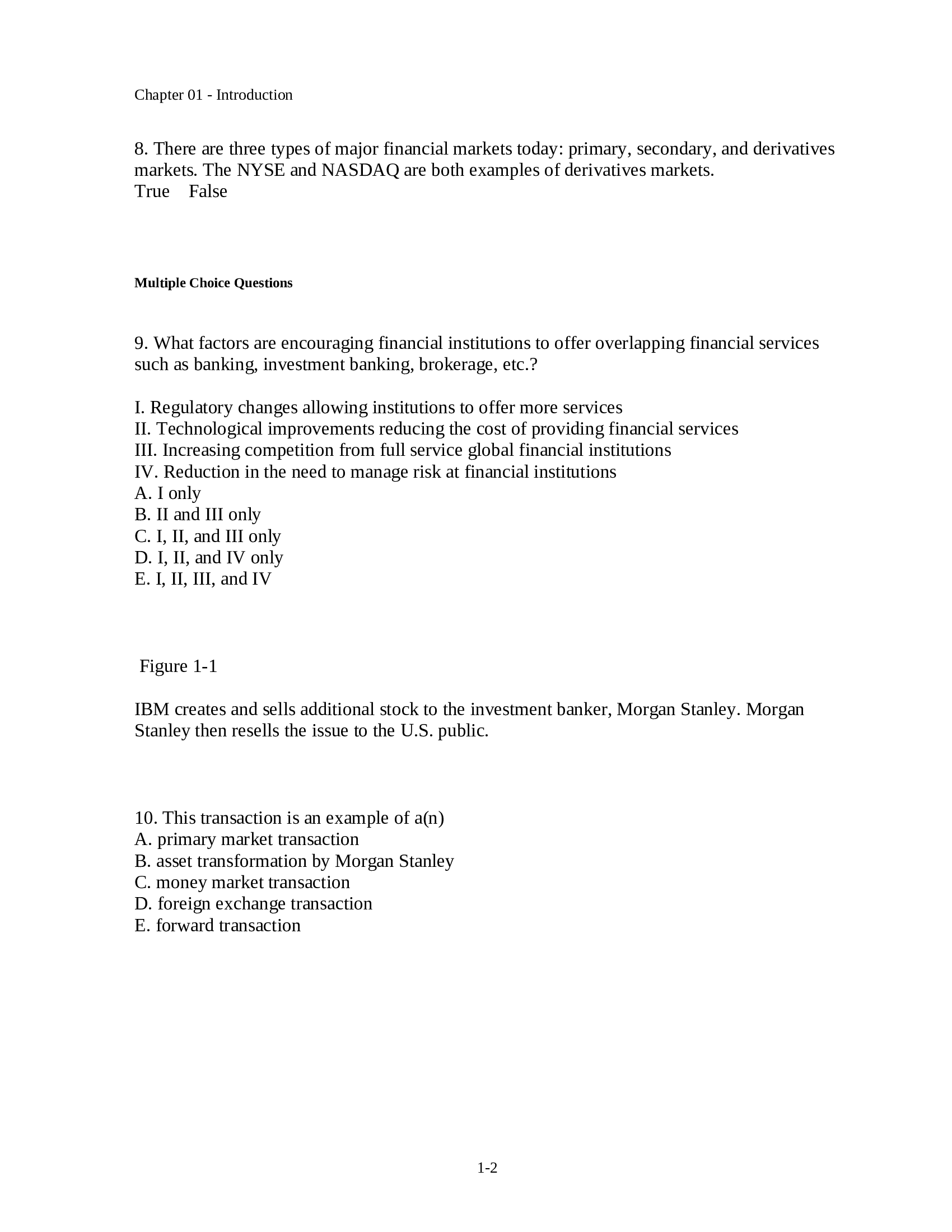
Preview page 1 Preview page 2 Preview page 3
Add To Favorites

Share this item Share this item

  • Item Details
  • Comments (0)
  • Reviews (0)
  • Contact Seller

Test Bank For Financial Markets And Institutions 8th Edition By Saunders 

Chapter 10 - Derivative Securities Markets

63. A stock is priced at $33.25. The stock has 35 call options that expire in 60 days. The

underlying stock price volatility is 39% per year and the annual risk-free rate is 4.5%.

According to the Black-Scholes option pricing model, what is the most you should be willing

to pay for this call option? 


using the Normsdist function in excel to find N(dx)

C

0

 = ($33.25 x 0.42131) - [$35e

-0.045(60/365)

 x 0.3607]= $1.4781 or $147.81 per contract

Feedback: Note to Instructor: This is an Appendix question and it requires either a cumulative

normal density table or access to the Excel function Normsdist to find N(dx).


AACSB: Analytic

AACSB: Reflective Thinking

Blooms: Analyze

Blooms: Apply

Difficulty: 3 Difficult

Learning Goal: 10-04 Recognize what option contracts are.

Topic: Black-Scholes Option Pricing Model


10-46


Chapter 11 - Commercial Banks: Industry Overview


True / False Questions


Chapter 11

Commercial Banks: Industry Overview

1. Business loans have dropped in importance since 1987 as measured by the proportion of

these loans on the bank balance sheet.

True    False


2. Loans comprise the single largest asset category for a bank.

True    False


3. Banks have an average total debt ratio of about 90%.

True    False


4. On average, bank liabilities tend to have shorter maturities and greater liquidity than bank

assets.

True    False


5. Nontransaction deposits at banks include NOW accounts and demand deposits.

True    False


6. The majority of banks are nationally chartered and insured by the FDIC.

True    False


7. Since 1980 the number of banks in the United States has been increasing dramatically due

to deregulation of the industry.

True    False


11-1

Chapter 11 - Commercial Banks: Industry Overview

8. Small banks control about 70% of banking industry assets.

True    False


9. In 2010, the notional value of bank off-balance-sheet activities was greater than bank

industry assets.

True    False


Multiple Choice Questions


10. Banking may be subdivided into at least three categories of banks. Match up the

definitions with the appropriate name.

I. A bank that specializes in retail or consumer banking in a local market.

II. A bank that engages in a complete array of wholesale commercial banking activities and

usually also provides retail banking services.

III. A bank that is located in a financial center and relies on nondeposit or borrowed sources

of funds for a significant portion of its liabilities.

A. Money center bank; Community bank; Super-regional bank

B. Community bank; Money center bank; Super-regional bank

C. Super-regional bank; Money center bank; Community bank

D. Money center bank; Super-regional bank; Community bank

E. Community bank; Super-regional bank; Money center bank


11. Bank assets tend to have _____________ maturities and _____________ liquidity than/as

bank liabilities.

A. longer; greater

B. longer; lower

C. shorter; greater

D. shorter; lower

E. equal; equal


11-2

Chapter 11 - Commercial Banks: Industry Overview

12. In comparison to small banks, larger banks typically have

A. more equity capital

B. more core deposits

C. more off-balance-sheet activities

D. larger net interest margins

E. all of the above


13. In terms of profitability, a well-run bank usually has an ROA of

A. 0.5-3%

B. 3-5%

C. 5-10%

D. 10-15%

E. 15-20%


14. Which of the following could result in a negative NIM?

A. Growth in net interest income

B. Lower non interest expense

C. Decline in net interest income

D. Higher non interest income

E. Positive net interest spread


15. Most of the changes in size, structure, and composition of the banking industry in recent

years are due to

A. bank failures

B. increasing regulations

C. new charters granted

D. declines in the number of branch offices

E. mergers and acquisitions


11-3

Chapter 11 - Commercial Banks: Industry Overview

16. About __________________ of federally insured banks are nationally chartered and about

__________________ of federally insured banks are members of the Federal Reserve.

A. 77%; 65%

B. 65%; 77%

C. 34%; 22%

D. 22%; 34%

E. 40%; 60%


17. Nationally chartered banks receive chartering and merger approval from the

A. Federal Deposit Insurance Corporation

B. Office of Comptroller of the Currency

C. Federal Reserve System

D. Office of Thrift Supervision

E. Any of the above may grant a charter and approve a merger.


18. State chartered banks ________________ be members of the Federal Reserve System and

nationally chartered banks ________________ be members of the Federal Reserve System.

A. must; may

B. must; must

C. may; must

D. may; may


19. The largest single category of loans on the typical bank's balance sheet in 2010 was

A. U.S. government securities

B. commercial and industrial loans

C. consumer loans

D. real estate loans

E. interbank loans


11-4

Chapter 11 - Commercial Banks: Industry Overview

20. Equity capital at commercial banks in 2010 comprised about ____________ of liabilities

and equity.

A. 25%

B. 21%

C. 55%

D. 11%

E. 5%


21. Commercial banks are the __________________ financial intermediary in the United

States as measured by asset size.

A. largest

B. second-largest

C. third-largest

D. fourth-largest

E. fifth-largest


22. The provision of banking services to other banks, such as check clearing, foreign

exchange trading, etc., are examples of

A. correspondent banking

B. trust services

C. off-balance-sheet assets

D. economies of scope

E. credit derivatives


23. A contingent promise by a bank to pay a bill when it comes due if the bill's originator fails

to pay is an example of a

A. swap agreement

B. standby letters of credit

C. forward contract

D. loan commitment

E. commitment to buy foreign exchange


11-5

Chapter 11 - Commercial Banks: Industry Overview

24. A contingent item that may eventually be placed on the right-hand side of the balance

sheet or expensed on the income statement is a(n)

A. loan commitment

B. off-balance-sheet liability

C. off-balance-sheet asset

D. net charge-off

E. loan sold without recourse


25. Reasons behind the drop in bank profitability in the second half of this decade include

I. flattening of the yield curve.

II. increase in competitive pressures on asset pricing.

III. increases in foreclosures in the mortgage market.

IV. increases in net interest margin.

A. I only

B. II and III only

C. I, II, and III only

D. II, III, and IV only

E. III and IV only


26. Loans past due 90 days or more and loans that are not accruing interest because of

problems of the borrower are called

A. loan losses

B. net charge-offs

C. provisional loans

D. noncurrent loans

E. contra loans


27. Which of the following is the primary regulator of bank holding company activities?

A. Federal Bank Holding Company Board

B. FDIC

C. Federal Reserve

D. State regulatory agency in the chartering states

E. U.S. Treasury


11-6

Chapter 11 - Commercial Banks: Industry Overview

28. Banks differ from other types of depository institutions in that

I. banks have more diversified asset portfolios.

II. banks obtain funds from more different types sources.

III. the average size bank is larger than other depository institutions.

A. I only

B. I and II only

C. I and III only

D. II and III only

E. I, II, and III


29. Advantages of going global for U.S. banks include all but which one of the following?

A. Diversification of earnings

B. Greater opportunities to exploit economies of scale

C. Greater sources of funds

D. Conducting business in less regulated environments

E. Low fixed costs involved in international expansion


30. An ILC is a type of

A. finance company

B. thrift institution

C. credit card bank

D. nonbank bank

E. foreign-owned loan corporation


31. A bank has an interest rate spread of 150 basis points on $30 million in earning assets

funded by interest bearing liabilities. However, the interest rate on its assets is fixed and the

interest rate on its liabilities is variable. If all interest rates go up 50 basis points, the bank's

new pre-tax net interest income will be __________.

A. $600,000

B. $450,000

C. $300,000

D. $250,000

E. $175,000


11-7

Chapter 11 - Commercial Banks: Industry Overview

32. A bank is earning 6% on its $150 million in earning assets and is paying 4.75% on its

liabilities. The bank's NIM is __________________.

A. 6.00%

B. 4.75%

C. 1.25%

D. 10.75%

E. 1.26%


Short Answer Questions


33. The ROA for financial institutions such as banks is typically quite low as compared to

non-financial firms. Why? With such a low ROA, how can banks attract stockholders? 


34. Why are loans such a high percentage of total assets at the typical bank? What four broad

classes of loans do banks engage in? 


35. Most non-financial firms would never hold as much of their assets in safe liquid securities

as banks do. Why do banks maintain such a high percentage of investment in securities? 


11-8

Chapter 11 - Commercial Banks: Industry Overview

36. What are the major sources of funds for banks? Provide a breakdown of all the major

sources of funds at a bank and briefly describe the different types of deposits/non-deposit

sources. 


37. What are the major advantages a bank gains by expanding into international bank

services? What are three disadvantages of international expansion? 


38. Why are banks different from other depository institutions? 


39. Discuss the major differences between large banks and small banks. Which have had 

higher ROAs? Why? 


11-9

Chapter 11 - Commercial Banks: Industry Overview

40. Why did bank profitability decline beginning in late 2006 and through 2008? 


11-10

Chapter 11 - Commercial Banks: Industry Overview

Chapter 11 Commercial Banks: Industry Overview Answer Key


True / False Questions


1. Business loans have dropped in importance since 1987 as measured by the proportion of

these loans on the bank balance sheet.

TRUE


AACSB: Reflective Thinking

Blooms: Remember

Difficulty: 2 Medium

Learning Goal: 11-02 Identify the main assets held by commercial banks.

Topic: Balance Sheets and Recent Trends


2. Loans comprise the single largest asset category for a bank.

TRUE


AACSB: Reflective Thinking

Blooms: Remember

Difficulty: 1 Easy

Learning Goal: 11-02 Identify the main assets held by commercial banks.

Topic: Balance Sheets and Recent Trends


3. Banks have an average total debt ratio of about 90%.

TRUE


AACSB: Reflective Thinking

Blooms: Remember

Difficulty: 2 Medium

Learning Goal: 11-03 Identify the main liabilities held by commercial banks.

Topic: Balance Sheets and Recent Trends


11-11

Chapter 11 - Commercial Banks: Industry Overview

4. On average, bank liabilities tend to have shorter maturities and greater liquidity than bank

assets.

TRUE


AACSB: Reflective Thinking

Blooms: Remember

Difficulty: 1 Easy

Learning Goal: 11-03 Identify the main liabilities held by commercial banks.

Topic: Balance Sheets and Recent Trends


5. Nontransaction deposits at banks include NOW accounts and demand deposits.

FALSE


AACSB: Reflective Thinking

Blooms: Remember

Difficulty: 1 Easy

Learning Goal: 11-03 Identify the main liabilities held by commercial banks.

Topic: Balance Sheets and Recent Trends


6. The majority of banks are nationally chartered and insured by the FDIC.

FALSE


AACSB: Reflective Thinking

Blooms: Remember

Difficulty: 1 Easy

Learning Goal: 11-07 Know the main regulators of commercial banks.

Topic: Regulators


7. Since 1980 the number of banks in the United States has been increasing dramatically due

to deregulation of the industry.

FALSE


AACSB: Reflective Thinking

Blooms: Remember

Difficulty: 2 Medium

Learning Goal: 11-05 Discuss which factors have motivated the significant decrease in the number of commercial banks.

Topic: Size, Structure, and Composition of the Industry


11-12

Chapter 11 - Commercial Banks: Industry Overview

8. Small banks control about 70% of banking industry assets.

FALSE


AACSB: Reflective Thinking

Blooms: Remember

Difficulty: 1 Easy

Learning Goal: 11-05 Discuss which factors have motivated the significant decrease in the number of commercial banks.

Topic: Size, Structure, and Composition of the Industry


9. In 2010, the notional value of bank off-balance-sheet activities was greater than bank

industry assets.

TRUE


AACSB: Reflective Thinking

Blooms: Remember

Difficulty: 2 Medium

Learning Goal: 11-04 Understand the types of off-balance-sheet activities that commercial banks undertake.

Topic: Balance Sheets and Recent Trends


Multiple Choice Questions


10. Banking may be subdivided into at least three categories of banks. Match up the

definitions with the appropriate name.

I. A bank that specializes in retail or consumer banking in a local market.

II. A bank that engages in a complete array of wholesale commercial banking activities and

usually also provides retail banking services.

III. A bank that is located in a financial center and relies on nondeposit or borrowed sources

of funds for a significant portion of its liabilities.

A. Money center bank; Community bank; Super-regional bank

B. Community bank; Money center bank; Super-regional bank

C. Super-regional bank; Money center bank; Community bank

D. Money center bank; Super-regional bank; Community bank

E. Community bank; Super-regional bank; Money center bank


AACSB: Reflective Thinking

Blooms: Understand

Difficulty: 2 Medium

Learning Goal: 11-05 Discuss which factors have motivated the significant decrease in the number of commercial banks.

Topic: Size, Structure, and Composition of the Industry


11-13

Chapter 11 - Commercial Banks: Industry Overview

11. Bank assets tend to have _____________ maturities and _____________ liquidity than/as

bank liabilities.

A. longer; greater

B. longer; lower

C. shorter; greater

D. shorter; lower

E. equal; equal


AACSB: Reflective Thinking

Blooms: Understand

Difficulty: 2 Medium

Learning Goal: 11-02 Identify the main assets held by commercial banks.

Learning Goal: 11-03 Identify the main liabilities held by commercial banks.

Topic: Balance Sheets and Recent Trends


12. In comparison to small banks, larger banks typically have

A. more equity capital

B. more core deposits

C. more off-balance-sheet activities

D. larger net interest margins

E. all of the above


AACSB: Reflective Thinking

Blooms: Remember

Difficulty: 2 Medium

Learning Goal: 11-05 Discuss which factors have motivated the significant decrease in the number of commercial banks.

Topic: Size, Structure, and Composition of the Industry


13. In terms of profitability, a well-run bank usually has an ROA of

A. 0.5-3%

B. 3-5%

C. 5-10%

D. 10-15%

E. 15-20%


AACSB: Reflective Thinking

Blooms: Remember

Difficulty: 2 Medium

Learning Goal: 11-06 Evaluate the performance of the commercial banking industry in recent years.

Topic: Industry Performance


11-14

Chapter 11 - Commercial Banks: Industry Overview

14. Which of the following could result in a negative NIM?

A. Growth in net interest income

B. Lower non interest expense

C. Decline in net interest income

D. Higher non interest income

E. Positive net interest spread


AACSB: Reflective Thinking

Blooms: Understand

Difficulty: 1 Easy

Learning Goal: 11-06 Evaluate the performance of the commercial banking industry in recent years.

Topic: Industry Performance


15. Most of the changes in size, structure, and composition of the banking industry in recent

years are due to

A. bank failures

B. increasing regulations

C. new charters granted

D. declines in the number of branch offices

E. mergers and acquisitions


AACSB: Reflective Thinking

Blooms: Remember

Difficulty: 2 Medium

Learning Goal: 11-05 Discuss which factors have motivated the significant decrease in the number of commercial banks.

Topic: Size, Structure, and Composition of the Industry


16. About __________________ of federally insured banks are nationally chartered and about

__________________ of federally insured banks are members of the Federal Reserve.

A. 77%; 65%

B. 65%; 77%

C. 34%; 22%

D. 22%; 34%

E. 40%; 60%


AACSB: Reflective Thinking

Blooms: Remember

Difficulty: 3 Difficult

Learning Goal: 11-07 Know the main regulators of commercial banks.

Topic: Regulators


11-15

Chapter 11 - Commercial Banks: Industry Overview

17. Nationally chartered banks receive chartering and merger approval from the

A. Federal Deposit Insurance Corporation

B. Office of Comptroller of the Currency

C. Federal Reserve System

D. Office of Thrift Supervision

E. Any of the above may grant a charter and approve a merger.


AACSB: Reflective Thinking

Blooms: Remember

Difficulty: 2 Medium

Learning Goal: 11-07 Know the main regulators of commercial banks.

Topic: Regulators


18. State chartered banks ________________ be members of the Federal Reserve System and

nationally chartered banks ________________ be members of the Federal Reserve System.

A. must; may

B. must; must

C. may; must

D. may; may


AACSB: Reflective Thinking

Blooms: Remember

Difficulty: 1 Easy

Learning Goal: 11-07 Know the main regulators of commercial banks.

Topic: Regulators


19. The largest single category of loans on the typical bank's balance sheet in 2010 was

A. U.S. government securities

B. commercial and industrial loans

C. consumer loans

D. real estate loans

E. interbank loans


AACSB: Reflective Thinking

Blooms: Remember

Difficulty: 2 Medium

Learning Goal: 11-02 Identify the main assets held by commercial banks.

Topic: Balance Sheets and Recent Trends


11-16

Chapter 11 - Commercial Banks: Industry Overview

20. Equity capital at commercial banks in 2010 comprised about ____________ of liabilities

and equity.

A. 25%

B. 21%

C. 55%

D. 11%

E. 5%


AACSB: Reflective Thinking

Blooms: Remember

Difficulty: 2 Medium

Learning Goal: 11-03 Identify the main liabilities held by commercial banks.

Topic: Balance Sheets and Recent Trends


21. Commercial banks are the __________________ financial intermediary in the United

States as measured by asset size.

A. largest

B. second-largest

C. third-largest

D. fourth-largest

E. fifth-largest


AACSB: Reflective Thinking

Blooms: Remember

Difficulty: 1 Easy

Learning Goal: 11-01 Define what a commercial bank is.

Topic: Commercial Banks as a Sector of the Financial Institutions Industry: Chapter Overview


22. The provision of banking services to other banks, such as check clearing, foreign

exchange trading, etc., are examples of

A. correspondent banking

B. trust services

C. off-balance-sheet assets

D. economies of scope

E. credit derivatives


AACSB: Reflective Thinking

Blooms: Remember

Difficulty: 2 Medium

Learning Goal: 11-04 Understand the types of off-balance-sheet activities that commercial banks undertake.

Topic: Balance Sheets and Recent Trends


11-17

Chapter 11 - Commercial Banks: Industry Overview

23. A contingent promise by a bank to pay a bill when it comes due if the bill's originator fails

to pay is an example of a

A. swap agreement

B. standby letters of credit

C. forward contract

D. loan commitment

E. commitment to buy foreign exchange


AACSB: Reflective Thinking

Blooms: Remember

Difficulty: 2 Medium

Learning Goal: 11-04 Understand the types of off-balance-sheet activities that commercial banks undertake.

Topic: Definition of a Commercial Bank


24. A contingent item that may eventually be placed on the right-hand side of the balance

sheet or expensed on the income statement is a(n)

A. loan commitment

B. off-balance-sheet liability

C. off-balance-sheet asset

D. net charge-off

E. loan sold without recourse


AACSB: Reflective Thinking

Blooms: Understand

Difficulty: 2 Medium

Learning Goal: 11-04 Understand the types of off-balance-sheet activities that commercial banks undertake.

Topic: Definition of a Commercial Bank


11-18

Chapter 11 - Commercial Banks: Industry Overview

25. Reasons behind the drop in bank profitability in the second half of this decade include

I. flattening of the yield curve.

II. increase in competitive pressures on asset pricing.

III. increases in foreclosures in the mortgage market.

IV. increases in net interest margin.

A. I only

B. II and III only

C. I, II, and III only

D. II, III, and IV only

E. III and IV only


AACSB: Reflective Thinking

Blooms: Remember

Difficulty: 2 Medium

Learning Goal: 11-06 Evaluate the performance of the commercial banking industry in recent years.

Topic: Industry Performance


26. Loans past due 90 days or more and loans that are not accruing interest because of

problems of the borrower are called

A. loan losses

B. net charge-offs

C. provisional loans

D. noncurrent loans

E. contra loans


AACSB: Reflective Thinking

Blooms: Remember

Difficulty: 2 Medium

Learning Goal: 11-06 Evaluate the performance of the commercial banking industry in recent years.

Topic: Industry Performance


11-19

Chapter 11 - Commercial Banks: Industry Overview

27. Which of the following is the primary regulator of bank holding company activities?

A. Federal Bank Holding Company Board

B. FDIC

C. Federal Reserve

D. State regulatory agency in the chartering states

E. U.S. Treasury


AACSB: Reflective Thinking

Blooms: Remember

Difficulty: 1 Easy

Learning Goal: 11-07 Know the main regulators of commercial banks.

Topic: Regulators


28. Banks differ from other types of depository institutions in that

I. banks have more diversified asset portfolios.

II. banks obtain funds from more different types sources.

III. the average size bank is larger than other depository institutions.

A. I only

B. I and II only

C. I and III only

D. II and III only

E. I, II, and III


AACSB: Reflective Thinking

Blooms: Remember

Difficulty: 2 Medium

Learning Goal: 11-01 Define what a commercial bank is.

Topic: Definition of a Commercial Bank


29. Advantages of going global for U.S. banks include all but which one of the following?

A. Diversification of earnings

B. Greater opportunities to exploit economies of scale

C. Greater sources of funds

D. Conducting business in less regulated environments

E. Low fixed costs involved in international expansion


AACSB: Reflective Thinking

Blooms: Remember

Difficulty: 2 Medium

Learning Goal: 11-08 List the world's biggest banks.

Topic: Global Issues


11-20

Contact the Seller

Please Sign In to contact this seller.


  • 👎  Report Copyright Violation

Frequently Asked Questions

What Do I Get When I Buy This Study Material?

+

When you buy a study material on Passing Grades, an instant download link will be sent directly to your email, giving you access to the file anytime after payment is completed.

Is Passing Grades a Trusted Platform?

+

Yes, Passing Grades is a reputable students’ marketplace with a secure payment system and reliable customer support. You can trust us to ensure a safe and seamless transaction experience.

Will I Be Stuck with a Subscription?

+

No, all purchases on Passing Grades are one-time transactions. You only pay for the notes you choose to buy, with no subscriptions or hidden fees attached.

Who Am I Buying These Study Materials From?

+

Passing Grades is a marketplace, which means you are purchasing the document from an individual vendor, not directly from us. We facilitate the payment and delivery process between you and the vendor.

Does Passing Grades Offer Free Study Materials?

+

Yes, sellers on Passing Grades have uploaded numerous free test banks, exams, practice questions, and class notes that can be downloaded at no cost.

Pasinggrades - Quality Study Materials

USD 15

    • Quality checked by Pasing Grades
    • 100% satisfaction guarantee
    • Seller: mentor2000
Buy PDF $15

Seller Information

mentor2000

Member since April 2021

  • icon
  • icon
View Profile
  • total sales

    1
  • Favourites

    0
  • Comments

    0
    ( 0 Ratings )

Item Information

  • Uploaded

    03 October 2023

  • Updated

    20 May 2025

  • Category

    Business

  • Item Type

    test bank

  • Tags

    Test Bank For Financial Markets And Institutions 8th Edition By Saunders

Related Exam Prep Guides by mentor2000

Test Bank for Essentials for Nursing Practice 8th Edition by Potter | All Chapters
View Document

Test Bank for Essent...

  • mentor2000

    mentor2000

  • test bank

Master nursing concepts with this study material; Test Bank for Essentials for Nursing Practice, 8th...

15 USD

0

1

A &P 1 MA278 BSC2 Final Module II Questions & Answers 2026 Update
View Document

A &P 1 MA278 BSC2 Fi...

  • mentor2000

    mentor2000

  • test bank

Prepare for success with A&P 1 MA278 BSC2 Final Module II 2024 Q&A. Boost your grades with this comp...

15 USD

0

1

ATI Comprehensive Predictor Exam 2026
View Document

ATI Comprehensive Pr...

  • mentor2000

    mentor2000

  • test bank

Prepare for success with the ATI Comprehensive Predictor Exam 2026. Access key practice questions to...

15 USD

0

1

Purchase

Download link will be sent to this email immediately after purchase.

IMPORTANT LINKS

  • How To Upload Class Notes
  • Selling Tips
  • Passing Grades's Study Materials
  • Scholarships for International Students 2025

POPULAR CATEGORIES

  • Law
  • Accounting
  • English
  • Psychology
  • Business
  • Nursing
  • Computer Science
  • General

View Document

  • Blog
  • Contact
  • Delivery Policy
  • Latest Scholarships Around the World
  • How to Pass Bar Exams: Passing Grades’ Strategies
  • How to Study and Pass the CPA Exam
  • All Test Banks
  • Faq
  • Copyright Claims
  • Privacy Policy
  • Terms of Use

KNOWLEDGE BASE

  • How to Write A+ Grade Good Research Paper
  • How to Manage Stress During Exam Period
  • Best Time to Study
  • How to Pass NCLEX-RN Exam
  • How To Effectively Utilize Test Banks
  • Popular Shadow Health Exam Assessments
  • Popular HESI Case Studies
  • How to Prepare for a Nursing Career
  • The Importance Of Summaries in Exam Revisvion

© 2026 Pasing Grades. All rights reserved.