Pasing Grades
  • Start Selling
  • Blog
  • Contact
  • 0

    Your cart is empty!

English

  • English
  • Spanish
  • Arabic
Create Account Sign In
  • Library
    • New Prep Guides
    • Featured Prep Guides
    • Free Exam Prep Guides
    • Best sellers
  • General
  • Nursing
    • Research Paper
    • Case Study
    • Discussion Post
    • Assignment
    • Exam
    • Practice Questions and Answers
    • Test Bank
    • solutions manual
  • Accounting
    • Case Study
    • Thesis
    • Study Guide
    • Summary
    • Research Paper
    • test bank
  • English
    • Creative Writing
    • Research Paper
    • Summary
    • Rhetorics
    • Literature
    • Journal
    • Exam
    • Grammar
    • Discussion Post
    • Essay
  • Psychology
    • Hesi
    • Presentation
    • Essay
    • Summary
    • Study Guide
    • Essay
    • Solution Manual
    • Final Exam Review
    • Class Notes
    • test bank
  • Business
    • Lecture Notes
    • Solution Manual
    • Presentation
    • Business Plan
    • Class Notes
    • Experiment
    • Summary
    • Practice Questions
    • Study Guide
    • Case Study
    • test bank
    • Exam
  • More
    • Computer Science
    • Economics
    • Statistics
    • Engineering
    • Biology
    • Religious Studies
    • Physics
    • Chemistry
    • Mathematics
    • History
    • Sociology
    • Science
    • Philosophy
    • Law
  • Pages
    • About Us
    • Selling Tips
    • Delivery Policy
    • Faq
    • Privacy Policy
  • Flash Sale
  • Home
  • Test Bank for Evidence Based Practice in Nursing and Healthcare 5th Edition by Melnyk

Test Bank for Evidence Based Practice in Nursing and Healthcare 5th Edition by Melnyk

Preview page 1 Preview page 2 Preview page 3
Add To Favorites

Share this item Share this item

  • Item Details
  • Comments (0)
  • Reviews (0)
  • Contact Seller

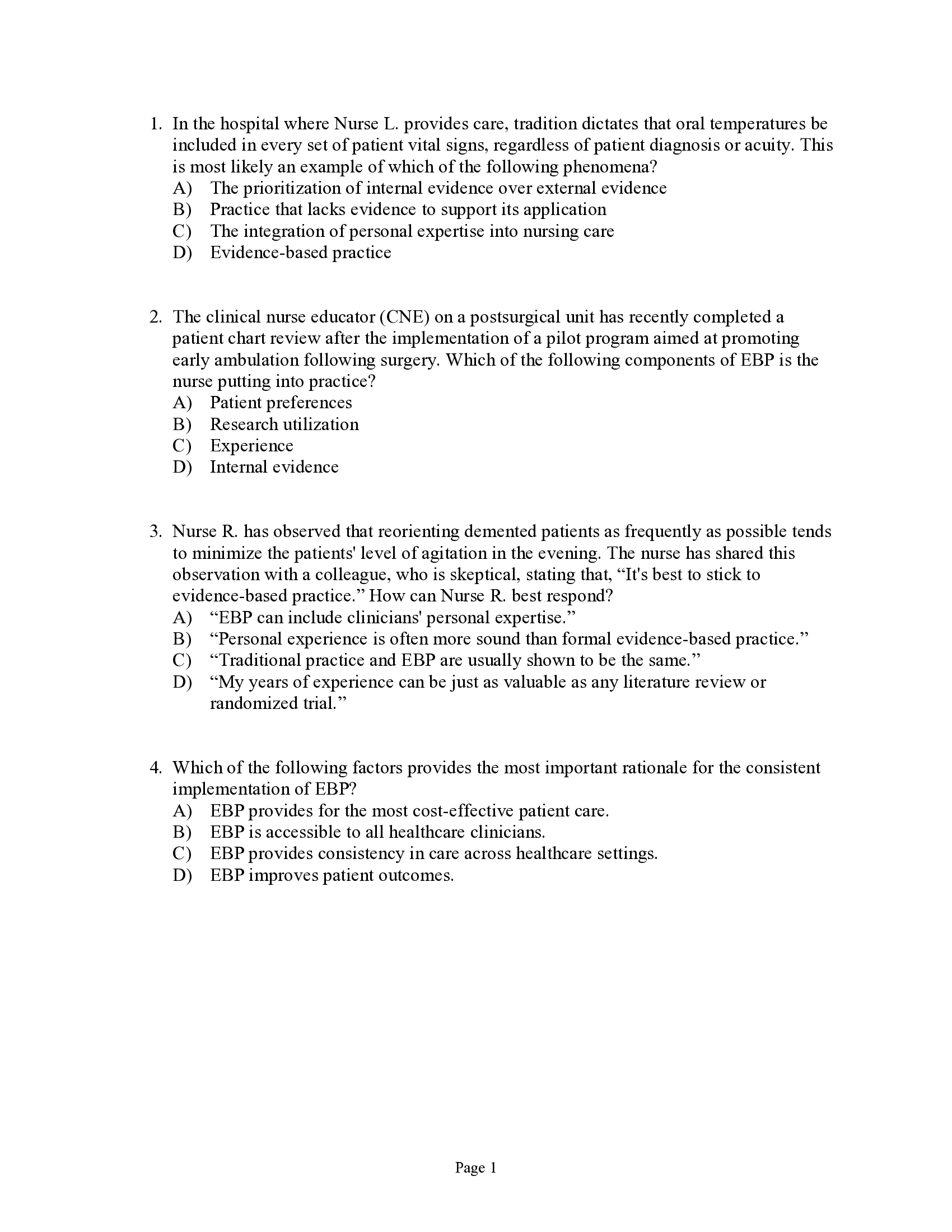
Test Bank for Evidence Based Practice in Nursing and Healthcare 5th Edition by Melnyk 1. In the hospital where Nurse L. provides care, tradition dictates that oral temperatures be included in every set of patient vital signs, regardless of patient diagnosis or acuity. This is most likely an example of which of the following phenomena? A) The prioritization of internal evidence over external evidence B) Practice that lacks evidence to support its application C) The integration of personal expertise into nursing care D) Evidence-based practice 2. The clinical nurse educator (CNE) on a postsurgical unit has recently completed a patient chart review after the implementation of a pilot program aimed at promoting early ambulation following surgery. Which of the following components of EBP is the nurse putting into practice? A) Patient preferences B) Research utilization C) Experience D) Internal evidence 3. Nurse R. has observed that reorienting demented patients as frequently as possible tends to minimize the patients' level of agitation in the evening. The nurse has shared this observation with a colleague, who is skeptical, stating that, “It's best to stick to evidence-based practice.” How can Nurse R. best respond? A) “EBP can include clinicians' personal expertise.” B) “Personal experience is often more sound than formal evidence-based practice.” C) “Traditional practice and EBP are usually shown to be the same.” D) “My years of experience can be just as valuable as any literature review or randomized trial.” 4. Which of the following factors provides the most important rationale for the consistent implementation of EBP? A) EBP provides for the most cost-effective patient care. B) EBP is accessible to all healthcare clinicians. C) EBP provides consistency in care across healthcare settings. D) EBP improves patient outcomes. 5. The Institute of Medicine's Roundtable on Evidence-Based Medicine has been established to address EBP. Which of the following issues is the Roundtable emphasizing? A) Ensuring that external evidence, rather than internal evidence, is integrated into care B) Fostering the level of learning that exists in the American healthcare system C) Issuing clinical guidelines to ensure best nursing practice D) Comparing the implementation of EBP in the United States with that of other Western countries 6. You have become frustrated with some aspects of patient care that you believe are outdated and ineffective at the long-term care facility where you have recently begun practicing. Consequently, you have resolved to examine some of these practices in light of evidence. Which of the following should occur first in the steps of EBP? A) Conducting an electronic search of the literature and ranking individual sources B) Creating “buy-in” from the other clinicians who provide care at the facility C) Developing an inquisitive and curious mindset D) Assessing whether the practices in question may, in fact, be evidence-based 7. Which of the following clinical questions best exemplifies the PICOT format? A) What effect does parents' smoking have on the smoking habits of their children, ages 13 to 16? B) Among cancer patients, what role does meditation, rather than benzodiazepines, have on anxiety levels during the 7 days following hospital admission? C) Among undergraduate college students, what is the effectiveness of a sexual health campaign undertaken during the first 4 weeks of the fall semester as measured by incidence of new gonorrheal and chlamydial infections reported to the campus medical center? D) In patients aged 8 to 12, is the effectiveness of a pain scale using faces superior to a numeric rating scale in the emergency room context? 8. After formulating a clinical question, a nurse has proceeded to search for evidence for ways to foster restful sleep in patients who are receiving care in the intensive care unit (ICU). The nurse has identified a relevant meta-analysis in an electronic database. What will this source of evidence consist of? A) A statistical summary of the results from several different studies B) An examination of the theoretical and conceptual underpinnings of the issue C) An interdisciplinary analysis of the clinical question D) A qualitative study of different interventions related to the clinical question 9. The nurses on a postpartum unit have noted that many primiparous (first-time) mothers are giving up on breastfeeding within the 24 hours following delivery, and the nurses want to create uniform guidelines for promoting breastfeeding on the unit. Which of the following sources is most likely to provide the best evidence in their quest for an intervention? A) Evidence from a randomized control trial that had more than 2500 participants B) Evidence from a study that is widely regarded as a classic within the obstetrical nursing community C) Evidence from a systematic review of breastfeeding-promotion studies that one of the nurses identified in an electronic database D) The consensus opinion of the most senior nurses on the unit 10. The nurse educator on an acute medicine unit is advocating for the use of evidence-based clinical practice guidelines on wound care in order to standardize and optimize the practice of the nurses on the unit. Which of the following statements best describes clinical practice guidelines? A) The result of replication studies of existing research by an impartial third party B) A collection of authorized interventions that are required by law C) A number of interventions that are the result of a large, publically-funded RCT D) A group of practice recommendations that result from a rigorous review of the literature 11. A nurse is conducting a literature review on the evidence regarding the use of vacuum dressings on stage IV pressure ulcers. After locating a recent study that appears to be relevant, which of the following questions would the nurse consider first when critically appraising the study? A) “Are the findings of this study cost-effective in our clinical context?” B) "How would the implementation of this intervention affect our staffing needs?" C) “Were the patients in the study similar to the patients on my unit?” D) “Are the findings of the study significantly different from what we are currently doing on the unit? 12. The primary care provider of a 49-year-old male patient has examined and briefly explained the evidence that supports beginning regular digital-rectal exams. Which of the following factors would justify not performing digital-rectal examinations in this patient's care? A) The patient is vehemently opposed to undergoing a digital-rectal exam. B) Clinical practice guidelines for prostate care have not been published. C) The clinician has been unable to find any large RCTs in a literature review. D) The clinician has previously waited until patients are 55 to begin regular digital-rectal exams. 13. The implementation of a new, evidence-based infection-control regimen in a community hospital has resulted in a significant reduction in the incidence of nosocomial (hospital-acquired) infections. What should constitute the final step in the nurses' evidence-based practice? A) Calculating the cost-savings that will be realized by using the new regimen B) Sharing their experience with other healthcare professionals C) Implementing enforcement measures to ensure compliance with the new regimen D) Conducting a meta-analysis of other infection-control measures 14. Frustrated by the lack of follow-up provided to patients who are newly diagnosed with type 2 diabetes, a community health nurse has begun the process of identifying evidence for the best interventions for this patient population. Which of the following factors is most likely to promote the use of EBP in this nurse's workplace? A) Bringing in nurses who have been educated at a baccalaureate (bachelor's degree) level B) Increasing nurses' accountability for patient outcomes C) Increased funding D) Support from the practice leaders and administration 15. In the process of advocating for EBP in the unit guidelines around the management of increased intracranial pressure, a nurse has met with skepticism from other members of the nursing staff, with several stating, “Evidence-based practice is good in theory, but it's almost impossible to actually search hundreds of journals and find the evidence.” What could the nurse recommend? A) Self-reflection on the nurses' current practices B) Accessing the Cochrane Library C) Contacting the clinical nurse educator on the unit D) Beginning with lay publications before progressing to peer-reviewed journals Chapter 2 Asking Compelling Clinical Questions 1. Which of the following components of a clinical question represents the “P” in the PICOT format for asking clinical questions? A) The nurse's preparation for patient teaching prior to surgery B) Early ambulation versus aggressive anticoagulant therapy C) Individuals who require peritoneal dialysis D) Deep vein thrombosis 2. An unacceptably high number of patients on a geriatric, subacute medicine unit have developed pressure ulcers during their period of care. The nurses on the unit have agreed on a goal of reducing the incidence of these wounds by 50% over the next 10 weeks. This goal represents which component of the PICOT format for asking clinical questions? A) O B) P C) I D) C 3. Which of the following scenarios represents the most common obstacle that nurses encounter when attempting to gain the knowledge necessary for EBP? A) A nurse identifies several articles relevant to a clinical question, but the methodology of each is significantly flawed. B) A nurse is overwhelmed by the number of hits during a CINAHL search. C) Current research that relates to the nurse's clinical question does not exist. D) The research that the nurse locates is rooted in a medical, not nursing, perspective. 4. A nurse has attempted to begin the process of implementing EBP in the area of falls prevention but has become disillusioned by the possibility of having to read a vast number of publications. Which of the following strategies should the nurse implement in response to this problem? A) Narrow the scope of the clinical question B) Restrict the information search to publications from the past 24 months C) Seek recommendations for information sources from trusted colleagues D) Limit the search to articles that relate the findings of randomized control trials (RCTs) 5. A pediatric nurse provides care for many children who present to the emergency department (ED) with signs and symptoms of asthma. Which of the following questions is a background question that the nurse can utilize in the process of providing EBP? A) What evidence exists to recommend the use of nebulizers over metered-dose inhalers (MDIs)? B) What patient populations respond best to nebulized bronchodilators? C) How effective are nebulizers compared to metered-dose inhalers at reducing bronchospasm? D) Are nebulizers provided to patients in the ED more often than metered-dose inhalers? 6. Which of the following statements is true of foreground questions? A) They focus on issues that can be addressed by applying scientific evidence. B) They have a broad, rather than narrow, scope. C) They can be answered by examining electronic information sources instead of print sources. D) They are rooted in the current practices of a nurse's clinical setting. 7. An oncology nurse is engaged in increasing the quality of EBP that is provided on the cancer unit of the local hospital. Which of the following questions would the nurse consider to be an adequate and useful foreground question? A) “Are benzodiazepines and analgesics provided before patients have a bone marrow biopsy?” B) “What is the clinical rationale for using bone marrow biopsy to gauge and predict the course of a patient's cancer?” C) “Does guided imagery reduce the anxiety of patients who undergo bone marrow biopsy?” D) “How often is bone marrow biopsy performed on the unit?” 8. Which of the following clinical questions would be most justified in lacking a comparison? A) An examination of the antipyretic qualities of cool bed-bathing B) A study on the perceived meaning of hope among palliative patients C) A study on the influence of prenatal care on preventing perineal tearing during delivery D) An examination of the effect of rehydration using lactated Ringer's on patients' energy levels

Contact the Seller

Please Sign In to contact this seller.


  • 👎  Report Copyright Violation

Frequently Asked Questions

What Do I Get When I Buy This Study Material?

+

When you buy a study material on Passing Grades, an instant download link will be sent directly to your email, giving you access to the file anytime after payment is completed.

Is Passing Grades a Trusted Platform?

+

Yes, Passing Grades is a reputable students’ marketplace with a secure payment system and reliable customer support. You can trust us to ensure a safe and seamless transaction experience.

Will I Be Stuck with a Subscription?

+

No, all purchases on Passing Grades are one-time transactions. You only pay for the notes you choose to buy, with no subscriptions or hidden fees attached.

Who Am I Buying These Study Materials From?

+

Passing Grades is a marketplace, which means you are purchasing the document from an individual vendor, not directly from us. We facilitate the payment and delivery process between you and the vendor.

Does Passing Grades Offer Free Study Materials?

+

Yes, sellers on Passing Grades have uploaded numerous free test banks, exams, practice questions, and class notes that can be downloaded at no cost.

Pasinggrades - Quality Study Materials

USD 15

    • Quality checked by Pasing Grades
    • 100% satisfaction guarantee
    • Seller: Opati-Kaka
Buy PDF $15

Seller Information

Opati-Kaka

Member since June 2021

  • icon
  • icon
View Profile
  • total sales

    1
  • Favourites

    0
  • Comments

    0
    ( 0 Ratings )

Item Information

  • Uploaded

    05 December 2023

  • Updated

    24 October 2025

  • Category

    No category

  • Item Type

    test bank

  • Tags

    Test Bank for Evidence Based Practice in Nursing and Healthcare 5th Edition by Melnyk

Related Exam Prep Guides by Opati-Kaka

Temporal Bone: An Imaging Atlas Book by John I. Lane and Robert J. Witte
View Document

Temporal Bone: An Im...

  • Opati-Kaka

    Opati-Kaka

  • test bank

Imaging of the temporal bone has recently been advanced with multidetector CT and high-field MR imag...

15 USD

0

1

Test Bank For Human Anatomy & Physiology Laboratory Manual, Making Connections, Cat Version, 2nd Edition By Catharine C. Whiting
View Document

Test Bank For Human ...

  • Opati-Kaka

    Opati-Kaka

  • test bank

Test Bank For Human Anatomy & Physiology Laboratory Manual, Making Connections, Cat Version, 2nd Edi...

15 USD

0

1

Test Bank For Mastering Competencies in Family Therapy 3rd Edition by Gehart
View Document

Test Bank For Master...

  • Opati-Kaka

    Opati-Kaka

  • test bank

Test Bank For Mastering Competencies in Family Therapy 3rd Edition by Gehart...

15 USD

0

1

Purchase

Download link will be sent to this email immediately after purchase.

IMPORTANT LINKS

  • How To Upload Class Notes
  • Selling Tips
  • Passing Grades's Study Materials
  • Scholarships for International Students 2025

POPULAR CATEGORIES

  • Law
  • Accounting
  • English
  • Psychology
  • Business
  • Nursing
  • Computer Science
  • General

View Document

  • Blog
  • Contact
  • Delivery Policy
  • Latest Scholarships Around the World
  • How to Pass Bar Exams: Passing Grades’ Strategies
  • How to Study and Pass the CPA Exam
  • All Test Banks
  • Faq
  • Copyright Claims
  • Privacy Policy
  • Terms of Use

KNOWLEDGE BASE

  • How to Write A+ Grade Good Research Paper
  • How to Manage Stress During Exam Period
  • Best Time to Study
  • How to Pass NCLEX-RN Exam
  • How To Effectively Utilize Test Banks
  • Popular Shadow Health Exam Assessments
  • Popular HESI Case Studies
  • How to Prepare for a Nursing Career
  • The Importance Of Summaries in Exam Revisvion

© 2026 Pasing Grades. All rights reserved.