Pasing Grades
  • Start Selling
  • Blog
  • Contact
  • 0

    Your cart is empty!

English

  • English
  • Spanish
  • Arabic
Create Account Sign In
  • Library
    • New Prep Guides
    • Featured Prep Guides
    • Free Exam Prep Guides
    • Best sellers
  • General
  • Nursing
    • Research Paper
    • Case Study
    • Discussion Post
    • Assignment
    • Exam
    • Practice Questions and Answers
    • Test Bank
    • solutions manual
  • Accounting
    • Case Study
    • Thesis
    • Study Guide
    • Summary
    • Research Paper
    • test bank
  • English
    • Creative Writing
    • Research Paper
    • Summary
    • Rhetorics
    • Literature
    • Journal
    • Exam
    • Grammar
    • Discussion Post
    • Essay
  • Psychology
    • Hesi
    • Presentation
    • Essay
    • Summary
    • Study Guide
    • Essay
    • Solution Manual
    • Final Exam Review
    • Class Notes
    • test bank
  • Business
    • Lecture Notes
    • Solution Manual
    • Presentation
    • Business Plan
    • Class Notes
    • Experiment
    • Summary
    • Practice Questions
    • Study Guide
    • Case Study
    • test bank
    • Exam
  • More
    • Computer Science
    • Economics
    • Statistics
    • Engineering
    • Biology
    • Religious Studies
    • Physics
    • Chemistry
    • Mathematics
    • History
    • Sociology
    • Science
    • Philosophy
    • Law
  • Pages
    • About Us
    • Selling Tips
    • Delivery Policy
    • Faq
    • Privacy Policy
  • Flash Sale
  • Home
  • Test Bank for Essentials of Radiographic Physics and Imaging 3rd Edition by Johnston

Test Bank for Essentials of Radiographic Physics and Imaging 3rd Edition by Johnston

Preview page 1 Preview page 2 Preview page 3
Add To Favorites

Share this item Share this item

  • Item Details
  • Comments (0)
  • Reviews (0)
  • Contact Seller

Test Bank for Essentials of Radiographic Physics and Imaging 3rd Edition by Johnston

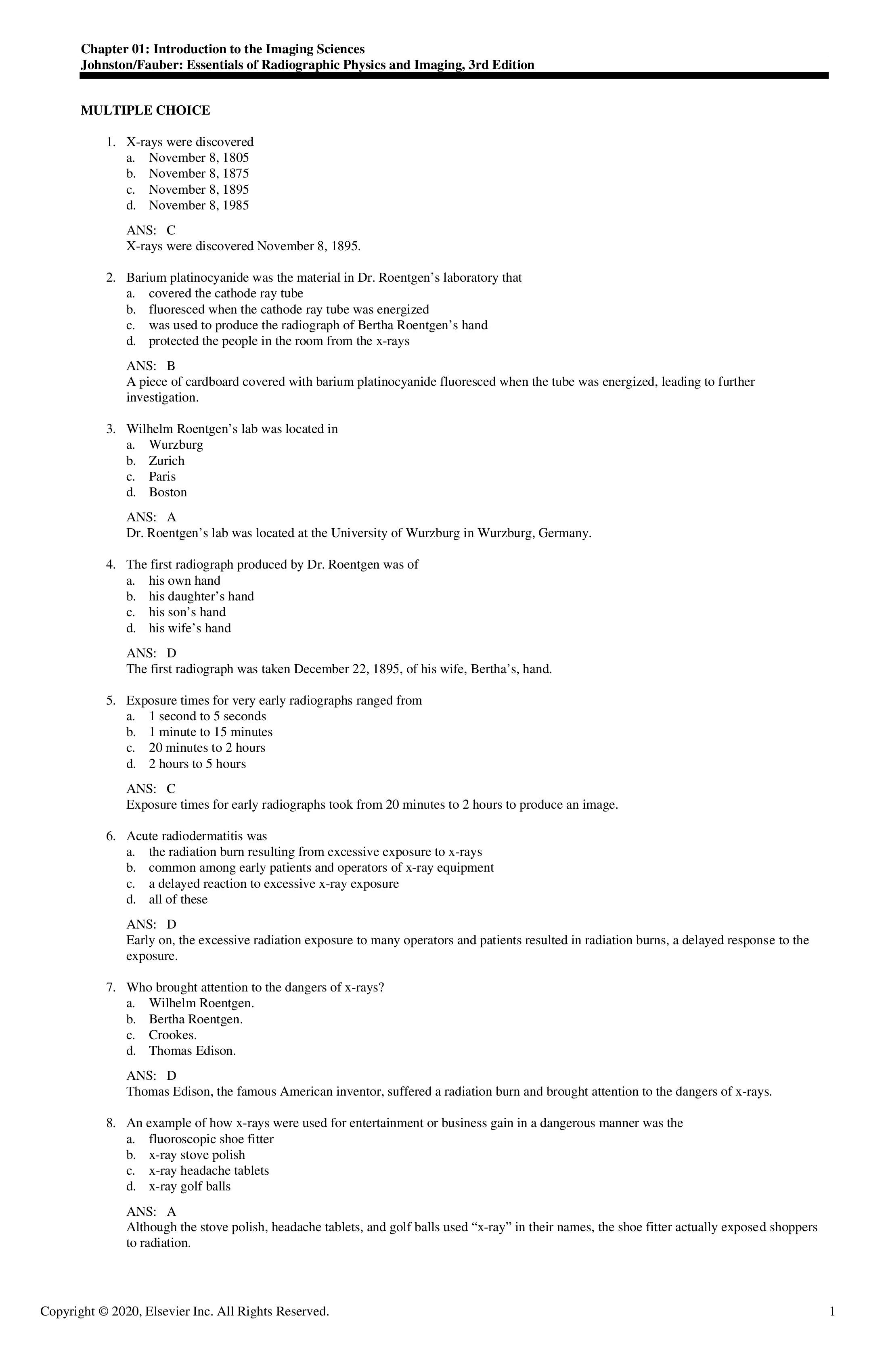
Chapter 01: Introduction to the Imaging Sciences

Johnston/Fauber: Essentials of Radiographic Physics and Imaging, 3rd Edition

MULTIPLE CHOICE

1.          X-rays were discovered

a.        November 8, 1805

b.        November 8, 1875

c.        November 8, 1895

d.       November 8, 1985

ANS: C

X-rays were discovered November 8, 1895.

2.          Barium platinocyanide was the material in Dr. Roentgen’s laboratory that

a.        covered the cathode ray tube

b.        fluoresced when the cathode ray tube was energized

c.        was used to produce the radiograph of Bertha Roentgen’s hand

d.       protected the people in the room from the x-rays

ANS: B

A piece of cardboard covered with barium platinocyanide fluoresced when the tube was energized, leading to further investigation.

3.          Wilhelm Roentgen’s lab was located in

a.        Wurzburg

b.        Zurich

c.        Paris

d.       Boston

ANS: A

Dr. Roentgen’s lab was located at the University of Wurzburg in Wurzburg, Germany.

4.          The first radiograph produced by Dr. Roentgen was of

a.        his own hand

b.        his daughter’s hand

c.        his son’s hand

d.       his wife’s hand

ANS: D

The first radiograph was taken December 22, 1895, of his wife, Bertha’s, hand.

5.          Exposure times for very early radiographs ranged from

a.        1 second to 5 seconds

b.        1 minute to 15 minutes

c.        20 minutes to 2 hours

d.       2 hours to 5 hours

ANS: C

Exposure times for early radiographs took from 20 minutes to 2 hours to produce an image.

6.          Acute radiodermatitis was

a.        the radiation burn resulting from excessive exposure to x-rays

b.        common among early patients and operators of x-ray equipment

c.        a delayed reaction to excessive x-ray exposure

d.       all of these

ANS: D

Early on, the excessive radiation exposure to many operators and patients resulted in radiation burns, a delayed response to the exposure.

7.          Who brought attention to the dangers of x-rays?

a.        Wilhelm Roentgen.

b.        Bertha Roentgen.

c.        Crookes.

d.       Thomas Edison.

ANS: D

Thomas Edison, the famous American inventor, suffered a radiation burn and brought attention to the dangers of x-rays.

8.          An example of how x-rays were used for entertainment or business gain in a dangerous manner was thea.    fluoroscopic shoe fitter

b.        x-ray stove polish

c.        x-ray headache tablets

d.       x-ray golf balls

ANS: A

Although the stove polish, headache tablets, and golf balls used “x-ray” in their names, the shoe fitter actually exposed shoppers to radiation.

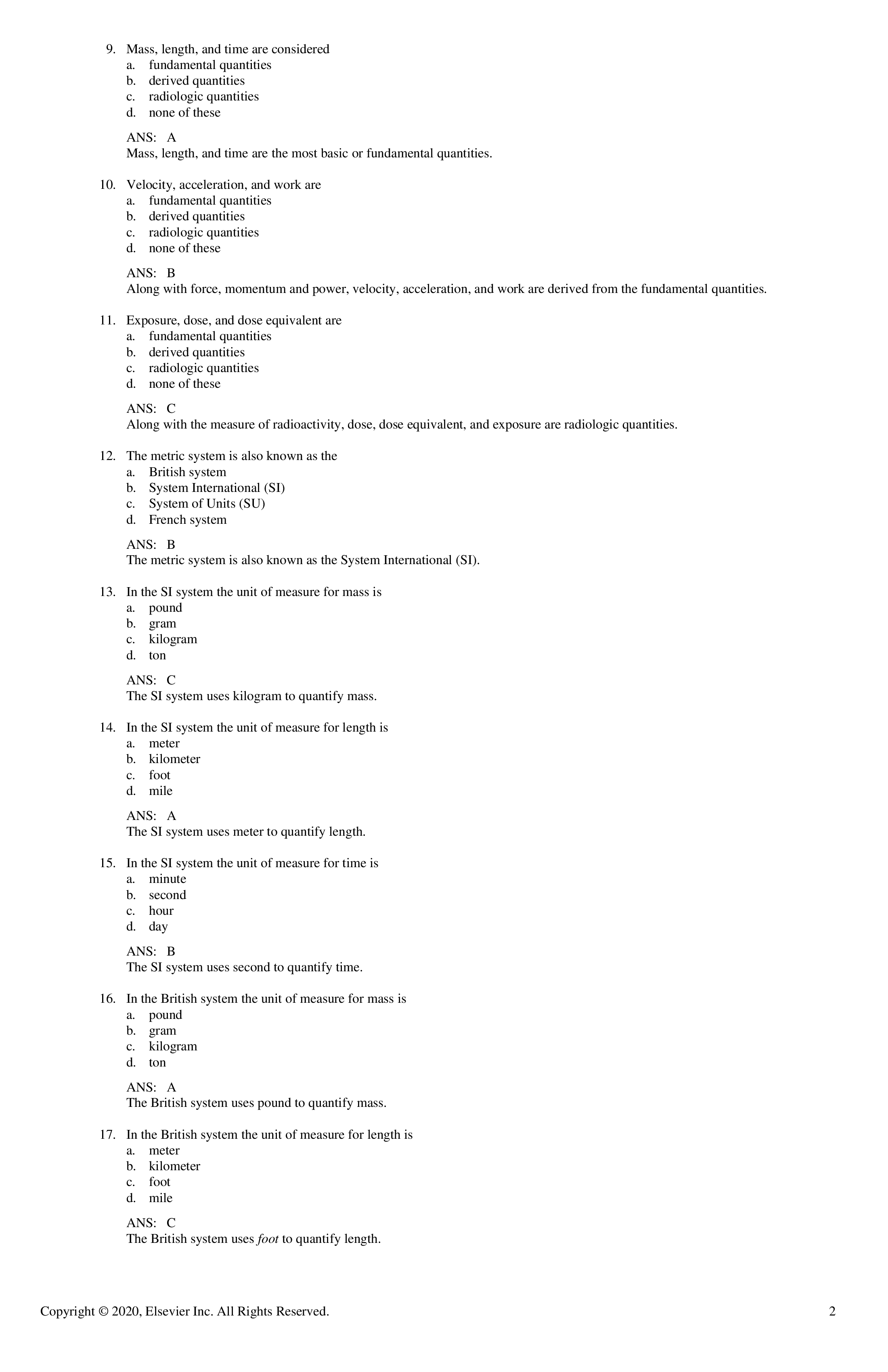
9.          Mass, length, and time are considered

a.        fundamental quantities

b.        derived quantities

c.        radiologic quantities

d.       none of these

ANS: A

Mass, length, and time are the most basic or fundamental quantities.

10.      Velocity, acceleration, and work are

a.        fundamental quantities

b.        derived quantities

c.        radiologic quantities

d.       none of these

ANS: B

Along with force, momentum and power, velocity, acceleration, and work are derived from the fundamental quantities.

11.      Exposure, dose, and dose equivalent are

a.        fundamental quantities

b.        derived quantities

c.        radiologic quantities

d.       none of these

ANS: C

Along with the measure of radioactivity, dose, dose equivalent, and exposure are radiologic quantities.

12.      The metric system is also known as the

a.        British system

b.        System International (SI)

c.        System of Units (SU)

d.       French system

ANS: B

The metric system is also known as the System International (SI).

13.      In the SI system the unit of measure for mass is

a.        pound

b.        gram

c.        kilogram

d.       ton

ANS: C

The SI system uses kilogram to quantify mass.

14.      In the SI system the unit of measure for length is

a.        meter

b.        kilometer

c.        foot

d.       mile

ANS: A

The SI system uses meter to quantify length.

15.      In the SI system the unit of measure for time is

a.        minute

b.        second

c.        hour

d.       day

ANS: B

The SI system uses second to quantify time.

16.      In the British system the unit of measure for mass is

a.        pound

b.        gram

c.        kilogram

d.       ton

ANS: A

The British system uses pound to quantify mass.

17.      In the British system the unit of measure for length is

a.        meter

b.        kilometer

c.        foot

d.       mile

ANS: C

The British system uses foot to quantify length.

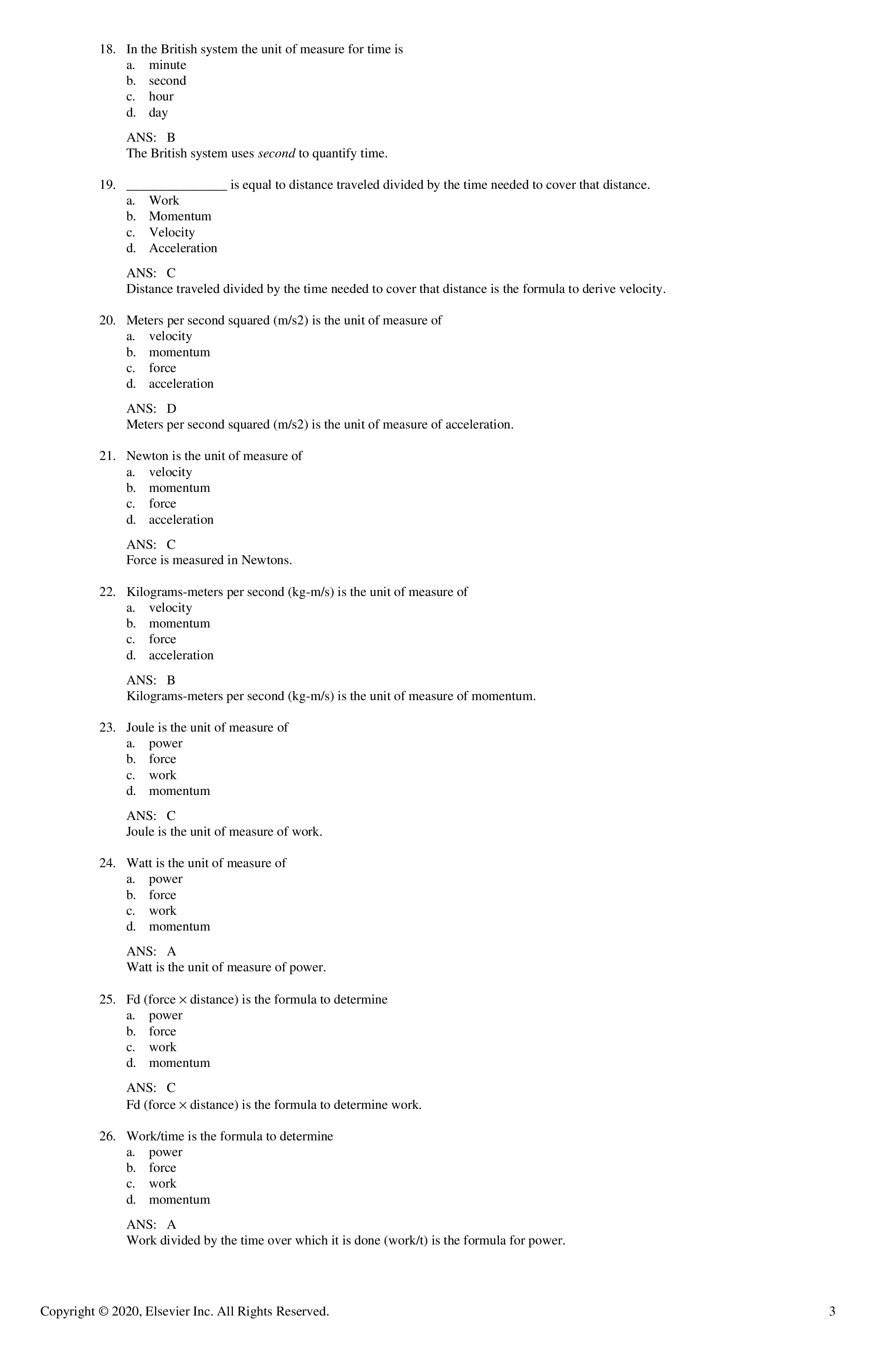
18.      In the British system the unit of measure for time is

a.        minute

b.        second

c.        hour

d.       day

ANS: B

The British system uses second to quantify time.

19.      _______________ is equal to distance traveled divided by the time needed to cover that distance.

a.        Work

b.        Momentum

c.        Velocity

d.       Acceleration

ANS: C

Distance traveled divided by the time needed to cover that distance is the formula to derive velocity.

20.      Meters per second squared (m/s2) is the unit of measure of

a.        velocity

b.        momentum

c.        force

d.       acceleration

ANS: D

Meters per second squared (m/s2) is the unit of measure of acceleration.

21.      Newton is the unit of measure of

a.        velocity

b.        momentum

c.        force

d.       acceleration

ANS: C

Force is measured in Newtons.

22.      Kilograms-meters per second (kg-m/s) is the unit of measure of

a.        velocity

b.        momentum

c.        force

d.       acceleration

ANS: B

Kilograms-meters per second (kg-m/s) is the unit of measure of momentum.

23.      Joule is the unit of measure of

a.        power

b.        force

c.        work

d.       momentum

ANS: C

Joule is the unit of measure of work.

24.      Watt is the unit of measure of

a.        power

b.        force

c.        work

d.       momentum

ANS: A

Watt is the unit of measure of power.

25.      Fd (force × distance) is the formula to determine

a.        power

b.        force

c.        work

d.       momentum

ANS: C

Fd (force Ă— distance) is the formula to determine work.

26.      Work/time is the formula to determine

a.        power

b.        force

c.        work

d.       momentum

ANS: A

Work divided by the time over which it is done (work/t) is the formula for power.

27.      The formula mv (mass × velocity) is used to determine

a.        power

b.        force

c.        work

d.       momentum

ANS: D

Mass Ă— velocity (mv) is the formula to determine momentum.

28.      The formula ma (mass × acceleration) is for

a.        power

b.        force

c.        work

d.       momentum

ANS: B

Mass Ă— acceleration (ma) is the formula to determine force.

29.      What is the velocity of a javelin that travels 45 meters in 3 seconds?

a.        0.067 m/s.

b.        15 m/s.

c.        67 m/s.

d.       135 m/s.

ANS: B

Velocity is determined by dividing the distance traveled (45 meters) by the time necessary to cover the distance (3 s); therefore 45 m/3 s or 15 m/s.

30.      What is the acceleration of the javelin if the initial velocity is 0, the final velocity is 15 m/s and the time of travel is 3 seconds?a.  1 m/s2.

b.        5 m/s2.

c.        10 m/s2.

d.       15 m/s2.

ANS: B

Acceleration is determined by subtracting the initial velocity (0 m/s) from the final velocity (15 m/s) and then dividing that amount by the time it took (3 seconds), resulting in 5 m/s2.

31.      How much force is needed to move a 30-kg piece of equipment at a rate of 3 m/s2?a.            10 N.

b.        30 N.

c.        60 N.

d.       90 N.

ANS: D

Force is determined by multiplying mass (30 kg) by acceleration (3 m/s2) and is measured in Newtons. 30 kg Ă— 3 m/s2 = 90 N.

32.      What is the momentum of a 30-kg object traveling at 2.5 m/s?

a.        12 kg-m/s.

b.        75 kg-m/s.

c.        150 kg-m/s.

d.       187.5 kg-m/s.

ANS: B

Momentum is determined by multiplying mass (30 kg) by its velocity (2.5 m/s), resulting in 75 kg-m/s.

33.      How much work is done if a force of 20 N is applied to move a patient 100 meters?a.            0.5 J.

b.        5 J.

c.        200 J.

d.       2000 J.

ANS: D

Work = Fd, in this case 20 (force) multiplied by 100 (distance) over which it’s moved, resulting in 2000 Joules.

34.      If it takes 2 minutes to perform 360 J of work, what is the power?

a.        3 W.

b.        9 W.

c.        180 W.

d.       720 W.

ANS: A

Power is determined by dividing the work done (360 J) by the time it takes to do the work (2 minutes or 120 seconds). 360/120 = 3 Watts.

35.      What is the velocity of a baseball that travels 15 meters in 2 seconds?

a.        7.5 N.

b.        7.5 m/s2.

c.        7.5 J.

d.       7.5 m/s.

ANS: D

Velocity is determined by dividing the distance traveled (15 meters) by the time necessary to cover the distance (2 s); therefore 15 m/2 s or 7.5 m/s. The unit of measurement for velocity is meter/second (m/s).


76.      What principle articulates the radiographer’s responsibility to minimize radiation exposure to the patient, oneself and others?a.      ASRT

b.        ALARA

c.        ARRT

d.       HVL

ANS: B

It is the radiographer’s responsibility to minimize radiation dose to the patient, oneself, and others in accordance with the As Low As Reasonably Achievable (ALARA) Principle.

77.      Which of the following is NOT a cardinal principle for minimizing radiation dose?a.  distance

b.        shielding

c.        collimation

d.       time

ANS: C

Central to minimizing radiation dose to oneself and others are the cardinal principles of shielding, time, and distance.

78.      Which of the following is NOT one of the “tools/tasks” of radiation protection?

a.        decrease collimation

b.        increase kVp and decrease mAs

c.        avoid duplicate exams

ANS: A

Decreasing the x-ray field size (increased collimation), using higher kVp along with lower mAs, and avoiding duplicate exams are tools/tasks the radiographer can use to minimize patient radiation protection.

TRUE/FALSE

1.      Mass does not change with gravitational force.

ANS: T

Although weight is based on the effect of gravitational force, mass is not.

2.      When 3 kilograms of frozen water is melted, it produces 3 kilograms of water.

ANS: T

Mass does not change when the substance changes form.

3.      Weight, measured in pounds, is not affected by gravitational force.

ANS: F

Weight, as opposed to mass, changes when the gravitational force changes (earth versus moon, for example).

4.      A floating table top is typical of today’s x-ray tables.

ANS: T

Today’s x-ray table has a floating table top with electromagnetic locks.

5.      Permanently installed radiographic equipment can never be replaced because it is permanent.

ANS: F

Although it is called permanent, this type of equipment can be removed and replaced, but it does take a week or so.

6.      Screening for pregnancy is not a task the radiographer would perform before a radiographic procedure on a female patient.

ANS: F

Screening for pregnancy is another important task to minimize unnecessary exposure to a developing fetus.

7.      Radiographers can develop good work habits by developing a mental checklist for radiographic procedures and performing them the same way every time.

ANS: T

Radiography is a practice where being a “creature of GOOD habits”—is a good thing. Develop a mental checklist for radiographic procedures and perform them the same way every time.

Contact the Seller

Please Sign In to contact this seller.


  • 👎  Report Copyright Violation

Frequently Asked Questions

What Do I Get When I Buy This Study Material?

+

When you buy a study material on Passing Grades, an instant download link will be sent directly to your email, giving you access to the file anytime after payment is completed.

Is Passing Grades a Trusted Platform?

+

Yes, Passing Grades is a reputable students’ marketplace with a secure payment system and reliable customer support. You can trust us to ensure a safe and seamless transaction experience.

Will I Be Stuck with a Subscription?

+

No, all purchases on Passing Grades are one-time transactions. You only pay for the notes you choose to buy, with no subscriptions or hidden fees attached.

Who Am I Buying These Study Materials From?

+

Passing Grades is a marketplace, which means you are purchasing the document from an individual vendor, not directly from us. We facilitate the payment and delivery process between you and the vendor.

Does Passing Grades Offer Free Study Materials?

+

Yes, sellers on Passing Grades have uploaded numerous free test banks, exams, practice questions, and class notes that can be downloaded at no cost.

Pasinggrades - Quality Study Materials

USD 15

    • Quality checked by Pasing Grades
    • 100% satisfaction guarantee
    • Seller: mentor2000
Buy PDF $15

Seller Information

mentor2000

Member since April 2021

  • icon
  • icon
View Profile
  • total sales

    0
  • Favourites

    0
  • Comments

    0
    ( 0 Ratings )

Item Information

  • Uploaded

    22 May 2022

  • Updated

    16 May 2025

  • Category

    Nursing

  • Item Type

    test bank

  • Tags

    Test Bank for Essentials of Radiographic Physics and Imaging 3rd Edition by Johnston

Related Exam Prep Guides by mentor2000

Test Bank for Essentials for Nursing Practice 8th Edition by Potter | All Chapters
View Document

Test Bank for Essent...

  • mentor2000

    mentor2000

  • test bank

Master nursing concepts with this study material; Test Bank for Essentials for Nursing Practice, 8th...

15 USD

0

0

A &P 1 MA278 BSC2 Final Module II Questions & Answers 2026 Update
View Document

A &P 1 MA278 BSC2 Fi...

  • mentor2000

    mentor2000

  • test bank

Prepare for success with A&P 1 MA278 BSC2 Final Module II 2024 Q&A. Boost your grades with this comp...

15 USD

0

0

ATI Comprehensive Predictor Exam 2026
View Document

ATI Comprehensive Pr...

  • mentor2000

    mentor2000

  • test bank

Prepare for success with the ATI Comprehensive Predictor Exam 2026. Access key practice questions to...

15 USD

0

0

Purchase

Download link will be sent to this email immediately after purchase.

IMPORTANT LINKS

  • How To Upload Class Notes
  • Selling Tips
  • Passing Grades's Study Materials
  • Scholarships for International Students 2025

POPULAR CATEGORIES

  • Law
  • Accounting
  • English
  • Psychology
  • Business
  • Nursing
  • Computer Science
  • General

View Document

  • Blog
  • Contact
  • Delivery Policy
  • Latest Scholarships Around the World
  • How to Pass Bar Exams: Passing Grades’ Strategies
  • How to Study and Pass the CPA Exam
  • All Test Banks
  • Faq
  • Copyright Claims
  • Privacy Policy
  • Terms of Use

KNOWLEDGE BASE

  • How to Write A+ Grade Good Research Paper
  • How to Manage Stress During Exam Period
  • Best Time to Study
  • How to Pass NCLEX-RN Exam
  • How To Effectively Utilize Test Banks
  • Popular Shadow Health Exam Assessments
  • Popular HESI Case Studies
  • How to Prepare for a Nursing Career
  • The Importance Of Summaries in Exam Revisvion

© 2026 Pasing Grades. All rights reserved.