Pasing Grades
  • Start Selling
  • Blog
  • Contact
  • 0

    Your cart is empty!

English

  • English
  • Spanish
  • Arabic
Create Account Sign In
  • Library
    • New Prep Guides
    • Featured Prep Guides
    • Free Exam Prep Guides
    • Best sellers
  • General
  • Nursing
    • Research Paper
    • Case Study
    • Discussion Post
    • Assignment
    • Exam
    • Practice Questions and Answers
    • Test Bank
    • solutions manual
  • Accounting
    • Case Study
    • Thesis
    • Study Guide
    • Summary
    • Research Paper
    • test bank
  • English
    • Creative Writing
    • Research Paper
    • Summary
    • Rhetorics
    • Literature
    • Journal
    • Exam
    • Grammar
    • Discussion Post
    • Essay
  • Psychology
    • Hesi
    • Presentation
    • Essay
    • Summary
    • Study Guide
    • Essay
    • Solution Manual
    • Final Exam Review
    • Class Notes
    • test bank
  • Business
    • Lecture Notes
    • Solution Manual
    • Presentation
    • Business Plan
    • Class Notes
    • Experiment
    • Summary
    • Practice Questions
    • Study Guide
    • Case Study
    • test bank
    • Exam
  • More
    • Computer Science
    • Economics
    • Statistics
    • Engineering
    • Biology
    • Religious Studies
    • Physics
    • Chemistry
    • Mathematics
    • History
    • Sociology
    • Science
    • Philosophy
    • Law
  • Pages
    • About Us
    • Selling Tips
    • Delivery Policy
    • Faq
    • Privacy Policy
  • Flash Sale
  • Home
  • Test Bank For Egan’s Fundamentals Of Respiratory Care 11th Edition By Kacmarek | All Chapters

Test Bank For Egan’s Fundamentals Of Respiratory Care 11th Edition By Kacmarek | All Chapters

Preview page 1 Preview page 2 Preview page 3
Add To Favorites

Share this item Share this item

  • Item Details
  • Comments (0)
  • Reviews (0)
  • Contact Seller

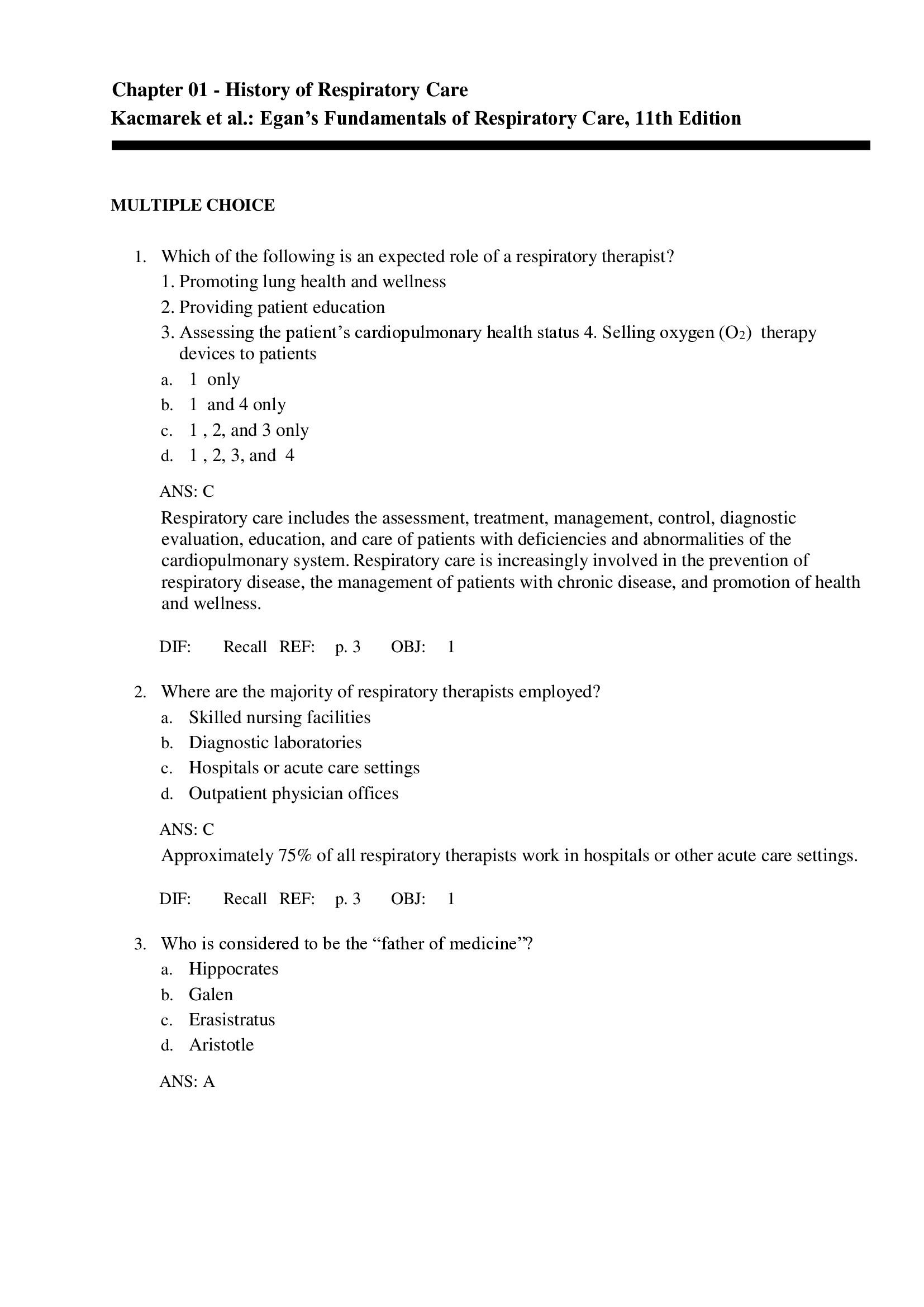
Chapter 01 - History of Respiratory Care

Kacmarek et al.: Egan’s Fundamentals of Respiratory Care, 11th Edition | Study Material

MULTIPLE CHOICE

1.      Which of the following is an expected role of a respiratory therapist?

1.  Promoting lung health and wellness

2.  Providing patient education

3.  Assessing the patient’s cardiopulmonary health status 4. Selling oxygen (O2)  therapy devices to patients

a.       1  only

b.      1  and 4 only

c.       1 , 2, and 3 only

d.      1 , 2, 3, and  4

ANS: C

Respiratory care includes the assessment, treatment, management, control, diagnostic evaluation, education, and care of patients with deficiencies and abnormalities of the cardiopulmonary system. Respiratory care is increasingly involved in the prevention of respiratory disease, the management of patients with chronic disease, and promotion of health and wellness.

DIF:       Recall  REF:    p. 3      OBJ:    1

2.      Where are the majority of respiratory therapists employed?

a.       Skilled nursing facilities

b.      Diagnostic laboratories

c.       Hospitals or acute care settings

d.      Outpatient physician offices

ANS: C

Approximately 75% of all respiratory therapists work in hospitals or other acute care settings.

DIF:       Recall  REF:    p. 3      OBJ:    1

3.      Who is considered to be the “father of medicine”?

a.       Hippocrates

b.      Galen

c.       Erasistratus

d.      Aristotle

ANS: A

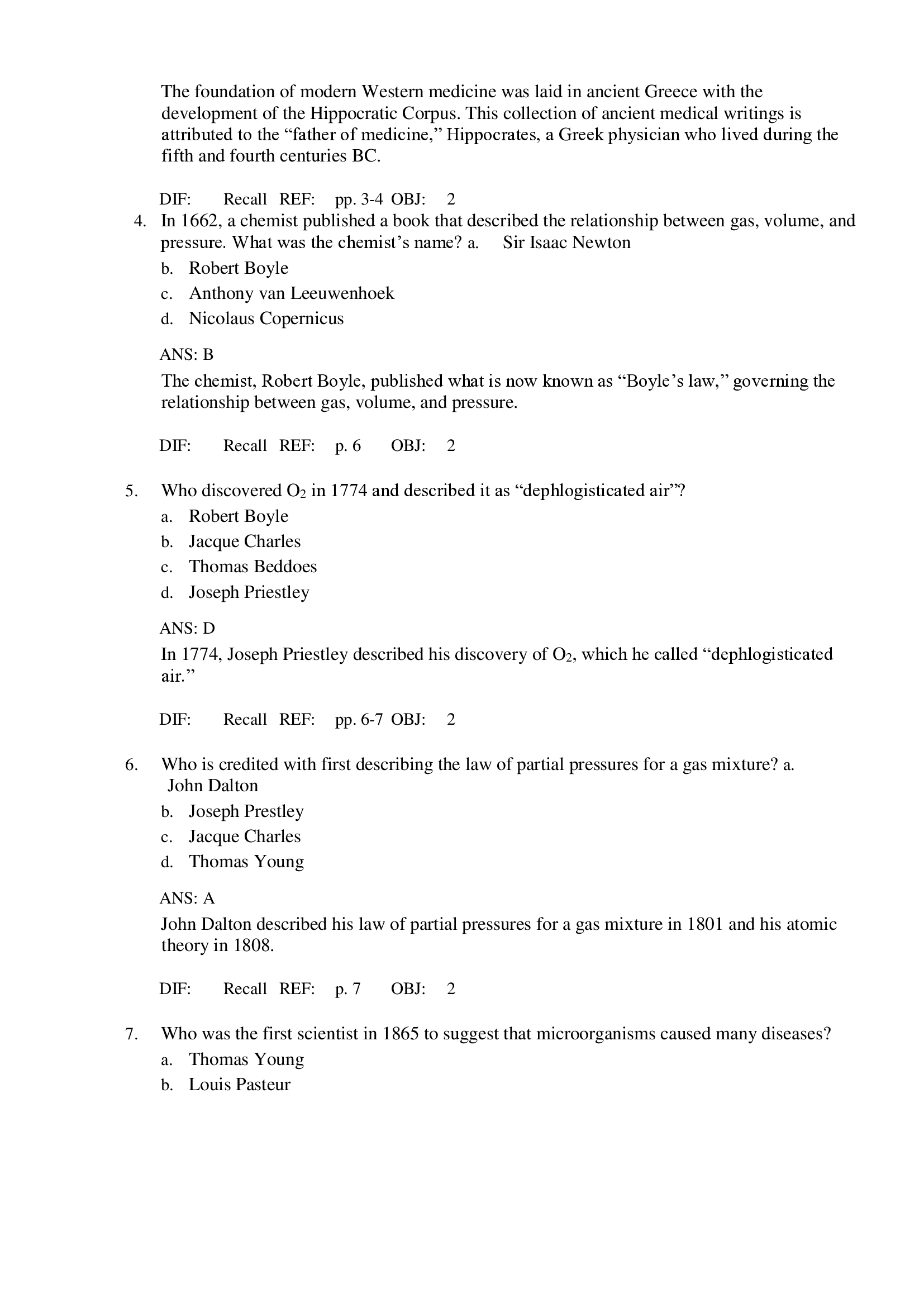
The foundation of modern Western medicine was laid in ancient Greece with the development of the Hippocratic Corpus. This collection of ancient medical writings is attributed to the “father of medicine,” Hippocrates, a Greek physician who lived during the fifth and fourth centuries BC.

DIF:       Recall  REF:    pp. 3-4 OBJ:    2

4.      In 1662, a chemist published a book that described the relationship between gas, volume, and pressure. What was the chemist’s name? a.         Sir Isaac Newton

b.      Robert Boyle

c.       Anthony van Leeuwenhoek

d.      Nicolaus Copernicus

ANS: B

The chemist, Robert Boyle, published what is now known as “Boyle’s law,” governing the relationship between gas, volume, and pressure.

DIF:       Recall  REF:    p. 6      OBJ:    2

5.         Who discovered O2 in 1774 and described it as “dephlogisticated air”?

a.       Robert Boyle

b.      Jacque Charles

c.       Thomas Beddoes

d.      Joseph Priestley

ANS: D

In 1774, Joseph Priestley described his discovery of O2, which he called “dephlogisticated air.”

DIF:       Recall  REF:    pp. 6-7 OBJ:    2

6.         Who is credited with first describing the law of partial pressures for a gas mixture? a.          John Dalton

b.      Joseph Prestley

c.       Jacque Charles

d.      Thomas Young

ANS: A

John Dalton described his law of partial pressures for a gas mixture in 1801 and his atomic theory in 1808.

DIF:       Recall  REF:    p. 7      OBJ:    2

7.         Who was the first scientist in 1865 to suggest that microorganisms caused many diseases?

a.       Thomas Young

b.      Louis Pasteur

c.       Henry Graham

d.      Robert Koch

ANS: B

In 1865, Louis Pasteur advanced his “germ theory” of disease, which held that many diseases are caused by microorganisms.

DIF:       Recall  REF:    p. 7      OBJ:    2

8.         Who discovered the x-ray and opened the door for the modern field of radiology? a.          John Dalton

b.      William Smith


c.       William Roentgen

d.      Thomas Young

ANS: C

In 1895, William Roentgen discovered the x-ray and the modern field of radiologic imaging sciences was born.

DIF:       Recall  REF:    p. 7      OBJ:    2

9.         What was the primary duty of the first inhalation therapists?

a.       Provide airway care.

b.      Support O2 therapy.

c.       Aerosol therapy to patients.

d.      Maintain patients on mechanical ventilation.

ANS: B

The first inhalation therapists were really just O2 technicians.

DIF:       Recall  REF:    p. 7      OBJ:    3

10.     When did the designation “respiratory therapist” become standard?

a.       1954

b.      1964

c.       1974

d.      1984

ANS: C

In 1974, the designation “respiratory therapist” became standard.

DIF:       Recall  REF:    p. 7      OBJ:    3

11.     Who was the first to develop the large-scale production of O2 in 1907?

a.       Robert Dalton

b.      David Boyle

c.       Thomas Anderson

d.      Karl von Linde

ANS: D

Large-scale production of O2 was developed by Karl von Linde in 1907.

DIF:       Recall  REF:    p. 7      OBJ:    4

12.     When was the first Venti-mask introduced that allows the precise delivery of 24%, 28%, 35%, and 40% O2? a.    1945

b.      1954

c.       1960

d.      1972

ANS: C

The Campbell Venti-mask, which allowed the administration of 24%, 28%, 35%, or 40% O2, was introduced in 1960.

DIF:       Recall  REF:    p. 8      OBJ:    4

13.     When were aerosolized glucocorticoids for the maintenance of patients with moderate to severe asthma first introduced? a.       In the 1950s

b.      In the 1960s

c.       In the 1970s

d.      In the 1980s

ANS: C

The use of aerosolized glucocorticoids for the maintenance of patients with moderate to severe asthma began in the 1970s.

DIF:       Recall  REF:    p. 8      OBJ:    4

14.     Which of the following medications has never been delivered as an aerosol by a respiratory therapist?

a.       Inotropes

b.      Anticholinergic

c.       Mucolytic

d.      Antibiotic

ANS: A

There has been a proliferation of medications designed for aerosol administration, including bronchodilators, mucolytic, antibiotic, anticholinergic, and antiinflammatory agents.

DIF:       Recall  REF:    p. 8      OBJ:    4

15.     Which two names are linked to the development of the iron lung, which was extensively used to treat the polio epidemic in the 1950s? a.      Allison and Smyth

b.      Drinker and Emerson

c.       Drager and Bennett

d.      Byrd and Tyler

ANS: B

The iron lung was developed by Drinker, an engineer at Harvard University. Jack H. Emerson developed a commercial version of the iron lung that was used extensively during the polio epidemics of the 1930s and 1950s.

DIF:       Recall  REF:    p. 8      OBJ:    5

16.     Which of the following was one of the first positive-pressure ventilators developed?

a.       MA-1

b.      Bird Mark 7

c.       Dräger Pulmotor

d.      Engstrom

ANS: C

Early positive-pressure ventilators included the Dräger Pulmotor (1911), the Spiropulsator (1934), the Bennett TV-2P (1948), the Morch Piston Ventilator (1952), and the Bird Mark 7 (1958).

DIF:       Recall  REF:    p. 8      OBJ:    4

17.     When was positive end expiratory pressure (PEEP) first introduced to treat patients with acute respiratory distress syndrome?

a.       1935

b.      1946

c.       1958

d.      1967

ANS: D

Positive end expiratory pressure (PEEP) was introduced for use in patients with ARDS in 1967.

DIF:       Recall  REF:    p. 9      OBJ:    4

18.     When was synchronized intermittent mandatory ventilation (SIMV) first introduced? a.     1975

b.      1985

c.       1995

d.      2005

ANS: A

SIMV was introduced in 1975.

DIF:       Recall  REF:    p. 9      OBJ:    4

19.     Who introduced the first laryngoscope, in 1913?

a.       Thomas Allen

b.      Chevalier Jackson

c.       Jack Emerson

d.      Forrest Bird

ANS: B

In 1913, the laryngoscope was introduced by Chevalier Jackson.

DIF:       Recall  REF:    p. 10    OBJ:    5

20.     Who introduced the use of soft rubber endotracheal tubes around 1930?

a.       Davidson

b.      McGill

c.       Haight

d.      Murphy

ANS: B

Ivan McGill introduced the use of soft rubber endotracheal tubes.

DIF:       Recall  REF:    p. 10    OBJ:    5

21.     In 1846, who developed a water seal spirometer, which allowed accurate measurement of the patient’s vital capacity? a.           Hutchinson

b.      Strohl

c.       Tiffeneau

d.      Davis

ANS: A

In 1846, John Hutchinson developed a water seal spirometer, with which he measured the vital capacity.

DIF:       Recall  REF:    p. 10    OBJ:    5

22.     What was the name of the first professional organization for the field of respiratory care?

a.       American Association for Inhalation Therapy

b.      National Organization for Inhalation Therapy

c.       Inhalation Therapy Association

d.      Better Breathers Organization

ANS: C

Founded in 1947 in Chicago, the Inhalational Therapy Association (ITA) was the first professional association for the field of respiratory care.

DIF:       Recall  REF:    p. 10    OBJ:    7

23.     In which year did the respiratory care professional organization American Association for Respiratory Therapy (ARRT) change its name to American Association for Respiratory Care ( AARC)? a.        1954

b.      1966

c.       1975

d.      1982

ANS: D

The ITA became the American Association for Inhalation Therapists (AAIT) in 1954, the American Association for Respiratory Therapy (ARRT) in 1973, and the AARC in 1982.

DIF:       Recall  REF:    p. 10    OBJ:    7

24.     What organization has developed an examination to enable respiratory therapists to become licensed?

a.       American Respiratory Care Board

b.      National Board for Respiratory Care

c.       American Association for Respiratory Care

d.      National Organization for Respiratory Therapist

ANS: B

During the 1980s, the AARC began a major push to introduce state licensure for respiratory care practitioners based on the National Board for Respiratory Care (NBRC) credentials.

DIF:       Recall  REF:    p. 10    OBJ:    6

25.     Today, respiratory care educational programs in the United States are accredited by what organization?

a.       National Board for Respiratory Care (NBRC)

b.      American Association for Respiratory Care (AARC)

c.       Committee on Accreditation for Respiratory Care (CoARC)

d.      Joint Review Committee for Respiratory Therapy Education (JRCRTE)

ANS: C

Today, respiratory care educational programs in the United States are accredited by the

CoARC.

DIF:       Recall  REF:    p. 13    OBJ:    6

26.     The majority of respiratory care education programs in the United States offer what degree? a.  Associate’s degree

b.      Bachelor’s degree

c.       Master’s degree

d.      Certificate degree

ANS: A

There are approximately 300 associate, 50 baccalaureate, and 3 graduate-level degree programs in the United States.

DIF:       Recall  REF:    p. 13    OBJ:    8

27.     Which of the following are predicted to be a growing trend in respiratory care for the future?

1.  Greater use of respiratory therapy protocols

2.  Increased need for patient assessment skills

3.  Increased involvement in smoking cessation programs 4 . Clinical decisions will increasingly be data-driven

a.       1  and 2 only

b.      2  and 3 only

c.       2 , 3, and 4 only

d.      1 , 2, 3, and  4

ANS: D

Dr. David Pierson, a prominent pulmonary physician, described the future of respiratory care in 2001. Among other things, he predicted greater use of patient assessment and protocols in disease state management in all clinical settings; a more active role for respiratory therapists in palliative care; increasing emphasis on smoking cessation and prevention; early detection and intervention in COPD; and an increase in the use of respiratory therapists as coordinators and caregivers for homecare. The science of respiratory care will continue to evolve and increase in complexity, and clinical decisions will increasingly be data-driven.

DIF:       Recall  REF:    p. 14    OBJ:    9

28.     How is competency to practice Respiratory Care determined?

a.       Achievement of good grades in school and graduating from an approved program. b.    Applying for a state license.

c.       Only by graduating from a CoARC approved program.

d.      Obtaining a passing grade on a credentialing examination administered by the NBRC after graduation from a CoARC approved program.

ANS: D

State licensing laws set the minimum educational requirements and the method of determining competence to practice.

DIF:       Recall  REF:    p. 10    OBJ:    6

29.     Due to the aging of the majority of the population, which of the following will be the focus of the Respiratory Therapist of the future? 1 . Verifying insurance information

2.  Disease management and rehabilitation

3.  Patient and family education

4.  Tobacco education and smoking cessation

a.       1  and 3 only

b.      1 , 2, and 3 only

c.       2 , 3, and 4 only

d.      1 , 2, 3, and  4

ANS: C

In the future, there will be an increase in demand for respiratory care due to advances in treatment and technology, increases in the aging of the population, and increases in the number of people with asthma, COPD, and other cardiopulmonary diseases. Due to this the RT of the future will be focused on patient assessment, care plan development, protocol administration, disease management and rehabilitation, and patient and family education, to include tobacco education and smoking cessation.

DIF:       Application      REF:    pp. 14-15         OBJ:    9

30.     According to the AARC’s “2015 and Beyond” project, all of the following are included in the seven major competencies required by Respiratory Therapists by the Year 2015 except: a. chronic disease state management.

b.      bronchoscopy.

c.       evidence-based medicine and respiratory care protocols.

d.      leadership.

ANS: B

According to the AARC’s “2015 and Beyond” project, the seven major competencies required by Respiratory Therapists by the Year 2015 will be, diagnostic, chronic disease state management, evidence-based medicine and respiratory care protocols, patient assessment, leadership, emergency and critical care, and therapeutics.

DIF:       Recall  REF:    pp. 14-15         OBJ:    9

Chapter 02 - Delivering Evidence-Based Respiratory Care

Kacmarek et al.: Egan’s Fundamentals of Respiratory Care, 11th Edition


MULTIPLE CHOICE

1.      Quality in the practice of respiratory care encompasses which of the following?

1.  Personnel performing care

2.  Equipment used

3.  Method or manner in which care is provided 4 . Level of experience of respiratory care providers

a.       1  and 2 only

b.      3  only

c.       1 , 3, and 4 only

d.      1 , 2, 3, and  4

ANS: D

Quality, as applied to the practice of respiratory care, is multidimensional. It encompasses the personnel who perform respiratory care, the equipment used, and the method or manner in which care is provided.

DIF:       Recall  REF:    p. 18    OBJ:    1

2.      Who is professionally responsible for the clinical function of the respiratory care department? a.     Shift supervisor

b.      Department head

c.       Medical director

d.      Clinical supervisor

ANS: C

The medical director of respiratory care is professionally responsible for the clinical function of the department and provides oversight of the clinical care that is delivered (Box 2-1).

DIF:       Recall  REF:    p. 19    OBJ:    1

3.      What is the most essential aspect of providing quality respiratory care?

1.  Care being provided is indicated.

2.  Care is delivered competently and appropriately.

3.  Physician appropriately evaluates patient before care is initiated.

a.       1  and 2 only

b.      3  only

c.       2  and 3 only

d.      1 , 2, and  3

ANS: A

The medical director of respiratory care is professionally responsible for the clinical function of the department and provides oversight of the clinical care that is delivered (Box 2-1).

DIF:       Recall  REF:    p. 19    OBJ:    2

4.      The medical director of respiratory care is responsible for which of the following?

1.  Supervision of ongoing quality assurance activities

2.  Supervision of respiratory therapists performing pulmonary function testing

3.  Participation in the selection and promotion of technical staff 4 . Medical direction of the in-service and educational programs

a.       1  only

b.      1  and 4 only

c.       1 , 2, and 3 only

d.      1 , 2, 3, and  4

ANS: D

Perhaps the most essential aspect of providing quality respiratory care is to ensure that the care being provided is indicated and that it is delivered competently and appropriately.

DIF:       Recall  REF:    p. 19    OBJ:    1

5.         What is the chief reason that respiratory care protocols were developed and are currently being used in hospitals throughout North America?

a.       Enhance proper allocation of respiratory care services.

b.      Decrease patient care costs to hospitals and insurance companies.

c.       Expand patient care skills among respiratory care providers.

d.      Enhance efficiency of respiratory care personnel in providing patient care.

ANS: A

Misallocation has led to the use of respiratory care protocols that are implemented by respiratory therapists (as described under “Methods for Enhancing the Quality of Respiratory Care”).

DIF:       Application      REF:    p. 19    OBJ:    1

6.         Which of the following factors is important in determining the quality of care delivered by a respiratory therapist? a.      Education

b.      Experience

c.       Training

d.      All of the above

ANS: D

The quality of respiratory therapists depends primarily on their training, education, experience, and professionalism.

DIF:       Recall  REF:    p. 19    OBJ:    1

7.         Respiratory care education programs are reviewed by which committee to ensure quality?

a.       Committee on Accreditation for Respiratory Care

b.      American Association for Respiratory Care Education

c.       Joint Review Committee Respiratory Care Education

d.      Respiratory Care Education Committee

ANS: A

Respiratory care education programs are reviewed by the Committee on Accreditation for Respiratory Care (CoARC).

DIF:       Recall  REF:    p. 19    OBJ:    1

8.         The word “credentialing” in general refers to what?

a.       Recognition of an individual in the profession

b.      Licensure by a state or national organization

c.       Successful completion of entry-level board examination

d.      Voluntary certification by state agency

ANS: A

“Credentialing” is a general term that refers to the recognition of individuals in particular occupations or professions.

DIF:       Recall  REF:    p. 20    OBJ:    1

9.         What term is used to describe the process in which a government agency gives an individual permission to practice an occupation? a.    Certification

b.      Licensure

c.       Registry

d.      Credentialing

ANS: B

Licensure is the process in which a government agency gives an individual permission to practice an occupation.

DIF:       Recall  REF:    p. 20    OBJ:    1

Contact the Seller

Please Sign In to contact this seller.


  • 👎  Report Copyright Violation

Frequently Asked Questions

What Do I Get When I Buy This Study Material?

+

When you buy a study material on Passing Grades, an instant download link will be sent directly to your email, giving you access to the file anytime after payment is completed.

Is Passing Grades a Trusted Platform?

+

Yes, Passing Grades is a reputable students’ marketplace with a secure payment system and reliable customer support. You can trust us to ensure a safe and seamless transaction experience.

Will I Be Stuck with a Subscription?

+

No, all purchases on Passing Grades are one-time transactions. You only pay for the notes you choose to buy, with no subscriptions or hidden fees attached.

Who Am I Buying These Study Materials From?

+

Passing Grades is a marketplace, which means you are purchasing the document from an individual vendor, not directly from us. We facilitate the payment and delivery process between you and the vendor.

Does Passing Grades Offer Free Study Materials?

+

Yes, sellers on Passing Grades have uploaded numerous free test banks, exams, practice questions, and class notes that can be downloaded at no cost.

Pasinggrades - Quality Study Materials

USD 17

    • Quality checked by Pasing Grades
    • 100% satisfaction guarantee
    • Seller: mentor2000
Buy PDF $17

Seller Information

mentor2000

Member since April 2021

  • icon
  • icon
View Profile
  • total sales

    0
  • Favourites

    0
  • Comments

    0
    ( 0 Ratings )

Item Information

  • Uploaded

    05 February 2024

  • Updated

    29 September 2025

  • Category

    Nursing

  • Item Type

    exam

  • Tags

    TEST BANK FOR EGANS FUNDAMENTALS OF RESPIRATORY CARE 11th EDITION BY KACMAREK

Related Exam Prep Guides by mentor2000

Test Bank for Essentials for Nursing Practice 8th Edition by Potter | All Chapters
View Document

Test Bank for Essent...

  • mentor2000

    mentor2000

  • exam

Master nursing concepts with this study material; Test Bank for Essentials for Nursing Practice, 8th...

17 USD

0

0

A &P 1 MA278 BSC2 Final Module II Questions & Answers 2026 Update
View Document

A &P 1 MA278 BSC2 Fi...

  • mentor2000

    mentor2000

  • exam

Prepare for success with A&P 1 MA278 BSC2 Final Module II 2024 Q&A. Boost your grades with this comp...

17 USD

0

0

ATI Comprehensive Predictor Exam 2026
View Document

ATI Comprehensive Pr...

  • mentor2000

    mentor2000

  • exam

Prepare for success with the ATI Comprehensive Predictor Exam 2026. Access key practice questions to...

17 USD

0

0

Purchase

Download link will be sent to this email immediately after purchase.

IMPORTANT LINKS

  • How To Upload Class Notes
  • Selling Tips
  • Passing Grades's Study Materials
  • Scholarships for International Students 2025

POPULAR CATEGORIES

  • Law
  • Accounting
  • English
  • Psychology
  • Business
  • Nursing
  • Computer Science
  • General

View Document

  • Blog
  • Contact
  • Delivery Policy
  • Latest Scholarships Around the World
  • How to Pass Bar Exams: Passing Grades’ Strategies
  • How to Study and Pass the CPA Exam
  • All Test Banks
  • Faq
  • Copyright Claims
  • Privacy Policy
  • Terms of Use

KNOWLEDGE BASE

  • How to Write A+ Grade Good Research Paper
  • How to Manage Stress During Exam Period
  • Best Time to Study
  • How to Pass NCLEX-RN Exam
  • How To Effectively Utilize Test Banks
  • Popular Shadow Health Exam Assessments
  • Popular HESI Case Studies
  • How to Prepare for a Nursing Career
  • The Importance Of Summaries in Exam Revisvion

© 2026 Pasing Grades. All rights reserved.