Pasing Grades
  • Start Selling
  • Blog
  • Contact
  • 0

    Your cart is empty!

English

  • English
  • Spanish
  • Arabic
Create Account Sign In
  • Library
    • New Prep Guides
    • Featured Prep Guides
    • Free Exam Prep Guides
    • Best sellers
  • General
  • Nursing
    • Research Paper
    • Case Study
    • Discussion Post
    • Assignment
    • Exam
    • Practice Questions and Answers
    • Test Bank
    • solutions manual
  • Accounting
    • Case Study
    • Thesis
    • Study Guide
    • Summary
    • Research Paper
    • test bank
  • English
    • Creative Writing
    • Research Paper
    • Summary
    • Rhetorics
    • Literature
    • Journal
    • Exam
    • Grammar
    • Discussion Post
    • Essay
  • Psychology
    • Hesi
    • Presentation
    • Essay
    • Summary
    • Study Guide
    • Essay
    • Solution Manual
    • Final Exam Review
    • Class Notes
    • test bank
  • Business
    • Lecture Notes
    • Solution Manual
    • Presentation
    • Business Plan
    • Class Notes
    • Experiment
    • Summary
    • Practice Questions
    • Study Guide
    • Case Study
    • test bank
    • Exam
  • More
    • Computer Science
    • Economics
    • Statistics
    • Engineering
    • Biology
    • Religious Studies
    • Physics
    • Chemistry
    • Mathematics
    • History
    • Sociology
    • Science
    • Philosophy
    • Law
  • Pages
    • About Us
    • Selling Tips
    • Delivery Policy
    • Faq
    • Privacy Policy
  • Flash Sale
  • Home
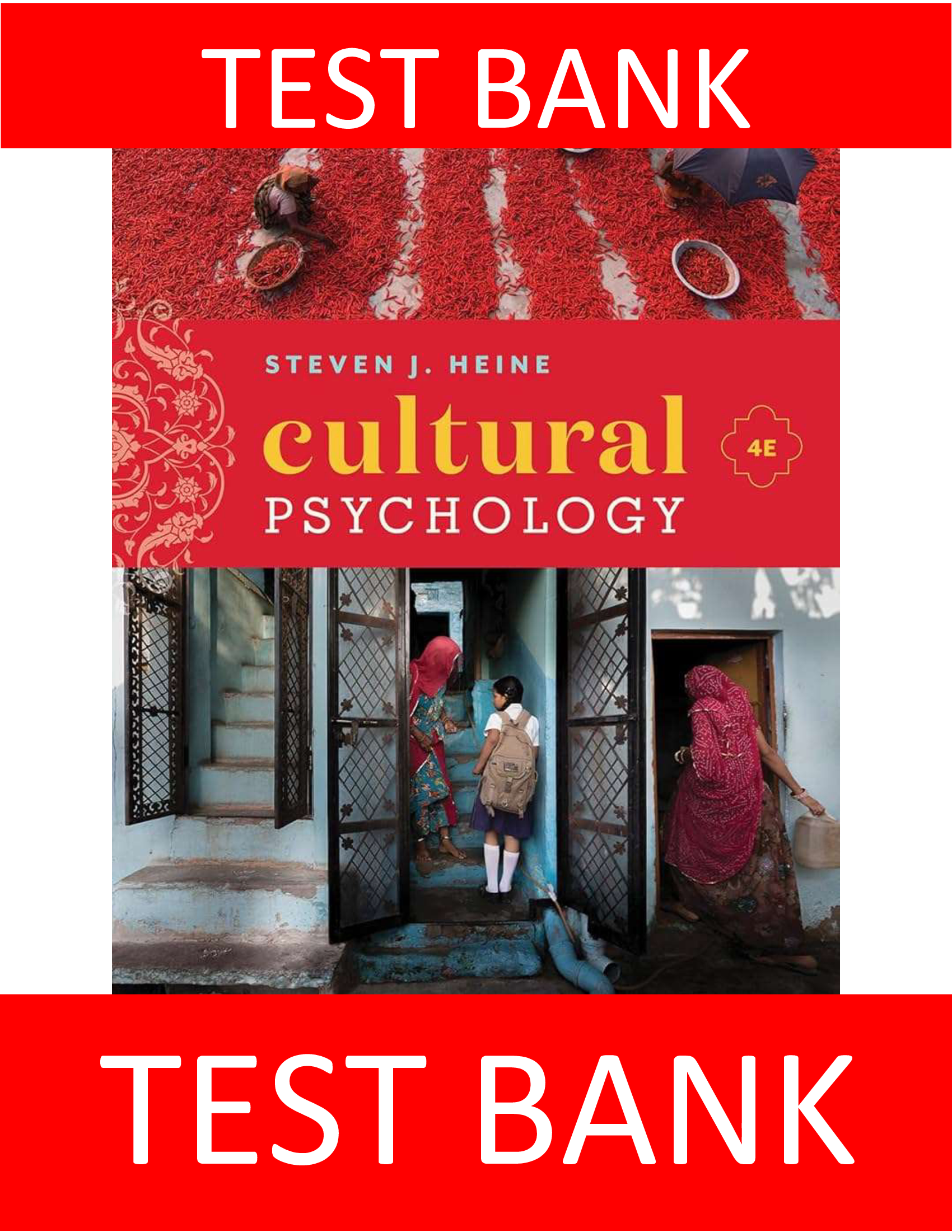
  • Test Bank For Cultural Psychology 4th Edition Steven J Heine

Test Bank For Cultural Psychology 4th Edition Steven J Heine

Preview page 1 Preview page 2 Preview page 3
Add To Favorites

Share this item Share this item

  • Item Details
  • Comments (0)
  • Reviews (0)
  • Contact Seller

Test Bank For Cultural Psychology 4th Edition Steven J Heine

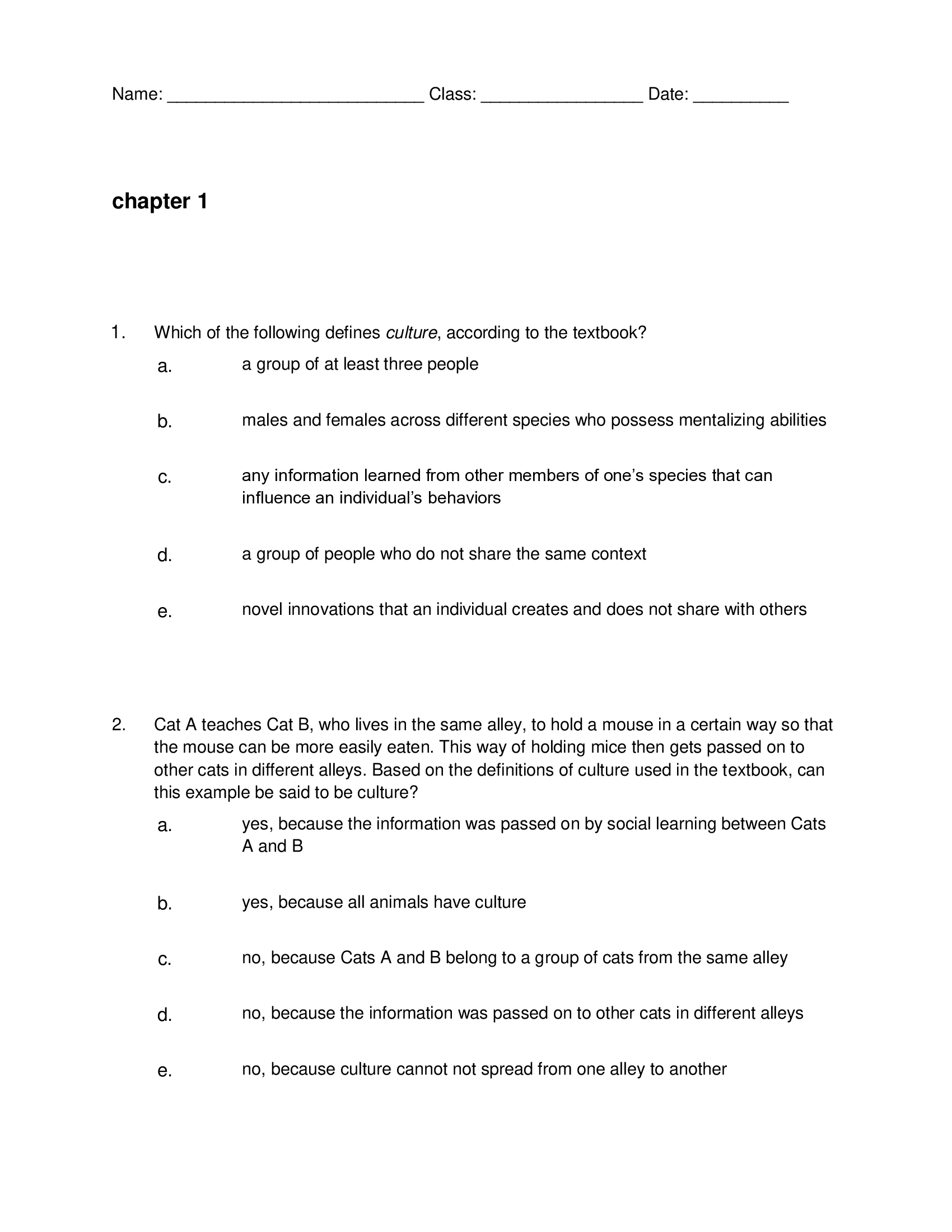
Sample Exam Questions from Cultural Psychology

1.           Which of the following defines culture, according to the textbook?  

a.                    a group of at least three people  

b.                    males and females across different species who possess mentalizing abilities  

c.                     any information learned from other members of one’s species that can influence an individual’s behaviors  

d.                    a group of people who do not share the same context  

e.                    novel innovations that an individual creates and does not share with others  


2.           Cat A teaches Cat B, who lives in the same alley, to hold a mouse in a certain way so that the mouse can be more easily eaten. This way of holding mice then gets passed on to other cats in different alleys. Based on the definitions of culture used in the textbook, can this example be said to be culture? 

a.                    yes, because the information was passed on by social learning between Cats A and B  

b.                    yes, because all animals have culture  

c.                     no, because Cats A and B belong to a group of cats from the same alley  

d.                    no, because the information was passed on to other cats in different alleys  

e.                    no, because culture cannot not spread from one alley to another  


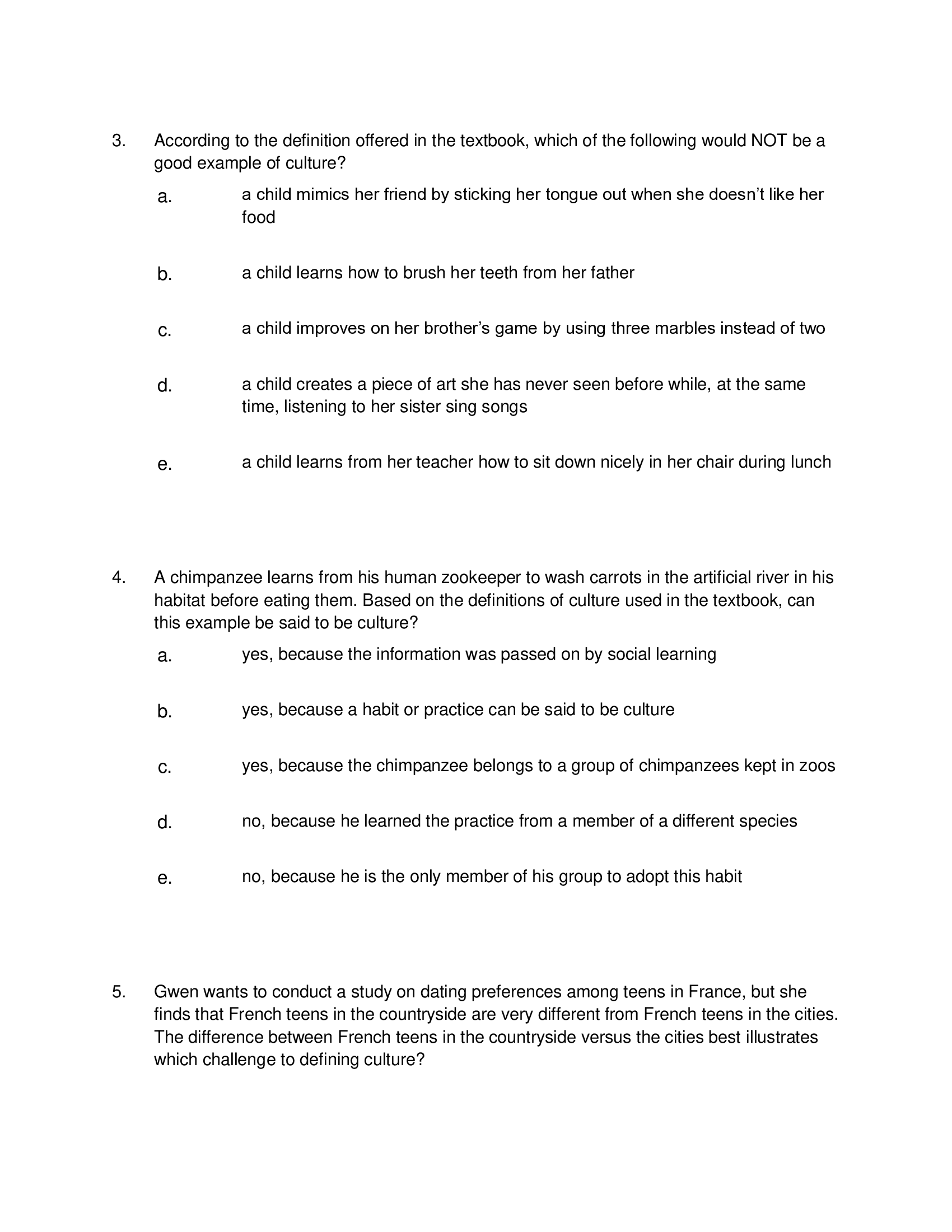
3.           According to the definition offered in the textbook, which of the following would NOT be a good example of culture? 

a.                    a child mimics her friend by sticking her tongue out when she doesn’t like her food  

b.                    a child learns how to brush her teeth from her father  

c.                     a child improves on her brother’s game by using three marbles instead of two  

d.                    a child creates a piece of art she has never seen before while, at the same time, listening to her sister sing songs  

e.                    a child learns from her teacher how to sit down nicely in her chair during lunch  


4.           A chimpanzee learns from his human zookeeper to wash carrots in the artificial river in his habitat before eating them. Based on the definitions of culture used in the textbook, can this example be said to be culture? 

a.                    yes, because the information was passed on by social learning  

b.                    yes, because a habit or practice can be said to be culture  

c.                     yes, because the chimpanzee belongs to a group of chimpanzees kept in zoos  

d.                    no, because he learned the practice from a member of a different species  

e.                    no, because he is the only member of his group to adopt this habit  


5.           Gwen wants to conduct a study on dating preferences among teens in France, but she finds that French teens in the countryside are very different from French teens in the cities. The difference between French teens in the countryside versus the cities best illustrates which challenge to defining culture? 

a.                    Cultural boundaries are not always clear-cut.  

b.                    Cultures are dynamic and change over time.  

c.                     Culture and the mind make each other up.  

d.                    There are as many variations within cultures as there are between cultures.  

e.                    Psychology relies too much on WEIRD samples.  


6.           In an African studies research paper that you are writing for publication, you use the word

“culture” to refer to a group of South African people. Which of the following is a challenge to using “culture” to define a group of South Africans? 

a.                    South Africans are likely very different from people who live in parts of North Africa.  

b.                    Present-day South Africans are likely very similar to South Africans in the early twentieth century.  

c.                     All South Africans share the same political and environmental contexts, leading them to have very similar experiences.  

d.                    There is too much variability within the South African population to warrant a single “South African” category.  

e.                    South Africa is economically very different from its neighbor, Botswana.  


7.           A key difference between cultural psychologists and general psychologists is that 

a.                    cultural psychologists study people in many different cultures in order to study universals, whereas general psychologists study people from one culture to study universals.  

b.                    cultural psychologists study people from one culture, whereas general psychologists study people from many cultures.  

c.                     cultural psychologists try to discover laws that govern the mind as a central processing unit (CPU), whereas general psychologists study variability across contexts.  

d.                    general psychologists believe that the mind is independent from context and content, whereas cultural psychologists believe that the mind cannot be separated from context and content.  

e.                    general psychologists believe that all of human psychology is universal, whereas cultural psychologists believe that people in different cultures think and behave in very different ways that cannot be explained.  


8.           Trina believes that deep down, people from different cultures are all the same. Which psychological perspective best represents Trina’s view?  a.   multicultural approach  

b.                    existential universal  

c.                     nonuniversal  

d.                    cultural psychology  

e.                    general psychology  


9.           A cultural neuroscience study by Hedden, Ketay, Aron, Markus, and Gabrieli (2008) had European Americans and East Asians make judgments on the figure-line task while in an fMRI scanner. The key results were that European Americans showed more activation in the left inferior parietal lobe and right precentral gyrus during the relative task, while East Asians showed this pattern during the absolute task. What do these results mean? 

a.                    European Americans had to pay more attention in the absolute task than the relative task.  

b.                    East Asians had to pay more attention in the absolute task than the relative task.  

c.                     East Asians were better at the absolute task than at the relative task.  

d.                    European Americans were happier during the absolute task than during the relative task.  

e.                    European Americans were more fearful during the relative task than during the absolute task.  


10.        Some people would describe cultural psychology as the study of how “culture and mind make each other up.” What does this statement mean? 

a.                    Culture and the mind are interchangeable concepts.  

b.                    Culture and the mind are opposite concepts from one another.  

c.                     Culture and the mind can be perceived as fantasy or make-believe.  

d.                    Culture and the mind are dependent on each other.  

e.                    Culture and the mind are very similar concepts.  


11.        A key belief of the Sambia is that 

a.                    people are born straight and become gay over time with experience.  

b.                    femaleness is innate but maleness must be explicitly learned.  

c.                     male sexuality is stable throughout life.  

d.                    homosexual encounters are natural for males and females between the ages of 7 and 15.  

e.                    maleness is innate, but femaleness must be explicitly learned.  


12.        In the Sambian context, the cultural emphasis on boys to go through rituals such as piercing their noses and thrashing them with sticks suggests that, for the Sambia, 

a.                    men must work hard to maintain their innate maleness.  

b.                    women need to work toward obtaining a female essence.  

c.                     pain is not associated with masculinity.  

d.                    masculinity is something that boys gain from certain behaviors.  

e.                    there is also a strong emphasis on sexuality being rigid and unchangeable.  


13.        According to the Sambia, 

a.                    men can get jerungdu from trees with white sap.  

b.                    females must be taught to engage in warfare.  

c.                     men can never lose jerungdu.  

d.                    heterosexuality is the only accepted form of sexuality.  

e.                    maleness will develop naturally over time.  


14.        What is the highest level of universality? 

a.                    nonuniversal  

b.                    existential universal  


functional universal  accessibility universal  ultimate universal  


15.        After an exhaustive study, you find no cultural variation across all samples explored in terms of sleeping in a tree at night. In other words, all examined cultures exhibited this practice, used trees for sleeping in the same way, and preferred sleeping in trees to the same extent. This finding would best be labeled as a(n)  a.   nonuniversal.  

b.                    existential universal.  

c.                     functional universal.  

d.                    accessibility universal.  

e.                    conditional universal.  


16.        If a psychological process involved in statistical reasoning is present only among individuals in a certain culture, it is a(n) 

a.                    statistical universal.  

b.                    nonuniversal.  

c.                     accessibility universal.  

d.                    existential universal.  

e.                    functional universal.  


17.        All cultures congratulate their members’ achievements to make them feel good about themselves, but some cultures are much more willing to do this than others. According to Norenzayan and Heine (2005), what is this an example of? 

a.                    existential universal  

b.                    accessibility universal  

c.                     functional universal  

d.                    nonuniversal  

e.                    conditional universal  


18.        Assume that the act of giving gifts to neighbors has been documented in every culture that exists in the world. Which of the following is definitely true about the act of gift giving? 

a.                    It is a nonuniversal.  

b.                    It serves the same purpose across all cultures.  

c.                     It happens more in Western than in non-Western cultures.  

d.                    It solves the same evolutionary problem in all cultures.  

e.                    It shows some level of universality.  


19.        Your research team found evidence that people in multiple cultures walk with their shoes on their heads, but this “shoe-on-head” way of walking is activated for different reasons across cultures. This would be evidence of a(n)  a.   nonuniversal.  

                b.               existential universal.  

functional universal.  accessibility universal.  

conditional universal.  


20.        People from all cultures use umbrellas, but in some cultures umbrellas are used only to block rainwater, whereas in other cultures umbrellas are used only to block the sun. The use of umbrellas across cultures would thus be classified as a(n) 

a.                    statistical universal.  

b.                    nonuniversal.  

c.                     accessibility universal.  

d.                    existential universal.  

e.                    functional universal.  


21.        You grew up learning that nodding your head means “yes,” and most people you know do the same; however, you recently learned that people in some cultures nod their heads when they mean to say “no.” Nodding your head would thus be characterized as a(n) 

a.                    existential universal.  

b.                    functional universal.  

c.                     nonuniversal.  

d.                    accessibility universal.  

e.                    statistical universal.  


22.        Celebrating birthdays is a functional universal. This means that in two cultures, the purpose of birthdays is ________ across the cultures and the importance of birthdays is ________ across the cultures. 

a.                    different; the same  

b.                    different; different  

c.                     the same; the same  

d.                    the same; different  

e.                    There is not enough information to answer this question.  

23.        What does the acronym “WEIRD” stand for? 

a.                    White, Educated, Industrialized, Rural, Democratic  

b.                    White, Educated, Introverted, Rich, Democratic  

c.                     Western, Elite, Industrialized, Rich, Driven  

d.                    Western, Educated, Industrialized, Rich, Democratic  

e.                    Western, Educated, Introverted, Rural, Democratic  

Contact the Seller

Please Sign In to contact this seller.


  • 👎  Report Copyright Violation

Frequently Asked Questions

What Do I Get When I Buy This Study Material?

+

When you buy a study material on Passing Grades, an instant download link will be sent directly to your email, giving you access to the file anytime after payment is completed.

Is Passing Grades a Trusted Platform?

+

Yes, Passing Grades is a reputable students’ marketplace with a secure payment system and reliable customer support. You can trust us to ensure a safe and seamless transaction experience.

Will I Be Stuck with a Subscription?

+

No, all purchases on Passing Grades are one-time transactions. You only pay for the notes you choose to buy, with no subscriptions or hidden fees attached.

Who Am I Buying These Study Materials From?

+

Passing Grades is a marketplace, which means you are purchasing the document from an individual vendor, not directly from us. We facilitate the payment and delivery process between you and the vendor.

Does Passing Grades Offer Free Study Materials?

+

Yes, sellers on Passing Grades have uploaded numerous free test banks, exams, practice questions, and class notes that can be downloaded at no cost.


Pasinggrades - Quality Study Materials

USD 15

    • Quality checked by Pasing Grades
    • 100% satisfaction guarantee
    • Seller: mentor2000
Buy PDF $15

Seller Information

mentor2000

Member since April 2021

  • icon
  • icon
View Profile
  • total sales

    0
  • Favourites

    0
  • Comments

    0
    ( 0 Ratings )

Item Information

  • Uploaded

    27 February 2025

  • Updated

    21 June 2025

  • Category

    No category

  • Item Type

    test bank

  • Tags

    Test Bank For Cultural Psychology 4th Edition Steven J Heine

Related Exam Prep Guides by mentor2000

Test Bank for Essentials for Nursing Practice 8th Edition by Potter | All Chapters
View Document

Test Bank for Essent...

  • mentor2000

    mentor2000

  • test bank

Master nursing concepts with this study material; Test Bank for Essentials for Nursing Practice, 8th...

15 USD

0

0

A &P 1 MA278 BSC2 Final Module II Questions & Answers 2026 Update
View Document

A &P 1 MA278 BSC2 Fi...

  • mentor2000

    mentor2000

  • test bank

Prepare for success with A&P 1 MA278 BSC2 Final Module II 2024 Q&A. Boost your grades with this comp...

15 USD

0

0

ATI Comprehensive Predictor Exam 2026
View Document

ATI Comprehensive Pr...

  • mentor2000

    mentor2000

  • test bank

Prepare for success with the ATI Comprehensive Predictor Exam 2026. Access key practice questions to...

15 USD

0

0

Purchase

Download link will be sent to this email immediately after purchase.

IMPORTANT LINKS

  • How To Upload Class Notes
  • Selling Tips
  • Passing Grades's Study Materials
  • Scholarships for International Students 2025

POPULAR CATEGORIES

  • Law
  • Accounting
  • English
  • Psychology
  • Business
  • Nursing
  • Computer Science
  • General

View Document

  • Blog
  • Contact
  • Delivery Policy
  • Latest Scholarships Around the World
  • How to Pass Bar Exams: Passing Grades’ Strategies
  • How to Study and Pass the CPA Exam
  • All Test Banks
  • Faq
  • Copyright Claims
  • Privacy Policy
  • Terms of Use

KNOWLEDGE BASE

  • How to Write A+ Grade Good Research Paper
  • How to Manage Stress During Exam Period
  • Best Time to Study
  • How to Pass NCLEX-RN Exam
  • How To Effectively Utilize Test Banks
  • Popular Shadow Health Exam Assessments
  • Popular HESI Case Studies
  • How to Prepare for a Nursing Career
  • The Importance Of Summaries in Exam Revisvion

© 2026 Pasing Grades. All rights reserved.