Pasing Grades
  • Start Selling
  • Blog
  • Contact
  • 0

    Your cart is empty!

English

  • English
  • Spanish
  • Arabic
Create Account Sign In
  • Library
    • New Prep Guides
    • Featured Prep Guides
    • Free Exam Prep Guides
    • Best sellers
  • General
  • Nursing
    • Research Paper
    • Case Study
    • Discussion Post
    • Assignment
    • Exam
    • Practice Questions and Answers
    • Test Bank
    • solutions manual
  • Accounting
    • Case Study
    • Thesis
    • Study Guide
    • Summary
    • Research Paper
    • test bank
  • English
    • Creative Writing
    • Research Paper
    • Summary
    • Rhetorics
    • Literature
    • Journal
    • Exam
    • Grammar
    • Discussion Post
    • Essay
  • Psychology
    • Hesi
    • Presentation
    • Essay
    • Summary
    • Study Guide
    • Essay
    • Solution Manual
    • Final Exam Review
    • Class Notes
    • test bank
  • Business
    • Lecture Notes
    • Solution Manual
    • Presentation
    • Business Plan
    • Class Notes
    • Experiment
    • Summary
    • Practice Questions
    • Study Guide
    • Case Study
    • test bank
    • Exam
  • More
    • Computer Science
    • Economics
    • Statistics
    • Engineering
    • Biology
    • Religious Studies
    • Physics
    • Chemistry
    • Mathematics
    • History
    • Sociology
    • Science
    • Philosophy
    • Law
  • Pages
    • About Us
    • Selling Tips
    • Delivery Policy
    • Faq
    • Privacy Policy
  • Flash Sale
  • Home
  • Test Bank for concepts for nursing practice 3rd Edition by Giddens

Test Bank for concepts for nursing practice 3rd Edition by Giddens

Preview page 1 Preview page 2 Preview page 3
Add To Favorites

Share this item Share this item

  • Item Details
  • Comments (0)
  • Reviews (0)
  • Contact Seller

Test Bank for concepts for nursing practice 3rd Edition by Giddens

Multiple Choice Study Material


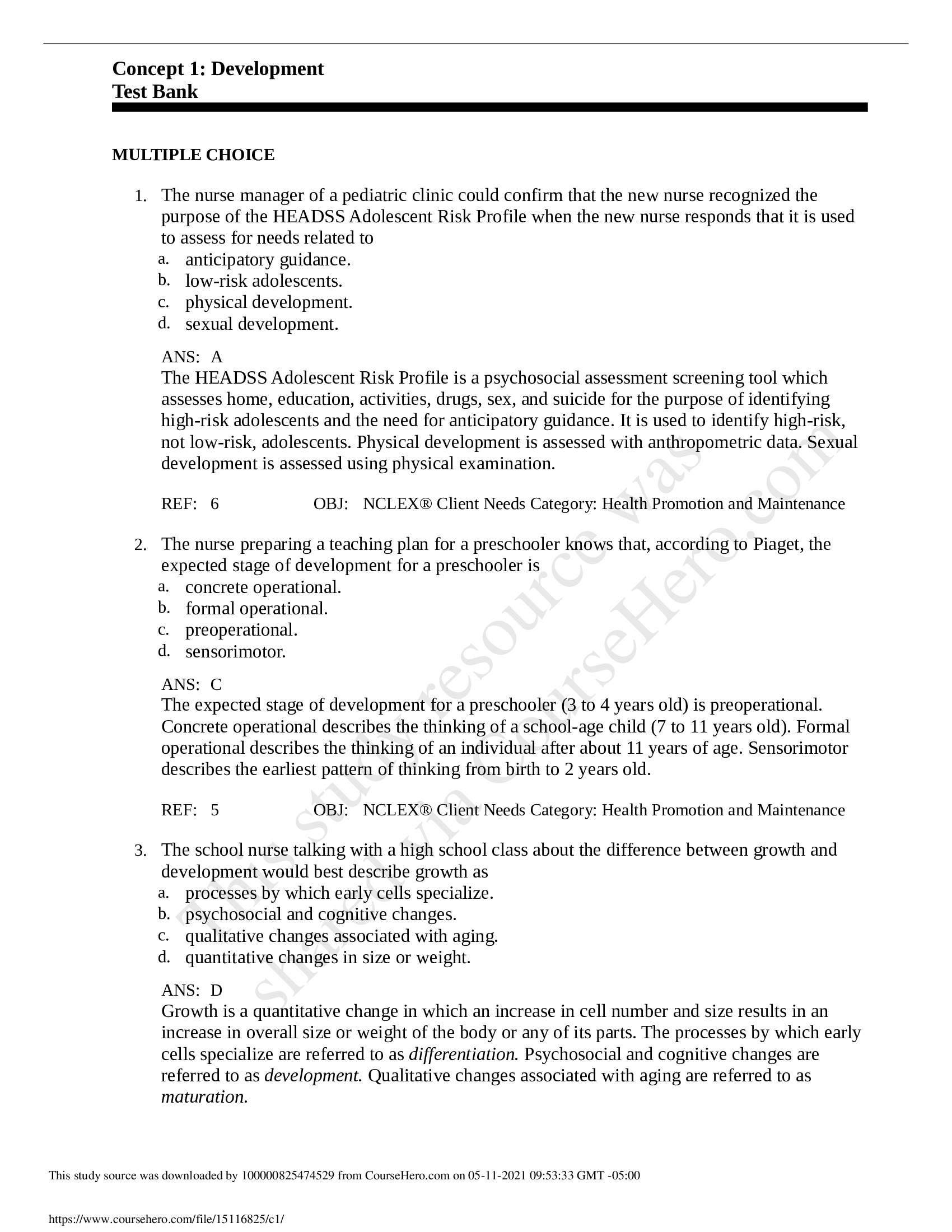
1.   The nurse manager of a pediatric clinic could confirm that the new nurse recognized the purpose of the HEADSS Adolescent Risk Profile when the new nurse responds that it is used to assess for needs related to

a.   anticipatory guidance.

b.   low-risk adolescents.

c.   physical development.

d.   sexual development.


ANS:  A

The HEADSS Adolescent Risk Profile is a psychosocial assessment screening tool which assesses home, education, activities, drugs, sex, and suicide for the purpose of identifying high-risk adolescents and the need for anticipatory guidance. It is used to identify high-risk, not low-risk, adolescents. Physical development is assessed with anthropometric data. Sexual

development is assessed using physical examination.


REF:   6                      OBJ:   NCLEX® Client Needs Category: Health Promotion and Maintenance


2.   The nurse preparing a teaching plan for a preschooler knows that, according to Piaget, the expected stage of development for a preschooler is

a.   concrete operational.

b.   formal operational.

c.   preoperational.

d.   sensorimotor.


ANS:  C

The expected stage of development for a preschooler (3 to 4 years old) is preoperational. Concrete operational describes the thinking of a school-age child (7 to 11 years old). Formal operational describes the thinking of an individual after about 11 years of age. Sensorimotor

describes the earliest pattern of thinking from birth to 2 years old.


REF:   5                      OBJ:   NCLEX® Client Needs Category: Health Promotion and Maintenance


3.   The school nurse talking with a high school class about the difference between growth and development would best describe growth as

a.   processes by which early cells specialize.

b.   psychosocial and cognitive changes.

c.   qualitative changes associated with aging.

d.   quantitative changes in size or weight.


ANS:  D

Growth is a quantitative change in which an increase in cell number and size results in an

increase in overall size or weight of the body or any of its parts. The processes by which early cells specialize are referred to as differentiation. Psychosocial and cognitive changes are referred to as development. Qualitative changes associated with aging are referred to as maturation.


REF:   2                      OBJ:   NCLEX® Client Needs Category: Health Promotion and Maintenance


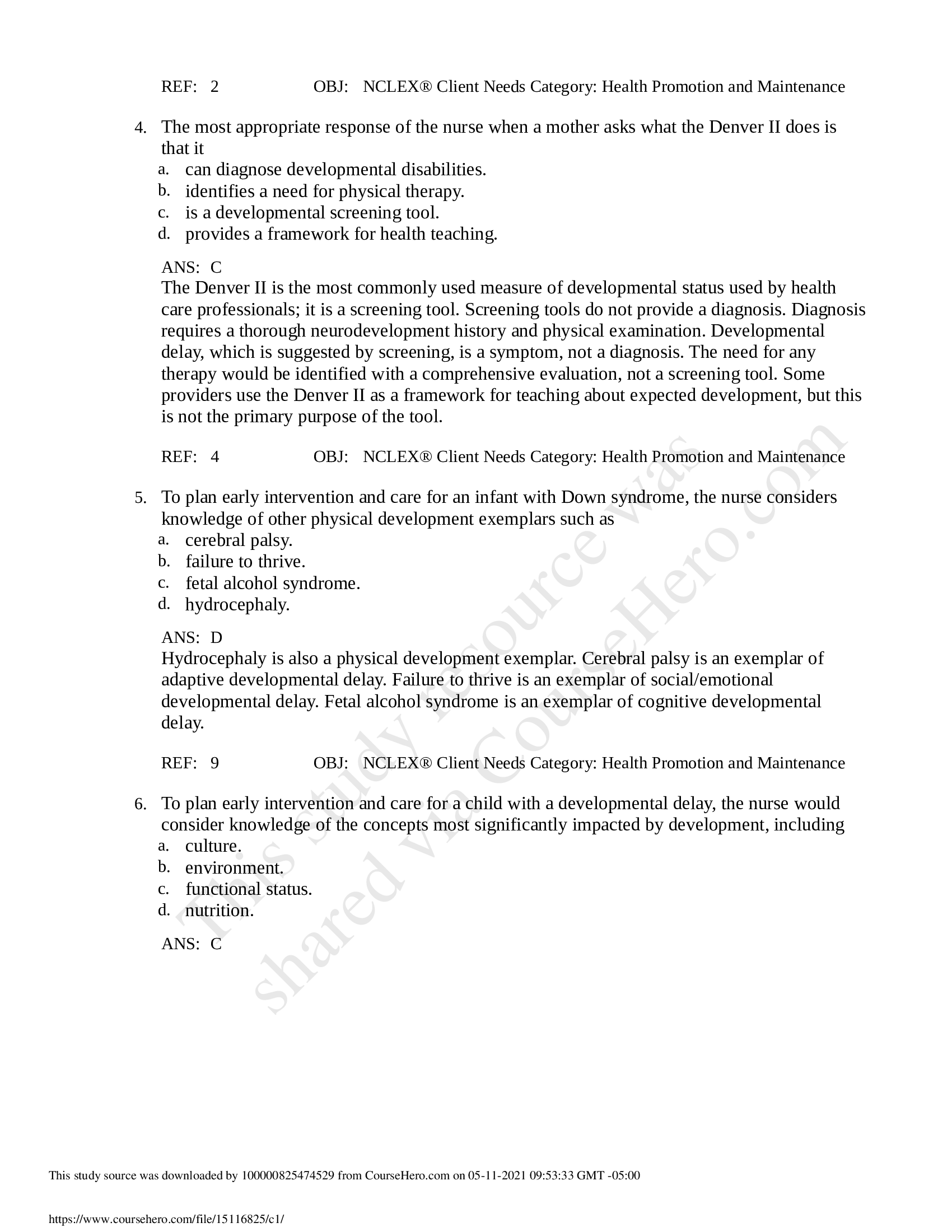
4.   The most appropriate response of the nurse when a mother asks what the Denver II does is that it

a.   can diagnose developmental disabilities. b.   identifies a need for physical therapy. is a c.   developmental screening tool. provides a

d.   framework for health teaching.


ANS:  C

The Denver II is the most commonly used measure of developmental status used by health

care professionals; it is a screening tool. Screening tools do not provide a diagnosis. Diagnosis requires a thorough neurodevelopment history and physical examination. Developmental

delay, which is suggested by screening, is a symptom, not a diagnosis. The need for any therapy would be identified with a comprehensive evaluation, not a screening tool. Some providers use the Denver II as a framework for teaching about expected development, but this is not the primary purpose of the tool.


REF:   4                      OBJ:   NCLEX® Client Needs Category: Health Promotion and Maintenance


5.   To plan early intervention and care for an infant with Down syndrome, the nurse considers knowledge of other physical development exemplars such as

a.   cerebral palsy.

b.   failure to thrive.

c.   fetal alcohol syndrome.

d.   hydrocephaly.


ANS:  D

Hydrocephaly is also a physical development exemplar. Cerebral palsy is an exemplar of adaptive developmental delay. Failure to thrive is an exemplar of social/emotional developmental delay. Fetal alcohol syndrome is an exemplar of cognitive developmental delay.


REF:   9                      OBJ:   NCLEX® Client Needs Category: Health Promotion and Maintenance


6.   To plan early intervention and care for a child with a developmental delay, the nurse would consider knowledge of the concepts most significantly impacted by development, including a.   culture.

b.   environment.

c.   functional status.

d.   nutrition.


ANS:  C


Function is one of the concepts most significantly impacted by development. Others include sensory-perceptual, cognition, mobility, reproduction, and sexuality. Knowledge of these concepts can help the nurse anticipate areas that need to be addressed. Culture is a concept

that is considered to significantly affect development; the difference is the concepts that affect development are those that represent major influencing factors (causes), hence determination of development and would be the focus of preventive interventions. Environment is

considered to significantly affect development. Nutrition is considered to significantly affect

development.


REF:   1                      OBJ:   NCLEX® Client Needs Category: Health Promotion and Maintenance


7.   A mother complains to the nurse at the pediatric clinic that her 4-year-old child always talks to her toys and makes up stories. The mother wants her child to have a psychologic evaluation. The nurse’s best initial response is to

a.   refer the child to a psychologist.

b.   explain that playing make believe with dolls and people is normal at this age.

c.   complete a developmental screening.

d.   separate the child from the mother to get more information.


ANS:  B

By the end of the fourth year, it is expected that a child will engage in fantasy, so this is normal at this age. A referral to a psychologist would be premature based only on the

complaint of the mother. Completing a developmental screening would be very appropriate but not the initial response. The nurse would certainly want to get more information, but

separating the child from the mother is not necessary at this time.


REF:   5                      OBJ:   NCLEX® Client Needs Category: Health Promotion and Maintenance


8.   A 17-year-old girl is hospitalized for appendicitis, and her mother asks the nurse why she is so needy and acting like a child. The best response of the nurse is that in the hospital, adolescents

a.   have separation anxiety.

b.   rebel against rules.

c.   regress because of stress.

d.   want to know everything.


ANS:  C

Regression to an earlier stage of development is a common response to stress. Separation anxiety is most common in infants and toddlers. Rebellion against hospital rules is usually not an issue if the adolescent understands the rules and would not create childlike behaviors. An adolescent may want to “know everything” with their logical thinking and deductive reasoning, but that would not explain why they would act like a child.


REF:   4                      OBJ:   NCLEX® Client Needs Category: Health Promotion and Maintenance


Concept 2: Functional Ability

Test Bank


MULTIPLE CHOICE


1.   The nurse is assessing a patient's functional ability. Which activities most closely match the definition of functional ability?

a.   Healthy individual, works outside the home, uses a cane, well groomed

b.   Healthy individual, college educated, travels frequently, can balance a checkbook

c.   Healthy individual, works out, reads well, cooks and cleans house

d.   Healthy individual, volunteers at church, works part time, takes care of family and

house


ANS:  D

Functional ability refers to the individual's ability to perform the normal daily activities required to meet basic needs; fulfill usual roles in the family, workplace, and community; and maintain health and well-being. The other options are good; however, each option has advanced or independent activities in the context of the option.


REF:   11

OBJ:   NCLEX® Client Needs Category: Physiological Integrity: Basic Care and Comfort


2.   The nurse is assessing a patient's functional performance. What assessment parameters will be most important in this assessment?

a.   Continence assessment, gait assessment, feeding assessment, dressing assessment,

transfer assessment

b.   Height, weight, body mass index (BMI), vital signs assessment

c.   Sleep assessment, energy assessment, memory assessment, concentration assessment

d.   Healthy individual, volunteers at church, works part time, takes care of family and house


ANS:  A

Functional impairment, disability, or handicap refers to varying degrees of an individual's inability to perform the tasks required to complete normal life activities without assistance. Height, weight, BMI, and vital signs are physical assessment. Sleep, energy, memory, and concentration are part of a depression screening. Healthy, volunteering, working, and caring

for family and house are functional abilities, not performance.


REF:   11

OBJ:   NCLEX® Client Needs Category: Physiological Integrity: Reduction of Risk Potential


3.   The nurse is assessing a patient with a mobility dysfunction and wants to gain insight into the patient's functional ability. What question would be the most appropriate?

a.   "Are you able to shop for yourself?"

b.   "Do you use a cane, walker, or wheelchair to ambulate?"

c.   "Do you know what today's date is?"

d.   "Were you sad or depressed more than once in the last 3 days?"


ANS:  B


"Do you use a cane, walker, or wheelchair to ambulate?" will assist the nurse in determining the patient's ability to perform self-care activities. A nutritional health risk assessment is not the functional assessment. Knowing the date is part of a mental status exam. Assessing sadness is a question to ask in the depression screening.


REF:   11-12

OBJ:   NCLEX® Client Needs Category: Physiological Integrity: Physiological Adaptation


4.   The nurse is developing an interdisciplinary plan of care using the Roper-Logan-Tierney Model of Nursing for a patient who is currently unconscious. Which interventions would be most critical to developing a plan of care for this patient?

a.   Eating and drinking, personal cleansing and dressing, working and playing

b.   Toileting, transferring, dressing, and bathing activities

c.   Sleeping, expressing sexuality, socializing with peers

d.   Maintaining a safe environment, breathing, maintaining temperature


ANS:  D

The most critical aspects of care for an unconscious patient are safe environment, breathing, and temperature. Eating and drinking are contraindicated in unconscious patients. Toileting, transferring, dressing, and bathing activities are BADLs. Sleeping, expressing sexuality, and socializing with peers are a part of the Roper-Logan-Tierney Model of Nursing; however,

these are not the most critical for developing the plan of care in an unconscious patient.


REF:   13

OBJ:   NCLEX® Client Needs Category: Physiological Integrity: Physiological Adaptation


5.   The home care nurse is trying to determine the necessary services for a 65-year-old patient who was admitted to the home care service status after left knee replacement. Which tool(s) will assist with this determination?

a.   Minimum Data Set (MDS)

b.   Functional Status Scale (FSS)

c.   24-Hour Functional Ability Questionnaire (24hFAQ)

d.   The Edmonton Functional Assessment Tool


ANS:  C

The 24hFAQ assesses the postoperative patient in the home setting. The MDS is for nursing home patients. The FSS is for children. The Edmonton is for cancer patients.


REF:   13                    OBJ:   NCLEX® Client Needs Category: Health Promotion and Maintenance


6.   The nurse is assessing a patient's functional abilities and asks the patient, "How would you rate your ability to prepare a balanced meal?" "How would you rate your ability to balance a checkbook?" "How would you rate your ability to keep track of your appointments?" Which tool would be indicated for the best results of this patient's perception of their abilities?

a.   Functional Activities Questionnaire (FAQ)™

b.   Mini Mental Status Exam (MMSE)

c.   24hFAQ

d.   Performance-based functional measurement


ANS:  A


The FAQ is an example of a self-report tool which provides information about the patient's perception of functional ability. The MMSE assesses cognitive impairment. The 24hFAQ is used to assess functional ability in postoperative patients. Performance-based tools involve actual observation of a standardized task, completion of which is judged by objective criteria.


REF:   12                    OBJ:   NCLEX® Client Needs Category: Health Promotion and Maintenance


MULTIPLE RESPONSE


1.   A 65-year-old female patient has been admitted to the medical/surgical unit. The nurse is assessing the patient's risk for falls so that falls prevention can be implemented if necessary. Select all the risk factors that apply from this patient's history and physical.  (Select all that apply.)

a.   Being a woman

b.   Taking more than six medications

c.   Having hypertension

d.   Having cataracts

e.   Muscle strength 3/5 bilaterally

f.    Incontinence


ANS:  B, D, E, F

Adverse effects of medications can contribute to falls. Cataracts impair vision, which is a risk factor for falls. Poor muscle strength is a risk factor for falls. Incontinence of urine or stool increases risk for falls. Men have a higher risk for falls. Hypertension itself does not contribute to falls. Dizziness does contribute to falls.


REF:   14

OBJ:   NCLEX® Client Needs Category: Physiological Integrity: Reduction of Risk Potential


OTHER


1.   Match the activities listed with the appropriate functional level of ability: Use A for instrumental activities of daily living (IADLs) and use B for basic activities of daily living (BADLs). (Your answer should appear as letters separated by commas and spaces [e.g., A, A, A, A, A, A].)

A.   Uses a cane

B.   Bathes daily

C.  Takes medications as prescribed

D.   Dresses self

E.   Balances the checkbook

F.   Cleans the house


ANS:

B, B, A, B, A, A

Functional impairment, disability, or handicap refers to varying degrees of an individual's inability to perform the tasks required to complete normal life activities without assistance. IADLs are more complex skills that are essential to living in the community.


REF:   14

OBJ:   NCLEX® Client Needs Category: Physiological Integrity: Reduction of Risk Potential


Concept 3: Family Dynamics

Test Bank


MULTIPLE CHOICE


1.   The most appropriate initial nursing intervention when the nurse notes dysfunctional interactions and lack of family support for a patient would be to

a.   enforce hospital visiting policies.

b.   monitor the dysfunctional interactions.

c.   notify the primary care provider.

d.   role model appropriate support.


ANS:  D

Nurses can, at times, role model more appropriate interactions or provide suggestions for improving communication and interactions among family members. If the nurse determines that the number of visitors has a negative impact on the patient, hospital policy may be to limit visitors, but that would not be the initial action. Monitoring the dysfunctional

interactions would not be an adequate response. The primary care provider should certainly be

notified, but that would not be the initial response.


REF:   22                    OBJ:   NCLEX® Client Needs Category: Psychosocial Integrity


2.   The nurse caring for a patient would identify a need for additional interventions related to family dynamics when

a.   extended family offers to help.

b.   family members express concern.

c.   the ill member demands attention.

d.   memories are shared.


ANS:  C

It is not uncommon for the ill family member to become demanding and indicate that they deserve special treatment and care, and the supportive family may need assistance in understanding the dynamics of the illness in order to continue to be supportive. Offers from

extended family to help can be indicative of positive dynamics. Concern expressed by family

members can be indicative of positive dynamics. Sharing of family memories can be indicative of positive dynamics.


REF:   24-25              OBJ:   NCLEX® Client Needs Category: Psychosocial Integrity


3.   Jane and Janet have an established long-term relationship and are attending parenting classes in anticipation of finalizing adoption of baby Joan. Jane and Janet would be considered which type of family?

a.   Cohabiting

b.   Nuclear

c.   Same-sex

d.   Single parent


ANS:  C


Jane and Janet would be considered a same-sex family. Cohabiting refers to a couple who live together with no legal bond. Nuclear refers to the traditional male and female core family with one or more children. Single parent refers to a family with one adult and one or more children.


REF:   20                    OBJ:   NCLEX® Client Needs Category: Psychosocial Integrity


4.   Critical Thinking: The nurse identifies the family with a child graduating from college as being in the family life cycle of


a.   single young adult leaving home.

b.   new couple joins their families through marriage or living together.

c.   families with young children.

d.   launching children and moving on.


ANS:  D

The launching children and moving cycle occurs when the children become independent and establish their own home, as when they graduate and begin to establish their own lives, separate from the family of origin. The single young adult leaving home cycle occurs when the "child" establishes their own home away from the family they grew up with. The new couple

joins their families through marriage or living together cycle begins when a couple establishes a household separate from the family of origin. The families with young children cycle begins with the addition of a child to the family.


REF:   23|27               OBJ:   NCLEX® Client Needs Category: Psychosocial Integrity


5.   When reviewing the purposes of a family assessment, the nurse educator would identify a need for further teaching if the student responded that family assessment is used to gain an understanding of the family

a.   development.

b.   function.

c.   political views.

d.   structure.


ANS:  C

An understanding of the political views of family members is not a primary purpose of a family assessment. A family assessment provides the nurse with information and an understanding of family dynamics. This is important to nurses for the provision of quality health care. A family assessment provides an understanding of family development, function,

and structure.


REF:   23-24              OBJ:   NCLEX® Client Needs Category: Health Promotion and Maintenance


6.   The nurse planning to assess the structure of a family would which question?

a.   "Who lives with you?"

b.   "Who does the grocery shopping?"

c.   "Who provides support in your family?"

d.   "How old are the members of your family?"


ANS:  A


The structure of the family includes who is in the family and what their relationship is. "Who does the shopping?" would provide information about family functioning. "Who provides support?" would provide information about family functioning. "How old are the members?" would provide information about family development.


REF:   23-24              OBJ:   NCLEX® Client Needs Category: Psychosocial Integrity


7.   Factors which would alert the nurse to negative/dysfunctional family dynamics include

a.   aging of family members.

b.   chronic illness of a family member.

c.   disability of a family member.

d.   intimate partner violence.


ANS:  D

Intimate partner violence is an exemplar of negative/dysfunctional family dynamics. Aging of family members is an exemplar of changes to family dynamics. Chronic illness of a family member is an exemplar of changes to family dynamics. Disability of a family member is an exemplar of changes to family dynamics.


REF:   24-25              OBJ:   NCLEX® Client Needs Category: Psychosocial Integrity


Concept 4: Culture

Test Bank


MULTIPLE CHOICE


1.   The nurse is triaging a hysterical patient in the ER. The patient is crying, with uncontrollable spasms, trembling, and shouting. It is important to identify manifestation of illness in order to effectively treat a patient. The nurse identifies this as a culture-bound syndrome called

a.   shenjing sharo.

b.   loco de la cabeza.

c.   ataque de nervios.

d.   neuroasthenia.


ANS:  C

Ataque de nervios is a Latin-Caribbean culture-bound syndrome that usually occurs in response to a specific stressor and is characterized by dissociation or trance-like states, crying, uncontrollable spasms, trembling, or shouting. Shenjeng sharo refers to “weakness of nerves” in Chinese culture; it is caused by a decrease in vital energy that reduces the function of the

internal organ systems and lowers resistance to disease. Loco de la cabeza is a Spanish phrase meaning crazy in the mind and not necessarily manifested by physical symptoms. Neuroasthenia is an Asian term characterized by extreme fatigue after mental effort and bodily weakness of persistent duration.


REF:   30

OBJ:   NCLEX® Client Needs Category: Psychosocial Integrity and Physiological Integrity: Basic

Care and Comfort


2.   Understanding cultural differences in health care is important because it will help the nurse to understand the manner in which people decide on obtaining treatments and medical care. In independent cultures an individual will

a.   put himself first.

b.   consult family members for advice.

c.   ask for a second opinion.

d.   travel great distances to receive the best care.


ANS:  A

In independent cultures, an individual will put himself first in the case of a life-threatening illness, whereas even in dire circumstances, members of collectivist cultures may still consult other family members for the best course of action. In independent cultures, an individual will not consult with other family members, ask for a second opinion, or travel great distances to

receive the best care.


REF:   31                    OBJ:   NCLEX® Client Needs Category: Psychosocial Integrity


3.   When teaching an Asian patient with newly diagnosed diabetes, the nurse notes the patient nodding yes to everything that is being said. With a better understanding of cultural interdependence in self-concept, a nurse should immediately

a.   write everything down for the patient to refer to later.

b.   prompt further to elicit additional questions or concerns.

c.   call the recognized elder for this patient.


d.   call the oldest male relative for help with decision making.


ANS:  B

When a nurse provides nutritional education to a patient who is from a culture that values greater power distance, it might appear that the patient is willing to accept all that the nurse suggests, when further prompting would elicit additional questions or concerns. The patient from a collectivist culture will usually consult family members for a best course of action. It is

not acceptable for nurses to take it upon themselves to call the recognized elder or oldest male relative for help with decision making. While writing everything down may be OK for some cultures, with Asian patients it may be best to prompt further to elicit additional questions or concerns.


REF:   31                    OBJ:   NCLEX® Client Needs Category: Psychosocial Integrity


4.   Women who are given the job of caretaker for aging relatives are subject to caregiver strain due to

a.   feminine attributes.

b.   unequal gender.

c.   fixed gender roles.

d.   female inequality.


ANS:  C

In cultures with more fixed gender roles, women are usually given the role of caretaker for aging relatives and may suffer the stresses of caregiver strain. Feminine attributes refers to harmonious relationships, modesty, and taking care of others. Unequal gender refers to roles of males and females being unevenly distributed. Female inequality refers to female gender

and roles being less than or unequal to male roles.


REF:   31                    OBJ:   NCLEX® Client Needs Category: Psychosocial Integrity


5.   Mr. Giuseppe is a 60-year-old Italian immigrant who presents for an annual physical. He is counseled about diagnostic testing including laboratory testing, colonoscopy, influenza vaccination, and pneumococcal vaccination. His reply is “If it ain’t broke, don’t try to fix it.” Understanding that respect for traditions and fulfilling obligations is important in developing a nursing plan of care. Mr. Giuseppe’s cultural orientation is towards

a.   short term.

b.   long term.

c.   leisurely term.

d.   noncommittal.


ANS:  A

Short-term cultural orientation is towards the present or past and emphasizes quick results. Long-term cultural orientation is towards the future and long-term rewards. Long-term- oriented cultures favor thrift, perseverance, and adopting to changing circumstances. Leisurely term and noncommittal are undefined in cultural orientation.


REF:   31-32              OBJ:   NCLEX® Client Needs Category: Psychosocial Integrity


6.   The emphasis on understanding cultural influence on health care is important because of

a.   disability entitlements.

b.   HIPAA requirements.


c.   increasing global diversity.

d.   litigious society.


ANS:  C

Culture is an essential aspect of health care because of increasing diversity. Disability entitlements refer to defined benefits for eligible mental or physically disabled beneficiaries in relation to housing, employment, and health care. HIPAA requirements refers to the HIPAA Privacy Rule, which protects the privacy of individually identifiable health information; the

HIPAA Security Rule, which sets national standards for the security of electronic protected health information; and the confidentiality provisions of the Patient Safety Rule, which protect identifiable information being used to analyze patient safety events and improve patient

safety.

Litigious society refers to excessively ready to go to law or initiate a lawsuit.


REF:   29                    OBJ:   NCLEX® Client Needs Category: Health Promotion and Maintenance


7.   What interrelated constructs facilitate a nurse to become culturally competent?

a.   Cultural diversity, self-awareness, cultural skill, and cultural knowledge b.    Cultural desire, self-awareness, cultural knowledge, and cultural identity c.    Cultural desire, self-awareness, cultural knowledge, and cultural diversity d.    Cultural desire, self-awareness, cultural knowledge, and cultural skill


ANS:  D

The process of cultural competence consists of four interrelated constructs: cultural desire, self-awareness, cultural knowledge, and cultural skill. Cultural diversity in the context of health care refers to achieving the highest level of health care for all people by addressing societal inequalities and historical and contemporary injustices. Cultural identity is the norms,

values, beliefs, and behaviors of a culture learned through families and group members.


REF:   34                    OBJ:   NCLEX® Client Needs Category: Psychosocial Integrity

Contact the Seller

Please Sign In to contact this seller.


  • 👎  Report Copyright Violation

Frequently Asked Questions

What Do I Get When I Buy This Study Material?

+

When you buy a study material on Passing Grades, an instant download link will be sent directly to your email, giving you access to the file anytime after payment is completed.

Is Passing Grades a Trusted Platform?

+

Yes, Passing Grades is a reputable students’ marketplace with a secure payment system and reliable customer support. You can trust us to ensure a safe and seamless transaction experience.

Will I Be Stuck with a Subscription?

+

No, all purchases on Passing Grades are one-time transactions. You only pay for the notes you choose to buy, with no subscriptions or hidden fees attached.

Who Am I Buying These Study Materials From?

+

Passing Grades is a marketplace, which means you are purchasing the document from an individual vendor, not directly from us. We facilitate the payment and delivery process between you and the vendor.

Does Passing Grades Offer Free Study Materials?

+

Yes, sellers on Passing Grades have uploaded numerous free test banks, exams, practice questions, and class notes that can be downloaded at no cost.

Pasinggrades - Quality Study Materials

USD 15

    • Quality checked by Pasing Grades
    • 100% satisfaction guarantee
    • Seller: mentor2000
Buy PDF $15

Seller Information

mentor2000

Member since April 2021

  • icon
  • icon
View Profile
  • total sales

    0
  • Favourites

    0
  • Comments

    0
    ( 0 Ratings )

Item Information

  • Uploaded

    02 October 2023

  • Updated

    29 September 2025

  • Category

    Nursing

  • Item Type

    exam

  • Tags

    Test Bank for concepts for nursing practice 3rd Edition by Giddens

Related Exam Prep Guides by mentor2000

Test Bank for Essentials for Nursing Practice 8th Edition by Potter | All Chapters
View Document

Test Bank for Essent...

  • mentor2000

    mentor2000

  • exam

Master nursing concepts with this study material; Test Bank for Essentials for Nursing Practice, 8th...

15 USD

0

0

A &P 1 MA278 BSC2 Final Module II Questions & Answers 2026 Update
View Document

A &P 1 MA278 BSC2 Fi...

  • mentor2000

    mentor2000

  • exam

Prepare for success with A&P 1 MA278 BSC2 Final Module II 2024 Q&A. Boost your grades with this comp...

15 USD

0

0

ATI Comprehensive Predictor Exam 2026
View Document

ATI Comprehensive Pr...

  • mentor2000

    mentor2000

  • exam

Prepare for success with the ATI Comprehensive Predictor Exam 2026. Access key practice questions to...

15 USD

0

0

Purchase

Download link will be sent to this email immediately after purchase.

IMPORTANT LINKS

  • How To Upload Class Notes
  • Selling Tips
  • Passing Grades's Study Materials
  • Scholarships for International Students 2025

POPULAR CATEGORIES

  • Law
  • Accounting
  • English
  • Psychology
  • Business
  • Nursing
  • Computer Science
  • General

View Document

  • Blog
  • Contact
  • Delivery Policy
  • Latest Scholarships Around the World
  • How to Pass Bar Exams: Passing Grades’ Strategies
  • How to Study and Pass the CPA Exam
  • All Test Banks
  • Faq
  • Copyright Claims
  • Privacy Policy
  • Terms of Use

KNOWLEDGE BASE

  • How to Write A+ Grade Good Research Paper
  • How to Manage Stress During Exam Period
  • Best Time to Study
  • How to Pass NCLEX-RN Exam
  • How To Effectively Utilize Test Banks
  • Popular Shadow Health Exam Assessments
  • Popular HESI Case Studies
  • How to Prepare for a Nursing Career
  • The Importance Of Summaries in Exam Revisvion

© 2026 Pasing Grades. All rights reserved.