Pasing Grades
  • Start Selling
  • Blog
  • Contact
  • 0

    Your cart is empty!

English

  • English
  • Spanish
  • Arabic
Create Account Sign In
  • Library
    • New Prep Guides
    • Featured Prep Guides
    • Free Exam Prep Guides
    • Best sellers
  • General
  • Nursing
    • Research Paper
    • Case Study
    • Discussion Post
    • Assignment
    • Exam
    • Practice Questions and Answers
    • Test Bank
    • solutions manual
  • Accounting
    • Case Study
    • Thesis
    • Study Guide
    • Summary
    • Research Paper
    • test bank
  • English
    • Creative Writing
    • Research Paper
    • Summary
    • Rhetorics
    • Literature
    • Journal
    • Exam
    • Grammar
    • Discussion Post
    • Essay
  • Psychology
    • Hesi
    • Presentation
    • Essay
    • Summary
    • Study Guide
    • Essay
    • Solution Manual
    • Final Exam Review
    • Class Notes
    • test bank
  • Business
    • Lecture Notes
    • Solution Manual
    • Presentation
    • Business Plan
    • Class Notes
    • Experiment
    • Summary
    • Practice Questions
    • Study Guide
    • Case Study
    • test bank
    • Exam
  • More
    • Computer Science
    • Economics
    • Statistics
    • Engineering
    • Biology
    • Religious Studies
    • Physics
    • Chemistry
    • Mathematics
    • History
    • Sociology
    • Science
    • Philosophy
    • Law
  • Pages
    • About Us
    • Selling Tips
    • Delivery Policy
    • Faq
    • Privacy Policy
  • Flash Sale
  • Home
  • Test Bank for Concept Based Clinical Nursing Skills 1st Edition by Stein

Test Bank for Concept Based Clinical Nursing Skills 1st Edition by Stein

Preview page 1 Preview page 2 Preview page 3
Add To Favorites

Share this item Share this item

  • Item Details
  • Comments (0)
  • Reviews (0)
  • Contact Seller

Test Bank for Concept Based Clinical Nursing Skills 1st Edition by Stein

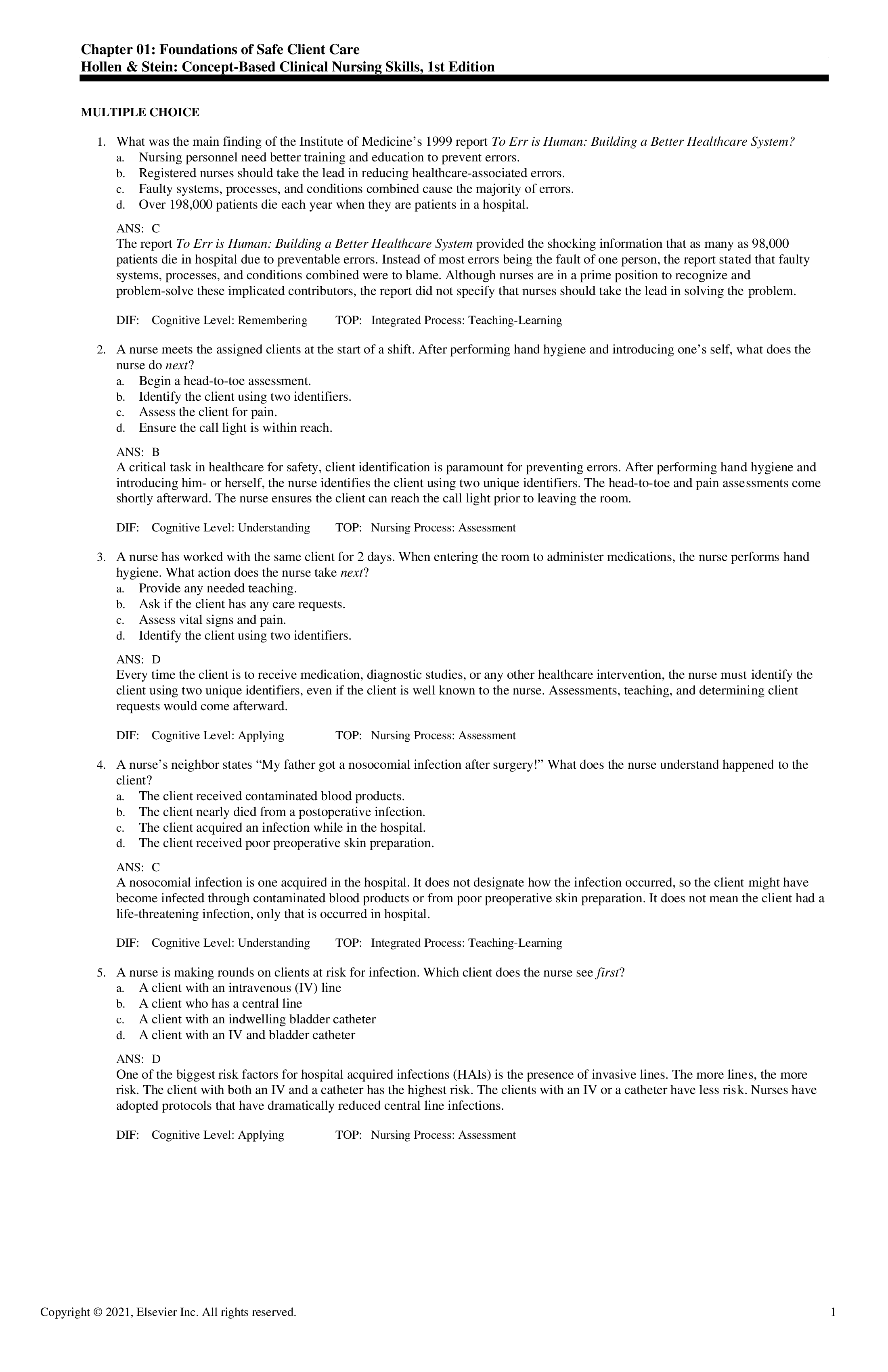
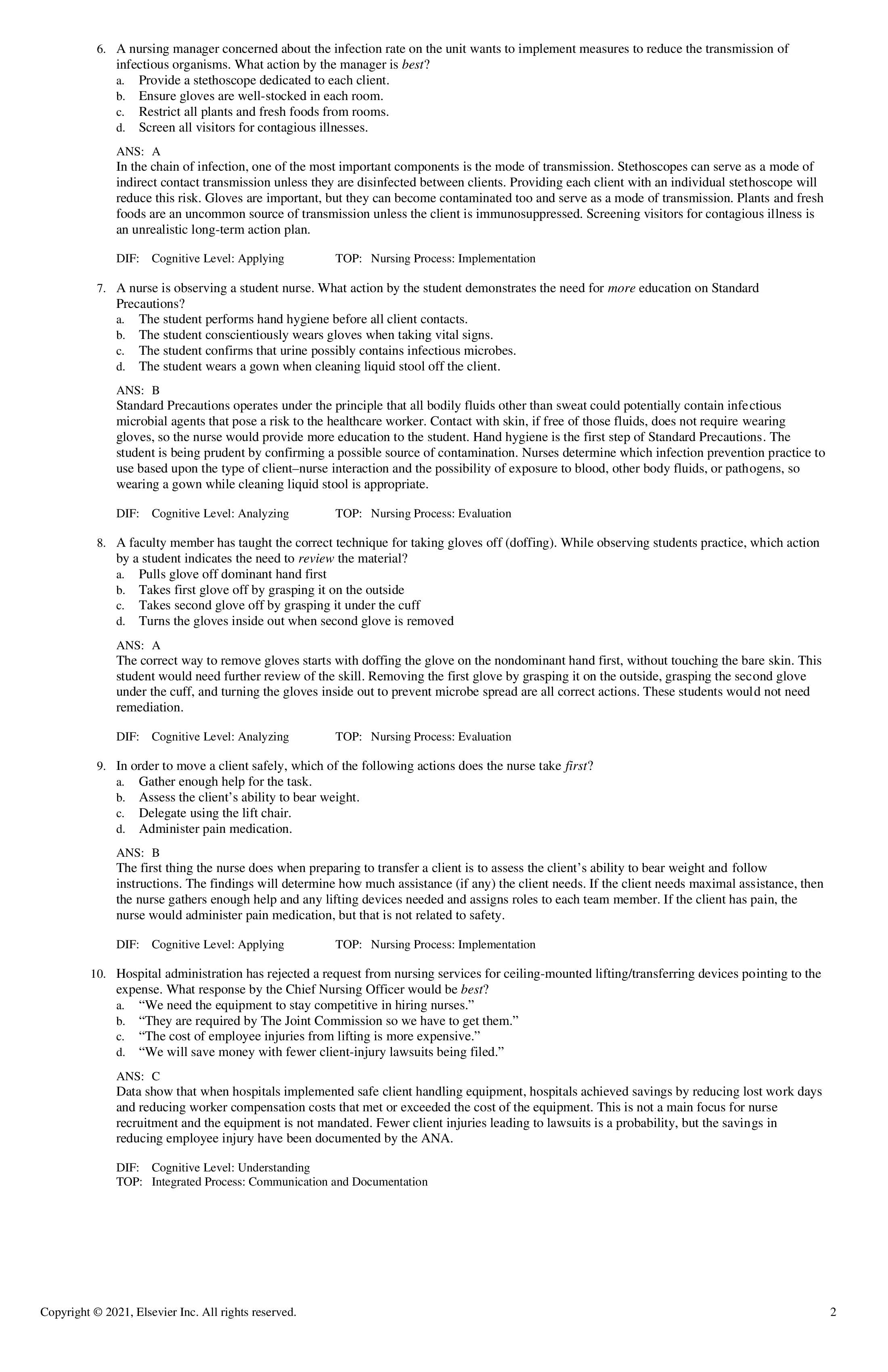
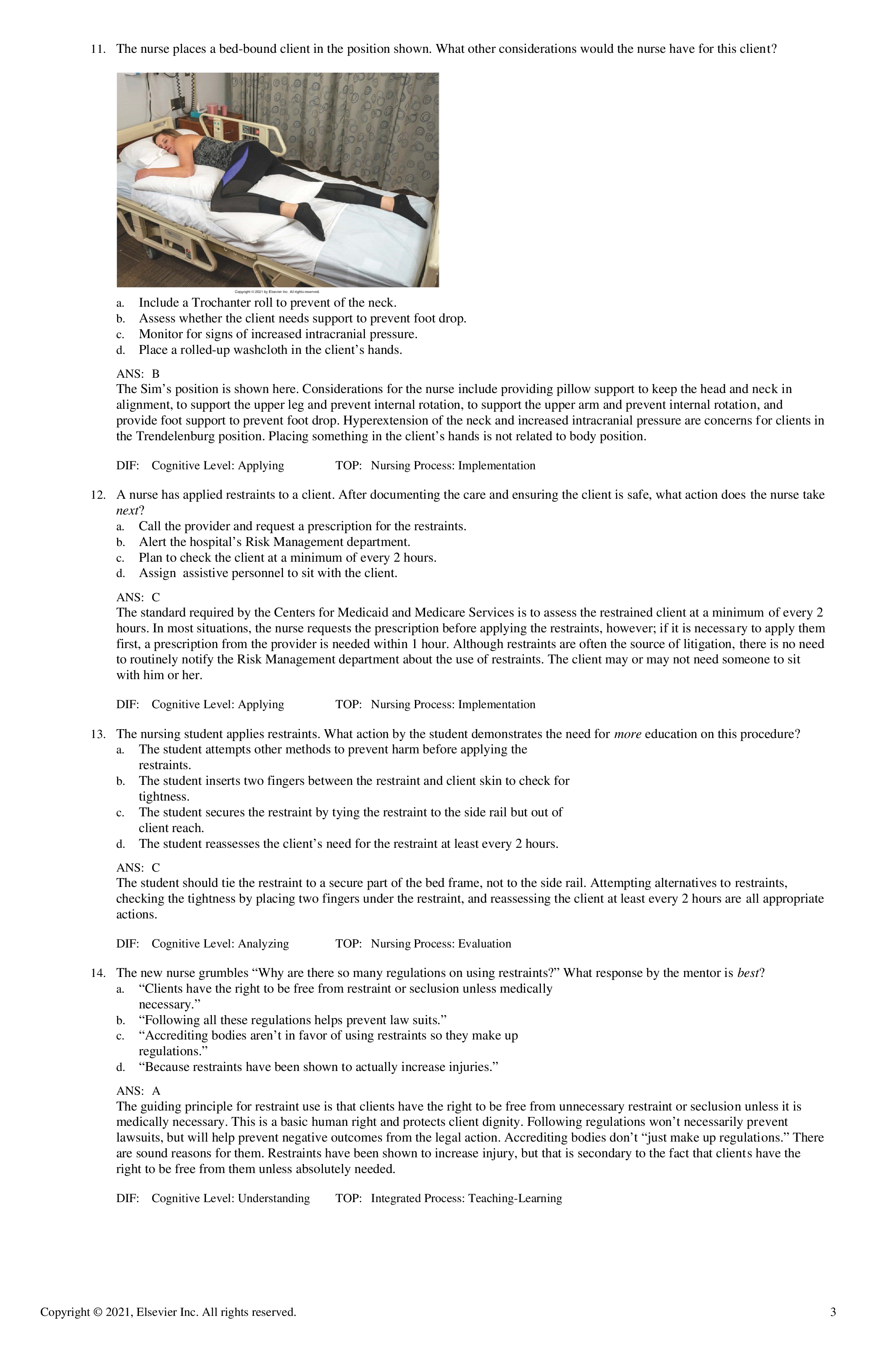
1.         A nurse has applied restraints to a client. After documenting the care and ensuring the client is safe, what action does the nurse take next?

a.        Call the provider and request a prescription for the restraints.

b.        Alert the hospital’s Risk Management department.

c.        Plan to check the client at a minimum of every 2 hours.

d.        Assign  assistive personnel to sit with the client.

ANS: C

The standard required by the Centers for Medicaid and Medicare Services is to assess the restrained client at a minimum of every 2 hours. In most situations, the nurse requests the prescription before applying the restraints, however; if it is necessary to apply them first, a prescription from the provider is needed within 1 hour. Although restraints are often the source of litigation, there is no need to routinely notify the Risk Management department about the use of restraints. The client may or may not need someone to sit with him or her.

               DIF: Cognitive Level: Applying               TOP: Nursing Process: Implementation

2.         The nursing student applies restraints. What action by the student demonstrates the need for more education on this procedure?

a.        The student attempts other methods to prevent harm before applying the restraints.

b.        The student inserts two fingers between the restraint and client skin to check for tightness.

c.        The student secures the restraint by tying the restraint to the side rail but out of client reach.

d.        The student reassesses the client’s need for the restraint at least every 2 hours.

ANS: C

The student should tie the restraint to a secure part of the bed frame, not to the side rail. Attempting alternatives to restraints, checking the tightness by placing two fingers under the restraint, and reassessing the client at least every 2 hours are all appropriate actions.

               DIF: Cognitive Level: Analyzing              TOP: Nursing Process: Evaluation

3.         The new nurse grumbles “Why are there so many regulations on using restraints?” What response by the mentor is best?

a.        “Clients have the right to be free from restraint or seclusion unless medically necessary.”

b.        “Following all these regulations helps prevent law suits.”

c.        “Accrediting bodies aren’t in favor of using restraints so they make up regulations.”

d.        “Because restraints have been shown to actually increase injuries.”

ANS: A

The guiding principle for restraint use is that clients have the right to be free from unnecessary restraint or seclusion unless it is medically necessary. This is a basic human right and protects client dignity. Following regulations won’t necessarily prevent lawsuits, but will help prevent negative outcomes from the legal action. Accrediting bodies don’t “just make up regulations.” There are sound reasons for them. Restraints have been shown to increase injury, but that is secondary to the fact that clients have the right to be free from them unless absolutely needed.

              DIF:   Cognitive Level: Understanding      TOP: Integrated Process: Teaching-Learning

4.         A nurse is caring for a client in Droplet Precautions. What action does the nurse take to decrease a common complaint from clients in isolation?

a. appropriate for a client weighing under 200 pounds (90.0 kg). Since the client is not standing on the floor, the nonskid slippers are not needed.

               DIF: Cognitive Level: Applying               TOP: Nursing Process: Intervention

5.      The charge nurse is conducting an audit on compliance with Transmission-Based Precautions. Which action by the nursing staff shows good understanding and correct application of these precautions? (Select all that apply.) a.    Contact Precautions: Dons gloves and a gown before entering the room

b.        Droplet Precautions: Cares for the client only if immunity to the disease is present

c.        Standard Precautions: Combines Standard Precautions with any other precautions

d.        Droplet Precautions: Wears a mask when taking client vital signs

e.        Two levels of Precautions: Maintains compliance with both types of precautions

f.         Contact Precautions: Places two patients with MRSA in the same room

ANS: A, C, D, E, F

Transmission-based precautions are determined by the illness and mode of transmission. The minimum required for Contact Precautions is donning gloves and a gown when entering the room. Nurses always use Standard Precautions for every client, no matter what other type of precautions the client is on. Nurses put on a mask when entering the room of a client on Droplet Precautions if close contact with the client is expected, such as when taking vital signs. When a client has two (or more) levels of Transmission-based Precautions, nurses correctly maintain compliance with all types. While private rooms are preferred for clients on Transmission-Based Precautions, cohorting clients with the same infectious agent is acceptable. Immunity is an important consideration for nurses caring for clients on Airborne Precautions.

               DIF: Cognitive Level: Analyzing              TOP: Nursing Process: Evaluation

6.      What does the nurse remember about appropriate hand hygiene? (Select all that apply.)

a.        Alcohol-based hand sanitizers are the gold standard for hand hygiene.

b.        Washing with soap and water is needed after using the toilet.

c.        After contact with certain organisms, soap and water is required.

d.        Alcohol-based hand sanitizers are only good for a few client types.

e.        The presence of hand sanitizers decreases the frequency of hand hygiene.

ANS: A, B, C

The CDC and WHO have concluded that alcohol-based hand sanitizers are the gold standard for hand hygiene and should be used whenever possible and appropriate. After using the toilet, if hands are visibly soiled, or after contact with certain microbes, washing with soap and water is required. The presence of hand sanitizers has increased the frequency of hand hygiene performed.

              DIF:   Cognitive Level: Remembering       TOP: Integrated Process: Teaching-Learning

7.      Which of the following are Joint Commission accepted unique client identifiers in a hospital? (Select all that apply.) a.    Name

b.        Date of birth

c.        Room number

d.        Photograph in medical record

e.        Hospital account number

f.         Social security number

ANS: A, B, E

In the hospital setting, acceptable identifiers include the client’s name, date of birth, and account number. In a behavioral healthcare setting, a photograph may be used. In an outpatient setting, the social security is an acceptable choice.

              DIF: Cognitive Level: Remembering        TOP: Nursing Process: Assessment

Contact the Seller

Please Sign In to contact this seller.


  • 👎  Report Copyright Violation

Frequently Asked Questions

What Do I Get When I Buy This Study Material?

+

When you buy a study material on Passing Grades, an instant download link will be sent directly to your email, giving you access to the file anytime after payment is completed.

Is Passing Grades a Trusted Platform?

+

Yes, Passing Grades is a reputable students’ marketplace with a secure payment system and reliable customer support. You can trust us to ensure a safe and seamless transaction experience.

Will I Be Stuck with a Subscription?

+

No, all purchases on Passing Grades are one-time transactions. You only pay for the notes you choose to buy, with no subscriptions or hidden fees attached.

Who Am I Buying These Study Materials From?

+

Passing Grades is a marketplace, which means you are purchasing the document from an individual vendor, not directly from us. We facilitate the payment and delivery process between you and the vendor.

Does Passing Grades Offer Free Study Materials?

+

Yes, sellers on Passing Grades have uploaded numerous free test banks, exams, practice questions, and class notes that can be downloaded at no cost.

Pasinggrades - Quality Study Materials

USD 15

    • Quality checked by Pasing Grades
    • 100% satisfaction guarantee
    • Seller: mentor2000
Buy PDF $15

Seller Information

mentor2000

Member since April 2021

  • icon
  • icon
View Profile
  • total sales

    0
  • Favourites

    0
  • Comments

    0
    ( 0 Ratings )

Item Information

  • Uploaded

    22 May 2022

  • Updated

    16 May 2025

  • Category

    Nursing

  • Item Type

    test bank

  • Tags

    Test Bank for Concept Based Clinical Nursing Skills 1st Edition by Stein

Related Exam Prep Guides by mentor2000

Test Bank for Essentials for Nursing Practice 8th Edition by Potter | All Chapters
View Document

Test Bank for Essent...

  • mentor2000

    mentor2000

  • test bank

Master nursing concepts with this study material; Test Bank for Essentials for Nursing Practice, 8th...

15 USD

0

0

A &P 1 MA278 BSC2 Final Module II Questions & Answers 2026 Update
View Document

A &P 1 MA278 BSC2 Fi...

  • mentor2000

    mentor2000

  • test bank

Prepare for success with A&P 1 MA278 BSC2 Final Module II 2024 Q&A. Boost your grades with this comp...

15 USD

0

0

ATI Comprehensive Predictor Exam 2026
View Document

ATI Comprehensive Pr...

  • mentor2000

    mentor2000

  • test bank

Prepare for success with the ATI Comprehensive Predictor Exam 2026. Access key practice questions to...

15 USD

0

0

Purchase

Download link will be sent to this email immediately after purchase.

IMPORTANT LINKS

  • How To Upload Class Notes
  • Selling Tips
  • Passing Grades's Study Materials
  • Scholarships for International Students 2025

POPULAR CATEGORIES

  • Law
  • Accounting
  • English
  • Psychology
  • Business
  • Nursing
  • Computer Science
  • General

View Document

  • Blog
  • Contact
  • Delivery Policy
  • Latest Scholarships Around the World
  • How to Pass Bar Exams: Passing Grades’ Strategies
  • How to Study and Pass the CPA Exam
  • All Test Banks
  • Faq
  • Copyright Claims
  • Privacy Policy
  • Terms of Use

KNOWLEDGE BASE

  • How to Write A+ Grade Good Research Paper
  • How to Manage Stress During Exam Period
  • Best Time to Study
  • How to Pass NCLEX-RN Exam
  • How To Effectively Utilize Test Banks
  • Popular Shadow Health Exam Assessments
  • Popular HESI Case Studies
  • How to Prepare for a Nursing Career
  • The Importance Of Summaries in Exam Revisvion

© 2026 Pasing Grades. All rights reserved.