Pasing Grades
  • Start Selling
  • Blog
  • Contact
  • 0

    Your cart is empty!

English

  • English
  • Spanish
  • Arabic
Create Account Sign In
  • Library
    • New Prep Guides
    • Featured Prep Guides
    • Free Exam Prep Guides
    • Best sellers
  • General
  • Nursing
    • Research Paper
    • Case Study
    • Discussion Post
    • Assignment
    • Exam
    • Practice Questions and Answers
    • Test Bank
    • solutions manual
  • Accounting
    • Case Study
    • Thesis
    • Study Guide
    • Summary
    • Research Paper
    • test bank
  • English
    • Creative Writing
    • Research Paper
    • Summary
    • Rhetorics
    • Literature
    • Journal
    • Exam
    • Grammar
    • Discussion Post
    • Essay
  • Psychology
    • Hesi
    • Presentation
    • Essay
    • Summary
    • Study Guide
    • Essay
    • Solution Manual
    • Final Exam Review
    • Class Notes
    • test bank
  • Business
    • Lecture Notes
    • Solution Manual
    • Presentation
    • Business Plan
    • Class Notes
    • Experiment
    • Summary
    • Practice Questions
    • Study Guide
    • Case Study
    • test bank
    • Exam
  • More
    • Computer Science
    • Economics
    • Statistics
    • Engineering
    • Biology
    • Religious Studies
    • Physics
    • Chemistry
    • Mathematics
    • History
    • Sociology
    • Science
    • Philosophy
    • Law
  • Pages
    • About Us
    • Selling Tips
    • Delivery Policy
    • Faq
    • Privacy Policy
  • Flash Sale
  • Home
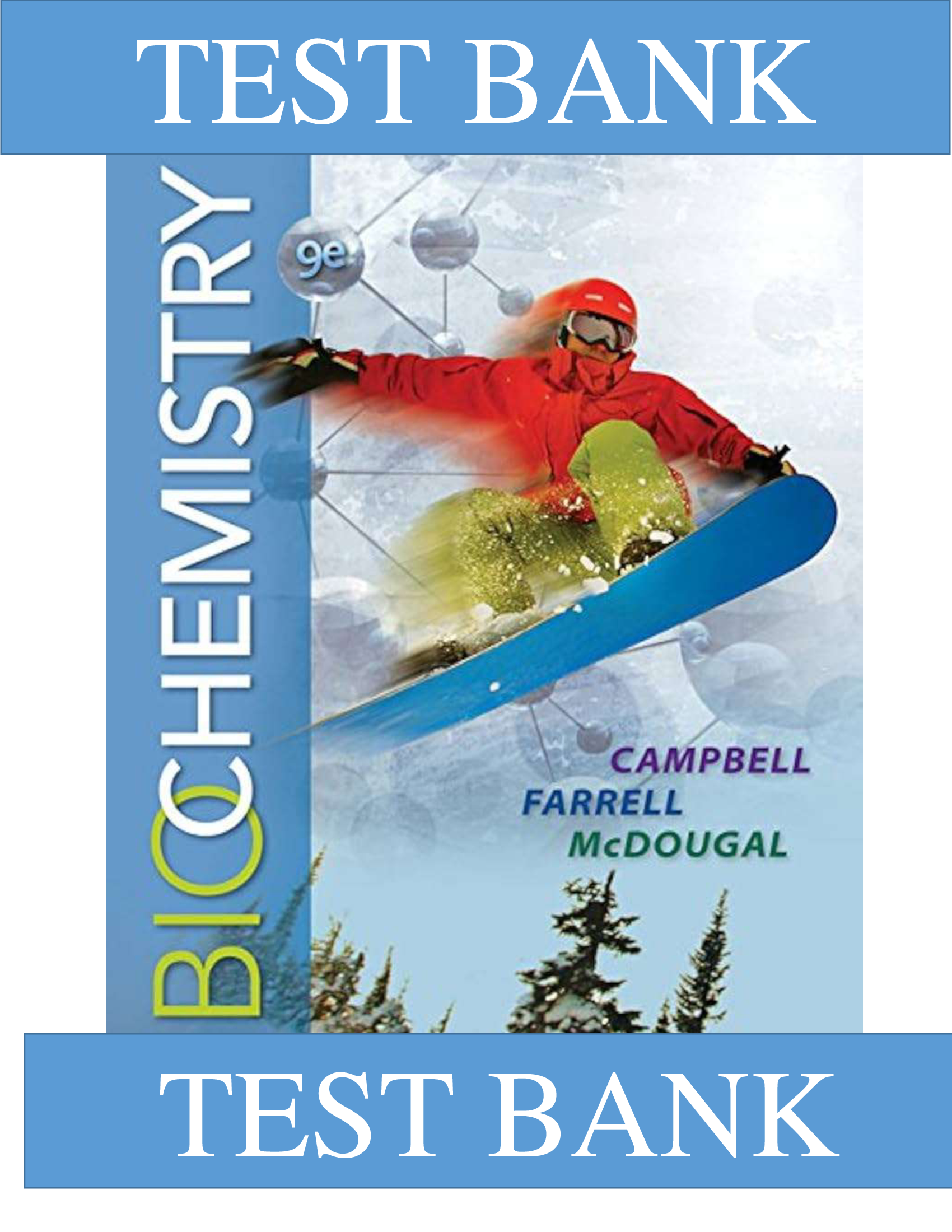
  • Test Bank for Biochemistry 9th Edition Campbell, Farrell (All Chapters)

Test Bank for Biochemistry 9th Edition Campbell, Farrell (All Chapters)

Preview page 1 Preview page 2 Preview page 3
Add To Favorites

Share this item Share this item

  • Item Details
  • Comments (0)
  • Reviews (0)
  • Contact Seller

Test Bank Description for Biochemistry, 9th Edition by Campbell, Farrell, and McDougal

This comprehensive test bank is tailored to accompany Biochemistry, 9th Edition by Mary Campbell, Shawn Farrell, and Owen McDougal. Designed to align closely with the textbook’s chapters and learning objectives, it provides a wide variety of question types—including multiple choice, true/false, short answer, and application-based problems—ideal for exam prep, quizzes, and homework support.

Each question is crafted to reinforce key biochemical principles, helping students master foundational topics such as enzyme kinetics, metabolism, protein structure, and nucleic acids. Questions are categorized by difficulty level and cognitive skill (based on Bloom’s Taxonomy), making it easy for instructors to build assessments or for students to self-test and track progress.


Whether you're an instructor preparing classroom materials or a student aiming to ace your biochemistry course, this test bank is a powerful tool that supports deeper learning and better performance.

Sample Test Bank Questions and Answer

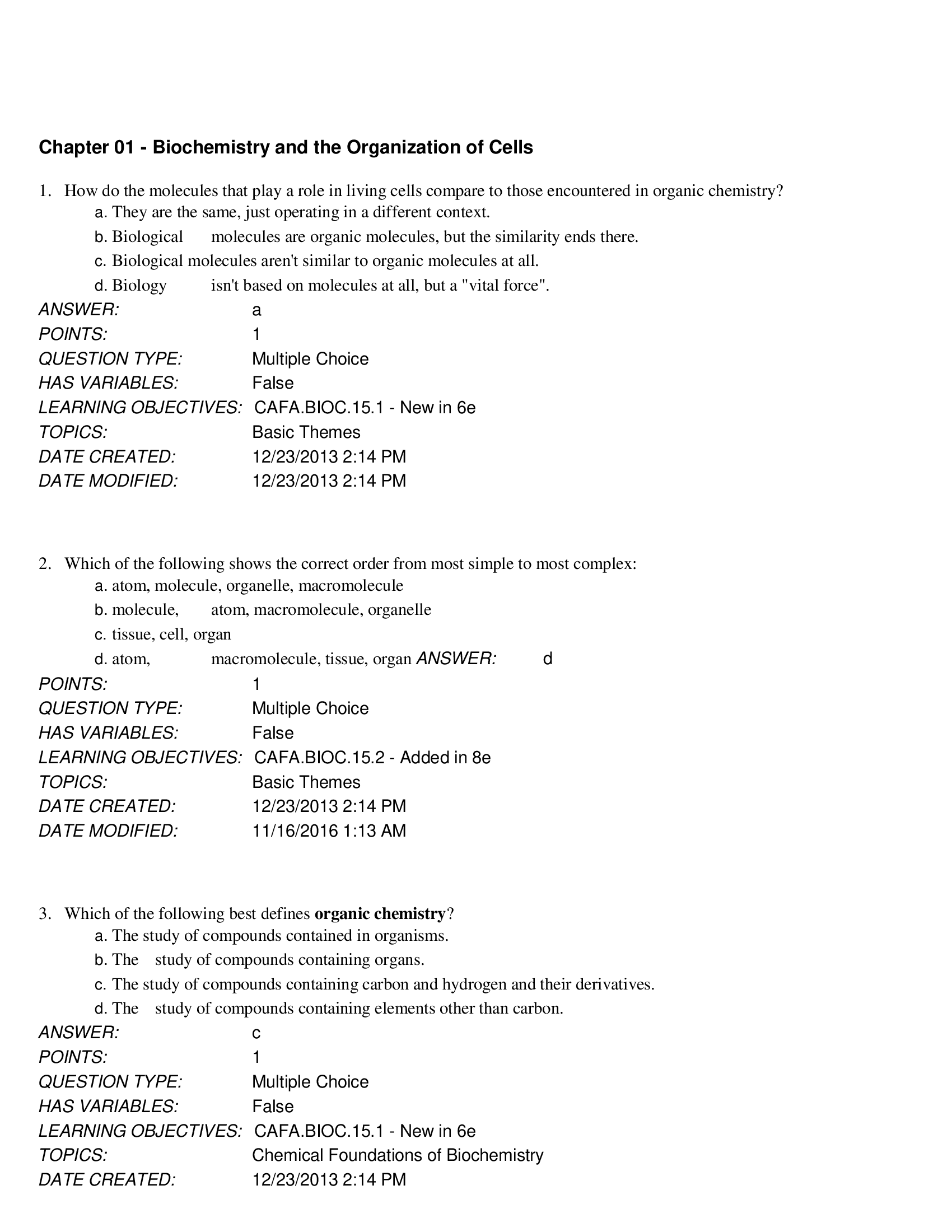
1. How do the molecules that play a role in living cells compare to those encountered in organic chemistry?

a. They are the same, just operating in a different context.

b. Biological molecules are organic molecules, but the similarity ends there.

c. Biological molecules aren't similar to organic molecules at all.

d. Biology  isn't based on molecules at all, but a "vital force".

ANSWER:  a

2.  Which of the following shows the correct order from most simple to most complex:

a. atom, molecule, organelle, macromolecule

b.molecule, atom, macromolecule, organelle

c. tissue, cell, organ

d.atom, macromolecule, tissue, organ

ANSWER:             d

3.                  Which of the following best defines organic chemistry?

a.             The study of compounds contained in organisms.

b.            The         study of compounds containing organs.

c.             The study of compounds containing carbon and hydrogen and their derivatives.

d.            The         study of compounds containing elements other than carbon.

ANSWER:             c

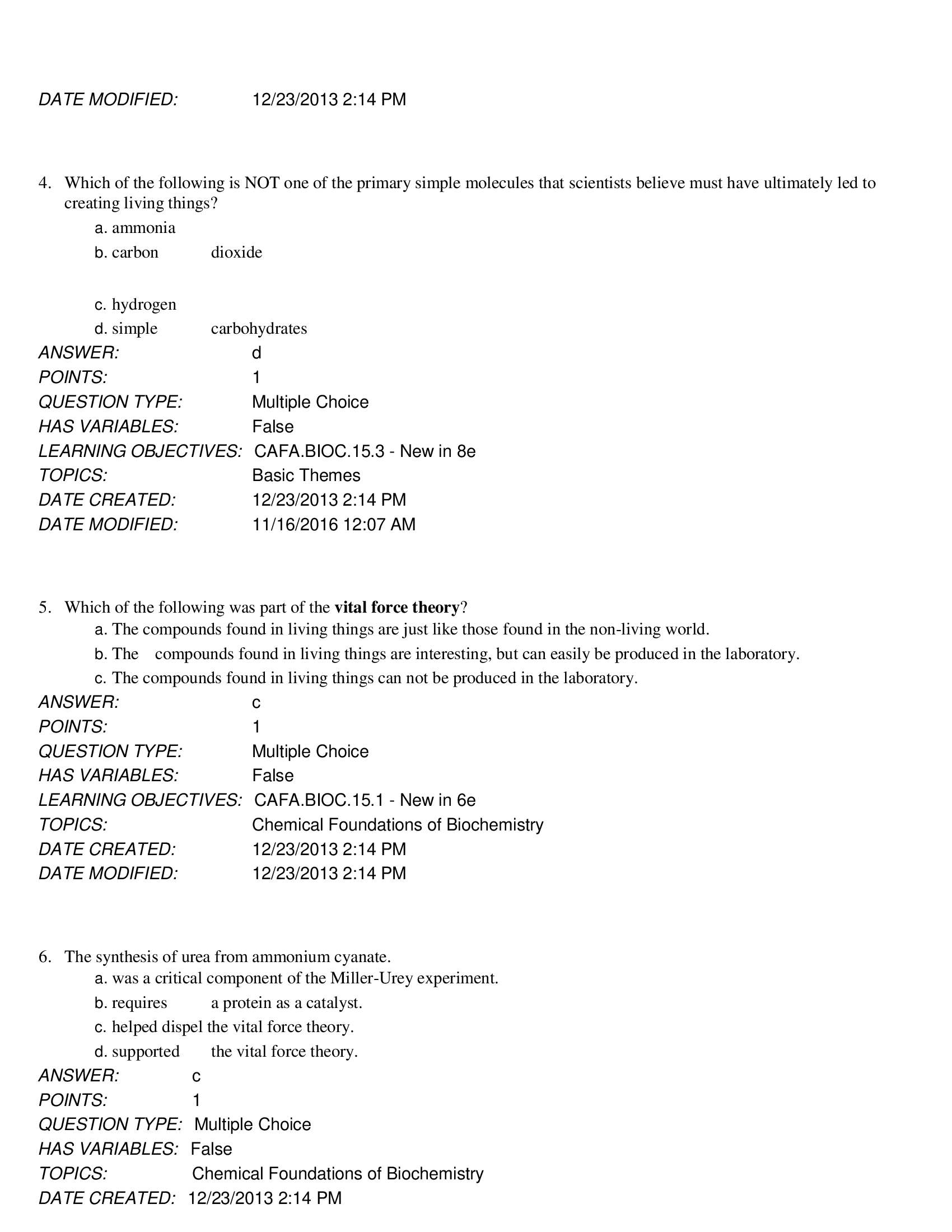
4.                  Which of the following is NOT one of the primary simple molecules that scientists believe must have ultimately led to creating living things?

a.             ammonia

b.            carbon  dioxide

c.             hydrogen

d.            simple    carbohydrates

ANSWER:             d

5.                  Which of the following was part of the vital force theory?

a.             The compounds found in living things are just like those found in the non-living world.

b.            The         compounds found in living things are interesting, but can easily be produced in the laboratory.

c.             The compounds found in living things can not be produced in the laboratory.

ANSWER:             c

6.                  The synthesis of urea from ammonium cyanate.

a.             was a critical component of the Miller-Urey experiment.

b.            requires                a protein as a catalyst.

c.             helped dispel the vital force theory.

d.            supported            the vital force theory.

ANSWER:             c

7.                  Which of the following is NOT a Functional Group

a.             Amino group

b.            Protein                  

c.             Alcohol group

d.            Carbonyl               group

ANSWER:             b

8.                  Which of the following functional groups is specific to an alcohol?

a.             -NH

b.            - OH

c.             -C=O

d.            C=C         

e.             O-P

ANSWER:             b

9.                  Which of the following functional groups are not commonly seen in biomolecules?

a.             Alkyl halides

b.            Amides                  

c.             Carboxylic acids

d.            Ethers    

e.             Phosphate esters

ANSWER:             a

10.              Which of the following statements regarding biomolecules is false?

a.             They contain predominantly ionic bonds.

b.            They       contain predominantly nonmetallic elements.

c.             Carbon is the key element.

d.            Specific                  stereoisomers are essential in most cases.

ANSWER:             a

11.              All of the following bonds are important in biomolecules, except:

a.             C−Cl

b.            C −H

c.             C−N

d.            O −H

e.             O−P

ANSWER:             a

12.              Which of the following statements regarding biopolymers is false?

a.             Different sequences of the monomers can lead to different functions.

b.            Only        soluble polymers can be created from soluble monomers.

c.             A wide, almost uncountable variety of polymers can be created from just a few monomers.

d.            Different              linkages between the monomers can lead to different functions.

e.             Biopolymers can fold up into complex shapes.

ANSWER:             b

13.              Which statement is not correct about peptide nucleic acids, PNA?

a.             They are combinations of peptides and nucleic acids.

b.            Scientists              create them to study the origins of life

c.             They were proven to be the first hereditary molecule.

d.            They       may combine the catalytic properties of proteins with the information transfer ability of nucleic acid

e.             All of these statements apply to PNA.

ANSWER:             c

14.              According to the big bang theory of the creation of the universe,

a.             the universe has been getting cooler since its beginning

b.            the          initial explosion caused the creation of all of the elements of the periodic table

c.             carbon is the most abundant element in the universe

d.            the          earth could be no older than 1 billion years

ANSWER:             a

15.              In its earliest stages, which atoms were present in the universe?

a.             carbon, hydrogen, and oxygen

b.            hydrogen,            helium, and lithium

c.             nitrogen, sulfur, and phosphorous

d.            uranium,               polonium, and radium

e.             helium, neon, and argon

ANSWER:             b

16.              How are the majority of elements thought to have been formed?

a.             By thermonuclear reactions that normally take place in stars.

b.            In  explosions of stars.

c.             By the action of cosmic rays outside the stars since the formation of the galaxy.

d.            All            of the choices are true

e.             None of the choices; all the elements were present from the initial Big Bang.

ANSWER:             d

17.              What is the chemical formula for ozone?

a.             O2

b.            O3

c.             NH3

d.            H2S

e.             CH4

ANSWER:             b

18.              It is generally believed that the following gas was missing in the primordial atmosphere:   a.  H2

b.            CO2

c.             CH4

d.            NH3

e.             O2

ANSWER:             e

19.              A catalyst

a.             increases the rate of a chemical reaction

b.            increases              the amount of product obtained in a chemical reaction

c.             decreases the amount of product obtained in a chemical reaction

d.            none      of the choices

ANSWER:             a

20.              The genetic coding material is

a.             protein

b.            DNA        

c.             polysaccharide

d.            lipid         

ANSWER:             b

21.              The presence of two anhydride linkages is an important feature of

a.             ATP

b.            proteins                

c.             glucose

d.            carbon  monoxide

ANSWER:             a

22.              Which of the following best describes the results of the Miller-Urey experiment?

a.             It proved that DNA is the genetic material.

b.            It  produced proteins under conditions simulating the early Earth.

c.             It created living cells from non-living materials.

d.            It  produced some simple organic compounds from a mixture of gases presumed to have existed in the early atmosphere.

e.             All of these results of the Miller-Urey experiment.

ANSWER:             d

23.              The idea that a coding system and a catalysis system came about separately and then combined to form life as we know it is known as            a.  the origin of life

b.            the          big bang theory

c.             the double origen theory

d.            the          theory of evolution

ANSWER:             c

24.              The genetic code

a.             determines the order of sugars in a polysaccharide

b.            has          no effect on the sequence of amino acids in proteins

c.             is the means by which the "blueprint" for living organisms is passed from one generation to the next

d.            cannot  be understood by currently available experimental methods

ANSWER:             c

25.              Biological catalysts are   a.  proteins exclusively

b.            RNA        exclusively

c.             DNA exclusively

d.            some      proteins and some RNA

ANSWER:             d

Contact the Seller

Please Sign In to contact this seller.


  • 👎  Report Copyright Violation

Frequently Asked Questions

What Do I Get When I Buy This Study Material?

+

When you buy a study material on Passing Grades, an instant download link will be sent directly to your email, giving you access to the file anytime after payment is completed.

Is Passing Grades a Trusted Platform?

+

Yes, Passing Grades is a reputable students’ marketplace with a secure payment system and reliable customer support. You can trust us to ensure a safe and seamless transaction experience.

Will I Be Stuck with a Subscription?

+

No, all purchases on Passing Grades are one-time transactions. You only pay for the notes you choose to buy, with no subscriptions or hidden fees attached.

Who Am I Buying These Study Materials From?

+

Passing Grades is a marketplace, which means you are purchasing the document from an individual vendor, not directly from us. We facilitate the payment and delivery process between you and the vendor.

Does Passing Grades Offer Free Study Materials?

+

Yes, sellers on Passing Grades have uploaded numerous free test banks, exams, practice questions, and class notes that can be downloaded at no cost.

Pasinggrades - Quality Study Materials

USD 15

    • Quality checked by Pasing Grades
    • 100% satisfaction guarantee
    • Seller: mentor2000
Buy PDF $15

Seller Information

mentor2000

Member since April 2021

  • icon
  • icon
View Profile
  • total sales

    1
  • Favourites

    0
  • Comments

    0
    ( 0 Ratings )

Item Information

  • Uploaded

    03 April 2024

  • Updated

    16 July 2025

  • Category

    Biology

  • Item Type

    test bank

  • Tags

    Test Bank for Biochemistry 9th Edition Campbell Farrell Biochemistry 9th Edition

Related Exam Prep Guides by mentor2000

Test Bank for Essentials for Nursing Practice 8th Edition by Potter | All Chapters
View Document

Test Bank for Essent...

  • mentor2000

    mentor2000

  • test bank

Master nursing concepts with this study material; Test Bank for Essentials for Nursing Practice, 8th...

15 USD

0

1

A &P 1 MA278 BSC2 Final Module II Questions & Answers 2026 Update
View Document

A &P 1 MA278 BSC2 Fi...

  • mentor2000

    mentor2000

  • test bank

Prepare for success with A&P 1 MA278 BSC2 Final Module II 2024 Q&A. Boost your grades with this comp...

15 USD

0

1

ATI Comprehensive Predictor Exam 2026
View Document

ATI Comprehensive Pr...

  • mentor2000

    mentor2000

  • test bank

Prepare for success with the ATI Comprehensive Predictor Exam 2026. Access key practice questions to...

15 USD

0

1

Purchase

Download link will be sent to this email immediately after purchase.

IMPORTANT LINKS

  • How To Upload Class Notes
  • Selling Tips
  • Passing Grades's Study Materials
  • Scholarships for International Students 2025

POPULAR CATEGORIES

  • Law
  • Accounting
  • English
  • Psychology
  • Business
  • Nursing
  • Computer Science
  • General

View Document

  • Blog
  • Contact
  • Delivery Policy
  • Latest Scholarships Around the World
  • How to Pass Bar Exams: Passing Grades’ Strategies
  • How to Study and Pass the CPA Exam
  • All Test Banks
  • Faq
  • Copyright Claims
  • Privacy Policy
  • Terms of Use

KNOWLEDGE BASE

  • How to Write A+ Grade Good Research Paper
  • How to Manage Stress During Exam Period
  • Best Time to Study
  • How to Pass NCLEX-RN Exam
  • How To Effectively Utilize Test Banks
  • Popular Shadow Health Exam Assessments
  • Popular HESI Case Studies
  • How to Prepare for a Nursing Career
  • The Importance Of Summaries in Exam Revisvion

© 2026 Pasing Grades. All rights reserved.