Pasing Grades
  • Start Selling
  • Blog
  • Contact
  • 0

    Your cart is empty!

English

  • English
  • Spanish
  • Arabic
Create Account Sign In
  • Library
    • New Prep Guides
    • Featured Prep Guides
    • Free Exam Prep Guides
    • Best sellers
  • General
  • Nursing
    • Research Paper
    • Case Study
    • Discussion Post
    • Assignment
    • Exam
    • Practice Questions and Answers
    • Test Bank
    • solutions manual
  • Accounting
    • Case Study
    • Thesis
    • Study Guide
    • Summary
    • Research Paper
    • test bank
  • English
    • Creative Writing
    • Research Paper
    • Summary
    • Rhetorics
    • Literature
    • Journal
    • Exam
    • Grammar
    • Discussion Post
    • Essay
  • Psychology
    • Hesi
    • Presentation
    • Essay
    • Summary
    • Study Guide
    • Essay
    • Solution Manual
    • Final Exam Review
    • Class Notes
    • test bank
  • Business
    • Lecture Notes
    • Solution Manual
    • Presentation
    • Business Plan
    • Class Notes
    • Experiment
    • Summary
    • Practice Questions
    • Study Guide
    • Case Study
    • test bank
    • Exam
  • More
    • Computer Science
    • Economics
    • Statistics
    • Engineering
    • Biology
    • Religious Studies
    • Physics
    • Chemistry
    • Mathematics
    • History
    • Sociology
    • Science
    • Philosophy
    • Law
  • Pages
    • About Us
    • Selling Tips
    • Delivery Policy
    • Faq
    • Privacy Policy
  • Flash Sale
  • Home
  • Test Bank for An Introduction to Psychological Science 2nd Canadian Edition Mark Krause Daniel Corts Stephen C Smith Dan Dolderman

Test Bank for An Introduction to Psychological Science 2nd Canadian Edition Mark Krause Daniel Corts Stephen C Smith Dan Dolderman

Preview page 1 Preview page 2 Preview page 3
Add To Favorites

Share this item Share this item

  • Item Details
  • Comments (0)
  • Reviews (0)
  • Contact Seller
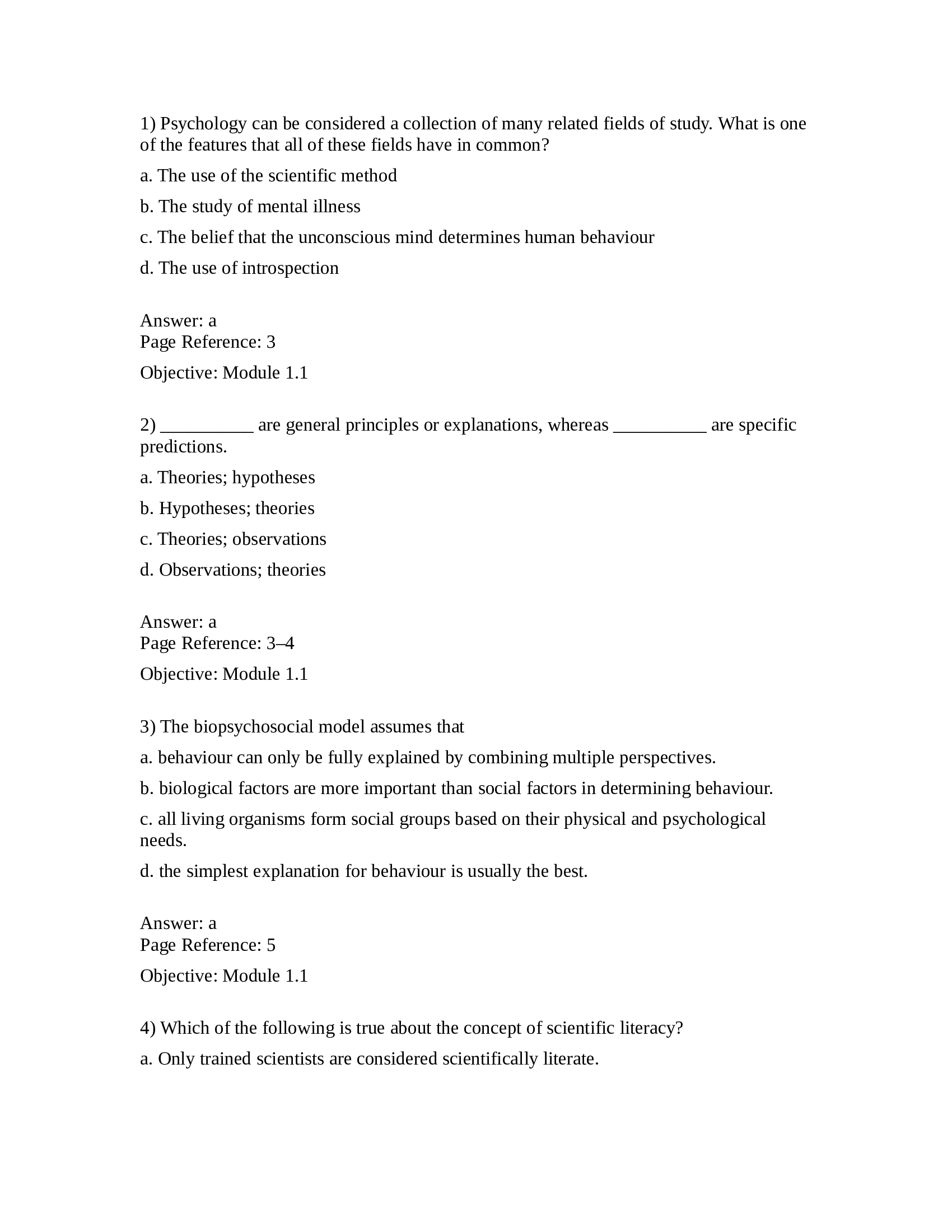
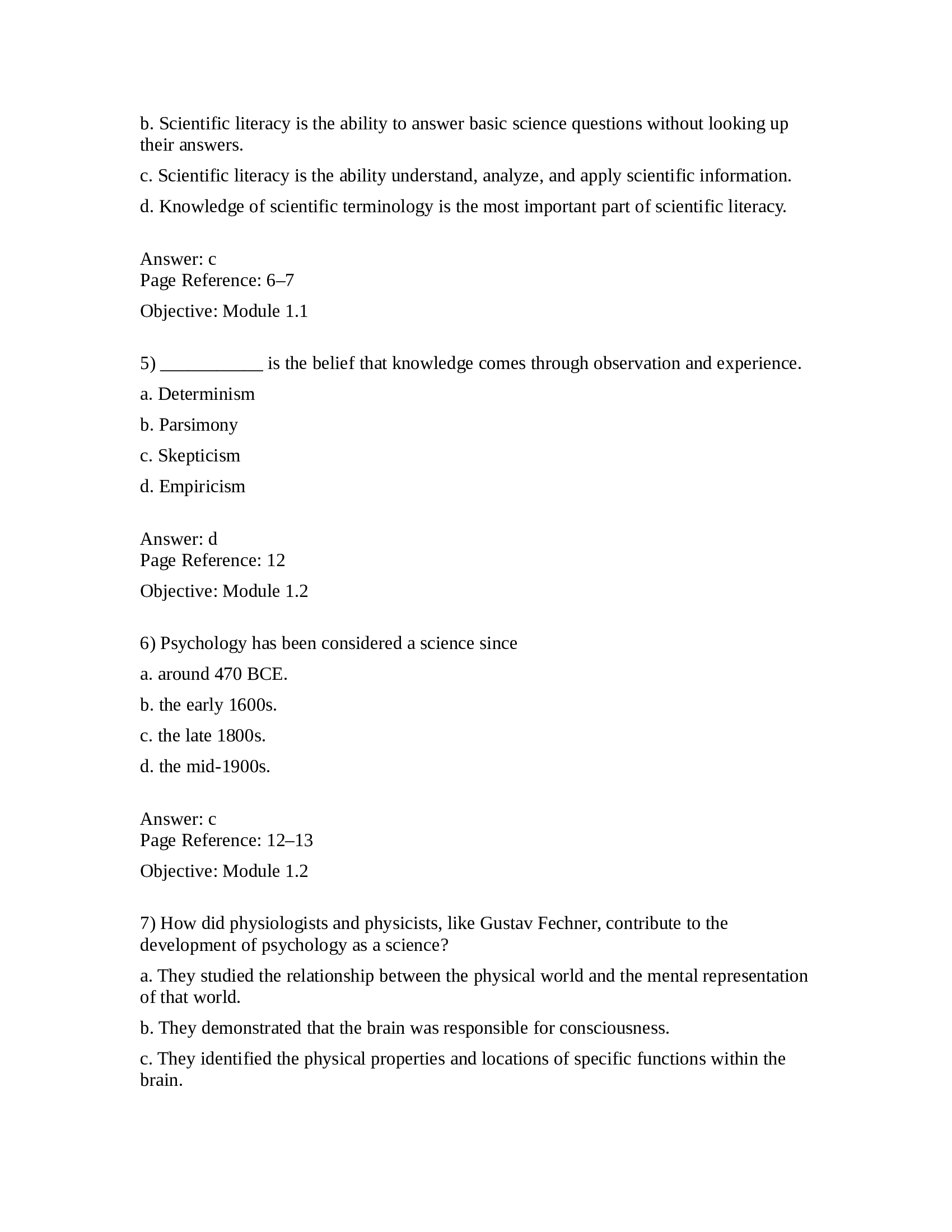
Test Bank for An Introduction to Psychological Science 2nd Canadian Edition Mark Krause Daniel Corts Stephen C Smith Dan Dolderman 1) Psychology can be considered a collection of many related fields of study. What is one of the features that all of these fields have in common? a. The use of the scientific method b. The study of mental illness c. The belief that the unconscious mind determines human behaviour d. The use of introspection Answer: a Page Reference: 3 Objective: Module 1.1 2) __________ are general principles or explanations, whereas __________ are specific predictions. a. Theories; hypotheses b. Hypotheses; theories c. Theories; observations d. Observations; theories Answer: a Page Reference: 3–4 Objective: Module 1.1 3) The biopsychosocial model assumes that a. behaviour can only be fully explained by combining multiple perspectives. b. biological factors are more important than social factors in determining behaviour. c. all living organisms form social groups based on their physical and psychological needs. d. the simplest explanation for behaviour is usually the best. Answer: a Page Reference: 5 Objective: Module 1.1 4) Which of the following is true about the concept of scientific literacy? a. Only trained scientists are considered scientifically literate. b. Scientific literacy is the ability to answer basic science questions without looking up their answers. c. Scientific literacy is the ability understand, analyze, and apply scientific information. d. Knowledge of scientific terminology is the most important part of scientific literacy. Answer: c Page Reference: 6–7 Objective: Module 1.1 5) ___________ is the belief that knowledge comes through observation and experience. a. Determinism b. Parsimony c. Skepticism d. Empiricism Answer: d Page Reference: 12 Objective: Module 1.2 6) Psychology has been considered a science since a. around 470 BCE. b. the early 1600s. c. the late 1800s. d. the mid-1900s. Answer: c Page Reference: 12–13 Objective: Module 1.2 7) How did physiologists and physicists, like Gustav Fechner, contribute to the development of psychology as a science? a. They studied the relationship between the physical world and the mental representation of that world. b. They demonstrated that the brain was responsible for consciousness. c. They identified the physical properties and locations of specific functions within the brain. d. They extended Darwin's theory of evolution to behaviour and cognitive abilities. Answer: a Page Reference: 13 Objective: Module 1.2 8) The belief that the unconscious mind has an influence on a person's behaviour is part of which early approach to psychology? a. Structuralism b. Functionalism c. Psychoanalysis d. Behaviourism Answer: c Page Reference: 16 Objective: Module 1.2 9) The investigation into the influence of environment and genetics on behaviour and mental processes is often referred to as the study of a. the nature and nurture relationship. b. eugenics. c. Psychology. d. Anthropology. Answer: a Page Reference: 17 Objective: Module 1.2 10) Why was the perspective followed by Wilhelm Wundt and his followers called structuralism? a. They wanted to identify the major brain structures. b. Their primary goal was to understand the physiology of the mind and its interaction with the physical world. c. They focused their efforts on analyzing the elements of the nervous system. d. Their primary focus was on describing the basic components of conscious experience. Answer: d Page Reference: 18 Objective: Module 1.2 11) Which school of psychology questioned whether psychologists should study the mind, which was thought to be unobservable? a. Psychoanalysis b. Behaviourism c. Gestalt psychology d. Humanism Answer: b Page Reference: 19 Objective: Module 1.2 12) You attend a lecture by a psychologist who uses terms such as free will and life's meaning. Which psychological perspective is most consistent with the points the psychologist presented? a. Behaviourism b. Humanistic psychology c. Functionalism d. Psychodynamics Answer: b Page Reference: 21 Objective: Module 1.2 13) The primary focus of social psychologists is a. exploring the influence of others on an individual's behaviour. b. investigating the nature and nurture relationship. c. explaining how people, like Hitler, grow up. d. studying how different personality characteristics can influence how we think and act. Answer: a Page Reference: 23–24 Objective: Module 1.2 14) Dr. Fernwood is a research psychologist. The main focus of her research is the use of psychological knowledge to find ways to reduce bullying in schools. Dr. Fernwood's research could be described as _________ psychology. a. basic b. forensic c. applied d. industrial/organizational Answer: c Page Reference: 27 Objective: Module 1.2 15) Dr. D'Arcy's research focuses on the relationship between activity in specific regions of the brain and decision-making. It is likely that Dr. D'Arcy is in the field of _____________. a. biopsychology b. cognitive psychology c. industrial/organizational psychology d. cognitive neuroscience Answer: d Page Reference: 25–26 Objective: Module 1.2 1) 01-3-01 In order to be scientific, a hypothesis must be testable . 2) 01-3-02 For psychologists, critical thinking means that we apply scientific methods carefully, examine our assumptions and biases, and tolerate ambiguity when the evidence is inconclusive. 3) 01-3-03 The principle of parsimony holds that, when dealing with competing theories, the simplest one should be chosen. 4) 01-3-04 Empiricism is the pursuit of knowledge through careful observation rather than speculation. 5) 01-3-05 Clinical psychology is the field of psychology that concentrates on the diagnosis and treatment of psychological disorders. 6) 01-3-06 Developed by Freud, psychoanalysis was an approach that attempted to explain the relationship between behaviour and the unconscious. 7) 01-3-07 Wundt's primary research method was training volunteers to use introspection to describe their experiences. 8) 01-3-08 Although Ivan Pavlov is usually credited with its discovery, professor Edwin Twitmyer was one of the first people to study classical conditioning. 9) 01-3-09 Cognitive neuroscientists combine cognitive psychology and biopsychology to investigate the structure and functions of the brain. 10) 01-3-10 Industrial psychologists apply psychological concepts specifically to the work environment. 1) According to the textbook, the discipline of psychology is best defined as a. a collection of self-help principles used to treat psychological disorders. b. a combination of hypotheses and personal intuition about human behaviour and mental processes. c. a process for encouraging individuals to reach their ultimate potential. d. the scientific study of behaviour, thought, and experience. Answer: d Page Reference: 3 Skill: Factual Objective: Know the key terminology of the scientific method. 2) Which of the following statements regarding the over-arching goals of psychology is FALSE? a. Psychology involves researching the role of brain structures on human behaviour. b. Psychology is centred around curing all psychological disorders. c. The field of psychology focuses on understanding the effects of genetics and environment on behaviour. d. Psychology focuses on understanding how many different factors contribute to the development of psychological disorders. Answer: b Page Reference: 3 Skill: Conceptual Objective: Know the key terminology of the scientific method. 3) What process is used across all areas of psychology? a. the scientific method b. the curation of opinions c. the belief that the unconscious mind determines human behaviour d. the science of persuasion Answer: a Page Reference: 3 Skill: Conceptual Objective: Know the key terminology of the scientific method. 4) A scientist is best described as a. an individual who conducts experiments. b. an individual who dissects specimens or combines chemicals to answer questions about the world. c. an individual who studies in the fields of biology, chemistry, physics, or geology. d. an individual who arrives at conclusions based on a careful system of observing, predicting, and testing. Answer: d Page Reference: 3 Skill: Conceptual Objective: Know the key terminology of the scientific method. 5) Caroline is interested in determining how black-capped chickadees find the caches of seeds they stored several months earlier. She watches the chickadees in a park and notices that they tend to hide their food in trees near landmarks, such as sculptures or benches. She predicts that moving these landmarks after the chickadees have stored their food will prevent them from finding it later, and designs an experiment to test her prediction. Caroline's approach is an example of a. pseudoscience. b. the scientific method. c. theory development. d. the biopsychological model. Answer: b Page Reference: 3–4 Skill: Applied Objective: Understand the steps of the scientific method. 6) Collecting observations, testing predictions about how to best explain the observations, and developing theories are all part of a. the scientific method. b. pseudoscience. c. the biopsychosocial model. d. the psychoanalytic model. Answer: a Page Reference: 3–4 Skill: Conceptual Objective: Understand the steps of the scientific method. 7) "Children who watch violent cartoons will become more aggressive compared to those who do not watch violent cartoons." This statement is most likely a(n) a. theory. b. untestable statement. c. hypothesis. d. pseudoscience. Answer: c Page Reference: 3–4 Skill: Applied Objective: Know the key terminology of the scientific method. 8) As part of the scientific method, scientists form testable predictions that can be observed and measured. These are called a. theories. b. proofs. c. hypotheses. d. models. Answer: c Page Reference: 3–4 Skill: Factual Objective: Understand the steps of the scientific method. 9) A sound hypothesis must be a. testable. b. agreed upon by the majority of experts in the field.

Contact the Seller

Please Sign In to contact this seller.


  • 👎  Report Copyright Violation

Frequently Asked Questions

What Do I Get When I Buy This Study Material?

+

When you buy a study material on Passing Grades, an instant download link will be sent directly to your email, giving you access to the file anytime after payment is completed.

Is Passing Grades a Trusted Platform?

+

Yes, Passing Grades is a reputable students’ marketplace with a secure payment system and reliable customer support. You can trust us to ensure a safe and seamless transaction experience.

Will I Be Stuck with a Subscription?

+

No, all purchases on Passing Grades are one-time transactions. You only pay for the notes you choose to buy, with no subscriptions or hidden fees attached.

Who Am I Buying These Study Materials From?

+

Passing Grades is a marketplace, which means you are purchasing the document from an individual vendor, not directly from us. We facilitate the payment and delivery process between you and the vendor.

Does Passing Grades Offer Free Study Materials?

+

Yes, sellers on Passing Grades have uploaded numerous free test banks, exams, practice questions, and class notes that can be downloaded at no cost.


Pasinggrades - Quality Study Materials

USD 17

    • Quality checked by Pasing Grades
    • 100% satisfaction guarantee
    • Seller: Pasing-Grades
Buy PDF $17

Seller Information

Pasing-Grades

Member since May 2021

  • icon
View Profile
  • total sales

    0
  • Favourites

    0
  • Comments

    0
    ( 0 Ratings )

Item Information

  • Uploaded

    14 October 2023

  • Updated

    29 September 2025

  • Category

    No category

  • Item Type

    exam

  • Tags

    Test Bank for An Introduction to Psychological Science 2nd Canadian Edition Mark Krause Daniel Corts Stephen C Smith Dan Dolderman

Related Exam Prep Guides by Pasing-Grades

Understanding Anatomy and Physiology; A Visual, Auditory, Interactive Approach by Gale. S. Thompson
View Document

Understanding Anatom...

  • Pasing-Grades

    Pasing-Grades

  • exam

Third Edition: Understanding Anatomy and Physiology; A Visual, Auditory, Interactive Approach by Gal...

17 USD

0

0

Workbook to Accompany Understanding Anatomy & Physiology: A Visual, Auditory, Interactive Approach by Gale Sloan Thompson RN
View Document

Workbook to Accompan...

  • Pasing-Grades

    Pasing-Grades

  • exam

Workbook to Accompany Understanding Anatomy & Physiology: A Visual, Auditory, Interactive Approach b...

17 USD

0

0

Test Bank for Fundamentals of Nursing 10th Edition by Taylor
View Document

Test Bank for Fundam...

  • Pasing-Grades

    Pasing-Grades

  • exam

Get now the Test Bank for Fundamentals of Nursing 10th Edition by Taylor. Instant PDF Download....

17 USD

0

0

Purchase

Download link will be sent to this email immediately after purchase.

IMPORTANT LINKS

  • How To Upload Class Notes
  • Selling Tips
  • Passing Grades's Study Materials
  • Scholarships for International Students 2025

POPULAR CATEGORIES

  • Law
  • Accounting
  • English
  • Psychology
  • Business
  • Nursing
  • Computer Science
  • General

View Document

  • Blog
  • Contact
  • Delivery Policy
  • Latest Scholarships Around the World
  • How to Pass Bar Exams: Passing Grades’ Strategies
  • How to Study and Pass the CPA Exam
  • All Test Banks
  • Faq
  • Copyright Claims
  • Privacy Policy
  • Terms of Use

KNOWLEDGE BASE

  • How to Write A+ Grade Good Research Paper
  • How to Manage Stress During Exam Period
  • Best Time to Study
  • How to Pass NCLEX-RN Exam
  • How To Effectively Utilize Test Banks
  • Popular Shadow Health Exam Assessments
  • Popular HESI Case Studies
  • How to Prepare for a Nursing Career
  • The Importance Of Summaries in Exam Revisvion

© 2026 Pasing Grades. All rights reserved.