Pasing Grades
  • Start Selling
  • Blog
  • Contact
  • 0

    Your cart is empty!

English

  • English
  • Spanish
  • Arabic
Create Account Sign In
  • Library
    • New Prep Guides
    • Featured Prep Guides
    • Free Exam Prep Guides
    • Best sellers
  • General
  • Nursing
    • Research Paper
    • Case Study
    • Discussion Post
    • Assignment
    • Exam
    • Practice Questions and Answers
    • Test Bank
    • solutions manual
  • Accounting
    • Case Study
    • Thesis
    • Study Guide
    • Summary
    • Research Paper
    • test bank
  • English
    • Creative Writing
    • Research Paper
    • Summary
    • Rhetorics
    • Literature
    • Journal
    • Exam
    • Grammar
    • Discussion Post
    • Essay
  • Psychology
    • Hesi
    • Presentation
    • Essay
    • Summary
    • Study Guide
    • Essay
    • Solution Manual
    • Final Exam Review
    • Class Notes
    • test bank
  • Business
    • Lecture Notes
    • Solution Manual
    • Presentation
    • Business Plan
    • Class Notes
    • Experiment
    • Summary
    • Practice Questions
    • Study Guide
    • Case Study
    • test bank
    • Exam
  • More
    • Computer Science
    • Economics
    • Statistics
    • Engineering
    • Biology
    • Religious Studies
    • Physics
    • Chemistry
    • Mathematics
    • History
    • Sociology
    • Science
    • Philosophy
    • Law
  • Pages
    • About Us
    • Selling Tips
    • Delivery Policy
    • Faq
    • Privacy Policy
  • Flash Sale
  • Home
  • Stein’s Concept-Based Clinical Nursing Skills 1st Ed | Verified Test Bank

Stein’s Concept-Based Clinical Nursing Skills 1st Ed | Verified Test Bank

Preview page 1 Preview page 2 Preview page 3
Add To Favorites

Share this item Share this item

  • Item Details
  • Comments (0)
  • Reviews (0)
  • Contact Seller

Test Bank for Concept Based Clinical Nursing Skills 1st Edition by Stein

Chapter 01: Foundations of Safe Client Care

Hollen & Stein: Concept-Based Clinical Nursing Skills, 1st Edition

MULTIPLE CHOICE

1.         What was the main finding of the Institute of Medicine’s 1999 report To Err is Human: Building a Better Healthcare System? a.     Nursing personnel need better training and education to prevent errors.

b.        Registered nurses should take the lead in reducing healthcare-associated errors.

c.        Faulty systems, processes, and conditions combined cause the majority of errors.

d.        Over 198,000 patients die each year when they are patients in a hospital.

ANS: C

The report To Err is Human: Building a Better Healthcare System provided the shocking information that as many as 98,000 patients die in hospital due to preventable errors. Instead of most errors being the fault of one person, the report stated that faulty systems, processes, and conditions combined were to blame. Although nurses are in a prime position to recognize and problem-solve these implicated contributors, the report did not specify that nurses should take the lead in solving the problem.

              DIF:   Cognitive Level: Remembering       TOP: Integrated Process: Teaching-Learning

2.         A nurse meets the assigned clients at the start of a shift. After performing hand hygiene and introducing one’s self, what does the nurse do next?

a.        Begin a head-to-toe assessment.

b.        Identify the client using two identifiers.

c.        Assess the client for pain.

d.        Ensure the call light is within reach.

ANS: B

A critical task in healthcare for safety, client identification is paramount for preventing errors. After performing hand hygiene and introducing him- or herself, the nurse identifies the client using two unique identifiers. The head-to-toe and pain assessments come shortly afterward. The nurse ensures the client can reach the call light prior to leaving the room.

              DIF: Cognitive Level: Understanding        TOP: Nursing Process: Assessment

3.         A nurse has worked with the same client for 2 days. When entering the room to administer medications, the nurse performs hand hygiene. What action does the nurse take next? a.      Provide any needed teaching.

b.        Ask if the client has any care requests.

c.        Assess vital signs and pain.

d.        Identify the client using two identifiers.

ANS: D

Every time the client is to receive medication, diagnostic studies, or any other healthcare intervention, the nurse must identify the client using two unique identifiers, even if the client is well known to the nurse. Assessments, teaching, and determining client requests would come afterward.

               DIF: Cognitive Level: Applying               TOP: Nursing Process: Assessment

4.         A nurse’s neighbor states “My father got a nosocomial infection after surgery!” What does the nurse understand happened to the client?

a.        The client received contaminated blood products.

b.        The client nearly died from a postoperative infection.

c.        The client acquired an infection while in the hospital.

d.        The client received poor preoperative skin preparation.

ANS: C

A nosocomial infection is one acquired in the hospital. It does not designate how the infection occurred, so the client might have become infected through contaminated blood products or from poor preoperative skin preparation. It does not mean the client had a life-threatening infection, only that is occurred in hospital.

              DIF:   Cognitive Level: Understanding      TOP: Integrated Process: Teaching-Learning

5.         A nurse is making rounds on clients at risk for infection. Which client does the nurse see first? a.       A client with an intravenous (IV) line

b.        A client who has a central line

c.        A client with an indwelling bladder catheter

d.        A client with an IV and bladder catheter

ANS: D

One of the biggest risk factors for hospital acquired infections (HAIs) is the presence of invasive lines. The more lines, the more risk. The client with both an IV and a catheter has the highest risk. The clients with an IV or a catheter have less risk. Nurses have adopted protocols that have dramatically reduced central line infections.

               DIF: Cognitive Level: Applying               TOP: Nursing Process: Assessment

6.         A nursing manager concerned about the infection rate on the unit wants to implement measures to reduce the transmission of infectious organisms. What action by the manager is best? a.         Provide a stethoscope dedicated to each client.

b.        Ensure gloves are well-stocked in each room.

c.        Restrict all plants and fresh foods from rooms.

d.        Screen all visitors for contagious illnesses.

ANS: A

In the chain of infection, one of the most important components is the mode of transmission. Stethoscopes can serve as a mode of indirect contact transmission unless they are disinfected between clients. Providing each client with an individual stethoscope will reduce this risk. Gloves are important, but they can become contaminated too and serve as a mode of transmission. Plants and fresh foods are an uncommon source of transmission unless the client is immunosuppressed. Screening visitors for contagious illness is an unrealistic long-term action plan.

               DIF: Cognitive Level: Applying               TOP: Nursing Process: Implementation

7.         A nurse is observing a student nurse. What action by the student demonstrates the need for more education on Standard Precautions?

a.        The student performs hand hygiene before all client contacts.

b.        The student conscientiously wears gloves when taking vital signs.

c.        The student confirms that urine possibly contains infectious microbes.

d.        The student wears a gown when cleaning liquid stool off the client.

ANS: B

Standard Precautions operates under the principle that all bodily fluids other than sweat could potentially contain infectious microbial agents that pose a risk to the healthcare worker. Contact with skin, if free of those fluids, does not require wearing gloves, so the nurse would provide more education to the student. Hand hygiene is the first step of Standard Precautions. The student is being prudent by confirming a possible source of contamination. Nurses determine which infection prevention practice to use based upon the type of client–nurse interaction and the possibility of exposure to blood, other body fluids, or pathogens, so wearing a gown while cleaning liquid stool is appropriate.

               DIF: Cognitive Level: Analyzing              TOP: Nursing Process: Evaluation

8.         A faculty member has taught the correct technique for taking gloves off (doffing). While observing students practice, which action by a student indicates the need to review the material? a.       Pulls glove off dominant hand first

b.        Takes first glove off by grasping it on the outside

c.        Takes second glove off by grasping it under the cuff

d.        Turns the gloves inside out when second glove is removed

ANS: A

The correct way to remove gloves starts with doffing the glove on the nondominant hand first, without touching the bare skin. This student would need further review of the skill. Removing the first glove by grasping it on the outside, grasping the second glove under the cuff, and turning the gloves inside out to prevent microbe spread are all correct actions. These students would not need remediation.

               DIF: Cognitive Level: Analyzing              TOP: Nursing Process: Evaluation

9.         In order to move a client safely, which of the following actions does the nurse take first?

a.        Gather enough help for the task.

b.        Assess the client’s ability to bear weight.

c.        Delegate using the lift chair.

d.        Administer pain medication.

ANS: B

The first thing the nurse does when preparing to transfer a client is to assess the client’s ability to bear weight and follow instructions. The findings will determine how much assistance (if any) the client needs. If the client needs maximal assistance, then the nurse gathers enough help and any lifting devices needed and assigns roles to each team member. If the client has pain, the nurse would administer pain medication, but that is not related to safety.

               DIF: Cognitive Level: Applying               TOP: Nursing Process: Implementation

10.     Hospital administration has rejected a request from nursing services for ceiling-mounted lifting/transferring devices pointing to the expense. What response by the Chief Nursing Officer would be best? a.     “We need the equipment to stay competitive in hiring nurses.”

b.        “They are required by The Joint Commission so we have to get them.”

c.        “The cost of employee injuries from lifting is more expensive.”

d.        “We will save money with fewer client-injury lawsuits being filed.”

ANS: C

Data show that when hospitals implemented safe client handling equipment, hospitals achieved savings by reducing lost work days and reducing worker compensation costs that met or exceeded the cost of the equipment. This is not a main focus for nurse recruitment and the equipment is not mandated. Fewer client injuries leading to lawsuits is a probability, but the savings in reducing employee injury have been documented by the ANA.

              DIF:   Cognitive Level: Understanding

TOP: Integrated Process: Communication and Documentation

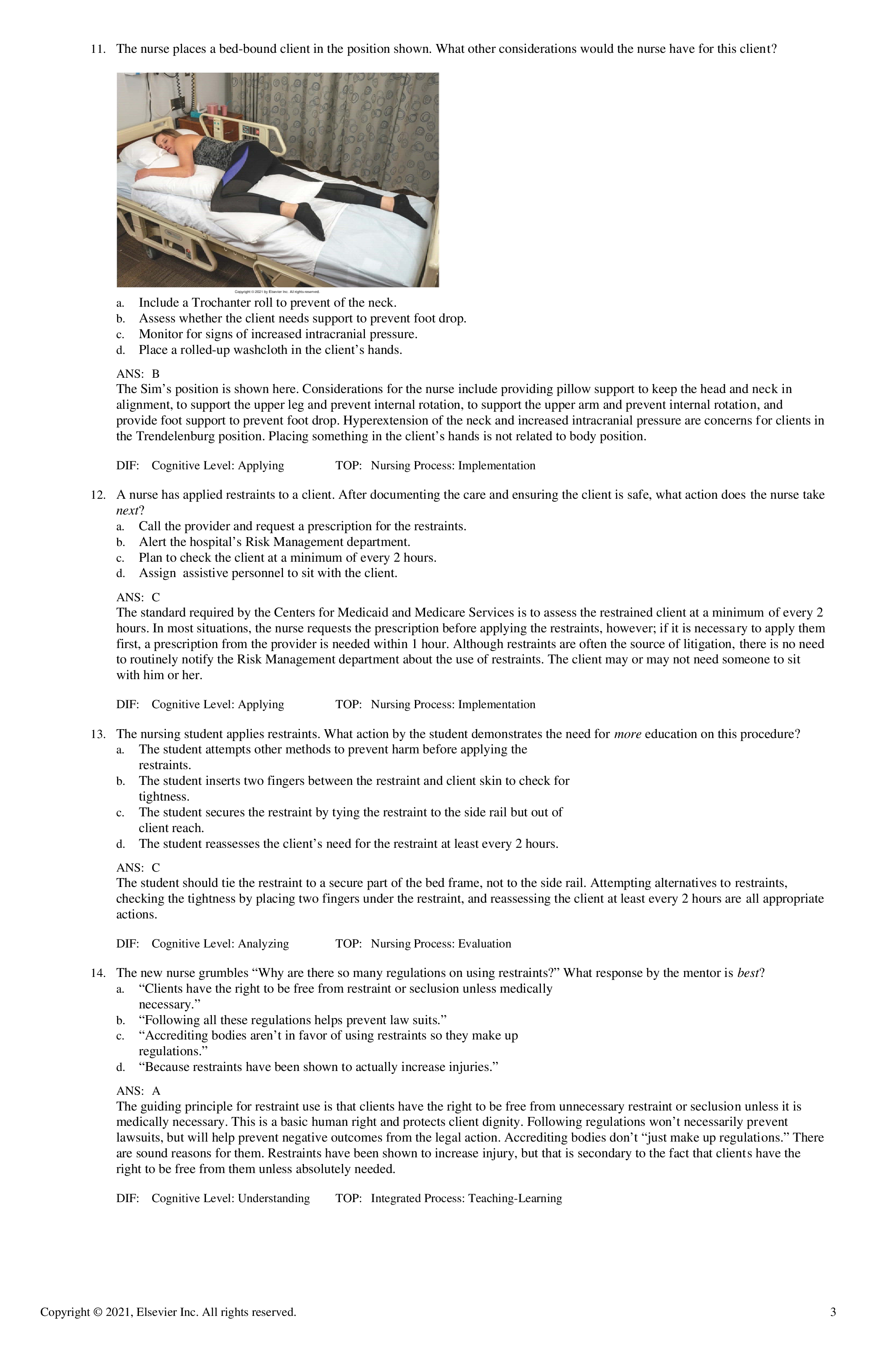
11.     The nurse places a bed-bound client in the position shown. What other considerations would the nurse have for this client?

Contact the Seller

Please Sign In to contact this seller.


  • 👎  Report Copyright Violation

Frequently Asked Questions

What Do I Get When I Buy This Study Material?

+

When you buy a study material on Passing Grades, an instant download link will be sent directly to your email, giving you access to the file anytime after payment is completed.

Is Passing Grades a Trusted Platform?

+

Yes, Passing Grades is a reputable students’ marketplace with a secure payment system and reliable customer support. You can trust us to ensure a safe and seamless transaction experience.

Will I Be Stuck with a Subscription?

+

No, all purchases on Passing Grades are one-time transactions. You only pay for the notes you choose to buy, with no subscriptions or hidden fees attached.

Who Am I Buying These Study Materials From?

+

Passing Grades is a marketplace, which means you are purchasing the document from an individual vendor, not directly from us. We facilitate the payment and delivery process between you and the vendor.

Does Passing Grades Offer Free Study Materials?

+

Yes, sellers on Passing Grades have uploaded numerous free test banks, exams, practice questions, and class notes that can be downloaded at no cost.

Pasinggrades - Quality Study Materials

USD 15

    • Quality checked by Pasing Grades
    • 100% satisfaction guarantee
    • Seller: mentor2000
Buy PDF $15

Seller Information

mentor2000

Member since April 2021

  • icon
  • icon
View Profile
  • total sales

    1
  • Favourites

    0
  • Comments

    0
    ( 0 Ratings )

Item Information

  • Uploaded

    04 February 2022

  • Updated

    16 May 2025

  • Category

    Nursing

  • Item Type

    test bank

  • Tags

    Test Bank for Concept Based Clinical Nursing Skills 1st Edition by Stein

Related Exam Prep Guides by mentor2000

Test Bank for Essentials for Nursing Practice 8th Edition by Potter | All Chapters
View Document

Test Bank for Essent...

  • mentor2000

    mentor2000

  • test bank

Master nursing concepts with this study material; Test Bank for Essentials for Nursing Practice, 8th...

15 USD

0

1

A &P 1 MA278 BSC2 Final Module II Questions & Answers 2026 Update
View Document

A &P 1 MA278 BSC2 Fi...

  • mentor2000

    mentor2000

  • test bank

Prepare for success with A&P 1 MA278 BSC2 Final Module II 2024 Q&A. Boost your grades with this comp...

15 USD

0

1

ATI Comprehensive Predictor Exam 2026
View Document

ATI Comprehensive Pr...

  • mentor2000

    mentor2000

  • test bank

Prepare for success with the ATI Comprehensive Predictor Exam 2026. Access key practice questions to...

15 USD

0

1

Purchase

Download link will be sent to this email immediately after purchase.

IMPORTANT LINKS

  • How To Upload Class Notes
  • Selling Tips
  • Passing Grades's Study Materials
  • Scholarships for International Students 2025

POPULAR CATEGORIES

  • Law
  • Accounting
  • English
  • Psychology
  • Business
  • Nursing
  • Computer Science
  • General

View Document

  • Blog
  • Contact
  • Delivery Policy
  • Latest Scholarships Around the World
  • How to Pass Bar Exams: Passing Grades’ Strategies
  • How to Study and Pass the CPA Exam
  • All Test Banks
  • Faq
  • Copyright Claims
  • Privacy Policy
  • Terms of Use

KNOWLEDGE BASE

  • How to Write A+ Grade Good Research Paper
  • How to Manage Stress During Exam Period
  • Best Time to Study
  • How to Pass NCLEX-RN Exam
  • How To Effectively Utilize Test Banks
  • Popular Shadow Health Exam Assessments
  • Popular HESI Case Studies
  • How to Prepare for a Nursing Career
  • The Importance Of Summaries in Exam Revisvion

© 2026 Pasing Grades. All rights reserved.