Pasing Grades
  • Start Selling
  • Blog
  • Contact
  • 0

    Your cart is empty!

English

  • English
  • Spanish
  • Arabic
Create Account Sign In
  • Library
    • New Prep Guides
    • Featured Prep Guides
    • Free Exam Prep Guides
    • Best sellers
  • General
  • Nursing
    • Research Paper
    • Case Study
    • Discussion Post
    • Assignment
    • Exam
    • Practice Questions and Answers
    • Test Bank
    • solutions manual
  • Accounting
    • Case Study
    • Thesis
    • Study Guide
    • Summary
    • Research Paper
    • test bank
  • English
    • Creative Writing
    • Research Paper
    • Summary
    • Rhetorics
    • Literature
    • Journal
    • Exam
    • Grammar
    • Discussion Post
    • Essay
  • Psychology
    • Hesi
    • Presentation
    • Essay
    • Summary
    • Study Guide
    • Essay
    • Solution Manual
    • Final Exam Review
    • Class Notes
    • test bank
  • Business
    • Lecture Notes
    • Solution Manual
    • Presentation
    • Business Plan
    • Class Notes
    • Experiment
    • Summary
    • Practice Questions
    • Study Guide
    • Case Study
    • test bank
    • Exam
  • More
    • Computer Science
    • Economics
    • Statistics
    • Engineering
    • Biology
    • Religious Studies
    • Physics
    • Chemistry
    • Mathematics
    • History
    • Sociology
    • Science
    • Philosophy
    • Law
  • Pages
    • About Us
    • Selling Tips
    • Delivery Policy
    • Faq
    • Privacy Policy
  • Flash Sale
  • Home
  • Solutions Manual for Chemical Principles the Quest for Insight 7th Edition Atkins

Solutions Manual for Chemical Principles the Quest for Insight 7th Edition Atkins

Preview page 1 Preview page 2 Preview page 3
Add To Favorites

Share this item Share this item

  • Item Details
  • Comments (0)
  • Reviews (0)
  • Contact Seller

Unlock the Solutions Manual for Chemical Principles: The Quest for Insight 7th Edition by Atkins. Access detailed answers and step-by-step guidance to master complex chemistry concepts. Essential for physics and chemistry students. Available as a downloadable PDF.

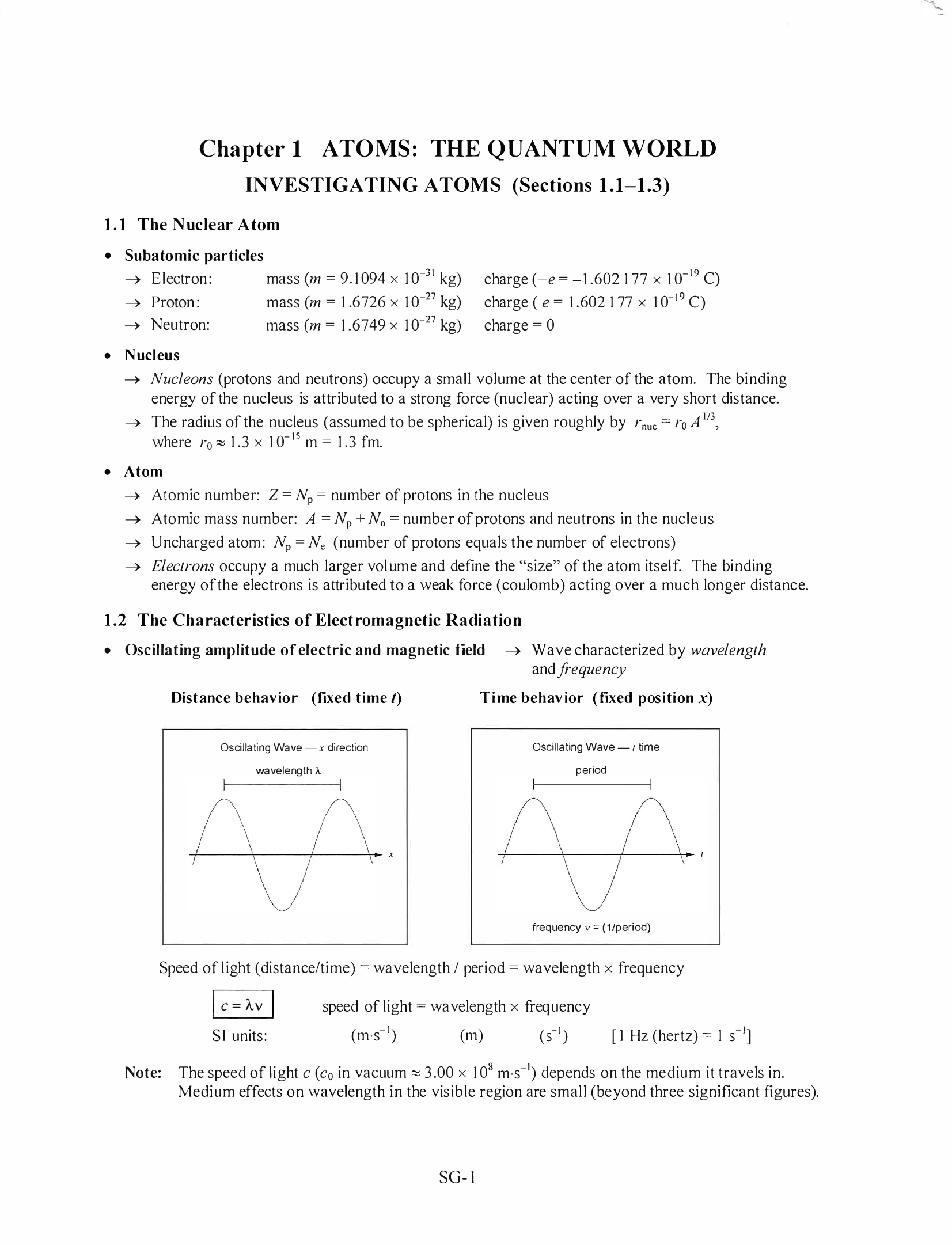
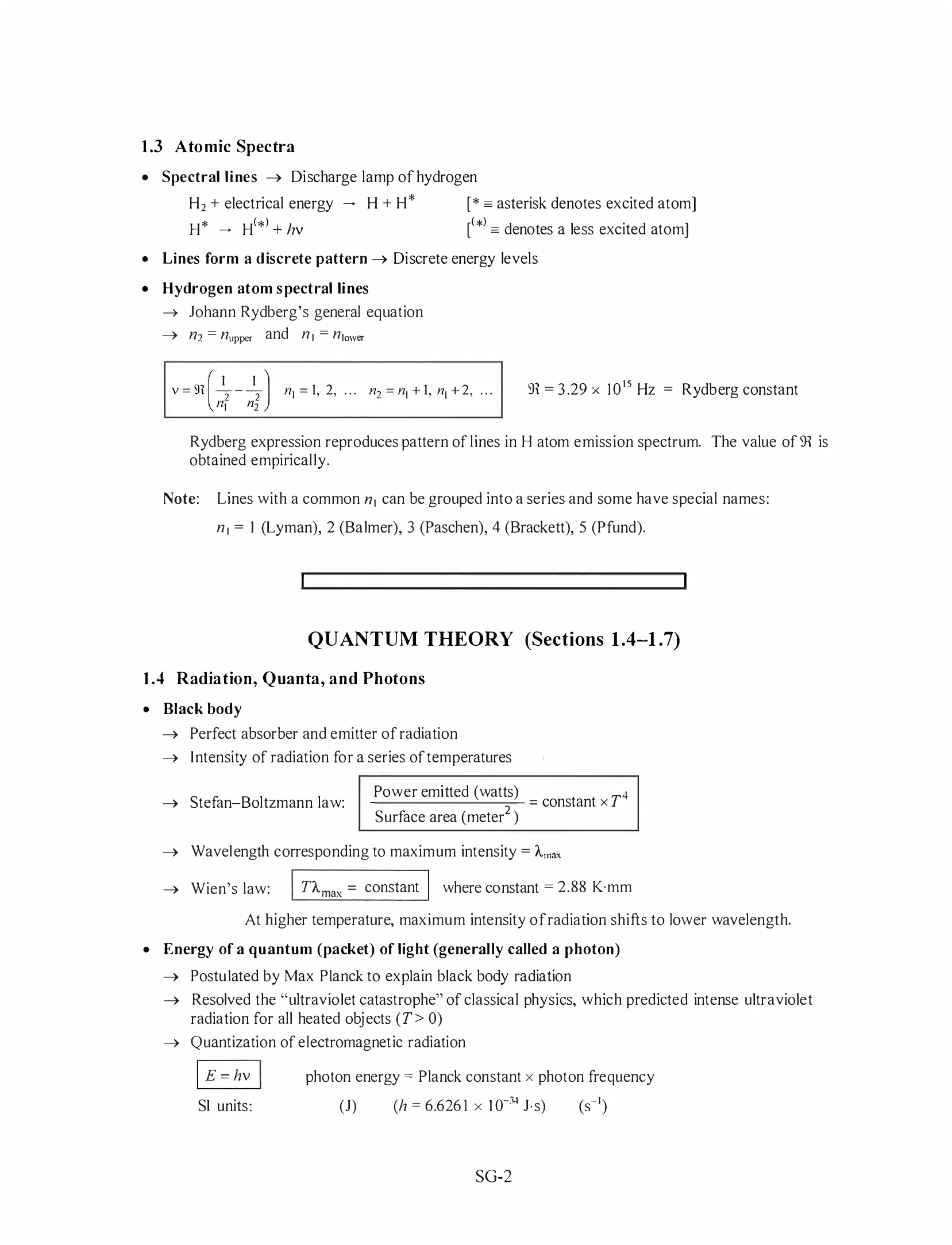
Chapter 1 ATOMS: THE QUANTUM WORLD INVESTIGATING ATOMS (Sections 1 . 1-1 .3) 1.1 The Nuclear Atom • Subatomic particles � Electron: mass (m = 9. 1 094 x 1 0- 31 kg) � Proton: mass (m = 1 .6726 x 1 0- 27 kg) � Neutron: mass (m = 1 .6749 x 1 0- 27 kg) • Nucleus charge (-e = -1.602 1 77 x 1 0- 19 C) charge ( e = 1 .602 1 77 x 1 0- 19 C) charge = 0 � Nucleons (protons and neutrons) occupy a small volume at the center of the atom. The binding energy of the nucleus is attributed to a strong force (nuclear) acting over a very short distance. � The radius of the nucleus (assumed to be spherical) is given roughly by rnue = ro A lI3 , where ro:::; 1 .3 x 1 0- 15 m = 1 .3 fm. • Atom � Atomic number: Z = Np = number of protons in the nucleus � Atomic mass number: A = Np + Nn = number of protons and neutrons in the nucleus � Uncharged atom: Np = Ne (number of protons equals the number of electrons) � Electrons occupy a much larger volume and define the "size" of the atom itself. The binding energy of the electrons is attributed to a weak force (coulomb) acting over a much longer distance. 1.2 The Characteristics of Electromagnetic Radiation • Oscillating amplitude of electric and magnetic field � Wave characterized by wavelength and frequency Distance behavior (fixed time t) Oscillating Wave -x direction wavelength A +-----'-r----f-------'l- .. x Time behavior (fixed position x) Oscillating Wave -I time period frequency v = (1/period) Speed of light (distance/time) = wavelength / period = wavelength x frequency I c = AV I SI units: speed of light = wavelength x frequency (m·sI ) (m) (S-I ) [1 Hz (hertz) = 1 S-I ] Note: The speed of light c (co in vacuum:::; 3.00 x 1 08 m·s-I) depends on the medium it travels in. Medium effects on wavelength in the visible region are small (beyond three significant fi gures). SG-l 1.3 Atomic Spectra • Spectral lines � Discharge lamp of hydrogen H2 + electrical energy - H + H * [* == asterisk denotes excited atom] H* - H(* ) + hv [ (* ) == denotes a less excited atom] • Lines form a discrete pattern � Discrete energy levels • Hydrogen atom spectral lines � Johann Rydberg' s general equation � n2 = nupper and n) = n)ower 91 = 3.29 X 1 0)5 Hz = Rydberg constant Rydberg expression reproduces pattern of lines in H atom emission spectrum. The value of 91 is obtained empirical ly. Note: Lines with a common n) can be grouped into a series and some have special names: n) = I (Lyman), 2 (Balmer), 3 (Paschen), 4 (Brackett), 5 (Pfund). QUANTUM THEORY (Sections 1.4-1.7) 1.4 Radiation, Quanta, and Photons • Black body � Perfect absorber and emitter of radiation � Intensity of radiation for a series of temperatures � Stefan-Boltzmann law: Power emitted (watts) = constant x T4 Surface area (meter2 ) � Wavelength corresponding to maximum intensity = "max � Wien's law: I T"-rnax = constant I where constant = 2.88 K-mm At higher temperature, maximum intensity of radiation shifts to lower wavelength. • Energy of a quantum (packet) of light (generally called a photon) � Postulated by Max Planck to explain black body radiation � Resolved the "ultraviolet catastrophe" of classical physics, which predicted intense ultraviolet radiation for all heated objects (T> 0) � Quantization of electromagnetic radiation photon energy = Planck constant x photon frequency SI units: (J) (h = 6.626 1 x 1 0- :14 J.s) SG-2 • Photoelectric effect � Ejection of electrons from a metal su rface exposed to photons of su fficient energy � I ndicates that light behaves as a particle EK = kinetic energy of the ejected electron, = threshold energy (work fu nction) requ ired for electron ejection from the metal su rface, and hv = photon energy � hv � requ ired for electron ejection • Bohr frequency condition I hv = Eupper - Elower I Relates photon energy to energy difference between two energy levels in an atom • Wave behavior of light � Diffraction and interference effects of su perimposed waves (constructive and destructive) 1.5 The Wave-Particle Duality of Matter • Matter has wave properties � Proposed by Lou is de Broglie � Consider matter with mass m and velocity v � Su ch matter behaves as a wave with a characteristic wavelength I A � h I de Brogl;e wavelength fo' a part; cle w; th h ne", momentu m p � mv mv 1.6 The Uncertainty Principle • Complementarity of location (x) and momentum (P) � U ncertainty in x is fu; u ncertainty in p is t:..p � Limitation of knowledge I i3.ptu � h/2 I Heisenberg u ncertainty principle, where Ii = hl2n � I 17 is called "h bar" I Ii = 1.0546 x 10⁻³⁴ J· s � Refu tes classical physics on the atomic scale 1.7 Wavefunctions and Energy Levels • Classical trajectories � Precisely defined paths • Wavefunction \jJ � Gives probable position of particle with mass m • Born interpretation � Probability of fi nding particle in a region is proportional to \jJ 2 SG-3 • SchrOdinger equation � Allows calcu lation of \1' by solving a differential equ ation � H\If = E\If; H is called the Hamiltonian • Particle in a box � Mass m confi ned b etween two rigid walls a distance L apart � \1' = 0 outside the b ox and at the walls (b oundary condition) ( 2 ) 1/2 . (nnx) \/f17(x) = L Sin L n= l, 2, ... \If n(x) = wavefunction t hat satisfies the Schro dinger equation b etween the b ox l imits. n is a quantum number. Note: A node is a poi nt in the b ox where \If = 0 and \jJ changes sign. I \lf2 � 0, always I En = allowed energy val ues of a particle in a b ox Note: n = I gives the zero-point energy EI • EI *' 0 implies residual motion. t::"E = E - E = (2n+l)h IHI n 8117L2 2 E nergy difference b etween two neighb oring levels • Probability as a function of position in the box � Plot is shown for the first three levels E 11( 2 Particle in a box 't' n -> \lf 2 as a function of the dimensionless variab le xlL o //�� ________________________ '" � ___ ///"'-�"'''' ____________________ '' . n = 2 ..-.-_ .. _ ....... _---.- .. -. .-­ -"'''''- __ "�·:,·:�: __________________________________ �_:·:-;cco,�- n = 1 0.0 0.2 0.4 x/L 06 THE HYDROGEN ATOM (Sections 1.8-1.11) 1.8 The Principal Quantum Number • Charge on an electron � q = -e = -1.602 177 33 x 10-19 C • Vacuum permittivity � Eo = 8.854 187 817 x 10-12 C2. N-I. m-2 • Coulomb potential energy ( ) product of charges on pm1icles V r =--------�----------�--�-------------- 411: x permittivity of free space x distance between charges SG-4 (SI system) 0. 1.0 c 2 (k -2) k ? -2 Units of V(r): ]= 2 I 2 =N · m= g·m·s m= g·m-· s (C ·N - · m- ) m • H atom and one-electron ion energy levels (He+ , Lr, Be3+ , etc.) � Solut ions to the Schro dinger equat ion 2=1 & n=I,2,3, ... 4 9"l = ny 2 = 3.289842 x 10¹⁵ Hz 8h EO Units: (n is dimensionless) � All quant um numbers are dimensionless. With 91 in units of frequency, the H atom ener gy-level equat ion has t he same for m as the Planck equat ion, E = hv. � En = ener gy levels (st at es) of t he H at om. N ote t he negative sign. � 91 = Rydberg constant, calculated exact ly using Bohr theory or t he Schro di nger equat ion � Z = at omic number, equal to I for hydr ogen � n = pr incipal quantum number � As n incr eases, ener gy incr eases, t he at om becomes less stable, and ener gy stat es become more closely spaced (more dense). � Integer n var ies fr om 1 (gr ound stat e) to higher int egers (excit ed st ates) to 00 (ionizat ion). � Ener gies of H at om stat es vary fr om -h91 (n = I) to 0 (n = 00). Stat es with E> 0 are possible and correspond to an ionized atom in which the ener gy > 0 equals t he kinetic ener gy of t he electr on. 1 .9 Atomic Orbitals (AOs) • Definition of AO � Wavefunct ion (\jJ, psi) descr ibes an electr on in an at om. � Or bit al (\jJ 2) holds 0, 1, or 2 electr ons. � Or bit al can be viewed as a cloud wit hin which t he point density r epresents t he probability of finding the electr on at that point. � Or bital is specified by three quant um numbers (n, f!, n1(; see below). • Wavefunction � Fills all space � Depends on t he three spher ical coor dinates: r, 8, � � Wr it ten as a pr oduct of a r adial [R(r)] and an angular [Y(8,�)] wavefunct ion; mat hemat ical ly, \jJ(r, 8, �) = R(r)Y(8, �) SG-S • Wavefunction for the H atom 2s orbital � n = 2, I! = 0, and me = ° R(r) = (2_*}-rI2 ao (2ao )312 ao= 4TIEofi2 = { 5.29177X10⁻¹¹ m } mee2 (Bohr radius) Units: R(r) = m-312 Y(8,$) = none (C2 ·W1 .m-2 ) (J·S) 2 a - =m 0- kg. C 2 Three Quantum Numbers [11, e, mel Specify an Atomic Orbital Symbol Name n Principal quantum number I! Orbital angular momentum quantum number me Magnetic quantum number • Terminology (nomenclatu re) shell: AOs with the same n value Allowed Values = 1 , 2, 3, ... =0, 1, 2, ... , n-J = I!, I!-J, 1!-2, .. . ,-I! = 0, ± 1 , ± 2, .. . , ±I! subshell: AOs with the same n and e values; Constraints Positive integer Each value of n corresponds to n allowed values of I!. Each value of I! corresponds to (21!+ 1) al lowed values of me. I! = 0, 1 , 2,3 equivalent to S-, p-, d-, .f subshells, respectively, or s-orbital => I! = ° me = ° p-orbital => e= 1 me=-i,O,or+i d-orbital => e = 2 me = -2, -I, 0, +1 , or +2 .f orbital => e = 3 me = -3, -2, -I, 0, +1, +2, or +3 • Physical significance of the wavefu nction \l/(r,e,� ) F or all atoms and molecules, \II 2(r, e, �) is proportional to the probability of finding the electron at a point r, e ,�. We can also regard \112 (r, e ,�) as the electron density at point r, e ,�. • Plot of electron dens ity for the 2s-orbital of hydrogen Computer-generated electron density dot diagram for the hydrogen atom 2s-orbital. The nucleus is at the center of the square and the density of dots is proportional to the probability of finding the electron. Notice the location of the spherical node.  

Contact the Seller

Please Sign In to contact this seller.


  • 👎  Report Copyright Violation

Frequently Asked Questions

What Do I Get When I Buy This Study Material?

+

When you buy a study material on Passing Grades, an instant download link will be sent directly to your email, giving you access to the file anytime after payment is completed.

Is Passing Grades a Trusted Platform?

+

Yes, Passing Grades is a reputable students’ marketplace with a secure payment system and reliable customer support. You can trust us to ensure a safe and seamless transaction experience.

Will I Be Stuck with a Subscription?

+

No, all purchases on Passing Grades are one-time transactions. You only pay for the notes you choose to buy, with no subscriptions or hidden fees attached.

Who Am I Buying These Study Materials From?

+

Passing Grades is a marketplace, which means you are purchasing the document from an individual vendor, not directly from us. We facilitate the payment and delivery process between you and the vendor.

Does Passing Grades Offer Free Study Materials?

+

Yes, sellers on Passing Grades have uploaded numerous free test banks, exams, practice questions, and class notes that can be downloaded at no cost.


Pasinggrades - Quality Study Materials

USD 17

    • Quality checked by Pasing Grades
    • 100% satisfaction guarantee
    • Seller: Namwaki
Buy PDF $17

Seller Information

Namwaki

Member since April 2021

  • icon
  • icon
  • icon
View Profile
  • total sales

    0
  • Favourites

    0
  • Comments

    0
    ( 0 Ratings )

Item Information

  • Uploaded

    23 August 2022

  • Updated

    23 November 2024

  • Category

    Nursing

  • Item Type

    study guide

  • Tags

    Solutions Manual Chemical Principles

Related Exam Prep Guides by Namwaki

Sophia Finance Milestone Final_Complete Questions and Answers 2021.
View Document

Sophia Finance Miles...

  • Namwaki

    Namwaki

  • study guide

Sophia Finance Milestone Final_Complete Questions and Answers 2021...

17 USD

0

0

Medical Parasitology 7th Edition Leventhal Test Bank
View Document

Medical Parasitology...

  • Namwaki

    Namwaki

  • study guide

Medical Parasitology 7th Edition Leventhal Test Bank...

17 USD

0

0

TEST- BANK FOR WONGS NURSING CARE OF INFANTS AND CHILDREN 11TH EDITION HOCKENBERRY
View Document

TEST- BANK FOR WONGS...

  • Namwaki

    Namwaki

  • study guide

TEST- BANK FOR WONGS NURSING CARE OF INFANTS AND CHILDREN 11TH EDITION HOCKENBERRY – Download PDF...

17 USD

0

0

Purchase

Download link will be sent to this email immediately after purchase.

IMPORTANT LINKS

  • How To Upload Class Notes
  • Selling Tips
  • Passing Grades's Study Materials
  • Scholarships for International Students 2025

POPULAR CATEGORIES

  • Law
  • Accounting
  • English
  • Psychology
  • Business
  • Nursing
  • Computer Science
  • General

View Document

  • Blog
  • Contact
  • Delivery Policy
  • Latest Scholarships Around the World
  • How to Pass Bar Exams: Passing Grades’ Strategies
  • How to Study and Pass the CPA Exam
  • All Test Banks
  • Faq
  • Copyright Claims
  • Privacy Policy
  • Terms of Use

KNOWLEDGE BASE

  • How to Write A+ Grade Good Research Paper
  • How to Manage Stress During Exam Period
  • Best Time to Study
  • How to Pass NCLEX-RN Exam
  • How To Effectively Utilize Test Banks
  • Popular Shadow Health Exam Assessments
  • Popular HESI Case Studies
  • How to Prepare for a Nursing Career
  • The Importance Of Summaries in Exam Revisvion

© 2026 Pasing Grades. All rights reserved.