Pasing Grades
  • Start Selling
  • Blog
  • Contact
  • 0

    Your cart is empty!

English

  • English
  • Spanish
  • Arabic
Create Account Sign In
  • Library
    • New Prep Guides
    • Featured Prep Guides
    • Free Exam Prep Guides
    • Best sellers
  • General
  • Nursing
    • Research Paper
    • Case Study
    • Discussion Post
    • Assignment
    • Exam
    • Practice Questions and Answers
    • Test Bank
    • solutions manual
  • Accounting
    • Case Study
    • Thesis
    • Study Guide
    • Summary
    • Research Paper
    • test bank
  • English
    • Creative Writing
    • Research Paper
    • Summary
    • Rhetorics
    • Literature
    • Journal
    • Exam
    • Grammar
    • Discussion Post
    • Essay
  • Psychology
    • Hesi
    • Presentation
    • Essay
    • Summary
    • Study Guide
    • Essay
    • Solution Manual
    • Final Exam Review
    • Class Notes
    • test bank
  • Business
    • Lecture Notes
    • Solution Manual
    • Presentation
    • Business Plan
    • Class Notes
    • Experiment
    • Summary
    • Practice Questions
    • Study Guide
    • Case Study
    • test bank
    • Exam
  • More
    • Computer Science
    • Economics
    • Statistics
    • Engineering
    • Biology
    • Religious Studies
    • Physics
    • Chemistry
    • Mathematics
    • History
    • Sociology
    • Science
    • Philosophy
    • Law
  • Pages
    • About Us
    • Selling Tips
    • Delivery Policy
    • Faq
    • Privacy Policy
  • Flash Sale
  • Home
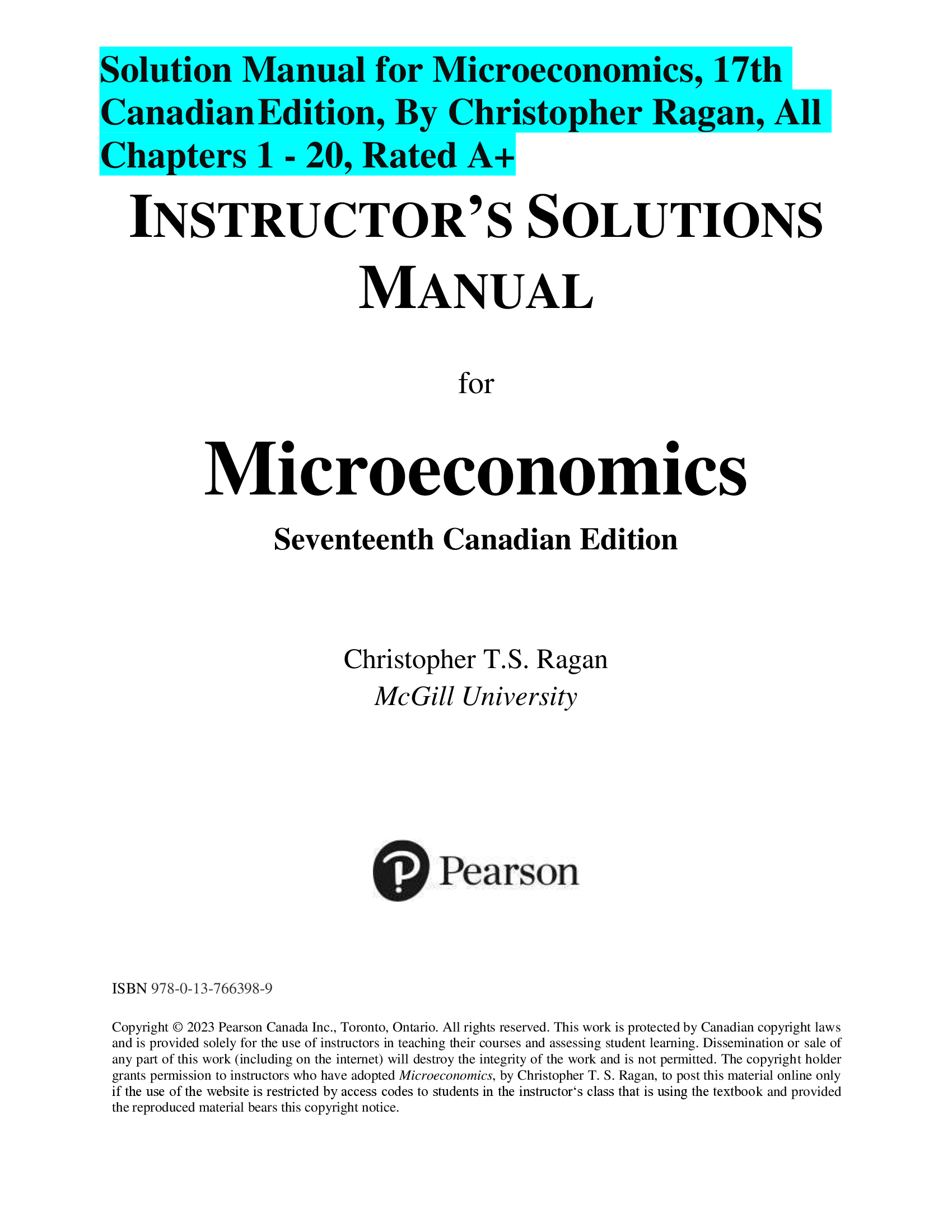
  • Solution Manual for Microeconomics, 17th Canadian Edition, By Christopher Ragan, All Chapters 1 - 20, Rated A+

Solution Manual for Microeconomics, 17th Canadian Edition, By Christopher Ragan, All Chapters 1 - 20, Rated A+

Preview page 1 Preview page 2 Preview page 3
Add To Favorites

Share this item Share this item

  • Item Details
  • Comments (0)
  • Reviews (0)
  • Contact Seller

QUESTIONS AND ANSWERS Question 1 a) land, labour, capital; factors b) opportunity cost c) production possibilities boundary d) scarcity (because points outside the boundary are unattainable); downward (or negative); the opportunity cost associated with any choice e) constant; increasing f) increases (meaning that more units of good B must be given up to get an extra unit of good A) Question 2 a) self; self-interest b) incentives c) firms; households; governments d) increase (maximize); increase (maximize) e) margin; (marginal) cost Question 3 a) division; specialization b) trade c) money d) globalization x Instructor‘s Solutions Manual for Ragan, Microeconomics, Seventeenth Canadian Edition Review Questions Question 4 Any realistic production possibilities boundary displays scarcity, the need for choice, and opportunity cost. Scarcity: The production possibilities boundary (PPB) separates attainable combinations of goods from those that are unattainable. Thus scarcity is shown by the existence of some unattainable bundles of goods. Choice: Because of scarcity, societies must somehow choose how resources are to be allocated; thus a particular point on the PPB must be chosen. Opportunity Cost: The slope of the PPB is negative, revealing the opportunity cost that is unavoidable every time a choice is made. For the economy as a whole, the decision to produce more of one good must involve a decision to produce less of some other good. Question 5 Consider any country‘s production possibilities boundary, and suppose the two products are X and Y. A technological improvement in industry X shifts the PPB out (along the X axis), increasing the maximum amount of X that can be produced. Note that the maximum amount of Y that can be produced has not changed. But since the PPB has shifted out, there are many combinations of both goods that are now available that were not before, and some of these involve producing more of both goods. Thus, even though the technology for producing Y has not changed, the technological improvement in X does allow the country to choose to produce more of both products. Question 6 The central ideas illustrated by the two-good version of the production possibilities boundary (PPB) are scarcity, choice, and opportunity cost. Exactly the same ideas can be illustrated in a more realistic threegood version of the model, which is more complicated to draw, or by the much more realistic N-good version of the model (with N  4), which is impossible to draw. Thus the assumption of only two goods is merely a simplifying one: it allows us to easily grasp and illustrate some central points that would be more difficult to understand in the more general N-good case. Question 7 a) If all Canadian families had $80,000 of after-tax income (roughly the Canadian average), it would be difficult to say that real poverty existed in Canada. At this level of income, all families would easily have enough income to provide the essentials of food, shelter, and clothing, and could also have much beyond these essentials. However, there would still be many things that these families could not afford, such as expensive university education, expensive vacations, a cottage in the country, etc. Defining poverty with any precision is difficult, and we will say more about this in Chapter 18. Chapter 3: Demand, Supply, and Price xi b) Would scarcity exist in such a setting? Yes, certainly. By scarcity we mean simply an excess of wants over the resources available to satisfy those wants. And scarcity would exist for each of those families because most (if not all) of them would still desire to have more than they actually had. c) Scarcity is an excess of wants over the resources available to satisfy those wants. Poverty—at least in its ―absolute form‖—is concerned with a level of resources below some threshold of sufficiency. One can conceivably eliminate poverty, as in part (a), but that would not eliminate scarcity. Question 8 Microeconomics is the study of the allocation of resources within and across individual markets, and the determination of relative prices and quantities in those specific markets. Little or no attention is paid to the behaviour of the aggregate economy. Macroeconomics is the study of the determination of aggregates such as aggregate output, employment, the price level, the unemployment rate, and the exchange rate. When doing macroeconomics, little or no attention is paid to what is going on in the individual markets for specific products. Question 9 In the answers that follow, note that the statements are made ceteris paribus. In other words, the predicted result of a change in some specific price is made under the assumption that nothing else changes. a) As the price of ski-lift tickets rises, you are likely to substitute toward other leisure activities (whose price has not increased) and thus reduce your purchases of ski-lift tickets. b) As the hourly wage for your weekend job rises, the opportunity cost of not working rises. So you are more likely than before to decide not to go skiing, and to work instead. c) As the fine for speeding rises, the cost of being caught speeding clearly increases. The benefit of driving over the speed limit is presumably unchanged, however. So an increase in the value of speeding tickets is likely to cause you to reduce your speed (and to watch more carefully for hidden police cars!). d) The higher the weight placed on the assignment, the greater is the incentive for you to work hard on that assignment (and thus hopefully receive a higher grade on the assignment and on the course). This is one obvious reason why professors like to put significant weight on midterm exams – to get students to work hard early in the course rather than leaving all the work to the few days before the final exam! e) As tuition fees for one specific institution increase, you are likely to substitute toward other institutions whose fees have not increased, and thus reduce your desire to attend the first institution. (For small changes in tuition fees, this effect may be very small because of the perceived large differences between some educational institutions.) Question 10 xii Instructor‘s Solutions Manual for Ragan, Microeconomics, Seventeenth Canadian Edition There are two reasons why the specialization of labour is more efficient than self-sufficiency. First, since individual abilities differ, specializing allows each person to focus their energies on what they do best, leaving everything else to be done by others. As a result, total output will rise. Second, as people specialize, they often ―learn by doing‖ and become even better at their specific task. Thus specialization often leads to improvements in ability that would not otherwise occur. Question 11 The market for doctors‘ services depends heavily on the specialization of labour. A person with back pain will not know what is wrong. They go to a general practitioner (GP) who is somewhat familiar with a broad range of symptoms and illnesses. The GP may rule out the simplest possible causes for the pain, and in the process determine that the patient requires the services of a specialist who diagnoses and treats the patient‘s back. The patient is referred to this specialist who may diagnose a ruptured disk and perform the delicate surgery necessary to solve the problem. Given this reliance on specialization, the market depends on having relatively more GPs who see a large number of patients and act as ―gatekeepers‖ for patients to the more specific specialists. Question 12 Traditional systems: Behaviour is based primarily on tradition, custom, and habit. Command systems: Decisions about production and consumption are determined by a central planning authority. Free-market systems: Production and consumption decisions are made privately, by decentralized producers and consumers. Mixed systems: These economic systems contain elements of tradition, command, and free markets. Question 13 This quote, if put to a group of students, would stimulate much interesting discussion, not only about views on how alternative economic systems work, but also about the words used to describe them. The term planned economy, for example, describes the conscious use of centralized decision making for key economic decisions, but the results of that process often look anything but planned, with shortages in some sectors, surpluses in others, and often a rather dispirited and unmotivated private sector. On the other hand, the unplanned decentralized market economy––though surely not perfect––creates a much more orderly looking set of outcomes.

Contact the Seller

Please Sign In to contact this seller.


  • 👎  Report Copyright Violation

Frequently Asked Questions

What Do I Get When I Buy This Study Material?

+

When you buy a study material on Passing Grades, an instant download link will be sent directly to your email, giving you access to the file anytime after payment is completed.

Is Passing Grades a Trusted Platform?

+

Yes, Passing Grades is a reputable students’ marketplace with a secure payment system and reliable customer support. You can trust us to ensure a safe and seamless transaction experience.

Will I Be Stuck with a Subscription?

+

No, all purchases on Passing Grades are one-time transactions. You only pay for the notes you choose to buy, with no subscriptions or hidden fees attached.

Who Am I Buying These Study Materials From?

+

Passing Grades is a marketplace, which means you are purchasing the document from an individual vendor, not directly from us. We facilitate the payment and delivery process between you and the vendor.

Does Passing Grades Offer Free Study Materials?

+

Yes, sellers on Passing Grades have uploaded numerous free test banks, exams, practice questions, and class notes that can be downloaded at no cost.

Pasinggrades - Quality Study Materials

USD 17

    • Quality checked by Pasing Grades
    • 100% satisfaction guarantee
    • Seller: Highergrades
Buy PDF $17

Seller Information

Highergrades

Member since January 2024

  • icon
  • icon
View Profile
  • total sales

    0
  • Favourites

    0
  • Comments

    0
    ( 0 Ratings )

Item Information

  • Uploaded

    17 January 2024

  • Updated

    24 October 2025

  • Category

    No category

  • Item Type

    questions & answers

  • Tags

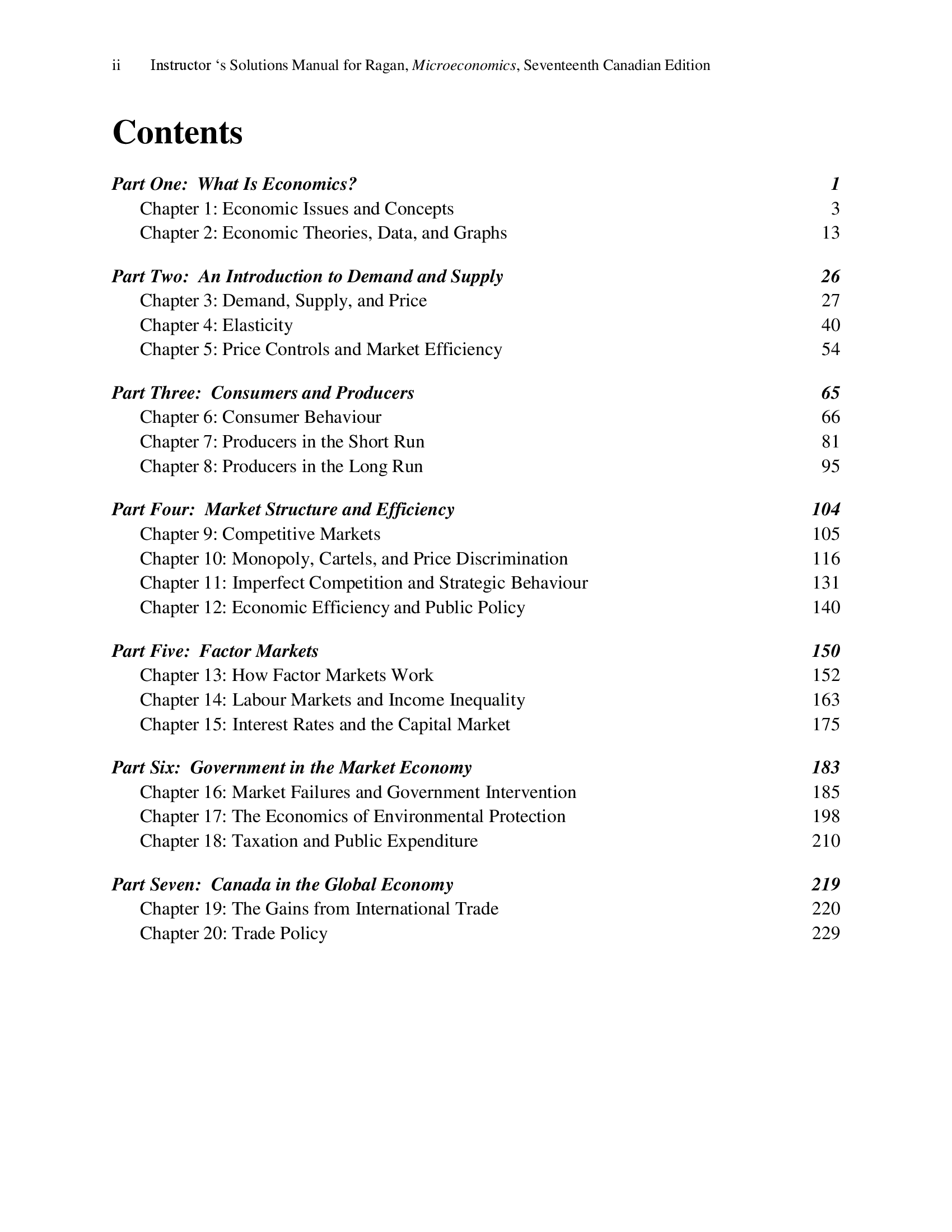
    Contents Part One: What Is Economics? 1 Chapter 1: Economic Issues and Concepts 3 Chapter 2: Economic Theories Data and Graphs 13 Part Two: An Introduction to Demand and Supply 26 Chapter 3: Demand Supply and Price 27 Chapter 4: Elasticity 40 Chapter 5: Price Controls and Market Efficiency 54 Part Three: Consumers and Producers 65 Chapter 6: Consumer Behaviour 66 Chapter 7: Producers in the Short Run 81 Chapter 8: Producers in the Long Run 95 Part Four: Market Structure and Efficiency 104 Chapter 9: Competitive Markets 105 Chapter 10: Monopoly Cartels and Price Discrimination 116 Chapter 11: Imperfect Competition and Strategic Behaviour 131 Chapter 12: Economic Efficiency and Public Policy 140 Part Five: Factor Markets 150 Chapter 13: How Factor Markets Work 152 Chapter 14: Labour Markets and Income Inequality 163 Chapter 15: Interest Rates and the Capital Market 175 Part Six: Government in the Market Economy 183 Chapter 16: Market Failures and Government Intervention 185 Chapter 17: The Economics of Environmental Protection 198 Chapter 18: Taxation and Public Expenditure 210 Part Seven: Canada in the Global Economy 219 Chapter 19: The Gains from International Trade 220 Chapter 20: Trade Policy 229

Related Exam Prep Guides by Highergrades

ATI RN Nursing Care of Children Exam Test Bank Latest 2024
View Document

ATI RN Nursing Care ...

  • Highergrades

    Highergrades

  • questions & answers

ATI RN Nursing Care of Children Exam Test Bank Latest 2024 – Download PDF...

17 USD

0

0

PN ADULT MEDICAL SURGICAL 2023, 2024 100 percent VERIFIED ANSWERS
View Document

PN ADULT MEDICAL SUR...

  • Highergrades

    Highergrades

  • questions & answers

PN ADULT MEDICAL SURGICAL 2023, 2024 100 percent VERIFIED ANSWERS – Download PDF...

17 USD

0

0

TMU Practice Exam with Verified Answers 2023, 2024
View Document

TMU Practice Exam wi...

  • Highergrades

    Highergrades

  • questions & answers

TMU Practice Exam with Verified Answers 2023, 2024 – Download PDF...

17 USD

0

0

Purchase

Download link will be sent to this email immediately after purchase.

IMPORTANT LINKS

  • How To Upload Class Notes
  • Selling Tips
  • Passing Grades's Study Materials
  • Scholarships for International Students 2026

POPULAR CATEGORIES

  • Law
  • Accounting
  • English
  • Psychology
  • Business
  • Nursing
  • Computer Science
  • General

View Document

  • Blog
  • Contact
  • Delivery Policy
  • Latest Scholarships Around the World
  • How to Pass Bar Exams: Passing Grades’ Strategies
  • How to Study and Pass the CPA Exam
  • All Test Banks
  • Faq
  • Copyright Claims
  • Privacy Policy
  • Terms of Use

KNOWLEDGE BASE

  • How to Write A+ Grade Good Research Paper
  • How to Manage Stress During Exam Period
  • Best Time to Study
  • How to Pass NCLEX-RN Exam
  • How To Effectively Utilize Test Banks
  • Popular Shadow Health Exam Assessments
  • Popular HESI Case Studies
  • How to Prepare for a Nursing Career
  • The Importance Of Summaries in Exam Revisvion

© 2026 Pasing Grades. All rights reserved.