Pasing Grades
  • Start Selling
  • Blog
  • Contact
  • 0

    Your cart is empty!

English

  • English
  • Spanish
  • Arabic
Create Account Sign In
  • Library
    • New Prep Guides
    • Featured Prep Guides
    • Free Exam Prep Guides
    • Best sellers
  • General
  • Nursing
    • Research Paper
    • Case Study
    • Discussion Post
    • Assignment
    • Exam
    • Practice Questions and Answers
    • Test Bank
    • solutions manual
  • Accounting
    • Case Study
    • Thesis
    • Study Guide
    • Summary
    • Research Paper
    • test bank
  • English
    • Creative Writing
    • Research Paper
    • Summary
    • Rhetorics
    • Literature
    • Journal
    • Exam
    • Grammar
    • Discussion Post
    • Essay
  • Psychology
    • Hesi
    • Presentation
    • Essay
    • Summary
    • Study Guide
    • Essay
    • Solution Manual
    • Final Exam Review
    • Class Notes
    • test bank
  • Business
    • Lecture Notes
    • Solution Manual
    • Presentation
    • Business Plan
    • Class Notes
    • Experiment
    • Summary
    • Practice Questions
    • Study Guide
    • Case Study
    • test bank
    • Exam
  • More
    • Computer Science
    • Economics
    • Statistics
    • Engineering
    • Biology
    • Religious Studies
    • Physics
    • Chemistry
    • Mathematics
    • History
    • Sociology
    • Science
    • Philosophy
    • Law
  • Pages
    • About Us
    • Selling Tips
    • Delivery Policy
    • Faq
    • Privacy Policy
  • Flash Sale
  • Home
  • Solution Manual for Intermediate Accounting 10th Edition By Spiceland

Solution Manual for Intermediate Accounting 10th Edition By Spiceland

Preview page 1 Preview page 2 Preview page 3
Add To Favorites

Share this item Share this item

  • Item Details
  • Comments (0)
  • Reviews (0)
  • Contact Seller

Solution Manual for Intermediate Accounting 10th Edition By Spiceland

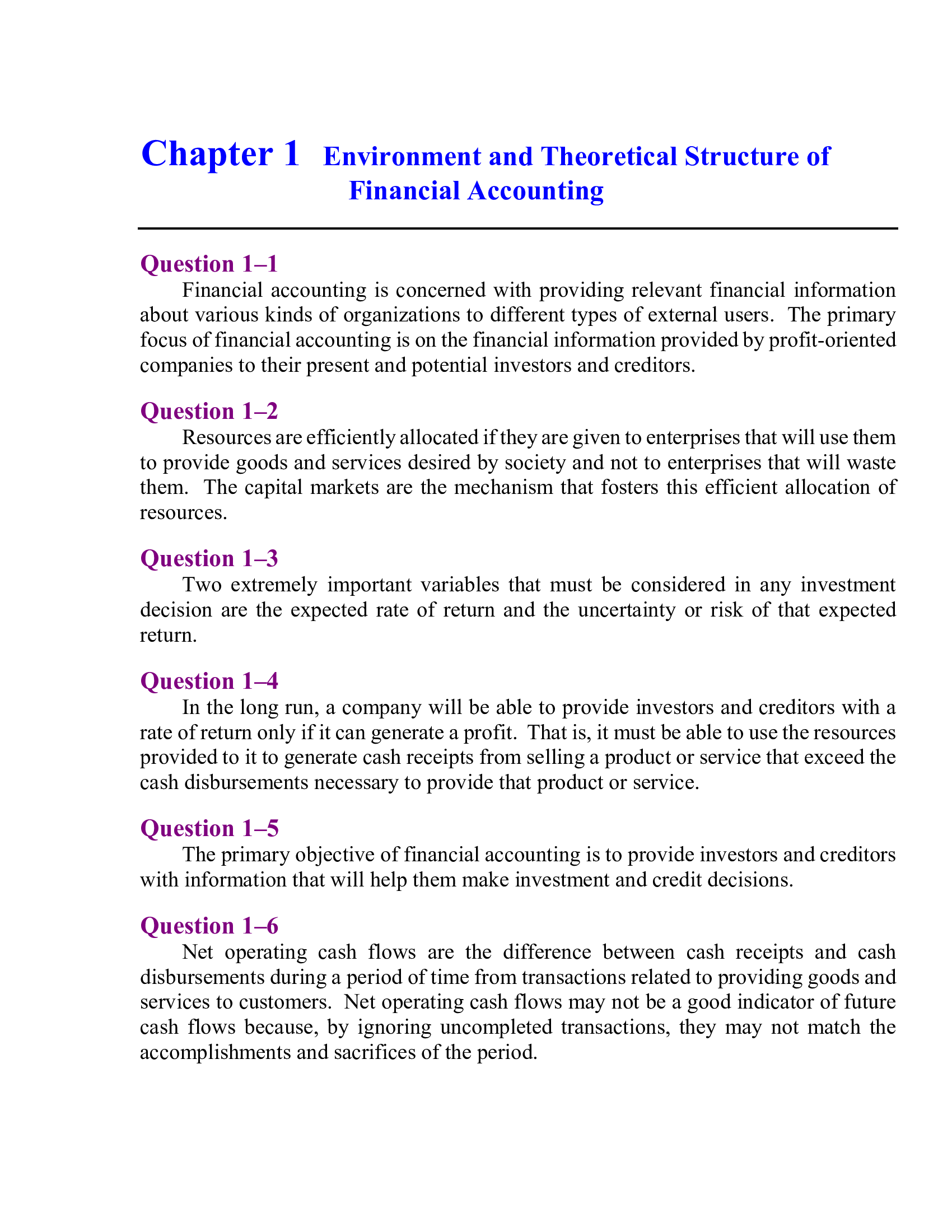
Chapter 1   Environment and Theoretical Structure of Financial Accounting  

Question 1–1 

Financial accounting is concerned with providing relevant financial information

about various kinds of organizations to different types of external users.  The primary

focus of financial accounting is on the financial information provided by profit-oriented

companies to their present and potential investors and creditors. 

Question 1–2 

Resources are efficiently allocated if they are given to enterprises that will use them

to provide goods and services desired by society and not to enterprises that will waste

them.  The capital markets are the mechanism that fosters this efficient allocation of

resources. 

Question 1–3 

Two extremely important variables that must be considered in any investment

decision are the expected rate of return and the uncertainty or risk of that expected

return. 

Question 1–4 

In the long run, a company will be able to provide investors and creditors with a

rate of return only if it can generate a profit.  That is, it must be able to use the resources

provided to it to generate cash receipts from selling a product or service that exceed the

cash disbursements necessary to provide that product or service. 

Question 1–5 

The primary objective of financial accounting is to provide investors and creditors

with information that will help them make investment and credit decisions. 

Question 1–6 

Net operating cash flows are the difference between cash receipts and cash

disbursements during a period of time from transactions related to providing goods and

services to customers.  Net operating cash flows may not be a good indicator of future

cash flows because, by ignoring uncompleted transactions, they may not match the

accomplishments and sacrifices of the period. 


Answers to Questions (continued) 


Question 1–7 

GAAP (generally accepted accounting principles) are a dynamic set of both broad

and specific guidelines that a company should follow in measuring and reporting the

information in their financial statements and related notes.  It is important that all

companies follow GAAP so that investors can compare financial information across

companies to make their resource allocation decisions. 

Question 1–8 

In 1934, Congress created the SEC and gave it the job of setting accounting and

reporting standards for companies whose securities are publicly traded.  The SEC has

retained the power, but has relied on private sector bodies to create the standards.  The

current private sector body responsible for setting accounting standards is the FASB. 

Question 1–9 

Auditors are independent, professional accountants who examine financial

statements to express an opinion.  The opinion reflects the auditors’ assessment of the

statements' fairness, which is determined by the extent to which they are prepared in

compliance with GAAP.  The auditor adds credibility to the financial statements, which

increases the confidence of capital market participants relying on that information. 


Answers to Questions (continued) 


Question 1–10 

On July 30, 2002, President Bush signed into law the Sarbanes-Oxley Act of 2002.

The most dramatic change to federal securities laws since the 1930s, the Act radically

redesigns federal regulation of public company corporate governance and reporting

obligations. It also significantly tightens accountability standards for directors and

officers, auditors, securities analysts, and legal counsel. Student opinions as to the

relative importance of the key provisions of the act will vary. Key provisions in the

order of presentation in the text are: 


 Creation of an Oversight Board

 Corporate executive accountability

 Nonaudit services

 Retention of work papers

 Auditor rotation

 Conflicts of interest

 Hiring of auditor

 Internal control 

Question 1–11 

New accounting standards, or changes in standards, can have significant

differential effects on

 companies, investors and creditors, and other interest groups by

causing redistribution of wealth.  There also is the possibility that standards could harm

the economy as a whole by causing companies to change their behavior. 

Question 1–12 

The FASB undertakes a series of elaborate information gathering steps before

issuing an accounting standard to determine consensus as to the preferred method of 

accounting, as well as to anticipate adverse economic consequences. 

Question 1–13 

The purpose of the conceptual framework is to guide the Board in developing

accounting standards by providing an underlying foundation and basic reasoning on

which to consider merits of alternatives.  The framework does not prescribe GAAP. 


Answers to Questions (continued) 


Question 1–14 

Relevance and faithful representation are the primary qualitative characteristics

that make information decision-useful.  Relevant information will possess predictive

and/or confirmatory value.  Faithful representation is the extent to which there is

agreement between a measure or description and the phenomenon it purports to

represent.  

Question 1–15 

The components of relevant information are predictive value, confirmatory value

and materiality.  The components of faithful representation are completeness, neutrality,

and freedom from error. 

Question 1–16 

The benefit from providing accounting information is increased decision

usefulness.  If the information is relevant and possesses faithful representation, it will

improve the decisions made by investors and creditors.  However, there are costs to

providing information that include costs to gather, process, and disseminate that

information.  There also are costs to users in interpreting the information as well as

possible adverse economic consequences that could result from disclosing information. 

Information should not be provided unless the benefits exceed the costs.


Question 1–17 

Information is material if it is deemed to have an effect on a decision made by a

user.  The threshold for materiality will depend principally on the relative dollar amount

of the transaction being considered.  One consequence of materiality is that GAAP need

not be followed in measuring and reporting a transaction if that transaction is not 

material.  The threshold for materiality has been left to subjective judgment. 


Answers to Questions (continued)

Question 1–18 

1.  Assets are probable future economic benefits obtained or controlled by a particular

entity as a result of past transactions or events. 

2. Liabilities are probable future sacrifices of economic benefits arising from present

obligations of a particular entity to transfer assets or provide services to other

entities in the future as a result of past transactions. 

3. Equity is the residual interest in the assets of any entity that remains after deducting

its liabilities. 

4. Investments by owners are increases in equity resulting from transfers of

resources, usually cash, to a company in exchange for ownership interest. 

5. Distributions to owners are decreases in equity resulting from transfers to owners. 

6. Revenues are inflows of assets or settlements of liabilities from delivering or 


producing goods, rendering services, or other activities that constitute the entity’s

ongoing major or central operations. 

7. Expenses are outflows or other using up of assets or incurrences of liabilities

during a period from delivering or producing goods, rendering services, or other

activities that constitute the entity’s ongoing major or central operations. 

8. Gains are defined as increases in equity from peripheral or incidental transactions

of an entity. 

9. Losses represent decreases in equity arising from peripheral or incidental

transactions of an entity. 

10. Comprehensive income is defined as the change in equity of an entity during a

period from nonowner transactions. 

Question 1–19 

The four basic assumptions underlying GAAP are (1) the economic entity

assumption, (2) the going concern assumption, (3) the periodicity assumption, and (4) 

the monetary unit assumption. 

Question 1–20 

The going concern assumption means that, in the absence of information to the

contrary, it is anticipated that a business entity will continue to operate indefinitely. 

This assumption is important to many broad and specific accounting principles such as

the historical cost principle. 


Answers to Questions (continued)

Question 1–21 

The periodicity assumption relates to needs of external users to receive timely

financial information.  This assumption requires that the economic life of a company be

divided into artificial periods for financial reporting. Companies usually report to

external users at least once a year. 


Question 1–22 

Four accounting practices, often referred to as principles, that guide accounting

practice are (1) revenue recognition, (2) expense recognition, (3) mixed-attribute

measurement (including historical cost), and (4) full disclosure. 


Question 1–23 

Two advantages to basing valuation on historical cost are (1) historical cost

provides important cash flow information since it represents the cash or cash equivalent

paid for an asset or received in exchange for the assumption of a liability, and (2)

historical cost valuation is the result of an exchange transaction between two

independent parties and the agreed upon exchange value is, therefore, objective and

possesses a high degree of verifiability. 


Question 1–24 

Companies recognize revenue when goods or services are transferred to customers. 

However, no revenue is recognized if it isn’t probable that the seller will collect the

amounts it’s entitled to receive.  The amount of revenue recognized is the amount the

company expects to be entitled to receive in exchange for those goods or services. 

Revenue is recognized at a point in time or over a period of time, depending on when

goods or services are transferred to customers. So, revenue for the sale of most goods

is recognized upon delivery, but revenue for services like renting apartments or lending

money is recognized over time as those services are provided.  


Answers to Questions (continued)

Question 1–25 


The four different approaches to implementing expense recognition are:

1. Recognizing an expense based on an exact cause-and-effect relationship 

between a revenue and expense event.  Cost of goods sold is an example of an

expense recognized by this approach. 

2. Recognizing an expense by identifying the expense with the revenues

recognized in a specific time period.  Office salaries are an example of an

expense recognized by this approach. 

3. Recognizing an expense by a systematic and rational allocation to specific time

periods.  Depreciation is an example of an expense recognized by this approach. 

4. Recognizing expenses in the period incurred, without regard to related

revenues.  Advertising is an example of an expense recognized by this

approach. 


Question 1–26 

In addition to the financial statement elements arrayed in the basic financial

statements, information is disclosed by means of parenthetical or modifying comments,

notes, and supplemental schedules and tables. 


Question 1–27 

GAAP prioritizes the inputs companies should use when determining fair value. 

The highest and most desirable inputs, Level 1, are quoted market prices in active

markets for identical assets or liabilities.  Level 2 inputs are other than quoted prices

that are observable, including quoted prices for similar assets or liabilities in active or

inactive markets and inputs that are derived principally from observable related market 

data.  Level 3 inputs, the least desirable, are inputs that reflect the entity’s own

assumptions about the assumptions market participants would use in pricing the asset

or liability based on the best information available in the circumstances. 

Question 1–28 

Common measurement attributes are historical cost, net realizable value, current

cost, present value, and fair value. 


Answers to Questions (concluded)

Question 1–29 

Under the revenue/expense approach, revenues and expenses are considered

primary, and assets, liabilities, and equities are secondary in the sense of being

recognized at the time and amount necessary to achieve proper revenue and expense

recognition.  Under the asset/liability approach, assets and liabilities are considered

primary, and revenues and expenses are secondary in the sense of being recognized at

the time and amount necessary to allow recognition and measurement of assets and

liabilities as required by their definitions.   


Question 1–30 

Under IFRS, the conceptual framework provides guidance to accounting standard

setters but also provides GAAP when more specific accounting standards do not provide

guidance. 

Question 1–31 

The International Accounting Standards Board (IASB) is responsible for

determining IFRS. The IASB is funded by the IFRS Foundation. . 

Question 1–32 

The SEC staff’s Final Staff Report concludes that it is not feasible for the U.S. to

simply adopt IFRS, given (1) a need for the U.S. to have strong influence on the standard

setting process and insure that standards meet U.S. needs, (2) the high costs to

companies of converting to IFRS, and (3) the fact that many laws, regulations and

private contracts reference U.S. GAAP. 


BRIEF EXERCISES 


Brief Exercise 1–1 

Revenues ($340,000 + 60,000) $400,000

Expenses:

   Rent ($40,000  2) (20,000)

   Salaries (120,000)

   Utilities

($50,000 + 2,000)   (52,000)

      Net income $208,000


Brief Exercise 1–2 

(1) Liabilities

(2) Assets

(3) Revenues

(4) Losses 

Brief Exercise 1–3 

1. The periodicity assumption

2. The economic entity assumption

3. Revenue recognition

4. Expense recognition 

Brief Exercise 1–4 

1. Expense recognition

2. The historical cost (original transaction value) principle

3. The economic entity assumption 

Brief Exercise 1–5 

1. Disagree  — The full disclosure principle

2. Agree — The periodicity assumption

3. Disagree — Expense recognition

4. Agree — Revenue recognition 

Contact the Seller

Please Sign In to contact this seller.


  • 👎  Report Copyright Violation

Frequently Asked Questions

What Do I Get When I Buy This Study Material?

+

When you buy a study material on Passing Grades, an instant download link will be sent directly to your email, giving you access to the file anytime after payment is completed.

Is Passing Grades a Trusted Platform?

+

Yes, Passing Grades is a reputable students’ marketplace with a secure payment system and reliable customer support. You can trust us to ensure a safe and seamless transaction experience.

Will I Be Stuck with a Subscription?

+

No, all purchases on Passing Grades are one-time transactions. You only pay for the notes you choose to buy, with no subscriptions or hidden fees attached.

Who Am I Buying These Study Materials From?

+

Passing Grades is a marketplace, which means you are purchasing the document from an individual vendor, not directly from us. We facilitate the payment and delivery process between you and the vendor.

Does Passing Grades Offer Free Study Materials?

+

Yes, sellers on Passing Grades have uploaded numerous free test banks, exams, practice questions, and class notes that can be downloaded at no cost.


Pasinggrades - Quality Study Materials

USD 15

    • Quality checked by Pasing Grades
    • 100% satisfaction guarantee
    • Seller: tutorvalentine
Buy PDF $15

Seller Information

tutorvalentine

Member since October 2021

  • icon
  • icon
View Profile
  • total sales

    0
  • Favourites

    0
  • Comments

    0
    ( 0 Ratings )

Item Information

  • Uploaded

    05 February 2023

  • Updated

    24 October 2025

  • Category

    Business

  • Item Type

    test bank

  • Tags

    Solution Manual Intermediate Accounting 10th Edition Spiceland

Related Exam Prep Guides by tutorvalentine

BIOLOGY 145 HESI Case Studies Medical Surgical-Traumatic Brain Injury (Jeff Dickson)
View Document

BIOLOGY 145 HESI Cas...

  • tutorvalentine

    tutorvalentine

  • test bank

BIOLOGY 145 HESI Case Studies Medical Surgical-Traumatic Brain Injury (Jeff Dickson)...

15 USD

0

0

BUSINESS 501 corporate communication Assessments 8-15
View Document

BUSINESS 501 corpora...

  • tutorvalentine

    tutorvalentine

  • test bank

BUSINESS 501 corporate communication Assessments 8-15...

15 USD

0

0

CS 31 Worksheet Week 4 Concepts While Loops, Do While Loops, String Traversal, Functions
View Document

CS 31 Worksheet Week...

  • tutorvalentine

    tutorvalentine

  • test bank

CS 31 Worksheet Week 4 Concepts While Loops, Do While Loops, String Traversal, Functions...

15 USD

0

0

Purchase

Download link will be sent to this email immediately after purchase.

IMPORTANT LINKS

  • How To Upload Class Notes
  • Selling Tips
  • Passing Grades's Study Materials
  • Scholarships for International Students 2025

POPULAR CATEGORIES

  • Law
  • Accounting
  • English
  • Psychology
  • Business
  • Nursing
  • Computer Science
  • General

View Document

  • Blog
  • Contact
  • Delivery Policy
  • Latest Scholarships Around the World
  • How to Pass Bar Exams: Passing Grades’ Strategies
  • How to Study and Pass the CPA Exam
  • All Test Banks
  • Faq
  • Copyright Claims
  • Privacy Policy
  • Terms of Use

KNOWLEDGE BASE

  • How to Write A+ Grade Good Research Paper
  • How to Manage Stress During Exam Period
  • Best Time to Study
  • How to Pass NCLEX-RN Exam
  • How To Effectively Utilize Test Banks
  • Popular Shadow Health Exam Assessments
  • Popular HESI Case Studies
  • How to Prepare for a Nursing Career
  • The Importance Of Summaries in Exam Revisvion

© 2026 Pasing Grades. All rights reserved.