Pasing Grades
  • Start Selling
  • Blog
  • Contact
  • 0

    Your cart is empty!

English

  • English
  • Spanish
  • Arabic
Create Account Sign In
  • Library
    • New Prep Guides
    • Featured Prep Guides
    • Free Exam Prep Guides
    • Best sellers
  • General
  • Nursing
    • Research Paper
    • Case Study
    • Discussion Post
    • Assignment
    • Exam
    • Practice Questions and Answers
    • Test Bank
    • solutions manual
  • Accounting
    • Case Study
    • Thesis
    • Study Guide
    • Summary
    • Research Paper
    • test bank
  • English
    • Creative Writing
    • Research Paper
    • Summary
    • Rhetorics
    • Literature
    • Journal
    • Exam
    • Grammar
    • Discussion Post
    • Essay
  • Psychology
    • Hesi
    • Presentation
    • Essay
    • Summary
    • Study Guide
    • Essay
    • Solution Manual
    • Final Exam Review
    • Class Notes
    • test bank
  • Business
    • Lecture Notes
    • Solution Manual
    • Presentation
    • Business Plan
    • Class Notes
    • Experiment
    • Summary
    • Practice Questions
    • Study Guide
    • Case Study
    • test bank
    • Exam
  • More
    • Computer Science
    • Economics
    • Statistics
    • Engineering
    • Biology
    • Religious Studies
    • Physics
    • Chemistry
    • Mathematics
    • History
    • Sociology
    • Science
    • Philosophy
    • Law
  • Pages
    • About Us
    • Selling Tips
    • Delivery Policy
    • Faq
    • Privacy Policy
  • Flash Sale
  • Home
  • Solution Manual for Inquiry into Life, 16th Edition, Sylvia Mader, Michael Windelspecht

Solution Manual for Inquiry into Life, 16th Edition, Sylvia Mader, Michael Windelspecht

Preview page 1 Preview page 2 Preview page 3
Add To Favorites

Share this item Share this item

  • Item Details
  • Comments (0)
  • Reviews (0)
  • Contact Seller

Solution Manual for Inquiry into Life, 16th Edition, Sylvia Mader, Michael Windelspecht 

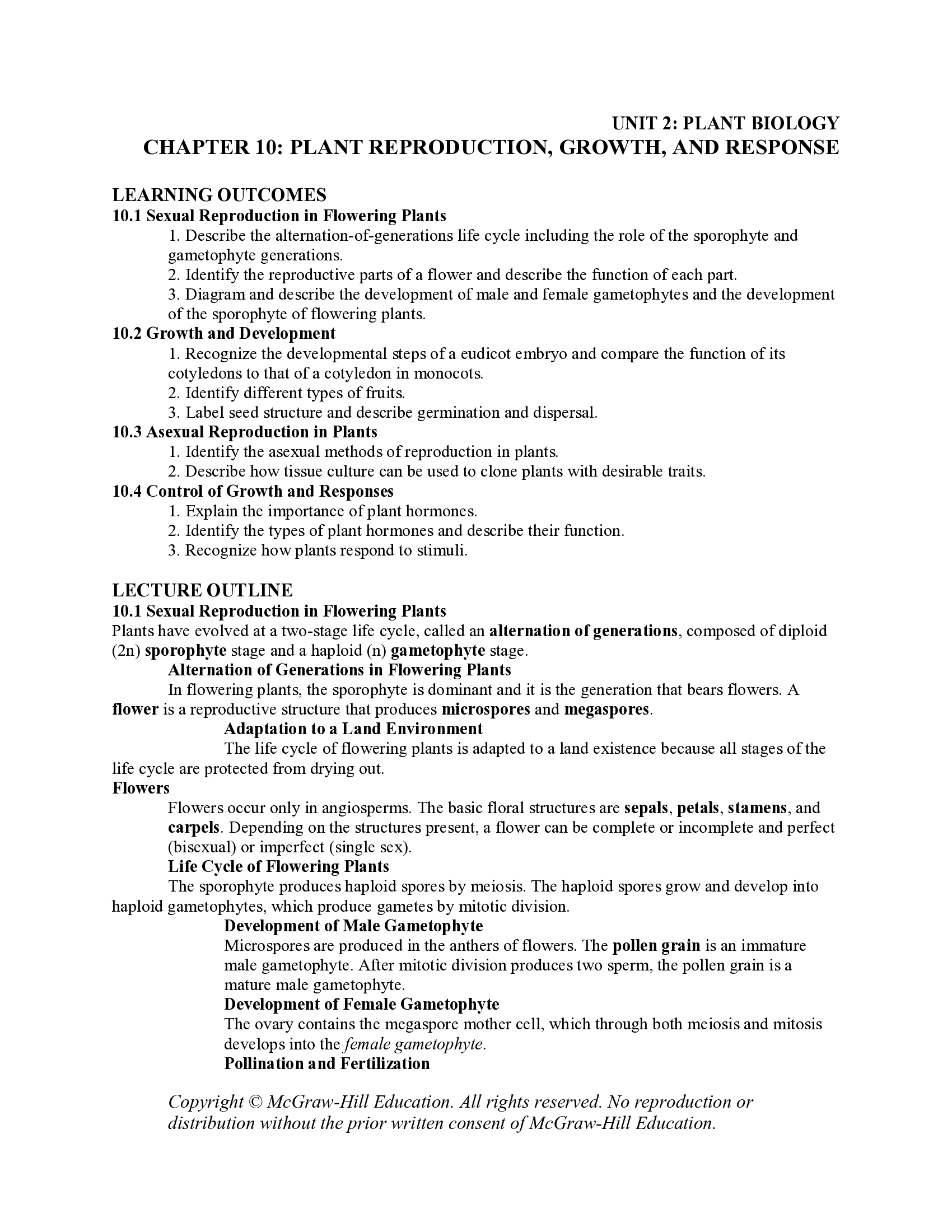
UNIT 2: PLANT BIOLOGYCHAPTER 10: PLANT REPRODUCTION, GROWTH, AND RESPONSELEARNING OUTCOMES 10.1 Sexual Reproduction in Flowering Plants 1. Describe the alternation-of-generations life cycle including the role of the sporophyte and gametophyte generations. 2. Identify the reproductive parts of a flower and describe the function of each part. 3. Diagram and describe the development of male and female gametophytes and the development of the sporophyte of flowering plants. 10.2 Growth and Development 1. Recognize the developmental steps of a eudicot embryo and compare the function of its cotyledons to that of a cotyledon in monocots. 2. Identify different types of fruits. 3. Label seed structure and describe germination and dispersal. 10.3 Asexual Reproduction in Plants 1. Identify the asexual methods of reproduction in plants. 2. Describe how tissue culture can be used to clone plants with desirable traits. 10.4 Control of Growth and Responses 1. Explain the importance of plant hormones. 2. Identify the types of plant hormones and describe their function. 3. Recognize how plants respond to stimuli. LECTURE OUTLINE 10.1 Sexual Reproduction in Flowering Plants Plants have evolved at a two-stage life cycle, called an alternation of generations, composed of diploid (2n) sporophyte stage and a haploid (n) gametophyte stage. Alternation of Generations in Flowering Plants In flowering plants, the sporophyte is dominant and it is the generation that bears flowers. A flower is a reproductive structure that produces microspores and megaspores. Adaptation to a Land Environment The life cycle of flowering plants is adapted to a land existence because all stages of the life cycle are protected from drying out. Flowers Flowers occur only in angiosperms. The basic floral structures are sepals, petals, stamens, and carpels. Depending on the structures present, a flower can be complete or incomplete and perfect (bisexual) or imperfect (single sex). Life Cycle of Flowering Plants The sporophyte produces haploid spores by meiosis. The haploid spores grow and develop into haploid gametophytes, which produce gametes by mitotic division. Development of Male Gametophyte Microspores are produced in the anthers of flowers. The pollen grain is an immature male gametophyte. After mitotic division produces two sperm, the pollen grain is a mature male gametophyte. Development of Female Gametophyte The ovary contains the megaspore mother cell, which through both meiosis and mitosis develops into the female gametophyte. Pollination and Fertilization Copyright © McGraw-Hill Education. All rights reserved. No reproduction or distribution without the prior written consent of McGraw-Hill Education. Pollination is the transfer of pollen from an anther to the stigma of a carpel. Selfpollination occurs if the pollen is from the same plant, and cross-pollination occurs if the pollen is from a different plant of the same species. Angiosperms have adaptations to foster cross-pollination. 10.2 Growth and Development Development of the Eudicot Embryo Within a seed, the zygote undergoes development to become an embryo. The root-shoot axis is established in the globular stage when the zygote becomes an embryo. Further development produces the radicle, hypocotyl, epicotyl, and cotyledons. Monocot versus Eudicot Embryos Monocots have only one cotyledon, which store the nutrient molecules that the embryo uses. Eudicots have two. Fruit Types and Seed Dispersal A fruit is derived from an ovary and sometimes other flower parts. It protects and helps disperse offspring. Fruits can be simple or compound, dry or fleshy, and so on. Dispersal of Seeds For plants to be widely distributed, their seeds must be dispersed from the parent plant. Plants have various means of ensuring that dispersal takes place. Germination of Seeds With the right environmental conditions, seeds germinate, or begin to grow so that a seedling appears. Germination requires regulation by both inhibitors and stimulators. Eudicot versus Monocot Seed Germination In eudicots, the cotyledons that have absorbed the endosperm supply nutrients to the embryo and seedling. In monocots, the endosperm is the food-storage tissue, and the single cotyledon has no storage role. 10.3 Asexual Reproduction in Plants Asexual reproduction produces genetically identical offspring from a single parent. Asexual Reproduction from Stems, Roots, and Cuttings Because plants contain nondifferentiated meristem tissue, they routinely reproduce asexually by vegetative propagation. Propagation of Plants in Tissue Culture Tissue culture is the growth of a tissue in an artificial liquid or solid culture medium. Plant cells are totipotent, which means that individual plant cells can develop into an entire plant. 10.4 Control of Growth and Responses Plants respond to environmental stimuli such as light, gravity, and seasonal changes. These responses require hormones. Plant Hormones Plant hormones are small, organic molecules that serve as chemical signals between cells and tissues in plants and regulate growth. Commonly recognized hormone groups are the auxins, gibberellins, cytokinins, abscisic acid, ethylenes, and brassinosteroids. Auxins The most common naturally occurring auxin is indoleacetic acid. Effects of Auxin Auxin is present in the apical meristem of a plant shoot where it causes the shoot to grow from the top, a phenomenon called apical dominance. How Auxins Work In unidirectional light, auxin moves to the shady side. It binds to receptors and activates an ATP-driven pump that transports hydrogen ions out of the cell. This Copyright © McGraw-Hill Education. All rights reserved. No reproduction or distribution without the prior written consent of McGraw-Hill Education. weakens the cell wall and water enters the cell, causing it to elongate and bend. The plant bends toward the light—phototropism. Gibberellins Gibberellins are growth-promoting hormones that bring about elongation of the cells. Effects of Gibberellins When gibberellins are applied externally to plants, they grow taller through stem elongation. Cytokinins Cytokinins encourage cell division. Effects of Cytokinins Because cytokinins promote cell division, applying them can prevent the senescence (aging) of leaves. Abscisic Acid Abscisic acid was once thought to function in abscission, the dropping of leaves, fruits, and flowers from a plant. However, it is no longer believed to be involved in abscission. Effects of Abscisic Acid Abscisic acid is sometimes called the stress hormone because it initiates and maintains seed and bud dormancy and brings about the closure of stomata when a plant is under water stress. Ethylene Ethylene is a gas that works with other hormones to bring about certain effects. Effects of Ethylene Ethylene is involved in abscission. Brassinosteroids These compounds function in plant growth and development of the plant, specifically in the specialization of the vascular tissue. They also help with the plant’s response to stress, such as cold or drought conditions. Plant Responses to Environmental Stimuli Environmental signals determine the seasonality of growth, reproduction, and dormancy in plants. Plant responses are strongly influenced by such environmental stimuli as light, day length, gravity, and touch. Plant Tropisms Plant growth toward or away from a directional stimulus is called a tropism. Tropisms are due to differential growth. Flowering Flowering occurs according to the photoperiod, which is the ratio of the length of day to the length of night over a 24-hour period. Plants can be divided into short-day plants, long-day plants, and day-neutral plants. Phytochrome and Plant Flowering Phytochrome is a blue-green leaf pigment that allows plants to detect photoperiods. Other Functions of Phytochrome Other functions of phytochrome include indicating to seeds that sunlight is present and conditions are favorable for germination. LECTURE ENRICHMENT IDEAS 1. Have students dissect a monocot flower. Have them draw and label the various parts of the flower. A lily is a larger monocot flower with easily differentiated parts. Copyright © McGraw-Hill Education. All rights reserved. No reproduction or distribution without the prior written consent of McGraw-Hill Education. 2. Bring in a variety of fruits and have students discuss whether they are looking at simple fruits, compound fruits, multiple fruits, dry fruits, fleshy fruits, accessory fruits, legumes, and so on. Good fruits include apples, raspberries, pineapples, beans, corn, and peanuts. 3. Have students read the Science in Your Life—Ecology “The Coevolution of Plants and Their Pollinators” before coming to class. Discuss the answers to the discussion questions at the end of the reading. 4. Allow students to germinate seeds in the classroom. Choose both monocot and eudicot seeds so students can compare and contrast germination in these two types. Many seeds will germinate between wet layers of paper towels if they are kept warm. 5. Have students read the Science in Your Life—Health “Are Genetically Engineered Foods Safe?” before coming to class. Discuss the answers to the discussion questions at the end of the reading. ESSAY QUESTIONS WITH ANSWERS 1. What is the difference between fertilization and pollination in flowering plants? Answer: Fertilization takes place in the ovary when one of two sperm nuclei from the generative nucleus in the pollen tube combines with the egg forming a zygote. Pollination, on the other hand, occurs when pollen attaches to the stigma of the ovary due to transfer by the wind, insects, birds, or bats. 2. What is meant by double fertilization in flowering plants? Answer: Fertilization in flowering plants takes place in the ovary when one of two sperm nuclei from the generative nucleus fertilizes the egg to form a zygote, and the second sperm nucleus unites with the two polar nuclei to form the 3n endosperm nucleus. 3. Why would all plants not be short-day plants? Why would plants develop a variety of responses to environmental seasonal changes? Answer: Pollinators are a limited resource. Variation reduces competition for pollinators among flower species. Also, this is linked to other adaptations in seed durability and dormancy. Each difference is beneficial if it distances the plant from competition with others

Contact the Seller

Please Sign In to contact this seller.


  • 👎  Report Copyright Violation

Frequently Asked Questions

What Do I Get When I Buy This Study Material?

+

When you buy a study material on Passing Grades, an instant download link will be sent directly to your email, giving you access to the file anytime after payment is completed.

Is Passing Grades a Trusted Platform?

+

Yes, Passing Grades is a reputable students’ marketplace with a secure payment system and reliable customer support. You can trust us to ensure a safe and seamless transaction experience.

Will I Be Stuck with a Subscription?

+

No, all purchases on Passing Grades are one-time transactions. You only pay for the notes you choose to buy, with no subscriptions or hidden fees attached.

Who Am I Buying These Study Materials From?

+

Passing Grades is a marketplace, which means you are purchasing the document from an individual vendor, not directly from us. We facilitate the payment and delivery process between you and the vendor.

Does Passing Grades Offer Free Study Materials?

+

Yes, sellers on Passing Grades have uploaded numerous free test banks, exams, practice questions, and class notes that can be downloaded at no cost.


Pasinggrades - Quality Study Materials

USD 20

    • Quality checked by Pasing Grades
    • 100% satisfaction guarantee
    • Seller: GradeA
Buy PDF $20

Seller Information

GradeA

Member since April 2021

  • icon
  • icon
  • icon
View Profile
  • total sales

    0
  • Favourites

    0
  • Comments

    0
    ( 0 Ratings )

Item Information

  • Uploaded

    09 November 2023

  • Updated

    24 October 2025

  • Category

    Nursing

  • Item Type

    test bank

  • Tags

    Solution Manual Inquiry into Life 16th Edition Sylvia Mader Michael Windelspecht

Related Exam Prep Guides by GradeA

Test Bank for Fundamentals of Corporate Finance 12th Edition By Stephen Ross and Randolph Westerfield and Bradford Jordan
View Document

Test Bank for Fundam...

  • GradeA

    GradeA

  • test bank

Test Bank for Fundamentals of Corporate Finance 12th Edition By Stephen Ross and Randolph Westerfiel...

20 USD

0

0

[SOLUTION MANUAL) Fundamentals of Corporate Finance 12th Edition By Stephen Ross and Randolph Westerfield and Bradford Jordan
View Document

[SOLUTION MANUAL) Fu...

  • GradeA

    GradeA

  • test bank

[SOLUTION MANUAL) Fundamentals of Corporate Finance 12th Edition By Stephen Ross and Randolph Wester...

20 USD

0

0

QMI1500 Assignment 02 2021 AS PER UPDATED TUTORIAL LETTER
View Document

QMI1500 Assignment 0...

  • GradeA

    GradeA

  • test bank

QMI1500 Assignment 02 2021 AS PER UPDATED TUTORIAL LETTER...

20 USD

0

0

Purchase

Download link will be sent to this email immediately after purchase.

IMPORTANT LINKS

  • How To Upload Class Notes
  • Selling Tips
  • Passing Grades's Study Materials
  • Scholarships for International Students 2025

POPULAR CATEGORIES

  • Law
  • Accounting
  • English
  • Psychology
  • Business
  • Nursing
  • Computer Science
  • General

View Document

  • Blog
  • Contact
  • Delivery Policy
  • Latest Scholarships Around the World
  • How to Pass Bar Exams: Passing Grades’ Strategies
  • How to Study and Pass the CPA Exam
  • All Test Banks
  • Faq
  • Copyright Claims
  • Privacy Policy
  • Terms of Use

KNOWLEDGE BASE

  • How to Write A+ Grade Good Research Paper
  • How to Manage Stress During Exam Period
  • Best Time to Study
  • How to Pass NCLEX-RN Exam
  • How To Effectively Utilize Test Banks
  • Popular Shadow Health Exam Assessments
  • Popular HESI Case Studies
  • How to Prepare for a Nursing Career
  • The Importance Of Summaries in Exam Revisvion

© 2026 Pasing Grades. All rights reserved.