Pasing Grades
  • Start Selling
  • Blog
  • Contact
  • 0

    Your cart is empty!

English

  • English
  • Spanish
  • Arabic
Create Account Sign In
  • Library
    • New Prep Guides
    • Featured Prep Guides
    • Free Exam Prep Guides
    • Best sellers
  • General
  • Nursing
    • Research Paper
    • Case Study
    • Discussion Post
    • Assignment
    • Exam
    • Practice Questions and Answers
    • Test Bank
    • solutions manual
  • Accounting
    • Case Study
    • Thesis
    • Study Guide
    • Summary
    • Research Paper
    • test bank
  • English
    • Creative Writing
    • Research Paper
    • Summary
    • Rhetorics
    • Literature
    • Journal
    • Exam
    • Grammar
    • Discussion Post
    • Essay
  • Psychology
    • Hesi
    • Presentation
    • Essay
    • Summary
    • Study Guide
    • Essay
    • Solution Manual
    • Final Exam Review
    • Class Notes
    • test bank
  • Business
    • Lecture Notes
    • Solution Manual
    • Presentation
    • Business Plan
    • Class Notes
    • Experiment
    • Summary
    • Practice Questions
    • Study Guide
    • Case Study
    • test bank
    • Exam
  • More
    • Computer Science
    • Economics
    • Statistics
    • Engineering
    • Biology
    • Religious Studies
    • Physics
    • Chemistry
    • Mathematics
    • History
    • Sociology
    • Science
    • Philosophy
    • Law
  • Pages
    • About Us
    • Selling Tips
    • Delivery Policy
    • Faq
    • Privacy Policy
  • Flash Sale
  • Home
  • Solution Manual For Chemistry 4th Edition By Blackman

Solution Manual For Chemistry 4th Edition By Blackman

Preview page 1 Preview page 2 Preview page 3
Add To Favorites

Share this item Share this item

  • Item Details
  • Comments (0)
  • Reviews (0)
  • Contact Seller

Chapter 1: The atom

Practice exercises

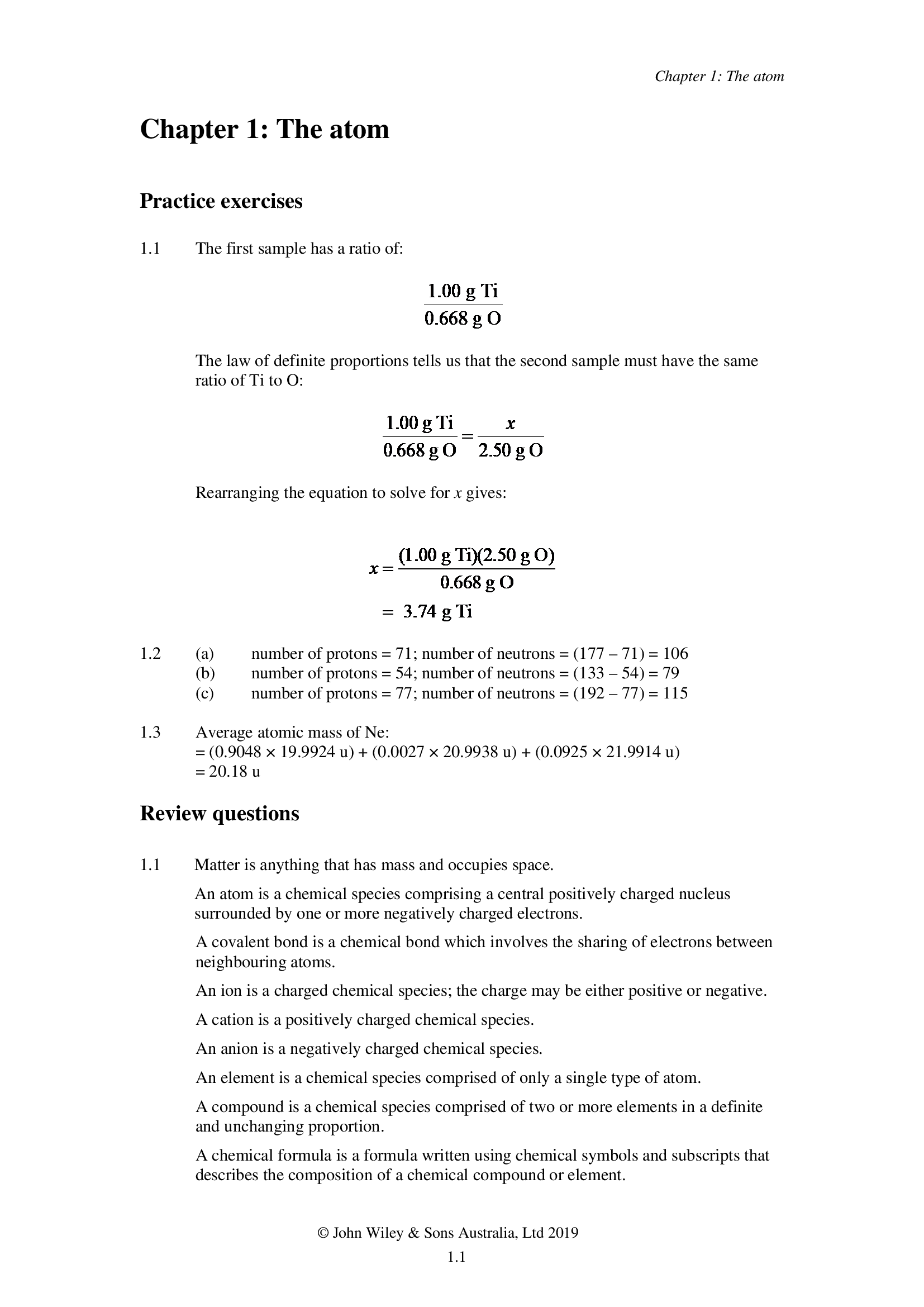
1.1 The first sample has a ratio of:

The law of definite proportions tells us that the second sample must have the same

ratio of Ti to O:

Rearranging the equation to solve for x gives:

1.2 (a) number of protons = 71; number of neutrons = (177 – 71) = 106

(b) number of protons = 54; number of neutrons = (133 – 54) = 79

(c) number of protons = 77; number of neutrons = (192 – 77) = 115

1.3 Average atomic mass of Ne:

= (0.9048 × 19.9924 u) + (0.0027 × 20.9938 u) + (0.0925 × 21.9914 u)

= 20.18 u

Review questions

1.1 Matter is anything that has mass and occupies space.

An atom is a chemical species comprising a central positively charged nucleus

surrounded by one or more negatively charged electrons.

A covalent bond is a chemical bond which involves the sharing of electrons between

neighbouring atoms.

An ion is a charged chemical species; the charge may be either positive or negative.

A cation is a positively charged chemical species.

An anion is a negatively charged chemical species.

An element is a chemical species comprised of only a single type of atom.

A compound is a chemical species comprised of two or more elements in a definite

and unchanging proportion.

A chemical formula is a formula written using chemical symbols and subscripts that

describes the composition of a chemical compound or element.

Solutions manual to accompany Chemistry 4e by Blackman et al

© John Wiley & Sons Australia, Ltd 2019

1.2

A reactant is a chemical species which is transformed in a chemical reaction.

A chemical reaction is a process whereby one or more chemical species is/are

transformed into different chemical species. This generally involves the making

and/or breaking of chemical bonds.

A product is the species formed in a chemical reaction.

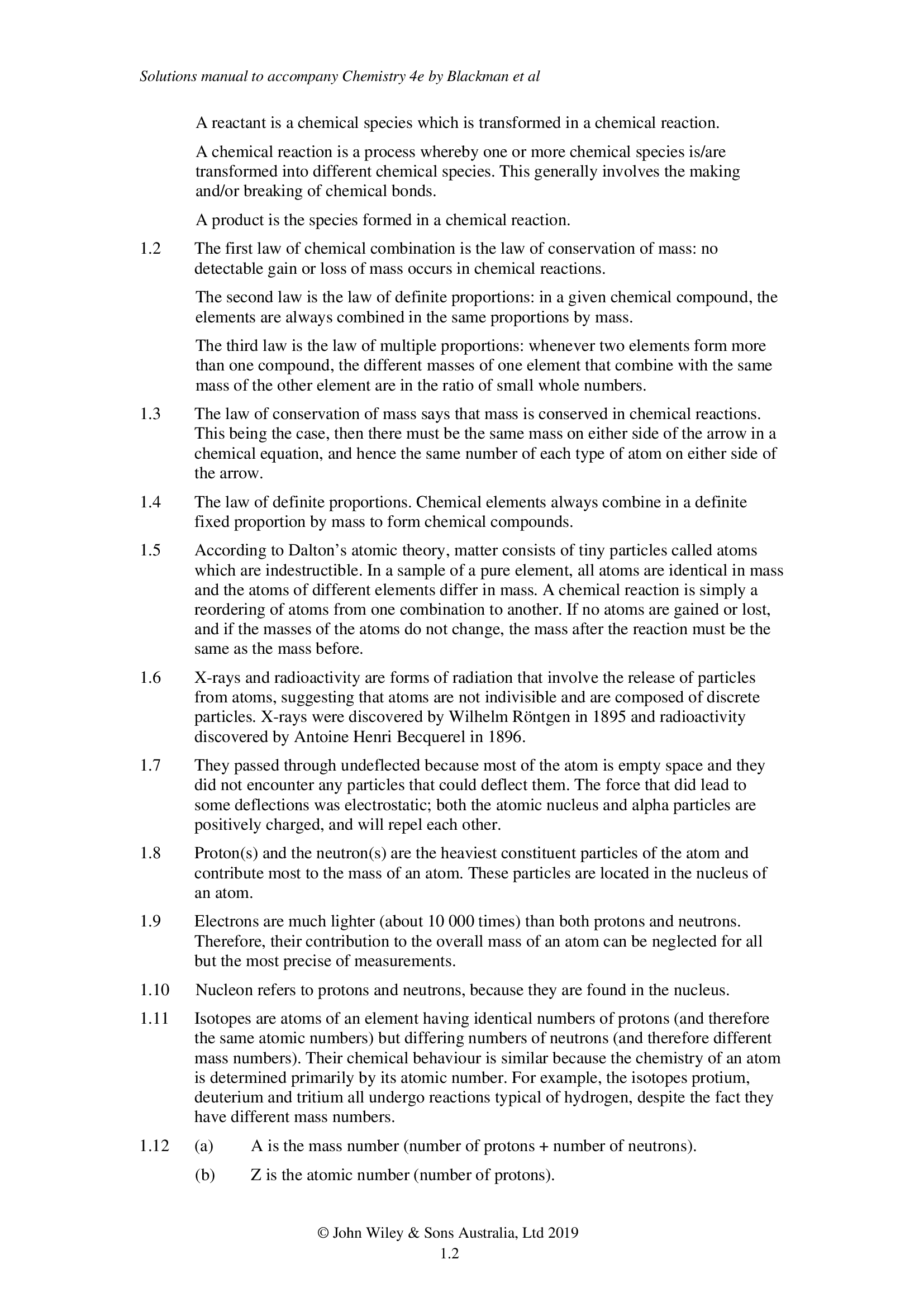
1.2 The first law of chemical combination is the law of conservation of mass: no

detectable gain or loss of mass occurs in chemical reactions.

The second law is the law of definite proportions: in a given chemical compound, the

elements are always combined in the same proportions by mass.

The third law is the law of multiple proportions: whenever two elements form more

than one compound, the different masses of one element that combine with the same

mass of the other element are in the ratio of small whole numbers.

1.3 The law of conservation of mass says that mass is conserved in chemical reactions.

This being the case, then there must be the same mass on either side of the arrow in a

chemical equation, and hence the same number of each type of atom on either side of

the arrow.

1.4 The law of definite proportions. Chemical elements always combine in a definite

fixed proportion by mass to form chemical compounds.

1.5 According to Dalton’s atomic theory, matter consists of tiny particles called atoms

which are indestructible. In a sample of a pure element, all atoms are identical in mass

and the atoms of different elements differ in mass. A chemical reaction is simply a

reordering of atoms from one combination to another. If no atoms are gained or lost,

and if the masses of the atoms do not change, the mass after the reaction must be the

same as the mass before.

1.6 X-rays and radioactivity are forms of radiation that involve the release of particles

from atoms, suggesting that atoms are not indivisible and are composed of discrete

particles. X-rays were discovered by Wilhelm Röntgen in 1895 and radioactivity

discovered by Antoine Henri Becquerel in 1896.

1.7 They passed through undeflected because most of the atom is empty space and they

did not encounter any particles that could deflect them. The force that did lead to

some deflections was electrostatic; both the atomic nucleus and alpha particles are

positively charged, and will repel each other.

1.8 Proton(s) and the neutron(s) are the heaviest constituent particles of the atom and

contribute most to the mass of an atom. These particles are located in the nucleus of

an atom.

1.9 Electrons are much lighter (about 10 000 times) than both protons and neutrons.

Therefore, their contribution to the overall mass of an atom can be neglected for all

but the most precise of measurements.

1.10 Nucleon refers to protons and neutrons, because they are found in the nucleus.

1.11 Isotopes are atoms of an element having identical numbers of protons (and therefore

the same atomic numbers) but differing numbers of neutrons (and therefore different

mass numbers). Their chemical behaviour is similar because the chemistry of an atom

is determined primarily by its atomic number. For example, the isotopes protium,

deuterium and tritium all undergo reactions typical of hydrogen, despite the fact they

have different mass numbers.

1.12 (a) A is the mass number (number of protons + number of neutrons).

(b) Z is the atomic number (number of protons).

Contact the Seller

Please Sign In to contact this seller.


  • 👎  Report Copyright Violation

Frequently Asked Questions

What Do I Get When I Buy This Study Material?

+

When you buy a study material on Passing Grades, an instant download link will be sent directly to your email, giving you access to the file anytime after payment is completed.

Is Passing Grades a Trusted Platform?

+

Yes, Passing Grades is a reputable students’ marketplace with a secure payment system and reliable customer support. You can trust us to ensure a safe and seamless transaction experience.

Will I Be Stuck with a Subscription?

+

No, all purchases on Passing Grades are one-time transactions. You only pay for the notes you choose to buy, with no subscriptions or hidden fees attached.

Who Am I Buying These Study Materials From?

+

Passing Grades is a marketplace, which means you are purchasing the document from an individual vendor, not directly from us. We facilitate the payment and delivery process between you and the vendor.

Does Passing Grades Offer Free Study Materials?

+

Yes, sellers on Passing Grades have uploaded numerous free test banks, exams, practice questions, and class notes that can be downloaded at no cost.


Pasinggrades - Quality Study Materials

USD 15

    • Quality checked by Pasing Grades
    • 100% satisfaction guarantee
    • Seller: Namwaki
Buy PDF $15

Seller Information

Namwaki

Member since April 2021

  • icon
  • icon
  • icon
View Profile
  • total sales

    1
  • Favourites

    0
  • Comments

    0
    ( 0 Ratings )

Item Information

  • Uploaded

    02 June 2024

  • Updated

    24 October 2025

  • Category

    General

  • Item Type

    exam

  • Tags

    Solution Manual For Chemistry 4th Edition By Blackman

Related Exam Prep Guides by Namwaki

Sophia Finance Milestone Final_Complete Questions and Answers 2021.
View Document

Sophia Finance Miles...

  • Namwaki

    Namwaki

  • exam

Sophia Finance Milestone Final_Complete Questions and Answers 2021...

15 USD

0

1

Medical Parasitology 7th Edition Leventhal Test Bank
View Document

Medical Parasitology...

  • Namwaki

    Namwaki

  • exam

Medical Parasitology 7th Edition Leventhal Test Bank...

15 USD

0

1

TEST- BANK FOR WONGS NURSING CARE OF INFANTS AND CHILDREN 11TH EDITION HOCKENBERRY
View Document

TEST- BANK FOR WONGS...

  • Namwaki

    Namwaki

  • exam

TEST- BANK FOR WONGS NURSING CARE OF INFANTS AND CHILDREN 11TH EDITION HOCKENBERRY – Download PDF...

15 USD

0

1

Purchase

Download link will be sent to this email immediately after purchase.

IMPORTANT LINKS

  • How To Upload Class Notes
  • Selling Tips
  • Passing Grades's Study Materials
  • Scholarships for International Students 2025

POPULAR CATEGORIES

  • Law
  • Accounting
  • English
  • Psychology
  • Business
  • Nursing
  • Computer Science
  • General

View Document

  • Blog
  • Contact
  • Delivery Policy
  • Latest Scholarships Around the World
  • How to Pass Bar Exams: Passing Grades’ Strategies
  • How to Study and Pass the CPA Exam
  • All Test Banks
  • Faq
  • Copyright Claims
  • Privacy Policy
  • Terms of Use

KNOWLEDGE BASE

  • How to Write A+ Grade Good Research Paper
  • How to Manage Stress During Exam Period
  • Best Time to Study
  • How to Pass NCLEX-RN Exam
  • How To Effectively Utilize Test Banks
  • Popular Shadow Health Exam Assessments
  • Popular HESI Case Studies
  • How to Prepare for a Nursing Career
  • The Importance Of Summaries in Exam Revisvion

© 2026 Pasing Grades. All rights reserved.