Pasing Grades
  • Start Selling
  • Blog
  • Contact
  • 0

    Your cart is empty!

English

  • English
  • Spanish
  • Arabic
Create Account Sign In
  • Library
    • New Prep Guides
    • Featured Prep Guides
    • Free Exam Prep Guides
    • Best sellers
  • General
  • Nursing
    • Research Paper
    • Case Study
    • Discussion Post
    • Assignment
    • Exam
    • Practice Questions and Answers
    • Test Bank
    • solutions manual
  • Accounting
    • Case Study
    • Thesis
    • Study Guide
    • Summary
    • Research Paper
    • test bank
  • English
    • Creative Writing
    • Research Paper
    • Summary
    • Rhetorics
    • Literature
    • Journal
    • Exam
    • Grammar
    • Discussion Post
    • Essay
  • Psychology
    • Hesi
    • Presentation
    • Essay
    • Summary
    • Study Guide
    • Essay
    • Solution Manual
    • Final Exam Review
    • Class Notes
    • test bank
  • Business
    • Lecture Notes
    • Solution Manual
    • Presentation
    • Business Plan
    • Class Notes
    • Experiment
    • Summary
    • Practice Questions
    • Study Guide
    • Case Study
    • test bank
    • Exam
  • More
    • Computer Science
    • Economics
    • Statistics
    • Engineering
    • Biology
    • Religious Studies
    • Physics
    • Chemistry
    • Mathematics
    • History
    • Sociology
    • Science
    • Philosophy
    • Law
  • Pages
    • About Us
    • Selling Tips
    • Delivery Policy
    • Faq
    • Privacy Policy
  • Flash Sale
  • Home
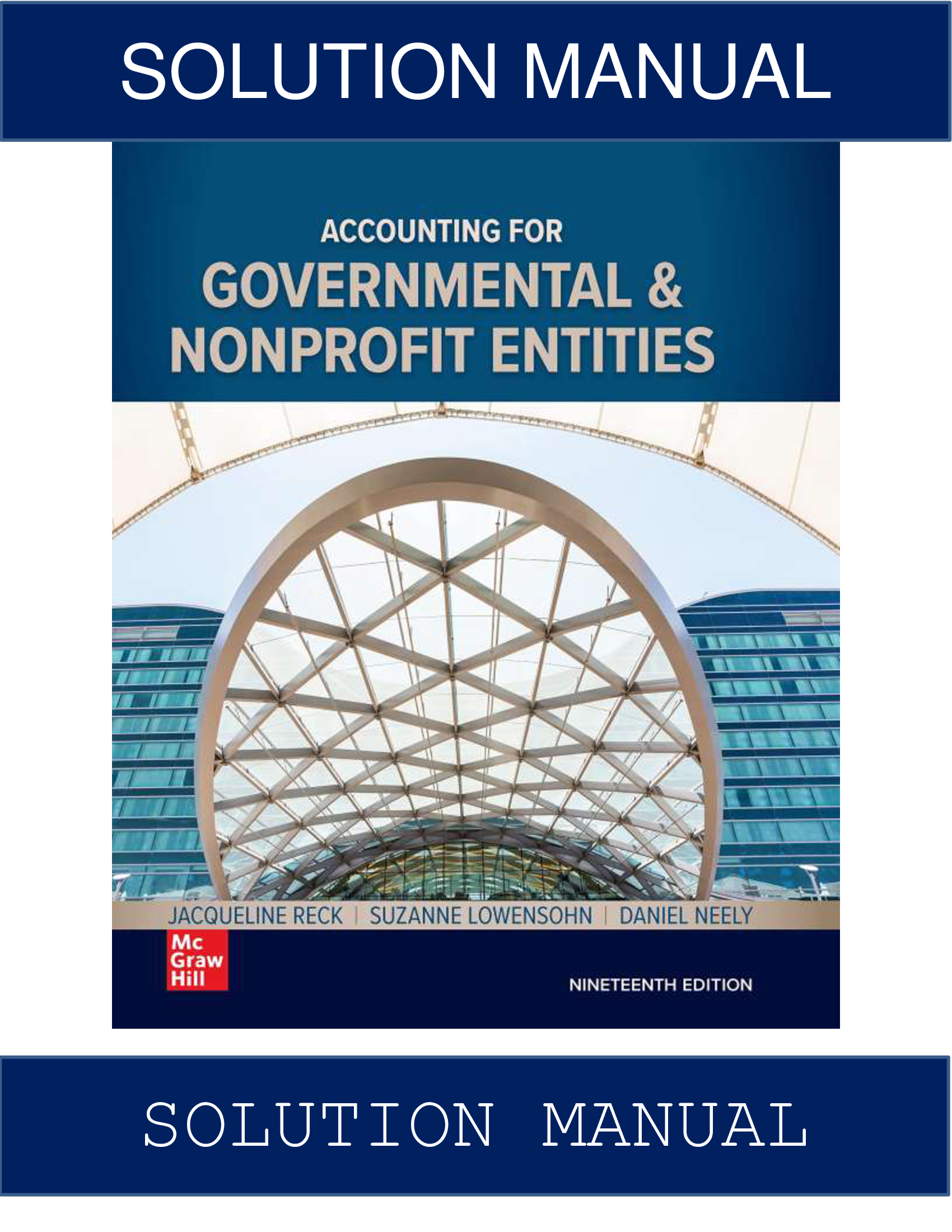
  • Solution Manual for Accounting for Governmental & Nonprofit Entities, 19th Edition, Jacqueline Reck, Suzanne Lowensohn Daniel Neely

Solution Manual for Accounting for Governmental & Nonprofit Entities, 19th Edition, Jacqueline Reck, Suzanne Lowensohn Daniel Neely

Preview page 1 Preview page 2 Preview page 3
Add To Favorites

Share this item Share this item

  • Item Details
  • Comments (0)
  • Reviews (0)
  • Contact Seller

Solution Manual for Accounting for Governmental & Nonprofit Entities

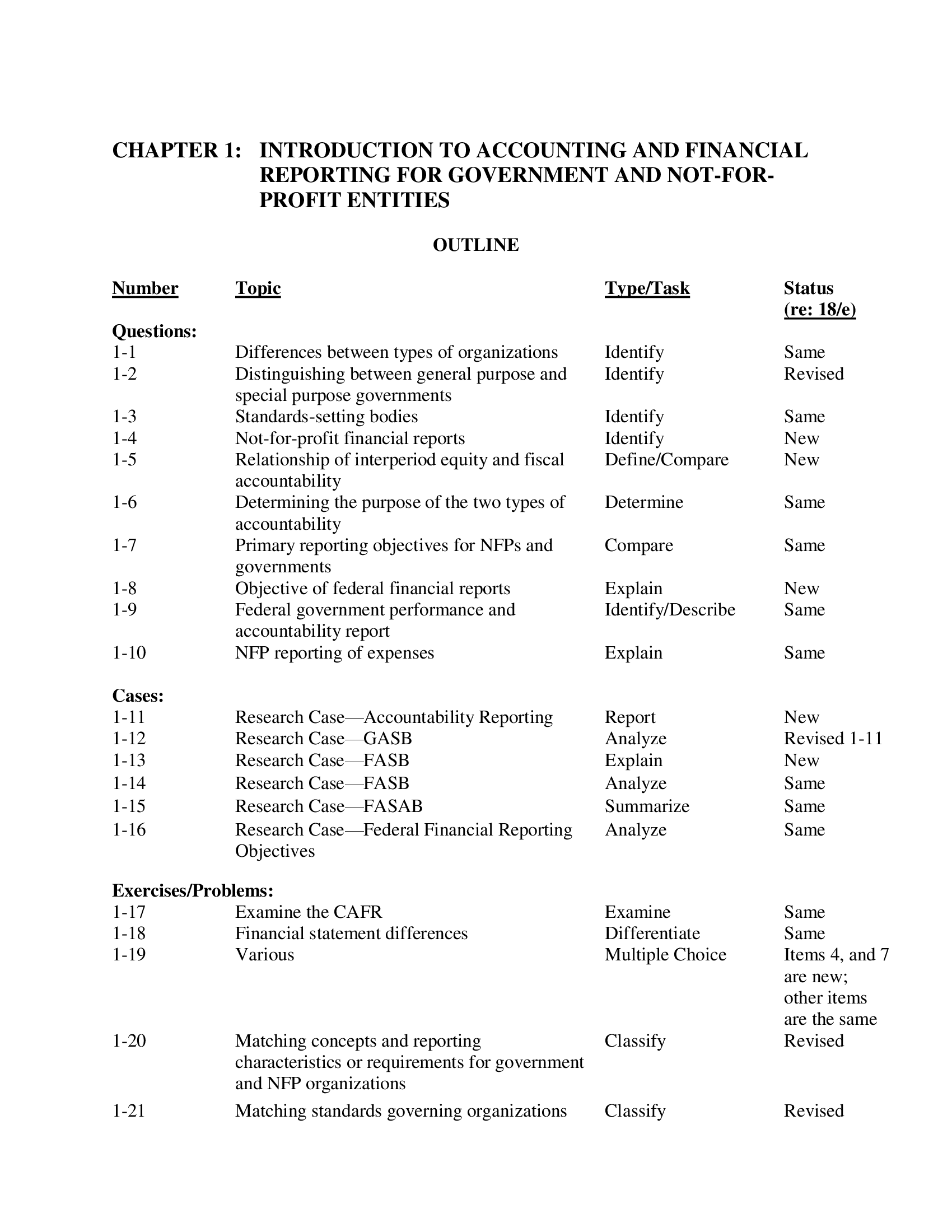
INTRODUCTION TO ACCOUNTING AND FINANCIAL: REPORTING FOR GOVERNMENT AND NOT-FORPROFIT ENTITIES


Answers to Questions


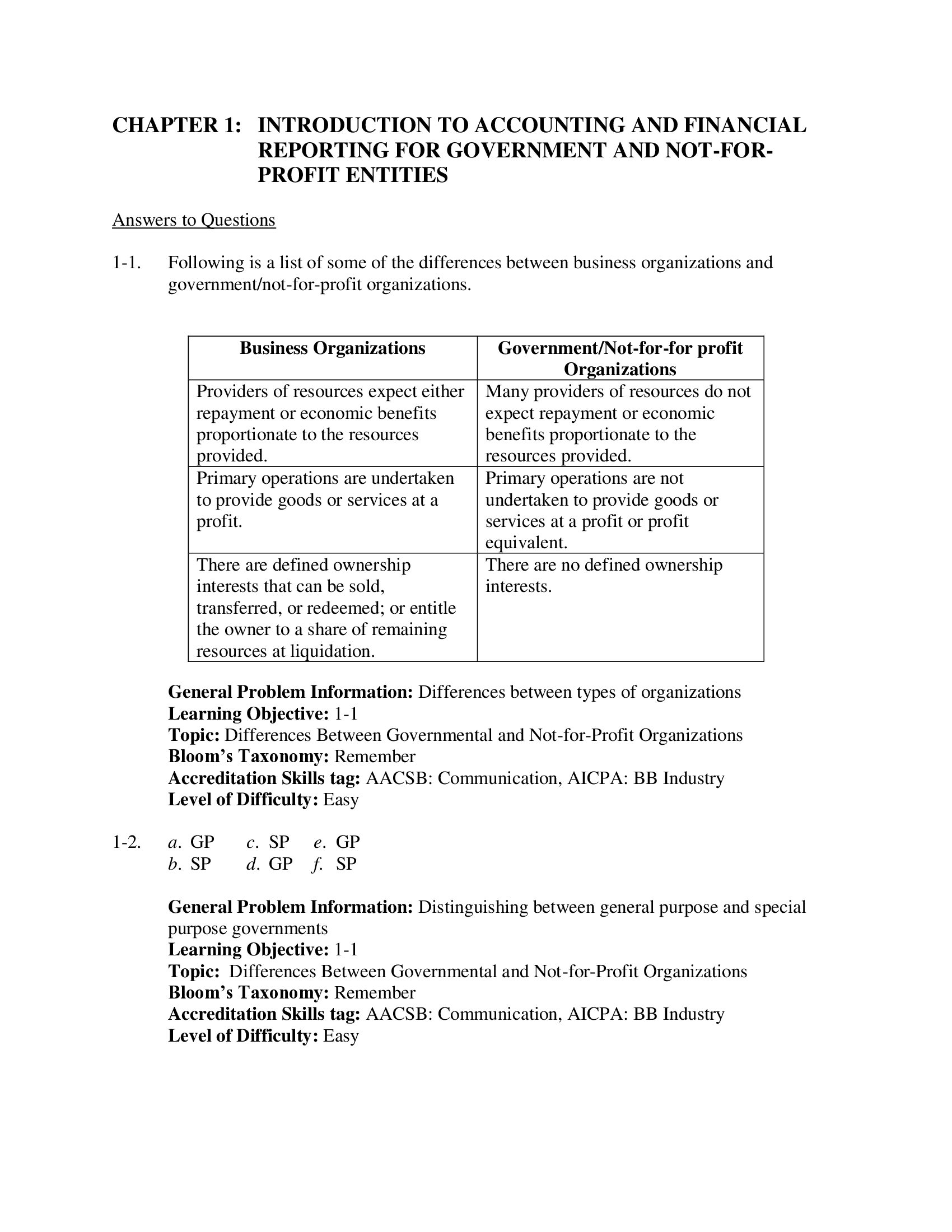
1-1.      Following is a list of some of the differences between business organizations and government/not-for-profit organizations.


Business Organizations Government/Not-for-for profit Organizations
Providers of resources expect either repayment or economic benefits proportionate to the resources provided. Many providers of resources do not expect repayment or economic benefits proportionate to the resources provided.
Primary operations are undertaken to provide goods or services at a profit. Primary operations are not undertaken to provide goods or services at a profit or profit equivalent.
There are defined ownership interests that can be sold, transferred, or redeemed; or entitle the owner to a share of remaining resources at liquidation. There are no defined ownership interests.


General Problem Information: Differences between types of organizations


Learning Objective: 1-1


Topic: Differences Between Governmental and Not-for-Profit Organizations


Bloom’s Taxonomy: Remember 


Accreditation Skills tag: AACSB: Communication, AICPA: BB Industry Level of Difficulty: Easy


1-2. a. GP   c. SP   e. GP  b. SP    d. GP  f. SP


General Problem Information: Distinguishing between general purpose and special purpose governments 


Learning Objective: 1-1


Topic:  Differences Between Governmental and Not-for-Profit Organizations


Bloom’s Taxonomy: Remember 


Accreditation Skills tag: AACSB: Communication, AICPA: BB Industry Level of Difficulty: Easy


1-3.      Illustration 1-1 shows the standard-setting jurisdiction of the FASB, GASB and FASAB. As shown, the FASB has responsibility for setting accounting and financial reporting standards for business entities and nongovernmental not-for-profit organizations. The GASB has responsibility for setting standards for state and local governments and government not-for-profit organizations. The FASAB has responsibility for setting accounting and reporting standards for the federal government and its agencies and departments.


General Problem Information: Standards-setting bodies


Learning Objective: 1-2


Topic: Sources of Financial Reporting Standards


Bloom’s Taxonomy: Remember 


Accreditation Skills tag: AACSB: Communication, AICPA: FN Reporting Level of Difficulty: Easy


1-4.      The required financial statements for a not-for-profit (NFP) organization applying the FASB standards are (1) Statement of financial position or a balance sheet, (2) Statement of activities, and (3) Statement of cash flows.


Although not a required statement, NFPs are also required to provide information on the relationship between functional expenses and natural expenses. The FASB allows NFPs to provide that information using a separate financial statement, a schedule in the notes, or displayed on the statement of activities.


General Problem Information: Financial reporting of not-for-profit organizations


Learning Objective: 1-6


Topic: Financial Reporting for Not-for-Profit Organizations


Bloom’s Taxonomy: Remember 


Accreditation Skills tag: AACSB: Communication, AICPA: FN Reporting Level of Difficulty: Easy


1-5.      Interperiod equity is whether current period revenues are sufficient to pay for current period services, and it is considered an important component of accountability. Failure to pay for current period services means that the financial burden is being passed to future year taxpayers who may not receive any benefit from the past services. Interperiod equity is closely related to fiscal accountability in that fiscal accountability is intended to help ensure that the government is raising and spending resources in compliance with laws and regulations, which would include the legally approved budget. Providing information on whether the government is meeting budgetary requirements helps in assessing whether the government is “living within its means” (achieving interperiod equity) during the current reporting period.  


Ch. 1, Answers, Question 1-5 (Cont’d)


General Problem Information: Relationship of interperiod equity and fiscal accountability 


Learning Objective: 1-3 


Learning Objective: 1-4 


Topic: Objectives of Financial Reporting; Financial Reporting of State and Local Governments Bloom’s Taxonomy: Analyze


Accreditation Skills tag: AACSB: Analytical Thinking, AICPA: BB Critical Thinking Level of Difficulty: Medium


1-6.      The purpose of operational accountability is to assess whether the government has used its resources efficiently and effectively in meeting its operating objectives. The purpose of fiscal accountability is to assess the short-term flow of current financial resources. Government-wide financial statements are primarily focused on providing information to assess operational accountability, while fund financial statements are focused on providing information to assess fiscal accountability.


General Problem Information: Determining the purpose of the two types of accountability


Learning Objective: 1-4


Topic: Financial Reporting of State and Local Governments


Bloom’s Taxonomy: Understand 


Accreditation Skills tag: AACSB: Communication, AICPA: FN Reporting Level of Difficulty: Easy


1-7.      The primary financial reporting objective for not-for-profit organizations is to provide decision-useful financial information to resource providers, such as donors, members, and creditors. The primary financial reporting objective for a government organization is accountability, but other objectives include providing useful information for economic, social, and political decisions. Thus, the reporting focus for the two types of organizations differs in that the not-for-profit organization financial reports are to focus on providing information that is useful in making decisions; while the government organization financial reports are to focus primarily on providing information that can be used to assess whether public resources were raised and used for their intended purposes. 


General Problem Information: Primary reporting objectives for NFPs and governments


Learning Objective: 1-3


Topic: Objectives of Financial Reporting


Bloom’s Taxonomy: Understand 


Accreditation Skills tag: AACSB: Communication, AICPA: FN Reporting Level of Difficulty: Medium


1-8.      The FASAB indicates that federal financial reports are to help meet the needs of both external and internal users. As such, financial reports are prepared to provide information that is useful in assessing accountability, efficiency, effectiveness and the results of providing and spending federal resources.


Ch. 1, Answers, Question 1-8 (Cont’d)


General Problem Information: Objective of federal financial reports  


Learning Objective: 1-5


Topic: Financial Reporting of the Federal Government


Bloom’s Taxonomy: Remember 


Accreditation Skills tag: AACSB: Communication, AICPA: FN Reporting Level of Difficulty: Easy


1-9.      The four sections of a federal agency’s performance and accountability report (PAR) are (1) an MD&A, which provides a brief overview of the entire PAR and describes the agency’s mission and performance goals, among other items; (2) the performance section, essentially consisting of the agency’s annual performance report (APR); (3) the basic financial statements, which are listed in this chapter; and (4) other accompanying information, such as information about the nation’s tax burden, the tax gap, challenges facing the agency’s management, and revenue foregone. 


General Problem Information: Federal government performance and accountability report


Learning Objective: 1-5


Topic: Financial Reporting of the Federal Government


Bloom’s Taxonomy: Remember 


Accreditation Skills tag: AACSB: Communication, AICPA: FN Reporting Level of Difficulty: Easy


1-10. Reporting program expenses separately from management and general expenses and fund-raising costs provides information to donors, members, and oversight bodies to assess the effectiveness of the organization in accomplishing its purpose. Most donors and members wish to have the funds they contribute used for the organizational purpose rather than supporting management costs or fund-raising expenses. This reporting is also necessary for oversight bodies, such as the Internal Revenue Service, to permit the continued existence of the organization as a not-for-profit.


General Problem Information: NFP reporting of expenses


Learning Objective: 1-6


Topic: Financial Reporting of Not-for-Profit Organizations (NFPs)


Bloom’s Taxonomy: Understand 


Accreditation Skills tag: AACSB: Communication, AICPA: FN Reporting Level of Difficulty: Medium 


Solutions to Cases


1-11. Instructors may want to note that answers for a are found under Impact, b under Datasets, and c will be determined by the student. As with all websites, the location of the answers may change. Accessing Open Government will provide students with insight into data sources that are becoming increasingly available to users of government data and information. 


Ch. 1, Solutions, Case 1-11 (Cont’d)


a.      Data.gov increases the transparency of government, making it more open and accountable to citizens, allowing data to have a greater impact. By making data available, data.gov increases accessibility and transparency of government information, allowing for more informed and increased public participation on government policy and issues.


b.      Data are available from states, cities, counties, foreign countries, and regions.


c.       There is a wide variety of data available from the different sites, with the amount of data available varying considerably by government.  Data can include information on finance, public safety, transportation, parks and recreation, health, demographics, economic development, enterprise activities (such as trash, recycling, etc.), among others.


General Problem Information: Research Case—Accountability reporting 


Learning Objective: 1-4


Topic: Financial Reporting of State and Local Governments


Bloom’s Taxonomy: Remember 


Accreditation Skills tag: AACSB: Technology, AICPA: BB Leveraging Technology Level of Difficulty: Easy


1-12. Instructors may wish to provide specific instructions for the format of the students' brief reports. Only some of the topics covered in the White Paper have been identified for this assignment. 


Major revenue sources – for-profits’ major revenue is generated from the goods or services provided in exchange transactions. As a result, the principle for recognizing revenue under the FASB standard is: “Recognize revenue to depict the transfer of promised goods or services to customers in an amount that reflects the consideration to which the entity expects to be entitled in exchange for those goods or services.” This is unlike governments that depend heavily on taxes or nonexchange revenues. Since  property taxes are nonexchange transactions, the same rules as are used for recognition of revenue by for-profit organizations cannot apply, in that there is frequently no transfer of promised goods or services. For this reason, the government will recognize and report tax revenue in the period that the costs of providing the services for which the taxes were levied are provided, generally defined as the revenues being measurable and available to pay for current period costs.


Ch. 1, Solutions, Case 1-12 (Cont’d)


Postemployment benefits: Although similar in several respects, postemployment benefit accounting and reporting for government differs due to the longevity of governments, the importance of information to policymakers and others on the cost of providing the benefits, and the need to address interperiod equity.


As a result of these different information needs, accounting for postemployment benefits for governments differs from the FASB standards in two key areas:


  • The discount rate used for determining the actuarial present value of postemployment benefits. The GASB allows the use of expected rate of return as the discount rate, provided the postemployment plan is projected to have enough resources to cover all projected benefit payments for current employees and retirees. If all or a portion of the projected benefit payments will not be covered (i.e., projected payments are greater than projected resources), the discount rate is to be adjusted to a municipal bond index rate for that period and beyond in which the projected resources are less than the projected payments. This differs from the FASB, which requires a discount rate that reflects the rate at which the postemployment benefits could be settled.
  • The effect of the benefit received by the employee for work provided is represented as a percentage of projected pay over the projected career of the employee. This differs from the FASB standard that bases the benefits formula on the assignment of benefits to units of service credits.


General Problem Information: Research Case—GASB Understanding why government reporting standards are different 


Learning Objective: 1-2


Topic: Differences Between Governmental and Not-for-Profit Organizations 


Bloom’s Taxonomy: Apply 


Accreditation Skills tag: AACSB: Communication, AICPA: FN Research Level of Difficulty: Hard


1-13. Instructors may wish to provide specific instructions for the format of the students’ brief reports. The objective of this case is to familiarize students with the FASB website and allow them to see how standards are ever changing and can differ between for-profit entities and NFPs. Following are the two updates related to intangible assets and collections.


2019-06-Intangibles-Goodwill and Other: Extending the Private Company Accounting


Alternatives on Goodwill and Certain Identifiable Intangible Assets to Not-for-Profit Entities


This update provides not-for-profit entities an alternative to the annual impairment testing of goodwill that is required of private companies. Under this alternative the not-for-profit is allowed to amortize goodwill. A not-for-profit entity should amortize goodwill on a straight-line basis over 10 years, or less than 10 years if the not-for-profit entity demonstrates that a shorter useful life is more appropriate. A not-for-profit entity that elects this accounting alternative is required to make an accounting policy election to test goodwill for impairment at either the entity level or the reporting unit level. A not-for-profit entity is required to test goodwill for 


Ch. 1, Solutions, Case 1-13 (Cont’d)


impairment when a triggering event occurs that indicates that the fair value of the entity (or a reporting unit) may be below its carrying amount. 


2019-03-Not-for-Profit Entities: Updating the Definition of Collections


The amendments in this update modify the definition of the term collections and require that a collection-holding entity disclose its policy for the use of proceeds when collection items are removed from a collection. If a collection-holding entity has a policy that allows proceeds from collection items removed from the collection to be used for direct care, it should disclose its definition of direct care. This modification to the definition aligns the definition with the American Alliance of Museums Code of Ethics for Museums definition.


General Problem Information: Research Case—FASB NFP reporting standards changes


Learning Objective: 1-6


Topic: Financial Reporting of Not-for-profit Organizations


Bloom’s Taxonomy: Summarize 


Accreditation Skills tag: AACSB: Communication, AICPA: FN Research


Level of Difficulty: Medium


1-14. Instructors may wish to provide specific instructions for their students’ brief reports. 


Unlike for-profit organizations, not-for-profit organizations do not have a profit indicator such as net income to help users in determining how to allocate their scarce resources.  For this reason, it is important that financial reports assist the users in determining not only that management has kept safe the assets of the organization, but that it has also efficiently and effectively used the assets to meet and grow the organization’s mission. In addition, effective stewardship means the management has complied with all legal and contractual responsibilities.


General Problem Information: Research Case—FASB NFP reporting objectives Learning Objective: 1-3


Topic: Objectives of Financial Reporting 


Bloom’s Taxonomy: Analyze 


Accreditation Skills tag: AACSB: Communication, AICPA: FN Research Level of Difficulty: Hard


1-15. Instructors may wish to provide specific instructions for their students’ brief reports. 


FASAB’s website may change over time, but the website does provide extensive information about the board’s mission, structure, and due process. A good source of information is the Memorandum of Understanding between the Comptroller General, Director of OMB, and the Secretary of the Treasury that created the FASAB, which currently is a 9-member board. Because FASAB’s technical projects and members of the Accounting and Auditing Policy Committee will change over time, students should describe the projects and committee representation that currently exist. 


Ch. 1, Solutions, Case 1-15 (Cont’d)


All statements and other pronouncements of the FASAB are contained in a compendium of all original pronouncements called Pronouncements as Amended and are available for downloading from its website at no charge. All due process documents are available at that site as well.


General Problem Information: Research Case—Understanding FASAB


Learning Objective: 1-2


Topic: Sources of Financial Reporting Standards


Bloom’s Taxonomy: Summarize 


Accreditation Skills tag: AACSB: Communication, AICPA: FN Research


Level of Difficulty: Medium


Contact the Seller

Please Sign In to contact this seller.


  • 👎  Report Copyright Violation

Frequently Asked Questions

What Do I Get When I Buy This Study Material?

+

When you buy a study material on Passing Grades, an instant download link will be sent directly to your email, giving you access to the file anytime after payment is completed.

Is Passing Grades a Trusted Platform?

+

Yes, Passing Grades is a reputable students’ marketplace with a secure payment system and reliable customer support. You can trust us to ensure a safe and seamless transaction experience.

Will I Be Stuck with a Subscription?

+

No, all purchases on Passing Grades are one-time transactions. You only pay for the notes you choose to buy, with no subscriptions or hidden fees attached.

Who Am I Buying These Study Materials From?

+

Passing Grades is a marketplace, which means you are purchasing the document from an individual vendor, not directly from us. We facilitate the payment and delivery process between you and the vendor.

Does Passing Grades Offer Free Study Materials?

+

Yes, sellers on Passing Grades have uploaded numerous free test banks, exams, practice questions, and class notes that can be downloaded at no cost.


Pasinggrades - Quality Study Materials

USD 15

    • Quality checked by Pasing Grades
    • 100% satisfaction guarantee
    • Seller: Opati-Kaka
Buy PDF $15

Seller Information

Opati-Kaka

Member since June 2021

  • icon
  • icon
View Profile
  • total sales

    0
  • Favourites

    0
  • Comments

    0
    ( 0 Ratings )

Item Information

  • Uploaded

    14 July 2025

  • Updated

    15 July 2025

  • Category

    Accounting

  • Item Type

    solution manual

  • Tags

    Solution Manual for Accounting for Governmental & Nonprofit Entities

Related Exam Prep Guides by Opati-Kaka

Temporal Bone: An Imaging Atlas Book by John I. Lane and Robert J. Witte
View Document

Temporal Bone: An Im...

  • Opati-Kaka

    Opati-Kaka

  • solution manual

Imaging of the temporal bone has recently been advanced with multidetector CT and high-field MR imag...

15 USD

0

0

Test Bank For Human Anatomy & Physiology Laboratory Manual, Making Connections, Cat Version, 2nd Edition By Catharine C. Whiting
View Document

Test Bank For Human ...

  • Opati-Kaka

    Opati-Kaka

  • solution manual

Test Bank For Human Anatomy & Physiology Laboratory Manual, Making Connections, Cat Version, 2nd Edi...

15 USD

0

0

Test Bank For Mastering Competencies in Family Therapy 3rd Edition by Gehart
View Document

Test Bank For Master...

  • Opati-Kaka

    Opati-Kaka

  • solution manual

Test Bank For Mastering Competencies in Family Therapy 3rd Edition by Gehart...

15 USD

0

0

Purchase

Download link will be sent to this email immediately after purchase.

IMPORTANT LINKS

  • How To Upload Class Notes
  • Selling Tips
  • Passing Grades's Study Materials
  • Scholarships for International Students 2025

POPULAR CATEGORIES

  • Law
  • Accounting
  • English
  • Psychology
  • Business
  • Nursing
  • Computer Science
  • General

View Document

  • Blog
  • Contact
  • Delivery Policy
  • Latest Scholarships Around the World
  • How to Pass Bar Exams: Passing Grades’ Strategies
  • How to Study and Pass the CPA Exam
  • All Test Banks
  • Faq
  • Copyright Claims
  • Privacy Policy
  • Terms of Use

KNOWLEDGE BASE

  • How to Write A+ Grade Good Research Paper
  • How to Manage Stress During Exam Period
  • Best Time to Study
  • How to Pass NCLEX-RN Exam
  • How To Effectively Utilize Test Banks
  • Popular Shadow Health Exam Assessments
  • Popular HESI Case Studies
  • How to Prepare for a Nursing Career
  • The Importance Of Summaries in Exam Revisvion

© 2026 Pasing Grades. All rights reserved.