Pasing Grades
  • Start Selling
  • Blog
  • Contact
  • 0

    Your cart is empty!

English

  • English
  • Spanish
  • Arabic
Create Account Sign In
  • Library
    • New Prep Guides
    • Featured Prep Guides
    • Free Exam Prep Guides
    • Best sellers
  • General
  • Nursing
    • Research Paper
    • Case Study
    • Discussion Post
    • Assignment
    • Exam
    • Practice Questions and Answers
    • Test Bank
    • solutions manual
  • Accounting
    • Case Study
    • Thesis
    • Study Guide
    • Summary
    • Research Paper
    • test bank
  • English
    • Creative Writing
    • Research Paper
    • Summary
    • Rhetorics
    • Literature
    • Journal
    • Exam
    • Grammar
    • Discussion Post
    • Essay
  • Psychology
    • Hesi
    • Presentation
    • Essay
    • Summary
    • Study Guide
    • Essay
    • Solution Manual
    • Final Exam Review
    • Class Notes
    • test bank
  • Business
    • Lecture Notes
    • Solution Manual
    • Presentation
    • Business Plan
    • Class Notes
    • Experiment
    • Summary
    • Practice Questions
    • Study Guide
    • Case Study
    • test bank
    • Exam
  • More
    • Computer Science
    • Economics
    • Statistics
    • Engineering
    • Biology
    • Religious Studies
    • Physics
    • Chemistry
    • Mathematics
    • History
    • Sociology
    • Science
    • Philosophy
    • Law
  • Pages
    • About Us
    • Selling Tips
    • Delivery Policy
    • Faq
    • Privacy Policy
  • Flash Sale
  • Home
  • Probability and Statistics for Engineers and Scientists 9th Edition Walpole Solutions Manual

Probability and Statistics for Engineers and Scientists 9th Edition Walpole Solutions Manual

Preview page 1 Preview page 2 Preview page 3
Add To Favorites

Share this item Share this item

  • Item Details
  • Comments (0)
  • Reviews (0)
  • Contact Seller
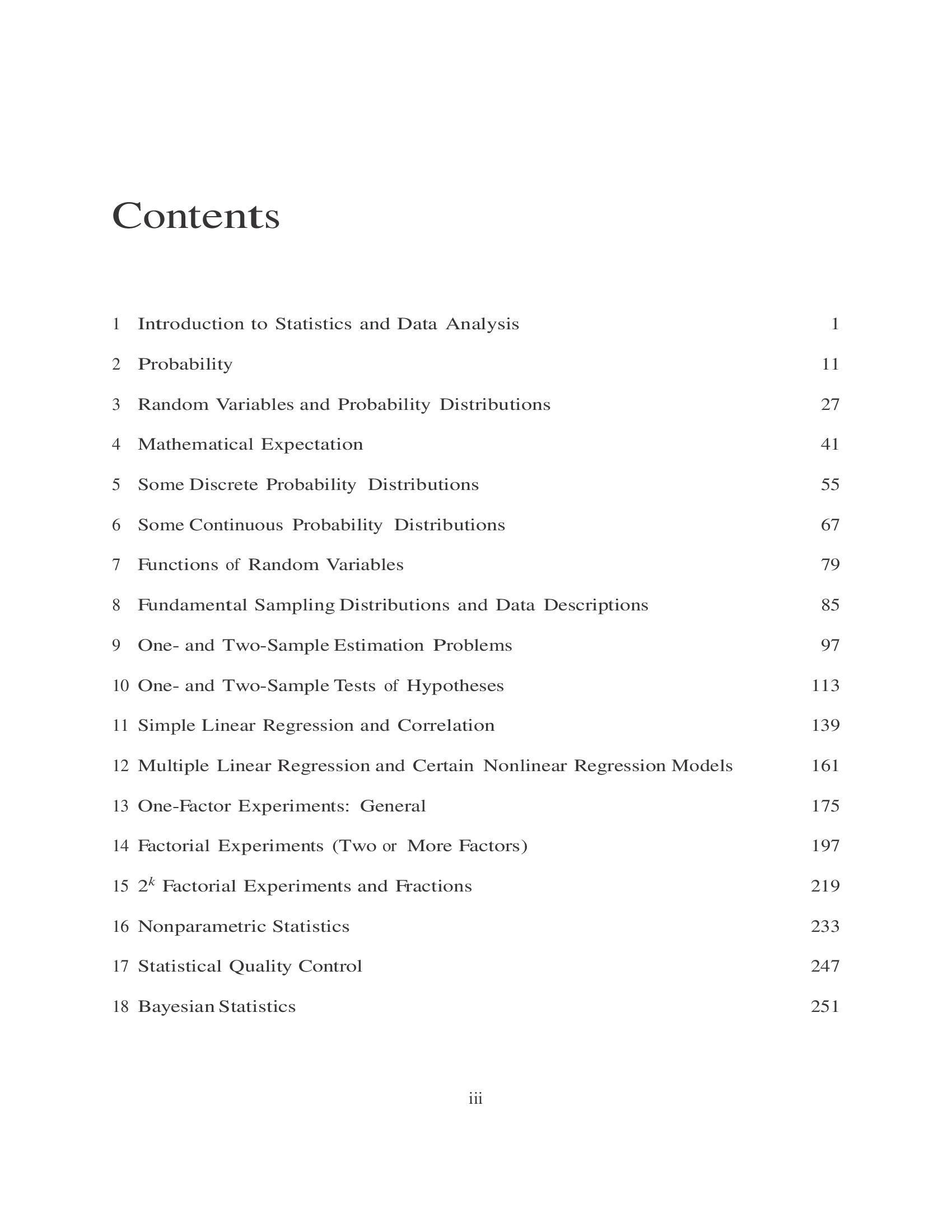
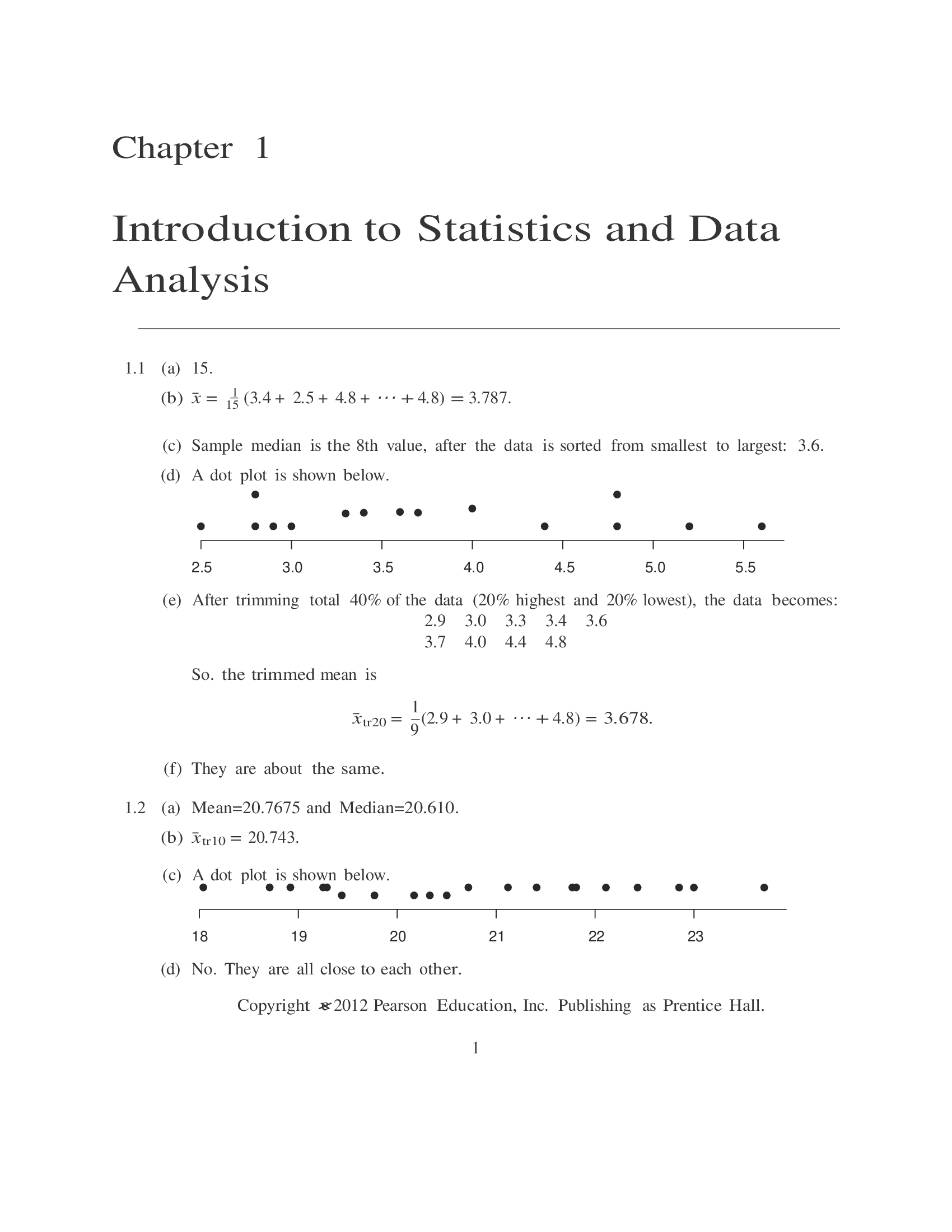
Probability and Statistics for Engineers and Scientists 9th Edition Walpole Solutions Manual PROBABILITY AND STATISTICS FOR ENGINEERS AND SCIENTISTS 9TH EDITION WALPOLE SOLUTIONS MANUAL Contents 1 Introduction to Statistics and Data Analysis 1 2 Probability 11 3 Random Variables and Probability Distributions 27 4 Mathematical Expectation 41 5 Some Discrete Probability Distributions 55 6 Some Continuous Probability Distributions 67 7 Functions of Random Variables 79 8 Fundamental Sampling Distributions and Data Descriptions 85 9 One- and Two-Sample Estimation Problems 97 10 One- and Two-Sample Tests of Hypotheses 113 11 Simple Linear Regression and Correlation 139 12 Multiple Linear Regression and Certain Nonlinear Regression Models 161 13 One-Factor Experiments: General 175 14 Factorial Experiments (Two or More Factors) 197 15 2 k Factorial Experiments and Fractions 219 16 Nonparametric Statistics 233 17 Statistical Quality Control 247 18 Bayesian Statistics 251 iii 15 Chapter 1 Introduction to Statistics and Data Analysis 1.1 (a) 15. (b) x¯ = 1 (3.4 + 2.5 + 4.8 + ··· + 4.8) = 3.787. (c) Sample median is the 8th value, after the data is sorted from smallest to largest: 3.6. (d) A dot plot is shown below. 2.5 3.0 3.5 4.0 4.5 5.0 5.5 (e) After trimming total 40% of the data (20% highest and 20% lowest), the data becomes: So. the trimmed mean is 2.9 3.0 3.3 3.4 3.6 3.7 4.0 4.4 4.8 1 x¯ tr20 = 9 (2.9 + 3.0 + ··· + 4.8) = 3.678. (f ) They are about the same. 1.2 (a) Mean=20.7675 and Median=20.610. (b) x¯ tr10 = 20.743. (c) A dot plot is shown below. 18 19 20 21 22 23 (d) No. They are all close to each other. Copyright × c 2012 Pearson Education, Inc. Publishing as Prentice Hall. 1 2 Chapter 1 Introduction to Statistics and Data Analysis 2 Solutions for Exercises in Chapter 1 15−1 1.3 (a) A dot plot is shown below. 200 205 210 215 220 225 230 In the figure, “×” represents the “No aging” group and “◦ ” represents the “Aging” group. (b) Yes; tensile strength is greatly reduced due to the aging process. (c) Mean Aging = 209.90, and Mean No aging = 222.10. (d) Median Aging = 210.00, and Median No aging = 221.50. The means and medians for each group are similar to each other. 1.4 (a) X ¯ A = 7.950 and X ˜ A = 8.250; X ¯ B = 10.260 and X ˜ B = 10.150. (b) A dot plot is shown below. 6.5 7.5 8.5 9.5 10.5 11.5 In the figure, “×” represents company A and “◦ ” represents company B. The steel rods made by company B show more flexibility. 1.5 (a) A dot plot is shown below. −10 0 10 20 30 40 (b) In the figure, “×” represents the control group and “◦ ” represents the treatment group. X ¯ Control = 5.60, X ˜ Control = 5.00, and X ¯ tr(10);Control = 5.13; X ¯ Treatment = 7.60, X ˜ Treatment = 4.50, and X ¯ tr(10);Treatment = 5.63. (c) The difference of the means is 2.0 and the differences of the medians and the trimmed means are 0.5, which are much smaller. The possible cause of this might be due to the extreme values (outliers) in the samples, especially the value of 37. 1.6 (a) A dot plot is shown below. (b) 1.95 2.05 2.15 2.25 2.35 2.45 2.55 In the figure, “×” represents the 20 ◦ C group and “◦ ” represents the 45 ◦ C group. X ¯ 20 ◦ C = 2.1075, and X ¯ 45 ◦ C = 2.2350. (c) Based on the plot, it seems that high temperature yields more high values of tensile strength, along with a few low values of tensile strength. Overall, the temperature does have an influence on the tensile strength. (d) It also seems that the variation of the tensile strength gets larger when the cure temper- ature is increased. 1.7 s 2 = 1 [(3.4 − 3.787) 2 + (2.5 − 3.787) 2 + (4.8 − 3.787) 2 + ··· + (4.8 − 3.787) 2 ] = 0.94284; s = √ s 2 = √ 0.9428 = 0.971. 3 Chapter 1 Introduction to Statistics and Data Analysis 3 Solutions for Exercises in Chapter 1 20−1 1.9 (a) s 10−1 A B Control 20 ◦ C 45 ◦ C 1.8 s 2 = 1 [(18.71 − 20.7675) 2 + (21.41 − 20.7675) 2 + ··· + (21.12 − 20.7675) 2 ] = 2.5329; s = √ 2.5345 = 1.5915. 2 No Aging = 1 [(227 − 222.10) 2 + (222 − 222.10) 2 + ··· + (221 − 222.10) 2 ] = 23.66; s No Aging = √ 23.62 = 4.86. s 2 1 2 2 2 Aging = 10−1 [(219 − 209.90) s Aging = √ 42.12 = 6.49. + (214 − 209.90) + ··· + (205 − 209.90) ] = 42.10; (b) Based on the numbers in (a), the variation in “Aging” is smaller that the variation in “No Aging” although the difference is not so apparent in the plot. 1.10 For company A: s 2 For company B: s 2 = 1.2078 and s A = √ 1.2072 = 1.099. = 0.3249 and s B = √ 0.3249 = 0.570. 1.11 For the control group: s 2 For the treatment group: s 2 = 69.38 and s Control = 8.33. = 128.04 and s Treatment = 11.32. Treatment 1.12 For the cure temperature at 20 ◦ C: s 2 For the cure temperature at 45 ◦ C: s 2 = 0.005 and s 20 ◦ C = 0.071. = 0.0413 and s 45 ◦ C = 0.2032. The variation of the tensile strength is influenced by the increase of cure temperature. 1.13 (a) Mean = X ¯ = 124.3 and median = X ˜ = 120; (b) 175 is an extreme observation. 1.14 (a) Mean = X ¯ = 570.5 and median = X ˜ = 571; (b) Variance = s 2 = 10; standard deviation= s = 3.162; range=10; (c) Variation of the diameters seems too big so the quality is questionable. 1.15 Yes. The value 0.03125 is actually a P -value and a small value of this quantity means that the outcome (i.e., HHHHH ) is very unlikely to happen with a fair coin. 1.16 The term on the left side can be manipulated to n n n x i − nx¯ = x i − x i = 0, i=1 which is the term on the right side. i=1 i=1 1.17 (a) X ¯ smokers = 43.70 and X ¯ nonsmokers = 30.32; (b) s smokers = 16.93 and s nonsmokers = 7.13; (c) A dot plot is shown below. 10 20 30 40 50 60 70 4 Chapter 1 Introduction to Statistics and Data Analysis 4 Solutions for Exercises in Chapter 1 In the figure, “×” represents the nonsmoker group and “◦ ” represents the smoker group. (d) Smokers appear to take longer time to fall asleep and the time to fall asleep for smoker group is more variable. 1.18 (a) A stem-and-leaf plot is shown below. 5 Chapter 1 Introduction to Statistics and Data Analysis 5 Solutions for Exercises in Chapter 1 Relative Frequency Stem Leaf Frequency 1 057 3 2 35 2 3 246 3 4 1138 4 5 22457 5 6 00123445779 11 7 01244456678899 14 8 00011223445589 14 9 0258 4 (b) The following is the relative frequency distribution table. Relative Frequency Distribution of Grades Class Interval Class Midpoint Frequency, f Relative Frequency 10 − 19 20 − 29 30 − 39 40 − 49 50 − 59 60 − 69 70 − 79 80 − 89 90 − 99 14.5 24.5 34.5 44.5 54.5 64.5 74.5 84.5 94.5 3 2 3 4 5 11 14 14 4 0.05 0.03 0.05 0.07 0.08 0.18 0.23 0.23 0.07 (c) A histogram plot is given below. (d) 14.5 24.5 34.5 44.5 54.5 64.5 74.5 84.5 94.5 Final Exam Grades The distribution skews to the left. X ¯ = 65.48, X ˜ = 71.50 and s = 21.13. 1.19 (a) A stem-and-leaf plot is shown below. Stem Leaf Frequency 0 22233457 8 1 023558 6 2 035 3 3 03 2 4 057 3 5 0569 4 6 Chapter 1 Introduction to Statistics and Data Analysis 6 Solutions for Exercises in Chapter 1 6 0005 4 7 Chapter 1 Introduction to Statistics and Data Analysis 7 Solutions for Exercises in Chapter 1 Relative Frequency (b) The following is the relative frequency distribution table. Relative Frequency Distribution of Years Class Interval Class Midpoint Frequency, f Relative Frequency 0.0 − 0.9 1.0 − 1.9 2.0 − 2.9 3.0 − 3.9 4.0 − 4.9 5.0 − 5.9 6.0 − 6.9 0.45 1.45 2.45 3.45 4.45 5.45 6.45 8 6 3 2 3 4 4 0.267 0.200 0.100 0.067 0.100 0.133 0.133 (c) X ¯ = 2.797, s = 2.227 and Sample range is 6.5 − 0.2 = 6.3. 1.20 (a) A stem-and-leaf plot is shown next. Stem Leaf Frequency 0* 34 2 0 56667777777889999 17 1* 0000001223333344 16 1 5566788899 10 2* 034 3 2 7 1 3* 2 1 (b) The relative frequency distribution table is shown next. Relative Frequency Distribution of Fruit Fly Lives Class Interval Class Midpoint Frequency, f Relative Frequency 0 − 4 5 − 9 10 − 14 15 − 19 20 − 24 25 − 29 30 − 34 2 7 12 17 22 27 32 2 17 16 10 3 1 1 0.04 0.34 0.32 0.20 0.06 0.02 0.02 (c) A histogram plot is shown next. 2 7 12 17 22 27 32 Fruit fly lives (seconds) 8 Chapter 1 Introduction to Statistics and Data Analysis 8 Solutions for Exercises in Chapter 1 (d) X ˜ = 10.50. 9 Chapter 1 Introduction to Statistics and Data Analysis 9 Solutions for Exercises in Chapter 1 Relative Frequency 1.21 (a) X ¯ = 74.02 and X ˜ = 78; (b) s = 39.26. 1.22 (a) X ¯ = 6.7261 and X ˜ = 0.0536. (b) A histogram plot is shown next. 6.62 6.66 6.7 6.74 6.78 6.82 Relative Frequency Histogram for Diameter (c) The data appear to be skewed to the left. 1.23 (a) A dot plot is shown next. 160.15 395.10 (b) 0 100 200 300 400 500 600 700 800 900 1000 X ¯ 1980 = 395.1 and X ¯ 1990 = 160.2. (c) The sample mean for 1980 is over twice as large as that of 1990. The variability for 1990 decreased also as seen by looking at the picture in (a). The gap represents an increase of over 400 ppm. It appears from the data that hydrocarbon emissions decreased considerably between 1980 and 1990 and that the extreme large emission (over 500 ppm) were no longer in evidence. 1.24 (a) X ¯ = 2.8973 and s = 0.5415. (b) A histogram plot is shown next. 1.8 2.1 2.4 2.7 3 3.3 3.6 3.9 Salaries 7 Solutions for Exercises in Chapter 1 7 Chapter 1 Introduction to Statistics and Data Analysis wear Relative Frequency 250 300 350 (c) Use the double-stem-and-leaf plot, we have the following. Stem Leaf Frequency 1 (84) 1 2* (05)(10)(14)(37)(44)(45) 6 2 (52)(52)(67)(68)(71)(75)(77)(83)(89)(91)(99) 11 3* (10)(13)(14)(22)(36)(37) 6 3 (51)(54)(57)(71)(79)(85) 6 1.25 (a) (b) X ¯ = 33.31; X ˜ = 26.35; (c) A histogram plot is shown next. (d) 10 20 30 40 50 60 70 80 90 Percentage of the families X ¯ tr(10) = 30.97. This trimmed mean is in the middle of the mean and median using the full amount of data. Due to the skewness of the data to the right (see plot in (c)), it is common to use trimmed data to have a more robust result. 1.26 If a model using the function of percent of families to predict staff salaries, it is likely that the model would be wrong due to several extreme values of the data. Actually if a scatter plot of these two data sets is made, it is easy to see that some outlier would influence the trend. 1.27 (a) The averages of the wear are plotted here. 700 800 900 1000 1100 1200 1300 load 8 Solutions for Exercises in Chapter 1 8 Chapter 1 Introduction to Statistics and Data Analysis (b) When the load value increases, the wear value also increases. It does show certain relationship. 9 Solutions for Exercises in Chapter 1 9 Chapter 1 Introduction to Statistics and Data Analysis 2.0 2.5 3.0 3.5 wear 100 300 500 700 (c) A plot of wears is shown next. 700 800 900 1000 1100 1200 1300 load (d) The relationship between load and wear in (c) is not as strong as the case in (a), especially for the load at 1300. One reason is that there is an extreme value (750) which influence the mean value at the load 1300. 1.28 (a) A dot plot is shown next. High Low 71.45 71.65 71.85 72.05 72.25 72.45 72.65 72.85 73.05 In the figure, “×” represents the low-injection-velocity group and “◦ ” represents the high-injection-velocity group. (b) It appears that shrinkage values for the low-injection-velocity group is higher than those for the high-injection-velocity group. Also, the variation of the shrinkage is a little larger for the low injection velocity than that for the high injection velocity. 1.29 A box plot is shown next. Solutions for Exercises in Chapter 1 1 0 Chapter 1 Introduction to Statistics and Data Analysis 700 800 900 1000 1100 1200 1300 1.30 A box plot plot is shown next. 1.31 (a) A dot plot is shown next. Low High 76 79 82 85 88 91 94 In the figure, “×” represents the low-injection-velocity group and “◦ ” represents the high-injection-velocity group. (b) In this time, the shrinkage values are much higher for the high-injection-velocity group than those for the low-injection-velocity group. Also, the variation for the former group is much higher as well. (c) Since the shrinkage effects change in different direction between low mode temperature and high mold temperature, the apparent interactions between the mold temperature and injection velocity are significant. 1.32 An interaction plot is shown next. mean shrinkage value high mold temp low mold temp Low high injection velocity It is quite obvious to find the interaction between the two variables. Since in this experimental data, those two variables can be controlled each at two levels, the interaction can be inves- 1 0 Solutions for Exercises in Chapter 1 1 1 Chapter 1 Introduction to Statistics and Data Analysis tigated. However, if the data are from an observational studies, in which the variable values cannot be controlled, it would be difficult to study the interactions among these variables. 1 1 Chapter 2 Probability 2.1 (a) S = {8, 16, 24, 32, 40, 48}. (b) For x 2 + 4x − 5 = (x + 5)(x − 1) = 0, the only solutions are x = −5 and x = 1. S = {−5, 1}. (c) S = {T, HT, HHT, H HH }. (d) S = {N. America, S. America, Europe, Asia, Africa, Australia, Antarctica}. (e) Solving 2x − 4 ≥ 0 gives x ≥ 2. Since we must also have x < 1, it follows that S = φ. 2.2 S = {(x, y) | x 2 + y 2 < 9; x ≥ 0, y ≥ 0}. 2.3 (a) A = {1, 3}. (b) B = {1, 2, 3, 4, 5, 6}. (c) C = {x | x 2 − 4x + 3 = 0} = {x | (x − 1)(x − 3) = 0} = {1, 3}. (d) D = {0, 1, 2, 3, 4, 5, 6}. Clearly, A = C . 2.4 (a) S = {(1, 1), (1, 2), (1, 3), (1, 4), (1, 5), (1, 6), (2, 1), (2, 2), (2, 3), (2, 4), (2, 5), (2, 6), (3, 1), (3, 2), (3, 3), (3, 4), (3, 5), (3, 6), (4, 1), (4, 2), (4, 3), (4, 4), (4, 5), (4, 6), (5, 1), (5, 2), (5, 3), (5, 4), (5, 5), (5, 6), (6, 1), (6, 2), (6, 3), (6, 4), (6, 5), (6, 6)}. (b) S = {(x, y) | 1 ≤ x, y ≤ 6}. 2.5 S = {1HH, 1HT, 1T H, 1T T , 2H, 2T, 3HH, 3HT, 3T H, 3T T , 4H, 4T, 5HH, 5HT, 5T H, 5T T , 6H, 6T }. 2.6 S = {A 1 A 2 , A 1 A 3 , A 1 A 4 , A 2 A 3 , A 2 A 4 , A 3 A 4 }. 2.7 S 1 = {MMMM, MMMF, MMF M, MF MM, F MMM, MMF F, MF MF, M F F M, FM FM, F FM M, FM M F, M FF F, F M F F, FFM F, FFFM, F FFF }. S 2 = {0, 1, 2, 3, 4}. 2.8 (a) A = {(3, 6), (4, 5), (4, 6), (5, 4), (5, 5), (5, 6), (6, 3), (6, 4), (6, 5), (6, 6)}. (b) B = {(1, 2), (2, 2), (3, 2), (4, 2), (5, 2), (6, 2), (2, 1), (2, 3), (2, 4), (2, 5), (2, 6)}. Copyright × c 2012 Pearson Education, Inc. Publishing as Prentice Hall. 11 12 Chapter 2 Probability 12 Solutions for Exercises in Chapter 2 (c) C = {(5, 1), (5, 2), (5, 3), (5, 4), (5, 5), (5, 6), (6, 1), (6, 2), (6, 3), (6, 4), (6, 5), (6, 6)}. (d) A ∩ C = {(5, 4), (5, 5), (5, 6), (6, 3), (6, 4), (6, 5), (6, 6)}. (e) A ∩ B = φ. (f ) B ∩ C = {(5, 2), (6, 2)}. (g) A Venn diagram is shown next. S A A ∩ C B B ∩ C C 2.9 (a) A = {1HH, 1HT, 1T H, 1T T , 2H, 2T }. (b) B = {1T T , 3T T , 5T T }. (c) A = {3HH, 3HT, 3T H, 3T T , 4H, 4T, 5HH, 5HT, 5T H, 5T T , 6H, 6T }. (d) A ∩ B = {3T T , 5T T }. (e) A ∪ B = {1HH, 1HT, 1T H, 1T T , 2H, 2T, 3T T , 5T T }. 2.10 (a) S = {F F F, F F N, F NF, N F F, F NN, N F N, NNF, NNN }. (b) E = {FF F, FFN, F N F, N FF }. (c) The second river was safe for fishing. 2.11 (a) S = {M 1 M 2 , M 1 F 1 , M 1 F 2 , M 2 M 1 , M 2 F 1 , M 2 F 2 , F 1 M 1 , F 1 M 2 , F Copyright × c 2012 Pearson Education, Inc. Publishing as Prentice Hall. Copyright × c 2012 Pearson Education, Inc. Publishing as Prentice Hall. 1 F 2 , F 2 M 1 , F 2 M 2 , F 2 F 1 }. (b) A = {M 1 M 2 , M 1 F 1 , M 1 F 2 , M 2 M 1 , M 2 F 1 , M 2 F 2 }. (c) B = {M 1 F 1 , M 1 F 2 , M 2 F 1 , M 2 F 2 , F 1 M 1 , F 1 M 2 , F 2 M 1 , F 2 M 2 }. (d) C = {F 1 F 2 , F 2 F 1 }. (e) A ∩ B = {M 1 F 1 , M 1 F 2 , M 2 F 1 , M 2 F 2 }. (f ) A ∪ C = {M 1 M 2 , M 1 F 1 , M 1 F 2 , M 2 M 1 , M 2 F 1 , M 2 F 2 , F 1 F 2 , F 2 F 1 }. S A A ∩B C B 13 Chapter 2 Probability 13 Solutions for Exercises in Chapter 2 (g) Copyright × c 2012 Pearson Education, Inc. Publishing as Prentice Hall. Copyright × c 2012 Pearson Education, Inc. Publishing as Prentice Hall. 14 Chapter 2 Probability 14 Solutions for Exercises in Chapter 2 2.12 (a) S = {Z Y F, Z N F, W Y F, W N F, SY F, SN F, Z Y M }. (b) A ∪ B = {Z Y F, Z N F, W Y F, W N F, SY F, SN F } = A. (c) A ∩ B = {WY F, SY F }. 2.13 A Venn diagram is shown next. Sample Space P S F 2.14 (a) A ∪ C = {0, 2, 3, 4, 5, 6, 8}. (b) A ∩ B = φ. (c) C = {0, 1, 6, 7, 8, 9}. (d) C ∩ D = {1, 6, 7}, so (C ∩ D) ∪ B = {1, 3, 5, 6, 7, 9}. (e) (S ∩ C ) = C = {0, 1, 6, 7, 8, 9}. (f ) A ∩ C = {2, 4}, so A ∩ C ∩ D = {2, 4}. 2.15 (a) A = {nitrogen, potassium, uranium, oxygen}. (b) A ∪ C = {copper, sodium, zinc, oxygen}. (c) A ∩ B = {copper, zinc} and C = {copper, sodium, nitrogen, potassium, uranium, zinc}; so (A ∩ B ) ∪ C = {copper, sodium, nitrogen, potassium, uranium, zinc}. (d) B ∩ C = {copper, uranium, zinc}. (e) A ∩ B ∩ C = φ. (f ) A ∪ B = {copper, nitrogen, potassium, uranium, oxygen, zinc} and A ∩ C = {oxygen}; so, (A ∪ B ) ∩ (A ∩ C ) = {oxygen}. 2.16 (a) M ∪ N = {x | 0 < x < 9}. (b) M ∩ N = {x | 1 < x < 5}. (c) M ∩ N = {x | 9 < x < 12}. Copyright × c 2012 Pearson Education, Inc. Publishing as Prentice Hall. Copyright × c 2012 Pearson Education, Inc. Publishing as Prentice Hall. 15 Chapter 2 Probability 15 Solutions for Exercises in Chapter 2 2.17 A Venn diagram is shown next. Copyright × c 2012 Pearson Education, Inc. Publishing as Prentice Hall. Copyright × c 2012 Pearson Education, Inc. Publishing as Prentice Hall. 16 Chapter 2 Probability 16 Solutions for Exercises in Chapter 2 8 S A B 1 2 3 4 (a) From the above Venn diagram, (A ∩ B) contains the regions of 1, 2 and 4. (b) (A ∪ B) contains region 1. (c) A Venn diagram is shown next. S 1 4 B A 5 2 7 3 C 6 (A ∩ C ) ∪ B contains the regions of 3, 4, 5, 7 and 8. 2.18 (a) Not mutually exclusive. (b) Mutually exclusive. (c) Not mutually exclusive. (d) Mutually exclusive. 2.19 (a) The family will experience mechanical problems but will receive no ticket for traffic violation and will not arrive at a campsite that has no vacancies. (b) The family will receive a traffic ticket and arrive at a campsite that has no vacancies but will not experience mechanical problems. (c) The family will experience mechanical problems and will arrive at a campsite that has no vacancies. (d) The family will receive a traffic ticket but will not arrive at a campsite that has no vacancies. (e) The family will not experience mechanical problems. 2.20 (a) 6; (b) 2; (c) 2, 5, 6; (d) 4, 5, 7, 8. Copyright × c 2012 Pearson Education, Inc. Publishing as Prentice Hall. Copyright × c 2012 Pearson Education, Inc. Publishing as Prentice Hall. 17 Chapter 2 Probability 17 Solutions for Exercises in Chapter 2 2.21 With n 1 = 6 sightseeing tours each available on n 2 = 3 different days, the multiplication rule gives n 1 n 2 = (6)(3) = 18 ways for a person to arrange a tour. Copyright × c 2012 Pearson Education, Inc. Publishing as Prentice Hall. Copyright × c 2012 Pearson Education, Inc. Publishing as Prentice Hall. 18 Chapter 2 Probability 18 Solutions for Exercises in Chapter 2 5 3 2.22 With n 1 = 8 blood types and n 2 = 3 classifications of blood pressure, the multiplication rule gives n 1 n 2 = (8)(3) = 24 classifications. 2.23 Since the die can land in n 1 = 6 ways and a letter can be selected in n Copyright × c 2012 Pearson Education, Inc. Publishing as Prentice Hall. Copyright × c 2012 Pearson Education, Inc. Publishing as Prentice Hall. 2 = 26 ways, the multiplication rule gives n 1 n 2 = (6)(26) = 156 points in S. 2.24 Since a student may be classified according to n 1 = 4 class standing and n 2 = 2 gender classifications, the multiplication rule gives n 1 n 2 = (4)(2) = 8 possible classifications for the students. 2.25 With n 1 = 5 different shoe styles in n 2 = 4 different colors, the multiplication rule gives n 1 n 2 = (5)(4) = 20 different pairs of shoes. 2.26 Using Theorem 2.8, we obtain the followings. (a) There are 7 = 21 ways. (b) There are 5 = 10 ways. 2.27 Using the generalized multiplication rule, there are n 1 × n 2 × n 3 × n 4 = (4)(3)(2)(2) = 48 different house plans available. 2.28 With n 1 = 5 different manufacturers, n 2 = 3 different preparations, and n 3 = 2 different strengths, the generalized multiplication rule yields n 1 n 2 n 3 = (5)(3)(2) = 30 different ways to prescribe a drug for asthma. 2.29 With n 1 = 3 race cars, n 2 = 5 brands of gasoline, n 3 = 7 test sites, and n 4 = 2 drivers, the generalized multiplication rule yields (3)(5)(7)(2) = 210 test runs. 2.30 With n 1 = 2 choices for the first question, n 2 = 2 choices for the second question, and so forth, the generalized multiplication rule yields n 1 n 2 ··· n 9 = 2 9 = 512 ways to answer the test. 2.31 Since the first digit is a 5, there are n 1 = 9 possibilities for the second digit and then n 2 = 8 possibilities for the third digit. Therefore, by the multiplication rule there are n 1 n 2 = (9)(8) = 72 registrations to be checked. 2.32 (a) By Theorem 2.3, there are 6! = 720 ways. (b) A certain 3 persons can follow each other in a line of 6 people in a specified order is 4 ways or in (4)(3!) = 24 ways with regard to order. The other 3 persons can then be placed in line in 3! = 6 ways. By Theorem 2.1, there are total (24)(6) = 144 ways to line up 6 people with a certain 3 following each other. (c) Similar as in (b), the number of ways that a specified 2 persons can follow each other in a line of 6 people is (5)(2!)(4!) = 240 ways. Therefore, there are 720 − 240 = 480 ways if a certain 2 persons refuse to follow each other. 19 Chapter 2 Probability 19 Solutions for Exercises in Chapter 2 2.33 (a) With n 1 = 4 possible answers for the first question, n 2 = 4 possible answers for the second question, and so forth, the generalized multiplication rule yields 4 Copyright × c 2012 Pearson Education, Inc. Publishing as Prentice Hall. Copyright × c 2012 Pearson Education, Inc. Publishing as Prentice Hall. 5 = 1024 ways to answer the test. 20 Chapter 2 Probability 20 Solutions for Exercises in Chapter 2 5! 3! 2! (b) With n 1 = 3 wrong answers for the first question, n 2 = 3 wrong answers for the second question, and so forth, the generalized multiplication rule yields n 1 n 2 n 3 n 4 n 5 = (3)(3)(3)(3)(3) = 3 5 = 243 ways to answer the test and get all questions wrong. 2.34 (a) By Theorem 2.3, 7! = 5040. (b) Since the first letter must be m, the remaining 6 letters can be arranged in 6! = 720 ways. 2.35 The first house can be placed on any of the n 1 = 9 lots, the second house on any of the remaining n 2 = 8 lots, and so forth. Therefore, there are 9! = 362, 880 ways to place the 9 homes on the 9 lots. 2.36 (a) Any of the 6 nonzero digits can be chosen for the hundreds position, and of the remaining 6 digits for the tens position, leaving 5 digits for the units position. So, there are (6)(6)(5) = 180 three digit numbers. (b) The units position can be filled using any of the 3 odd digits. Any of the remaining 5 nonzero digits can be chosen for the hundreds position, leaving a choice of 5 digits for the tens position. By Theorem 2.2, there are (3)(5)(5) = 75 three digit odd numbers. (c) If a 4, 5, or 6 is used in the hundreds position there remain 6 and 5 choices, respectively, for the tens and units positions. This gives (3)(6)(5) = 90 three digit numbers beginning with a 4, 5, or 6. If a 3 is used in the hundreds position, then a 4, 5, or 6 must be used in the tens position leaving 5 choices for the units position. In this case, there are (1)(3)(5) = 15 three digit number begin with a 3. So, the total number of three digit numbers that are greater than 330 is 90 + 15 = 105. 2.37 The first seat must be filled by any of 5 girls and the second seat by any of 4 boys. Continuing in this manner, the total number of ways to seat the 5 girls and 4 boys is (5)(4)(4)(3)(3)(2)(2)(1)(1) = 2880. 2.38 (a) 8! = 40320. (b) There are 4! ways to seat 4 couples and then each member of a couple can be interchanged resulting in 2 4 (4!) = 384 ways. (c) By Theorem 2.3, the members of each gender can be seated in 4! ways. Then using Theorem 2.1, both men and women can be seated in (4!)(4!) = 576 ways. 2.39 (a) Any of the n 1 = 8 finalists may come in first, and of the n 2 = 7 remaining finalists can then come in second, and so forth. By Theorem 2.3, there 8! = 40320 possible orders in which 8 finalists may finish the spelling bee. (b) The possible orders for the first three positions are 8 P 3 = 8! Copyright × c 2012 Pearson Education, Inc. Publishing as Prentice Hall. Copyright × c 2012 Pearson Education, Inc. Publishing as Prentice Hall. = 336. 2.40 By Theorem 2.4, 8 P 5 = 8! = 6720. 2.41 By Theorem 2.4, 6 P 4 = 6! = 360. 21 Chapter 2 Probability 21 Solutions for Exercises in Chapter 2 37! 2.42 By Theorem 2.4, 40 P 3 = 40! = 59, 280. Copyright × c 2012 Pearson Education, Inc. Publishing as Prentice Hall. Copyright × c 2012 Pearson Education, Inc. Publishing as Prentice Hall. 22 Chapter 2 Probability 22 Solutions for Exercises in Chapter 2 3!2! 3 3!4!2! 3 18 36 2.43 By Theorem 2.5, there are 4! = 24 ways. 2.44 By Theorem 2.5, there are 7! = 5040 arrangements. 2.45 By Theorem 2.6, there are 8! = 3360. 2.46 By Theorem 2.6, there are 9! = 1260 ways. 2.47 By Theorem 2.8, there are 8 = 56 ways. 2.48 Assume February 29th as March 1st for the leap year. There are total 365 days in a year. The number of ways that all these 60 students will have different birth dates (i.e, arranging 60 from 365) is 365 P 60 . This is a very large number. 2.49 (a) Sum of the probabilities exceeds 1. (b) Sum of the probabilities is less than 1. (c) A negative probability. (d) Probability of both a heart and a black card is zero. 2.50 Assuming equal weights (a) P (A) = 5 ; (b) P (C ) = 1 ; (c) P (A ∩ C ) = 7 . 2.51 S = {$10, $25, $100} with weights 275/500 = 11/20, 150/500 = 3/10, and 75/500 = 3/20, respectively. The probability that the first envelope purchased contains less than $100 is equal to 11/20 + 3/10 = 17/20. 2.52 (a) P (S ∩ D ) = 88/500 = 22/125. (b) P (E ∩ D ∩ S ) = 31/500. (c) P (S ∩ E ) = 171/500. 2.53 Consider the events S: industry will locate in Shanghai, B: industry will locate in Beijing. (a) P (S ∩ B) = P (S) + P (B) − P (S ∪ B) = 0.7 + 0.4 − 0.8 = 0.3. (b) P (S ∩ B ) = 1 − P (S ∪ B) = 1 − 0.8 = 0.2. 2.54 Consider the events B: customer invests in tax-free bonds, M : customer invests in mutual funds. (a) P (B ∪ M ) = P (B) + P (M ) − P (B ∩ M ) = 0.6 + 0.3 − 0.15 = 0.75. (b) P (B ∩ M ) = 1 − P (B ∪ M ) = 1 − 0.75 = 0.25. Copyright × c 2012 Pearson Education, Inc. Publishing as Prentice Hall. Copyright × c 2012 Pearson Education, Inc. Publishing as Prentice Hall. 23 Chapter 2 Probability 23 Solutions for Exercises in Chapter 2 N = . 2.55 By Theorem 2.2, there are N = (26)(25)(24)(9)(8)(7)(6) = 47, 174, 400 possible ways to code the items of which n = (5)(25)(24)(8)(7)(6)(4) = 4, 032, 000 begin with a vowel and end with an even digit. Therefore, n 10 117 Copyright × c 2012 Pearson Education, Inc. Publishing as Prentice Hall. Copyright × c 2012 Pearson Education, Inc. Publishing as Prentice Hall. 24 Chapter 2 Probability 24 Solutions for Exercises in Chapter 2 5 ) 5 ) ( 9 ( 9 3 ) 2.56 (a) Let A = Defect in brake system; B = Defect in fuel system; P (A ∪ B) = P (A) + P (B) − P (A ∩ B) = 0.25 + 0.17 − 0.15 = 0.27. (b) P (No defect) = 1 − P (A ∪ B) = 1 − 0.27 = 0.73. 2.57 (a) Since 5 of the 26 letters are vowels, we get a probability of 5/26. (b) Since 9 of the 26 letters precede j, we get a probability of 9/26. (c) Since 19 of the 26 letters follow g, we get a probability of 19/26. 2.58 (a) Of the (6)(6) = 36 elements in the sample space, only 5 elements (2,6), (3,5), (4,4), (5,3), and (6,2) add to 8. Hence the probability of obtaining a total of 8 is then 5/36. (b) Ten of the 36 elements total at most 5. Hence the probability of obtaining a total of at most is 10/36=5/18. 4 48 2.59 (a) ( 3 )( 2 ) = 94 . ( 52 54145 13 13 (b) ( 4 )( 1 ) = 143 ( 52 39984 . 1 8 2.60 (a) ( 1 )( 2 ) = 1 . 3 ) 5 3 (b) ( 2 )( 1 ) = 5 14 . 3 2.61 (a) P (M ∪ H ) = 88/100 = 22/25; (b) P (M ∩ H ) = 12/100 = 3/25; (c) P (H ∩ M ) = 34/100 = 17/50. 2.62 (a) 9; (b) 1/9. 2.63 (a) 0.32; (b) 0.68; (c) office or den. 2.64 (a) 1 − 0.42 = 0.58; (b) 1 − 0.04 = 0.96. 2.65 P (A) = 0.2 and P (B) = 0.35 (a) P (A ) = 1 − 0.2 = 0.8; (b) P (A ∩ B ) = 1 − P (A ∪ B) = 1 − 0.2 − 0.35 = 0.45; (c) P (A ∪ B) = 0.2 + 0.35 = 0.55. 2.66 (a) 0.02 + 0.30 = 0.32 = 32%; Copyright × c 2012 Pearson Education, Inc. Publishing as Prentice Hall. Copyright × c 2012 Pearson Education, Inc. Publishing as Prentice Hall. 20 Chapter 2 Probability 20 Solutions for Exercises in Chapter 2 (b) 0.32 + 0.25 + 0.30 = 0.87 = 87%; (c) 0.05 + 0.06 + 0.02 = 0.13 = 13%; (d) 1 − 0.05 − 0.32 = 0.63 = 63%. Copyright × c 2012 Pearson Education, Inc. Publishing as Prentice Hall. Copyright × c 2012 Pearson Education, Inc. Publishing as Prentice Hall. 19 Solutions for Exercises in Chapter 2 19 Chapter 2 Probability 2.67 (a) 0.12 + 0.19 = 0.31; (b) 1 − 0.07 = 0.93; (c) 0.12 + 0.19 = 0.31. 2.68 (a) 1 − 0.40 = 0.60. (b) The probability that all six purchasing the electric oven or all six purchasing the gas oven is 0.007 + 0.104 = 0.111. So the probability that at least one of each type is purchased is 1 − 0.111 = 0.889. 2.69 (a) P (C ) = 1 − P (A) − P (B) = 1 − 0.990 − 0.001 = 0.009; (b) P (B ) = 1 − P (B) = 1 − 0.001 = 0.999; (c) P (B) + P (C ) = 0.01. 2.70 (a) ($4.50 − $4.00) × 50, 000 = $25, 000; (b) Since the probability of underfilling is 0.001, we would expect 50, 000 × 0.001 = 50 boxes to be underfilled. So, instead of having ($4.50 − $4.00) × 50 = $25 profit for those 50 boxes, there are a loss of $4.00 × 50 = $200 due to the cost. So, the loss in profit expected due to underfilling is $25 + $200 = $250. 2.71 (a) 1 − 0.95 − 0.002 = 0.048; (b) ($25.00 − $20.00) × 10, 000 = $50, 000; (c) (0.05)(10, 000) × $5.00 + (0.05)(10, 000) × $20 = $12, 500. 2.72 P (A ∩ B ) = 1 − P (A ∪ B) = 1 − (P (A) + P (B) − P (A ∩ B) = 1 + P (A ∩ B) − P (A) − P (B). 2.73 (a) The probability that a convict who pushed dope, also committed armed robbery. (b) The probability that a convict who committed armed robbery, did not push dope. (c) The probability that a convict who did not push dope also did not commit armed robbery. 2.74 P (S | A) = 10/18 = 5/9. 2.75 Consider the events: M : a person is a male; S: a person has a secondary education; C : a person has a college degree. (a) P (M | S) = 28/78 = 14/39; (b) P (C | M ) = 95/112. 2.76 Consider the events: A: a person is experiencing hypertension, B: a person is a heavy smoker, C : a person is a nonsmoker. Copyright × c 2012 Pearson Education, Inc. Publishing as Prentice Hall. Copyright × c 2012 Pearson Education, Inc. Publishing as Prentice Hall. 20 Solutions for Exercises in Chapter 2 20 Chapter 2 Probability (a) P (A | B) = 30/49; (b) P (C | A ) = 48/93 = 16/31. Copyright × c 2012 Pearson Education, Inc. Publishing as Prentice Hall. Copyright × c 2012 Pearson Education, Inc. Publishing as Prentice Hall. 21 Solutions for Exercises in Chapter 2 21 Chapter 2 Probability (d) 0.102+0.046 2.77 (a) P (M ∩ P ∩ H ) = 10 = 5 ; 68 34 (b) P (H ∩ M | P ) = P (H ∩M ∩P ) = 22−10 = 12 = 3 . P (P ) 100−68 32 8 2.78 (a) (0.90)(0.08) = 0.072; (b) (0.90)(0.92)(0.12) = 0.099. 2.79 (a) 0.018; (b) 0.22 + 0.002 + 0.160 + 0.102 + 0.046 + 0.084 = 0.614; (c) 0.102/0.614 = 0.166; 0.175+0.134 = 0.479. 2.80 Consider the events: C : an oil change is needed, F : an oil filter is needed. (a) P (F | C ) = P (F ∩C ) = 0.14 = 0.56. P (C ) 0.25 (b) P (C | F ) = P (C ∩F ) = 0.14 = 0.35. P (F ) 2.81 Consider the events: 0.40 H : husband watches a certain show, W : wife watches the same show. (a) P (W ∩ H ) = P (W )P (H | W ) = (0.5)(0.7) = 0.35. (b) P (W | H ) = P (W ∩H ) = 0.35 = 0.875. P (H ) 0.4 (c) P (W ∪ H ) = P (W ) + P (H ) − P (W ∩ H ) = 0.5 + 0.4 − 0.35 = 0.55. 2.82 Consider the events: H : the husband will vote on the bond referendum, W : the wife will vote on the bond referendum. Then P (H ) = 0.21, P (W ) = 0.28, and P (H ∩ W ) = 0.15. (a) P (H ∪ W ) = P (H ) + P (W ) − P (H ∩ W ) = 0.21 + 0.28 − 0.15 = 0.34. (b) P (W | H ) = P (H ∩W ) = 0.15 = 5 . P (H ) 0.21 7 (c) P (H | W ) = P (H ∩W ) = 0.06 = 1 . 2.83 Consider the events: P (W ) 0.72 12 A: the vehicle is a camper, B: the vehicle has Canadian license plates. Copyright × c 2012 Pearson Education, Inc. Publishing as Prentice Hall. Copyright × c 2012 Pearson Education, Inc. Publishing as Prentice Hall. 22 Solutions for Exercises in Chapter 2 22 Chapter 2 Probability (a) P (B | A) = P (A∩B) = 0.09 = 9 . P (A) 0.28 28 (b) P (A | B) = P (A∩B) = 0.09 = 3 . P (B) 0.12 4 (c) P (B ∪ A ) = 1 − P (A ∩ B) = 1 − 0.09 = 0.91. Copyright × c 2012 Pearson Education, Inc. Publishing as Prentice Hall. Copyright × c 2012 Pearson Education, Inc. Publishing as Prentice Hall. 23 Solutions for Exercises in Chapter 2 23 Chapter 2 Probability ( 8 8 2.84 Define H : head of household is home, C : a change is made in long distance carriers. P (H ∩ C ) = P (H )P (C | H ) = (0.4)(0.3) = 0.12. 2.85 Consider the events: A: the doctor makes a correct diagnosis, B: the patient sues. P (A ∩ B) = P (A )P (B | A ) = (0.3)(0.9) = 0.27. 2.86 (a) 0.43; (b) (0.53)(0.22) = 0.12; (c) 1 − (0.47)(0.22) = 0.90. 2.87 Consider the events: A: the house is open, B: the correct key is selected. 1 7 P (A) = 0.4, P (A ) = 0.6, and P (B) = ( 1 )( 2 ) = 3 = 0.375. 3 ) So, P [A ∪ (A ∩ B)] = P (A) + P (A )P (B) = 0.4 + (0.6)(0.375) = 0.625. 2.88 Consider the events: F : failed the test, P : passed the test. (a) P (failed at least one tests) = 1 − P (P 1 P 2 P 3 P 4 ) = 1 − (0.99)(0.97)(0.98)(0.99) = 1 − 0.93 = 0.07, (b) P (failed 2 or 3) = 1 − P (P 2 P 3 ) = 1 − (0.97)(0.98) = 0.0494. (c) 100 × 0.07 = 7. (d) 0.25. 2.89 Let A and B represent the availability of each fire engine. (a) P (A ∩ B ) = P (A )P (B ) = (0.04)(0.04) = 0.0016. (b) P (A ∪ B) = 1 − P (A ∩ B ) = 1 − 0.0016 = 0.9984. 2.90 (a) P (A ∩ B ∩ C ) = P (C | A ∩ B)P (B | A)P (A) = (0.20)(0.75)(0.3) = 0.045. (b) P (B ∩ C ) = P (A ∩ B ∩ C ) + P (A ∩ B ∩ C ) = P (C | A ∩ B )P (B Copyright × c 2012 Pearson Education, Inc. Publishing as Prentice Hall. Copyright × c 2012 Pearson Education, Inc. Publishing as Prentice Hall. | A)P (A) + P (C | A ∩ B )P (B | A )P (A ) = (0.80)(1 − 0.75)(0.3) + (0.90)(1 − 0.20)(1 − 0.3) = 0.564. (c) Use similar argument as in (a) and (b), P (C ) = P (A ∩ B ∩ C ) + P (A ∩ B ∩ C ) + P (A ∩ B ∩ C ) + P (A ∩ B ∩ C ) = 0.045 + 0.060 + 0.021 + 0.504 = 0.630. (d) P (A | B ∩ C ) = P (A ∩ B ∩ C )/P (B ∩ C ) = (0.06)(0.564) = 0.1064. 24 Solutions for Exercises in Chapter 2 24 Chapter 2 Probability 2.91 (a) P (Q 1 ∩ Q 2 ∩ Q 3 ∩ Q 4 ) = P (Q 1 )P (Q 2 | Q 1 )P (Q 3 | Q 1 ∩ Q 2 Copyright × c 2012 Pearson Education, Inc. Publishing as Prentice Hall. Copyright × c 2012 Pearson Education, Inc. Publishing as Prentice Hall. )P (Q 4 | Q 1 ∩ Q 2 ∩ Q 3 ) = (15/20)(14/19)(13/18)(12/17) = 91/323. 25 Solutions for Exercises in Chapter 2 25 Chapter 2 Probability 91 P system works = = 0.2045. P (B 1 | A) = (0.005)(0.20) (b) Let A be the event that 4 good quarts of milk are selected. Then 15 P (A) = 4 = . 20 4 2.92 P = (0.95)[1 − (1 − 0.7)(1 − 0.8)](0.9) = 0.8037. 2.93 This is a parallel system of two series subsystems. 323 (a) P = 1 − [1 − (0.7)(0.7)][1 − (0.8)(0.8)(0.8)] = 0.75112. (b) P = P (A ∩C ∩D∩E) (0.3)(0.8)(0.8)(0.8) 0.75112 2.94 Define S: the system works. P (A | S ) = P (A ∩S ) = P (A )(1−P (C ∩D∩E)) (0.3)[1−(0.8)(0.8)(0.8)] P (S ) 1−P (S) = 1−0.75112 = 0.588. 2.95 Consider the events: C : an adult selected has cancer, D: the adult is diagnosed as having cancer. P (C ) = 0.05, P (D | C ) = 0.78, P (C ) = 0.95 and P (D | C ) = 0.06. So, P (D) = P (C ∩ D) + P (C ∩ D) = (0.05)(0.78) + (0.95)(0.06) = 0.096. 2.96 Let S 1 , S 2 , S 3 , and S 4 represent the events that a person is speeding as he passes through the respective locations and let R represent the event that the radar traps is operating resulting in a speeding ticket. Then the probability that he receives a speeding ticket: 4 P (R) = P (R | S i )P (S i ) = (0.4)(0.2) + (0.3)(0.1) + (0.2)(0.5) + (0.3)(0.2) = 0.27. i=1 2.97 P (C | D) = P (C ∩D) = 0.039 = 0.40625. P (D) 0.096 2.98 P (S 2 | R) = P (R∩ S 2 ) = 0.03 = 1/9. P (R) 2.99 Consider the events: A: no expiration date, 0.27 B 1 : John is the inspector, P (B 1 ) = 0.20 and P (A | B 1 ) = 0.005, B 2 : Tom is the inspector, P (B 2 ) = 0.60 and P (A | B 2 ) = 0.010, B 3 : Jeff is the inspector, P (B 3 ) = 0.15 and P (A | B 3 ) = 0.011, B 4 : Pat is the inspector, P (B 4 ) = 0.05 and P (A | B 4 ) = 0.005, (0.005)(0.20)+(0.010)(0.60)+(0.011)(0.15)+(0.005)(0.05) = 0.1124. 2.100 Consider the events E: a malfunction by other human errors, A: station A, B: station B, and C : station C . P (C | E) = P (E | C )P (C ) (5/10)(10/43) 0.1163 P (E | A)P (A)+P (E | B)P (B)+P (E | C )P (C ) = (7/18)(18/43)+(7/15)(15/43)+(5/10)(10/43) Copyright × c 2012 Pearson Education, Inc. Publishing as Prentice Hall. Copyright × c 2012 Pearson Education, Inc. Publishing as Prentice Hall. = 26 Solutions for Exercises in Chapter 2 26 Chapter 2 Probability 0.4419 = 0.2632. 2.101 Consider the events: A: a customer purchases latex paint, A : a customer purchases semigloss paint, B: a customer purchases rollers. P (A | B) = P (B | A)P (A) (0.60)(0.75) P (B | A)P (A)+P (B | A )P (A ) = (0.60)(0.75)+(0.25)(0.30) = 0.857. Copyright × c 2012 Pearson Education, Inc. Publishing as Prentice Hall. Copyright × c 2012 Pearson Education, Inc. Publishing as Prentice Hall. 27 Solutions for Exercises in Chapter 2 27 Chapter 2 Probability 1 2.102 If we use the assumptions that the host would not open the door you picked nor the door with the prize behind it, we can use Bayes rule to solve the problem. Denote by events A, B, and C , that the prize is behind doors A, B, and C , respectively. Of course P (A) = P (B) = P (C ) = 1/3. Denote by H the event that you picked door A and the host opened door B, while there is no prize behind the door B. Then P (A|H ) = P (H |B)P (B) P (H |A)P (A) + P (H |B)P (B) + P (H |C )P (C ) = P (H |B) = P (H |A) + P (H |B) + P (H |C ) 1/2 1 = . 0 + 1/2+1 3 Hence you should switch door. 2.103 Consider the events: G: guilty of committing a crime, I : innocent of the crime, i: judged innocent of the crime, g: judged guilty of the crime. P (I | g) = P (g | I )P (I ) (0.01)(0.95) P (g | G)P (G)+P (g | I )P (I ) = (0.05)(0.90)+(0.01)(0.95) = 0.1743. 2.104 Let A i be the event that the ith patient is allergic to some type of week. (a) P (A 1 ∩ A 2 ∩ A 3 ∩ A 4 ) + P (A 1 ∩ A 2 ∩ A 3 ∩ A 4 ) + P (A 1 ∩ A 2 ∩ A Copyright × c 2012 Pearson Education, Inc. Publishing as Prentice Hall. Copyright × c 2012 Pearson Education, Inc. Publishing as Prentice Hall. 3 ∩ A 4 ) + P (A 1 ∩ A 2 ∩ A 3 ∩ A 4 ) = P (A 1 )P (A 2 )P (A 3 )P (A )+P (A 1 )P (A 2 )P (A )P (A 4 )+P (A 1 )P (A )P (A 3 )P (A 4 )+ 4 3 2 P (A )P (A 2 )P (A 3 )P (A 4 ) = (4)(1/2) 4 = 1/4. (b) P (A ∩ A ∩ A ∩ A ) = P (A )P (A )P (A )P (A ) = (1/2) 4 = 1/16. 1 2 3 4 1 2 3 4 2.105 No solution necessary. 2.106 (a) 0.28 + 0.10 + 0.17 = 0.55. (b) 1 − 0.17 = 0.83. (c) 0.10 + 0.17 = 0.27. 2.107 The number of hands = 13 13 13 13 . 4 6 1 2 2.108 (a) P (M 1 ∩ M 2 ∩ M 3 ∩ M 4 ) = (0.1) 4 = 0.0001, where M i represents that ith person make a mistake. (b) P (J ∩ C ∩ R ∩ W ) = (0.1)(0.1)(0.9)(0.9) = 0.0081. 2.109 Let R, S, and L represent the events that a client is assigned a room at the Ramada Inn, Sheraton, and Lakeview Motor Lodge, respectively, and let F represents the event that the plumbing is faulty. 28 Solutions for Exercises in Chapter 2 28 Chapter 2 Probability (a) P (F ) = P (F | R)P (R) + P (F | S)P (S) + P (F | L)P (L) = (0.05)(0.2) + (0.04)(0.4) + (0.08)(0.3) = 0.054. (b) P (L | F ) = (0.08)(0.3) 4 0.054 = 9 . 2.110 Denote by R the event that a patient survives. Then P (R) = 0.8. Copyright × c 2012 Pearson Education, Inc. Publishing as Prentice Hall. Copyright × c 2012 Pearson Education, Inc. Publishing as Prentice Hall. 29 Solutions for Exercises in Chapter 2 29 Chapter 2 Probability 1 0.0680 = 0.2941. 2 ) 2 ) (a) P (R 1 ∩R 2 ∩R 3 )+P (R 1 ∩R 2 ∩R 3 )P (R 1 ∩R 2 ∩R 3 ) = P (R 1 )P (R 2 Copyright × c 2012 Pearson Education, Inc. Publishing as Prentice Hall. Copyright × c 2012 Pearson Education, Inc. Publishing as Prentice Hall. )P (R 3 )+P (R 1 )P (R 2 )P (R 3 )+ P (R )P (R 2 )P (R 3 ) = (3)(0.8)(0.8)(0.2) = 0.384. (b) P (R 1 ∩ R 2 ∩ R 3 ) = P (R 1 )P (R 2 )P (R 3 ) = (0.8) 3 = 0.512. 2.111 Consider events M : an inmate is a male, N : an inmate is under 25 years of age. P (M ∩ N ) = P (M ) + P (N ) − P (M ∪ N ) = 2/5 + 1/3 − 5/8 = 13/120. 2.112 There are 4 5 6 = 800 possible selections. 3 3 3 2.113 Consider the events: B i : a black ball is drawn on the ith drawl, G i : a green ball is drawn on the ith drawl. (a) P (B 1 ∩ B 2 ∩ B 3 ) + P (G 1 ∩ G 2 ∩ G 3 ) = (6/10)(6/10)(6/10) + (4/10)(4/10)(4/10) = 7/25. (b) The probability that each color is represented is 1 − 7/25 = 18/25. 2.114 The total number of ways to receive 2 or 3 defective sets among 5 that are purchased is 3 9 + 3 9 = 288. 2 3 3 2 2.115 Consider the events: O: overrun, A: consulting firm A, B: consulting firm B, C : consulting firm C . (a) P (C | O) = P (O | C )P (C ) (0.15)(0.25) 0.0375 P (O | A)P (A)+P (O | B)P (B)+P (O | C )P (C ) = (0.05)(0.40)+(0.03)(0.35)+(0.15)(0.25) = 0.0680 = 0.5515. (b) P (A | O) = (0.05)(0.40) 2.116 (a) 36; (b) 12; (c) order is not important. 2.117 (a) 1 = 0.0016; ( 36 12 24 (b) ( 1 )( 1 ) = 288 ( 36 630 = 0.4571. 2.118 Consider the events: C : a woman over 60 has the cancer, P : the test gives a positive result. So, P (C ) = 0.07, P (P | C ) = 0.1 and P (P | C ) = 0.05. P (C | P ) = P (P | C )P (C ) (0.1)(0.07) 0.007 30 Solutions for Exercises in Chapter 2 30 Chapter 2 Probability P (P | C )P (C )+P (P | C )P (C ) = (0.1)(0.07)+(1−0.05)(1−0.07) Copyright × c 2012 Pearson Education, Inc. Publishing as Prentice Hall. Copyright × c 2012 Pearson Education, Inc. Publishing as Prentice Hall. = 0.8905 = 0.00786. 2.119 Consider the events: A: two nondefective components are selected, N : a lot does not contain defective components, P (N ) = 0.6, P (A | N ) = 1, 31 Solutions for Exercises in Chapter 2 31 Chapter 2 Probability Copyright × c 2012 Pearson Education, Inc. Publishing as Prentice Hall. Copyright × c 2012 Pearson Education, Inc. Publishing as Prentice Hall. 19 2 ) 2 ) 0.9505 = 0.2841; 3 P (A) = = 0.25. O: a lot contains one defective component, P (O) = 0.3, P (A | O) = ( 2 ) = 9 , ( 20 10 18 T : a lot contains two defective components,P (T ) = 0.1, P (A | T ) = ( 2 ) = 153 . ( 20 190 (a) P (N | A) = P (A | N )P (N ) (1)(0.6) = 0.6 P (A | N )P (N )+P (A | O)P (O)+P (A | T )P (T ) = (1)(0.6)+(9/10)(0.3)+(153/190)(0.1) 0.9505 = 0.6312; (b) P (O | A) = (9/10)(0.3) (c) P (T | A) = 1 − 0.6312 − 0.2841 = 0.0847. 2.120 Consider events: D: a person has the rare disease, P (D) = 1/500, P : the test shows a positive result, P (P | D) = 0.95 and P (P | D ) = 0.01. P (D | P ) = P (P | D)P (D) (0.95)(1/500) P (P | D)P (D)+P (P | D )P (D ) = (0.95)(1/500)+(0.01)(1−1/500) = 0.1599. 2.121 Consider the events: 1: engineer 1, P (1) = 0.7, and 2: engineer 2, P (2) = 0.3, E: an error has occurred in estimating cost, P (E | 1) = 0.02 and P (E | 2) = 0.04. P (1 | E) = P (E | 1)P (1) (0.02)(0.7) P (E | 1)P (1)+P (E | 2)P (2) = (0.02)(0.7)+(0.04)(0.3) = 0.5385, and P (2 | E) = 1 − 0.5385 = 0.4615. So, more likely engineer 1 did the job. 2.122 Consider the events: D: an item is defective (a) P (D 1 D 2 D 3 ) = P (D 1 )P (D 2 )P (D 3 ) = (0.2) 3 = 0.008. (b) P (three out of four are defectives) = 4 (0.2) 3 (1 − 0.2) = 0.0256. 2.123 Let A be the event that an injured worker is admitted to the hospital and N be the event that an injured worker is back to work the next day. P (A) = 0.10, P (N ) = 0.15 and P (A ∩ N ) = 0.02. So, P (A ∪ N ) = P (A) + P (N ) − P (A ∩ N ) = 0.1 + 0.15 − 0.02 = 0.23. 2.124 Consider the events: T : an operator is trained, P (T ) = 0.5, M an operator meets quota, P (M | T ) = 0.9 and P (M | T ) = 0.65. P (T | M ) = P (M | T )P (T ) (0.9)(0.5) P (M | T )P (T )+P (M | T )P (T ) = (0.9)(0.5)+(0.65)(0.5) = 0.581. 2.125 Consider the events: A: purchased from vendor A, D: a customer is dissatisfied. Then P (A) = 0.2, P (A | D) = 0.5, and P (D) = 0.1. So, P (D | A) = P (A | D)P (D) (0.5)(0.1) 0.2 2.126 (a) P (Union member | New company (same field)) = 13 = 13 = 0.5652. 13+10 23 (b) P (Unemployed | Union member) = 2 = 2 = 0.034. 32 Solutions for Exercises in Chapter 2 32 Chapter 2 Probability 2.127 Consider the events: C : the queen is a carrier, P (C ) = 0.5, 40+13+4+2 59 D: a prince has the disease, P (D | C ) = 0.5. P (D D D | C )P (C ) (0.5) Copyright × c 2012 Pearson Education, Inc. Publishing as Prentice Hall. Copyright × c 2012 Pearson Education, Inc. Publishing as Prentice Hall. 3 (0.5) 1 P (C | D 1 D 2 D 3 ) = 1 2 3 = (0.5) 3 (0.5)+1(0.5) = 9 . P (D D D | C )P (C )+P (D D D | C )P (C ) 1 2 3 1 2 3 Probability and Statistics for Engineers and Scientists 9th Edition Walpole Solutions Manual

Contact the Seller

Please Sign In to contact this seller.


  • 👎  Report Copyright Violation

Frequently Asked Questions

What Do I Get When I Buy This Study Material?

+

When you buy a study material on Passing Grades, an instant download link will be sent directly to your email, giving you access to the file anytime after payment is completed.

Is Passing Grades a Trusted Platform?

+

Yes, Passing Grades is a reputable students’ marketplace with a secure payment system and reliable customer support. You can trust us to ensure a safe and seamless transaction experience.

Will I Be Stuck with a Subscription?

+

No, all purchases on Passing Grades are one-time transactions. You only pay for the notes you choose to buy, with no subscriptions or hidden fees attached.

Who Am I Buying These Study Materials From?

+

Passing Grades is a marketplace, which means you are purchasing the document from an individual vendor, not directly from us. We facilitate the payment and delivery process between you and the vendor.

Does Passing Grades Offer Free Study Materials?

+

Yes, sellers on Passing Grades have uploaded numerous free test banks, exams, practice questions, and class notes that can be downloaded at no cost.

Pasinggrades - Quality Study Materials

USD 17

    • Quality checked by Pasing Grades
    • 100% satisfaction guarantee
    • Seller: Eddah-Nafula
Buy PDF $17

Seller Information

Eddah-Nafula

Member since June 2021

  • icon
  • icon
  • icon
View Profile
  • total sales

    0
  • Favourites

    0
  • Comments

    0
    ( 0 Ratings )

Item Information

  • Uploaded

    07 April 2023

  • Updated

    21 April 2025

  • Category

    Business

  • Item Type

    questions & answers

  • Tags

    Probability and Statistics for Engineers and Scientists 9th Edition Walpole Solutions Manual

Related Exam Prep Guides by Eddah-Nafula

HESI Pharmacology V2 – Practice Questions (120) Latest 2026
View Document

HESI Pharmacology V2...

  • Eddah-Nafula

    Eddah-Nafula

  • questions & answers

HESI Pharmacology V2 – Practice Questions (120) Latest 2025...

17 USD

0

0

AIN2601 ASSIGNMENT 1 QUESTIONS AND ANSWERS 100 CORRECT (2021)
View Document

AIN2601 ASSIGNMENT 1...

  • Eddah-Nafula

    Eddah-Nafula

  • questions & answers

AIN2601 ASSIGNMENT 1 QUESTIONS AND ANSWERS 100 CORRECT (2021)...

17 USD

0

0

Ashley Davis patho objectives 5,6,7,20
View Document

Ashley Davis patho o...

  • Eddah-Nafula

    Eddah-Nafula

  • questions & answers

Ashley Davis patho objectives 5,6,7,20...

17 USD

0

0

Purchase

Download link will be sent to this email immediately after purchase.

IMPORTANT LINKS

  • How To Upload Class Notes
  • Selling Tips
  • Passing Grades's Study Materials
  • Scholarships for International Students 2026

POPULAR CATEGORIES

  • Law
  • Accounting
  • English
  • Psychology
  • Business
  • Nursing
  • Computer Science
  • General

View Document

  • Blog
  • Contact
  • Delivery Policy
  • Latest Scholarships Around the World
  • How to Pass Bar Exams: Passing Grades’ Strategies
  • How to Study and Pass the CPA Exam
  • All Test Banks
  • Faq
  • Copyright Claims
  • Privacy Policy
  • Terms of Use

KNOWLEDGE BASE

  • How to Write A+ Grade Good Research Paper
  • How to Manage Stress During Exam Period
  • Best Time to Study
  • How to Pass NCLEX-RN Exam
  • How To Effectively Utilize Test Banks
  • Popular Shadow Health Exam Assessments
  • Popular HESI Case Studies
  • How to Prepare for a Nursing Career
  • The Importance Of Summaries in Exam Revisvion

© 2026 Pasing Grades. All rights reserved.