Pasing Grades
  • Start Selling
  • Blog
  • Contact
  • 0

    Your cart is empty!

English

  • English
  • Spanish
  • Arabic
Create Account Sign In
  • Library
    • New Prep Guides
    • Featured Prep Guides
    • Free Exam Prep Guides
    • Best sellers
  • General
  • Nursing
    • Research Paper
    • Case Study
    • Discussion Post
    • Assignment
    • Exam
    • Practice Questions and Answers
    • Test Bank
    • solutions manual
  • Accounting
    • Case Study
    • Thesis
    • Study Guide
    • Summary
    • Research Paper
    • test bank
  • English
    • Creative Writing
    • Research Paper
    • Summary
    • Rhetorics
    • Literature
    • Journal
    • Exam
    • Grammar
    • Discussion Post
    • Essay
  • Psychology
    • Hesi
    • Presentation
    • Essay
    • Summary
    • Study Guide
    • Essay
    • Solution Manual
    • Final Exam Review
    • Class Notes
    • test bank
  • Business
    • Lecture Notes
    • Solution Manual
    • Presentation
    • Business Plan
    • Class Notes
    • Experiment
    • Summary
    • Practice Questions
    • Study Guide
    • Case Study
    • test bank
    • Exam
  • More
    • Computer Science
    • Economics
    • Statistics
    • Engineering
    • Biology
    • Religious Studies
    • Physics
    • Chemistry
    • Mathematics
    • History
    • Sociology
    • Science
    • Philosophy
    • Law
  • Pages
    • About Us
    • Selling Tips
    • Delivery Policy
    • Faq
    • Privacy Policy
  • Flash Sale
  • Home
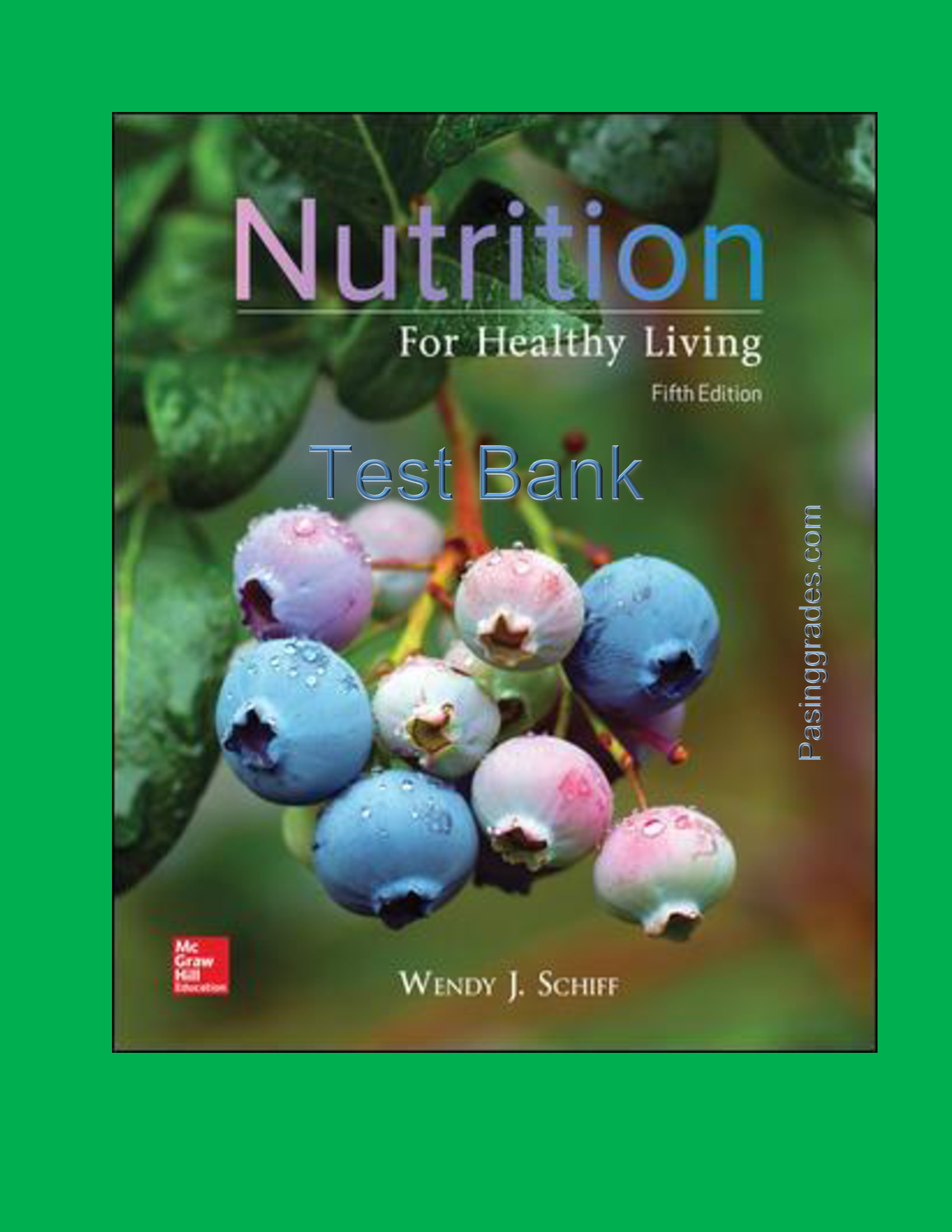
  • Nutrition For Healthy Living 5th Edition By Wendy Schiff Test Bank

Nutrition For Healthy Living 5th Edition By Wendy Schiff Test Bank

Preview page 1 Preview page 2 Preview page 3
Add To Favorites

Share this item Share this item

  • Item Details
  • Comments (0)
  • Reviews (0)
  • Contact Seller
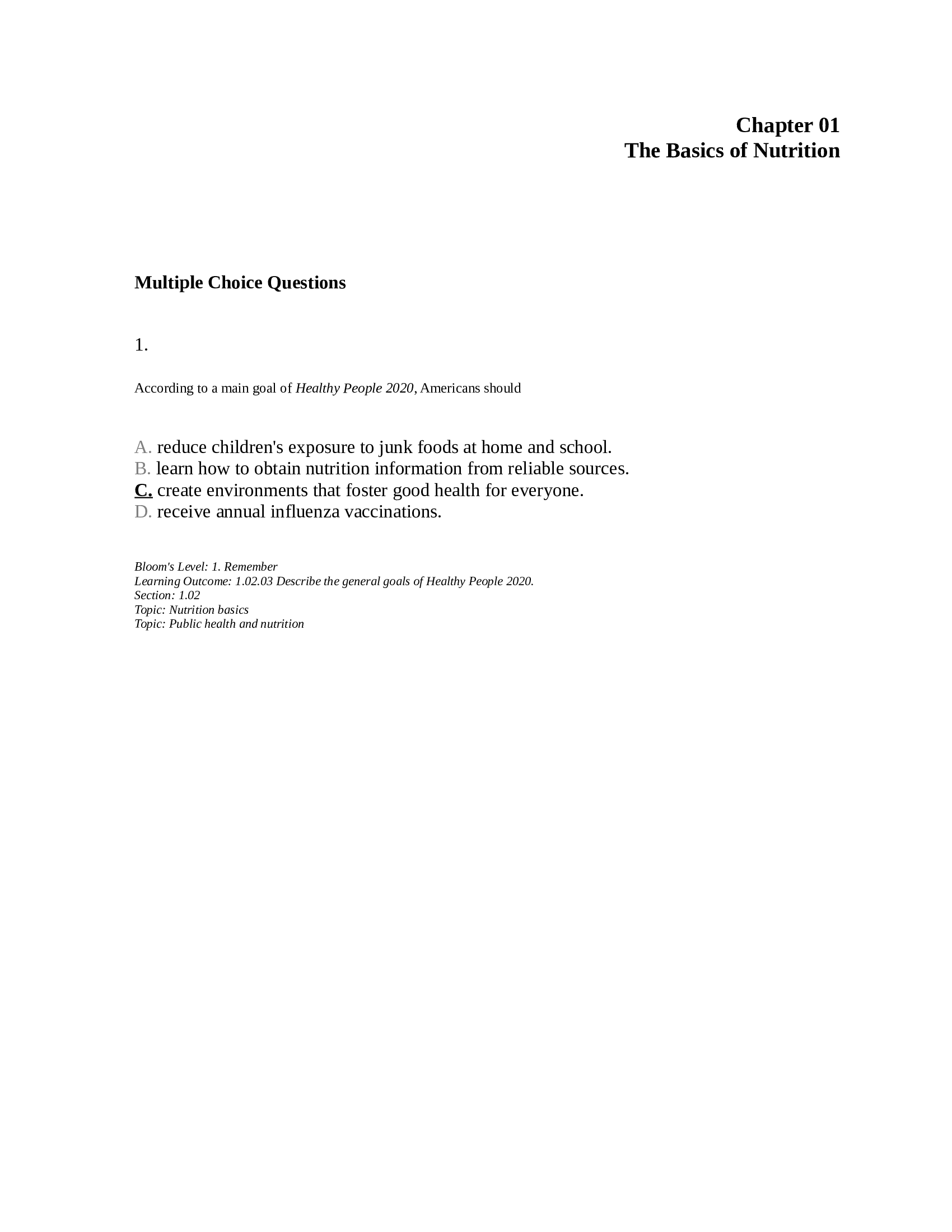
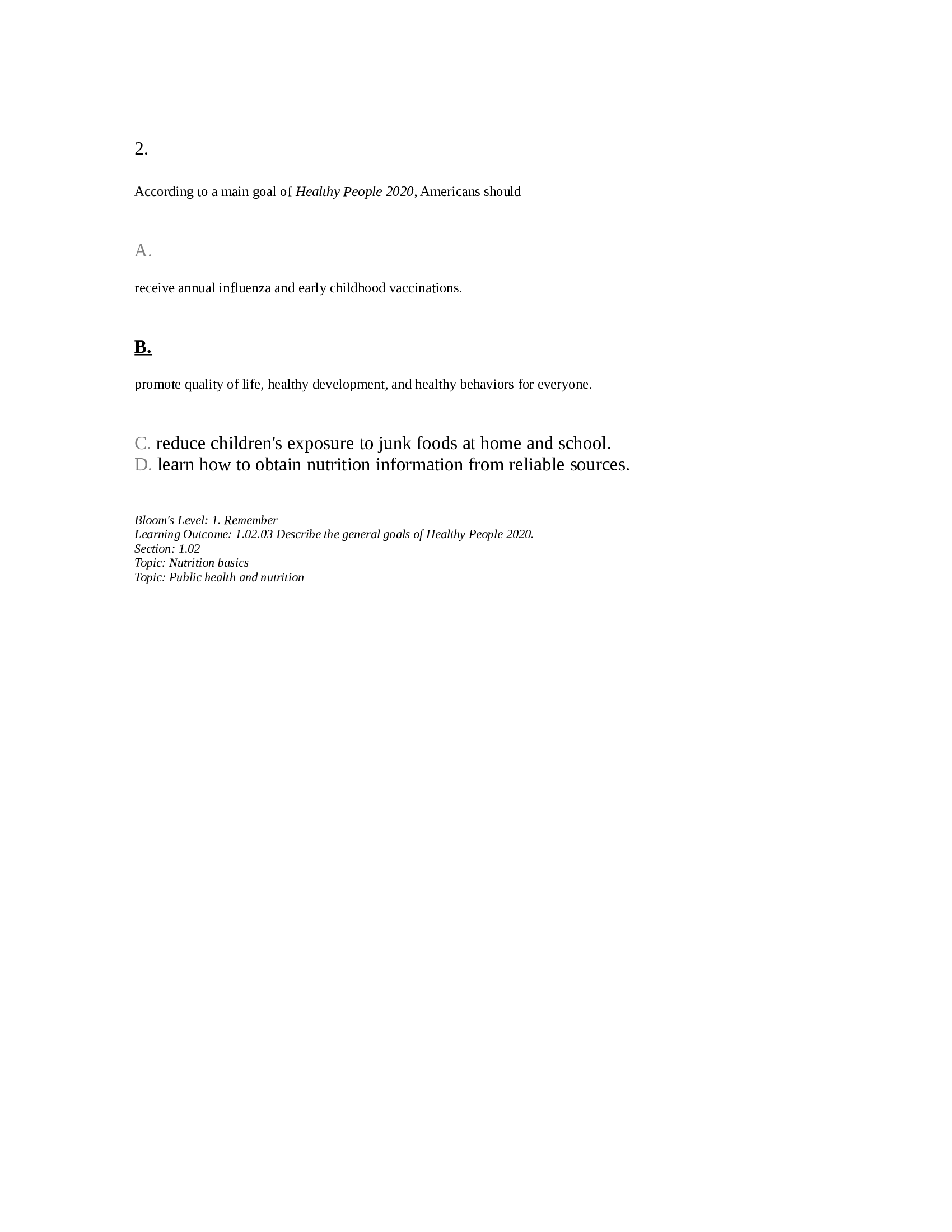
Nutrition For Healthy Living 5th Edition By Wendy Schiff Test Bank Chapter 1 The Basics of Nutrition Chapter 2 Evaluating Nutrition Information Chapter 3 Planning Nutritious Diets Chapter 4 Body Basics Chapter 5 Carbohydrates Chapter 6 Fats and Other Lipids Chapter 7 Proteins Chapter 8 Vitamins Chapter 9 Water and Minerals Chapter 10 Energy Balance and Weight Control Chapter 11 Nutrition for Physically Active Lifestyles Chapter 12 Food Safety Concerns Chapter 13 Nutrition for a Lifetime SAMPLE Chapter 01 The Basics of Nutrition Multiple Choice Questions 1. According to a main goal of Healthy People 2020, Americans should A. reduce children's exposure to junk foods at home and school. B. learn how to obtain nutrition information from reliable sources. C. create environments that foster good health for everyone. D. receive annual influenza vaccinations. Bloom's Level: 1. Remember Learning Outcome: 1.02.03 Describe the general goals of Healthy People 2020. Section: 1.02 Topic: Nutrition basics Topic: Public health and nutrition According to a main goal of Healthy People 2020, Americans should A. receive annual influenza and early childhood vaccinations. B. promote quality of life, healthy development, and healthy behaviors for everyone. C. reduce children's exposure to junk foods at home and school. D. learn how to obtain nutrition information from reliable sources. Bloom's Level: 1. Remember Learning Outcome: 1.02.03 Describe the general goals of Healthy People 2020. Section: 1.02 Topic: Nutrition basics Topic: Public health and nutrition   Which of the following is a main goal of Healthy People 2020? A. Receive annual physical checkups B. Provide opportunities to increase physical activity C. Improve the overall quality of Americans' food choices D. promote quality of life, healthy development, and healthy behaviors for everyone. Bloom's Level: 1. Remember Learning Outcome: 1.02.03 Describe the general goals of Healthy People 2020. Section: 1.02 Topic: Nutrition basics Topic: Public health and nutrition Which of the following statements is true? A. A person's diet is influenced by his or her blood type, birth order, and sustainability. B. Most people are born with the ability to choose a nutritious diet. C. Nutrients are life-sustaining phytochemicals in food. D. In the United States, poor eating habits contribute to some of the ten leading causes of death. Bloom's Level: 1. Remember Learning Outcome: 1.01.03 Identify lifestyle factors that contribute to some of the leading causes of death in the United States. Section: 1.01 Topic: Demographic trends and statistics Topic: Nutrition basics Topic: Public health and nutrition Which of the following conditions or diseases is a leading diet-related cause of death in the United States? A. Suicide B. Heart disease C. Influenza and pneumonia D. Chronic lower respiratory infections Bloom's Level: 1. Remember Learning Outcome: 1.01.03 Identify lifestyle factors that contribute to some of the leading causes of death in the United States. Section: 1.01 Topic: Demographic trends and statistics Topic: Nutrition basics Topic: Public health and nutrition Which of the following conditions or diseases is a leading diet-related cause of death in the United States? A. Chronic lower respiratory infections B. Influenza and pneumonia C. Suicide D. Stroke Bloom's Level: 1. Remember Learning Outcome: 1.01.03 Identify lifestyle factors that contribute to some of the leading causes of death in the United States. Section: 1.01 Topic: Demographic trends and statistics Topic: Nutrition basics Topic: Public health and nutrition Which of the following conditions or diseases is a leading diet-related cause of death in the United States? A. Influenza and pneumonia B. Diabetes C. Suicide D. Chronic lower respiratory infections Bloom's Level: 1. Remember Learning Outcome: 1.01.03 Identify lifestyle factors that contribute to some of the leading causes of death in the United States. Section: 1.01 Topic: Demographic trends and statistics Topic: Nutrition basics Topic: Public health and nutrition Which of the following factors has a major influence over a person's food choices? A. Blood type B. Vitamin A status C. Birth order D. Close friends Bloom's Level: 1. Remember Learning Outcome: 1.01.02 Identify factors that influence personal food choices. Section: 1.01 Topic: Nutrition basics 9. A person's _____ is not a major influence for his or her food selection practices. A. mood B. place of residence C. blood type D. health status Bloom's Level: 2. Understand Learning Outcome: 1.01.02 Identify factors that influence personal food choices. Section: 1.01 Topic: Nutrition basics   A person's _____ is not a major influence for his or her food selection practices. A. health status B. political beliefs C. mood D. place of residence Bloom's Level: 2. Understand Learning Outcome: 1.01.02 Identify factors that influence personal food choices. Section: 1.01 Topic: Nutrition basics   Which of the following statements is true? A. In the United States, poor eating habits contribute to the ten leading causes of death, including influenza and pneumonia. B. Nutrients are life-sustaining substances in food. C. A person's diet is influenced by his or her blood type, birth order, and sustainability. D. People have an instinctual ability to choose a nutritious variety of foods. Bloom's Level: 1. Remember Section: 1.01 Topic: Nutrition basics A substance that can protect a person's cells from being damaged or destroyed by certain harmful factors is a (an) A. vitamin. B. oxidizing agent. C. mineral nutrient. D. antioxidant. Bloom's Level: 1. Remember Section: 1.01 Topic: Nutrient functions Topic: Nutrition basics Which of the following statements is true? A. An essential nutrient must be supplied by the diet. B. Under certain conditions, the human body can make iron, copper, and zinc. C. People develop scurvy when their diets lack vitamin E. D. Phytochemicals are antioxidants produced by animal cells. Bloom's Level: 1. Remember Section: 1.01 Topic: Deficiency and toxicity diseases Topic: Nutrition basics According to the U.S. Food and Drug Administration, which of the following substances can not be classified as a dietary supplement? A. copper B. vitamin E C. tobacco D. lysine Bloom's Level: 1. Remember Learning Outcome: 1.01.01 Explain why it is important to learn about foods and nutrition. Section: 1.01 Topic: Dietary supplements Topic: Nutrition basics Which of the following substances is a phytochemical? A. glucose B. zinc C. caffeine D. pantothenic acid Bloom's Level: 1. Remember Learning Outcome: 1.01.01 Explain why it is important to learn about foods and nutrition. Section: 1.01 Topic: Nutrition basics Topic: Phytochemicals 16. Which of the following conditions is not a leading cause of death in the United States? A. Tuberculosis B. Heart disease C. Stroke D. Cancer Bloom's Level: 1. Remember Learning Outcome: 1.01.01 Explain why it is important to learn about foods and nutrition. Section: 1.01 Topic: Demographic trends and statistics Topic: Nutrition basics Topic: Public health and nutrition 17. Tamika's 52-year-old father died as a result of a condition that is the leading cause of death in the United States. Based on this information, Tamika's father died from A. heart disease. B. type 1 diabetes. C. lung cancer. D. influenza. Bloom's Level: 1. Remember Learning Outcome: 1.01.01 Explain why it is important to learn about foods and nutrition. Section: 1.01 Topic: Demographic trends and statistics Topic: Nutrition basics Topic: Public health and nutrition 18. Which of the following nutrients is a source of energy? A. Cholesterol B. Protein C. Vitamin D D. Iron Bloom's Level: 1. Remember Learning Outcome: 1.01.04 List the six classes of nutrients, and identify a major role of each class of nutrient in the body. Section: 1.03 Topic: Nutrition basics Most forms of _____ are a source of energy for cells. A. cholesterol B. water C. vitamin C D. carbohydrate Bloom's Level: 1. Remember Learning Outcome: 1.01.04 List the six classes of nutrients, and identify a major role of each class of nutrient in the body. Section: 1.01 Topic: Nutrient functions Topic: Nutrition basics Which of the following statements is true? A. Nutrient deficiency diseases develop when diets lack essential nutrients. B. A skin rash could be a symptom of a vitamin deficiency disease. C. A headache is a common sign of a mineral deficiency disease. D. Most phytochemicals are classified as essential nutrients. Bloom's Level: 2. Understand Learning Outcome: 1.01.05 Explain how to determine whether a substance is a phytochemical or an essential nutrient. Section: 1.01 Topic: Deficiency and toxicity diseases Topic: Nutrition basics Topic: Phytochemicals According to the U.S. Department of Agriculture, today's Americans eat more ____ than in 1970. A. whole grains B. eggs C. poultry D. red meats According to the U.S. Department of Agriculture, today's Americans eat more ____ than in 1970. A. whole grains B. eggs C. cheese D. red meats According to the U.S. Department of Agriculture, Americans eat more ____ than in 1970. A. eggs B. red meats C. fish D. whole grains In 2010, Americans ate more ____ than in 1970. A. added sugars B. whole grains C. red meats D. eggs In 2010, Americans ate more ____ than in 1970. A. eggs B. whole grains C. red meats D. added fat In 2010, Americans ate more ____ than in 1970. A. whole grains B. total calories C. fresh eggs D. red meats Bloom's Level: 1. Remember Learning Outcome: 1.02.02 Compare Americans’ current typical eating habits to the population’s typical eating habits in 1970. Section: 1.02 Topic: Demographic trends and statistics Topic: Food sources 27. A serving of food contains 15 g carbohydrate, 3 g protein, 5 g fat, 5 mg vitamin C, and 100 ml water. Based on this information, a serving of this food supplies _____ kcal. A. 87 B. 97 C. 107 D. 117 Bloom's Level: 3. Apply Learning Outcome: 1.03.02 Use the caloric values of macronutrients and alcohol to estimate the amount of energy (kcal) in a food. Section: 1.03 Topic: Nutrition basics Topic: Nutrition computations 28. Sam wants to estimate the grams of carbohydrate in a sugar-sweetened soft drink that supplies 100 kcal. The soft drink contains no fiber, protein, fat, and alcohol. To obtain this value, he should A. divide the number of kcal by 2. B. multiply the number per serving by 2. C. divide the number of kcal by 4. D. multiply the number of kcal by 4. Bloom's Level: 3. Apply Learning Outcome: 1.02.02 Compare Americans’ current typical eating habits to the population’s typical eating habits in 1970. Learning Outcome: 1.03.02 Use the caloric values of macronutrients and alcohol to estimate the amount of energy (kcal) in a food. Section: 1.03 Topic: Nutrition basics Topic: Nutrition computations 29. Lynne wants to estimate the grams of carbohydrate in a sugar-sweetened soft drink that supplies 200 kcal. The soft drink contains no fiber, protein, fat, and alcohol. To obtain this value, she should A. divide the number of kcal by 4. B. multiply the number of kcal by 4. C. divide the number of kcal by 9. D. multiply the number per serving by 9. Bloom's Level: 3. Apply Learning Outcome: 1.02.02 Compare Americans’ current typical eating habits to the population’s typical eating habits in 1970. Learning Outcome: 1.03.02 Use the caloric values of macronutrients and alcohol to estimate the amount of energy (kcal) in a food. Section: 1.03 Topic: Nutrition basics Topic: Nutrition computations 30. A serving of food supplies 100 kcal from protein. Based on this information, how many grams of protein are in the serving? A. 100 B. 25 C. 400 D. 125 Bloom's Level: 3. Apply Learning Outcome: 1.03.02 Use the caloric values of macronutrients and alcohol to estimate the amount of energy (kcal) in a food. Section: 1.03 Topic: Nutrition basics Topic: Nutrition computations 31. A serving of food supplies 144 kcal from protein. Based on this information, how many grams of protein are in the serving? A. 36 B. 46 C. 16 D. 26 Bloom's Level: 3. Apply Learning Outcome: 1.03.02 Use the caloric values of macronutrients and alcohol to estimate the amount of energy (kcal) in a food. Section: 1.03 Topic: Nutrition basics Topic: Nutrition computations 32. A serving of food supplies 99 kcal from fat. Based on this information, how many grams of fat are in the serving? A. 11 B. 25 C. 33 D. 9 Bloom's Level: 3. Apply Learning Outcome: 1.03.02 Use the caloric values of macronutrients and alcohol to estimate the amount of energy (kcal) in a food. Section: 1.03 Topic: Nutrition basics Topic: Nutrition computations 33. Which of the following substances is a nutrient that does not supply any energy for the human body? A. Alcohol B. Vitamin D C. Carbohydrate D. Fat Bloom's Level: 1. Remember Learning Outcome: 1.01.04 List the six classes of nutrients, and identify a major role of each class of nutrient in the body. Section: 1.01 Topic: Nutrient functions Topic: Nutrition basics 34. Which of the following substances is a nutrient that does not provide any energy for the human body? A. Alcohol B. Carbohydrate C. Water D. Protein Bloom's Level: 1. Remember Learning Outcome: 1.01.04 List the six classes of nutrients, and identify a major role of each class of nutrient in the body. Section: 1.01 Topic: Nutrient functions Topic: Nutrition basics 35. Which of the following foods is naturally a rich source of phytochemicals? A. Margarine B. Tuna C. Grapes D. Luncheon meat Bloom's Level: 2. Understand Learning Outcome: 1.01.05 Explain how to determine whether a substance is a phytochemical or an essential nutrient. Section: 1.01 Topic: Nutrition basics Topic: Phytochemicals 36. Which of the following foods is not a source of phytochemicals? A. Whole-grain bread B. Cashew nuts C. Fresh blueberries D. Lean meat Bloom's Level: 2. Understand Learning Outcome: 1.01.05 Explain how to determine whether a substance is a phytochemical or an essential nutrient. Section: 1.01 Topic: Phytochemicals 37. Which of the following behaviors is a known risk factor for heart disease? A. Smoking cigarettes B. Being physically active C. Consuming excess vitamin c D. Eating a high-fiber diet Bloom's Level: 1. Remember Learning Outcome: 1.02.01 Explain why people should be concerned about their lifestyle and risk factors for chronic diseases. Section: 1.02 Topic: Nutrition basics Topic: Public health and nutrition 38. Eating diets that contain high amounts of certain kinds of fat raise the risk of developing heart disease. Thus, a diet that supplies an excessive amount of such fats is a ____ for heart disease. A. dietary modulator B. hypothetical variable C. risk factor D. nutritional determinant Bloom's Level: 2. Understand Learning Outcome: 1.02.01 Explain why people should be concerned about their lifestyle and risk factors for chronic diseases. Section: 1.02 Topic: Nutrition basics Topic: Public health and nutrition 39. Eating a high-salt diet increases people's chances of developing high blood pressure. Thus, a diet that supplies excessive amounts of salt is a ____ for high blood pressure. A. primary predictor B. hypothetical variable C. dietary modulator D. risk factor Bloom's Level: 2. Understand Learning Outcome: 1.02.01 Explain why people should be concerned about their lifestyle and risk factors for chronic diseases. Section: 1.02 Topic: Nutrition basics Topic: Public health and nutrition 40. Which of the following lifestyle choices is the primary cause of most preventable cancer deaths in the United States? A. Exercising infrequently B. Consuming alcohol C. Eating fatty food D. Smoking cigarettes Bloom's Level: 1. Remember Learning Outcome: 1.02.01 Explain why people should be concerned about their lifestyle and risk factors for chronic diseases. Section: 1.02 Topic: Nutrition basics Topic: Public health and nutrition 41. Compared to 40 years ago, Americans generally consume more A. eggs. B. milk. C. red meat. D. fruit. Bloom's Level: 1. Remember Learning Outcome: 1.02.02 Compare Americans’ current typical eating habits to the population’s typical eating habits in 1970. Section: 1.02 Topic: Food production choices 42. Jorge weighs 198 pounds. What is his weight in kilograms? A. 80 kg B. 90 kg C. 100 kg D. 120 kg Bloom's Level: 3. Apply Learning Outcome: 1.03.01 Identify basic units of the metric system often used in nutrition. Section: 1.03 Topic: Nutrition basics Topic: Nutrition computations 43. Elisa weighs 62 kg, which is approximately _____ pounds. A. 136 B. 152 C. 176 D. 202 Bloom's Level: 3. Apply Learning Outcome: 1.03.01 Identify basic units of the metric system often used in nutrition. Section: 1.03 Topic: Nutrition basics Topic: Nutrition computations 44. Jerry's height is 70 inches. What is his approximate height in centimeters? A. 125 cm B. 150 cm C. 178 cm D. 225 cm Bloom's Level: 3. Apply Learning Outcome: 1.03.01 Identify basic units of the metric system often used in nutrition. Section: 1.03 Topic: Nutrition basics Topic: Nutrition computations 45. Kerry weighs 58 kg. What is her approximate weight in pounds? A. 86 pounds B. 98 pounds C. 106 pounds D. 128 pounds Bloom's Level: 3. Apply Learning Outcome: 1.03.01 Identify basic units of the metric system often used in nutrition. Section: 1.03 Topic: Nutrition basics Topic: Nutrition computations 46. Archie weighs 72 kg, which is approximately ____ pounds. A. 108 B. 178 C. 228 D. 158 Bloom's Level: 3. Apply Learning Outcome: 1.03.01 Identify basic units of the metric system often used in nutrition. Section: 1.03 Topic: Nutrition basics Topic: Nutrition computations 47. A teaspoon of sugar supplies about 16 kilocalories, which is the same as _____ calories. A. 1.6 B. 1600 C. 160,000 D. 16,000 Bloom's Level: 3. Apply Learning Outcome: 1.03.01 Identify basic units of the metric system often used in nutrition. Section: 1.03 Topic: Nutrition basics Topic: Nutrition computations 48. The energy value of a raw peach is reported as a number of A. thermals. B. rads. C. kilocalories. D. BTUs. Bloom's Level: 1. Remember Learning Outcome: 1.03.01 Identify basic units of the metric system often used in nutrition. Section: 1.03 Topic: Nutrition basics 49. A serving of food contains 2 g carbohydrate, 16 g protein, 6 g fat, 2 mcg vitamin B12, and 60 mg iron. Based on this information, this food provides ___ kcal/serving. A. 116 B. 96 C. 126 D. 136 Bloom's Level: 3. Apply Learning Outcome: 1.03.02 Use the caloric values of macronutrients and alcohol to estimate the amount of energy (kcal) in a food. Section: 1.03 Topic: Nutrition basics Topic: Nutrition computations 50. How many kilocalories are in a portion of food that contains 4 g protein, 10 g fat, 25 g carbohydrate, 130 mg vitamin C, and 120 ml water? A. 188 B. 118 C. 156 D. 206 Bloom's Level: 3. Apply Learning Outcome: 1.03.02 Use the caloric values of macronutrients and alcohol to estimate the amount of energy (kcal) in a food. Section: 1.03 Topic: Nutrition basics Topic: Nutrition computations 51. Erika is making a recipe from foods that contain the following nutrients: 120 ml of water, 50 g of fat, 40 g of protein, 500 mg of vitamin C, 235 g of carbohydrate, and 600 mg of calcium. Approximately how many kilocalories does the entire product of this recipe provide? A. 2020 B. 1550 C. 930 D. 580 Bloom's Level: 3. Apply Learning Outcome: 1.03.02 Use the caloric values of macronutrients and alcohol to estimate the amount of energy (kcal) in a food. Section: 1.03 Topic: Nutrition basics Topic: Nutrition computations 52. A serving of food supplies 25 g carbohydrate, 15 g fat, 18 g protein, and 100 g water. Which of the following statements is true about a serving of the food? A. Protein provides about 50% of total calories. B. Carbohydrate provides the most food energy. C. Water provides the most food energy. D. Fat provides the most food energy. Bloom's Level: 4. Analyze Learning Outcome: 1.03.02 Use the caloric values of macronutrients and alcohol to estimate the amount of energy (kcal) in a food. Section: 1.03 Topic: Nutrient functions Topic: Nutrition basics Topic: Nutrition computations 53. A serving of food supplies 18 g protein, 20 g carbohydrate, 7 g fat, 18 mg vitamin E, 2 mg iron, and 100 g water. Which of the following statements is true about a serving of the food? A. Carbohydrate provides the most food energy. B. Fat provides about 75% of total calories. C. Vitamin E provides the most food energy. D. Fat provides the most food energy. Bloom's Level: 4. Analyze Learning Outcome: 1.03.02 Use the caloric values of macronutrients and alcohol to estimate the amount of energy (kcal) in a food. Section: 1.03 Topic: Nutrient functions Topic: Nutrition basics Topic: Nutrition computations 54. A serving of food supplies 15 g carbohydrate, 15 g protein, 400 ml water, 25 mg vitamin C, and 4 g fat. According to this information, how many kilocalories are in a serving of this food? A. 136 B. 126 C. 156 D. 146 Bloom's Level: 3. Apply Learning Outcome: 1.03.02 Use the caloric values of macronutrients and alcohol to estimate the amount of energy (kcal) in a food. Section: 1.03 Topic: Nutrient functions Topic: Nutrition basics Topic: Nutrition computations 55. Which of the following foods is the most nutrient dense per serving? A. Soy milk B. Grape drink C. French fries D. Olive oil Bloom's Level: 3. Apply Learning Outcome: 1.04.01 Give examples of empty-calorie, energy-dense, and nutrient-dense foods. Section: 1.04 Topic: Nutrition basics 56. Which of the following foods is the most nutrient dense per serving? A. Cheese nachos B. Iceberg lettuce C. Fat-free milk D. Soft margarine Bloom's Level: 3. Apply Learning Outcome: 1.04.01 Give examples of empty-calorie, energy-dense, and nutrient-dense foods. Section: 1.04 Topic: Nutrition basics 57. The recommended amount of a nutrient is 100 mg. Therefore, a megadose of this nutrient would be A. 100 µg. B. 1 g. C. 10 mg. D. 1000 µg. Bloom's Level: 3. Apply Learning Outcome: 1.04.02 Discuss key basic nutrition concepts, such as the importance of eating a variety of foods and food is the best source of nutrients. Section: 1.04 Topic: Nutrition basics 58. The recommended dose of a vitamin is 2.0 mg. Based on this information, a megadose of the vitamin would be _____ mg or more. A. 10.0 B. 20.0 C. 15.0 D. 4.0 Bloom's Level: 3. Apply Learning Outcome: 1.04.02 Discuss key basic nutrition concepts, such as the importance of eating a variety of foods and food is the best source of nutrients. Section: 1.04 Topic: Nutrition basics 59. Each day, Phil takes ten pills that each supply 1000 mg of vitamin C. The recommended amount of vitamin C is 90 mg/day. His daily vitamin C intake is an example of a A. requirement. B. physiological level. C. marginal intake. D. megadose. Bloom's Level: 2. Understand Learning Outcome: 1.04.02 Discuss key basic nutrition concepts, such as the importance of eating a variety of foods and food is the best source of nutrients. Section: 1.04 Topic: Nutrition basics 60. Maria limits her sodium intake to 2.3 g/day. This amount is equivalent to A. 23 mg/day. B. 2300 mg/day. C. 230 mg/day. D. 23,000 mg/day. Bloom's Level: 2. Understand Learning Outcome: 1.03.01 Identify basic units of the metric system often used in nutrition. Section: 1.03 Topic: Nutrition basics Topic: Nutrition computations 61. Which of the following substances is a nutrient that provides energy for humans? A. Alcohol B. Sugar C. Caffeine D. Thiamin Bloom's Level: 1. Remember Learning Outcome: 1.01.04 List the six classes of nutrients, and identify a major role of each class of nutrient in the body. Section: 1.01 Topic: Nutrition basics 62. Which of the following nutrients is a micronutrient? A. Fat B. Water C. Iron D. Protein Bloom's Level: 1. Remember Learning Outcome: 1.03.02 Use the caloric values of macronutrients and alcohol to estimate the amount of energy (kcal) in a food. Section: 1.03 Topic: Nutrition basics 63. Which of the following statements is true? A. Milk, bananas, and soybeans are among the few nutritionally perfect foods for humans. B. Strawberries are an energy-dense food. C. Nutrition experts classify sugary foods as "junk" foods. D. Most naturally occurring foods contain more than one nutrient. Bloom's Level: 2. Understand Learning Outcome: 1.04.02 Discuss key basic nutrition concepts, such as the importance of eating a variety of foods and food is the best source of nutrients. Section: 1.04 Topic: Nutrition basics 64. Which of the following foods is the most energy dense per serving? A. 3 ounces baked chicken B. ½ cup fresh strawberries C. 4-ounce chocolate doughnut D. 8 ounces fat-free milk Bloom's Level: 2. Understand Learning Outcome: 1.04.01 Give examples of empty-calorie, energy-dense, and nutrient-dense foods. Section: 1.04 Topic: Nutrition basics 65. Which of the following foods is both energy and nutrient dense? A. Whole-grain bread B. Peanut butter C. Raw apples D. Strawberries Bloom's Level: 2. Understand Learning Outcome: 1.04.01 Give examples of empty-calorie, energy-dense, and nutrient-dense foods. Section: 1.04 Topic: Nutrition basics 66. Which of the following statements is true? A. In the United States, you are more likely to see undernourished than overnourished people. B. According to scientific evidence, taking megadoses of vitamins and minerals are a safe way to prevent many chronic diseases. C. Dietitians generally classify foods as either "good" or "junk." D. A diet that has variety contains many different kinds of nutritious foods. Bloom's Level: 2. Understand Learning Outcome: 1.04.02 Discuss key basic nutrition concepts, such as the importance of eating a variety of foods and food is the best source of nutrients. Section: 1.04 Topic: Nutrition basics 67. An essential nutrient A. must be supplied by the diet. B. is not in empty-calorie food. C. performs a vital function in the body. D. is only in foods from animal sources. Bloom's Level: 1. Remember Learning Outcome: 1.01.05 Explain how to determine whether a substance is a phytochemical or an essential nutrient. Section: 1.01 Topic: Nutrition basics 68. Which of the following nutrients is the most essential for life? A. Water B. Omega-3 fatty acids C. Protein D. Vitamin C Bloom's Level: 1. Remember Learning Outcome: 1.01.04 List the six classes of nutrients, and identify a major role of each class of nutrient in the body. Section: 1.01 Topic: Nutrition basics 69. An 8-ounce serving of a beverage contains 450 ml water, 20 g sugar, and 5 g alcohol. This amount of the beverage supplies _____ kcal. A. 125 B. 180 C. 115 D. 95 Bloom's Level: 3. Apply Learning Outcome: 1.03.02 Use the caloric values of macronutrients and alcohol to estimate the amount of energy (kcal) in a food. Section: 1.03 Topic: Nutrition basics Topic: Nutrition computations 70. An 8-ounce serving of a beverage contains 250 ml water, 15 g sugar, 3 mg caffeine, and 5 g alcohol. This amount of the beverage supplies _____ kcal. A. 95 B. 125 C. 185 D. 115 Bloom's Level: 3. Apply Learning Outcome: 1.03.02 Use the caloric values of macronutrients and alcohol to estimate the amount of energy (kcal) in a food. Section: 1.03 Topic: Nutrition basics Topic: Nutrition computations 71. An 8-ounce serving of a beverage contains 250 ml water, 30 g sugar, 3 mg caffeine, and 8 g alcohol. This amount of the beverage supplies _____ kcal. A. 176 B. 96 C. 185 D. 115 Bloom's Level: 3. Apply Learning Outcome: 1.03.02 Use the caloric values of macronutrients and alcohol to estimate the amount of energy (kcal) in a food. Section: 1.03 Topic: Nutrition basics Topic: Nutrition computations 72. Which of the following substances is not a macronutrient? A. Carbohydrate B. Protein C. Vitamin C D. Fat Bloom's Level: 1. Remember Learning Outcome: 1.03.02 Use the caloric values of macronutrients and alcohol to estimate the amount of energy (kcal) in a food. Section: 1.03 Topic: Nutrient functions Topic: Nutrition basics 73. Which of the following federally subsidized food programs is designed to improve the nutritional status specifically of low-income pregnant and breastfeeding women and their preschool children in the United States? A. Commodity Supplemental Food Program B. UNICEF C. WIC D. Meals on Wheels Bloom's Level: 1. Remember Learning Outcome: 1.05.03 Identify major federal food assistance programs and the populations served by each program. Section: 1.05 Topic: Community nutrition services Topic: Public health and nutrition 74. _____ includes farming techniques that do not deplete natural resources or harm the environment. A. Organoleptic crop management B. Nutrigenomic farming C. Sustainable agriculture D. Biotechnologic food production Bloom's Level: 1. Remember Learning Outcome: 1.05.04 Discuss how sustainable agriculture can improve the environment. Section: 1.05 Topic: Food production choices 75. Which of the following groups of Americans is most at risk of undernutrition? A. Preschool children B. Middle-age men C. Chronic alcoholics D. College freshmen Bloom's Level: 1. Remember Learning Outcome: 1.05.01 Discuss factors that contribute to undernutrition in the world. Section: 1.05 Topic: Hunger and food insecurity 76. In the United States, food insecurity is most likely to affect A. body builders who consume too many protein supplements. B. adolescent boys experiencing a growth spurt. C. older adults on fixed incomes. D. adult women who take birth control pills. Bloom's Level: 1. Remember Learning Outcome: 1.05.01 Discuss factors that contribute to undernutrition in the world. Section: 1.05 Topic: Hunger and food insecurity 77. Hannah is in her 5th month of pregnancy. Her diet is poor because she rarely pays attention to her food choices, and she eats a limited variety of foods that she likes. Hannah was described as "undernourished" by her physician. Based on this information, Hannah is likely to A. deliver a baby with type 1 diabetes. B. give birth at least two weeks later than expected. C. deliver a baby who has breathing difficulties. D. give birth to a high-birth-weight baby. Bloom's Level: 3. Apply Learning Outcome: 1.05.02 Describe how undernutrition during pregnancy and childhood can affect a child’s physical and intellectual development. Section: 1.05 Topic: Hunger and food insecurity 78. Impoverished children who live in developing countries have a high risk of dying from A. developing type 2 diabetes. B. developing cystic fibrosis. C. consuming too much fat and sugar. D. drinking polluted water. Bloom's Level: 1. Remember Learning Outcome: 1.05.02 Describe how undernutrition during pregnancy and childhood can affect a child’s physical and intellectual development. Section: 1.05 Topic: Public health and nutrition 79. Which of the following statements is true? A. The School Lunch and Breakfast programs are available to low- and middle-income children in 20 states. B. The School Breakfast Program offers free or reduced-cost breakfasts to children, regardless of their family incomes. C. The Supplemental Nutrition Assistance Program helps low-income Americans buy food. D. Meals on Wheels provides nutritious meals for pregnant, low-income women who are too sick to leave their homes. Bloom's Level: 1. Remember Learning Outcome: 1.05.03 Identify major federal food assistance programs and the populations served by each program. Section: 1.05 Topic: Public health and nutrition 80. Dietitians often refer to _____ as "empty-calorie" foods. A. 100% fruit juices B. breads C. fat-free dairy products D. sugar-sweetened soft drinks Bloom's Level: 2. Understand Learning Outcome: 1.04.01 Give examples of empty-calorie, energy-dense, and nutrient-dense foods. Section: 1.04 Topic: Nutrition basics 81. ____ is an example of an "empty-calorie" food. A. Cottage cheese B. Whole milk C. Lite beer D. Unsalted crackers Bloom's Level: 2. Understand Learning Outcome: 1.04.01 Give examples of empty-calorie, energy-dense, and nutrient-dense foods. Section: 1.04 Topic: Nutrition basics 82. Which of the following foods is not nutrient-dense? A. Fresh strawberries B. Romaine lettuce C. Potato chips D. Orange juice Bloom's Level: 2. Understand Learning Outcome: 1.04.01 Give examples of empty-calorie, energy-dense, and nutrient-dense foods. Section: 1.04 Topic: Nutrition basics 83. Which of the following statements is true? A. A healthy diet supplies 90% of its calories from protein-rich foods. B. Peanut butter is an empty-calorie food. C. Most foods are mixtures of nutrients. D. A megadose of vitamin C is within the range of safe intake for the nutrient. Bloom's Level: 2. Understand Learning Outcome: 1.04.02 Discuss key basic nutrition concepts, such as the importance of eating a variety of foods and food is the best source of nutrients. Section: 1.04 Topic: Food sources Topic: Nutrition basics 84. Which of the following practices is most likely to result in a vitamin toxicity disorder? A. Eating 4 ounces of chicken liver once a week B. Taking megadoses of various vitamin supplements daily C. Consuming 6 servings of fruits and vegetables daily D. Drinking 8 ounces of fat-free milk with each meal Bloom's Level: 2. Understand Learning Outcome: 1.04.02 Discuss key basic nutrition concepts, such as the importance of eating a variety of foods and food is the best source of nutrients. Section: 1.04 Topic: Nutrition basics 85. Belle is pregnant and has two young children. She is having difficulty supporting her family on an income of $18,000/year. Recently, she was diagnosed with high blood pressure and iron deficiency. Based on this information, Belle should enroll in the _____ program. A. WIC B. FDIC C. HWHB D. FDA Bloom's Level: 6. Create Learning Outcome: 1.05.03 Identify major federal food assistance programs and the populations served by each program. Section: 1.05 Topic: Community nutrition services 86. Anna is 17 years of age and pregnant with her first child. She has difficulty earning enough money to support herself, and recently, she was diagnosed with iron deficiency. Based on this information, Anna should enroll in the _____ program. A. WIC B. HWHB C. FDIC D. FDA Bloom's Level: 6. Create Learning Outcome: 1.05.03 Identify major federal food assistance programs and the populations served by each program. Section: 1.05 Topic: Community nutrition services 87. A food scientist would like to develop a ready-to-use therapeutic food that would be supplied to 3- to 5-year-old starving children. Based on this information, which of the following ingredients is not necessary to include in the food's recipe? A. Vitamin A B. Cholesterol C. Peanut butter D. Iron Bloom's Level: 5. Evaluate Learning Outcome: 1.05.01 Discuss factors that contribute to undernutrition in the world. Section: 1.05 Topic: Hunger and food insecurity 88. A scientist thinks she has discovered an essential nutrient for humans, because this substance is A. in most natural foods. B. required by cats and dogs. C. easily manufactured by chemists. D. needed for the normal development of human cells. Bloom's Level: 3. Apply Learning Outcome: 1.01.01 Explain why it is important to learn about foods and nutrition. Section: 1.01 Topic: Nutrition basics 89. Scientists at a major university have isolated a chemical from grapes. Which of the following features is an indication that this chemical could be a vitamin? A. When large amounts of the chemical are consumed, no health problems occur. B. When a person's diet lacks the chemical, his or her body experiences abnormal functioning. C. The chemical is in grapes, cherries, and tomatoes. D. The chemical has a very limited range of safe intake. Bloom's Level: 4. Analyze Learning Outcome: 1.01.01 Explain why it is important to learn about foods and nutrition. Section: 1.01 Topic: Nutrition basics 90. For 5 years, Michael ate only plant foods. He recently developed numbness in his feet and a sore swollen tongue. A few days after he added eggs and milk to his diet, his tongue healed and the numbness in his feet stopped bothering him. Based on this information, Michael probably A. developed a nutrient deficiency disorder that was cured by the eating animal foods. B. suffered from a rare genetic disorder that developed when high levels of various phytochemicals were consumed. C. had been infected with a rare viral disease that was transmitted by certain plant foods. D. had absorbed toxic minerals from plant foods, which were eliminated from his body when he consumed the animal foods. Bloom's Level: 4. Analyze Learning Outcome: 1.01.01 Explain why it is important to learn about foods and nutrition. Section: 1.01 Topic: Nutrition basics 91. Most of the people living in a small South African village have access to nutritious foods. Soon after their birth, 10 infants in the village developed severe diarrhea, which resulted in dehydration. After questioning the infants' parents, local public health officials were able to determine the cause of the diarrhea. Based on the officials' findings, the parents were advised to A. add more fruit juice to the babies' diets. B. give megadoses of vitamin C to each baby. C. stop diluting the babies' formula with local well water. D. reduce the amount of iron in the babies' diets. Bloom's Level: 3. Apply Learning Outcome: 1.05.01 Discuss factors that contribute to undernutrition in the world. Section: 1.05 Topic: Hunger and food insecurity 92. Which of the following food-related practices is recommended because it can improve the environment? A. Eating more meat, especially beef B. Throwing out uneaten and/or leftover foods C. Eating smaller food portions D. Consuming more corn-fed beef and pork Bloom's Level: 2. Understand Learning Outcome: 1.05.04 Discuss how sustainable agriculture can improve the environment. Section: 1.05 Topic: Food production choices 93. Which of the following agricultural practices is recommended because it can improve the environment? A. Using chemical methods to control crop pests B. Applying irrigation water directly to the roots of crops C. Raising more corn-fed beef and pork D. Expanding farmland into forests and grasslands Bloom's Level: 2. Understand Learning Outcome: 1.05.04 Discuss how sustainable agriculture can improve the environment. Section: 1.05 Topic: Food production choices

Contact the Seller

Please Sign In to contact this seller.


  • 👎  Report Copyright Violation

Frequently Asked Questions

What Do I Get When I Buy This Study Material?

+

When you buy a study material on Passing Grades, an instant download link will be sent directly to your email, giving you access to the file anytime after payment is completed.

Is Passing Grades a Trusted Platform?

+

Yes, Passing Grades is a reputable students’ marketplace with a secure payment system and reliable customer support. You can trust us to ensure a safe and seamless transaction experience.

Will I Be Stuck with a Subscription?

+

No, all purchases on Passing Grades are one-time transactions. You only pay for the notes you choose to buy, with no subscriptions or hidden fees attached.

Who Am I Buying These Study Materials From?

+

Passing Grades is a marketplace, which means you are purchasing the document from an individual vendor, not directly from us. We facilitate the payment and delivery process between you and the vendor.

Does Passing Grades Offer Free Study Materials?

+

Yes, sellers on Passing Grades have uploaded numerous free test banks, exams, practice questions, and class notes that can be downloaded at no cost.

Pasinggrades - Quality Study Materials

USD 10

    • Quality checked by Pasing Grades
    • 100% satisfaction guarantee
    • Seller: Namwaki
Buy PDF $10

Seller Information

Namwaki

Member since April 2021

  • icon
  • icon
  • icon
View Profile
  • total sales

    1
  • Favourites

    0
  • Comments

    0
    ( 0 Ratings )

Item Information

  • Uploaded

    19 August 2021

  • Updated

    21 April 2025

  • Category

    Nursing

  • Item Type

    test bank

  • Tags

    Nutrition For Healthy Living 5th Edition By Wendy Schiff Test Bank

Related Exam Prep Guides by Namwaki

Sophia Finance Milestone Final_Complete Questions and Answers 2021.
View Document

Sophia Finance Miles...

  • Namwaki

    Namwaki

  • test bank

Sophia Finance Milestone Final_Complete Questions and Answers 2021...

10 USD

0

1

Medical Parasitology 7th Edition Leventhal Test Bank
View Document

Medical Parasitology...

  • Namwaki

    Namwaki

  • test bank

Medical Parasitology 7th Edition Leventhal Test Bank...

10 USD

0

1

TEST- BANK FOR WONGS NURSING CARE OF INFANTS AND CHILDREN 11TH EDITION HOCKENBERRY
View Document

TEST- BANK FOR WONGS...

  • Namwaki

    Namwaki

  • test bank

TEST- BANK FOR WONGS NURSING CARE OF INFANTS AND CHILDREN 11TH EDITION HOCKENBERRY – Download PDF...

10 USD

0

1

Purchase

Download link will be sent to this email immediately after purchase.

IMPORTANT LINKS

  • How To Upload Class Notes
  • Selling Tips
  • Passing Grades's Study Materials
  • Scholarships for International Students 2025

POPULAR CATEGORIES

  • Law
  • Accounting
  • English
  • Psychology
  • Business
  • Nursing
  • Computer Science
  • General

View Document

  • Blog
  • Contact
  • Delivery Policy
  • Latest Scholarships Around the World
  • How to Pass Bar Exams: Passing Grades’ Strategies
  • How to Study and Pass the CPA Exam
  • All Test Banks
  • Faq
  • Copyright Claims
  • Privacy Policy
  • Terms of Use

KNOWLEDGE BASE

  • How to Write A+ Grade Good Research Paper
  • How to Manage Stress During Exam Period
  • Best Time to Study
  • How to Pass NCLEX-RN Exam
  • How To Effectively Utilize Test Banks
  • Popular Shadow Health Exam Assessments
  • Popular HESI Case Studies
  • How to Prepare for a Nursing Career
  • The Importance Of Summaries in Exam Revisvion

© 2026 Pasing Grades. All rights reserved.