Pasing Grades
  • Start Selling
  • Blog
  • Contact
  • 0

    Your cart is empty!

English

  • English
  • Spanish
  • Arabic
Create Account Sign In
  • Library
    • New Prep Guides
    • Featured Prep Guides
    • Free Exam Prep Guides
    • Best sellers
  • General
  • Nursing
    • Research Paper
    • Case Study
    • Discussion Post
    • Assignment
    • Exam
    • Practice Questions and Answers
    • Test Bank
    • solutions manual
  • Accounting
    • Case Study
    • Thesis
    • Study Guide
    • Summary
    • Research Paper
    • test bank
  • English
    • Creative Writing
    • Research Paper
    • Summary
    • Rhetorics
    • Literature
    • Journal
    • Exam
    • Grammar
    • Discussion Post
    • Essay
  • Psychology
    • Hesi
    • Presentation
    • Essay
    • Summary
    • Study Guide
    • Essay
    • Solution Manual
    • Final Exam Review
    • Class Notes
    • test bank
  • Business
    • Lecture Notes
    • Solution Manual
    • Presentation
    • Business Plan
    • Class Notes
    • Experiment
    • Summary
    • Practice Questions
    • Study Guide
    • Case Study
    • test bank
    • Exam
  • More
    • Computer Science
    • Economics
    • Statistics
    • Engineering
    • Biology
    • Religious Studies
    • Physics
    • Chemistry
    • Mathematics
    • History
    • Sociology
    • Science
    • Philosophy
    • Law
  • Pages
    • About Us
    • Selling Tips
    • Delivery Policy
    • Faq
    • Privacy Policy
  • Flash Sale
  • Home
  • NUR2092 Health Assessment Exam 2

NUR2092 Health Assessment Exam 2

Preview page 1 Preview page 2 Preview page 3
Add To Favorites

Share this item Share this item

  • Item Details
  • Comments (0)
  • Reviews (0)
  • Contact Seller
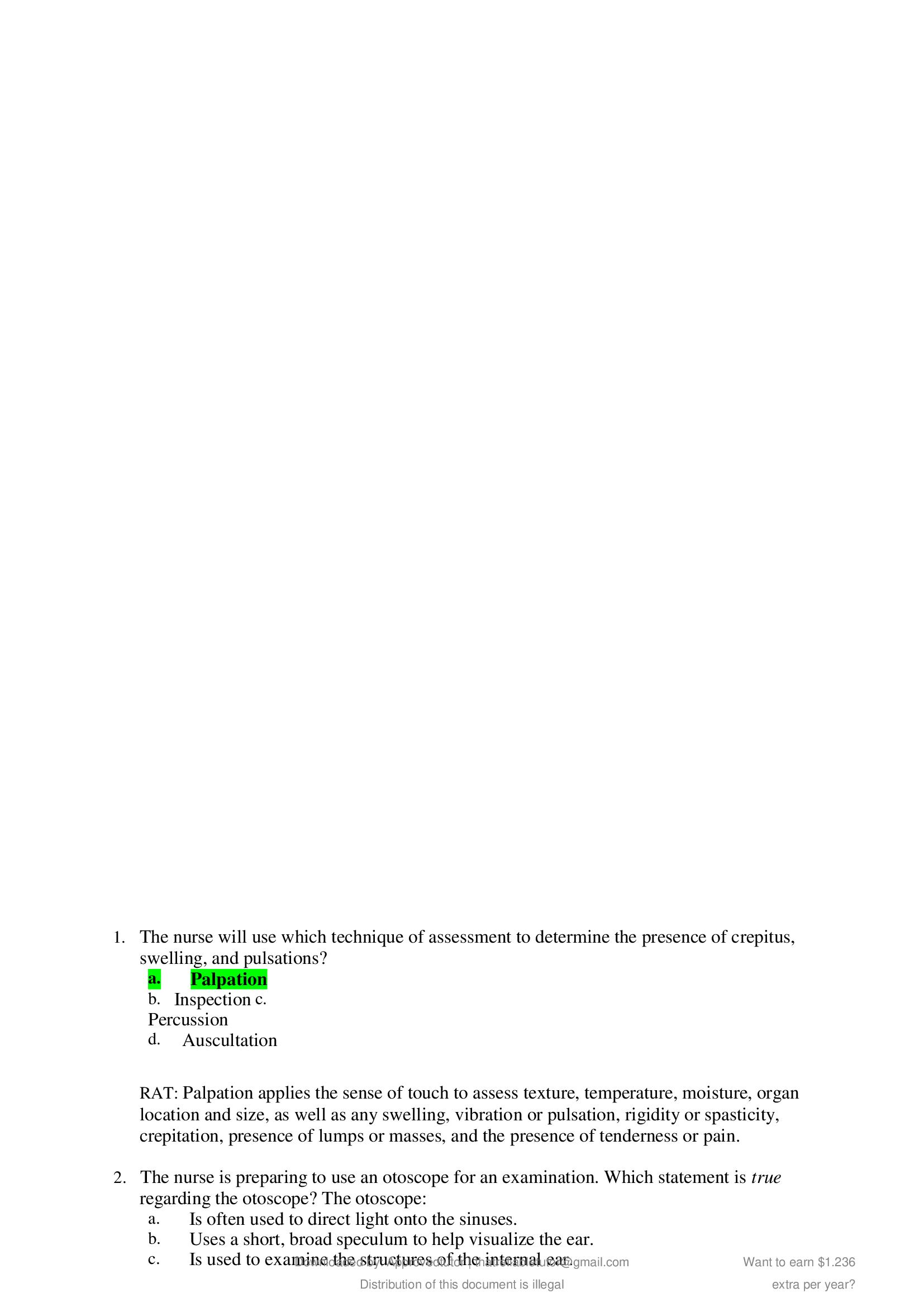
NUR2092 Health Assessment Exam 2 QuizBank Questions and Answers with Rationale Latest Rasmussen College 2024 1. The nurse will use which technique of assessment to determine the presence of crepitus, swelling, and pulsations? a. Palpation b. Inspection c. Percussion d. Auscultation RAT: Palpation applies the sense of touch to assess texture, temperature, moisture, organ location and size, as well as any swelling, vibration or pulsation, rigidity or spasticity, crepitation, presence of lumps or masses, and the presence of tenderness or pain. 2. The nurse is preparing to use an otoscope for an examination. Which statement is true regarding the otoscope? The otoscope: a. Is often used to direct light onto the sinuses. b. Uses a short, broad speculum to help visualize the ear. c. Is used to examine the structures of the internal ear. d. Directs light into the ear canal and onto the tympanic membrane. RAT: The otoscope directs light into the ear canal and onto the tympanic membrane that divides the external and middle ear. A short, broad speculum is used to visualize the nares. 3. An examiner is using an ophthalmoscope to examine a patient’s eyes. The patient has astigmatism and is nearsighted. The use of which of these techniques would indicate that the examination is being correctly performed? a. Using the large full circle of light when assessing pupils that are not dilated b. Rotating the lens selector dial to the black numbers to compensate for astigmatism c. Using the grid on the lens aperture dial to visualize the external structures of the eye d. Rotating the lens selector dial to bring the object into focus RAT: The ophthalmoscope is used to examine the internal eye structures. It can compensate for nearsightedness or farsightedness, but it will not correct for astigmatism. The grid is used to assess size and location of lesions on the fundus. The large full spot of light is used to assess dilated pupils. Rotating the lens selector dial brings the object into focus. 4. The nurse is unable to palpate the right radial pulse on a patient. The best action would be to: a. Auscultate over the area with a fetoscope. b. Use a goniometer to measure the pulsations. c. Use a Doppler device to check for pulsations over the area. d. Check for the presence of pulsations with a stethoscope. RAT: Doppler devices are used to augment pulse or blood pressure measurements. Goniometers measure joint range of motion. A fetoscope is used to auscultate fetal heart tones. Stethoscopes are used to auscultate breath, bowel, and heart sounds. 5. The nurse is preparing to perform a physical assessment. The correct action by the nurse is reflected by which statement? The nurse: a. Performs the examination from the left side of the bed. b. Examines tender or painful areas first to help relieve the patient’s anxiety. c. Follows the same examination sequence, regardless of the patient’s age or condition. d. Organizes the assessment to ensure that the patient does not change positions too often. RAT: The steps of the assessment should be organized to ensure that the patient does not change positions too often. The sequence of the steps of the assessment may differ, depending on the age of the person and the examiner’s preference. Tender or painful areas should be assessed last. 6. A man is at the clinic for a physical examination. He states that he is “very anxious” about the physical examination. What steps can the nurse take to make him more comfortable? a. Appear unhurried and confident when examining him. b. Stay in the room when he undresses in case he needs assistance. c. Ask him to change into an examining gown and to take off his undergarments. d. Defer measuring vital signs until the end of the examination, which allows him time to become comfortable. RAT: Anxiety can be reduced by an examiner who is confident, self-assured, considerate, and unhurried. Familiar and relatively nonthreatening actions, such as measuring the person’s vital signs, will gradually accustom the person to the examination. 7. When performing a physical examination, safety must be considered to protect the examiner and the patient against the spread of infection. Which of these statements describes the most appropriate action the nurse should take when performing a physical examination? a. Washing one’s hands after removing gloves is not necessary, as long as the gloves are still intact. b. Hands are washed before and after every physical patient encounter. c. Hands are washed before the examination of each body system to prevent the spread of bacteria from one part of the body to another. d. Gloves are worn throughout the entire examination to demonstrate to the patient 19. When assessing the respiratory system of a 4-year-old child, which of these findings would the nurse expect? a. Crepitus palpated at the costochondral junctions b. No diaphragmatic excursion as a result of a child’s decreased inspiratory volume c. Presence of bronchovesicular breath sounds in the peripheral lung fields d. Irregular respiratory pattern and a respiratory rate of 40 breaths per minute at C rest Bronchovesicular breath sounds in the peripheral lung fields of the infant and young child up to age 5 or 6 years are normal findings. Their thin chest walls with underdeveloped musculature do not dampen the sound, as do the thicker chest walls of adults; therefore, breath sounds are loud and harsh. 20. When inspecting the anterior chest of an adult, the nurse should include which assessment? a. Diaphragmatic excursion b. Symmetric chest expansion c. Presence of breath sounds d. Shape and configuration of the chest wall D Inspection of the anterior chest includes shape and configuration of the chest wall; assessment of the patient’s level of consciousness and the patient’s skin color and condition; quality of respirations; presence or absence of retraction and bulging of the intercostal spaces; and use of accessory muscles. Symmetric chest expansion is assessed by palpation. Diaphragmatic excursion is assessed by percussion of the posterior chest. Breath sounds are assessed by auscultation. 21. The nurse knows that auscultation of fine crackles would most likely be noticed in: a. A healthy 5-year-old child. b. A pregnant woman. c. The immediate newborn period. d. Association with a pneumothorax. C Fine crackles are commonly heard in the immediate newborn period as a result of the opening of the airways and a clearing of fluid. Persistent fine crackles would be noticed with pneumonia, bronchiolitis, or atelectasis. 22. During an assessment of an adult, the nurse has noted unequal chest expansion and recognizes that this occurs in which situation?

Contact the Seller

Please Sign In to contact this seller.


  • 👎  Report Copyright Violation

Frequently Asked Questions

What Do I Get When I Buy This Study Material?

+

When you buy a study material on Passing Grades, an instant download link will be sent directly to your email, giving you access to the file anytime after payment is completed.

Is Passing Grades a Trusted Platform?

+

Yes, Passing Grades is a reputable students’ marketplace with a secure payment system and reliable customer support. You can trust us to ensure a safe and seamless transaction experience.

Will I Be Stuck with a Subscription?

+

No, all purchases on Passing Grades are one-time transactions. You only pay for the notes you choose to buy, with no subscriptions or hidden fees attached.

Who Am I Buying These Study Materials From?

+

Passing Grades is a marketplace, which means you are purchasing the document from an individual vendor, not directly from us. We facilitate the payment and delivery process between you and the vendor.

Does Passing Grades Offer Free Study Materials?

+

Yes, sellers on Passing Grades have uploaded numerous free test banks, exams, practice questions, and class notes that can be downloaded at no cost.

Pasinggrades - Quality Study Materials

USD 10

    • Quality checked by Pasing Grades
    • 100% satisfaction guarantee
    • Seller: Gradepush
Buy PDF $10

Seller Information

Gradepush

Member since December 2023

  • icon
  • icon
View Profile
  • total sales

    0
  • Favourites

    0
  • Comments

    0
    ( 0 Ratings )

Item Information

  • Uploaded

    31 December 2023

  • Updated

    29 September 2025

  • Category

    Nursing

  • Item Type

    exam

  • Tags

    NUR2092 NUR 2092 NUR 2092 Health Assessment Exam 2 QuizBank Questions and Answers Rasmussen College 2024

Related Exam Prep Guides by Gradepush

NR 509 Week 1 Quiz 2026 Real Test
View Document

NR 509 Week 1 Quiz 2...

  • Gradepush

    Gradepush

  • exam

NR 509 Week 1 Quiz 2025: Test your knowledge on holistic health, subjective vs. objective data, and ...

10 USD

0

0

NR 509 Week 2 Quiz 2026 Real Test
View Document

NR 509 Week 2 Quiz 2...

  • Gradepush

    Gradepush

  • exam

NR 509 Week 2 Quiz 2025: Evaluate your understanding of physical assessment techniques, including in...

10 USD

0

0

NR 509 Week 3 Quiz 2026 Real Test
View Document

NR 509 Week 3 Quiz 2...

  • Gradepush

    Gradepush

  • exam

NR 509 Week 3 Quiz 2025 focuses on key musculoskeletal concepts such as joint movements, flexion, an...

10 USD

0

0

Purchase

Download link will be sent to this email immediately after purchase.

IMPORTANT LINKS

  • How To Upload Class Notes
  • Selling Tips
  • Passing Grades's Study Materials
  • Scholarships for International Students 2025

POPULAR CATEGORIES

  • Law
  • Accounting
  • English
  • Psychology
  • Business
  • Nursing
  • Computer Science
  • General

View Document

  • Blog
  • Contact
  • Delivery Policy
  • Latest Scholarships Around the World
  • How to Pass Bar Exams: Passing Grades’ Strategies
  • How to Study and Pass the CPA Exam
  • All Test Banks
  • Faq
  • Copyright Claims
  • Privacy Policy
  • Terms of Use

KNOWLEDGE BASE

  • How to Write A+ Grade Good Research Paper
  • How to Manage Stress During Exam Period
  • Best Time to Study
  • How to Pass NCLEX-RN Exam
  • How To Effectively Utilize Test Banks
  • Popular Shadow Health Exam Assessments
  • Popular HESI Case Studies
  • How to Prepare for a Nursing Career
  • The Importance Of Summaries in Exam Revisvion

© 2026 Pasing Grades. All rights reserved.