Pasing Grades
  • Start Selling
  • Blog
  • Contact
  • 0

    Your cart is empty!

English

  • English
  • Spanish
  • Arabic
Create Account Sign In
  • Library
    • New Prep Guides
    • Featured Prep Guides
    • Free Exam Prep Guides
    • Best sellers
  • General
  • Nursing
    • Research Paper
    • Case Study
    • Discussion Post
    • Assignment
    • Exam
    • Practice Questions and Answers
    • Test Bank
    • solutions manual
  • Accounting
    • Case Study
    • Thesis
    • Study Guide
    • Summary
    • Research Paper
    • test bank
  • English
    • Creative Writing
    • Research Paper
    • Summary
    • Rhetorics
    • Literature
    • Journal
    • Exam
    • Grammar
    • Discussion Post
    • Essay
  • Psychology
    • Hesi
    • Presentation
    • Essay
    • Summary
    • Study Guide
    • Essay
    • Solution Manual
    • Final Exam Review
    • Class Notes
    • test bank
  • Business
    • Lecture Notes
    • Solution Manual
    • Presentation
    • Business Plan
    • Class Notes
    • Experiment
    • Summary
    • Practice Questions
    • Study Guide
    • Case Study
    • test bank
    • Exam
  • More
    • Computer Science
    • Economics
    • Statistics
    • Engineering
    • Biology
    • Religious Studies
    • Physics
    • Chemistry
    • Mathematics
    • History
    • Sociology
    • Science
    • Philosophy
    • Law
  • Pages
    • About Us
    • Selling Tips
    • Delivery Policy
    • Faq
    • Privacy Policy
  • Flash Sale
  • Home
  • NR 509 Final Exam Practice Questions | Best for Test Prepation

NR 509 Final Exam Practice Questions | Best for Test Prepation

Preview page 1 Preview page 2 Preview page 3
Add To Favorites

Share this item Share this item

  • Item Details
  • Comments (0)
  • Reviews (0)
  • Contact Seller

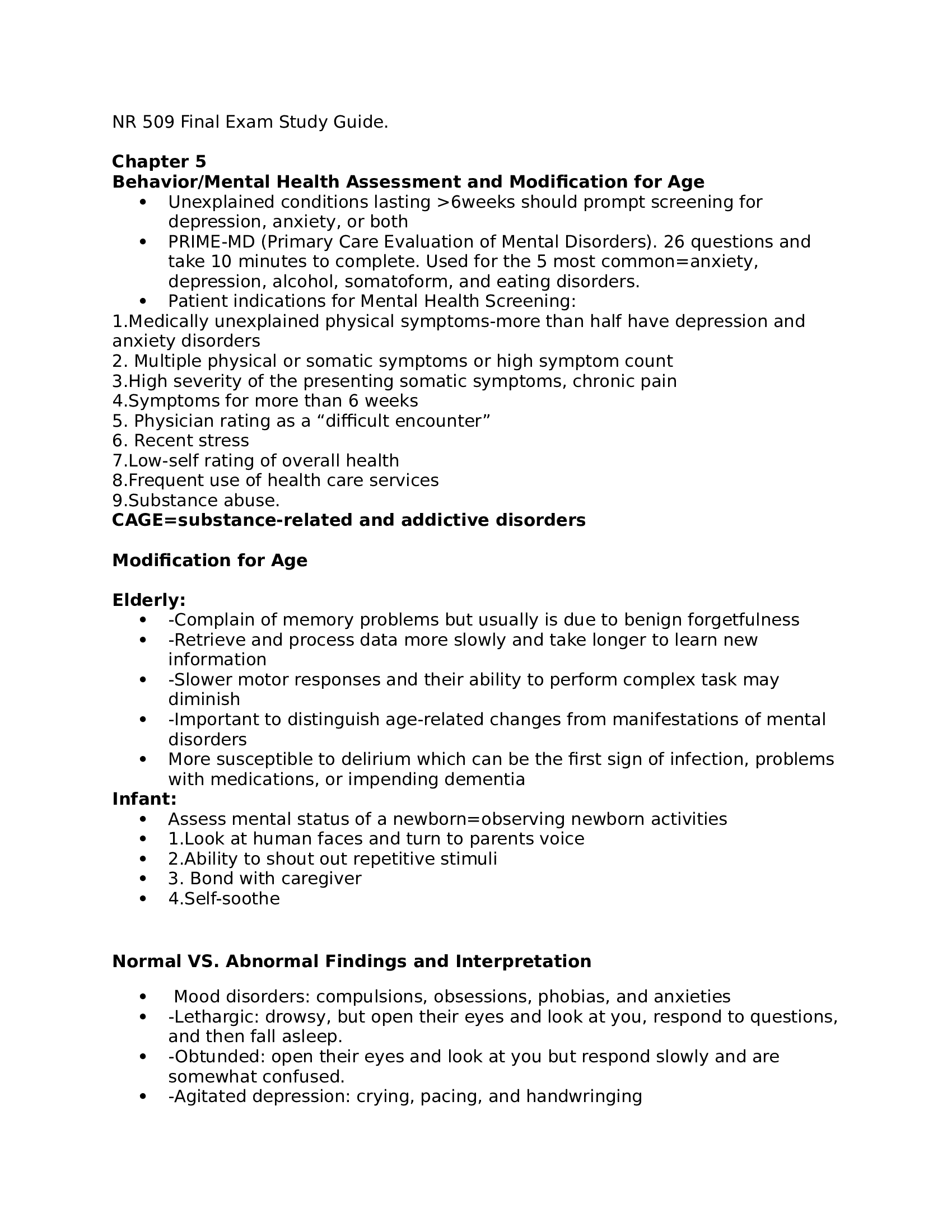
NR 509 Exam Study Guide

Behavior/Mental Health Assessment and Modification for  Age

Unexplained conditions lasting >6weeks should prompt screening for depression, anxiety, or both

PRIME-MD (Primary Care Evaluation of Mental Disorders). 26 questions and take 10 minutes to complete. Used for the 5 most common=anxiety, depression, alcohol, somatoform, and eating disorders.

Patient indications for Mental Health Screening:

1.Medically unexplained physical symptoms-more than half have depression and anxiety disorders

2. Multiple physical or somatic symptoms or high symptom count

3.High severity of the presenting somatic symptoms, chronic pain

4.Symptoms for more than 6 weeks

5. Physician rating as a “difficult encounter”

6. Recent stress

7.Low-self rating of overall health

8.Frequent use of health care services

9.Substance abuse.

CAGE=substance-related and addictive disorders

Modification for  Age

Elderly:

  • Complain of memory problems but usually is due to benign forgetfulness
  • Retrieve and process data more slowly and take longer to learn new information
  • Slower motor responses and their ability to perform complex task may diminish
  • Important to distinguish age-related changes from manifestations of mental disorders
  • More susceptible to delirium which can be the first sign of infection, problems with medications, or impending dementia

Infant:

          Assess mental status of a newborn=observing newborn activities

          1.Look at human faces and turn to parents voice

          2.Ability to shout out repetitive stimuli

          3. Bond with caregiver

          4.Self-soothe

Normal VS. Abnormal Findings  and Interpretation

Mood  disorders: compulsions, obsessions, phobias, and anxieties

  • Lethargic: drowsy, but open their eyes and look at you, respond to questions, and then fall asleep.
  • Obtunded: open their eyes and look at you but respond slowly and are somewhat confused.
  • Agitated depression: crying, pacing, and handwringing

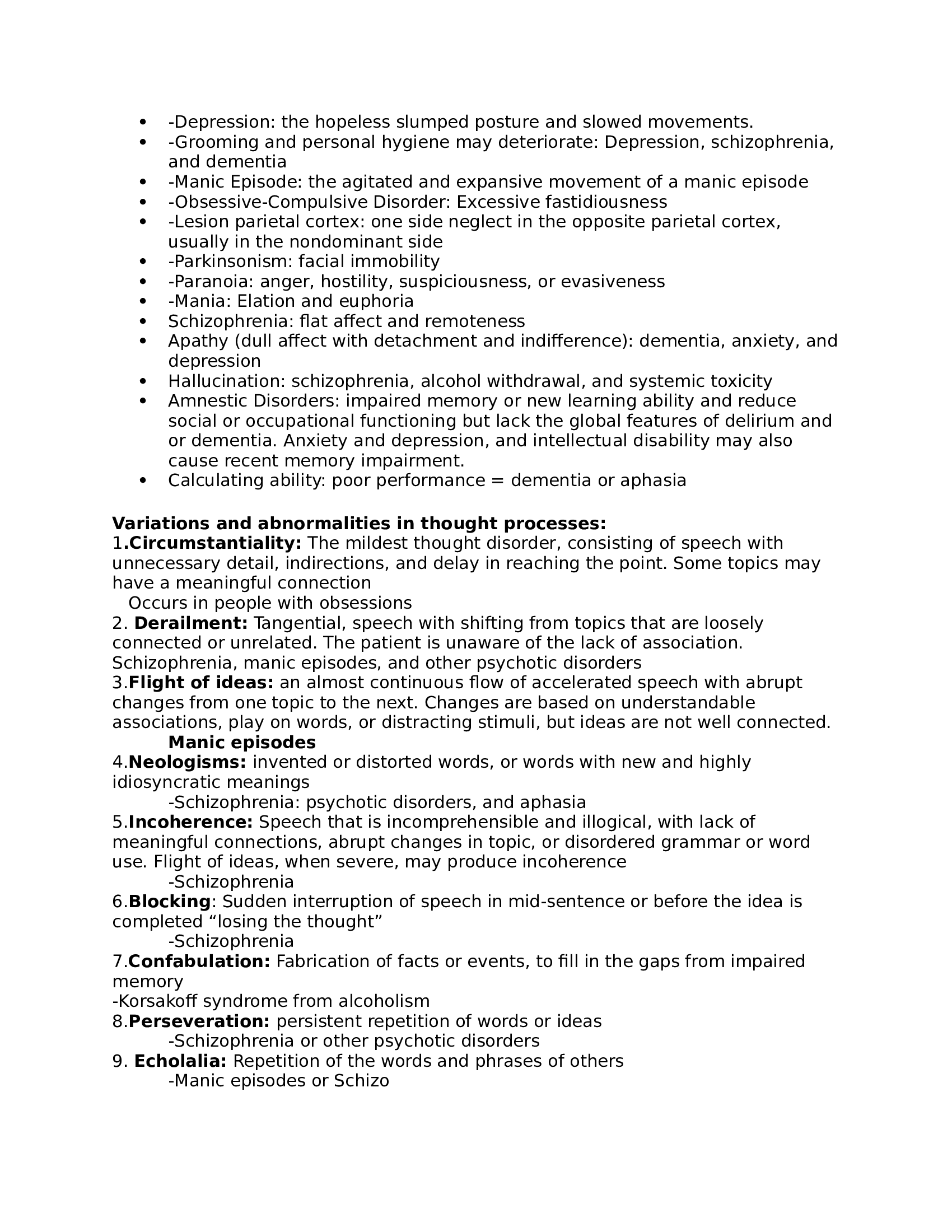
Depression: the hopeless slumped posture and slowed movements.

Grooming and personal hygiene may deteriorate: Depression, schizophrenia, and dementia

Manic Episode: the agitated and expansive movement of a manic episode

Obsessive-Compulsive Disorder: Excessive fastidiousness

Lesion parietal cortex: one side neglect in the opposite parietal cortex, usually in the nondominant side

Parkinsonism: facial immobility

Paranoia: anger, hostility, suspiciousness, or evasiveness

Mania: Elation and euphoria

Schizophrenia: flat affect and remoteness

Apathy (dull affect with detachment and indifference): dementia, anxiety, and depression

Hallucination: schizophrenia, alcohol withdrawal, and systemic toxicity

Amnestic Disorders: impaired memory or new learning ability and reduce social or occupational functioning but lack the global features of delirium and or dementia. Anxiety and depression, and intellectual disability may also cause recent memory impairment.

Calculating ability: poor performance = dementia or aphasia

Variations and abnormalities in thought processes:

1.Circumstantiality: The mildest thought disorder, consisting of speech with unnecessary detail, indirections, and delay in reaching the point. Some topics may have a meaningful connection

Occurs in people with obsessions

2. Derailment: Tangential, speech with shifting from topics that are loosely connected or unrelated. The patient is unaware of the lack of association. Schizophrenia, manic episodes, and other psychotic disorders

3.Flight of ideas: an almost continuous flow of accelerated speech with abrupt changes from one topic to the next. Changes are based on understandable associations, play on words, or distracting stimuli, but ideas are not well connected.

Manic episodes

4.Neologisms: invented or distorted words, or words with new and highly idiosyncratic meanings

-Schizophrenia: psychotic disorders, and aphasia

5.Incoherence: Speech that is incomprehensible and illogical, with lack of meaningful connections, abrupt changes in topic, or disordered grammar or word use. Flight of ideas, when severe, may produce incoherence

-Schizophrenia

6.Blocking: Sudden interruption of speech in mid-sentence or before the idea is completed “losing the thought”

-Schizophrenia

7.Confabulation: Fabrication of facts or events, to fill in the gaps from impaired memory

-Korsakoff syndrome from alcoholism

8.Perseveration: persistent repetition of words or ideas

-Schizophrenia or other psychotic disorders

9. Echolalia: Repetition of the words and phrases of others

-Manic episodes or Schizo

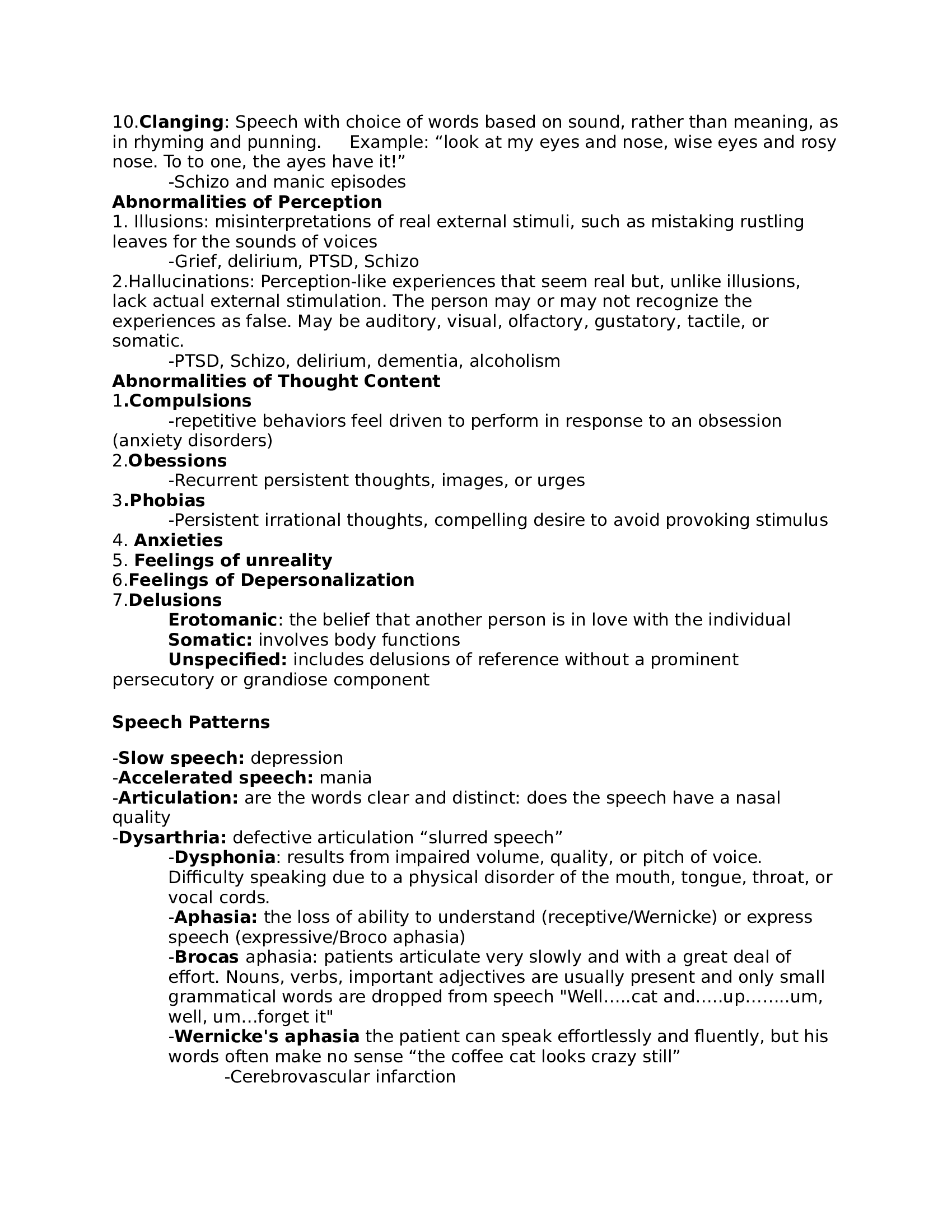
10.Clanging: Speech with choice of words based on sound, rather than meaning, as in rhyming and punning.     Example: “look at my eyes and nose, wise eyes and rosy nose. To to one, the ayes have it!”

-Schizo and manic episodes

Abnormalities of Perception

1. Illusions: misinterpretations of real external stimuli, such as mistaking rustling leaves for the sounds of voices

-Grief, delirium, PTSD, Schizo

2.Hallucinations: Perception-like experiences that seem real but, unlike illusions, lack actual external stimulation. The person may or may not recognize the experiences as false. May be auditory, visual, olfactory, gustatory, tactile, or somatic.

-PTSD, Schizo, delirium, dementia, alcoholism

Abnormalities of Thought Content

1.Compulsions

-repetitive behaviors feel driven to perform in response to an obsession

(anxiety disorders)

2.Obessions

-Recurrent persistent thoughts, images, or urges

3.Phobias

-Persistent irrational thoughts, compelling desire to avoid provoking stimulus

4. Anxieties

5. Feelings of unreality

6.Feelings of Depersonalization

7.Delusions

Erotomanic: the belief that another person is in love with the individual

Somatic: involves body functions

Unspecified: includes delusions of reference without a prominent persecutory or grandiose component

Speech Patterns

  • Slow speech: depression
  • Accelerated speech: mania
  • Articulation: are the words clear and distinct: does the speech have a nasal quality
  • Dysarthria: defective articulation “slurred speech”
  • Dysphonia: results from impaired volume, quality, or pitch of voice. Difficulty speaking due to a physical disorder of the mouth, tongue, throat, or vocal cords.
  • Aphasia: the loss of ability to understand (receptive/Wernicke) or express speech (expressive/Broco aphasia)
  • Brocas aphasia: patients articulate very slowly and with a great deal of effort. Nouns, verbs, important adjectives are usually present and only small grammatical words are dropped from speech "Well…..cat and…..up……..um, well, um…forget it"
  • Wernicke's aphasia the patient can speak effortlessly and fluently, but his words often make no sense “the coffee cat looks crazy still”
  • Cerebrovascular infarction
  • Fluency: fluency reflects the rate, flow, and melody of speech and the content and use of words. Abnormalities
  • Hesitancies and gaps in the flow and rhythm of words
  • Disturbed inflections, such as monotone
  • Circumlocutions: phrases or sentences are substituted for a word  the person cannot      think of. Example “what you write with for “pen”
  • Paraphasia: malformed, wrong, or invented

Testing for  Aphasia

  • Word  comprehension: ask the patient to follow one-stage commands such as “Point to your nose”
  • Repetition
  • Naming
  • Reading comprehension
  • Writing

Mental Status Examination

Brief test used to screen for cognitive dysfunction or dementia and follow the patients course over time.

  • Orientation
  • Short-term memory-retention/recall
  • Language
  • Attention
  • Calculation
  • Constructive Praxis

Example of findings that suggest dementia: “The patient appears sad and fatigued; clothes are wrinkled. Speech is slow and words are mumbled. Thought processes are coherent, but insight into current life reverses is limited. The patient is oriented to person, place, and time. Digit span, serial

7s, and calculations accurate, but responses delayed. Clock drawing is good.

Screening for Depression

High Yield Screening Questions for  office practice: 1. over the past 2 weeks, have you felt down, depressed, or hopeless? 2. Over the past 2 weeks, have you felt little interest or pleasure in doing things (anhedonia)?

Symptoms of depression: low self-esteem, loss of pleasure (anhedonia), sleep disorder, difficulty concentrating.  Depression tends to be long-lasting and can recur. Suicide is the second leading cause of death among 15-24-year-old. Suicide rate are the highest among those ages 45 to 54, followed by elderly adults 85 years old or older. 90 % of suicide is non-Hispanic whites.

Other symptoms of depression: headaches, muscle aches, fatigue

Generalized Anxiety Disorder

  • Most common mental disorder in primary care
  • High Yield Screening Questions for office practice:

1. Over the past 2 weeks, have you been feeling nervous, anxious, on edge, unable to stop or control worrying?

2. Over the past 4 weeks, have you had an anxiety attack-suddenly feeling fear or panic?

You can screen for core anxiety symptoms by asking the first two questions from the

7-item generalized anxiety disorder (GAD) scale. Scores on this GAD subscale range from 0 to 6; a score of 0 suggests that no anxiety disorder is present. A score of 10 on the GAD-7 identifies GAD; scores of 5, 10, and 15 represent mild, moderate, and severe levels of anxiety. 

Depressive Disorders

Depression and anxiety disorders are a common cause of hospitalization in the  United States, and mental illness is associated with increased risks for chronic medical conditions, decreased life expectancy, disability, substance abuse, and suicide.

About 19million adult American or almost 7% have major depression with other co- existing anxiety disorder or substance abuse. Depression is as common in women as men, and the prevalence of postpartum depression is about 7% to 13%. Most patients with chronic medical conditions have depression. Symptoms of depression in high-risk patients may be subtle and may include;

  • Low self-esteem
  • Loss of pleasure in daily activities (Anhedonia)
  • Sleep disorder,
  • Difficulty concentrating or making decisions.

Look  carefully for symptoms of depression in vulnerable patients, especially those who  are young, female, single, divorced or separated, seriously or chronically ill, bereaved, or have other psychiatric disorders, including substance abuse. A personal or family history of depression also places patients at risk.

Asking two simple questions about mood and anhedonia appears to be as effective as using more detailed instruments. All positive screening tests warrant full diagnostic interviews. Failure to diagnose depression can have fatal consequences— the presence of an affective disorder is associated with an 11-fold increased risk for suicide.

Depression screening

  • Over the past 2 weeks, have you felt down, depressed, or hopeless?
  • Over the past 2 weeks, have you felt little interest or pleasure in doing things (anhedonia)?

Depression tends to be long-lasting and can recur. Because of these two factors, a wait-and-see approach to treatment is not desirable and timely treatment is necessary.

Schizophrenia

  • Grooming and personal hygiene may deteriorate flat affect and remoteness
  • Hallucinations: lack actual external stimulation
  • Derailment: Tangential, speech with shifting from topics that are loosely connected or unrelated. The patient is unaware of the lack of association.
  • Neologisms: invented or distorted words, or words with new and highly idiosyncratic meaning.
  • Incoherence: Speech that is incomprehensible and illogical, with lack of meaningful connections, abrupt changes in topic, or disordered grammar or word  use.
  • Flight of ideas, when severe, may produce incoherence

Contact the Seller

Please Sign In to contact this seller.


  • 👎  Report Copyright Violation

Frequently Asked Questions

What Do I Get When I Buy This Study Material?

+

When you buy a study material on Passing Grades, an instant download link will be sent directly to your email, giving you access to the file anytime after payment is completed.

Is Passing Grades a Trusted Platform?

+

Yes, Passing Grades is a reputable students’ marketplace with a secure payment system and reliable customer support. You can trust us to ensure a safe and seamless transaction experience.

Will I Be Stuck with a Subscription?

+

No, all purchases on Passing Grades are one-time transactions. You only pay for the notes you choose to buy, with no subscriptions or hidden fees attached.

Who Am I Buying These Study Materials From?

+

Passing Grades is a marketplace, which means you are purchasing the document from an individual vendor, not directly from us. We facilitate the payment and delivery process between you and the vendor.

Does Passing Grades Offer Free Study Materials?

+

Yes, sellers on Passing Grades have uploaded numerous free test banks, exams, practice questions, and class notes that can be downloaded at no cost.


Pasinggrades - Quality Study Materials

USD 10

    • Quality checked by Pasing Grades
    • 100% satisfaction guarantee
    • Seller: mentor2000
Buy PDF $10

Seller Information

mentor2000

Member since April 2021

  • icon
  • icon
View Profile
  • total sales

    0
  • Favourites

    0
  • Comments

    0
    ( 0 Ratings )

Item Information

  • Uploaded

    22 July 2022

  • Updated

    29 September 2025

  • Category

    Nursing

  • Item Type

    exam

  • Tags

    NR 509 Final Exam Study Guide

Related Exam Prep Guides by mentor2000

Test Bank for Essentials for Nursing Practice 8th Edition by Potter | All Chapters
View Document

Test Bank for Essent...

  • mentor2000

    mentor2000

  • exam

Master nursing concepts with this study material; Test Bank for Essentials for Nursing Practice, 8th...

10 USD

0

0

A &P 1 MA278 BSC2 Final Module II Questions & Answers 2026 Update
View Document

A &P 1 MA278 BSC2 Fi...

  • mentor2000

    mentor2000

  • exam

Prepare for success with A&P 1 MA278 BSC2 Final Module II 2024 Q&A. Boost your grades with this comp...

10 USD

0

0

ATI Comprehensive Predictor Exam 2026
View Document

ATI Comprehensive Pr...

  • mentor2000

    mentor2000

  • exam

Prepare for success with the ATI Comprehensive Predictor Exam 2026. Access key practice questions to...

10 USD

0

0

Purchase

Download link will be sent to this email immediately after purchase.

IMPORTANT LINKS

  • How To Upload Class Notes
  • Selling Tips
  • Passing Grades's Study Materials
  • Scholarships for International Students 2025

POPULAR CATEGORIES

  • Law
  • Accounting
  • English
  • Psychology
  • Business
  • Nursing
  • Computer Science
  • General

View Document

  • Blog
  • Contact
  • Delivery Policy
  • Latest Scholarships Around the World
  • How to Pass Bar Exams: Passing Grades’ Strategies
  • How to Study and Pass the CPA Exam
  • All Test Banks
  • Faq
  • Copyright Claims
  • Privacy Policy
  • Terms of Use

KNOWLEDGE BASE

  • How to Write A+ Grade Good Research Paper
  • How to Manage Stress During Exam Period
  • Best Time to Study
  • How to Pass NCLEX-RN Exam
  • How To Effectively Utilize Test Banks
  • Popular Shadow Health Exam Assessments
  • Popular HESI Case Studies
  • How to Prepare for a Nursing Career
  • The Importance Of Summaries in Exam Revisvion

© 2026 Pasing Grades. All rights reserved.