Pasing Grades
  • Start Selling
  • Blog
  • Contact
  • 0

    Your cart is empty!

English

  • English
  • Spanish
  • Arabic
Create Account Sign In
  • Library
    • New Prep Guides
    • Featured Prep Guides
    • Free Exam Prep Guides
    • Best sellers
  • General
  • Nursing
    • Research Paper
    • Case Study
    • Discussion Post
    • Assignment
    • Exam
    • Practice Questions and Answers
    • Test Bank
    • solutions manual
  • Accounting
    • Case Study
    • Thesis
    • Study Guide
    • Summary
    • Research Paper
    • test bank
  • English
    • Creative Writing
    • Research Paper
    • Summary
    • Rhetorics
    • Literature
    • Journal
    • Exam
    • Grammar
    • Discussion Post
    • Essay
  • Psychology
    • Hesi
    • Presentation
    • Essay
    • Summary
    • Study Guide
    • Essay
    • Solution Manual
    • Final Exam Review
    • Class Notes
    • test bank
  • Business
    • Lecture Notes
    • Solution Manual
    • Presentation
    • Business Plan
    • Class Notes
    • Experiment
    • Summary
    • Practice Questions
    • Study Guide
    • Case Study
    • test bank
    • Exam
  • More
    • Computer Science
    • Economics
    • Statistics
    • Engineering
    • Biology
    • Religious Studies
    • Physics
    • Chemistry
    • Mathematics
    • History
    • Sociology
    • Science
    • Philosophy
    • Law
  • Pages
    • About Us
    • Selling Tips
    • Delivery Policy
    • Faq
    • Privacy Policy
  • Flash Sale
  • Home
  • Module 8 Exam HESI Saunders Online Review : NCLEX-RN 2026 Exam Answered

Module 8 Exam HESI Saunders Online Review : NCLEX-RN 2026 Exam Answered

Preview page 1 Preview page 2 Preview page 3
Add To Favorites

Share this item Share this item

  • Item Details
  • Comments (0)
  • Reviews (0)
  • Contact Seller

HESI/Saunders Online Review for the NCLEX-RN Examination (2 Year), 2nd Edition


Module 8 Exam


1.     Questions

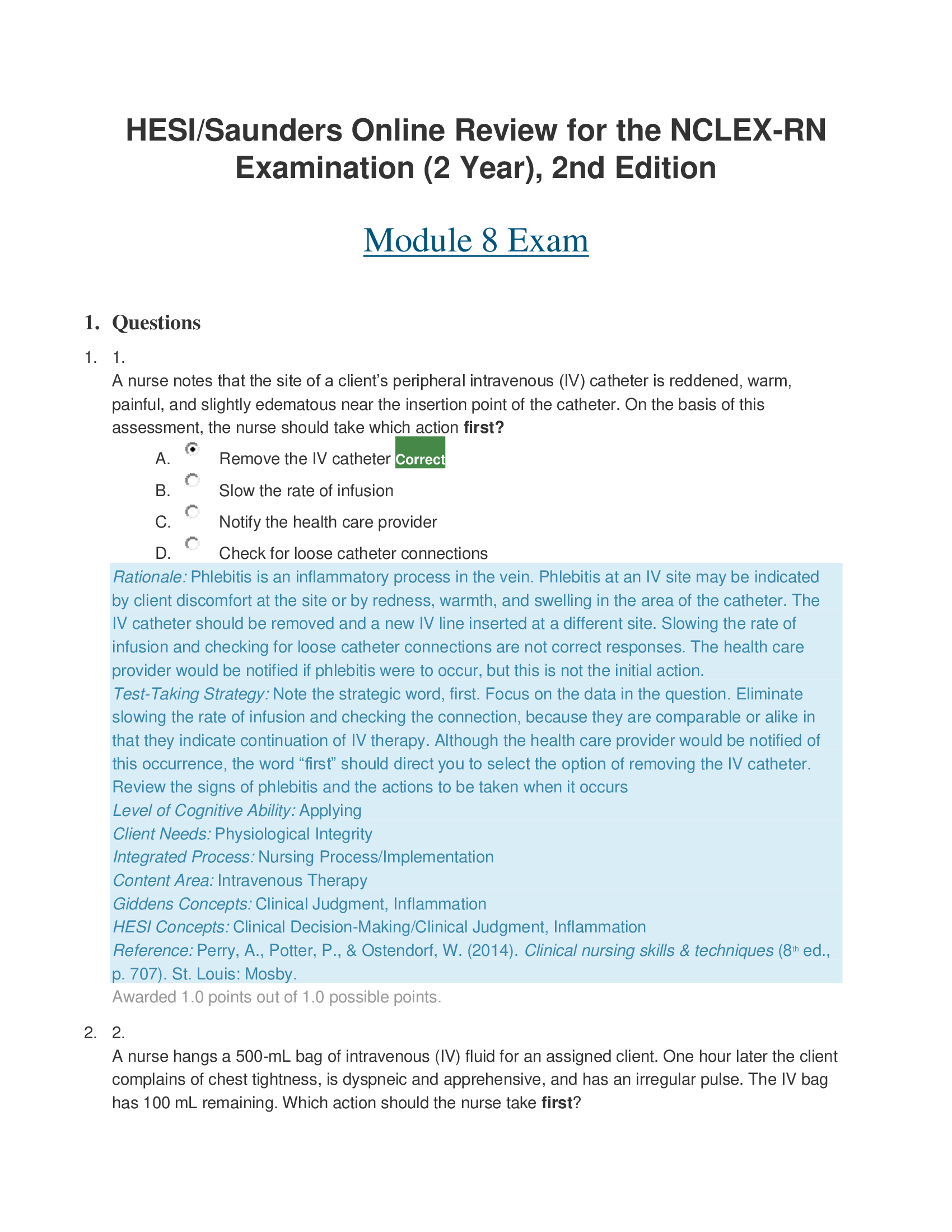
1.    1.

A nurse notes that the site of a client’s peripheral intravenous (IV) catheter is reddened, warm, painful, and slightly edematous near the insertion point of the catheter. On the basis of this assessment, the nurse should take which action first?

A.     Remove the IV catheter Correct

B.     Slow the rate of infusion

C.     Notify the health care provider

D.     Check for loose catheter connections

Rationale: Phlebitis is an inflammatory process in the vein. Phlebitis at an IV site may be indicated by client discomfort at the site or by redness, warmth, and swelling in the area of the catheter. The IV catheter should be removed and a new IV line inserted at a different site. Slowing the rate of infusion and checking for loose catheter connections are not correct responses. The health care provider would be notified if phlebitis were to occur, but this is not the initial action.
Test-Taking Strategy: Note the strategic word, first. Focus on the data in the question. Eliminate slowing the rate of infusion and checking the connection, because they are comparable or alike in that they indicate continuation of IV therapy. Although the health care provider would be notified of this occurrence, the word “first” should direct you to select the option of removing the IV catheter. Review the signs of phlebitis and the actions to be taken when it occurs
Level of Cognitive Ability: Applying
Client Needs: Physiological Integrity
Integrated Process: Nursing Process/Implementation
Content Area: Intravenous Therapy
Giddens Concepts: Clinical Judgment, Inflammation
HESI Concepts: Clinical Decision-Making/Clinical Judgment, Inflammation
Reference: Perry, A., Potter, P., & Ostendorf, W. (2014). Clinical nursing skills & techniques (8
th ed., p. 707). St. Louis: Mosby.

Awarded 1.0 points out of 1.0 possible points.

2.    2.

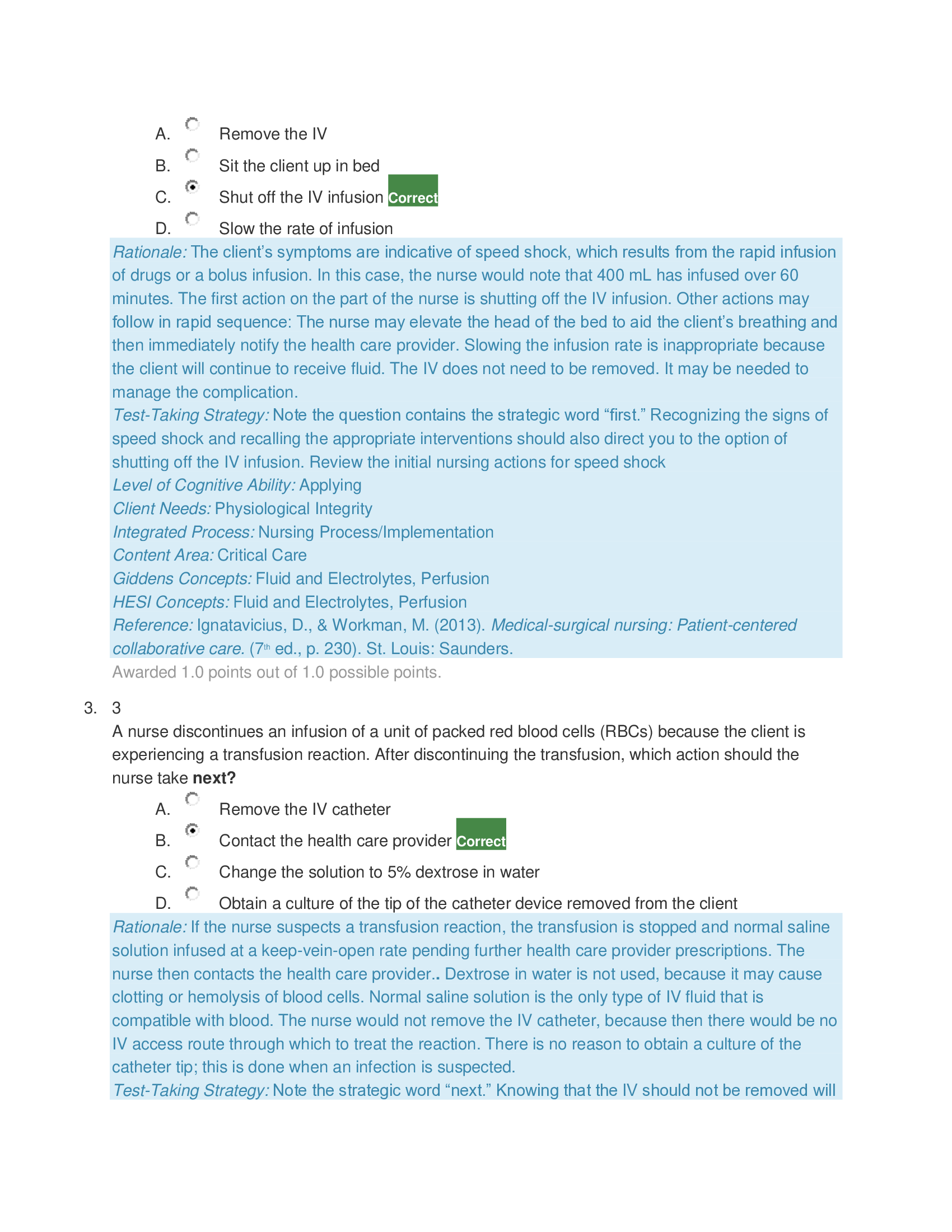
A nurse hangs a 500-mL bag of intravenous (IV) fluid for an assigned client. One hour later the client complains of chest tightness, is dyspneic and apprehensive, and has an irregular pulse. The IV bag has 100 mL remaining. Which action should the nurse take first?

A.     Remove the IV

B.     Sit the client up in bed

C.     Shut off the IV infusion Correct

D.     Slow the rate of infusion

Rationale: The client’s symptoms are indicative of speed shock, which results from the rapid infusion of drugs or a bolus infusion. In this case, the nurse would note that 400 mL has infused over 60 minutes. The first action on the part of the nurse is shutting off the IV infusion. Other actions may follow in rapid sequence: The nurse may elevate the head of the bed to aid the client’s breathing and then immediately notify the health care provider. Slowing the infusion rate is inappropriate because the client will continue to receive fluid. The IV does not need to be removed. It may be needed to manage the complication.
Test-Taking Strategy: Note the question contains the strategic word “first.” Recognizing the signs of speed shock and recalling the appropriate interventions should also direct you to the option of shutting off the IV infusion. Review the initial nursing actions for speed shock
Level of Cognitive Ability: Applying
Client Needs: Physiological Integrity
Integrated Process: Nursing Process/Implementation
Content Area: Critical Care
Giddens Concepts: Fluid and Electrolytes, Perfusion
HESI Concepts: Fluid and Electrolytes, Perfusion
Reference: Ignatavicius, D., & Workman, M. (2013). Medical-surgical nursing: Patient-centered collaborative care. (7
th ed., p. 230). St. Louis: Saunders.

Awarded 1.0 points out of 1.0 possible points.

3.    3

A nurse discontinues an infusion of a unit of packed red blood cells (RBCs) because the client is experiencing a transfusion reaction. After discontinuing the transfusion, which action should the nurse take next?

A.     Remove the IV catheter

B.     Contact the health care provider Correct

C.     Change the solution to 5% dextrose in water

D.     Obtain a culture of the tip of the catheter device removed from the client

Rationale: If the nurse suspects a transfusion reaction, the transfusion is stopped and normal saline solution infused at a keep-vein-open rate pending further health care provider prescriptions. The nurse then contacts the health care provider.. Dextrose in water is not used, because it may cause clotting or hemolysis of blood cells. Normal saline solution is the only type of IV fluid that is compatible with blood. The nurse would not remove the IV catheter, because then there would be no IV access route through which to treat the reaction. There is no reason to obtain a culture of the catheter tip; this is done when an infection is suspected.
Test-Taking Strategy: Note the strategic word “next.” Knowing that the IV should not be removed will assist you in the elimination process. Recalling that normal saline solution is the only type of IV fluid that is compatible with blood will also help you answer correctly. To select from the remaining options, note that infection is not the concern; this will help you eliminate the option of obtaining a culture of the catheter tip. Review care of the client experiencing a transfusion reaction
Level of Cognitive Ability: Applying
Client Needs: Physiological Integrity
Integrated Process: Nursing Process/Implementation
Content Area: Blood administration
Giddens Concepts: Clinical Judgment, Perfusion
HESI Concepts: Clinical Decision-Making/Clinical Judgment, Perfusion
Reference: Perry, A., Potter, P., & Ostendorf, W. (2014). Clinical nursing skills & techniques (8
th ed., pp. 740-741). St. Louis: Mosby.

Awarded 1.0 points out of 1.0 possible points.

4.    4.

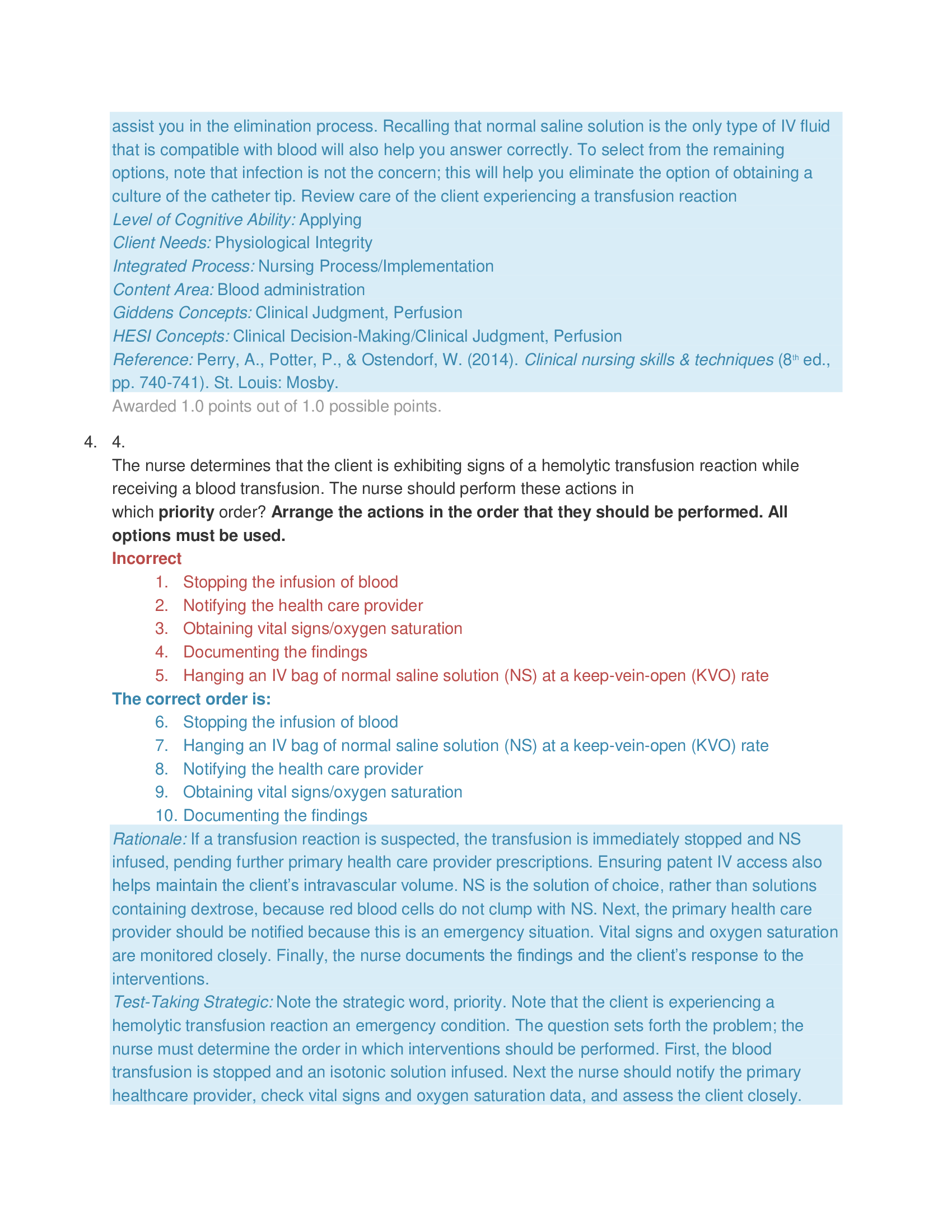
The nurse determines that the client is exhibiting signs of a hemolytic transfusion reaction while receiving a blood transfusion. The nurse should perform these actions in which priority order? Arrange the actions in the order that they should be performed. All options must be used.

Incorrect

1.    Stopping the infusion of blood

2.    Notifying the health care provider

3.    Obtaining vital signs/oxygen saturation

4.    Documenting the findings

5.    Hanging an IV bag of normal saline solution (NS) at a keep-vein-open (KVO) rate

The correct order is:

6.    Stopping the infusion of blood

7.    Hanging an IV bag of normal saline solution (NS) at a keep-vein-open (KVO) rate

8.    Notifying the health care provider

9.    Obtaining vital signs/oxygen saturation

10.  Documenting the findings

Rationale: If a transfusion reaction is suspected, the transfusion is immediately stopped and NS infused, pending further primary health care provider prescriptions. Ensuring patent IV access also helps maintain the client’s intravascular volume. NS is the solution of choice, rather than solutions containing dextrose, because red blood cells do not clump with NS. Next, the primary health care provider should be notified because this is an emergency situation. Vital signs and oxygen saturation are monitored closely. Finally, the nurse documents the findings and the client’s response to the interventions.
Test-Taking Strategic: Note the strategic word, priority. Note that the client is experiencing a hemolytic transfusion reaction an emergency condition. The question sets forth the problem; the nurse must determine the order in which interventions should be performed. First, the blood transfusion is stopped and an isotonic solution infused. Next the nurse should notify the primary healthcare provider, check vital signs and oxygen saturation data, and assess the client closely. Once prescriptions from the primary healthcare provider have been initiated, the nurse should document the event and client’s response. Review the prioritization of interventions for a transfusion reaction
Level of Cognitive Ability: Applying
Client Needs: Physiological Integrity
Integrated Process: Nursing Process/Implementation
Content Area: Blood Administration
Giddens Concepts: Care Coordination, Clinical Judgment
HESI Concepts: Clinical Decision-Making/Clinical Judgment, Collaboration/Managing Care – Care Coordination
Reference: Perry, A., Potter, P., & Ostendorf, W. (2014). Clinical nursing skills & techniques (8th ed., pp. 740-741). St. Louis: Mosby.

Awarded 0.0 points out of 1.0 possible points.

5.    5.

A client with heart failure is being given furosemide and digoxin. The client calls the nurse and complains of anorexia and nausea. Which action should the nurse take first?

 .       Administer an antiemetic

B.     Administer the daily dose of digoxin

C.     Discontinue the morning dose of furosemide

D.     Checkthe result of laboratory testing for potassium on the sample drawn 3 hours ago Correct

Rationale: Anorexia and nausea are symptoms commonly associated with digoxin toxicity, which is compounded by hypokalemia. Early clinical manifestations of digoxin toxicity include anorexia and mild nausea, but they are frequently overlooked or not associated with digoxin toxicity. Hallucinations and any change in pulse rhythm, color vision, or behavior should be investigated and reported to the health care provider. The nurse should first check the results of the potassium level, which will provide additional when the nurse calls the health care provider,an important follow-up action. The nurse should also check the digoxin reading if one is available. The nurse would not administer an antiemetic without further investigating the client’s problem. Because digoxin toxicity is suspected, the nurse would withhold the digoxin until the health care provider has been consulted. The nurse would not discontinue a medication without a prescription to do so.
Test-Taking Strategy: Note the strategic word “first” and use the steps of the nursing process to answer the question. The correct option is the only one that addresses assessment. Review nursing interventions for suspected digoxin toxicity
Level of Cognitive Ability: Applying
Client Needs: Physiological Integrity
Integrated Process: Nursing Process/Implementation
Content Area: Pharmacology
Giddens Concepts: Cellular Regulation, Clinical Judgment
HESI Concepts: Cellular Regulation, Clinical Decision-Making/Clinical Judgment
References: Hodgson, B., & Kizior, R. (2015). Saunders nursing drug handbook 2015. (p. 363) St. Louis: Saunders.
Ignatavicius, D., & Workman, M. (2013). Medical-surgical nursing: Patient-centered collaborative care. (7
th ed., p. 753). St. Louis: Saunders.

Awarded 1.0 points out of 1.0 possible points.

6.    6.

The health care provider (HCP)prescribes the administration of totalparenteral nutrition (TPN), to be started at a rate of 50 mL/hr by way of infusion pump through an established subclavian central line. After the first 2 hours of the TPN infusion, the client suddenly complains of difficulty breathing and chest pain. The nurse should take which immediate action?

 .       Obtain blood for culture

B.     Clamp the TPN infusion line Correct

C.     Obtain an electrocardiogram (ECG)

D.     Obtain a sample for blood glucose testing

Rationale: One complication of a subclavian central line is embolism, caused by air or thrombus. Sudden onset of chest pain shortly after the initiation of TPN may mean that this complication has developed. The infusion is clamped (the line should not be discontinued, however), the client turned on the left side with the head down, and the HCP notified immediately. Depending on agency protocol, the rapid response team would also be called. Blood cultures are not necessary in this situation, because infection is not the concern. Likewise, there is no useful reason for checking the blood glucose level. An ECG may be obtained, but this is not the immediate priority. If the client shows signs of an air embolism, the nurse should examine the catheter to determine whether an open port has allowed air into the circulatory system.
Test-Taking Strategy: Note the strategic word “immediate.” Focus on the data provided in the question to determine that an embolus has occurred. Eliminate blood cultures and blood glucose testing, which, respectively, relate to infection and hyperglycemia, which is not likely to occur during the first 2 hours of TPN administration. To select from the remaining options, focus on the strategic word “immediate”; this will direct you to the correct option. Review the complications of TPN and the associated nursing interventions
Level of Cognitive Ability: Applying
Client Needs: Physiological Integrity
Integrated Process: Nursing Process/Implementation
Content Area: TotalParenteral Nutrition
Giddens Concepts: Clinical Judgment, Perfusion
HESI Concepts: Clinical Decision-Making/Clinical Judgment, Perfusion-Clotting
Reference: Lewis, S., Dirksen, S., Heitkemper, M., & Bucher, L. (2014). Medical-surgical nursing: Assessment and management of clinical problems (9
th ed., p. 311). St. Louis: Mosby.

Awarded 1.0 points out of 1.0 possible points.

7.    7.

The health care provider prescribes 2000 mL of 5% dextrose and normal saline 0.45% for infusion over 24 hours. The drop factor is 15 gtt/mL. At how many drops per minute does the nurse set the flow rate? (Round to the nearest whole number).
Correct

Correct Responses

0.    21

Rationale: Use the IV flow rate formula:

https://coursewareobjects.elsevier.com/objects/NCLEX/silvestri1e_v1/mod_08/images/exam/M08Q007E01.gif


https://coursewareobjects.elsevier.com/objects/NCLEX/silvestri1e_v1/mod_08/images/exam/M08Q007E02.gif


Test-Taking Strategy: Focus on the information in the question. Use the formula for calculating IV flow rates when answering the question. Remember to convert 24 hours to minutes and to round the answer to the nearest whole number. Review IV infusion rates
Level of Cognitive Ability: Applying
Client Needs: Physiological Integrity
Integrated Process: Nursing Process/Implementation
Content Area: Intravenous Therapy
Giddens Concepts: Clinical Judgment, Safety
HESI Concepts: Clinical Decision-Making/Clinical Judgment, Safety
Reference: Perry, A., Potter, P., & Ostendorf, W. (2014). Clinical nursing skills & techniques (8
th ed., pp. 710-711). St. Louis: Mosby.

Awarded 1.0 points out of 1.0 possible points.

8.    8.

A nurse is assessing a peripheral intravenous (IV) site and notes blanching, coolness, and edema at the insertion site. What should the nurse do first?

 .       Remove the IV Correct

B.     Apply a warm compress

C.     Check for blood return

D.     Measure the area of infiltration

Rationale: Blanching, coolness, and edema of the IV site are all signs of infiltration. Because infiltration may result in damage to the surrounding tissue, the nurse must first remove the IV cannula to prevent any further damage. The nurse should not depend solely on the blood return for assurance that the cannula is in the vein, because blood return may be present even if the cannula is only partially in the vein. Compresses may be used, but the compress (warm or cool) depends on the type of solution infusing and health care provider preference. The nurse should measure the area of infiltration after the IV has been removed so that further tissue damage is prevented.
Test-Taking Strategy: Note the strategic word “first.” Although each of these options is appropriate, it is necessary to prioritize them. The signs presented in the question point to infiltration. Infiltration indicates that the IV must be removed. Review the signs of infiltration and the appropriate initial interventions
Level of Cognitive Ability: Applying
Client Needs: Physiological Integrity
Integrated Process: Nursing Process/Implementation
Content Area: Intravenous Therapy
Giddens Concepts: Clinical Judgment, Inflammation
HESI Concepts: Clinical Decision-Making/Clinical Judgment, Inflammation
Reference: Ignatavicius, D., & Workman, M. (2013). Medical-surgical nursing: Patient-centered collaborative care. (7
th ed., p. 228). St. Louis: Saunders.

Awarded 1.0 points out of 1.0 possible points.

9.    9.

A home care nurse has been assigned a client who has been discharged home with a prescription for total parenteral nutrition (TPN). Which parameters does the nurse plan to check at each visit as a means of identifying complications of the TPN therapy? Select all that apply.

 .       Weight Correct

B.     Glucose test Correct

C.     Temperature Correct

D.     Peripheral pulses

E.     Hemoglobin and hematocrit

Rationale: When a client is receiving TPN therapy, the nurse monitors the client’s weight to determine the effectiveness of the therapy. The nurse should weigh the client at each visit to make sure that the client has not gained or lost an excessive amount of weight. Because the formula contains a large amount of dextrose, the health care provider should check the client’s glucose level frequently. The nurse caring for a client receiving TPN at home should also monitor the temperature to detect infection, which is a potential complication of this therapy. An infection in the intravenous line could result in sepsis, because the catheter is in a blood vessel. The peripheral pulses and hemoglobin and hematocrit readings may provide data but are unrelated to complications associated with TPN therapy.
Test-Taking Strategy: Focus on the subject, complications associated with TPN therapy. Think about the procedures involved with the administration of TPN and the associated complications to answer correctly. Review the priority assessments in the client receiving TPN
Level of Cognitive Ability: Analyzing
Client Needs: Physiological Integrity
Integrated Process: Nursing Process/Planning
Content Area: Total Parenteral Nutrition
Giddens Concepts: Clinical Judgment, Nutrition
HESI Concepts: Clinical Decision-Making/Clinical Judgment, Metabolism-Nutrition
Reference: Perry, A., Potter, P., & Ostendorf, W. (2014). Clinical nursing skills & techniques (8
th ed., p. 800). St. Louis: Mosby.

Awarded 3.0 points out of 3.0 possible points.

10.  10.

A nurse is caring for a group of adult clients on an acute care nursing unit. Which clients does the nurse recognize as the most likely candidates for total parenteral nutrition (TPN)? Select all that apply.

 .       A client with pancreatitis Correct

B.     A client with severe sepsis Correct

C.     A client with renal calculi

D.     A client who has undergone repair of a hiatal hernia

E.     A client with a severe exacerbation of ulcerative colitis Correct

Rationale: TPN is indicated in the client whose gastrointestinal tract is not functional or who cannot tolerate an enteral diet for extended periods. The client with sepsis is very ill and may require TPN. Other candidates include clients who have undergone extensive surgery, sustained multiple fractures, or have advanced cancer or AIDS. The client who has undergone hiatal hernia repair is not a candidate, because this client would resume a normal diet within a relatively short period after the hernia repair. The client with renal calculi also is not a candidate because the client would be able to eat.
Test-Taking Strategy: Note that the question contains the strategic words “most likely,” telling you that the correct options are the clients who require this type of nutritional support. Focus on the needs of the clients identified in the options and use your knowledge of the purposes of TPN to direct you to the correct option. Review the purposes and uses for TPN
Level of Cognitive Ability: Analyzing
Client Needs: Physiological Integrity
Integrated Process: Nursing Process/Analysis
Content Area: Total Parenteral Nutrition
Giddens Concepts: Clinical Judgment, Nutrition
HESI Concepts: Clinical Decision-Making/Clinical Judgment, Metabolism-Nutrition
Reference: Perry, A., Potter, P., & Ostendorf, W. (2014). Clinical nursing skills & techniques (8
th ed., p. 797). St. Louis: Mosby.

Awarded 3.0 points out of 3.0 possible points.

11.  11.

A client with a peripheral intravenous (IV) line in place has a new prescription for infusion of total parenteral nutrition (TPN), a solution containing 25% glucose. Which action should be taken by the nurse?

 .       Hanging the IV solution as prescribed

B.     Questioning the health care provider about the prescription Correct

C.     Diluting the solution with sterile water to half-strength

D.     Hanging the IV solution but setting the infusion at just half the prescribed rate

Rationale: TPN solutions containing as much as 10% glucose can be infused through peripheral vessels. A TPN solution containing 25% glucose is hypertonic. The nurse should question the prescription in the absence of a central venous catheter or a peripherally inserted central catheter. Diluting the solution with sterile water to half-strength and hanging the IV solution as prescribed are both inappropriate. The nurse must not alter a prescribed solution independently.
Test-Taking Strategy: Focus on the information in the question. Note the words “peripheral intravenous (IV) line” and “25% glucose.” Recalling that TPN solutions containing as much as 10% glucose can be infused through peripheral vessels will direct you to the correct option. Review base solutions of TPN and their routes of administration
Level of Cognitive Ability: Applying
Client Needs: Physiological Integrity
Integrated Process: Nursing Process/Implementation
Content Area: Total Parenteral Nutrition
Giddens Concepts: Collaboration, Safety
HESI Concepts: Collaboration/Managing Care, Safety
References: Lewis, S., Dirksen, S., Heitkemper, M., & Bucher, L. (2014). Medical-surgical nursing: Assessment and management of clinical problems (9
th ed., p. 902). St. Louis: Mosby.
Potter, P., Perry, A. G., Stockert, P. A., & Hall, A. M. (2013). Fundamentals of nursing. (8
th ed., p. 905). St. Louis: Mosby.

Awarded 1.0 points out of 1.0 possible points.

12.  12.

The first bag of total parenteral nutrition (TPN) solution has arrived on the clinical unit for a client beginning this nutritional therapy. The solution is to be infused by way of a central line. Which essential piece of equipment should the nurse obtain before hanging the solution?

 .       Pulse oximeter

B.     Blood glucose meter

C.     Electronic infusion device Correct

D.     Noninvasive blood pressure monitor

Rationale: The nurse obtains an electronic infusion device before hanging a TPN solution. Because of the high glucose load, it is necessary to use an infusion device to ensure that the solution does not infuse too rapidly or fall too far behind. Because the client’s blood glucose is checked every 6 to 8 hours during administration of PN, a blood glucose meter will also be needed, but it is not essential before the solution is hung. A noninvasive blood pressure cuff is unnecessary for this procedure. Although oxygen saturation is important, in this situation, it is not the most important equipment to use at this time.
Test-Taking Strategy: Note the strategic word “essential” and note the words “before hanging.” This tells you that the correct option identifies the item that is needed to start the infusion. Use your knowledge of the procedures for TPN administration to eliminate each of the incorrect options. Review theprocedures for initiating a TPN infusion
Level of Cognitive Ability: Applying
Client Needs: Safe and Effective Care Environment
Integrated Process: Nursing Process/Implementation
Content Area: Total Parenteral Nutrition
Giddens Concepts: Clinical Judgment, Safety
HESI Concepts: Clinical Decision-Making/Clinical Judgment, Safety
Reference: Perry, A., Potter, P., & Ostendorf, W. (2014). Clinical nursing skills & techniques (8
th ed., p. 805). St. Louis: Mosby.

Awarded 1.0 points out of 1.0 possible points.

13.  13.

A nurse is monitoring a client who is receiving total parenteral nutrition (TPN). Which t signs and symptoms causes the nurse to suspect that the client is experiencing hyperglycemia as a complication?

 .       Pallor, weak pulse, and anuria

B.     Nausea, vomiting, and oliguria

C.     Nausea, thirst, and increased urine output Correct

D.     Sweating, chills, and decreased urine output

Rationale: The high glucose concentration in TPN puts the client at risk for hyperglycemia. Signs of hyperglycemia include polyuria, polydipsia, polyphagia, blurred vision, nausea and vomiting, and abdominal pain. The nurse checks the blood glucose level immediately if these symptoms develop. The signs and symptoms identified in the other options are unrelated to hyperglycemia.
Test-Taking Strategy: Focus on the subject, signs and symptoms of hyperglycemia. Remembering the “three P’s” (polyuria, polydipsia, and polyphagia) will direct you to the correct option. Also note that this option is the only one that includes increased urine output. Review the signs of hyperglycemia
Level of Cognitive Ability: Analyzing
Client Needs: Physiological Integrity
Integrated Process: Nursing Process/Assessment
Content Area: Total Parenteral Nutrition
Giddens Concepts: Clinical Judgment, Glucose Regulation
HESI Concepts: Clinical Decision-Making/Clinical Judgment, metabolism - GlucoseRegulation
Reference: Perry, A., Potter, P., & Ostendorf, W. (2014). Clinical nursing skills & techniques (8
th ed., p. 798). St. Louis: Mosby.

Awarded 1.0 points out of 1.0 possible points.

14.  14.

At 1600 the nurse checks a client’s total parenteral nutrition (TPN) infusion bag and notes that the solution is running at a rate of 100 mL/hr. The bag was hung the previous day at 1800. The nurse plans to change the infusion bag and tubing this evening at what time?

 .       1700

B.     1800 Correct

C.     2000

D.     2100

Rationale: The TPN solution should be changed every 24 hours as a means of helping prevent infection. Infection is also prevented with the use of aseptic technique during bag and tubing changes. Most agencies recommend that tubing be changed every 24 hours along with the TPN infusion bag. Specific agency policies should always be followed. The nurse should also use a filter when administering TPN in accordance with hospital protocol. Therefore the remaining options are incorrect.
Test-Taking Strategy: Focus on the information in the question and the subject, the time to change the infusion bag. Recalling that the infusion bag should be changed every 24 hours will direct you to the correct option. Review the principles of TPN administration
Level of Cognitive Ability: Applying
Client Needs: Physiological Integrity
Integrated Process: Nursing Process/Planning
Content Area: Total Parenteral Nutrition
Giddens Concepts: Clinical Judgment, Infection
HESI Concepts: Clinical Decision-Making/Clinical Judgment, Infection
Reference: Perry, A., Potter, P., & Ostendorf, W. (2014). Clinical nursing skills & techniques (8
th ed., p. 803). St. Louis: Mosby.

Awarded 1.0 points out of 1.0 possible points.

15.  15.

A nurse is changing the central line dressing of a client receiving total parenteral nutrition (TPN). The nurse notes moisture under the dressing covering the catheter insertion site. What should the nurse assess next?

 .       Temperature

B.     Time of the last dressing change

C.     Expiration date on the infusion bag

D.     Tightness of the tubing connections Correct

Rationale: A loose tubing connection — the most obvious cause of the moisture that could be readily detected and fixed by the nurse — is the first thing the nurse should look for. The client’s temperature would be assessed if the nurse were looking for signs of infection. The expiration date on the infusion bag and the time of the last dressing change are routine observations but have nothing to do with the subject of the question.
Test-Taking Strategy: The strategic word in the question is “next.” Also note the relationship between the subject of the question, moisture under the dressing, and tightness of the tubing connections. Review care of the client receiving TPN
Level of Cognitive Ability: Applying
Client Needs: Physiological Integrity
Integrated Process: Nursing Process/Implementation
Content Area: Total Parenteral Nutrition
Giddens Concepts: Caregiving, Clinical Judgment
HESI Concepts: Caregiving, Clinical Decision-Making/Clinical Judgment
Reference: Perry, A., Potter, P., & Ostendorf, W. (2014). Clinical nursing skills & techniques (8
th ed., pp. 803-804). St. Louis: Mosby.

Awarded 1.0 points out of 1.0 possible points.

16.  16.

A client receiving total parenteral nutrition (TPN) requires fat emulsion (lipids), which will be piggybacked to the TPN solution. On obtaining a bottle of fat emulsion, the nurse notes that fat globules are floating at the top of the solution. Which action should the nurse take?

 .       Shake the bottle vigorously

B.     Request a new bottle from the pharmacy Correct

C.     Rotate the bottle gently back and forth to mix the globules

D.     Run the bottle under warm water until the globules disappear

Rationale: The nurse should not hang a fat emulsion that contains visible fat globules. Another bottle of solution should be obtained and used in its place. When TPN is combined with fat emulsion, the solution should not be used if there is a visible “ring” noted in the container of solution. The actions in the other options are incorrect.
Test-Taking Strategy: Remember that options that are comparable or alike are not likely to be correct. With this in mind, eliminate rotating the bag and shaking the bottle first. To select from the remaining options, think about the significance of seeing fat globules in the solution and imagine the potential adverse effect of fat globules in the client’s bloodstream. This will direct you to the correct option. Review the procedures for administration of fat emulsion
Level of Cognitive Ability: Applying
Client Needs: Physiological Integrity
Integrated Process: Nursing Process/Implementation
Content Area: Total Parenteral Nutrition
Giddens Concepts: Clinical Judgment, Safety
HESI Concepts: Clinical Decision-Making/Clinical Judgment, Safety
Reference: Gahart, B., & Nazareno, A. (2015). 2015 Intravenous medications (31
st ed., p. 525). St. Louis: Mosby.

Awarded 1.0 points out of 1.0 possible points.

17.  17

A nurse is preparing a client for the insertion of a central intravenous line into the subclavian vein by the health care provider. The nurse gathers the equipment, places it at the bedside, and prepares to assist the health care provider with the procedure. As further preparation for the procedure, the nurse places the client in which position?

 .       Flat on the left side

B.     In the prone position

C.     In the supine position

D.     In a slight Trendelenburg position Correct

Rationale: Unless contraindicated, the client is placed in a slight Trendelenburg position. This position is used to increase dilation of the veins and positive pressure in the central veins, reducing the risk of air embolus during insertion. Note that Trendelenburg position is contraindicated in clients with head injuries, increased intracrainial pressure, certain respiratory conditions, and spinal cord injuries. If the client had any of these conditions then an alternative position as prescribed would need to be used for insertion. The other options are incorrect because they will not achieve this goal.
Test-Taking Strategy: Eliminate the options that are comparable or alike in that they indicate that the client should be positioned flat. Review the procedure for the insertion of a central intravenous line into the subclavian vein
Level of Cognitive Ability: Applying
Client Needs: Physiological Integrity
Integrated Process: Nursing Process/Implementation
Content Area: Intravenous Therapy
Giddens Concepts: Clinical Judgment, Safety
HESI Concepts: Clinical Decision-Making/Clinical Judgment, Safety
Reference: Perry, A., Potter, P., & Ostendorf, W. (2014). Clinical nursing skills & techniques (8
th ed., p. 728). St. Louis: Mosby.

Awarded 1.0 points out of 1.0 possible points.

18.  18.

A client is receiving total parenteral nutrition (TPN) with fat emulsion (lipids) piggybacked to the TPN solution. For which signs of an adverse reaction to the fat emulsion should the nurse monitor the client? Select all that apply.

 .       Chills Correct

B.     Pallor

C.     Headache Correct

D.     Chest and back pain Correct

E.     Nausea and vomiting Correct

F.     Subnormal temperature

Rationale: Signs of an adverse reaction to fat emulsion include chest and back pain, chills, fever, dyspnea, cyanosis, diaphoresis, flushing, headache, nausea and vomiting, pressure over the eyes, vertigo, and thrombophlebitis at the infusion site.
Test-Taking Strategy: Focus on the subject, adverse effects of fat emulsion. Recalling that fever and flushing occur will assist you in answering correctly. Specific knowledge about these adverse effects is needed to select the remaining correct options. Review the signs of an adverse reaction to fat emulsion
Level of Cognitive Ability: Analyzing
Client Needs: Physiological Integrity
Integrated Process: Nursing Process/Assessment
Content Area: Total Parenteral Nutrition
Giddens Concepts: Clinical Judgment, Immunity
HESI Concepts: Clinical Decision-Making/Clinical Judgment, Immunity
Reference: Gahart, B., & Nazareno, A. (2015). 2015 Intravenous medications (31
st ed., p. 528). St. Louis: Mosby.

Awarded 4.0 points out of 4.0 possible points.

19.  19.

The nurse is preparing to change the solution bag and intravenous tubing of a client receiving total parenteral nutrition (TPN) through a left subclavian central venous line. Which essential action does the nurse ask the client to perform just before switching the tubing?

 .       Turn the head to the left

B.     Turn the head to the right

C.     Exhale slowly and evenly

D.     Take a deep breath and hold it Correct

Rationale: The nurse must ask the client to take a deep breath and hold it. This effectively achieves the Valsalva maneuver during tubing changes, which helps prevent air embolism. If the line is on the left, it may be helpful to have the client turn the head to the right and vice versa. This allows more room for the nurse to work. However, it is not the most essential action. The other options are incorrect.
Test-Taking Strategy: Note that the question contains the strategic word “essential.” Recalling that there is a risk of air embolism during tubing changes will direct you to the correct option. Review the procedure for TPN bag and tubing changes
Level of Cognitive Ability: Applying
Client Needs: Physiological Integrity
Integrated Process: Nursing Process/Implementation
Content Area: Total Parenteral Nutrition
Giddens Concepts: Clinical Judgment, Safety
HESI Concepts: Clinical Decision-Making/Clinical Judgment, Safety
Reference: Ignatavicius, D., & Workman, M. (2013). Medical-surgical nursing: Patient-centered collaborative care. (7
th ed., p. 225). St. Louis: Saunders.

Awarded 1.0 points out of 1.0 possible points.

20.  20.

A nurse suspects that a client receiving total parenteral nutrition (TPN) through a central line has an air embolism. The nurse immediately places the client in which position?

 .       Left side with the head lower than the feet Correct

B.     Left side with the head higher than the feet

C.     Right side with the head lower than the feet

D.     Right side with the head higher than the feet

Rationale: When air embolism is suspected, the client should be placed in a left side–lying position with the head lower than the feet. This position is used to minimize the effect of the air traveling as a bolus to the lungs by trapping it in the right side of the heart. The positions in the other options are incorrect.
Test-Taking Strategy: Note the strategic word, immediately. To answer this question correctly, you must have specific knowledge of client positioning during the management of this complication. Think about the effect of air embolism and how an embolism travels to answer correctly. Review immediate interventions when air embolism is suspected
Level of Cognitive Ability: Applying
Client Needs: Physiological Integrity
Integrated Process: Nursing Process/Implementation
Content Area: Critical Care
Giddens Concepts: Clinical Judgment, Perfusion
HESI Concepts: Clinical Decision-Making/Clinical Judgment, Perfusion-Clotting
Reference: Perry, A., Potter, P., & Ostendorf, W. (2014). Clinical nursing skills & techniques (8
th ed., p. 798). St. Louis: Mosby.

Contact the Seller

Please Sign In to contact this seller.


  • 👎  Report Copyright Violation

Frequently Asked Questions

What Do I Get When I Buy This Study Material?

+

When you buy a study material on Passing Grades, an instant download link will be sent directly to your email, giving you access to the file anytime after payment is completed.

Is Passing Grades a Trusted Platform?

+

Yes, Passing Grades is a reputable students’ marketplace with a secure payment system and reliable customer support. You can trust us to ensure a safe and seamless transaction experience.

Will I Be Stuck with a Subscription?

+

No, all purchases on Passing Grades are one-time transactions. You only pay for the notes you choose to buy, with no subscriptions or hidden fees attached.

Who Am I Buying These Study Materials From?

+

Passing Grades is a marketplace, which means you are purchasing the document from an individual vendor, not directly from us. We facilitate the payment and delivery process between you and the vendor.

Does Passing Grades Offer Free Study Materials?

+

Yes, sellers on Passing Grades have uploaded numerous free test banks, exams, practice questions, and class notes that can be downloaded at no cost.


Pasinggrades - Quality Study Materials

USD 7

    • Quality checked by Pasing Grades
    • 100% satisfaction guarantee
    • Seller: Gorski
Buy PDF $7

Seller Information

Gorski

Member since August 2021

  • icon
  • icon
View Profile
  • total sales

    0
  • Favourites

    0
  • Comments

    0
    ( 0 Ratings )

Item Information

  • Uploaded

    16 October 2021

  • Updated

    05 January 2026

  • Category

    Nursing

  • Item Type

    questions & answers

  • Tags

    Module 8 Exam HESI Saunders Online Review NCLEX RN Examination 2 Year 2nd Edition evolve

Related Exam Prep Guides by Gorski

Test Bank for Phillips’s Manual of I.V. Therapeutics; Evidence-Based Practice for Infusion Therapy 7th Edition Lisa Gorski
View Document

Test Bank for Philli...

  • Gorski

    Gorski

  • questions & answers

Test Bank for Phillips’s Manual of I.V. Therapeutics; Evidence-Based Practice for Infusion Therapy...

7 USD

0

0

Test Bank for Phillips’s Manual of I.V. Therapeutics; Evidence-Based Practice for Infusion Therapy 6th Edition Lisa Gorski
View Document

Test Bank for Philli...

  • Gorski

    Gorski

  • questions & answers

Test Bank for Phillips’s Manual of I.V. Therapeutics; Evidence-Based Practice for Infusion Therapy...

7 USD

0

0

Module 1 Exam HESI Saunders Online Review for the NCLEX-RN Examination 2 Year, 2nd Edition
View Document

Module 1 Exam HESI S...

  • Gorski

    Gorski

  • questions & answers

Module 1 Exam HESI Saunders Online Review for the NCLEX-RN Examination 2 Year, 2nd Edition...

7 USD

0

0

Purchase

Download link will be sent to this email immediately after purchase.

IMPORTANT LINKS

  • How To Upload Class Notes
  • Selling Tips
  • Passing Grades's Study Materials
  • Scholarships for International Students 2026

POPULAR CATEGORIES

  • Law
  • Accounting
  • English
  • Psychology
  • Business
  • Nursing
  • Computer Science
  • General

View Document

  • Blog
  • Contact
  • Delivery Policy
  • Latest Scholarships Around the World
  • How to Pass Bar Exams: Passing Grades’ Strategies
  • How to Study and Pass the CPA Exam
  • All Test Banks
  • Faq
  • Copyright Claims
  • Privacy Policy
  • Terms of Use

KNOWLEDGE BASE

  • How to Write A+ Grade Good Research Paper
  • How to Manage Stress During Exam Period
  • Best Time to Study
  • How to Pass NCLEX-RN Exam
  • How To Effectively Utilize Test Banks
  • Popular Shadow Health Exam Assessments
  • Popular HESI Case Studies
  • How to Prepare for a Nursing Career
  • The Importance Of Summaries in Exam Revisvion

© 2026 Pasing Grades. All rights reserved.