Pasing Grades
  • Start Selling
  • Blog
  • Contact
  • 0

    Your cart is empty!

English

  • English
  • Spanish
  • Arabic
Create Account Sign In
  • Library
    • New Prep Guides
    • Featured Prep Guides
    • Free Exam Prep Guides
    • Best sellers
  • General
  • Nursing
    • Research Paper
    • Case Study
    • Discussion Post
    • Assignment
    • Exam
    • Practice Questions and Answers
    • Test Bank
    • solutions manual
  • Accounting
    • Case Study
    • Thesis
    • Study Guide
    • Summary
    • Research Paper
    • test bank
  • English
    • Creative Writing
    • Research Paper
    • Summary
    • Rhetorics
    • Literature
    • Journal
    • Exam
    • Grammar
    • Discussion Post
    • Essay
  • Psychology
    • Hesi
    • Presentation
    • Essay
    • Summary
    • Study Guide
    • Essay
    • Solution Manual
    • Final Exam Review
    • Class Notes
    • test bank
  • Business
    • Lecture Notes
    • Solution Manual
    • Presentation
    • Business Plan
    • Class Notes
    • Experiment
    • Summary
    • Practice Questions
    • Study Guide
    • Case Study
    • test bank
    • Exam
  • More
    • Computer Science
    • Economics
    • Statistics
    • Engineering
    • Biology
    • Religious Studies
    • Physics
    • Chemistry
    • Mathematics
    • History
    • Sociology
    • Science
    • Philosophy
    • Law
  • Pages
    • About Us
    • Selling Tips
    • Delivery Policy
    • Faq
    • Privacy Policy
  • Flash Sale
  • Home
  • Mental Health Final Exam Study Guide

Mental Health Final Exam Study Guide

Preview page 1 Preview page 2 Preview page 3
Add To Favorites

Share this item Share this item

  • Item Details
  • Comments (0)
  • Reviews (0)
  • Contact Seller
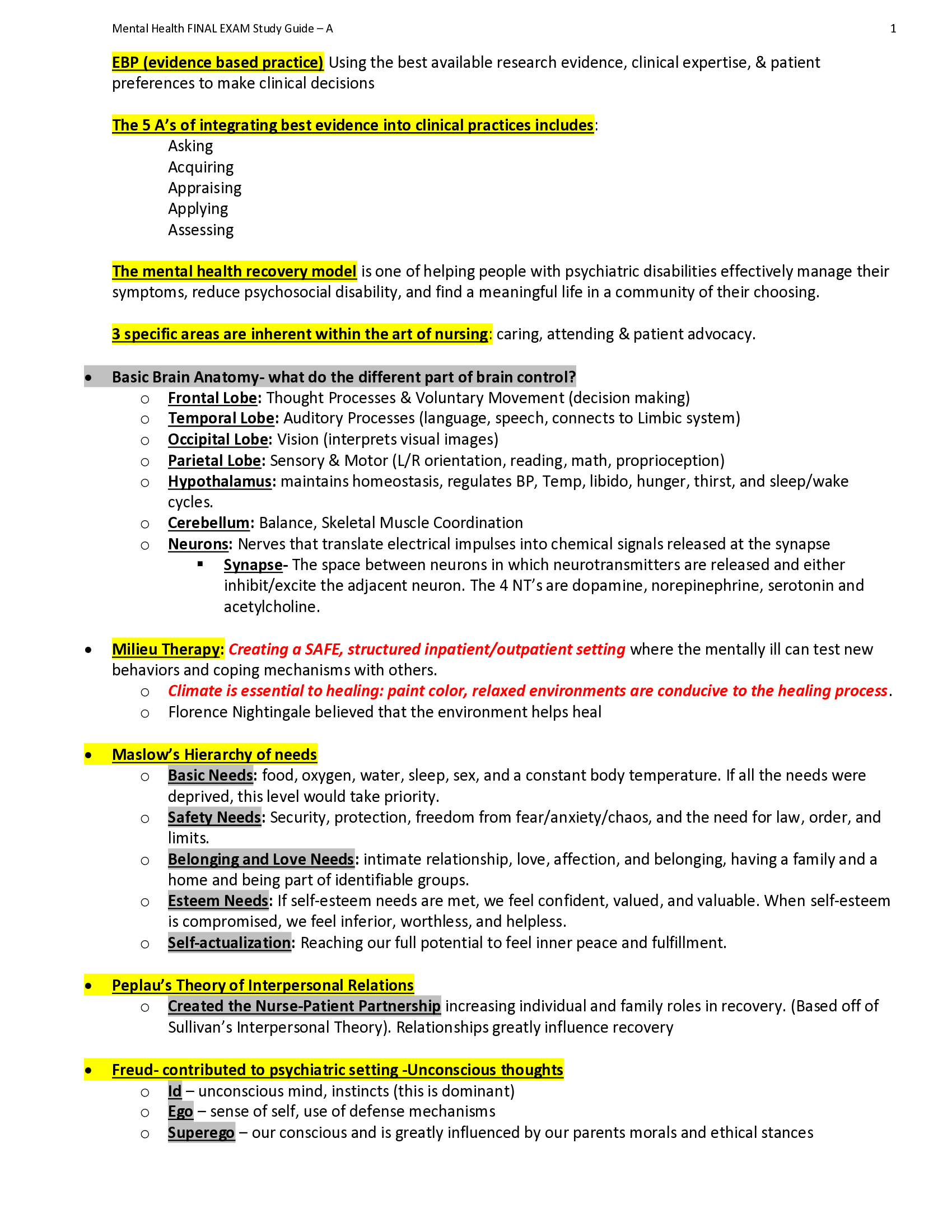
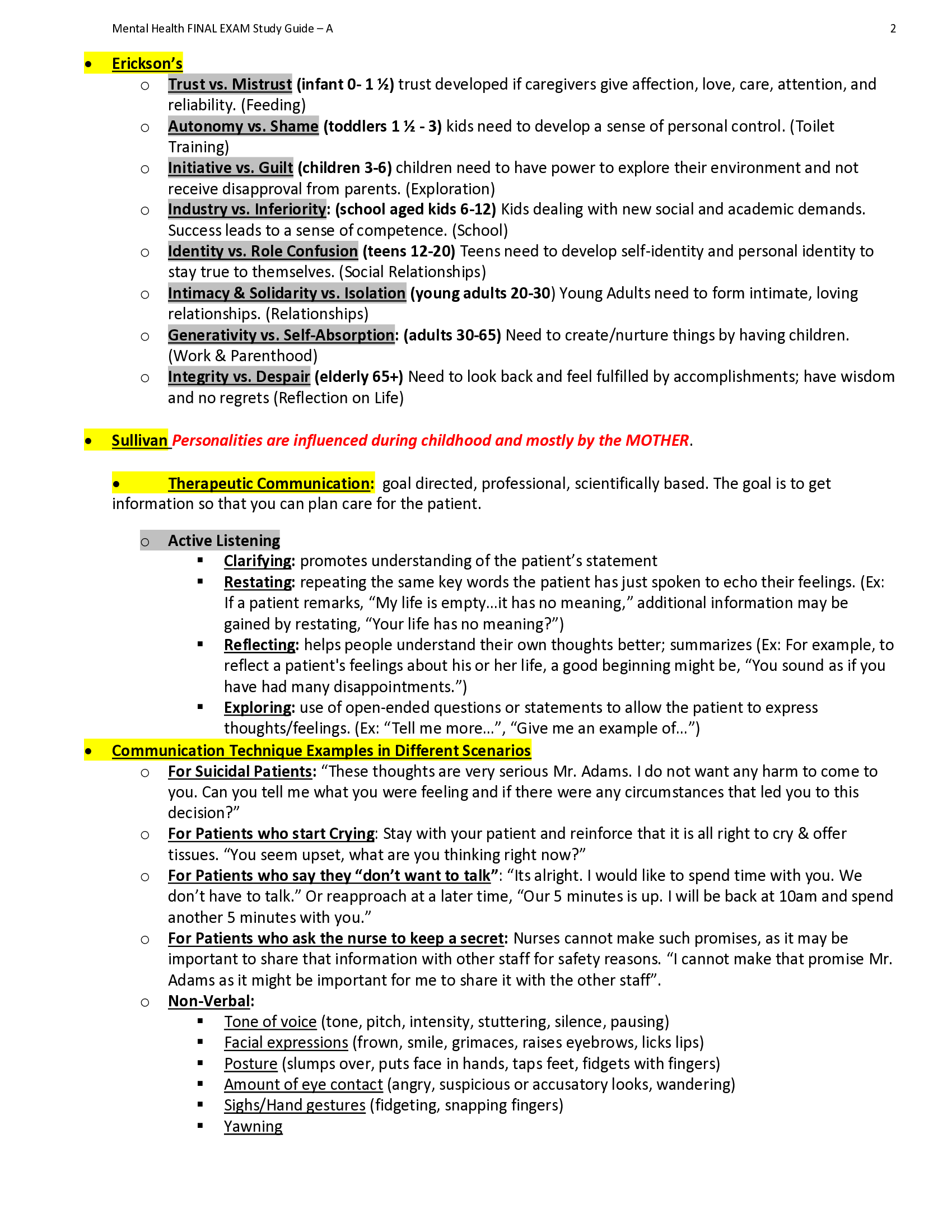
Mental Health Final Exam Study Guide Mental Health FINAL EXAM Study Guide – A 1 EBP (evidence based practice) Using the best available research evidence, clinical expertise, & patient preferences to make clinical decisions The 5 A’s of integrating best evidence into clinical practices includes: Asking Acquiring Appraising Applying Assessing The mental health recovery model is one of helping people with psychiatric disabilities effectively manage their symptoms, reduce psychosocial disability, and find a meaningful life in a community of their choosing. 3 specific areas are inherent within the art of nursing: caring, attending & patient advocacy.  Basic Brain Anatomy- what do the different part of brain control? o Frontal Lobe: Thought Processes & Voluntary Movement (decision making) o Temporal Lobe: Auditory Processes (language, speech, connects to Limbic system) o Occipital Lobe: Vision (interprets visual images) o Parietal Lobe: Sensory & Motor (L/R orientation, reading, math, proprioception) o Hypothalamus: maintains homeostasis, regulates BP, Temp, libido, hunger, thirst, and sleep/wake cycles. o Cerebellum: Balance, Skeletal Muscle Coordination o Neurons: Nerves that translate electrical impulses into chemical signals released at the synapse  Synapse- The space between neurons in which neurotransmitters are released and either inhibit/excite the adjacent neuron. The 4 NT’s are dopamine, norepinephrine, serotonin and acetylcholine.  Milieu Therapy: Creating a SAFE, structured inpatient/outpatient setting where the mentally ill can test new behaviors and coping mechanisms with others. o Climate is essential to healing: paint color, relaxed environments are conducive to the healing process. o Florence Nightingale believed that the environment helps heal  Maslow’s Hierarchy of needs o Basic Needs: food, oxygen, water, sleep, sex, and a constant body temperature. If all the needs were deprived, this level would take priority. o Safety Needs: Security, protection, freedom from fear/anxiety/chaos, and the need for law, order, and limits. o Belonging and Love Needs: intimate relationship, love, affection, and belonging, having a family and a home and being part of identifiable groups. o Esteem Needs: If self-esteem needs are met, we feel confident, valued, and valuable. When self-esteem is compromised, we feel inferior, worthless, and helpless. o Self-actualization: Reaching our full potential to feel inner peace and fulfillment.  Peplau’s Theory of Interpersonal Relations o Created the Nurse-Patient Partnership increasing individual and family roles in recovery. (Based off of Sullivan’s Interpersonal Theory). Relationships greatly influence recovery  Freud- contributed to psychiatric setting -Unconscious thoughts o Id – unconscious mind, instincts (this is dominant) o Ego – sense of self, use of defense mechanisms o Superego – our conscious and is greatly influenced by our parents morals and ethical stances Mental Health FINAL EXAM Study Guide – A 2  Erickson’s o Trust vs. Mistrust (infant 0- 1 ½) trust developed if caregivers give affection, love, care, attention, and reliability. (Feeding) o Autonomy vs. Shame (toddlers 1 ½ - 3) kids need to develop a sense of personal control. (Toilet Training) o Initiative vs. Guilt (children 3-6) children need to have power to explore their environment and not receive disapproval from parents. (Exploration) o Industry vs. Inferiority: (school aged kids 6-12) Kids dealing with new social and academic demands. Success leads to a sense of competence. (School) o Identity vs. Role Confusion (teens 12-20) Teens need to develop self-identity and personal identity to stay true to themselves. (Social Relationships) o Intimacy & Solidarity vs. Isolation (young adults 20-30) Young Adults need to form intimate, loving relationships. (Relationships) o Generativity vs. Self-Absorption: (adults 30-65) Need to create/nurture things by having children. (Work & Parenthood) o Integrity vs. Despair (elderly 65+) Need to look back and feel fulfilled by accomplishments; have wisdom and no regrets (Reflection on Life)  Sullivan Personalities are influenced during childhood and mostly by the MOTHER.  Therapeutic Communication: goal directed, professional, scientifically based. The goal is to get information so that you can plan care for the patient. o Active Listening  Clarifying: promotes understanding of the patient’s statement  Restating: repeating the same key words the patient has just spoken to echo their feelings. (Ex: If a patient remarks, “My life is empty…it has no meaning,” additional information may be gained by restating, “Your life has no meaning?”)  Reflecting: helps people understand their own thoughts better; summarizes (Ex: For example, to reflect a patient's feelings about his or her life, a good beginning might be, “You sound as if you have had many disappointments.”)  Exploring: use of open-ended questions or statements to allow the patient to express thoughts/feelings. (Ex: “Tell me more…”, “Give me an example of…”)  Communication Technique Examples in Different Scenarios o For Suicidal Patients: “These thoughts are very serious Mr. Adams. I do not want any harm to come to you. Can you tell me what you were feeling and if there were any circumstances that led you to this decision?” o For Patients who start Crying: Stay with your patient and reinforce that it is all right to cry & offer tissues. “You seem upset, what are you thinking right now?” o For Patients who say they “don’t want to talk”: “Its alright. I would like to spend time with you. We don’t have to talk.” Or reapproach at a later time, “Our 5 minutes is up. I will be back at 10am and spend another 5 minutes with you.” o For Patients who ask the nurse to keep a secret: Nurses cannot make such promises, as it may be important to share that information with other staff for safety reasons. “I cannot make that promise Mr. Adams as it might be important for me to share it with the other staff”. o Non-Verbal:  Tone of voice (tone, pitch, intensity, stuttering, silence, pausing)  Facial expressions (frown, smile, grimaces, raises eyebrows, licks lips)  Posture (slumps over, puts face in hands, taps feet, fidgets with fingers)  Amount of eye contact (angry, suspicious or accusatory looks, wandering)  Sighs/Hand gestures (fidgeting, snapping fingers)  Yawning Mental Health FINAL EXAM Study Guide – A 3  Non-Therapeutic Communication: not goal-directed, false reassurances, double messages, giving personal opinions, making assumptions of feelings, asking “Why” questions, showing disapproval, excessive questioning, non-attending behaviors, poor non-verbal communication (eye rolling, staring off into distance, ignoring patient). o Double Bind Messages: intent of the message is to cause confusion o Double Messages: conflicting/mixed messages o Giving premature advice o Presenting reality and focusing  Phases of the Nurse-Patient Relationships o Orientation Phase: first time the nurse & patient meet, interact according to their own backgrounds/standards/values/beliefs, roles of the patient and nurse are clarified, confidentiality is discussed and assumed, nurse becomes aware of transferences & countertransference issues, goals are established, termination terms are introduced. o Working Phase: exploration of feelings or situations that are causing the problems, re-experiencing of old conflicts can awaken high levels of anxiety, intense emotional states may surface, defense mechanisms, denying, manipulation, evaluation of problems and goals, promote alternative reactions/behaviors to situations, etc. The nurse’s awareness of his or her own personal feelings and reactions to the patient are VITAL for effective interaction with the patient. o Termination Phase: summarization of goals, review of what was achieved during communication, discussing new ways to implement new coping strategies, evokes strong feelings in both client & nurse.  Legal, Ethical, and Cultural o Negligence –or malpractice is an act or an omission to act that breaches the duty of due care and results in or is responsible for a person’s injuries. The five elements required to prove negligence are: (1) duty, (2) breach of duty, (3) cause in fact, (4) proximate cause, and (5) damages.  Example – A nurse know that a patient’s IV is malfunctioning and the wires are frayed, but decides not to act in a timely manner and leaves the IV on the patient and doesn’t tag it for repair, this results in the patient dying. o Beneficence - This relates to the quality of doing good and can be described as charity.  Example - A nurse helps a newly admitted client who has psychosis feel safe in the environment of the mental health facility. o Autonomy - This refers to the client’s right to make her own decisions. But the client must accept the consequences of those decisions. The client must also respect the decisions of others.  Example - Rather than giving advice to a client who has difficulty making decisions, a nurse helps the client explore all alternatives and arrive at a choice. o Justice - This is defined as fair and equal treatment for all.  Example - During a treatment team meeting, a nurse leads a discussion regarding whether or not two clients who broke the same facility rule were treated equally. o Fidelity - This relates to loyalty and faithfulness to the client and to one’s duty.  Example - A client asks a nurse to be present when he talks to his mother for the first time in a year. The nurse remains with the client during this interaction. o Veracity - This refers to being honest when dealing with a client.  Example - A client states, “You and that other staff member were talking about me, weren’t you?” The nurse truthfully replies, “We were discussing ways to help you relate to the other clients in a more positive way.”  Rights for Voluntary and Involuntary Admission o Voluntary Commitment – The client or client’s guardian chooses commitment to a mental health facility in order to obtain treatment. A voluntarily committed client has the right to apply for release at any time. This client is considered competent, and so has the right to refuse medication and treatment. o Involuntary (civil) Commitment – The client enters the mental health facility against her will for an indefinite period of time. The commitment is based on the client’s need for psychiatric treatment, the risk of harm to self or others, or the inability to provide self-care. The need for commitment could be Mental Health FINAL EXAM Study Guide – A 4 determined by a judge of the court or by another agency. The number of physicians, which is usually two, required to certify that the client’s condition requires commitment varies from state to state. Clients admitted under involuntary commitment are still considered competent and have the right to refuse treatment, unless they have gone through a legal competency hearing and have been judged incompetent.  Informed Consent o The principle of informed consent is based on a person’s right to self- determination, as enunciated in the landmark case of Canterbury v. Spence (1972): True consent to what happens to one’s self is the informed exercise of choice, and that entails an opportunity to evaluate knowledgeably the options available and the risks attendant on each. Proper orders for specific therapies and treatments are required and must be documented in the patient’s chart. Consent for surgery, electroconvulsive treatment, or the use of experimental drugs or procedures must be obtained  Confidentiality/HIPAA o Therefore, you may not, without the patient’s consent, disclose information obtained from the patient or information in the medical record to anyone except those individuals for whom it is necessary for implementation of the patient’s treatment plan.  Psychiatric Nursing Assessment – priority interventions, nursing dx, etc  Mood Disorders  Primary vs. Secondary Depression o Primary Depression: due to family history, female gender, 40yrs +, post-partum, chronic illness, ETOH abuse, stressful life events. o Secondary Depression: Resultant from another mental health disorder or debilitating chronic illness. Person is depressed BECAUSE of their decline in physical or mental functioning.  Borderline personality disorder - produces emotional lability and inconsistency in behavior. * Nurse should be consistent with clients with a personality disorder  Nursing Diagnosis for Depression: *Risk for Suicide, Risk for Self-Mutilation, Ineffective Coping, Hopelessness, Powerlessness, Social Isolation, Risk for Loneliness, Situational Low Self-Esteem.  First-line treatment for Depression: o TCA’s are #1 (Amitriptyline, Imipramine, Doxepin). o 2nd is SSRI/SNRI’s (citalopram, fluoxetine, sertraline, bupropion, Buspirone) o Last option is MAOI (phenelzine, isocarboxazid) Mental Health FINAL EXAM Study Guide – A 5  Suicidal Ideation – Assessment, Risk Factors & Interventions o Suicide Risk Factors: presence of a plan, previous suicide attempt, recent loss/life event, TBI/Brain Injury, recent visit to PCP, WHITE MALES. o Patient will say/do: “Everything will be okay now”, “Things will never work out”, giving away prized possessions, making a living will, suddenly increase in happy mood/euphoria. o Assessment:  Are you thinking of harming yourself?  Do you have a plan?  Precipitating Event?  History of attempts? Why did they fail?  Any MH dx that puts them at higher risk? o Diagnosis:  RISK FOR SUICIDE (outcome would be “Self Restraint from Suicide”) this is a priority diagnosis! o Interventions:  #1 is suicide precautions ( 1:1 monitoring, keep an arm’s length from pt, no suicide contract)  Make environment safe (remove sharp objects, metal silverware, mirrors, glass, cords, belts) o After Crisis Period:  Have friend stay the night or have pt stay with family  Remove weapons and pills from the house  Encourage the patient to talk openly about their feelings.  Don’t give person more than 1-3 days supply of a medication due to overdose (SSRI’s are least lethal)  Lithium Levels & Toxicity – o Therapeutic Range: 0.8-1.4 (fine hand tremors & mild N/V are normal) o Maintenance Range: 0.4 – 1.3 o Toxic Range: 1.5 and over o Toxicity: slurred speech, blurry vision, seizures, coarse tremors, severe N/V, thirst o Patient Teaching: regular salt diet, doesn’t get dehydrated, stay out of hot climates, avoid excessive exercise, take with food. o Lithium toxicity -possible when one becomes dehydrated, nausea or diarrhea.  Anxiety Disorders Anxiety Levels & Stages o Mild: Everyday anxiety, better focusing, more alert and in-tune with surroundings (nail biting, fidgeting, foot tapping are common) o Moderate: Narrowed perceptual field, hears/sees/grasps less info. (Pacing, pounding heart, banging hands on table) Mental Health FINAL EXAM Study Guide – A 6 o Severe: Cannot learn or problem solve. Confusion, hyperventilation, making threats and feeling of “impending doom”. (Stomach aches & physical symptoms are common: dizziness, H/A, insomnia, nausea) o Panic: Extreme Anxiety. Cannot problem solve/learn, Dilated Pupils, shouting, screaming, and hallucinations. Lost touch with reality. Nursing Interventions for Anxiety o Mild/Moderate: Be calm and listen! Find out what worked before. Clarify, use open-ended questions, have the patient NAME the anxiety/trigger, “what were you thinking right before the attack?”. o Severe/Panic: Firm, Short Answers, Set Limits (you cannot hit me or anyone else), move patient to quiet room, low pitch voice & speak slow, reinforce reality, remain with the patient (don’t leave them alone), Prevent dehydration & exhaustion (high calorie fluids). Gross motor activities to drain some of the tension (ping pong, dancing, etc) Anxiety/Depression Meds: o Antidepressants - prevents/relieves depression.  SSRI’s– (Ex: fluoxetine, citalopram, sertraline). Black Box Warning: increased suicidal thoughts are possible. Takes 2-4 weeks to work. Helps treat Depression, ETOH withdrawal, OCD,  Side Effects: Anxiety, tremors, sexual dysfunction, H/A, agitation, sleeplessness. Dry mouth.  S/Sx of Overdose: Serotonin Syndrome (fever, Hyper-Reflexia, sweating, high BP, delirium, hostility). Wait 2 weeks before starting an MAOI or vice-versa.  Contraindications: Those who have attempted suicide don’t use! Pregnancy, Renal/Liver issues, Elderly (due to increase of osteoporosis/fractures)  Patient Teaching: OTC drug interactions, slow standing, don’t take w/in 2 weeks of MAOI, monitor for suicidal ideations  Serotonin Syndrome Treatment:  STOP medication. •Serotonin receptor blockade: cyproheptadine, methysergide, propranolol •Cooling blankets, chlorpromazine for hyperthermia •Dantrolene, diazepam for muscle rigidity or rigors •Anticonvulsants •Artificial ventilation •Paralysis o TCA’s – Used for Depression, anorexia, insomnia, ODC, Panic disorder, and neurogenic pain. Takes 1014 days to become effective. Provider will chose this drug if (1) it worked on family member in past and (2) severity of adverse effects. “Start low and go slow”  Side Effects: Anticholinergic effects (urinary retention, dry mouth, blurred vision, dizziness, tachycardia, constipation, reflux), Postural Hypotension.  S/Sx of Overdose: tachycardia, MI, heart block, dysrhythmias  Contraindications: Elderly and those with Cardiac Disease  Patient Teaching: takes 6-8 for full effect, get up slowly from sitting position, take at BEDTIME to reduce side effects, good mouth care/lozenges for dry mouth, don’t stop cold turkey o MAOI–. (ex: Phenelzine/Nardil, Isocarboxazid, Parnate)  Side Effects: insomnia, palpitations, H/A, loss of libido, Orthostatic Hypotension  Contraindications: Foods with Tyramine (causes Hypertensive Crisis. Food Ex: avocados, figs, bananas, smoked meats, organs, lunch meat, yeast, aged cheese, beer/wine, smoked fish, soy sauce), Pregnancy!!!  Patient Teaching: Hypotension is HUGE – get up slowly from sitting, avoid Tyramine foods, avoid cold medications, go to ER if pounding H/A, avoid eating at Chinese restaurants.  Benzodiazepines – commonly given & teaching needed for patients o (Ex: Alprazolam, Diazepam, Lorazepam)(“Pam and Lam sisters”) o Very sedating, quick onset

Contact the Seller

Please Sign In to contact this seller.


  • 👎  Report Copyright Violation

Frequently Asked Questions

What Do I Get When I Buy This Study Material?

+

When you buy a study material on Passing Grades, an instant download link will be sent directly to your email, giving you access to the file anytime after payment is completed.

Is Passing Grades a Trusted Platform?

+

Yes, Passing Grades is a reputable students’ marketplace with a secure payment system and reliable customer support. You can trust us to ensure a safe and seamless transaction experience.

Will I Be Stuck with a Subscription?

+

No, all purchases on Passing Grades are one-time transactions. You only pay for the notes you choose to buy, with no subscriptions or hidden fees attached.

Who Am I Buying These Study Materials From?

+

Passing Grades is a marketplace, which means you are purchasing the document from an individual vendor, not directly from us. We facilitate the payment and delivery process between you and the vendor.

Does Passing Grades Offer Free Study Materials?

+

Yes, sellers on Passing Grades have uploaded numerous free test banks, exams, practice questions, and class notes that can be downloaded at no cost.


Pasinggrades - Quality Study Materials

USD 10

    • Quality checked by Pasing Grades
    • 100% satisfaction guarantee
    • Seller: Namwaki
Buy PDF $10

Seller Information

Namwaki

Member since April 2021

  • icon
  • icon
  • icon
View Profile
  • total sales

    0
  • Favourites

    0
  • Comments

    0
    ( 0 Ratings )

Item Information

  • Uploaded

    06 March 2023

  • Updated

    29 September 2025

  • Category

    Nursing

  • Item Type

    exam

  • Tags

    Mental Health Final Exam Study Guide

Related Exam Prep Guides by Namwaki

Sophia Finance Milestone Final_Complete Questions and Answers 2021.
View Document

Sophia Finance Miles...

  • Namwaki

    Namwaki

  • exam

Sophia Finance Milestone Final_Complete Questions and Answers 2021...

10 USD

0

0

Medical Parasitology 7th Edition Leventhal Test Bank
View Document

Medical Parasitology...

  • Namwaki

    Namwaki

  • exam

Medical Parasitology 7th Edition Leventhal Test Bank...

10 USD

0

0

TEST- BANK FOR WONGS NURSING CARE OF INFANTS AND CHILDREN 11TH EDITION HOCKENBERRY
View Document

TEST- BANK FOR WONGS...

  • Namwaki

    Namwaki

  • exam

TEST- BANK FOR WONGS NURSING CARE OF INFANTS AND CHILDREN 11TH EDITION HOCKENBERRY – Download PDF...

10 USD

0

0

Purchase

Download link will be sent to this email immediately after purchase.

IMPORTANT LINKS

  • How To Upload Class Notes
  • Selling Tips
  • Passing Grades's Study Materials
  • Scholarships for International Students 2025

POPULAR CATEGORIES

  • Law
  • Accounting
  • English
  • Psychology
  • Business
  • Nursing
  • Computer Science
  • General

View Document

  • Blog
  • Contact
  • Delivery Policy
  • Latest Scholarships Around the World
  • How to Pass Bar Exams: Passing Grades’ Strategies
  • How to Study and Pass the CPA Exam
  • All Test Banks
  • Faq
  • Copyright Claims
  • Privacy Policy
  • Terms of Use

KNOWLEDGE BASE

  • How to Write A+ Grade Good Research Paper
  • How to Manage Stress During Exam Period
  • Best Time to Study
  • How to Pass NCLEX-RN Exam
  • How To Effectively Utilize Test Banks
  • Popular Shadow Health Exam Assessments
  • Popular HESI Case Studies
  • How to Prepare for a Nursing Career
  • The Importance Of Summaries in Exam Revisvion

© 2026 Pasing Grades. All rights reserved.