Pasing Grades
  • Start Selling
  • Blog
  • Contact
  • 0

    Your cart is empty!

English

  • English
  • Spanish
  • Arabic
Create Account Sign In
  • Library
    • New Prep Guides
    • Featured Prep Guides
    • Free Exam Prep Guides
    • Best sellers
  • General
  • Nursing
    • Research Paper
    • Case Study
    • Discussion Post
    • Assignment
    • Exam
    • Practice Questions and Answers
    • Test Bank
    • solutions manual
  • Accounting
    • Case Study
    • Thesis
    • Study Guide
    • Summary
    • Research Paper
    • test bank
  • English
    • Creative Writing
    • Research Paper
    • Summary
    • Rhetorics
    • Literature
    • Journal
    • Exam
    • Grammar
    • Discussion Post
    • Essay
  • Psychology
    • Hesi
    • Presentation
    • Essay
    • Summary
    • Study Guide
    • Essay
    • Solution Manual
    • Final Exam Review
    • Class Notes
    • test bank
  • Business
    • Lecture Notes
    • Solution Manual
    • Presentation
    • Business Plan
    • Class Notes
    • Experiment
    • Summary
    • Practice Questions
    • Study Guide
    • Case Study
    • test bank
    • Exam
  • More
    • Computer Science
    • Economics
    • Statistics
    • Engineering
    • Biology
    • Religious Studies
    • Physics
    • Chemistry
    • Mathematics
    • History
    • Sociology
    • Science
    • Philosophy
    • Law
  • Pages
    • About Us
    • Selling Tips
    • Delivery Policy
    • Faq
    • Privacy Policy
  • Flash Sale
  • Home
  • Mader Biology 11 EDITION Lab Resource Guide 2026

Mader Biology 11 EDITION Lab Resource Guide 2026

Preview page 1 Preview page 2 Preview page 3
Add To Favorites

Share this item Share this item

  • Item Details
  • Comments (0)
  • Reviews (0)
  • Contact Seller

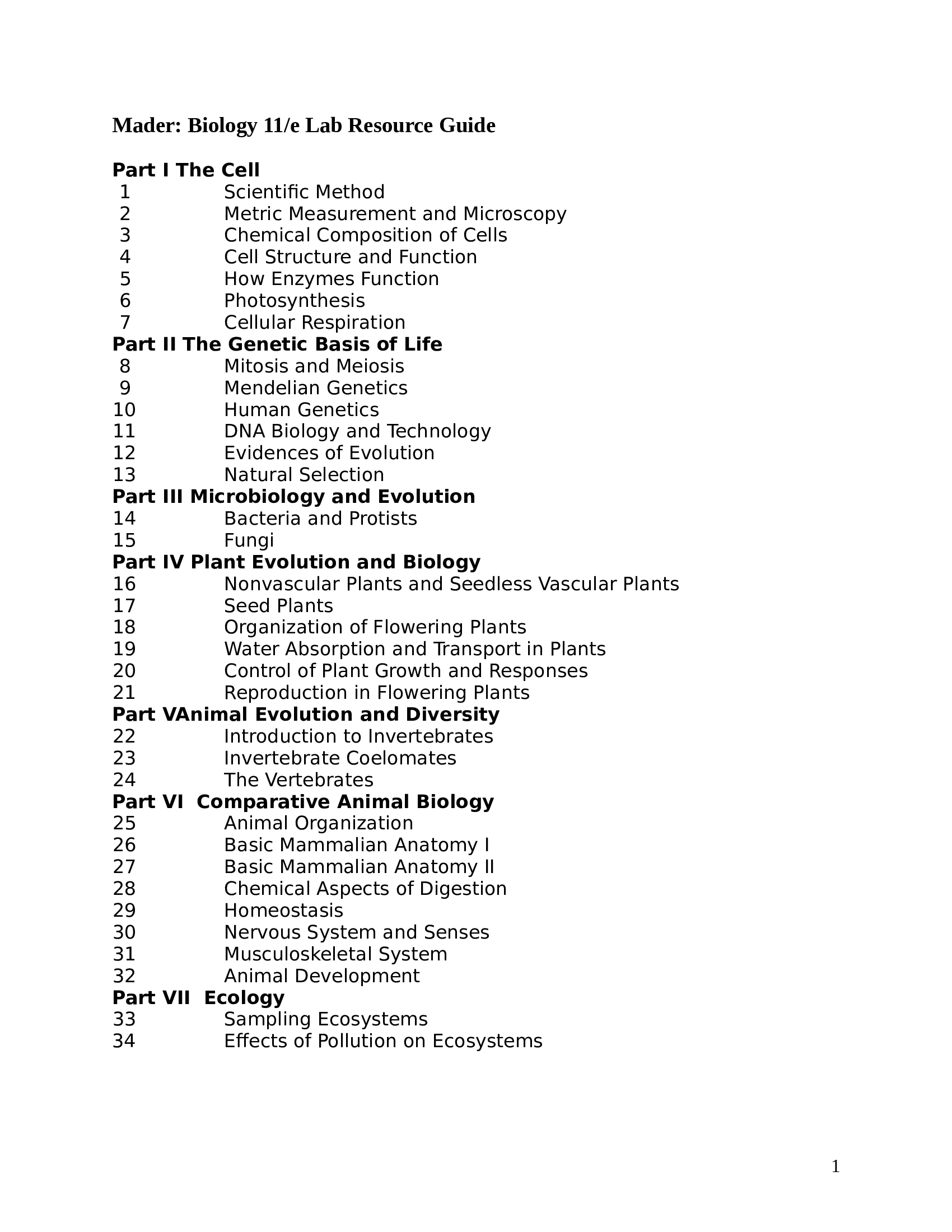
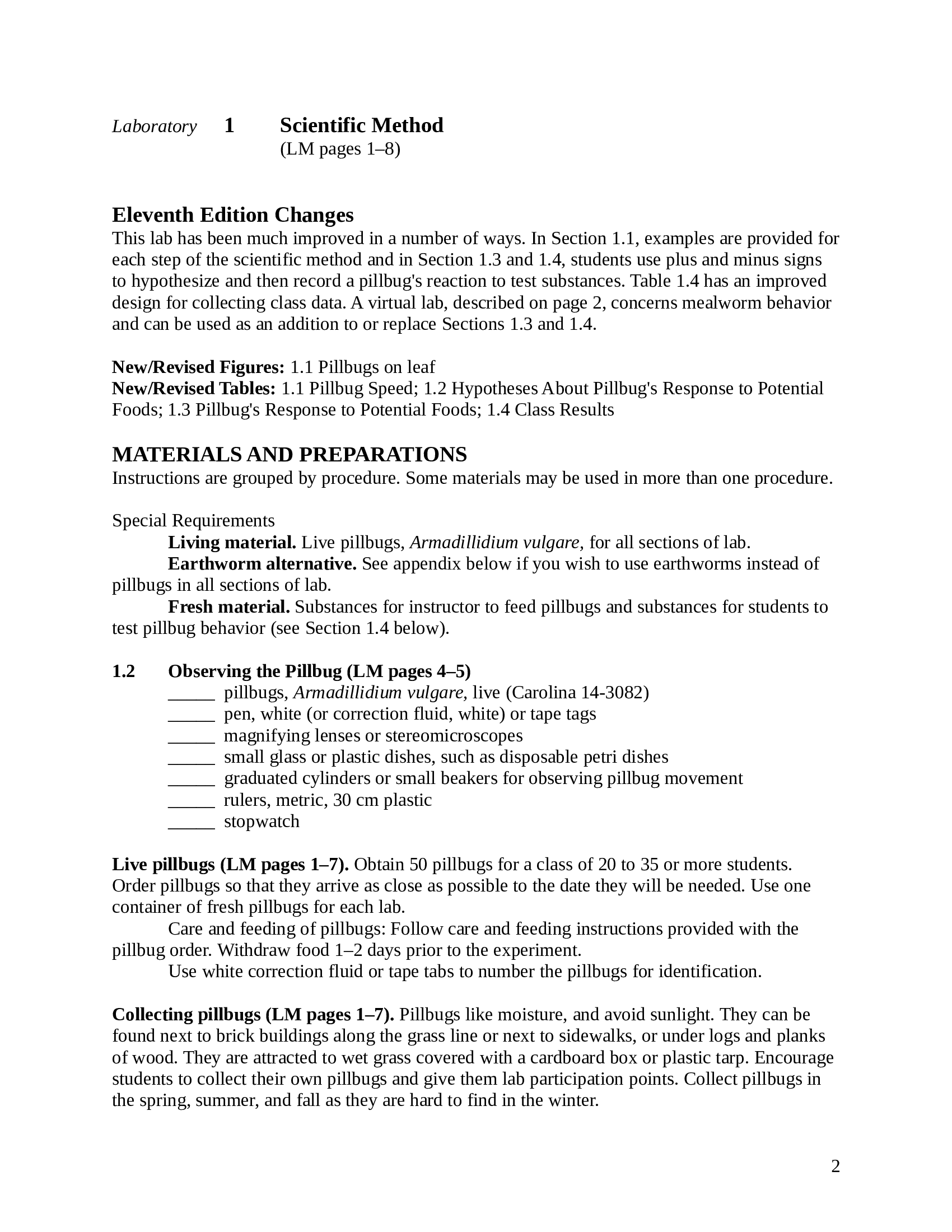
Laboratory 1 Scientific Method (LM pages 1–8) Eleventh Edition Changes This lab has been much improved in a number of ways. In Section 1.1, examples are provided for each step of the scientific method and in Section 1.3 and 1.4, students use plus and minus signs to hypothesize and then record a pillbug's reaction to test substances. Table 1.4 has an improved design for collecting class data. A virtual lab, described on page 2, concerns mealworm behavior and can be used as an addition to or replace Sections 1.3 and 1.4. New/Revised Figures: 1.1 Pillbugs on leaf New/Revised Tables: 1.1 Pillbug Speed; 1.2 Hypotheses About Pillbug's Response to Potential Foods; 1.3 Pillbug's Response to Potential Foods; 1.4 Class Results MATERIALS AND PREPARATIONS Instructions are grouped by procedure. Some materials may be used in more than one procedure. Special Requirements Living material. Live pillbugs, Armadillidium vulgare, for all sections of lab. Earthworm alternative. See appendix below if you wish to use earthworms instead of pillbugs in all sections of lab. Fresh material. Substances for instructor to feed pillbugs and substances for students to test pillbug behavior (see Section 1.4 below). 1.2 Observing the Pillbug (LM pages 4–5) _____ pillbugs, Armadillidium vulgare, live (Carolina 14-3082) _____ pen, white (or correction fluid, white) or tape tags _____ magnifying lenses or stereomicroscopes _____ small glass or plastic dishes, such as disposable petri dishes _____ graduated cylinders or small beakers for observing pillbug movement _____ rulers, metric, 30 cm plastic _____ stopwatch Live pillbugs (LM pages 1–7). Obtain 50 pillbugs for a class of 20 to 35 or more students. Order pillbugs so that they arrive as close as possible to the date they will be needed. Use one container of fresh pillbugs for each lab. Care and feeding of pillbugs: Follow care and feeding instructions provided with the pillbug order. Withdraw food 1–2 days prior to the experiment. Use white correction fluid or tape tabs to number the pillbugs for identification. Collecting pillbugs (LM pages 1–7). Pillbugs like moisture, and avoid sunlight. They can be found next to brick buildings along the grass line or next to sidewalks, or under logs and planks of wood. They are attracted to wet grass covered with a cardboard box or plastic tarp. Encourage students to collect their own pillbugs and give them lab participation points. Collect pillbugs in the spring, summer, and fall as they are hard to find in the winter. 2 Maintaining pillbugs in the lab (LM pages 1–7). After collecting, pillbugs can be easily maintained in a terrarium to keep a fresh supply all year long. They feed primarily on decaying organic matter; they like moisture and avoid sunlight. They like carrots and cucumbers. Change the food daily to prevent mold growth. 1.3 Formulating Hypotheses (LM page 6) 1.4 Performing the Experiment and Coming to a Conclusion (LM pages 6–7) _____ pillbugs, Armadillidium vulgare, live (Carolina 14-3082) _____ small beakers, 35-mm film cans, watch glasses, or small petri dishes for distributing test substances _____ petri dishes, preferably 150 mm (or else 100 mm) for testing the pillbugs _____ small plastic bottle for spritzing _____ distilled water _____ cotton balls Suggested test substances: _____ flour _____ cornstarch or bran flakes _____ coffee creamer _____ baking soda _____ fine sand (control) _____ milk _____ orange juice or apple juice _____ ketchup _____ applesauce _____ carbonated beverage _____ water (control) Do not use salt, vinegar, or honey, as these substances are harmful to pillbugs. Plain water is used as a control for liquids. Fine sand is used as a control for powders. Experimental design (LM pages 6–7). These methods are recommended: For a dry substance, make a circle of the test substance in a petri dish and put the pillbug in the center of the circle. For a liquid, put a cotton ball soaked with the test substance in the pillbug's path. Rinse pillbugs between testing procedures by spritzing with distilled water and then placing them on a paper towel to dry. Cleanup (LM pages 6–7). Cleanup is easier and the experiment goes well if there is a limited number of test substances and each student chooses only two dry and two liquid test substances. Substances can be distributed to several stations in small beakers, 35-mm film cans, watch glasses, or small petri dishes. Testing pillbugs in 150 mm petri dishes works well. 3 EXERCISE QUESTIONS 1.1 Using the Scientific Method (LM pages 2–3) Why does the scientific method begin with observations? To study the natural world, scientists have to observe natural phenomena. What is the benefit of formulating a hypothesis? The hypothesis tells what is to be tested by experiment or further observations. Why must a scientist keep complete records of an experiment? So others can repeat the experiment and can check that the data are valid. What is the purpose of the conclusion? The conclusion tells what has been learned from the experiment (or further observations). How is a scientific theory different from a conclusion? Each experiment has a conclusion. A scientific theory is based on many conclusions from various experiments in related fields. 1.2 Observing the Pillbug (LM pages 3–5) Observation: Pillbug’s External Anatomy (LM pages 3–4) 1. Examine the exterior of a pillbug. ď‚· How can you recognize the head END of a pillbug? The head bears antennae and eyes. ď‚· How many segments and pair of walking legs are in the thorax? There are 7 segments and 7 pairs of legs. Observation: Pillbug’s Motion (LM page 5) 1. Watch a pillbug's underside. a. Describe the action of the feet and any other motion you see. The seven pairs of legs move with the front pair leading, and each pair moves in succession thereafter. b. Allow a pillbug to crawl on your hand. Describe how it feels. It tickles the skin as it moves. c. Does a pillbug have the ability to move directly forward? yes d. Do you see evidence of mouthparts on the underside of the pillbug? A pillbug has four pairs of mouthparts. 2. As you watch the pillbug, identify a. the anatomical parts that allow a pillbug to identify and take in food. Antennae, eyes, and mouthparts b. behaviors that will allow a pillbug to acquire food. For example, is the ability of a pillbug to move directly forward a help in acquiring food? Explain. Yes because it is the most efficient way to reach food. What other behaviors allow a pillbug to acquire food? A pillbug has the ability to eat food. c. a behavior that helps a pillbug avoid dangerous situations The pillbug rolls into a ball when it is threatened

Contact the Seller

Please Sign In to contact this seller.


  • 👎  Report Copyright Violation

Frequently Asked Questions

What Do I Get When I Buy This Study Material?

+

When you buy a study material on Passing Grades, an instant download link will be sent directly to your email, giving you access to the file anytime after payment is completed.

Is Passing Grades a Trusted Platform?

+

Yes, Passing Grades is a reputable students’ marketplace with a secure payment system and reliable customer support. You can trust us to ensure a safe and seamless transaction experience.

Will I Be Stuck with a Subscription?

+

No, all purchases on Passing Grades are one-time transactions. You only pay for the notes you choose to buy, with no subscriptions or hidden fees attached.

Who Am I Buying These Study Materials From?

+

Passing Grades is a marketplace, which means you are purchasing the document from an individual vendor, not directly from us. We facilitate the payment and delivery process between you and the vendor.

Does Passing Grades Offer Free Study Materials?

+

Yes, sellers on Passing Grades have uploaded numerous free test banks, exams, practice questions, and class notes that can be downloaded at no cost.

Pasinggrades - Quality Study Materials

USD 8

    • Quality checked by Pasing Grades
    • 100% satisfaction guarantee
    • Seller: mentor2000
Buy PDF $8

Seller Information

mentor2000

Member since April 2021

  • icon
  • icon
View Profile
  • total sales

    0
  • Favourites

    0
  • Comments

    0
    ( 0 Ratings )

Item Information

  • Uploaded

    22 February 2024

  • Updated

    05 January 2026

  • Category

    Nursing

  • Item Type

    exam

  • Tags

    Mader Biology 11 EDITION Lab Resource Guide

Related Exam Prep Guides by mentor2000

Test Bank for Essentials for Nursing Practice 8th Edition by Potter | All Chapters
View Document

Test Bank for Essent...

  • mentor2000

    mentor2000

  • exam

Master nursing concepts with this study material; Test Bank for Essentials for Nursing Practice, 8th...

8 USD

0

0

A &P 1 MA278 BSC2 Final Module II Questions & Answers 2026 Update
View Document

A &P 1 MA278 BSC2 Fi...

  • mentor2000

    mentor2000

  • exam

Prepare for success with A&P 1 MA278 BSC2 Final Module II 2024 Q&A. Boost your grades with this comp...

8 USD

0

0

ATI Comprehensive Predictor Exam 2026
View Document

ATI Comprehensive Pr...

  • mentor2000

    mentor2000

  • exam

Prepare for success with the ATI Comprehensive Predictor Exam 2026. Access key practice questions to...

8 USD

0

0

Purchase

Download link will be sent to this email immediately after purchase.

IMPORTANT LINKS

  • How To Upload Class Notes
  • Selling Tips
  • Passing Grades's Study Materials
  • Scholarships for International Students 2025

POPULAR CATEGORIES

  • Law
  • Accounting
  • English
  • Psychology
  • Business
  • Nursing
  • Computer Science
  • General

View Document

  • Blog
  • Contact
  • Delivery Policy
  • Latest Scholarships Around the World
  • How to Pass Bar Exams: Passing Grades’ Strategies
  • How to Study and Pass the CPA Exam
  • All Test Banks
  • Faq
  • Copyright Claims
  • Privacy Policy
  • Terms of Use

KNOWLEDGE BASE

  • How to Write A+ Grade Good Research Paper
  • How to Manage Stress During Exam Period
  • Best Time to Study
  • How to Pass NCLEX-RN Exam
  • How To Effectively Utilize Test Banks
  • Popular Shadow Health Exam Assessments
  • Popular HESI Case Studies
  • How to Prepare for a Nursing Career
  • The Importance Of Summaries in Exam Revisvion

© 2026 Pasing Grades. All rights reserved.