Pasing Grades
  • Start Selling
  • Blog
  • Contact
  • 0

    Your cart is empty!

English

  • English
  • Spanish
  • Arabic
Create Account Sign In
  • Library
    • New Prep Guides
    • Featured Prep Guides
    • Free Exam Prep Guides
    • Best sellers
  • General
  • Nursing
    • Research Paper
    • Case Study
    • Discussion Post
    • Assignment
    • Exam
    • Practice Questions and Answers
    • Test Bank
    • solutions manual
  • Accounting
    • Case Study
    • Thesis
    • Study Guide
    • Summary
    • Research Paper
    • test bank
  • English
    • Creative Writing
    • Research Paper
    • Summary
    • Rhetorics
    • Literature
    • Journal
    • Exam
    • Grammar
    • Discussion Post
    • Essay
  • Psychology
    • Hesi
    • Presentation
    • Essay
    • Summary
    • Study Guide
    • Essay
    • Solution Manual
    • Final Exam Review
    • Class Notes
    • test bank
  • Business
    • Lecture Notes
    • Solution Manual
    • Presentation
    • Business Plan
    • Class Notes
    • Experiment
    • Summary
    • Practice Questions
    • Study Guide
    • Case Study
    • test bank
    • Exam
  • More
    • Computer Science
    • Economics
    • Statistics
    • Engineering
    • Biology
    • Religious Studies
    • Physics
    • Chemistry
    • Mathematics
    • History
    • Sociology
    • Science
    • Philosophy
    • Law
  • Pages
    • About Us
    • Selling Tips
    • Delivery Policy
    • Faq
    • Privacy Policy
  • Flash Sale
  • Home
  • HESI Med Surg Final Exam Practice Questions Evolve Actual Elsevier Questions and Answers 2026 (58 Pages)

HESI Med Surg Final Exam Practice Questions Evolve Actual Elsevier Questions and Answers 2026 (58 Pages)

Preview page 1 Preview page 2 Preview page 3
Add To Favorites

Share this item Share this item

  • Item Details
  • Comments (0)
  • Reviews (0)
  • Contact Seller

This is the copy of 2025 HESI Med Surg Final Exam Practice Questions Evolve Actual Elsevier Questions and Answers. Below are sample exam questions and answers from the document. 

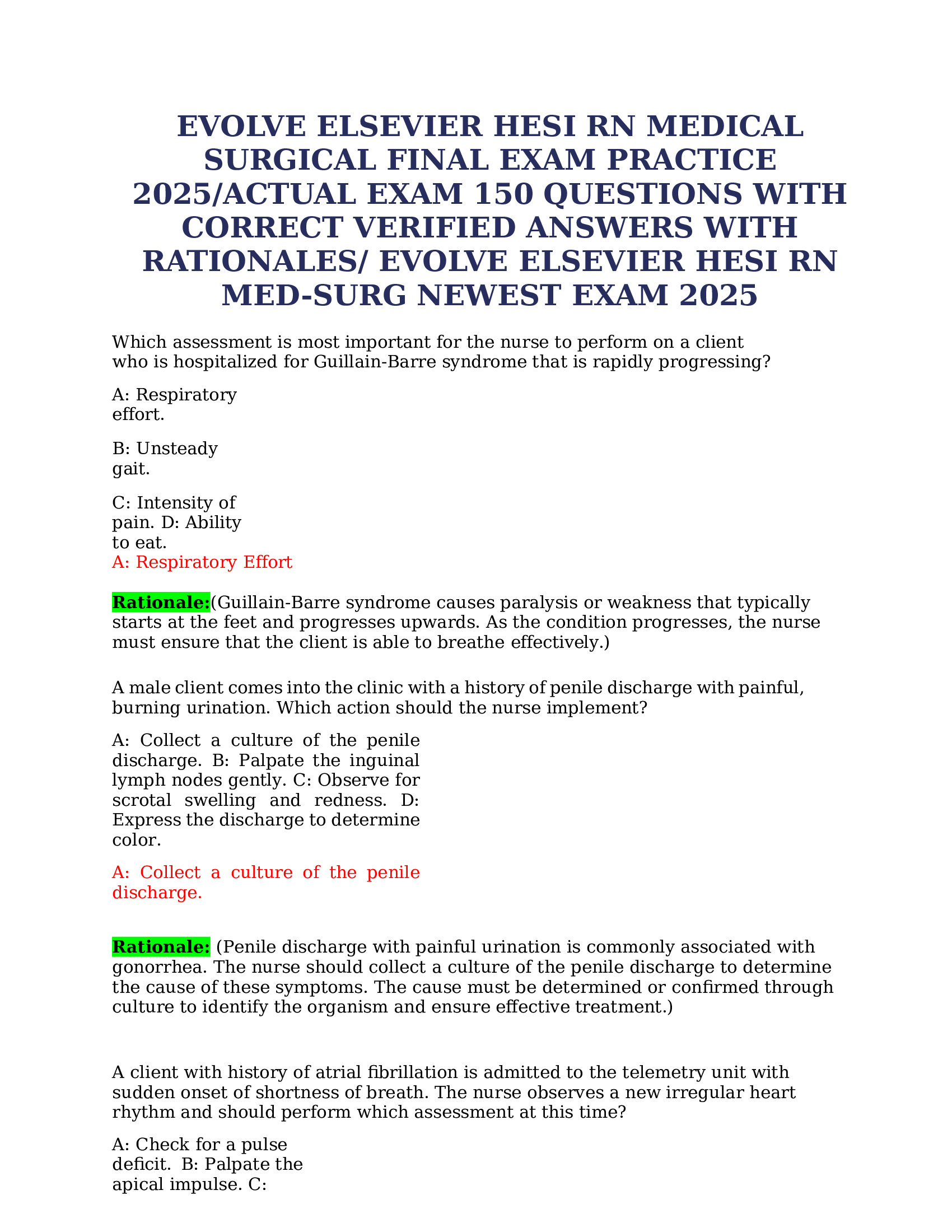
Which assessment is most important for  the  nurse to perform on a client who is hospitalized for  Guillain-Barre syndrome that is rapidly progressing?

A: Respiratory effort.

B: Unsteady gait.

C: Intensity of pain. D: Ability to eat.

A: Respiratory Effort

Rationale:(Guillain-Barre syndrome causes paralysis or weakness that typically starts at the  feet and progresses upwards. As the  condition progresses, the  nurse must ensure that the  client is able to breathe effectively.)

A male client comes into the  clinic with a history of penile discharge with painful, burning urination. Which action should the  nurse implement?

A:  Collect a culture of  the   penile discharge. B: Palpate the  inguinal lymph nodes gently. C: Observe for scrotal swelling and redness. D: Express the  discharge to determine color.

A:  Collect a culture of  the   penile discharge.


Rationale: (Penile discharge with painful urination is commonly associated with gonorrhea. The  nurse should collect a culture of the  penile discharge to determine the  cause of these symptoms. The  cause must be  determined or confirmed through culture to identify the  organism and ensure effective treatment.)

A client with history of atrial fibrillation is admitted to the  telemetry unit with sudden onset of shortness of breath. The  nurse observes a new irregular heart rhythm and should perform which assessment at this time?

A: Check for  a pulse deficit. B: Palpate the apical impulse. C:


Inspect jugular vein pulse.

D: Examine for  a carotid bruit. A: Check for  a pulse deficit.


Rationale: (A client with a past history of atrial fibrillation may return to that rhythm. Any  signs of atrial fibrillation, such as sudden onset shortness of breath, requires further investigation. The  nurse should assess this client for  a pulse deficit because this condition occurs with atrial fibrillation.)

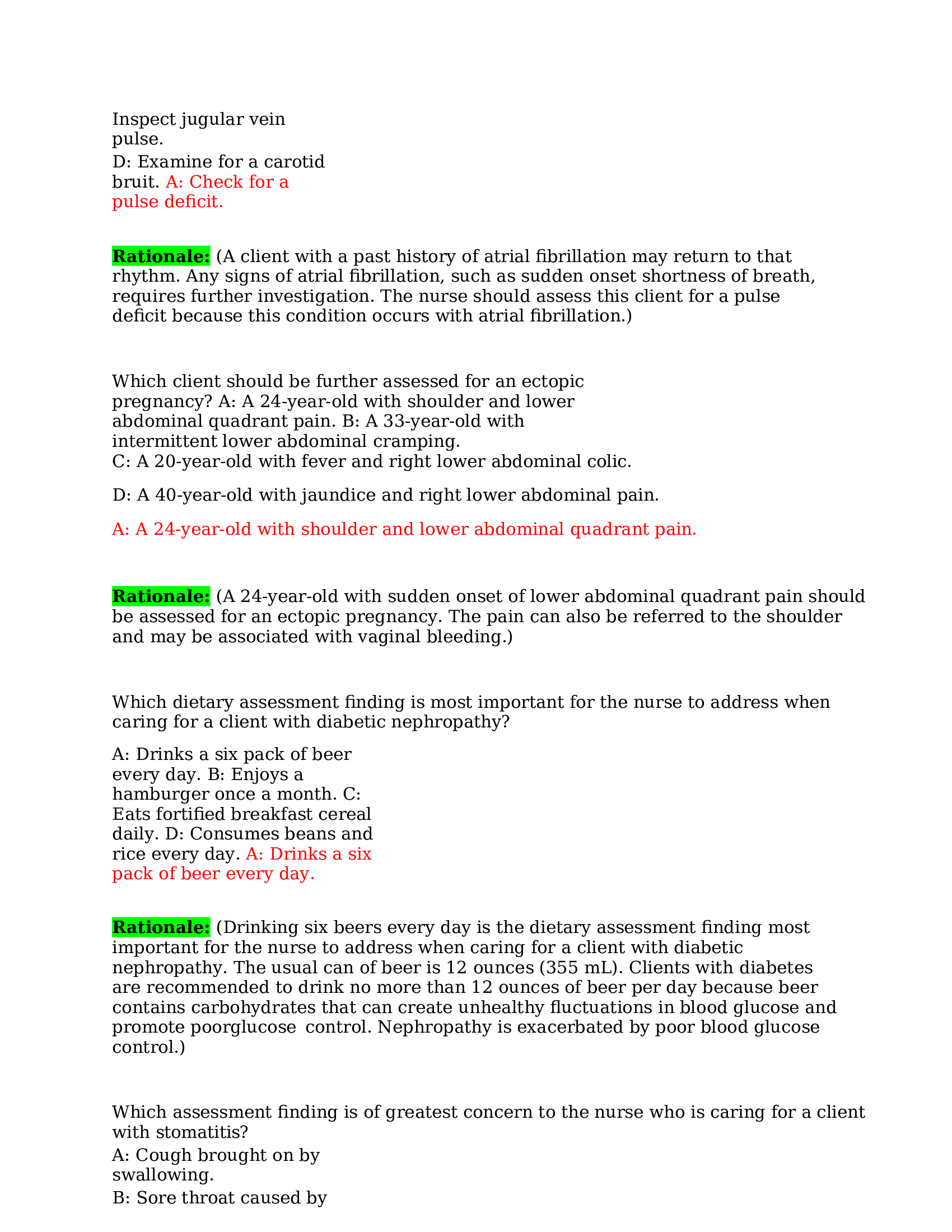
Which client should be  further assessed for  an ectopic pregnancy? A: A 24-year-old with shoulder and lower abdominal quadrant pain. B: A 33-year-old with intermittent lower abdominal cramping.

C: A 20-year-old with fever and right lower abdominal colic.


D: A 40-year-old with jaundice and right lower abdominal pain.


A: A 24-year-old with shoulder and lower abdominal quadrant pain.


Rationale: (A 24-year-old with sudden onset of lower abdominal quadrant pain should be  assessed for  an ectopic pregnancy. The  pain can also be  referred to the  shoulder and may be  associated with vaginal bleeding.)

Which dietary assessment finding is most important for  the  nurse to address when caring for  a client with diabetic nephropathy?


A: Drinks a six pack of beer every day. B: Enjoys a hamburger once a month. C: Eats fortified breakfast cereal daily. D: Consumes beans and rice every day. A: Drinks a six pack of beer every day.


Rationale: (Drinking six beers every day is the  dietary assessment finding most important for  the  nurse to address when caring for  a client with diabetic nephropathy. The  usual can of beer is 12 ounces (355 mL). Clients with diabetes are recommended to drink no more than 12 ounces of beer per  day because beer contains carbohydrates that can create unhealthy fluctuations in blood glucose and promote poorglucose control. Nephropathy is exacerbated by poor  blood glucose control.)


Which assessment finding is of greatest concern to the  nurse who  is caring for  a client with stomatitis?

A: Cough brought on by swallowing.

B: Sore throat caused by


speaking. C: Painful and dry oral cavity.

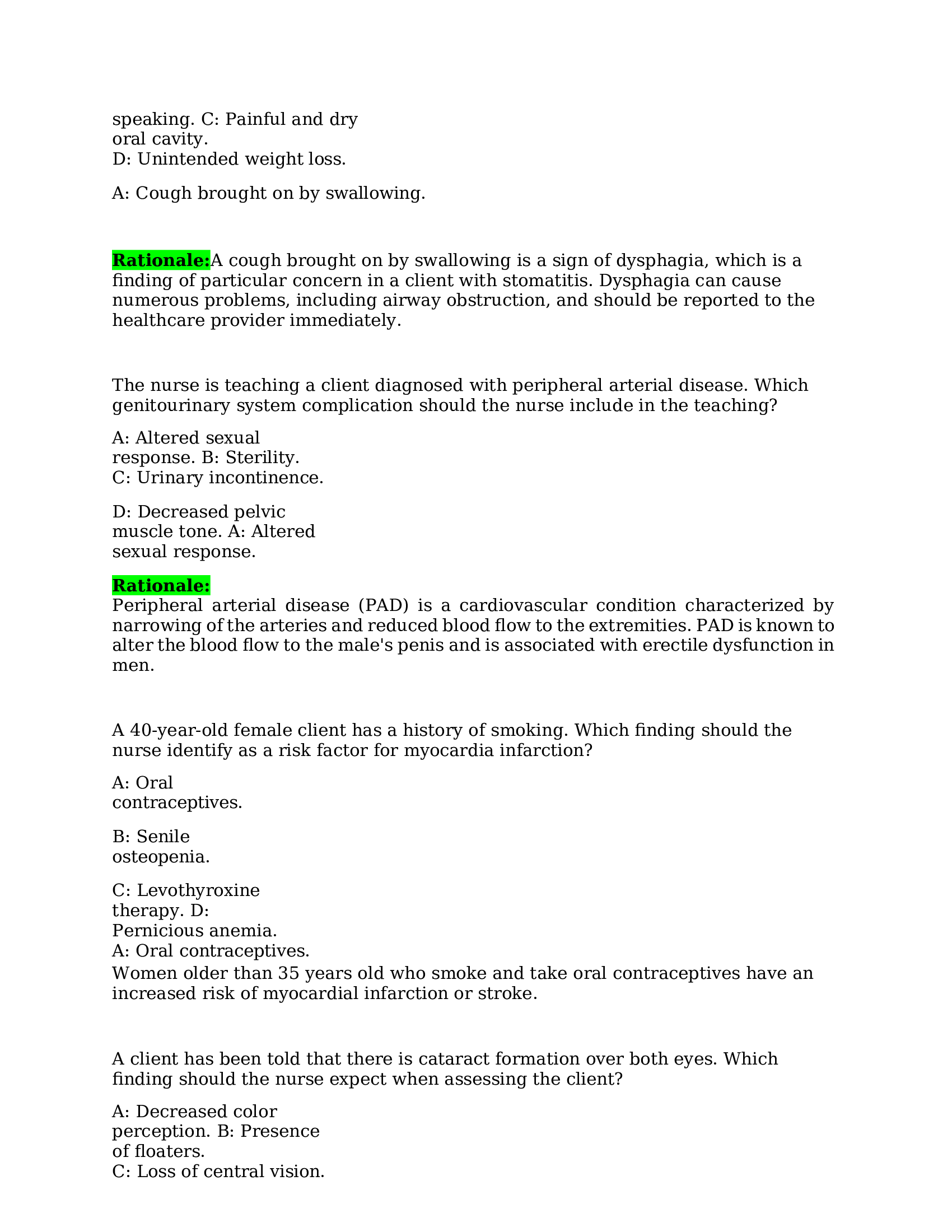
D: Unintended weight loss.


A: Cough brought on by swallowing.


Rationale:A cough brought on by swallowing is a sign of dysphagia, which is a finding of particular concern in a client with stomatitis. Dysphagia can cause numerous problems, including airway obstruction, and should be  reported to the healthcare provider immediately.


The  nurse is teaching a client diagnosed with peripheral arterial disease. Which genitourinary system complication should the  nurse include in the  teaching?


A: Altered sexual response. B: Sterility.

C: Urinary incontinence.


D: Decreased pelvic muscle tone. A: Altered sexual response.


Rationale:

Peripheral arterial disease (PAD) is a cardiovascular condition characterized by

narrowing of the  arteries and reduced blood flow to the  extremities. PAD is known to alter the  blood flow to the  male's penis and is associated with erectile dysfunction in men.


A 40-year-old female client has a history of smoking. Which finding should the nurse identify as a risk factor for  myocardia infarction?


A: Oral contraceptives.


B: Senile osteopenia.


C: Levothyroxine therapy. D: Pernicious anemia.

A: Oral contraceptives.

Women older than 35 years old  who  smoke and take oral contraceptives have an increased risk of myocardial infarction or stroke.


A client has been told that there is cataract formation over both eyes. Which finding should the  nurse expect when assessing the  client?


A: Decreased color perception. B: Presence of floaters.

C: Loss of central vision.


D: Reduced peripheral vision. A: Decreased color perception.


Rationale:Decreased color perception occurs with cataract formation. Cataract formation is also associated with blurred vision and a global loss of vision so gradual that the  client may not  be  aware of it.


Which assessment finding should most concern the  nurse who  is monitoring a client two  hours after a thoracentesis?


A: New onset of coughing. B: Low resting heart rate. C: Distended neck veins.

D: Decreased shallow respirations. A: New onset of coughing.


Rationale:A pneumothorax (partial or complete lung collapse) is the  potential complication of a thoracentesis. Manifestations of a pneumothorax include new onset of a nagging cough, tachycardia, and an increased shallow respiration rate.


While caring for  a client who  has esophageal varices, which nursing intervention is most important for  the  registered nurse (RN) to implement?


A: Monitor infusing IV fluids and any replacement blood products. B: Prepare for esophagogastroduodenoscopy (EGD).

C: Maintain the  client on strict bedrest.

D: Insert a nasogastric tube (NGT)  for  intermittent suction.


A: Monitor infusing IV fluids and any replacement blood products


Rationale: (Maintaining hemodynamic stability in a client with esophageal varices can precipitate a life-threatening crisis if esophageal varies leak or rupture and

can result in hemorrhage. The  priority is assessing and monitoring infusions of IV

fluids and any replacement blood products.)


The  registered nurse (RN) is caring for  a client who  developed oliguria and was diagnosed with sepsis and dehydration 48 hours ago. Which assessment finding indicates to the  RN that the  client is stabilizing?

A: Urine output of 40 mL/hour. B: Apical pulse 100 and blood

pressure 76/42. C: Urine specific

gravity 1.001.

D: Tented skin on dorsal surface


of hands. A: Urine output of 40 mL/hour.


A decrease in urinary output is a sign of dehydration. When the  urine output returns to a normal range, 40 mL/hour, the  client's kidneys are perfusing adequately and indicates the  client's status is stablizing

Upgrade to remove ads Only

$3.99/month

After a liver biopsy is performed at the  bedside, the  registered nurse (RN) is assigned the  care of the  client. Which nursing intervention is most important for the  RN to implement?


A: Position client on left side with pillow placed under the costal margin. B: Assist the  client with voiding immediately after the  procedure.

C:  Evaluate vital signs q10 to 20 minutes for  2 hours after procedure. D: Ambulate client 3 times in first hour with pillow held at abdomen. C: Evaluate vital signs q10 to 20 minutes for  2 hours after procedure.

Rationale:Vital signs should be  checked every 10 to 20 minutes to assess for bleeding after biopsy of the  liver, which is highly vascular. The  client should be positioned on the  right side with a pillow or sandbag under the  costal margin and supporting the  biopsy site. The  client should be  maintained on bedrest for  several hours to decrease the  risk of bleeding from the  biopsy site.


The  registered nurse (RN) is caring for  a client with aplastic anemia who  is hospitalized for  weight loss and generalized weakness. Laboratory values show a white blood count (WBC)  of 2,500/mm 3 and a platelet count of 160,000/mm 3. Which intervention is the  primary focus in the  client's plan of care for  the  RN to implement?


A: Assist with frequent ambulation. B: Encourage visitors to visit.

C: Maintain strict protective precautions. D: Avoid peripheral injections.

C: Maintain strict protective precautions.


The  client should be  under strict protective transmission precautions because the WBC values are low  and normal WBC levels are 4,000-10,000/mm3, so the  client is an increased high risk for  infection.


The  registered nurse (RN) is caring for  a young adult who  is having an oral

glucose tolerance tests (OGTT). Which laboratory result should the  RN assess as a normal value for  the  two  hour postprandial result?


A: 140 mg/dl. B: 160 mg/dl.


C: 180 mg/dl. D: 200 mg/dl. A: 140 mg/dl.


The  two  hour postprandial level should be  less 140 mg/dl for  a young adult client.


The  registered nurse (RN) is caring for  an older client who  recently experienced a fractured pelvis from a fall. Which assessment finding is most important for  the  RN to report the  healthcare provider?


A: Lower back pain.

B: Headache of 7 on scale

1 to 10. C: Blood pressure of 140/98.

D: Dyspnea.


D: Dyspnea.


A client with a large bone fracture is at risk for  intramedullary fat leaking into the blood stream and becoming embolic. Dyspnea is an indication of fat embolism to the  lungs and should be  reported to the  healthcare provider immediately.


The  registered nurse (RN) is caring for  a client with tuberculosis (TB) who  is taking a combination drug regimen. The  client complains about taking "so  many pills." What information should the  RN provide to the  client about the  prescribed treatment?


A: The  development of resistant strains of TB are decreased with a combination of drugs. B: Compliance to the  medication regimen is challenging but should be  maintained.

C: Side effects are minimized with the  use of a single medication but is less effective.


D: The  treatment time is decreased from 6 months to 3 months with this standard regimen. A: The  development of resistant strains of TB are decreased with a combination of drugs.


Combination therapy is necessary to decrease the  development of resistant strains of

TB and ensure treatment efficacy.


The  registered nurse (RN) is teaching a client who  is newly diagnosed with emphysema how  to perform pursed lip breathing. What is the  primary reason for teaching the  client this method of breathing?


A: Decreases respiratory rate.


B: Increases O 2 saturation throughout


the  body. C: Conserves energy while ambulating.

D: Promotes CO 2 elimination. D: Promotes CO 2 elimination.


Pursed lip breathing helps eliminate CO2 by increasing positive pressure within the alveoli increasing the  surface area of the  alveoli making it easier for  the  O2 and CO2 gas exchange to occur .


The  registered nurse (RN) is caring for  a client with acute pancreatitis and reviews the  admission laboratory results. What laboratory value should the  RN anticipate being elevated with this diagnosis?


A: Triglyceride s.

B: Amylase. C:

Creatinine

.


D: Uric acid.


B: Amylase.


An elevated amylase level is associated with acute pancreatitis.


A client is recently diagnosed with systemic lupus erythematosus (SLE) and the registered nurse (RN) is assessing for  common complications. Which symptom should the  RN instruct the  client to report immediately?


A: Fever related to infection.   B:   Weight loss and  anorexia.  C: Depressed mood.

D:  Break in tissue integrity. A: Fever related to infection.


Secondary infections are a major concern with SLE clients due to the  use of corticosteroids and chemotherapeutic agents, which suppresses the  immune system, so reporting fever and infections should be  reported immediately.


A client in an ambulatory clinic describes awaking in the  middle of the  night with difficulty breathing and shortness of breath related to paroxysmal nocturnal dyspnea. Which underlying condition should the  registered nurse (RN) identify in the  client's history?


A: Chronic bronchitis.


B: Gastroesophageal reflux disease (GERD). C: Heart failure (HF).

D: Chronic pancreatitis.


C: Heart failure (HF).


Paroxysmal nocturnal dyspnea is classic sign of heart failure and is secondary to fluid overload associated with heart failure which causes pulmonary edema.


A male client is admitted after falling from his bed. The  healthcare provider (HCP) tells the  family that he has an incomplete fracture of the  humerus. The  family ask the  RN what this means. Which explanation by the  nurse accurately describes the client's fracture?


A: Straight fracture line that is also a simple, closed fracture. B: Nondisplaced fracture line that wraps around the  bone. C: A complete fracture that also punctures the  skin.

D: A fracture that bends or splinters part of the  bone. D: A fracture that bends or splinters part of the  bone.


An incomplete fracture occurs when part of the  bone is splintered (broken)

and it has not  gone completely through the  thickness of the  bone.


Upgrade to remove ads Only

$3.99/month

The  registered nurse (RN) is caring for  a client who  has a closed head injury from a motor vehicle collision. Which finding would indicate to the  nurse that the  client is at risk for  diabetes insipidus (DI)?


A:High fever. B: Low blood

pressure.


C: Muscle rigidity.


D: Polydipsia.


D: Polydipsia.


A characteristic finding of DI is excretion of large quantities of urine (5 to

20L/day), and most clients compensate for  fluid loss by drinking large amounts of water (polydipsia). DI can occur when there has been damage or injury to the pituitary gland or hypothalamus as a result of head trauma, tumor or an illness such as meningitis. This damage interrupts the  ADH production, storage and release causing the  excessive urination and thirst.


The  registered nurse (RN) is assisting the  healthcare provider (HCP) with the removal of a chest tube. Which intervention has the  highest priority and should be anticipated by the  RN after the  removal of the  chest tube?


A: Prepare the  client for  chest x-ray at the  bedside. B: Review arterial blood gases after removal.

C: Elevate the  head of bed to 45 degrees.


D: Assist with disassembling the drainage system. A: Prepare the  client for  chest x-ray at the  bedside.


A chest x-ray should be  performed immediately after the  removal of a chest tube to ensure lung expansion has been maintained after its removal.


A client with chest pain, dizziness, and vomiting for  the  last 2 hours is admitted for evaluation for  Acute Coronary Syndrome (ACS). Which cardiac biomarker should the registered nurse (RN) anticipate to be  elevated if the  client experienced myocardial damage?


A: Creatine Kinase (CK-MB). B: Serum troponin.

C: Myoglobin.


D: Ischemia modified albumin. B: Serum troponin.


Troponin is the  most sensitive and specific test for  myocardial damage. Troponin elevation is more specific than CK-MB.

Contact the Seller

Please Sign In to contact this seller.


  • 👎  Report Copyright Violation

Frequently Asked Questions

What Do I Get When I Buy This Study Material?

+

When you buy a study material on Passing Grades, an instant download link will be sent directly to your email, giving you access to the file anytime after payment is completed.

Is Passing Grades a Trusted Platform?

+

Yes, Passing Grades is a reputable students’ marketplace with a secure payment system and reliable customer support. You can trust us to ensure a safe and seamless transaction experience.

Will I Be Stuck with a Subscription?

+

No, all purchases on Passing Grades are one-time transactions. You only pay for the notes you choose to buy, with no subscriptions or hidden fees attached.

Who Am I Buying These Study Materials From?

+

Passing Grades is a marketplace, which means you are purchasing the document from an individual vendor, not directly from us. We facilitate the payment and delivery process between you and the vendor.

Does Passing Grades Offer Free Study Materials?

+

Yes, sellers on Passing Grades have uploaded numerous free test banks, exams, practice questions, and class notes that can be downloaded at no cost.

Pasinggrades - Quality Study Materials

USD 10

    • Quality checked by Pasing Grades
    • 100% satisfaction guarantee
    • Seller: Pasing-Grades
Buy PDF $10

Seller Information

Pasing-Grades

Member since May 2021

  • icon
View Profile
  • total sales

    0
  • Favourites

    0
  • Comments

    0
    ( 0 Ratings )

Item Information

  • Uploaded

    10 March 2025

  • Updated

    05 January 2026

  • Category

    Accounting

  • Item Type

    hesi

  • Tags

    HESI Med Surg Final Exam Practice Questions Evolve

Related Exam Prep Guides by Pasing-Grades

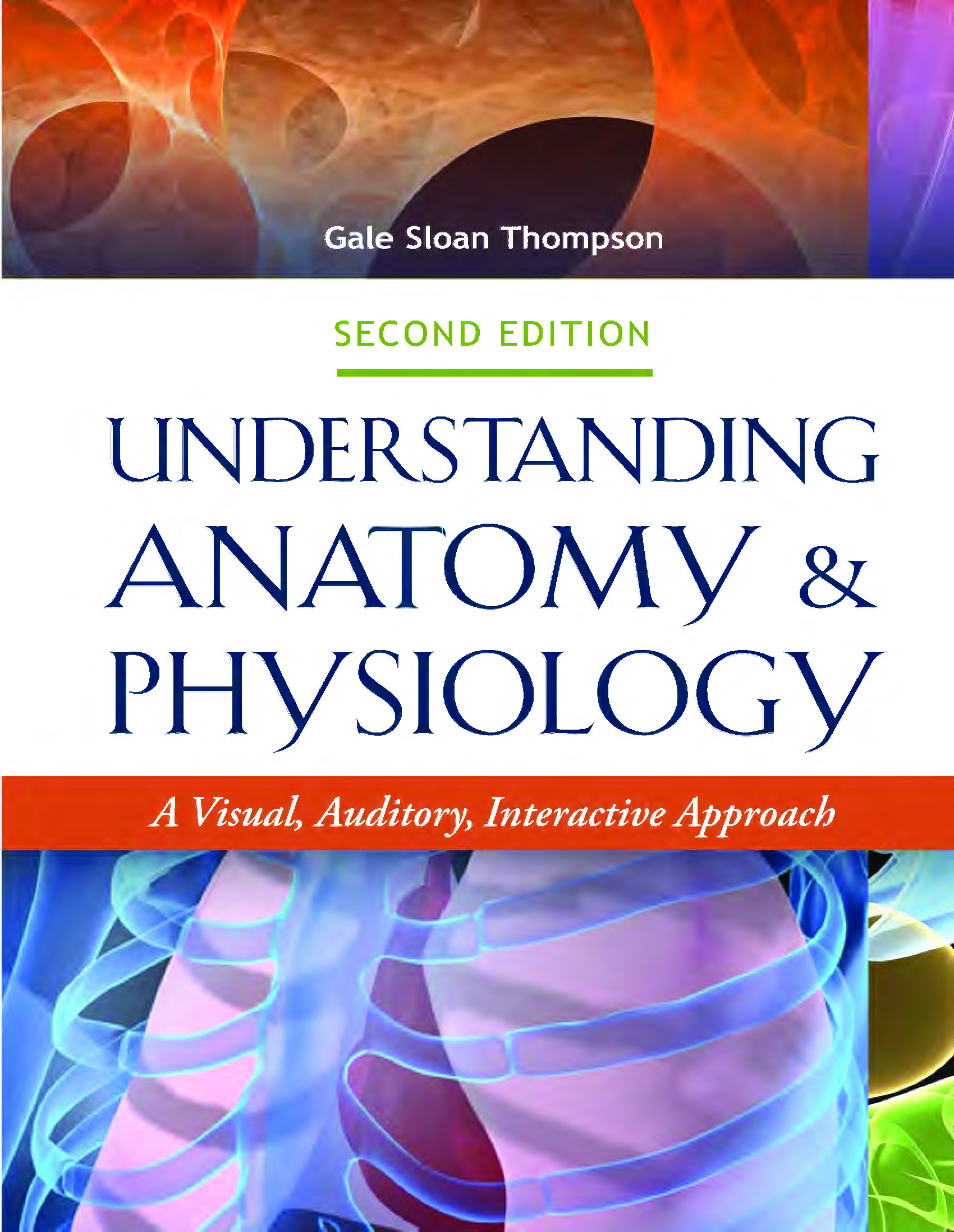
Understanding Anatomy and Physiology; A Visual, Auditory, Interactive Approach by Gale. S. Thompson
View Document

Understanding Anatom...

  • Pasing-Grades

    Pasing-Grades

  • hesi

Third Edition: Understanding Anatomy and Physiology; A Visual, Auditory, Interactive Approach by Gal...

10 USD

0

0

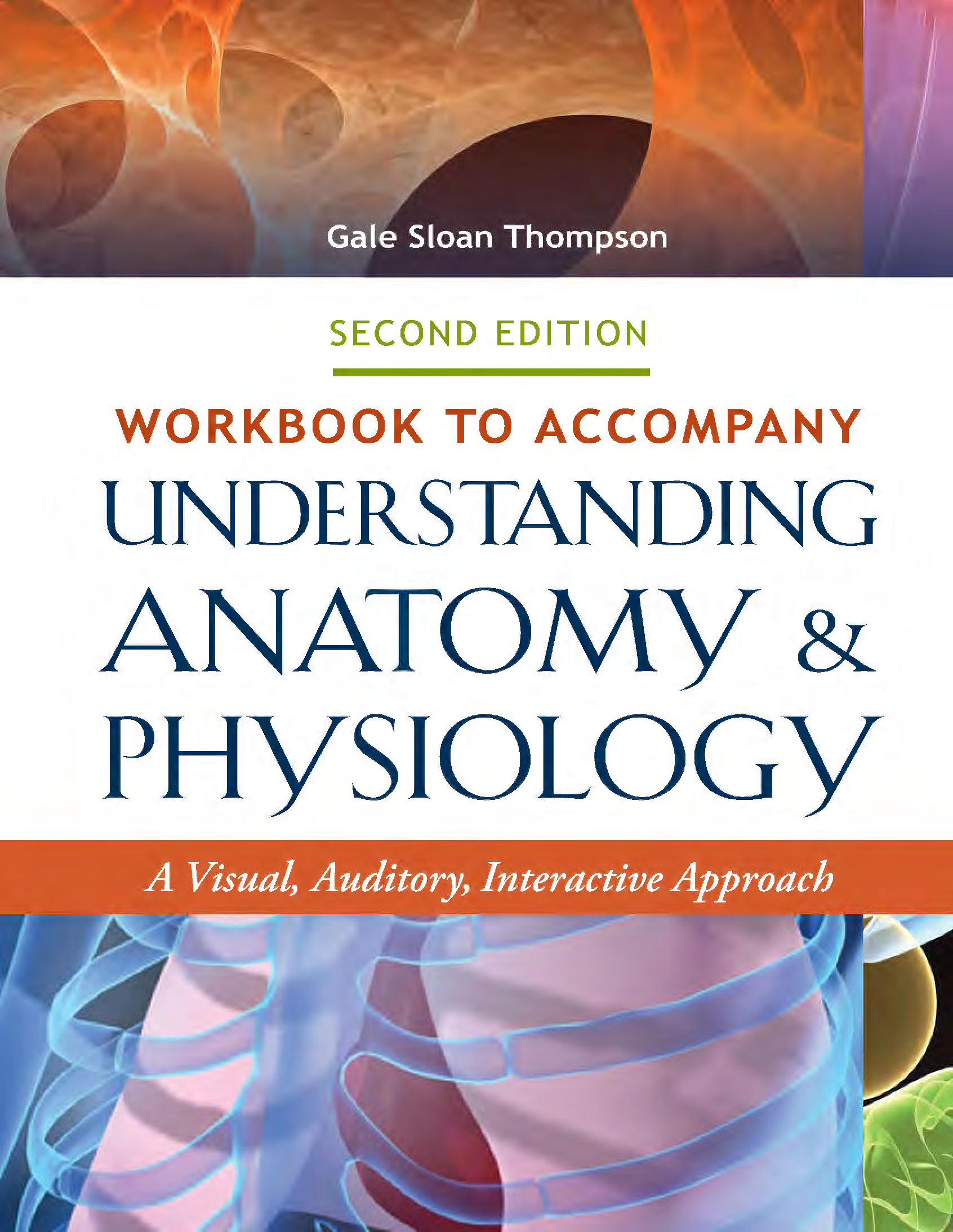
Workbook to Accompany Understanding Anatomy & Physiology: A Visual, Auditory, Interactive Approach by Gale Sloan Thompson RN
View Document

Workbook to Accompan...

  • Pasing-Grades

    Pasing-Grades

  • hesi

Workbook to Accompany Understanding Anatomy & Physiology: A Visual, Auditory, Interactive Approach b...

10 USD

0

0

Test Bank for Fundamentals of Nursing 10th Edition by Taylor
View Document

Test Bank for Fundam...

  • Pasing-Grades

    Pasing-Grades

  • hesi

Get now the Test Bank for Fundamentals of Nursing 10th Edition by Taylor. Instant PDF Download....

10 USD

0

0

Purchase

Download link will be sent to this email immediately after purchase.

IMPORTANT LINKS

  • How To Upload Class Notes
  • Selling Tips
  • Passing Grades's Study Materials
  • Scholarships for International Students 2025

POPULAR CATEGORIES

  • Law
  • Accounting
  • English
  • Psychology
  • Business
  • Nursing
  • Computer Science
  • General

View Document

  • Blog
  • Contact
  • Delivery Policy
  • Latest Scholarships Around the World
  • How to Pass Bar Exams: Passing Grades’ Strategies
  • How to Study and Pass the CPA Exam
  • All Test Banks
  • Faq
  • Copyright Claims
  • Privacy Policy
  • Terms of Use

KNOWLEDGE BASE

  • How to Write A+ Grade Good Research Paper
  • How to Manage Stress During Exam Period
  • Best Time to Study
  • How to Pass NCLEX-RN Exam
  • How To Effectively Utilize Test Banks
  • Popular Shadow Health Exam Assessments
  • Popular HESI Case Studies
  • How to Prepare for a Nursing Career
  • The Importance Of Summaries in Exam Revisvion

© 2026 Pasing Grades. All rights reserved.