Pasing Grades
  • Start Selling
  • Blog
  • Contact
  • 0

    Your cart is empty!

English

  • English
  • Spanish
  • Arabic
Create Account Sign In
  • Library
    • New Prep Guides
    • Featured Prep Guides
    • Free Exam Prep Guides
    • Best sellers
  • General
  • Nursing
    • Research Paper
    • Case Study
    • Discussion Post
    • Assignment
    • Exam
    • Practice Questions and Answers
    • Test Bank
    • solutions manual
  • Accounting
    • Case Study
    • Thesis
    • Study Guide
    • Summary
    • Research Paper
    • test bank
  • English
    • Creative Writing
    • Research Paper
    • Summary
    • Rhetorics
    • Literature
    • Journal
    • Exam
    • Grammar
    • Discussion Post
    • Essay
  • Psychology
    • Hesi
    • Presentation
    • Essay
    • Summary
    • Study Guide
    • Essay
    • Solution Manual
    • Final Exam Review
    • Class Notes
    • test bank
  • Business
    • Lecture Notes
    • Solution Manual
    • Presentation
    • Business Plan
    • Class Notes
    • Experiment
    • Summary
    • Practice Questions
    • Study Guide
    • Case Study
    • test bank
    • Exam
  • More
    • Computer Science
    • Economics
    • Statistics
    • Engineering
    • Biology
    • Religious Studies
    • Physics
    • Chemistry
    • Mathematics
    • History
    • Sociology
    • Science
    • Philosophy
    • Law
  • Pages
    • About Us
    • Selling Tips
    • Delivery Policy
    • Faq
    • Privacy Policy
  • Flash Sale
  • Home
  • Exam 2 Study Guide-Critical Care updated 2020

Exam 2 Study Guide-Critical Care updated 2020

Preview page 1 Preview page 2 Preview page 3
Add To Favorites

Share this item Share this item

  • Item Details
  • Comments (0)
  • Reviews (0)
  • Contact Seller

Exam 2 Study Guide-Critical Care updated 2020

Basic Dysrhythmia Interpretation & Mgmt-Ch 7

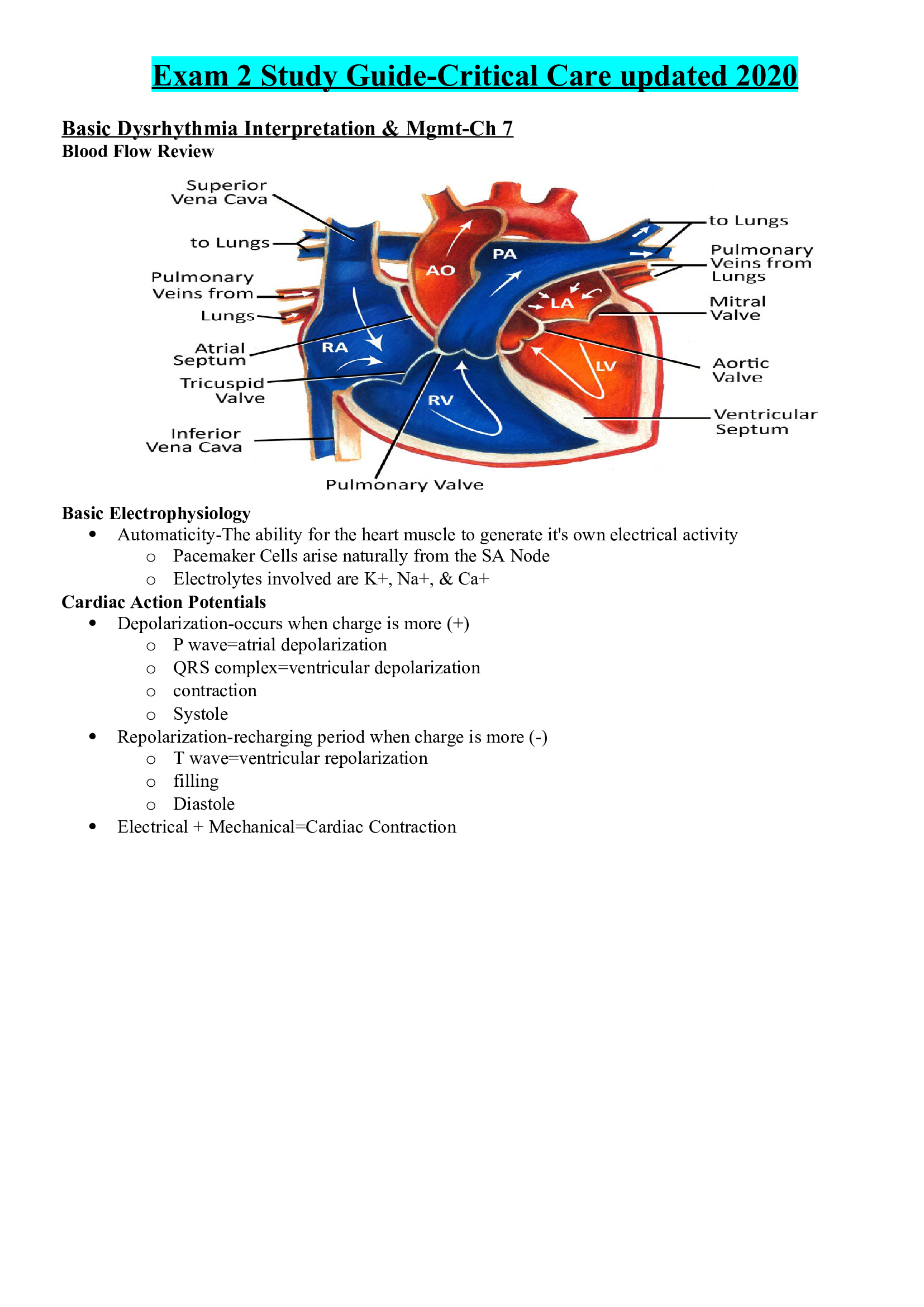
Blood Flow Review


Basic Electrophysiology

•             Automaticity-The ability for the heart muscle to generate it's own electrical activity o Pacemaker Cells arise naturally from the SA Node o Electrolytes involved are K+, Na+, & Ca+ Cardiac Action Potentials

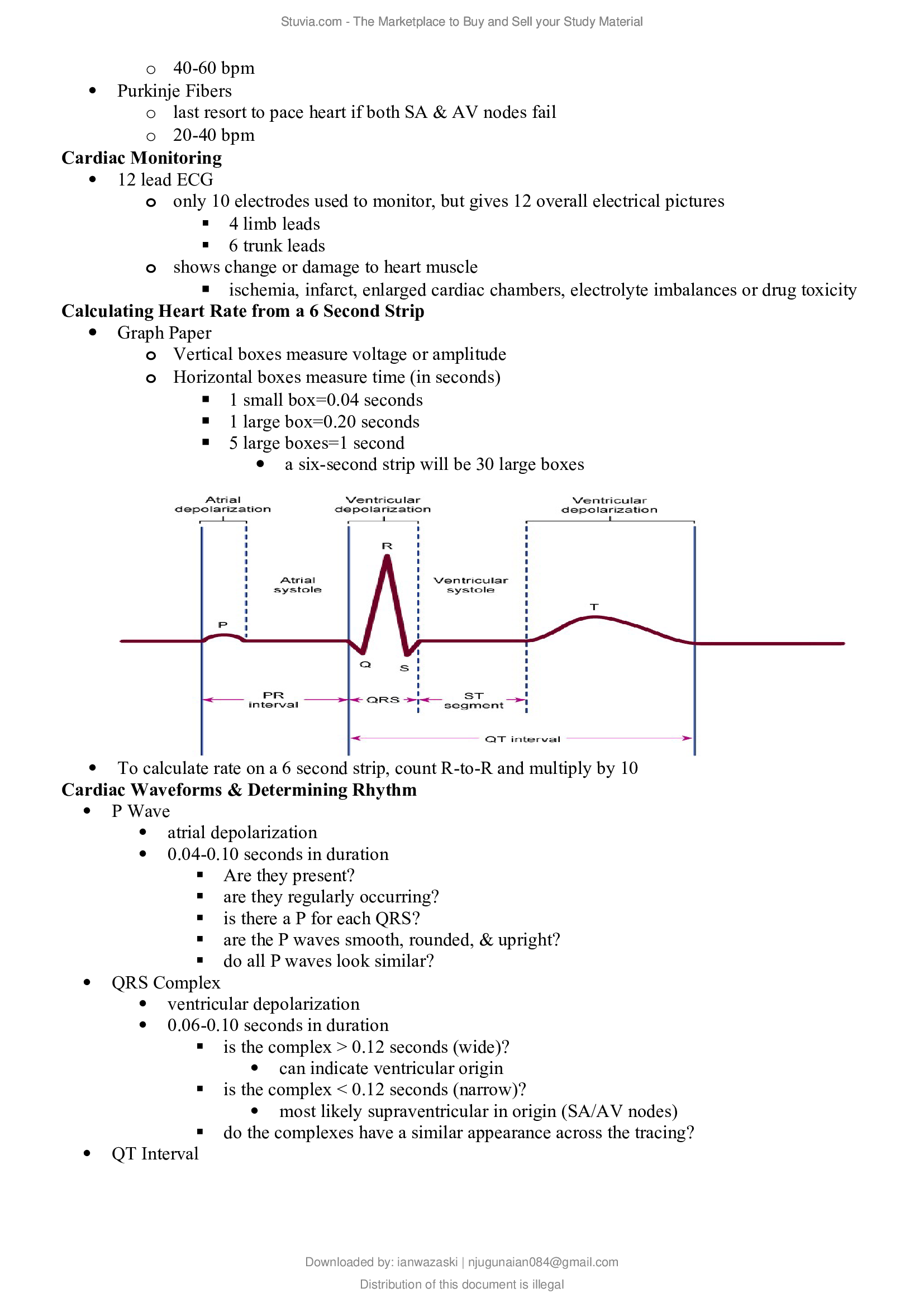
•             Depolarization-occurs when charge is more (+) o P wave=atrial depolarization o QRS complex=ventricular depolarization

o             contraction

o             Systole

•             Repolarization-recharging period when charge is more (-) o T wave=ventricular repolarization

o             filling o Diastole

•             Electrical + Mechanical=Cardiac Contraction


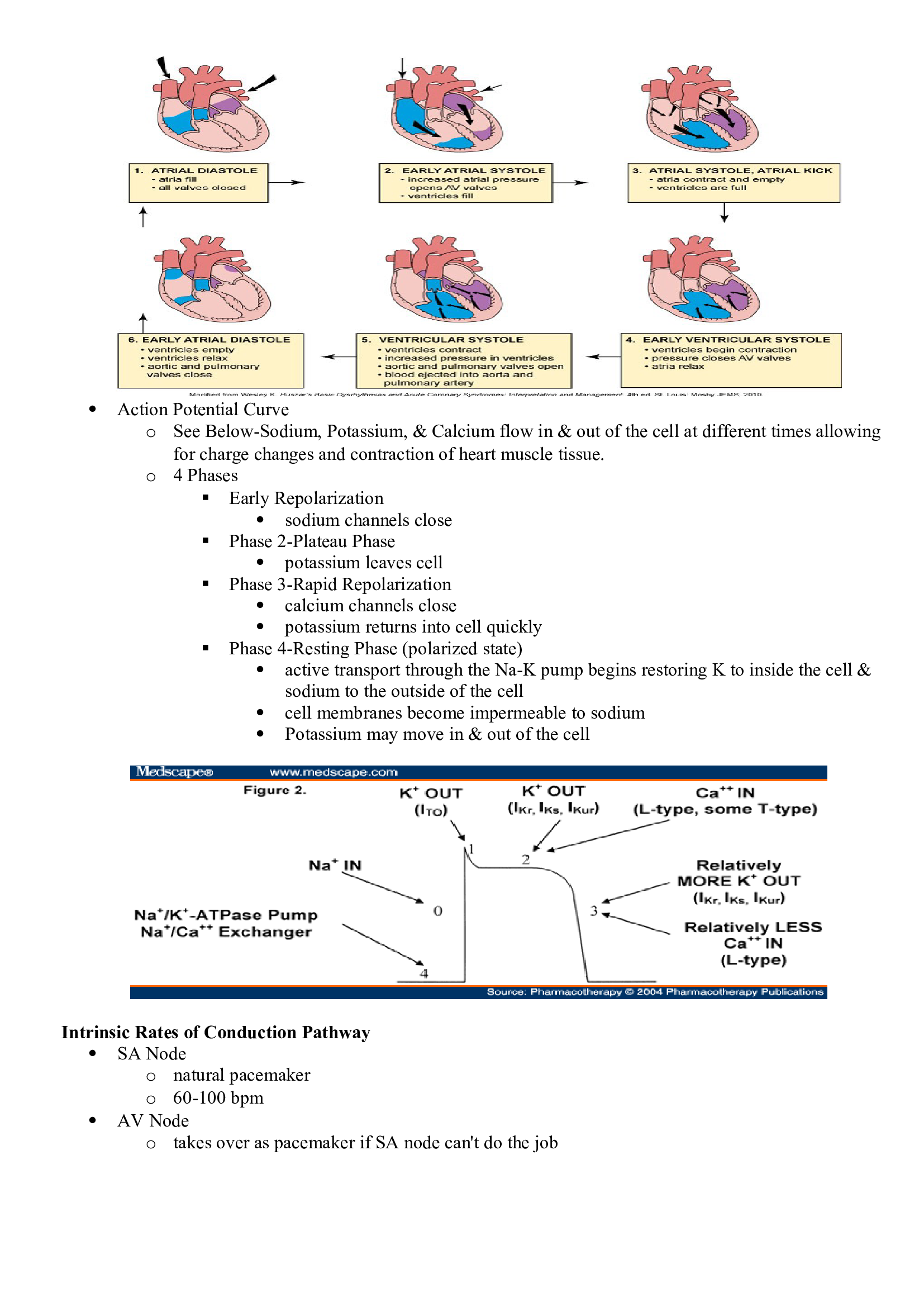
•             Action Potential Curve o See Below-Sodium, Potassium, & Calcium flow in & out of the cell at different times allowing for charge changes and contraction of heart muscle tissue. o 4 Phases

 Early Repolarization

•             sodium channels close

 Phase 2-Plateau Phase

•             potassium leaves cell

 Phase 3-Rapid Repolarization

•             calcium channels close

•             potassium returns into cell quickly

 Phase 4-Resting Phase (polarized state)

•             active transport through the Na-K pump begins restoring K to inside the cell & sodium to the outside of the cell

•             cell membranes become impermeable to sodium • Potassium may move in & out of the cell


Intrinsic Rates of Conduction Pathway

•             SA Node

o natural pacemaker o 60-100 bpm

•             AV Node

o             takes over as pacemaker if SA node can't do the job

o             40-60 bpm

•             Purkinje Fibers o last resort to pace heart if both SA & AV nodes fail

o             20-40 bpm

Cardiac Monitoring

•             12 lead ECG

o             only 10 electrodes used to monitor, but gives 12 overall electrical pictures

             4 limb leads

             6 trunk leads o shows change or damage to heart muscle

             ischemia, infarct, enlarged cardiac chambers, electrolyte imbalances or drug toxicity Calculating Heart Rate from a 6 Second Strip

•             Graph Paper

o             Vertical boxes measure voltage or amplitude o Horizontal boxes measure time (in seconds)

             1 small box=0.04 seconds

             1 large box=0.20 seconds

             5 large boxes=1 second

•             a six-second strip will be 30 large boxes


•             To calculate rate on a 6 second strip, count R-to-R and multiply by 10

Cardiac Waveforms & Determining Rhythm

•             P Wave

•             atrial depolarization

•             0.04-0.10 seconds in duration  Are they present?

             are they regularly occurring?

             is there a P for each QRS?

             are the P waves smooth, rounded, & upright?

             do all P waves look similar?

•             QRS Complex

•             ventricular depolarization

•             0.06-0.10 seconds in duration

 is the complex > 0.12 seconds (wide)?

•             can indicate ventricular origin

 is the complex < 0.12 seconds (narrow)?

•             most likely supraventricular in origin (SA/AV nodes)

 do the complexes have a similar appearance across the tracing?

•             QT Interval


•             0.38-0.42 seconds

•             begins at the QRS Complex to the end of the T wave

•             varies with heart rate

•             Pathological Q waves

•             0.04 seconds in width & more than 1/4 R wave amplitude

•             indication of MI or myocardial tissue death

•             ST Segment

•             Elevation

 myocardial injury or hyperkalemia

•             STEMI

 looks like a tombstone

•             Depression

 myocardial ischemia or digoxin use

•             T Wave

•             ventricular repolarization

•             follows QRS Complex

•             U Wave

•             can sometimes bee seen after the T wave

•             can be normal or indicate hypokalemia

•             PR Interval

•             0.12-0.20 seconds in duration

             is the interval > 0.20 seconds?

             is the interval < 0.12 seconds?

             is the interval constant across the tracing?

Cardiac Dysrhythmias

•             Normal Sinus


•             Rate 60-100

•             Rhythm regular

•             P waves before QRS & upright

•             PR interval 0.12-0.20 seconds

•             QRS complexes <0.12 seconds & look alike

•             Sinus tachycardia

•             Causes

 stress, exercise, fever, anemia, hypoxemia, CHF, pain

•             Effects on body

 faster rate decreases CO

•             S&S

             pounding heart, dizziness, anxiety, weak pulses

             decreased BP, UO

•             Treatment

             treat underlying cause

             give O2

             if CHF, give Digoxin


•             Rate 100-160

•             Rhythm regular

•             P waves before QRS & upright

•             PR interval 0.12-0.20 seconds

•             QRS complexes <0.12 seconds & look alike

•             Sinus bradycardia

•             Causes

 athletes, acute spinal cord injury

•             Effects on body

 lower rate decreases CO

•             S&S

 dizziness, SOB, weak pulses

•             Treatment

 Atropine by IV bolus to increase heart rate

•             0.5 mg q3-5 minutes for a total dose of no more than 3 mg

•             S/Es: dry mouth/eyes, blurry vision, decreased UO, further slowing of heart rate if <0.5 mg are given


•             Rate < 60

•             Rhythm regular

•             P waves before QRS & upright

•             PR interval 0.12-0.20 seconds

•             QRS complexes <0.12 seconds & look alike

Atrial Rhythms

•             Causes

o Stress response, electrolyte imbalances, hypoxia, atrial injury, Dig toxicity, hypothermia o hyperthyroidism, alcohol, pericarditis, drugs

•             Premature Atrial Contractions (PACs)

•             early beats initiated by the atria not the SA node resulting in an early P wave

•             P waves & PR intervals may vary and are not at a regular rhythm

•             normal QRS Complexes

•             Precursor to other atrial tachycardias

•             S&S

             palpitations, heart skipping or pausing

•             Supraventricular tachycardia (SVT)

•             Causes

             heart disease, use of digoxin

•             Effects on body

             rhythm can come & go

             decreases CO

•             S&S



•             Treatment

             O2, start an IV, vagal maneuvers/valsalva, carotid massage

             adenosine by rapid IV push to block AV node transmission & stop heart briefly

•             6 mg rapid IV push initially, followed by a second bolus of 12 mg 2 minutes later if not convert back to NSR o all doses followed by flush of NS and raising of arm

•             monitor HR, BP, and rhythm pattern

•             Have crash cart and/or defibrillator present in room

•             S/Es: diaphoresis, facial flushing, lightheadedness, chest pain

             Beta Blockers (Metroprolol, Labetalol)

•             decreases HR & BP, cardioprotective effects for MI patients

•             slow IV push

•             continuous monitoring of BP, HR, & rhythm o do NOT give for HR less than 50 or with 2nd or 3rd* heart block

•             S/Es: bradycardia, hypotension, heart failure

             Calcium Channel Blocker (Diltiazem, Verapamil)

•             slows conduction through AV node & decreases HR

•             Diltiazem 15-20 mg slow IV push over at least 2 minutes with a repeat bolus of

20-25mg if needed can be given after 15 minutes o IV infusion rate of 5-15 mg/hr may be started & titrated to desired HR

•             Verapamil 2.5-5 mg slow IV push over at least 2 minutes; if no response, can give repeat boluses of 5-10 mg every 15-30 minutes for a total dosage of 20 mg

•             S/Es: hypotension, bradycardia, flushing, burning at injection site, CHF, heart block


•             Rate 150-250

•             Rhythm regular

•             P waves usually not discernible, especially at high rates

•             PR interval usually not discernible

•             QRS complexes <0.12 seconds & look alike

•             Atrial fibrillation-

•             Causes:

             CHF, ischemic or rheumatic heart disease, pulmonary disease

•             Effects on Body

             decreases CO

•             S&S

             palpitations

•             Treatment

Contact the Seller

Please Sign In to contact this seller.


  • 👎  Report Copyright Violation

Frequently Asked Questions

What Do I Get When I Buy This Study Material?

+

When you buy a study material on Passing Grades, an instant download link will be sent directly to your email, giving you access to the file anytime after payment is completed.

Is Passing Grades a Trusted Platform?

+

Yes, Passing Grades is a reputable students’ marketplace with a secure payment system and reliable customer support. You can trust us to ensure a safe and seamless transaction experience.

Will I Be Stuck with a Subscription?

+

No, all purchases on Passing Grades are one-time transactions. You only pay for the notes you choose to buy, with no subscriptions or hidden fees attached.

Who Am I Buying These Study Materials From?

+

Passing Grades is a marketplace, which means you are purchasing the document from an individual vendor, not directly from us. We facilitate the payment and delivery process between you and the vendor.

Does Passing Grades Offer Free Study Materials?

+

Yes, sellers on Passing Grades have uploaded numerous free test banks, exams, practice questions, and class notes that can be downloaded at no cost.

Pasinggrades - Quality Study Materials

USD 7

    • Quality checked by Pasing Grades
    • 100% satisfaction guarantee
    • Seller: GradeA
Buy PDF $7

Seller Information

GradeA

Member since April 2021

  • icon
  • icon
  • icon
View Profile
  • total sales

    0
  • Favourites

    0
  • Comments

    0
    ( 0 Ratings )

Item Information

  • Uploaded

    24 October 2021

  • Updated

    24 October 2025

  • Category

    Nursing

  • Item Type

    exam

  • Tags

    Exam 2 Study Guide Critical Care

Related Exam Prep Guides by GradeA

Test Bank for Fundamentals of Corporate Finance 12th Edition By Stephen Ross and Randolph Westerfield and Bradford Jordan
View Document

Test Bank for Fundam...

  • GradeA

    GradeA

  • exam

Test Bank for Fundamentals of Corporate Finance 12th Edition By Stephen Ross and Randolph Westerfiel...

7 USD

0

0

[SOLUTION MANUAL) Fundamentals of Corporate Finance 12th Edition By Stephen Ross and Randolph Westerfield and Bradford Jordan
View Document

[SOLUTION MANUAL) Fu...

  • GradeA

    GradeA

  • exam

[SOLUTION MANUAL) Fundamentals of Corporate Finance 12th Edition By Stephen Ross and Randolph Wester...

7 USD

0

0

QMI1500 Assignment 02 2021 AS PER UPDATED TUTORIAL LETTER
View Document

QMI1500 Assignment 0...

  • GradeA

    GradeA

  • exam

QMI1500 Assignment 02 2021 AS PER UPDATED TUTORIAL LETTER...

7 USD

0

0

Purchase

Download link will be sent to this email immediately after purchase.

IMPORTANT LINKS

  • How To Upload Class Notes
  • Selling Tips
  • Passing Grades's Study Materials
  • Scholarships for International Students 2025

POPULAR CATEGORIES

  • Law
  • Accounting
  • English
  • Psychology
  • Business
  • Nursing
  • Computer Science
  • General

View Document

  • Blog
  • Contact
  • Delivery Policy
  • Latest Scholarships Around the World
  • How to Pass Bar Exams: Passing Grades’ Strategies
  • How to Study and Pass the CPA Exam
  • All Test Banks
  • Faq
  • Copyright Claims
  • Privacy Policy
  • Terms of Use

KNOWLEDGE BASE

  • How to Write A+ Grade Good Research Paper
  • How to Manage Stress During Exam Period
  • Best Time to Study
  • How to Pass NCLEX-RN Exam
  • How To Effectively Utilize Test Banks
  • Popular Shadow Health Exam Assessments
  • Popular HESI Case Studies
  • How to Prepare for a Nursing Career
  • The Importance Of Summaries in Exam Revisvion

© 2026 Pasing Grades. All rights reserved.