Pasing Grades
  • Start Selling
  • Blog
  • Contact
  • 0

    Your cart is empty!

English

  • English
  • Spanish
  • Arabic
Create Account Sign In
  • Library
    • New Prep Guides
    • Featured Prep Guides
    • Free Exam Prep Guides
    • Best sellers
  • General
  • Nursing
    • Research Paper
    • Case Study
    • Discussion Post
    • Assignment
    • Exam
    • Practice Questions and Answers
    • Test Bank
    • solutions manual
  • Accounting
    • Case Study
    • Thesis
    • Study Guide
    • Summary
    • Research Paper
    • test bank
  • English
    • Creative Writing
    • Research Paper
    • Summary
    • Rhetorics
    • Literature
    • Journal
    • Exam
    • Grammar
    • Discussion Post
    • Essay
  • Psychology
    • Hesi
    • Presentation
    • Essay
    • Summary
    • Study Guide
    • Essay
    • Solution Manual
    • Final Exam Review
    • Class Notes
    • test bank
  • Business
    • Lecture Notes
    • Solution Manual
    • Presentation
    • Business Plan
    • Class Notes
    • Experiment
    • Summary
    • Practice Questions
    • Study Guide
    • Case Study
    • test bank
    • Exam
  • More
    • Computer Science
    • Economics
    • Statistics
    • Engineering
    • Biology
    • Religious Studies
    • Physics
    • Chemistry
    • Mathematics
    • History
    • Sociology
    • Science
    • Philosophy
    • Law
  • Pages
    • About Us
    • Selling Tips
    • Delivery Policy
    • Faq
    • Privacy Policy
  • Flash Sale
  • Home
  • CRW2602 - Latest MCQ Exam Pack 2024 (VERIFIED)

CRW2602 - Latest MCQ Exam Pack 2024 (VERIFIED)

Preview page 1 Preview page 2 Preview page 3
Add To Favorites

Share this item Share this item

  • Item Details
  • Comments (0)
  • Reviews (0)
  • Contact Seller
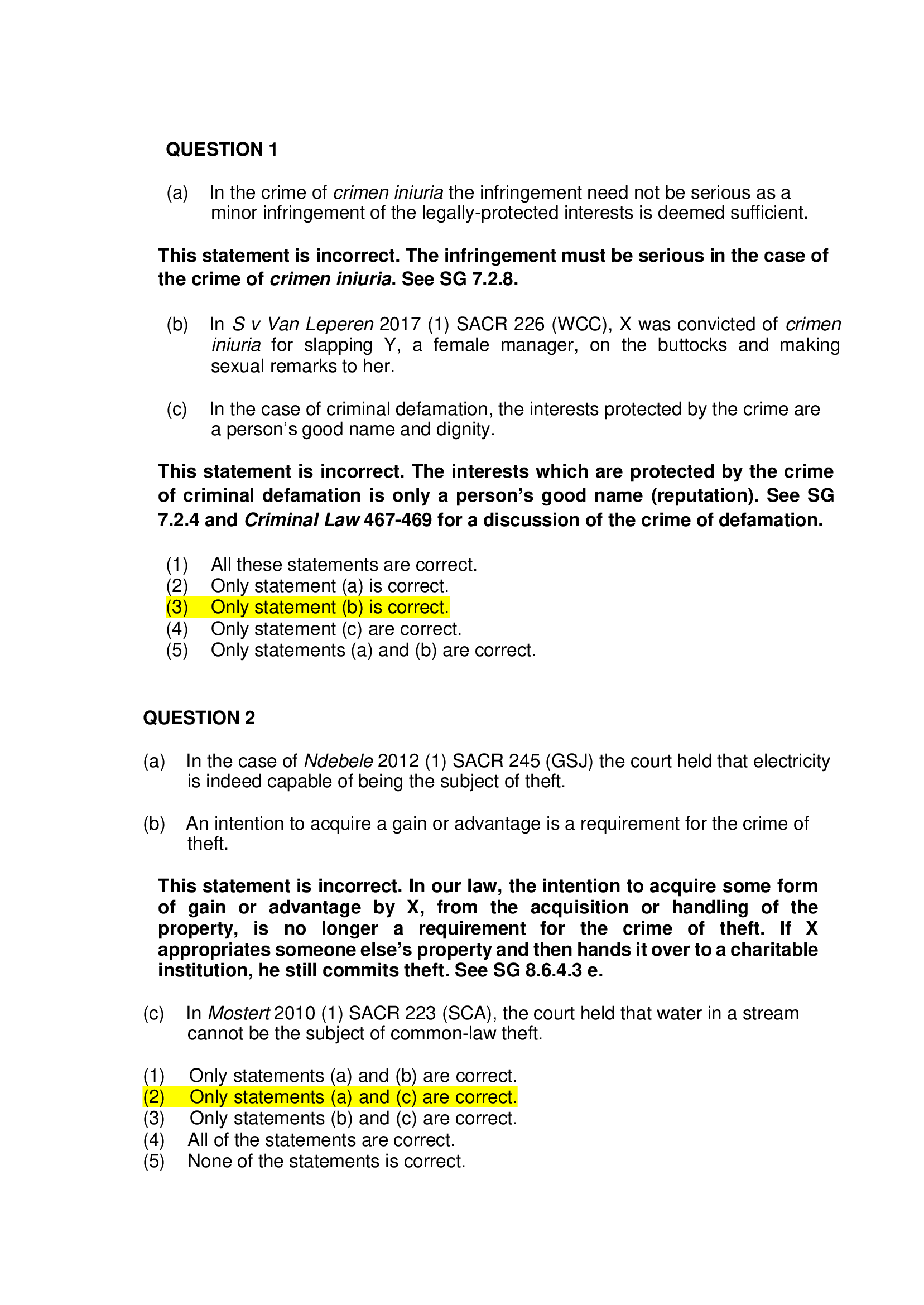
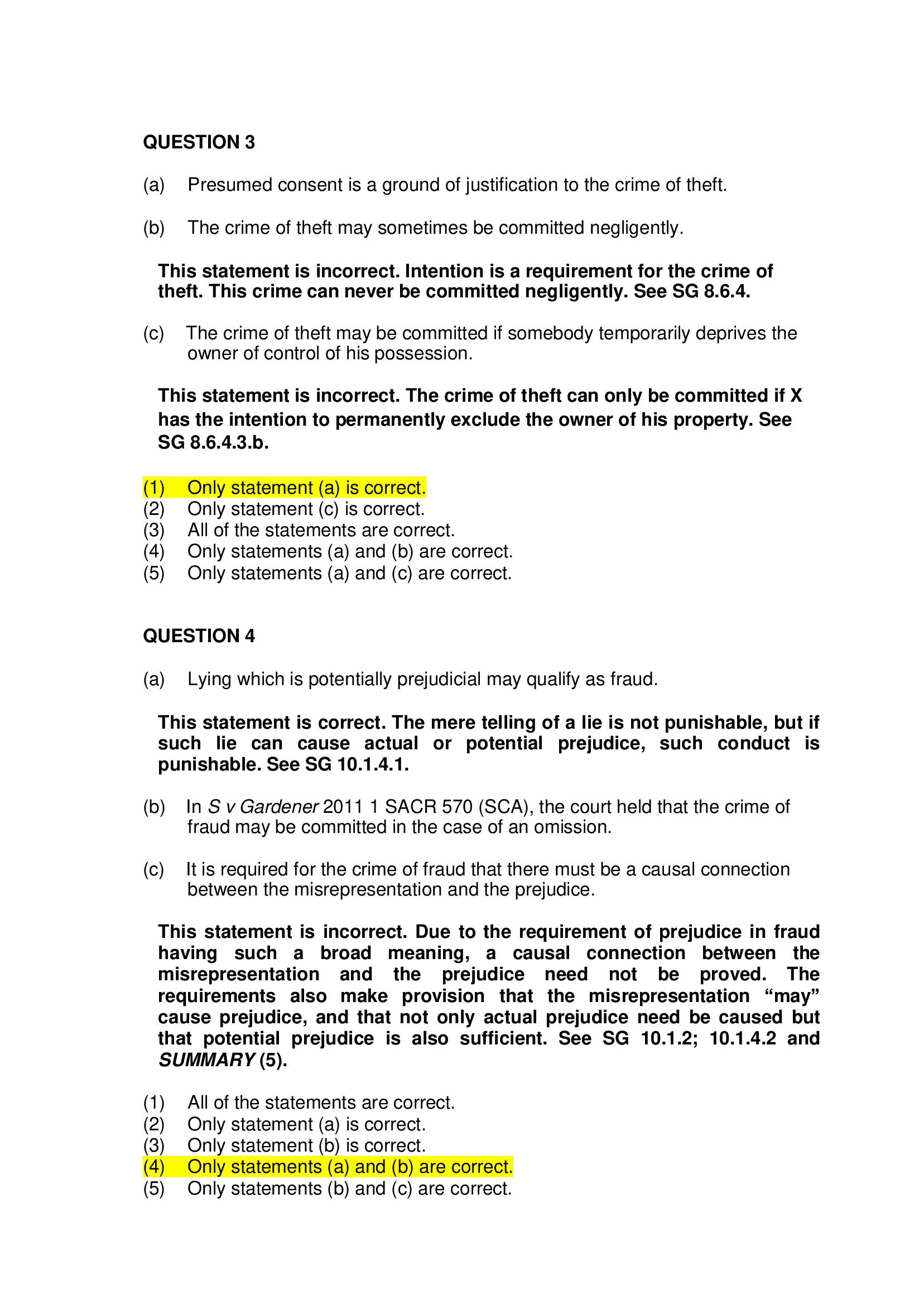
CRW2602 - Latest MCQ Exam Pack 2024 (VERIFIED) Question 1 (i) If Z bribes X to murder Y, and X in fact murders Y, Z is known as a direct perpetrator. (ii) In applying the common purpose doctrine, a finding that a person acted in common purpose with another person can only be made if there is proof of a prior conspiracy between the two persons. (iii) An accessory after the fact is not a participant to the crime, because he did not further the commission of the crime. (1) Only statement (i) is correct. (2) Only statements (i) and (ii) are correct. (3) Only statement (iii) is correct. (4) Only statements (ii) and (iii) are correct. (5) Only statements (i) and (iii) are correct. Question 2 (i) In Davies 1956 (3) the Appeal Court held that the commission of a so called putative crime is nevertheless punishable as attempt. (ii) Two or more people can be convicted of conspiracy only if there is proof that they were in communication with each other. (iii) If X voluntarily withdraws from his or her criminal conduct at a stage before his or her conduct amounts to an act of consummation, he or she is guilty of attempt. (1) Only statement (i) is correct. (2) Only statements (ii) and (iii) are correct. (3) Only statements (i) and (iii) are correct. (4) Only statement (iii) is correct. (5) Only statement (i) is correct. Question 3 (i) Public violence can only be committed in a public place. (ii) The crime of common-law perjury can only be committed if the particular statement is made orally. (iii) If X attempts to induce Y, a witness in a court case to give false evidence in court, X’s conduct may amount to committing the crime of defeating or obstructing the course of justice. (1) Only statements (i) and (iii) are correct. (2) Only statements (i) and (iii) are correct. (3) Only statement (ii) is correct. (4) Not one of these statements are correct (5) Only statement (iii) is correct. Question 4 (i) X may be guilty of corruption even if he or she only makes an offer to Y to give Y an improper benefit (assuming that X has an intention required for corruption). (ii) In order to prove the requirements of the acct in the crime of possession of a drug, it is sufficient for the prosecution to prove either that X had exercised control over the drug as if he or she were the owner, or that he or she had exercised control over it on behalf of somebody else. (iii) If X buys a dagga cigarette from Y in order to smoke it him-or herself, he or she commits an act in connection with the sale of dagga and is accordingly guilty of dealing in drugs. (1) Only statement (i) is correct (2) Only statements (i) and (ii) are correct (3) Only statements (ii) and (iii) are correct (4) Only statement (ii) is correct (5) Only statements (i) and (iii) are correct. Question 5 (i) The crime of unlawfully possessing a weapon is defined by the legislature in such a way that X commits the crime only if he or she exercises control over the weapon with the intention of possessing it as an owner for his or her own benefit. (ii) Negligence is a sufficient form of culpability in the crime of unlawfully possessing an arm. (iii) If a female commits an indecent act with an 18-year-old boy she renders herself guilty of contravening a provision of the Sexual Offences Act 23 of 1957. (1) Only statement (iii) is correct. (2) Only statements (i) and (iii) are correct. (3) Only statements (i) and (ii) are correct. (4) Only statement (ii) is correct. (5) Only statement (i) is correct. Question 6 (i) In order to be convicted of common-law abduction, the prosecution must prove that X in fact married the minor or had sexual intercourse with her. (ii) Common-law abduction is only committed if the removal of the minor takes place violently. (iii) Common-law abduction can also be committed in respect of a male (as opposed to a female) minor. (1)Only statement (i) is correct. (2) Only statements (i) and (ii) are correct. (3) Only statement (iii) is correct. (4) Only statements (i) and (iii) are correct. (5) Not one of these statements is correct. Question 7 (i) It is quite possible for a person to render him-or herself guilty of contempt of court even if he or she did not have culpability in the form of intention, but only in the form of negligence. (ii) A person can be convicted of assault with the intent to do grievous bodily harm only if he or she had indeed inflicted grievous bodily harm on the complainant. (iii) If X, a male, intentionally puts his hand on the breast of Y, a female, without her consent, but without injuring her, he may render himself guilty of indecent assault. (1) Only statement (iii) is correct. (2) Only statements (i) and (iii) is correct. (3) Only statement (ii) is correct. (4) Only statements (i) and (ii) are correct. (5) Only statements (ii) and (iii) are correct. Question 8 (i) If a male, X, secretly watches a female, Y, while she is undressing, he can be convicted of crimen iniuria even if, at the time she was undressing, Y was not even aware that someone was watching her. (ii) If X plants a bugging device in Y’s flat and listens to Y’s conversations without Y’s consent, X can be convicted of crimen iniuria only if the conversation which X overhears contains something scandalous or improper. (iii) Arson can only be committed in respect of immovable property. (1) All these statements are correct. (2) Only statement (iii) is correct. (3) Only statements (i) and (ii) are correct. (4) Only statements (i) and (iii) are correct. (5) Only statements (ii) and (iii) are correct. Question 9 (i) The reason the word “malicious” appears in the crime “malicious injury to property” is that this crime can be committed only if X had an evil motive when he damaged the property. (ii) For the purpose of the crime of forgery a document is deemed to be forged if it contains an untrue statement. (iii) A person may only be convicted of fraud if it is proved that the person to whom he or she had made the misrepresentation was in fact misled by the misrepresentation. (1) Only statement (ii) is correct. (2) Only statement (iii) is correct. (3) Only statements (i) and (ii) are correct. (4) Not one of these statements is correct. (5) Only statements (i) and (iii) are correct. Question 10 (i) The threat of violence in robbery may either be express or implied. (ii) In robbery there must be a causal link between the application of violence and the acquisition of the property. (iii) For the conviction of fraud a causal link between the misrepresentation and the prejudice is not required. (1) Only statement (i) is correct (2) Only statement (iii) is correct. (3) All three statements are correct. (4) Only statements (i) and (ii) are correct. (5) Only statements (i) and (iii) are correct. Question 1 (a) An indirect perpetrator is a person who makes use of somebody else to commit a crime. (b) Williams 1980 (1) SA 60 (A) is authority for the point of view that a person may be convicted as an accomplice to the crime of murder. (c) A “joiner in” is a person who actively associated himself with the common purpose of others (to kill Y) at a time before the lethal wound had been inflicted upon Y. (1) Only statement (a) is correct. (2) Only statement (a) and (b) are correct. (3) Only statements (a) and (c) are correct. (4) Only statement (b) is correct. (5)All of these statements are correct. Question 2 (a) For a conspiracy to be punishable, an agreement between at least two persons to commit a crime is required. (b) The purpose of the prohibition of the incitement to commit a crime is to discourage people from seeking to influence others to commit crimes. (c) The public violence can be committed by an individual acting alone. (1) Only statement (a) is correct. (2) Only statement (a) and (c) are correct. (3) Only statements (a) and (b) are correct. (4) Only statements (b) and (c) are correct. (5) Only statement (b) is correct Question 3 (a) The crime of common-law perjury is only committed if the false declaration is made in the course of legal proceedings. (b) Laying a false criminal charge against another may amount to the crime of defeating or obstructing the course of justice. (or attempting to do so) (c) Fair comment on the outcome of a case or on the administration of justice in general does not constitute contempt of court. (1) All these statements are correct. (2) Only statements (a) and (b) are correct. (3) Only statements (b) and (c) are correct. (4) Only statement (a) is correct (5) Only statement (a) and (c) are correct. Question 4 (a) Where an editor of a newspaper is charged with the contempt of court on the ground of having publishes information in his newspaper concerning a pending case which tends to influence the outcome of the case, it is sufficient if the state proves culpability in the form of negligence. (b) Unfair criticism of the South African Police Service by a newspaper reporter may amount to contempt of court. (c) The reason for the existence of the crime of contempt of court is to protect the dignity of an individual. (1) Only statement (2) Only statement (c) is correct (3) Only statement (a) is correct. (4) Only statements (a) and (b) are correct. (5) None of these statements are correct. Question 5 (a) The crime of extortion can only be committed by a public official. (b) The benefit in extortion is limited to patrimonial benefit. (c) The crime of extortion is completed the moment X intentionally exerts pressure on Y to hand over a benefit to him, irrespective of whether X has received the benefit or not. (1) Only statement (c) is correct. (2) Only statements (b) and (c) are correct. (3) Only statement (a) is correct. (4) Only statement (b) is correct. (5) None of these statements is correct Question 6 (a) If X obtains drugs for her own use, she cannot be convicted of the crime known as “dealing in drugs”. (b) Culpability in the form of intention is required for the offence of “dealing in drugs”. (c) Corruption in its active form is completed only once X has given the benefit to another. (1) Only statement (a) is correct. (2) Only statements (a) and (b) are correct. (3) All of these statements are correct. (4) Only statements (a) and (c) are correct. (5) Only statements (b) and (c) are correct. Question 7 (a) A husband may not be convicted of raping his wife. (b) If X, a twenty-two-year-old male, exposes himself indecently in front of a 13-year-old schoolgirl he may be convicted of a contravention of section 14 of the Sexual Offences Act 23 of 1957. (c) The crime of common-law abduction can only be committed by a male person. (1) Only statement (b) is correct. (2) Only statement (c) is correct. (3) Only statement (a) is correct. (4) Only statements (a) and (b) are correct. (5) None of these statements are correct. Question 8 (a) In A 1993 (1) SA 600 (A) the court held that because urine is not a poisonous or dangerous substance, X cannot be convicted of assault if he forces Y to drink his own urine. (b) The crime of indecent assault cannot be committed by a female. (c) X may only be convicted of assault with the intent to do grievous bodily harm if the victim had in fact been seriously injured. (1) Only statement (a) is correct. (2) Only statement (b) is correct. (3) Only statement (c) is correct. (4) None of these statements is correct. (5) Only statements (a) and (c) are correct. Question 9 (a) A person cannot be convicted of theft in respect of property belonging to him-herself. (b) An intention to require a benefit is a requirement for the crime of theft. (c) To listen to another person’s private telephone conversations by means of an electronic bugging device amounts to the crime of criminal defamation. (1) Only statement (b) is correct. (2) Only statement (c) is correct. (3) Only statement (a) is correct. (4) None of these statements are correct. (5) Only statements (a) and (b) are correct. Question 10 (a) It is not required for robbery that the property should necessarily be on the person of the victim or in his presence when the violence takes place. (b) The misrepresentation required for the crime of fraud may consist in an omission. (c) If X breaks into motor car with the intent to steal a car radio, he may be convicted of the crime of housebreaking with intent to commit a crime. (1) Only statements (a) and (c) are correct. (2) Only statements (b) and (c) are correct. (3) Only statement (c) is correct. (4) Only statements (a) and (b) are correct. (5) All of these statements are correct. Question 1 (a) An accomplice is a participant. (b) An indirect perpetrator is regarded as an accomplice because he does not comply with all the requirements for liability set out in the definition of the crime. (c) The liability of the accessory after the fact is accessory in character, but not that of an accomplice. (1) Only statement (a) is correct. (2) Only statement (b) is correct. (3) Only statement (c) is correct. (4) Only statements (a) and (b) are correct. (5) Only statements (a) and (c) are correct. Question 2 (a) Schoombie 1945 AD 541, the Appeal Court confirmed X’s conviction of (completed) arson on the basis that X’s act qualified as an act of execution or consummation. (b) In South African law, a putative crime is not punishable. (c) Any person, who joins an organization with the declared purpose of committing a crime or crimes whilst aware of its unlawful aims, commits conspiracy. (1) Only statements (a) and (c) are correct. (2) Only statements (a) and (b) are correct. (3) Only statements (b) and (c) are correct. (4) Only statement (b) is correct. (5) All the statements are correct. Question 3 (a) A common purpose of disturbing the public peace and order is required for the crime of public violence. (b) It is possible to convict a person of perjury at common law if, under oath and in the course of a legal proceeding, he speaks the truth while believing that he is telling a lie. (c) It is not a requirement for the crime of defeating the course of justice that the case must be pending. (1) Only statement (a) is correct. (2) Only statement (c) is correct. (3) Only statements (a) and (b) are correct. (4) Only statements (a) and (c) are correct. (5) All the statements are correct. Question 4 (a) An accessory after the fact is not a participant, because she does not further the commission of the crime. (b) It was held in Williams 1980 (1) SA 60 (A) that a person cannot be convicted as an accomplice to murder. (c) Participants are divided into two groups, namely perpetrators and accomplices. (1) Only statements (a) and (b) are correct. (2) Only statement (b) is correct. (3) Only statement (c) is correct (4) Only statements (b) and (c) are correct. (5) Only statements (a) and (c) are correct. Question 5 (a) A person may be convicted of incitement only if there is proof that he persuaded the incitee to commit the crime. (b) In order to be convicted of conspiracy, the parties must expressly agree. A mere tacit agreement is not sufficient. (c) The crime of public violence can be committed even if there is no actual disturbance of public peace and order. (1) Only statements (a) and (c) are correct. (2) Only statement (b) is correct. (3) Only statement (c) is correct. (4) Only statements (a) and (b) are correct. (5) Only statements (b) and (c) are correct. Question 6 (a) In the crime of corruption, the benefit must be of a patrimonial nature. (b) Corruption in its active form is completed only once X has given the benefit to another. (c) Incest is no longer a crime in our law. (1) Only statement (a) is correctly. (2) Only statement (c) is correct. (3) Only statements (a) and (c) are correct. (4) All these statements are correct. (5) Not one of theses statements are correct. Question 7 (a) An accomplice is a participant. (b) An indirect perpetrator is regarded as an accomplice because he does not comply with all the requirements for liability set out in the definition of the crime. (c) The liability of the accessory after the fact is accessory in character, but not that of the accomplice. (1) Only statement (a) is correct. (2) Only statement (b) is correct. (3) Only statement (c) is correct. (4) Only statements (a) and (b) are correct. (5) Only statements (a) and (c) are correct. Question 8 (a) In South African law, a putative crime is not punishable. (b) A putative crime is a crime which exists, but which X believes not to exist. (c) In Schoombie 1945 AD 541, the Appeal Court confirmed X’s conviction of (completed) arson on the basis that X’s act qualified as an act of execution or consummation. (1) Only statement (a) is correct. (2) Only statements (a) and (b) are correct. (3) Only statements (a) and (c) are correct. (4) Only statement (c) is correct. (5) None of these statements is correct. Question 9 (a) A common purpose of disturbing the public peace and order is required for the crime of public violence. (b) It is not a requirement for the crime of defeating or obstructing the course of justice that a case must be pending. (c) It is possible to convict a person of perjury at common law if, under oath and in the course of a legal proceeding, he speaks the truth while believing that he is telling a lie. (1) Only statement (a) is correct. (2) Only statement (b) is correct. (3) Only statements (a) and (b) are correct. (4) Only statement (c) is correct. (5) Only statements (a) and (c) are correct. Question 10 (a) Only a declaration that is made under oath can lead to a conviction of perjury. (b) X can be convicted of contempt of court if he unlawfully and intentionally falsely pretends to be an officer of the court, like an advocate or attorney. (c) A reporter may be convicted of contempt of court if a reasonable person in his position could foresee that the information which he publishes might deal with a pending case. (1) Only statement (a) is correct. (2) Only statement (b) is correct. (3) Only statement (c) is correct. (4) Only statements (a) and (b) are correct. (5) Only statements (b) and (c) are correct. Question 1 (a) In Williams 1980 (1) SA 60 (A) the court held that it is not possible to be an accomplice to murder. (b) Attempted assault is possible. (c) If X is charged with murder, but it cannot be proved that he had the necessary intention to murder, he will invariably be convicted of culpable homicide. (1) Only statement (a) is correct. (2) Only statements (b) and (c) are correct. (3) Only statements (a) and (b) are correct. (4) Only statement (b) is correct. (5) Only statements (a) and (c) are correct. Question 2 (a) In Van Zyl 1993 (1) SACR 338 (C) the court held that the offence of pointing of an arm is committed only if the arm is pointed directly at the particular person in such a way that, if it were discharged, the bullet would strike that person. (b) A person below the age of 16 years may possess an arm without a license with prior consent of the holder of a license to possess such firearm. (c) It is not possible to convict X of robbery unless the property was on the victim’s person. (1) Only statements (a) and (b) are correct. (2) Only statements (b) and (c) are correct. (3) Only statement (a) is correct. (4) Only statement (b) is correct. (5) Only statement (c) is correct. Question 3 (a) Spitting in someone’s face can amount to both assault and crimen iniuria. (b) X can be convicted of kidnapping if he unlawfully and intentionally deprives Y of her freedom of movement by locking her up in her own bathroom. (c) X will be guilty of statutory abduction if he abducts a minor with the intention to marry her. (1) Only statement (a) is correct. (2) Only statement (b) is correct. (3) Only statement (c) is correct. (4) Only statements (a) and (b) are correct. (5) All of these statements are correct. Question 4 (a) If a moveable, corporeal thing is set on fire unlawfully and intentionally, it amounts to arson.

Contact the Seller

Please Sign In to contact this seller.


  • 👎  Report Copyright Violation

Frequently Asked Questions

What Do I Get When I Buy This Study Material?

+

When you buy a study material on Passing Grades, an instant download link will be sent directly to your email, giving you access to the file anytime after payment is completed.

Is Passing Grades a Trusted Platform?

+

Yes, Passing Grades is a reputable students’ marketplace with a secure payment system and reliable customer support. You can trust us to ensure a safe and seamless transaction experience.

Will I Be Stuck with a Subscription?

+

No, all purchases on Passing Grades are one-time transactions. You only pay for the notes you choose to buy, with no subscriptions or hidden fees attached.

Who Am I Buying These Study Materials From?

+

Passing Grades is a marketplace, which means you are purchasing the document from an individual vendor, not directly from us. We facilitate the payment and delivery process between you and the vendor.

Does Passing Grades Offer Free Study Materials?

+

Yes, sellers on Passing Grades have uploaded numerous free test banks, exams, practice questions, and class notes that can be downloaded at no cost.

Pasinggrades - Quality Study Materials

USD 5

    • Quality checked by Pasing Grades
    • 100% satisfaction guarantee
    • Seller: Gradepush
Buy PDF $5

Seller Information

Gradepush

Member since December 2023

  • icon
  • icon
View Profile
  • total sales

    0
  • Favourites

    0
  • Comments

    0
    ( 0 Ratings )

Item Information

  • Uploaded

    31 December 2023

  • Updated

    17 October 2025

  • Category

    General

  • Item Type

    exam

  • Tags

    CRW2602 Latest MCQ Exam Pack 2024 (VERIFIED)

Related Exam Prep Guides by Gradepush

NR 509 Week 1 Quiz 2026 Real Test
View Document

NR 509 Week 1 Quiz 2...

  • Gradepush

    Gradepush

  • exam

NR 509 Week 1 Quiz 2025: Test your knowledge on holistic health, subjective vs. objective data, and ...

5 USD

0

0

NR 509 Week 2 Quiz 2026 Real Test
View Document

NR 509 Week 2 Quiz 2...

  • Gradepush

    Gradepush

  • exam

NR 509 Week 2 Quiz 2025: Evaluate your understanding of physical assessment techniques, including in...

5 USD

0

0

NR 509 Week 3 Quiz 2026 Real Test
View Document

NR 509 Week 3 Quiz 2...

  • Gradepush

    Gradepush

  • exam

NR 509 Week 3 Quiz 2025 focuses on key musculoskeletal concepts such as joint movements, flexion, an...

5 USD

0

0

Purchase

Download link will be sent to this email immediately after purchase.

IMPORTANT LINKS

  • How To Upload Class Notes
  • Selling Tips
  • Passing Grades's Study Materials
  • Scholarships for International Students 2025

POPULAR CATEGORIES

  • Law
  • Accounting
  • English
  • Psychology
  • Business
  • Nursing
  • Computer Science
  • General

View Document

  • Blog
  • Contact
  • Delivery Policy
  • Latest Scholarships Around the World
  • How to Pass Bar Exams: Passing Grades’ Strategies
  • How to Study and Pass the CPA Exam
  • All Test Banks
  • Faq
  • Copyright Claims
  • Privacy Policy
  • Terms of Use

KNOWLEDGE BASE

  • How to Write A+ Grade Good Research Paper
  • How to Manage Stress During Exam Period
  • Best Time to Study
  • How to Pass NCLEX-RN Exam
  • How To Effectively Utilize Test Banks
  • Popular Shadow Health Exam Assessments
  • Popular HESI Case Studies
  • How to Prepare for a Nursing Career
  • The Importance Of Summaries in Exam Revisvion

© 2026 Pasing Grades. All rights reserved.