

Pasing Grades
  • Start Selling
  • Blog
  • Contact
  • 0

    Your cart is empty!

English

  • English
  • Spanish
  • Arabic
Create Account Sign In
  • Library
    • New Prep Guides
    • Featured Prep Guides
    • Free Exam Prep Guides
    • Best sellers
  • General
  • Nursing
    • Research Paper
    • Case Study
    • Discussion Post
    • Assignment
    • Exam
    • Practice Questions and Answers
    • Test Bank
    • solutions manual
  • Accounting
    • Case Study
    • Thesis
    • Study Guide
    • Summary
    • Research Paper
    • test bank
  • English
    • Creative Writing
    • Research Paper
    • Summary
    • Rhetorics
    • Literature
    • Journal
    • Exam
    • Grammar
    • Discussion Post
    • Essay
  • Psychology
    • Hesi
    • Presentation
    • Essay
    • Summary
    • Study Guide
    • Essay
    • Solution Manual
    • Final Exam Review
    • Class Notes
    • test bank
  • Business
    • Lecture Notes
    • Solution Manual
    • Presentation
    • Business Plan
    • Class Notes
    • Experiment
    • Summary
    • Practice Questions
    • Study Guide
    • Case Study
    • test bank
    • Exam
  • More
    • Computer Science
    • Economics
    • Statistics
    • Engineering
    • Biology
    • Religious Studies
    • Physics
    • Chemistry
    • Mathematics
    • History
    • Sociology
    • Science
    • Philosophy
    • Law
  • Pages
    • About Us
    • Selling Tips
    • Delivery Policy
    • Faq
    • Privacy Policy
  • Flash Sale
  • Home
  • Contemporary Labor Economics 11th Edition McConnell Solutions Manual

Contemporary Labor Economics 11th Edition McConnell Solutions Manual

Preview page 1 Preview page 2 Preview page 3
Add To Favorites

Share this item Share this item

  • Item Details
  • Comments (0)
  • Reviews (0)
  • Contact Seller
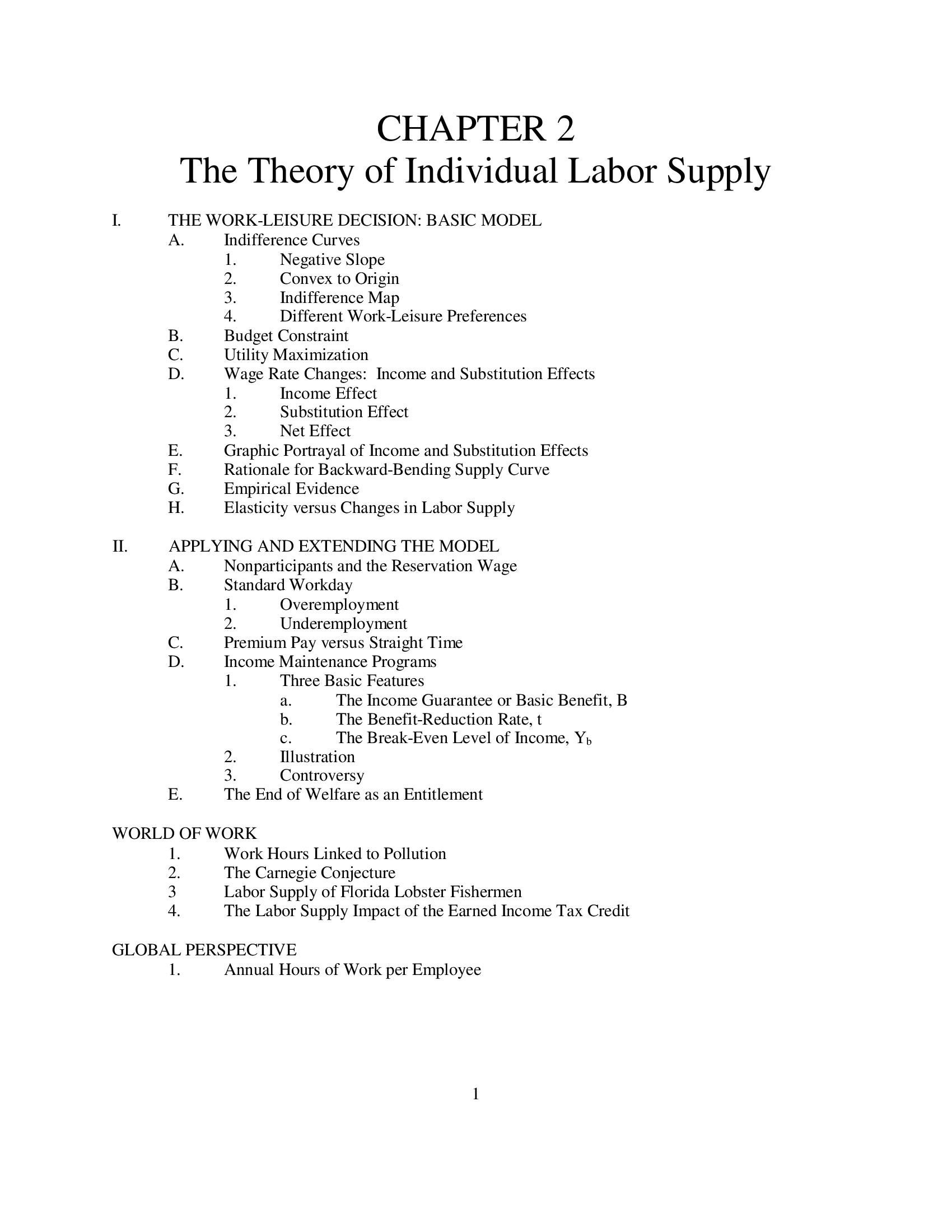
CONTEMPORARY LABOR ECONOMICS 11TH EDITION MCCONNELL SOLUTIONS MANUAL CHAPTER 2 The Theory of Individual Labor Supply I. THE WORK-LEISURE DECISION: BASIC MODEL A. Indifference Curves 1. Negative Slope 2. Convex to Origin 3. Indifference Map 4. Different Work-Leisure Preferences B. Budget Constraint C. Utility Maximization D. Wage Rate Changes: Income and Substitution Effects 1. Income Effect 2. Substitution Effect 3. Net Effect E. Graphic Portrayal of Income and Substitution Effects F. Rationale for Backward-Bending Supply Curve G. Empirical Evidence H. Elasticity versus Changes in Labor Supply II. APPLYING AND EXTENDING THE MODEL A. Nonparticipants and the Reservation Wage B. Standard Workday 1. Overemployment 2. Underemployment C. Premium Pay versus Straight Time D. Income Maintenance Programs 1. Three Basic Features a. The Income Guarantee or Basic Benefit, B b. The Benefit-Reduction Rate, t c. The Break-Even Level of Income, Y b 2. Illustration 3. Controversy E. The End of Welfare as an Entitlement WORLD OF WORK 1. Work Hours Linked to Pollution 2. The Carnegie Conjecture 3 Labor Supply of Florida Lobster Fishermen 4. The Labor Supply Impact of the Earned Income Tax Credit GLOBAL PERSPECTIVE 1. Annual Hours of Work per Employee 1 LEARNING OBJECTIVES After learning the material in Chapter 2 of Contemporary Labor Economics, the student should be able to: 1. graph an indifference map for a person who values leisure and income 2. explain how the slope of the indifference curve relates to the marginal rate of substitution of leisure for income 3. explain why there is a diminishing marginal rate of substitution of leisure for income, which results in convex indifference curves 4. explain why indifference curves farther from the origin represent higher levels of utility 5. relate personal differences in work-leisure preferences to personal differences in the shapes of indifference curves 6. graph an income-leisure budget constraint and explain how its slope relates to the wage rate 7. identify, using the basic income-leisure model, an individual’s optimal combination of income and leisure 8. distinguish between the income effect and substitution effect of a wage change and isolate each on a graph 9. explain, in terms of income and substitution effects, the rationale for a backward-bending labor supply curve 10. Correctly define and calculate the wage elasticity of labor supply 11. explain why a person with non-labor income may choose not to participate in the labor force, relating this decision to the concept of the reservation wage 12. explain why a person may choose to “moonlight” or to work part-time 13. show in a graph how unpaid absenteeism may be related to requirements that people work a standard 40-hour week 14. show graphically that a person’s utility-maximizing number of work hours may increase in response to a premium wage for overtime work 15. examine an income maintenance plan and determine the basic benefit, the benefit-reduction rate, and the break-even level of income 16. show, using the income-leisure model, why an income maintenance plan may reduce incentives to work 17. Relate provisions of the Temporary Assistance for Needy Family program to the drop in welfare caseloads over the past 10 years ANSWERS TO SELECTED END-OF-CHAPTER QUESTIONS 2. Work more hours in (a) and (b); fewer hours in (c) and (d). 4. The outcome assumes the substitution effect is stronger than the income effect. The statement reflects empirical evidence that the substitution effect strongly dominates the income effect for females, but they roughly offset each other for males. 2 5. She will choose the high-wage option. She will feel underemployed, but this option will allow her to reach a higher indifference curve (a higher level of utility.) 6. The lump-sum tax increases work effort through a pure income effect; the proportional tax may either increase or reduce work effort depending on the relative strengths of the opposing income and substitution effects. 11. The subsidy is $2400 ($3000 – .3 x $2000). The total income is $4400 ($2000 + the $2400 subsidy.) The break-even level of income is $10,000 ($3000 / .30). 12. HBW’ entails a zero benefit-reduction rate and the weakest disincentives to work. In contrast, HBYW entails a 100% benefit-reduction rate and the strongest disincentives to work. 15. An increase in the minimum wage may either increase or decrease desired work hours for those already in the labor market depending on the relative strengths of the substitution and income effects. The substitution effect of the higher wage will increase desired hours of work while the income effect will decrease desired hours of work. For those not in the labor force, there is only an income effect, encouraging participation. A direct grant of nonlabor income has only an income effect, reducing desired hours of work. 4 After reading this chapter, you should be able to: After reading this chapter, you should be able to: The Theory of Individual Labor Supply o LO 02-01: Use the basic income–leisure model to determine an individual’s optimal combination of income and leisure. After reading this chapter, you should be able to: o LO 02-02: Apply and extend the basic work–leisure model. 1. The Work-Leisure Decision: Basic Model © © © 2 M M 2 2 0 0 0 1 1 1 7 7 7 M M M c c c G G G r r r a a a w w w --H H H iillll E E E d d d u u u c c c a a a ttiioonn.. A A A llll rriig g g h h h tts s s r r r e e e s s s e e e r r r v v v e e e d d d . . . A A A u u u t t t h h h o o o r r r i i i z z z e e e d d d o o o n n n l l l y y y f f f o o o rr i i i n n n s s s t t t r r r u u u c c c t t t o o o r r r u u u s s s e e e i i i n n n t t t h h h e e e c c c l l l a a a s s s s s s r r r o o o o o o m m m . . . N N N o o o rre e e p p p r r r oodduuccttiioonn o o o r r r d d d i i i s s s ttr r r iib b b uuttiioonn w w w iitth h h o o o u u u tt t t t h h h e e e p p p r r r i i i orr w w w r r r iitttteenn c c c o o o n n n s s s e e e n n n tt o o o ff M c c c G G G r r a a r a w w w --H H H iill l l lE E E d d d u u u ccaattiioonn.. 1 1 1 --33 Assumptions Indifference Curve o Individuals choose between work and leisure. • Work is time spent on a paying job. • Leisure includes activities where one is not paid. ∞Education ∞Rest ∞Work within the household 1-4 1-4 Assumptions Indifference Curve Income/day • The indifference curve shows work and leisure combinations that yield the same amount of total utility. • More hours of leisure implies fewer hours of work. 0 24 Leisure Hr 1-5 1-5 Assumptions Indifference Curve 24 0 Work Hr 1-6 1-6 Indifference Curve Properties Indifference Curve Properties o Negative slope • To keep the level of utility the same, if one gets more leisure, some amount of income must be given up. o Convex to origin • With low hours of leisure, individuals are willing to give up a large amount of income to get 1 more leisure hour. 1-7 1-7 Indifference Curve Properties Indifference Curve Properties • With high hours of leisure, individuals are willing to give up a small amount of income to get 1 more leisure hour. 1-8 1-8 Marginal Rate of Substitution Indifference Map •The marginal rate of substitution (MRS) is the amount of income one must give up to compensate for 1 more hour if leisure. • At 3 hours of leisure (21 hours of work), one must give up 4 units of income to compensate Income/day 4 for 1 more hour of leisure. • At 8 hours of leisure (16 hours of work), one must give up 1 unit of income to compensate for 1 more hour of leisure. • The MRS falls as one moves southeast along an indifference curve. 1 0 3 4 8 9 24 Leisure 1-9 1-9 Marginal Rate of Substitution Indifference Map 24 0 Work 110 110 Marginal Rate of Substitution Indifference Map I • Curves further from the origin indicate higher utility. Income/day • Combination L 2 Y 2 is preferred to combination L 1 Y 1 since one gets both more income and Y 2 more leisure. Y 1 I 3 2 • A person will maximize utility I 1 by getting to the highest attainable indifference curve. 0 L 1 L 2 24 Leisure 111 111 Work-Leisure Preferences Budget Constraint • “Leisure lovers” place a high value on leisure. The have a steep indifference curve. They are willing to sacrifice a large amount of income to get a small increase in leisure. Income/day I B I A • “Workaholics” place a low value on leisure. The have a flat indifference curve. They must be given a large increase in leisure to compensate for a small decrease in income. I 1 I 2 0 24 Leisure 1101 0 1101 0 Work-Leisure Preferences Budget Constraint • The budget constraint shows the combinations of income and leisure that a worker could get given a wage rate. • At a wage rate of $5, a worker could get a maximum income of $120 per day ($5/hour * 24 ). • At a wage rate of $10, a worker could get a maximum income of $240 per day. • At a wage rate of $15, a worker could get a maximum income of $360 per day. • The slope of the budget constraint is–wage rate. Income/day $360 $240 $120 0 24 Leisure 1111 1 1111 1 Utility Maximization Backward Bending Labor Supply Curve • The optimal or utility maximizing point is where the budget constraint is tangent to the highest attainable indifference curve (U). Incom • At U, the MRS (slope of the indifference curve) is the equal to the wage rate (slope of the $240 budget constraint) • At B, the MRS is greater than the wage rate. The individual $80 values leisure more than the wage rate. • At A, the MRS is less than the wage rate. The individual values leisure less than the wage rate. e/day B U 0 16 I 3 I 2 A I 1 24 Leisure 1121 2 1121 2 Utility Maximization Backward Bending Labor Supply Curve • For a given person, hours of work may increase as the wage rate rises. Wa • If the wage rate rises from $10 to $25 per hour, hours $25 of work rises from 8 to 10 hours per day. ge Rate S L • Above $25 per hour, hours of work fall. • The backward bending labor supply curve is the result of the income and substitution effects of a wage change. $10 0 8 10 24 Hours of Work 1131 3 1131 3 Income Effect Substitution Effect o Income Effect • The change in desired hours of work resulting from a change in income, holding the wage constant. ∞Leisure is a normal good, so higher income implies a desire for more leisure (fewer hours of work). ∞For a wage increase, income is raised and so the income effect lowers desired work hours. 1141 4 1141 4 Income Effect Substitution Effect o Substitution Effect • The change in desired hours of work resulting from a change in the wage rate, holding income constant. ∞A higher wage rate raises the relative price of leisure. ∞For a wage increase, the substitution effect raises desired work hours. 1151 5 1151 5 Net Effect o For Wage Increases • If substitution effect > income effect, then hours of work rise. • If income effect > substitution effect, then hours of work fall. o For Wage Decreases • If substitution effect > income effect, then hours of work fall. • If income effect > substitution effect, then hours of work rise. 1161 6 1161 6 • If the wage rate rises to $15/hour, $360 the optimal hours of leisure is 15 at point U 2 . • The income effect (IE) is $240 Income and Substitution Effects • At a wage rate of $10/hour, the optimal hours of leisure is 16 (8 hours of work) at point U 1 . Income/day measured through a parallel shift of the old budget constraint. The IE is from U 1 to U 2 ’ (from 16 to 17 hours of leisure). • The substitution effect (SE) is measured by movement along I 2 . The SE is from U 2 ’ to U 2 (from 17 to 15 hours of leisure). U 2 U 2 ’ I 2 U 1 I 1 0 • T h e 1171 7 1171 7 net effect is an increase of hours of work by 1 hour. 15 16 17 24 Leisure 1191 9 1191 9 Backward Bending Labor Supply Rationale Empirical Evidence o The substitution effect dominates at low wage rates. • The MRS is low because income is scarce relative to leisure. o The income effect dominates at higher wage rates. • The MRS is high because leisure is scarce relative to income. 1181 8 1181 8 Backward Bending Labor Supply Rationale Empirical Evidence o The labor supply curve is slightly backward bending for men. • The income effect is slightly greater than the substitution effect. 1191 9 1191 9 Empirical Evidence Elasticity of Labor Supply o The labor supply curve is positive for women. • If substitution effect is greater than the income effect. ∞Women substitute between work at home and market work more than men. 1202 0 1202 0 Empirical Evidence Elasticity of Labor Supply o The elasticity of labor supply measures the responsiveness of desired hours of work to the wage rate. Elasticity = quant % Change in pplied of Labor Supply ity of labor su % Change in the wage rate 1212 1 1212 1 Elasticity of Labor Supply Questions for Thought o If the elasticity is zero, it is perfectly inelastic. o If the elasticity is negative, it is backward bending. o If the elasticity is positive and less than 1, it is relatively inelastic. o If the elasticity is positive and more than 1, it is relatively elastic. 1222 2 1222 2 Elasticity of Labor Supply Questions for Thought 1. Show the effect of a wage decrease on an individual’s income- leisure choices. Isolate the income and substitution effects. Is the worker on the forward-rising or backward bending portion of the labor supply curve? 2. Indicate in each of the following instances whether specified events would cause a worker to want to work more or fewer hours: (a) The wage rates rises and the substitution effect is greater than the income effect. (b) The wage rate falls and the income effect is greater than the substitution effect. 1232 3 1232 3 2. Applying and Extending the Model Non-Labor Income Non-Participants I • At a wage rate of $10/hour with no other income, the optimal hours of leisure is 16 (8 hours of work) at point U 1 . • If the person gets an inheritance that generates $60 a day of non-labor income, the budget constraint has a parallel shift. • The optimal hours of leisure rises to 17 at point U 2 . • With an increase in non- labor income, only the income Income/day $300 $240 U 2 U 1 2 I 1 effect occurs and so hours 0 work must fall. 16 17 24 Leisure Non-Labor Income Non-Participants • If a person has a low wage rate (WN is flat), higher non- labor income (NH), or steep indifference curves (I 1 ), he is less likely to participate in the labor force (U 1 ). • If a person has a high wage rate (HW ’ ), low non-labor income (0), or flat indifference curves (I 2 ), she is more likely to participate (U 2 ). • The reservation wage is the lowest wage necessary to induce someone to work. • College students are less likely to participate in the labor force than other persons. Why? Income/day I 2 W ’ I 1 W U 2 0 10 U 1 N H 24 Leisure Over-Employment Under-Employment • If an individual is free to choose the number of hours of work, she would choose point U 1 , with 18 hours of leisure and 6 hours of work. • If the individual is constrained to work a standard workday of 8 hours or not all, she will choose point U 2 . • At U 2 , her MRS is more than the wage rate and so she feels overemployed. • What is a potential solution to her overemployment situation? Income/day W 0 U 2 U 1 16 18 N H 24 Leisure Over-Employment Under-Employment U • If an individual is free to choose the number of hours of work, she would choose point U 1 , with 14 hours of work and 10 hours of leisure. • If the individual is constrained to work a standard workday of 8 hours or not all, Income/day W U 1 she will choose point U 2 . 2 • At U 2 , her MRS is less than the wage rate and so she feels N underemployed. • What is a potential solution H to her underemployment situation? 0 10 16 24 Leisure Income Maintenance Income Maintenance Program Programs o There are a variety of income maintenance programs such as food stamps, Medicaid, Temporary Assistance to Needy Families. o We will examine the work incentives of such programs. Income Maintenance Income Maintenance Program Features o Income Guarantee (B) • Benefit received if individual/family has no earned income. o Benefit Reduction Rate (t) • Rate by which the benefit is reduced as income is increased. ∞At t=.50, benefits are reduced by $.50 for every dollar earned. Income Maintenance Program Features o Break-Even Level of Income (Y b ) • The level of earned income at which the individual/family receives no benefit. Benefit Example Benefit Example The actual subsidy payment S illustrates these concepts as shown below. S = B – tY If B = $80, t = .5, earned income (Y) = $60 then… S = $80 - .5 * $60 =$50 Benefit Example Benefit Example The break-even level of income formula is shown below: Y b = B/t If B = $80, t = .5, then Y b = $160 Income Maintenance Program Welfare Reform • At a wage rate of $10/hour, the optimal hours of leisure is 16 (8 hours of work) at point U 1 . • If there is a welfare program is started with a B of $80 a day, t = .5, then Y b = $160. • The income effect (IE) is measured through a parallel shift of the old budget ’ Income/day $240 constraint. The IE is from U 1 to U 2 16 to 18 hours of leisure). • The substitution effect (SE) is (from $160 U 2 ’ U 2 measured by movement along I 2 . The ’ $80 I 2 SE is from U 2 to U 2 (from 18 to 22 hours of leisure). The tax lowers the “price” of leisure. U 1 I 1 • In contrast to a wage change, both 0 the IE and SE reduce desired hours of work. 16 18 22 24 Leisure Income Maintenance Program Welfare Reform Income Maintenance Program Welfare Reform o The main elements of the 1996 Welfare Reform Act are: • Two-year time limit for receiving assistance. • Five-year lifetime time limit for collecting assistance. • Provisions to help enforce the collection of child support payments from fathers. Welfare Reform Welfare Caseloads o There has been a large reduction in caseloads since 1996. Welfare Reform Welfare Caseloads Families (Millions) 1970 1973 1976 1979 1982 1985 1988 1991 1994 1997 2000 2003 2006 2009 2012 2015 6 5 4 3 2 1 0 Year Why Did Caseloads Fall? Why Did Caseloads Fall? o The economic boom of the 1990s helped the labor prospects of welfare recipients. o The expansion of tax subsidies for working low income families encouraged recipients to seek jobs. Why Did Caseloads Fall? Why Did Caseloads Fall? o The benefit time limits encouraged recipients to conserve their benefits. o Welfare benefit reductions, child care expansions, and changes in training programs also likely played a role. Questions for Thought 1. One way of aiding low-income families is to increase the minimum wage. An alternative is to provide a direct grant of non-labor income. Compare the impact of these two options on work incentives. 2. How would you expect each of the following factors to affect the probability someone chooses not to participate in the labor force? (a) Education (b) Presence of preschool children (c) Level of spouse’s income (d) Marital status

Contact the Seller

Please Sign In to contact this seller.


  • 👎  Report Copyright Violation

Frequently Asked Questions

What Do I Get When I Buy This Study Material?

+

When you buy a study material on Passing Grades, an instant download link will be sent directly to your email, giving you access to the file anytime after payment is completed.

Is Passing Grades a Trusted Platform?

+

Yes, Passing Grades is a reputable students’ marketplace with a secure payment system and reliable customer support. You can trust us to ensure a safe and seamless transaction experience.

Will I Be Stuck with a Subscription?

+

No, all purchases on Passing Grades are one-time transactions. You only pay for the notes you choose to buy, with no subscriptions or hidden fees attached.

Who Am I Buying These Study Materials From?

+

Passing Grades is a marketplace, which means you are purchasing the document from an individual vendor, not directly from us. We facilitate the payment and delivery process between you and the vendor.

Does Passing Grades Offer Free Study Materials?

+

Yes, sellers on Passing Grades have uploaded numerous free test banks, exams, practice questions, and class notes that can be downloaded at no cost.


Pasinggrades - Quality Study Materials

USD 17

    • Quality checked by Pasing Grades
    • 100% satisfaction guarantee
    • Seller: mentor2000
Buy PDF $17

Seller Information

mentor2000

Member since April 2021

  • icon
  • icon
View Profile
  • total sales

    0
  • Favourites

    0
  • Comments

    0
    ( 0 Ratings )

Item Information

  • Uploaded

    16 April 2023

  • Updated

    21 April 2025

  • Category

    Business

  • Item Type

    test bank

  • Tags

    Contemporary Labor Economics 11th Edition McConnell Solutions Manual

Related Exam Prep Guides by mentor2000

Test Bank for Essentials for Nursing Practice 8th Edition by Potter | All Chapters
View Document

Test Bank for Essent...

  • mentor2000

    mentor2000

  • test bank

Master nursing concepts with this study material; Test Bank for Essentials for Nursing Practice, 8th...

17 USD

0

0

A &P 1 MA278 BSC2 Final Module II Questions & Answers 2026 Update
View Document

A &P 1 MA278 BSC2 Fi...

  • mentor2000

    mentor2000

  • test bank

Prepare for success with A&P 1 MA278 BSC2 Final Module II 2024 Q&A. Boost your grades with this comp...

17 USD

0

0

ATI Comprehensive Predictor Exam 2026
View Document

ATI Comprehensive Pr...

  • mentor2000

    mentor2000

  • test bank

Prepare for success with the ATI Comprehensive Predictor Exam 2026. Access key practice questions to...

17 USD

0

0

Purchase

Download link will be sent to this email immediately after purchase.

IMPORTANT LINKS

  • How To Upload Class Notes
  • Selling Tips
  • Passing Grades's Study Materials
  • Scholarships for International Students 2025

POPULAR CATEGORIES

  • Law
  • Accounting
  • English
  • Psychology
  • Business
  • Nursing
  • Computer Science
  • General

View Document

  • Blog
  • Contact
  • Delivery Policy
  • Latest Scholarships Around the World
  • How to Pass Bar Exams: Passing Grades’ Strategies
  • How to Study and Pass the CPA Exam
  • All Test Banks
  • Faq
  • Copyright Claims
  • Privacy Policy
  • Terms of Use

KNOWLEDGE BASE

  • How to Write A+ Grade Good Research Paper
  • How to Manage Stress During Exam Period
  • Best Time to Study
  • How to Pass NCLEX-RN Exam
  • How To Effectively Utilize Test Banks
  • Popular Shadow Health Exam Assessments
  • Popular HESI Case Studies
  • How to Prepare for a Nursing Career
  • The Importance Of Summaries in Exam Revisvion

© 2026 Pasing Grades. All rights reserved.