Pasing Grades
  • Start Selling
  • Blog
  • Contact
  • 0

    Your cart is empty!

English

  • English
  • Spanish
  • Arabic
Create Account Sign In
  • Library
    • New Prep Guides
    • Featured Prep Guides
    • Free Exam Prep Guides
    • Best sellers
  • General
  • Nursing
    • Research Paper
    • Case Study
    • Discussion Post
    • Assignment
    • Exam
    • Practice Questions and Answers
    • Test Bank
    • solutions manual
  • Accounting
    • Case Study
    • Thesis
    • Study Guide
    • Summary
    • Research Paper
    • test bank
  • English
    • Creative Writing
    • Research Paper
    • Summary
    • Rhetorics
    • Literature
    • Journal
    • Exam
    • Grammar
    • Discussion Post
    • Essay
  • Psychology
    • Hesi
    • Presentation
    • Essay
    • Summary
    • Study Guide
    • Essay
    • Solution Manual
    • Final Exam Review
    • Class Notes
    • test bank
  • Business
    • Lecture Notes
    • Solution Manual
    • Presentation
    • Business Plan
    • Class Notes
    • Experiment
    • Summary
    • Practice Questions
    • Study Guide
    • Case Study
    • test bank
    • Exam
  • More
    • Computer Science
    • Economics
    • Statistics
    • Engineering
    • Biology
    • Religious Studies
    • Physics
    • Chemistry
    • Mathematics
    • History
    • Sociology
    • Science
    • Philosophy
    • Law
  • Pages
    • About Us
    • Selling Tips
    • Delivery Policy
    • Faq
    • Privacy Policy
  • Flash Sale
  • Home
  • Complete Test Bank for 'Strategic Management: A Competitive Advantage Approach, Concepts and Cases' (17th Edition) by Fred R. David

Complete Test Bank for 'Strategic Management: A Competitive Advantage Approach, Concepts and Cases' (17th Edition) by Fred R. David

Preview page 1 Preview page 2 Preview page 3
Add To Favorites

Share this item Share this item

  • Item Details
  • Comments (0)
  • Reviews (0)
  • Contact Seller

Test Bank for Strategic Management A Competitive Advantage Approach, Concepts and Cases 17th Edition (Global Edition) By Fred David, Forest David, Meredith David (All Chapters, 100% Original Verified, A+ Grade)

Sample Questions for Strategic Management 


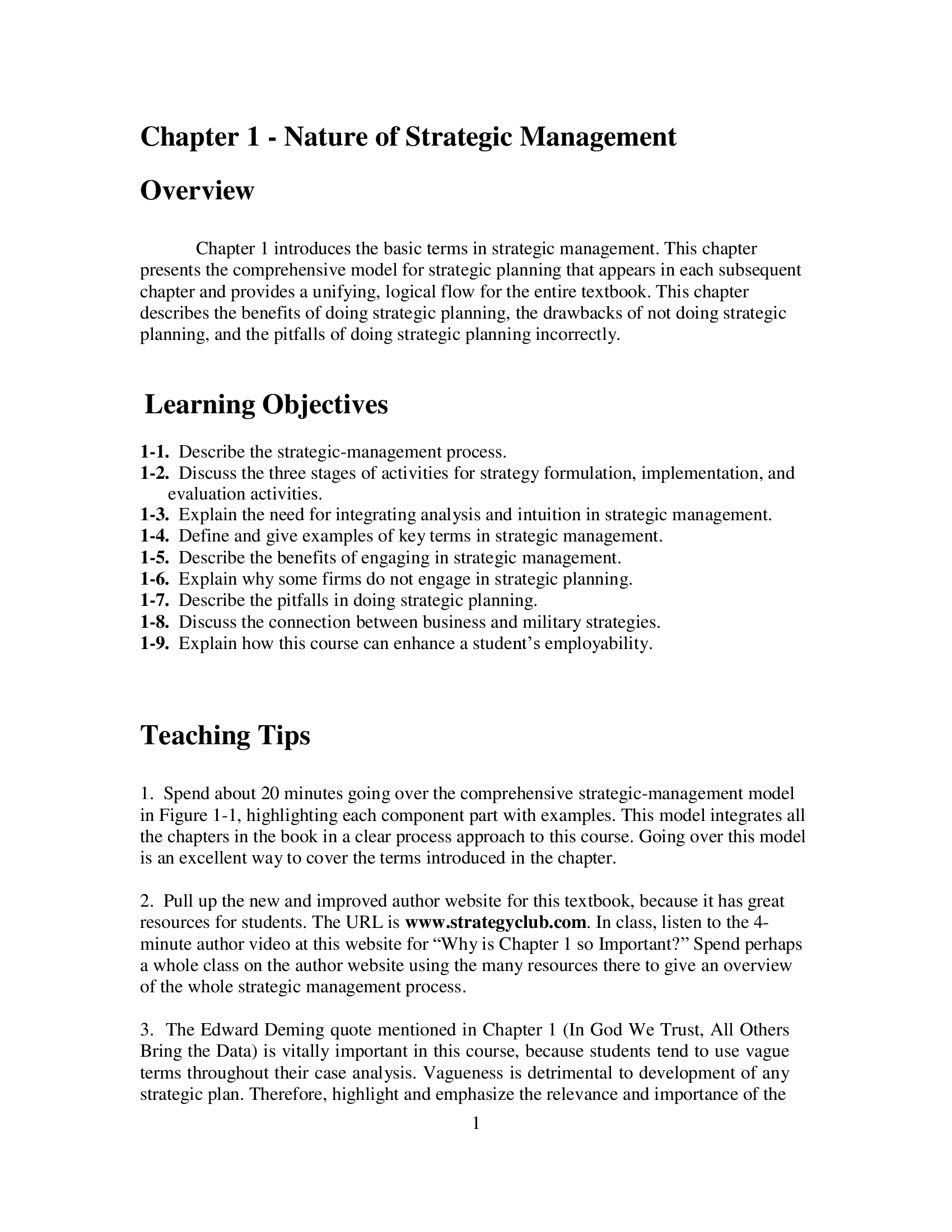
Answers to End-of-Chapter 1 Review Questions


1-1.  Why do you believe SWOT analysis is so commonly used by businesses in doing strategic planning?

Answer:  SWOT analysis is the most widely used strategic planning tool because it is

intuitively simple, contains no numbers, lends itself to group discussion, and contains the

basic building blocks of a strategic plan, namely strengths, weaknesses, opportunities, and threats.


1-2.  What variable does recent research reveal to be most important of all in doing business? Explain why this variable is so important.


Answer: Three Harvard Business School professors, Amy Cuddy, Susan Fiske, and Peter Glick, recently revealed in a new book, Presence, that the most important variable in doing business with someone you do not know is trustworthiness. The authors say that within seconds of meeting someone, people determine first and foremost the extent that the person is trustworthy. They say that variable is far more important than competence, intelligence, looks, strength, height, and numerous other variables.


1-3.  For your college or university, identify a strategy that would exemplify the matching concept evidenced in SWOT analysis.


Answer: An external threat could be “a 10% annual decline in state funding.” A weakness could be “lack of sufficient external fund raising.” The strategy to offset could be for the university to seek external funds by placing people’s names on buildings, classrooms, and even seats in classrooms.


1-4.  Diagram the comprehensive strategic-management model.


Answer:  See Figure 1-1 in Chapter 1.


1-5.  Develop a diagram to reveal the benefits to a firm for doing strategic planning. Include “improved understanding,” “enhanced communication,” “all managers and employees on a mission,” and “greater commitment” – in the correct order.


Answer:  See Figure 1-2 in Chapter 1.


1-6.  How important do you feel “having an excellent game plan” is to winning a basketball or football game against your university’s major rival? Discuss.


Answer:  Having an excellent game plan oftentimes is the key difference between winning and losing in an athletic event. A reason for this is that in most leagues in most sports, there is growing parity in terms of talent and skills among players. Player desire, motivation, and other intangible factors play a significant role in winning or losing, but every player relies on the head coach to develop an effective game plan by watching film of rivals’ prior games and studying the opponents’ strengths, weaknesses, and strategies – and devising a winning plan of action.


Outstanding coaches are often paid millions of dollars, for example in Division 1 college football and basketball, partly because they have demonstrated superior expertise in devising excellent game plans versus rival teams.


1-7.  Are “strategic management” and “strategic planning” synonymous terms? Explain.


Answer: The term “strategic management” in this text is used synonymously with the term “strategic planning.” The latter term is more often used in the business world, whereas the former is often used in academia. Sometimes the term “strategic management” is used to refer to strategy formulation, implementation, and evaluation, with “strategic planning” referring only to strategy formulation.


1-8.  Why do many firms move too hastily from vision/mission development to devising alternative strategies?


Answer: Firms that move too hastily from vision and mission development to devising alternative strategies are overlooking two important steps in the strategic management process: 1) identify and evaluate internal strengths/weaknesses and 2) identify and evaluate external opportunities/threats. Reasons why many firms are negligent in this regard include 1) laziness, 2) lack of time, 3) lack of knowledge, 4) unwillingness to do research to find specific facts and figures, and 5) being unaware that matching key external with internal factors is a key to strategy formulation.


1-9.  Why are strategic planning retreats often conducted away from the work site? How often should firms have a retreat, and who should participate in them?


Answer: The rationale for periodically conducting strategic-management meetings away from the work site is to encourage more creativity and candor from participants. Good communication and feedback are needed throughout the strategic-management process in order to 1) formulate effective strategies and 2) achieve understanding and commitment that are vital to strategy implementation.


1-10.  Distinguish between long-range planning and strategic planning.


Answer: Long-range planning is striving to optimize for tomorrow the trends of today, whereas strategic planning is striving to exploit and create new and different opportunities for tomorrow. Strategic planning requires much more work and diligence as indicated by the activities and stages described in the chapter.


1-11.  How important do you think “being adept at adapting” is for business firms? Explain.


Answer: Being adept at adapting is vital for survival of business firms (and organisms). The strategic-management process is based on the belief that an organization’s survival can depend on how well the firm continually monitors internal and external events and trends and makes timely changes as needed.


1-12.  As cited in the chapter, Edward Deming, a famous businessman, once said, “In God we trust. All others bring data.” What did Deming mean in terms of developing a strategic plan?


Answer: The strategic-management process can be described as an objective, logical, systematic approach for making major business decisions in an organization. The process attempts to organize qualitative and quantitative information in a way that allows effective decisions to be made under conditions of uncertainty. Mr. Deming insisted on facts and figures because he knew that vague generalities were not helpful in choosing among many attractive alternative strategies. Mr. Deming insisted on seeing #’s, $’s, ratios, and %’s across regions and products in order to best chart a path forward for any organization.


1-13.  What strategies do you believe can save newspaper companies from extinction?


Answer: Newspaper companies could invest more in Internet technologies, including developing nice apps for smartphones, and charging for the apps. Also, they could charge for an online subscription. Perhaps they could shift to a business model of giving away newspapers, while simultaneously enticing advertisers to advertise more, given the expected increased circulation from “free at newsstands and nominal fee for delivery.” Free is a good price, if expenses can be exceeded by advertising revenue. But any strategies pursued should be determined after thorough analysis as described in this text, rather than haphazardly determined.


1-14.  Distinguish between the concepts of mission and vision.


Answer:  Mission statements are “enduring statements of purpose that distinguish one business from other similar firms.” Vision statements answer the question “What do we want to become?” A vision statement should be one sentence, whereas a mission statement is several sentences, but less than 200 words.


1-15.  Your university has fierce competitors. List three external opportunities and three external threats that face your university.


Answer:

Opportunities – 1) The blackboard collaborating technology for online classes has become easier, more popular, and less expensive. 2) The USA economy and GDP is growing 6% annually. 3) Construction costs for building new buildings is declining 14% year-over-year.

Threats – 1) The local tech school has cheaper tuition and easier classes that transfer into our university. 2) Our rival firms all offer a BBA Degree online. 3) There is an 8% decline in population in the last few months in our county.


1-16.  List three internal strengths and three internal weaknesses that characterize your university.


Answer:

Strengths – 1) Our College of Business is AACSB accredited at both the BBA and MBA levels.


2) Our average classroom size is 19 students. 3) Our university has a new Nursing Program and

Building.

Weaknesses – 1) Only 50% of our business faculty hold a PhD in business. 2) Our university lacks sufficient dorm space for students. 3) Our university lacks sufficient parking for students and faculty.


1-17.  List reasons why objectives are essential for organizational success.


Answer: Objectives are essential for organizational success because they state direction, aid in evaluation, create synergy, reveal priorities, focus coordination, and provide a basis for effective planning, organizing, motivating, and controlling activities.


1-18.  Why are policies especially important in strategy formulation?


Answer: Policies, like annual objectives, are especially important in strategy implementation because they outline an organization’s expectations of its employees and managers. Policies allow consistency and coordination within and between organizational departments. Policies can be broad and include rules, regulations, and procedures.


1-19.  What is a “retreat” and why do firms take the time and spend the money to have these?


Answer: Retreats are formal meetings conducted semiannually to discuss and update the firm’s vision/mission, opportunities/threats, strengths/weaknesses, strategies, objectives, policies, and performance. Retreats are commonly held off-premises to encourage more creativity and candor from participants. The feeling is that an off-premise retreat facilitates communication, shared understanding, and commitment.


1-20.  Discuss the notion of strategic planning being more formal versus informal in an organization. On a 1 to 10 scale from formal to informal, what number best represents your view of the most effective approach? Why?


Answer: Formality refers to the extent that participants, responsibilities, authority, duties, and approach are specified. Application of the strategic-management process is typically more formal in larger and well-established organizations. Smaller businesses tend to be less formal. Firms that compete in complex, rapidly changing environments, such as technology companies, tend to be more formal in strategic planning. Firms that have many divisions, products, markets, and technologies

also tend to be more formal in applying strategic-management concepts. Greater formality in applying the strategic-management process is usually positively associated with the cost, comprehensiveness, accuracy, and success of planning across all types and sizes of organizations. Informality too often invites guessing, laziness, politics, and emotion, which are generally not good in strategic planning.


1-21.  List wh garnered fro

Answer: Both business and military organizations must adapt to change and constantly improve to be successful. Table 1-3 provides narrative excerpts from The Art of War, but some of the following especially apply to business.

o   Analyze the enemy’s plans so that you will know his shortcomings as well as his strong points.

o   An army should be likened to water. Just as flowing water avoids the heights and hastens to the lowlands, so an army should avoid strength and strike weakness.

o   Unskilled leaders work out their conflicts in courtrooms and battlefields. Brilliant strategists rarely go to battle or to court; they generally achieve their objectives through tactical positioning well in advance of any confrontation.

o   When you do decide to challenge a rival, much calculating, estimating, analyzing, and positioning bring triumph.

o   Skillful leaders do not let a strategy inhibit creative counter-movement.

o   When a decisive advantage is gained over a rival, skillful leaders do not press on. They hold

their position and give their rivals the opportunity to surrender or merge.

o   Brilliantstrategistsforgeaheadwithillusion,obscuringtheareasofmajorconfrontation,so thatopponents dividetheirforcesinanattempttodefendmanyareas.


1-22.  What is the fundamental difference between business strategy and military strategy in terms of basic assumptions?


Answer: The fundamental difference between military and business strategy is that business strategy is formulated, implemented, and evaluated with an assumption of competition, whereas military strategy is based on an assumption of conflict.


1-23.  Explain why the strategic management class is often is called a “capstone course.”


Answer:  Strategic management is commonly called a capstone course because students’ major responsibility in this class is to use all knowledge gained in prior courses to chart the future direction of different organizations. Students have the opportunity in this course to utilize their marketing, finance, management, MIS, and accounting knowledge.


1-24.  What aspect of strategy formulation do you think requires the most time? Why?

Answer: Important aspects of strategy formulation include developing a business mission, performing an external audit, conducting an internal audit, generating alternative strategies, and choosing among alternative strategies. Performing an external audit generally takes the most time. For example, identifying competitors’ strengths and weaknesses is an essential aspect of the external audit. Effective use of the Internet can reduce the time required for performing an external audit.


1-25.  Why is strategy implementation often considered the most difficult stage in the strategic-management process?


Answer: Strategy implementation is often considered to be the most difficult stage in strategic management because it requires discipline, sacrifice, commitment, and hard work from all employees and managers. It is always more difficult to do something than to say you’re going to do it.


1-26.  Why is it so important to integrate intuition and analysis in strategic management?


Answer: No analytical tools can capture all aspects of a given organization’s culture and situation. Nor can analytical tools assimilate all the subjective information that must be considered in strategic management, such as personalities, emotions, values, beliefs, customs, and ethical factors. However, analytical tools are essential to utilize in strategic planning because they have been developed over many years using actual data, and are effective for assimilating facts and figures. Intuition alone is insufficient for making good strategic decisions. Based on one’s past experiences, judgment, and “gut” feelings, intuition is especially under time constraints, and in assigning weights and ratings in planning matrices. Strategists must integrate intuition and analysis in strategic management, but in the view of this author, analysis is more important than intuition. Unfortunately, too many firms rely too heavily on intuition, and some disastrously rely exclusively on intuition.


1-27.  Explain the importance of a vision and mission statement.


Answer: Reaching agreement on a formal vision and mission statement can greatly facilitate the process of reaching agreement on an organization’s strategies, objectives, and policies. Organizational success depends on reasonable agreement on key issues, so a clear, jointly developed and supported, vision and mission statement are essential in strategic management.


1-28.  Discuss relationships among objectives, strategies, and policies.


Answer: Long-term objectives and strategies are products of strategy formulation. Short-term (annual) objectives and policies are products of strategy implementation. Firms should translate long- term objectives into annual objectives. Strategies should be supported with clear policies.

1-29.  Why do you think some chief executive officers fail to use a strategic-management approach to decision making?

Answer:  Various reasons listed and described in Chapter 1 include: Lack of knowledge or experience in strategic planning, poor reward structures, firefighting, waste of time, too expensive, laziness, content with success, fear of failure, overconfidence, prior bad experience, self-interest, fear of the unknown, honest difference of opinion, and suspicion.

1-30.  Discuss the importance of feedback in the strategic-management model.

Answer: As indicated in the strategic-management model, feedback is critically important. Changes can occur at any stage in the process and impact all other strategic-management activities. Feedback allows these changes to be identified and adjustments to be made. Feedback promotes the creation of a climate for two-way communication and, thus, allows esprit de corps to be achieved in an organization.

1-31.  How can strategists best ensure that strategies will be effectively implemented?


Contact the Seller

Please Sign In to contact this seller.


  • 👎  Report Copyright Violation

Frequently Asked Questions

What Do I Get When I Buy This Study Material?

+

When you buy a study material on Passing Grades, an instant download link will be sent directly to your email, giving you access to the file anytime after payment is completed.

Is Passing Grades a Trusted Platform?

+

Yes, Passing Grades is a reputable students’ marketplace with a secure payment system and reliable customer support. You can trust us to ensure a safe and seamless transaction experience.

Will I Be Stuck with a Subscription?

+

No, all purchases on Passing Grades are one-time transactions. You only pay for the notes you choose to buy, with no subscriptions or hidden fees attached.

Who Am I Buying These Study Materials From?

+

Passing Grades is a marketplace, which means you are purchasing the document from an individual vendor, not directly from us. We facilitate the payment and delivery process between you and the vendor.

Does Passing Grades Offer Free Study Materials?

+

Yes, sellers on Passing Grades have uploaded numerous free test banks, exams, practice questions, and class notes that can be downloaded at no cost.

Pasinggrades - Quality Study Materials

USD 15

    • Quality checked by Pasing Grades
    • 100% satisfaction guarantee
    • Seller: Pasing-Grades
Buy PDF $15

Seller Information

Pasing-Grades

Member since May 2021

  • icon
View Profile
  • total sales

    0
  • Favourites

    0
  • Comments

    0
    ( 0 Ratings )

Item Information

  • Uploaded

    05 April 2025

  • Updated

    01 October 2025

  • Category

    No category

  • Item Type

    test bank

  • Tags

    Test Bank for 'Strategic Management: A Competitive Advantage Approach Concepts and Cases' (17th Edition) by Fred R. David

Related Exam Prep Guides by Pasing-Grades

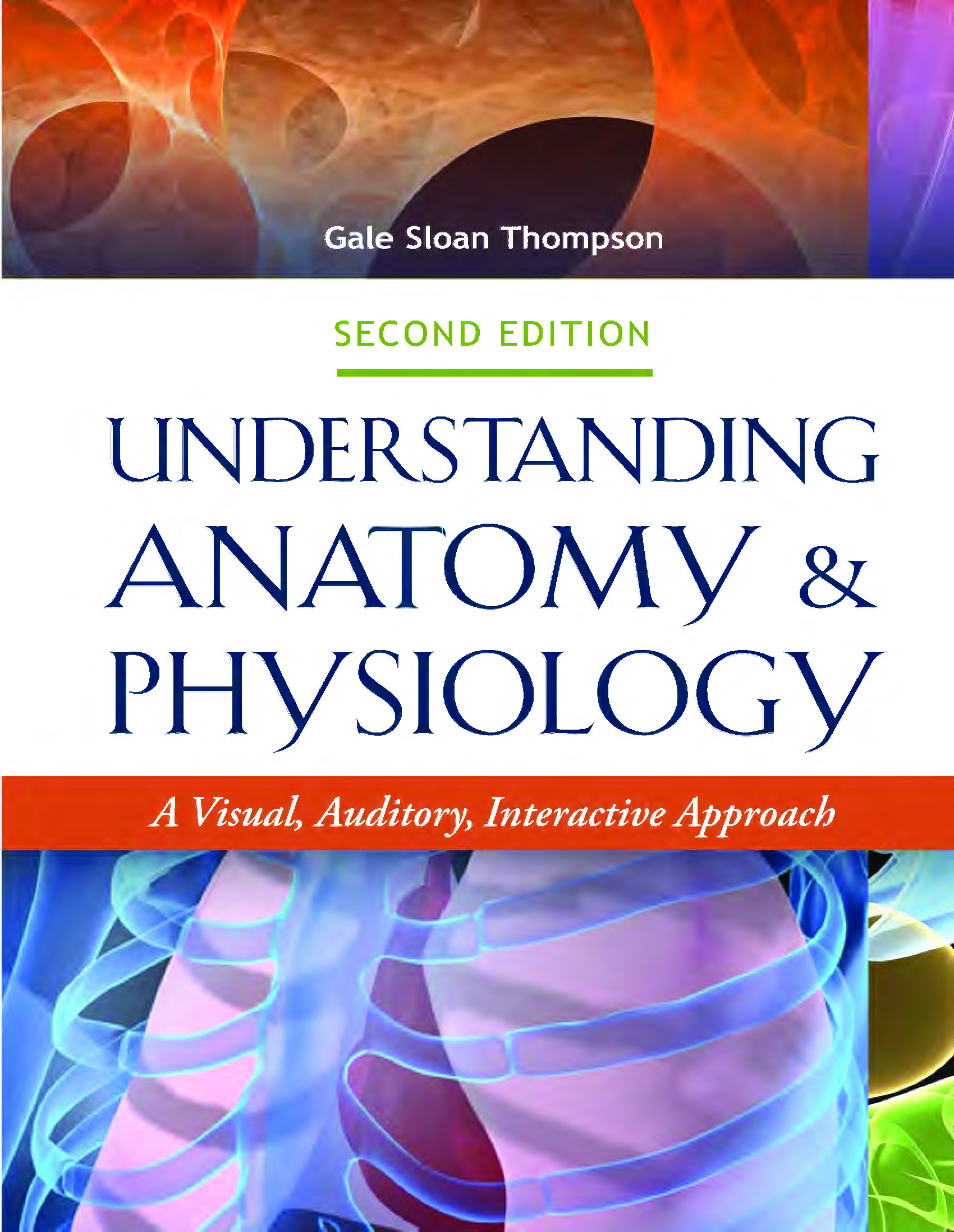
Understanding Anatomy and Physiology; A Visual, Auditory, Interactive Approach by Gale. S. Thompson
View Document

Understanding Anatom...

  • Pasing-Grades

    Pasing-Grades

  • test bank

Third Edition: Understanding Anatomy and Physiology; A Visual, Auditory, Interactive Approach by Gal...

15 USD

0

0

Workbook to Accompany Understanding Anatomy & Physiology: A Visual, Auditory, Interactive Approach by Gale Sloan Thompson RN
View Document

Workbook to Accompan...

  • Pasing-Grades

    Pasing-Grades

  • test bank

Workbook to Accompany Understanding Anatomy & Physiology: A Visual, Auditory, Interactive Approach b...

15 USD

0

0

Test Bank for Fundamentals of Nursing 10th Edition by Taylor
View Document

Test Bank for Fundam...

  • Pasing-Grades

    Pasing-Grades

  • test bank

Get now the Test Bank for Fundamentals of Nursing 10th Edition by Taylor. Instant PDF Download....

15 USD

0

0

Purchase

Download link will be sent to this email immediately after purchase.

IMPORTANT LINKS

  • How To Upload Class Notes
  • Selling Tips
  • Passing Grades's Study Materials
  • Scholarships for International Students 2025

POPULAR CATEGORIES

  • Law
  • Accounting
  • English
  • Psychology
  • Business
  • Nursing
  • Computer Science
  • General

View Document

  • Blog
  • Contact
  • Delivery Policy
  • Latest Scholarships Around the World
  • How to Pass Bar Exams: Passing Grades’ Strategies
  • How to Study and Pass the CPA Exam
  • All Test Banks
  • Faq
  • Copyright Claims
  • Privacy Policy
  • Terms of Use

KNOWLEDGE BASE

  • How to Write A+ Grade Good Research Paper
  • How to Manage Stress During Exam Period
  • Best Time to Study
  • How to Pass NCLEX-RN Exam
  • How To Effectively Utilize Test Banks
  • Popular Shadow Health Exam Assessments
  • Popular HESI Case Studies
  • How to Prepare for a Nursing Career
  • The Importance Of Summaries in Exam Revisvion

© 2026 Pasing Grades. All rights reserved.