Pasing Grades
  • Start Selling
  • Blog
  • Contact
  • 0

    Your cart is empty!

English

  • English
  • Spanish
  • Arabic
Create Account Sign In
  • Library
    • New Prep Guides
    • Featured Prep Guides
    • Free Exam Prep Guides
    • Best sellers
  • General
  • Nursing
    • Research Paper
    • Case Study
    • Discussion Post
    • Assignment
    • Exam
    • Practice Questions and Answers
    • Test Bank
    • solutions manual
  • Accounting
    • Case Study
    • Thesis
    • Study Guide
    • Summary
    • Research Paper
    • test bank
  • English
    • Creative Writing
    • Research Paper
    • Summary
    • Rhetorics
    • Literature
    • Journal
    • Exam
    • Grammar
    • Discussion Post
    • Essay
  • Psychology
    • Hesi
    • Presentation
    • Essay
    • Summary
    • Study Guide
    • Essay
    • Solution Manual
    • Final Exam Review
    • Class Notes
    • test bank
  • Business
    • Lecture Notes
    • Solution Manual
    • Presentation
    • Business Plan
    • Class Notes
    • Experiment
    • Summary
    • Practice Questions
    • Study Guide
    • Case Study
    • test bank
    • Exam
  • More
    • Computer Science
    • Economics
    • Statistics
    • Engineering
    • Biology
    • Religious Studies
    • Physics
    • Chemistry
    • Mathematics
    • History
    • Sociology
    • Science
    • Philosophy
    • Law
  • Pages
    • About Us
    • Selling Tips
    • Delivery Policy
    • Faq
    • Privacy Policy
  • Flash Sale
  • Home
  • Complete Test Bank for Burns and Grove’s The Practice of Nursing Research (9th Edition) by Gray

Complete Test Bank for Burns and Grove’s The Practice of Nursing Research (9th Edition) by Gray

Preview page 1 Preview page 2 Preview page 3
Add To Favorites

Share this item Share this item

  • Item Details
  • Comments (0)
  • Reviews (0)
  • Contact Seller

Gray: Burns and Grove’s The Practice of Nursing Research, 9th Edition Test Bank

Chapters/Units Included in This Burns and Grove's Test Bank

Unit One: Introduction to Nursing Research

  1. Discovering the World of Nursing Research
  2. Evolution of Research in Building Evidence-Based Nursing Practice
  3. Introduction to Quantitative Research
  4. Introduction to Qualitative Research

Unit Two: The Research Process

  1. Research Problem and Purpose
  2. Objectives, Questions, Variables, and Hypotheses
  3. Review of Relevant Literature
  4. Frameworks
  5. Ethics in Research
  6. Quantitative Methodology: Noninterventional Designs and Methods
  7. Quantitative Methodology: Interventional Designs and Methods
  8. Qualitative Research Methods
  9. Outcomes Research
  10. Mixed Methods Research
  11. Sampling
  12. Measurement Concepts
  13. Measurement Methods Used in Developing Evidence-Based Practice

Unit Three: Putting It All Together for Evidence-Based Health Care

  1. Critical Appraisal of Nursing Studies
  2. Evidence Synthesis and Strategies for Implementing Evidence-Based Practice

Unit Four: Analyzing Data, Determining Outcomes, and Disseminating Research

  1. Collecting and Managing Data
  2. Introduction to Statistical Analysis
  3. Using Statistics to Describe Variables
  4. Using Statistics to Examine Relationships
  5. Using Statistics to Predict
  6. Using Statistics to Determine Differences
  7. Interpreting Research Outcomes
  8. Disseminating Research Findings

Unit Five: Proposing and Seeking Funding for Research

  1. Writing Research Proposals
  2. Seeking Funding for Research

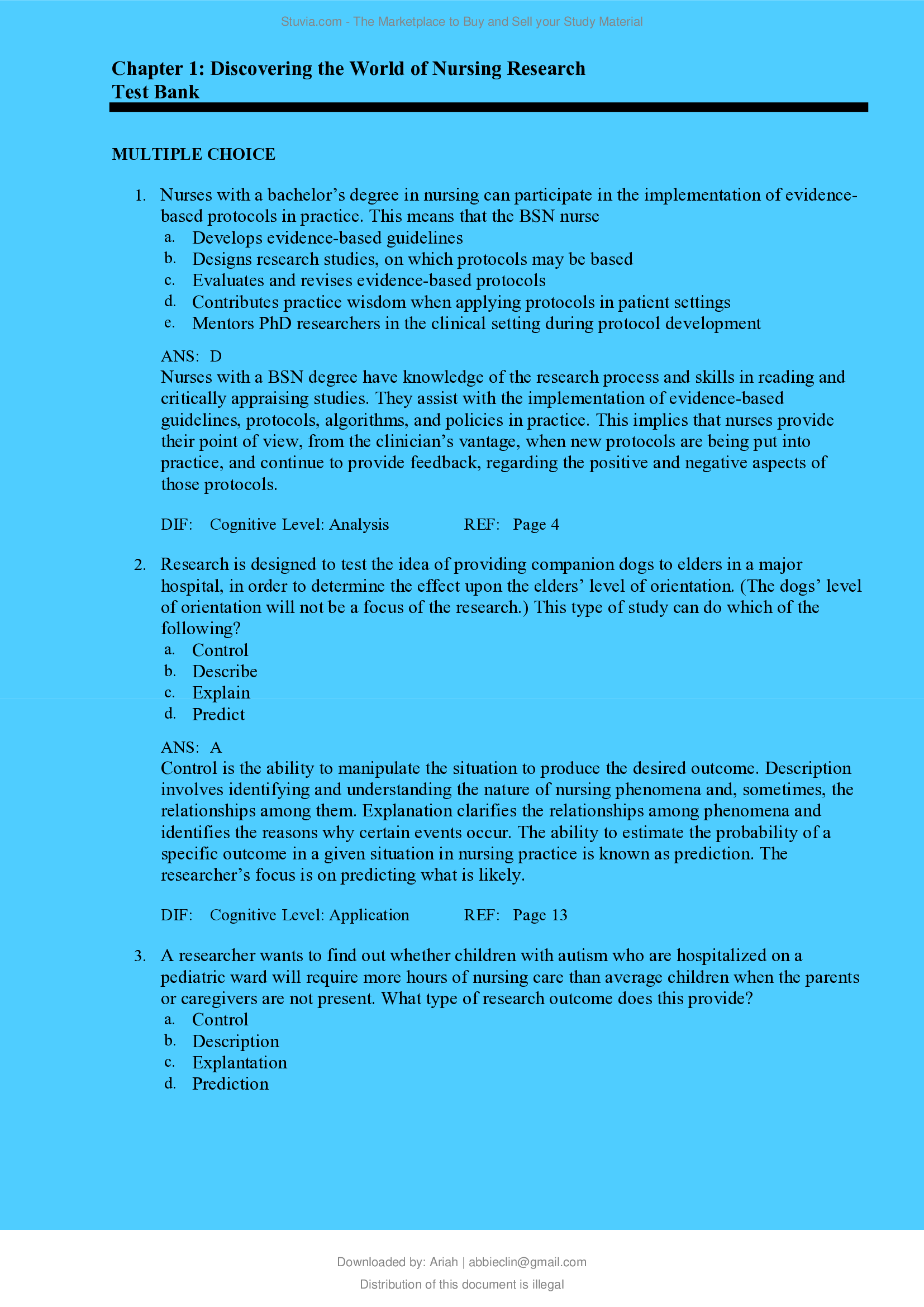
Chapter 01: Discovering the World of Nursing Research

MULTIPLE CHOICE

1. Nurses with a bachelor’s degree in nursing can participate in the implementation of research into practice. This means that the BSN nurse:

a. develops evidence-based guidelines.

b. designs research studies on which protocols may be based.

c. evaluates and revises evidence-based protocols.

d. reads and critically appraises existing studies.

ANS: D

Nurses with a Bachelor of Science in Nursing (BSN) degree have knowledge of the research process and skills in reading and critically appraising studies. They use the best research evidence in practice with guidance. Nurses with a BSN also assist with problem identification and data collection. Nurses with a Master of Science in Nursing (MSN) critically appraise and synthesize findings from studies to revise or develop protocols, algorithms, or policies for use in practice. Nurses with a Doctor of Nursing Practice (DNP) develop, implement, and evaluate evidence-based guidelines. Nurses with a Doctor of Philosophy (PhD) assume a major role in conducting research.

DIF: Cognitive Level: Analysis

2. A study is designed to test the idea of providing companion dogs to elders in a major hospital, in order to determine the effect upon the elders’ level of orientation. This type of study can do which of the following? a. Control

b. Describe

c. Explain

d. Predict

ANS: A

Control is the ability to manipulate the situation to produce the desired outcome. Description involves observing and documenting nursing phenomena, providing a snapshot of reality. Explanation clarifies the relationships among concepts and variables with the goal of understanding how they work with each other. Prediction involves estimating the probability of a specific outcome in a given situation.

DIF: Cognitive Level: Application

3. A researcher wants to know whether children with autism who are hospitalized in a pediatric ward will require more hours of nursing care than the average child, when the parents or caregivers are not present. What type of research outcome does this provide?

a. Control

b. Description

c. Explanation

d. Prediction

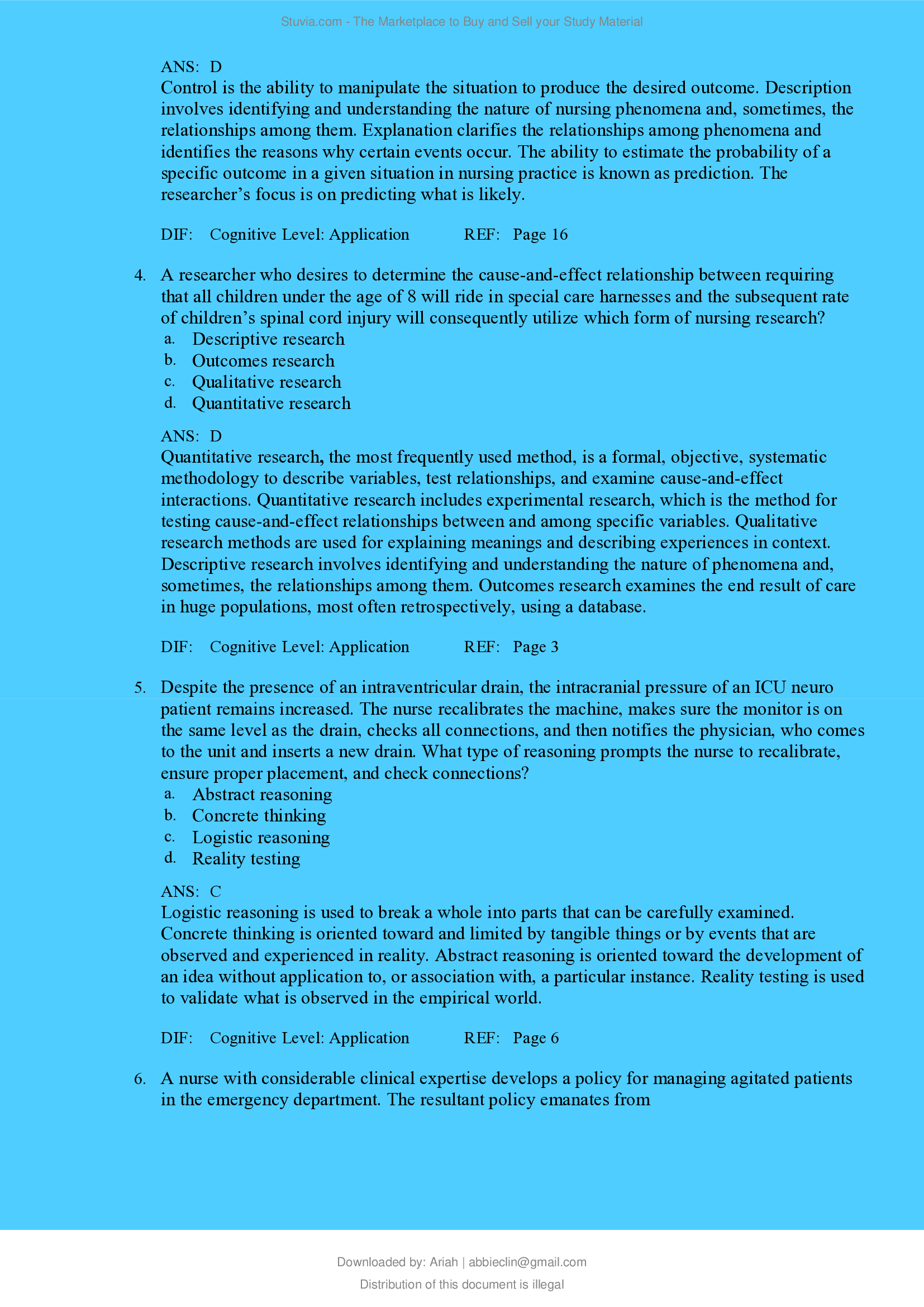
ANS: D

Prediction involves estimating the probability of a specific outcome in a given situation. Control is the ability to manipulate the situation to produce the desired outcome. Description involves observing and documenting nursing phenomena, providing a snapshot of reality. Explanation clarifies the relationships among concepts and variables with the goal of understanding how they work with each other.

DIF: Cognitive Level: Application

4. Despite the presence of an intraventricular drain, the intracranial pressure of a patient in neurological intensive care remains increased. The nurse recalibrates the machine, makes sure the monitor is on the same level as the drain, checks all connections, and then notifies the physician, who comes to the unit and inserts a new drain. What type of reasoning or thinking prompts the nurse to recalibrate, assure proper placement, and check connections? a. Abstract thinking

b. Concrete thinking

c. Logical reasoning

d. Dialectical reasoning

ANS: C

Logical reasoning is used to dissect components of a situation or conclusion, examine each carefully, and analyze relationships among the parts. Abstract thinking is oriented toward the development of an idea without application to, or association with, a particular instance. Concrete thinking is oriented toward and limited by tangible things or by events that are observed and experienced in reality. Dialectical reasoning involves looking at situations in a holistic way.

DIF: Cognitive Level: Application

5. A nurse with considerable clinical expertise develops a policy for managing agitated patients in the Emergency Department. The resultant policy emanates from: a. abstract thinking.

b. concrete thinking.

c. operational reasoning.

d. dialectical reasoning.

ANS: A

Abstract thinking is oriented toward the development of an idea without application to, or association with, a particular instance.

Concrete thinking is oriented toward and limited by tangible things or by events that are observed and experienced in reality. Operational reasoning is the identification of and discrimination among many alternatives and viewpoints. Dialectical reasoning involves looking at situations in a holistic way.

DIF: Cognitive Level: Application

6. A nurse with considerable clinical expertise develops a policy for managing agitated patients in the Emergency Department. The type of reasoning the nurse uses to do this is: a. problematic reasoning.

b. operational reasoning.

c. collaborative reasoning.

d. inductive reasoning.

ANS: D

Inductive reasoning involves reasoning that moves from the specific to the general, whereby particular instances are observed and then combined into a larger whole or general statement. Problematic reasoning involves: (1) identifying a problem and factors influencing it, (2) selecting solutions to the problem, and (3) resolving the problem. Operational reasoning involves the identification of and discrimination among many alternatives and viewpoints. Collaborative reasoning occurs when individuals with different perspectives “reason together” to develop a coordinated plan of action.

DIF: Cognitive Level: Synthesis

7. What is the best explanation of the type of intuition that forms a legitimate source of knowledge in nursing?

a. It is the result of recognizing patterns in a way that allows rapid conclusions.

b. It is based on a gift from the universe and should be honored when it arrives. c. It is never inaccurate.

d. It is the process of examining and critiquing one’s thoughts.

ANS: A

Intuition is understanding without rationale. Intuition is described as pattern recognition, seeing similarities and dissimilarities of a situation and seeing the whole in a way that allows rapid conclusions. Because intuition is a type of knowing that seems to come unbidden, it may also be described as a guy feeling, hunch, or sixth sense. Intuition cannot be explained scientifically, therefore many people discount it or are uncomfortable talking about it. Expert nurses are more likely to experience intuition, especially when they connect with their patients and are open to their feelings.

Nurses understand that reality varies with perception and that individual truth is relative. Consequently, they would not try to impose their views of truth and reality on patients. Rather, they would accept patients’ views of the world and help them seek health from within those worldviews, which is a critical component of evidence-based practice. The best research evidence, clinical expertise, and patient needs and values merge to produce evidence-based practice.

DIF: Cognitive Level: Analysis

Download PDF Test Bank For Burns and Grove's The Practice of Nursing Research Appraisal, Synthesis, and Generation of Evidence 9th Edition by Jennifer R. Gray; Susan K. Grove

Contact the Seller

Please Sign In to contact this seller.


  • 👎  Report Copyright Violation

Frequently Asked Questions

What Do I Get When I Buy This Study Material?

+

When you buy a study material on Passing Grades, an instant download link will be sent directly to your email, giving you access to the file anytime after payment is completed.

Is Passing Grades a Trusted Platform?

+

Yes, Passing Grades is a reputable students’ marketplace with a secure payment system and reliable customer support. You can trust us to ensure a safe and seamless transaction experience.

Will I Be Stuck with a Subscription?

+

No, all purchases on Passing Grades are one-time transactions. You only pay for the notes you choose to buy, with no subscriptions or hidden fees attached.

Who Am I Buying These Study Materials From?

+

Passing Grades is a marketplace, which means you are purchasing the document from an individual vendor, not directly from us. We facilitate the payment and delivery process between you and the vendor.

Does Passing Grades Offer Free Study Materials?

+

Yes, sellers on Passing Grades have uploaded numerous free test banks, exams, practice questions, and class notes that can be downloaded at no cost.

Pasinggrades - Quality Study Materials

USD 15

    • Quality checked by Pasing Grades
    • 100% satisfaction guarantee
    • Seller: mentor2000
Buy PDF $15

Seller Information

mentor2000

Member since April 2021

  • icon
  • icon
View Profile
  • total sales

    1
  • Favourites

    1
  • Comments

    0
    ( 0 Ratings )

Item Information

  • Uploaded

    22 May 2022

  • Updated

    23 October 2025

  • Category

    Nursing

  • Item Type

    test bank

  • Tags

    Test Bank for Burns and Grove The Practice of Nursing Research 9th Edition by Gray burns and grove test bank nursing research test bank gray test bank

Related Exam Prep Guides by mentor2000

Test Bank for Essentials for Nursing Practice 8th Edition by Potter | All Chapters
View Document

Test Bank for Essent...

  • mentor2000

    mentor2000

  • test bank

Master nursing concepts with this study material; Test Bank for Essentials for Nursing Practice, 8th...

15 USD

1

1

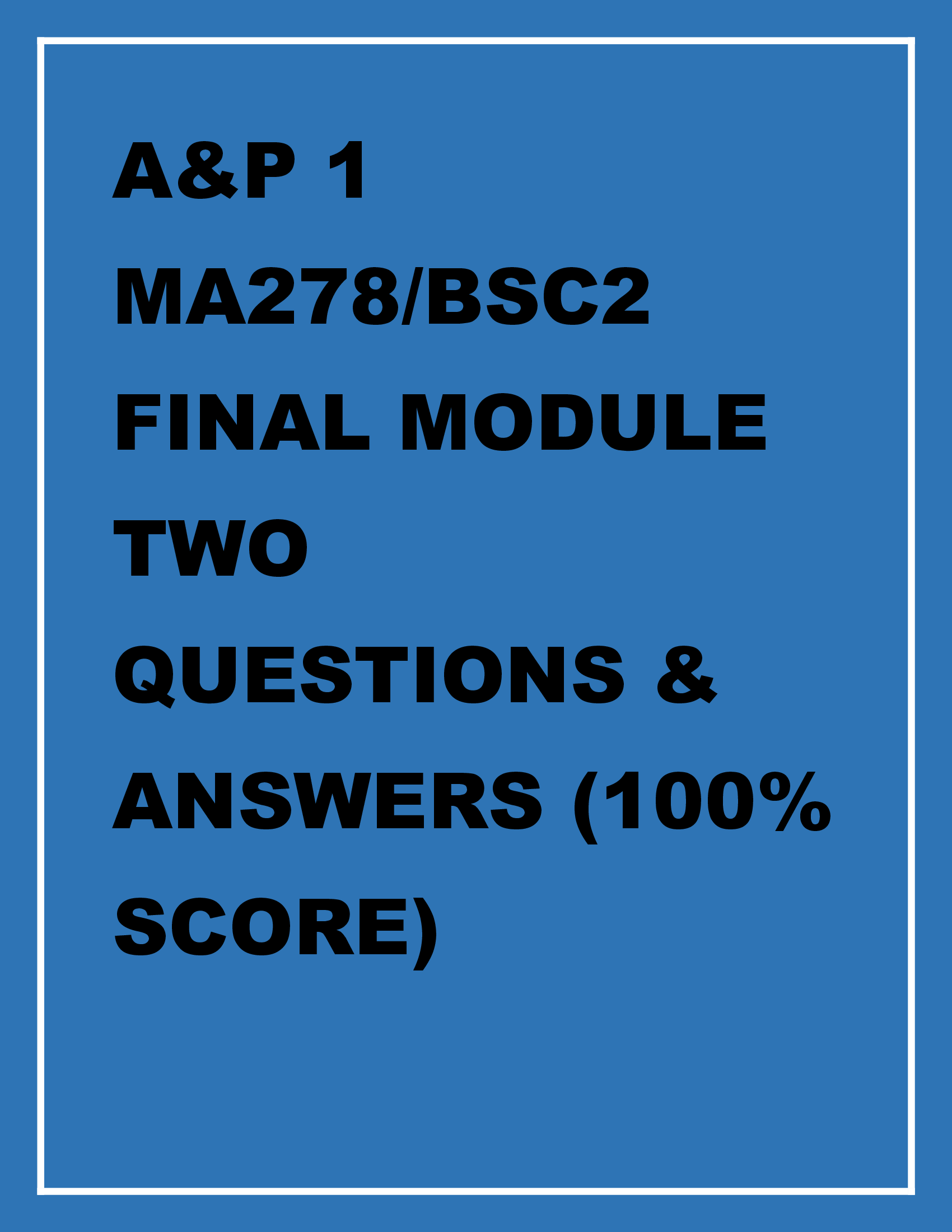
A &P 1 MA278 BSC2 Final Module II Questions & Answers 2026 Update
View Document

A &P 1 MA278 BSC2 Fi...

  • mentor2000

    mentor2000

  • test bank

Prepare for success with A&P 1 MA278 BSC2 Final Module II 2024 Q&A. Boost your grades with this comp...

15 USD

1

1

ATI Comprehensive Predictor Exam 2026
View Document

ATI Comprehensive Pr...

  • mentor2000

    mentor2000

  • test bank

Prepare for success with the ATI Comprehensive Predictor Exam 2026. Access key practice questions to...

15 USD

1

1

Purchase

Download link will be sent to this email immediately after purchase.

IMPORTANT LINKS

  • How To Upload Class Notes
  • Selling Tips
  • Passing Grades's Study Materials
  • Scholarships for International Students 2025

POPULAR CATEGORIES

  • Law
  • Accounting
  • English
  • Psychology
  • Business
  • Nursing
  • Computer Science
  • General

View Document

  • Blog
  • Contact
  • Delivery Policy
  • Latest Scholarships Around the World
  • How to Pass Bar Exams: Passing Grades’ Strategies
  • How to Study and Pass the CPA Exam
  • All Test Banks
  • Faq
  • Copyright Claims
  • Privacy Policy
  • Terms of Use

KNOWLEDGE BASE

  • How to Write A+ Grade Good Research Paper
  • How to Manage Stress During Exam Period
  • Best Time to Study
  • How to Pass NCLEX-RN Exam
  • How To Effectively Utilize Test Banks
  • Popular Shadow Health Exam Assessments
  • Popular HESI Case Studies
  • How to Prepare for a Nursing Career
  • The Importance Of Summaries in Exam Revisvion

© 2026 Pasing Grades. All rights reserved.